Celery Juice: History and Origins
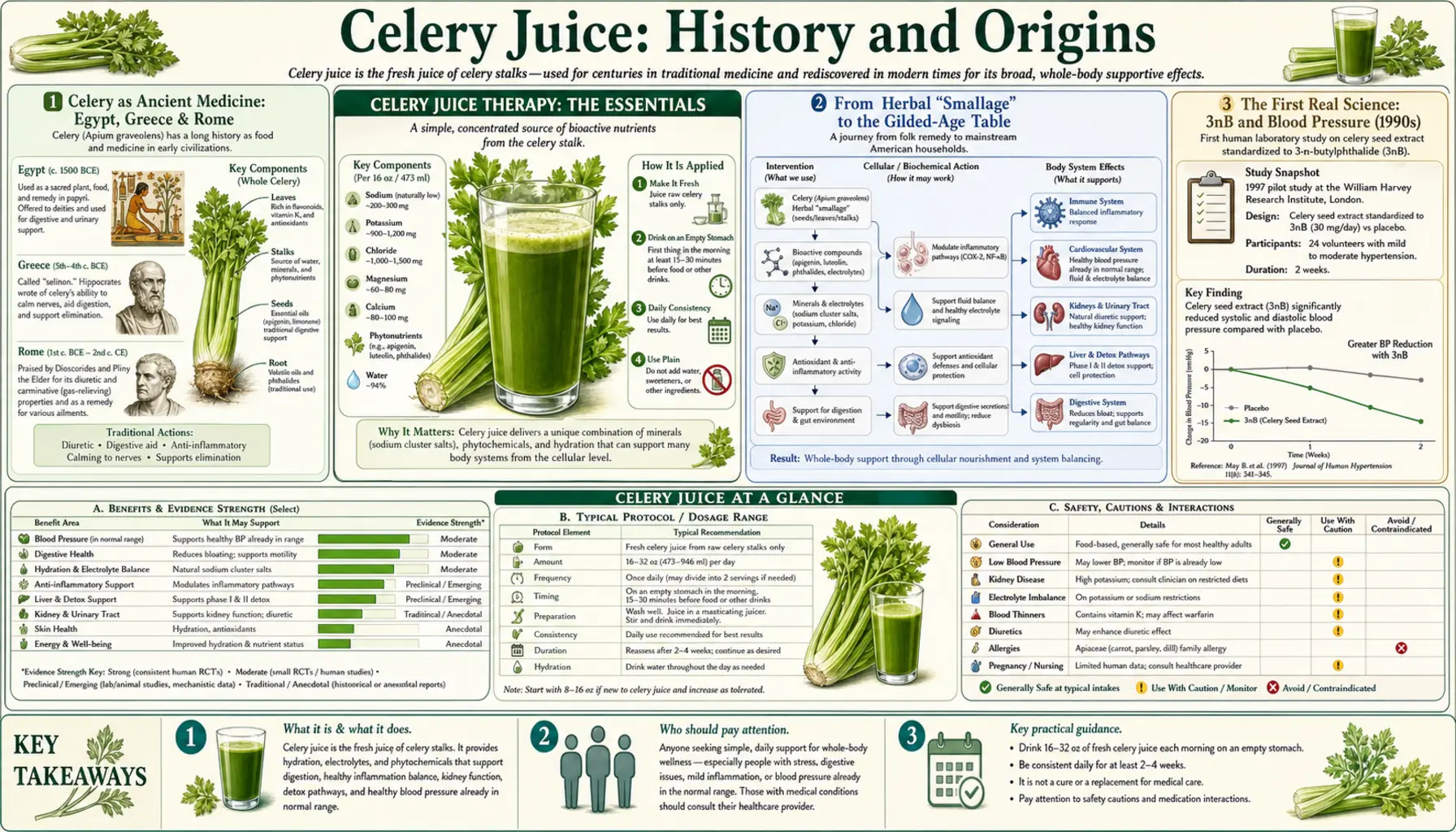
Celery juice has two histories, and honesty requires telling them apart. One is ancient and real: celery (Apium graveolens) was a sacred and medicinal plant in ancient Egypt, Greece, and Rome, a luxury at Gilded-Age dinner tables, and the subject of genuine pharmacological research into its blood-pressure effects in the early 1990s. The other is recent and far more controversial: the modern "morning celery juice" ritual — 16 ounces of straight, strained celery juice on an empty stomach — was popularized in the mid-2010s by Anthony William, an author with no medical, nutritional, or scientific credentials who attributes his health guidance to a spirit he calls "Spirit of Compassion." This page traces both threads: the long, documented life of celery as a remedy, and the full story of the man who turned a humble stalk into a global wellness movement — together with what mainstream science and medicine actually say about the claims made for it.
Table of Contents
- Celery as Ancient Medicine: Egypt, Greece & Rome
- From Herbal "Smallage" to the Gilded-Age Table
- The First Real Science: 3nB and Blood Pressure (1990s)
- Anthony William: The Founder of the Modern Movement
- "Spirit of Compassion" and the Medical Medium Books
- How the 16-Ounce Protocol Took Over the Internet
- Evidence & Reception: What Mainstream Science Says
- Two Histories, One Glass: An Honest Summary
- Research Papers and References
- Connections
- Featured Videos
Celery as Ancient Medicine: Egypt, Greece & Rome
Celery is one of the oldest plants in the human medicine cabinet, and its documented story begins thousands of years before anyone juiced it. Archaeobotanists have identified wild celery leaves woven into the floral collars and garlands placed in the tomb of the Egyptian pharaoh Tutankhamun (who died around 1323 BC); preserved examples survive in museum collections today. In ancient Egypt celery was treated as a plant of meaning — associated with funerary ritual — as well as a practical remedy used for swelling and digestive complaints.
In the Greek world celery was known as selinon, the word that gives the plant its modern botanical name. It appears in Homer's Odyssey, growing in the meadows around Calypso's cave, and it carried strong associations with both victory and death: winners of the Isthmian Games at Corinth were crowned with wreaths of wild celery, at least until around the fifth century BC (the time of the poet Pindar), after which the wreath was changed to pine. The deceased were also crowned with celery, and the plant was linked to the gods Zeus and Poseidon. On the medical side, the tradition associated with Hippocrates (c. 460–370 BC) valued celery for calming the nerves and easing fluid retention — uses that, remarkably, echo through to the present.
Roman writers carried the tradition forward. Dioscorides (1st century AD), whose De Materia Medica remained a standard reference for more than a millennium, and later Galen documented celery for digestive disorders, edema, and rheumatic complaints. What the ancient record reliably establishes is not that celery cured these conditions, but that for several major civilizations it was regarded as a genuine medicinal plant — a status it has never entirely lost.
From Herbal "Smallage" to the Gilded-Age Table
Through the medieval and early-modern periods celery remained, above all, a medicinal herb. Monastic gardeners grew the wild form — called smallage — in physic gardens for gout, kidney complaints, and what the texts called "obstructions." The English herbalist Nicholas Culpeper, in his widely read Complete Herbal (1653), praised smallage for opening "obstructions of the liver and spleen," for provoking urine, and for cleansing the blood. That characterization — celery as a cleansing, diuretic, liver-supporting herb — has persisted, almost word for word, into modern naturopathy and into the marketing of celery juice today.
The transformation of celery from bitter medicinal herb into the crisp, mild salad stalk was the slow work of Italian, French, and Dutch gardeners from the sixteenth century onward, who selected and blanched the plant for sweeter, thicker stems. By the nineteenth century celery had become a prestige vegetable. In Gilded-Age America it was displayed in ornate cut-glass "celery vases" on the tables of the wealthy and listed by name on the menus of grand hotels and even White House state dinners — a marker of refinement and expense.
It was in this era that celery first became a drink. Dr. Brown's Celery Tonic — later renamed Cel-Ray — was, by the company's own account, first produced in Brooklyn around 1868 and sold as a bottled celery-flavored soda from the 1880s; it became so beloved in New York's Jewish delicatessens that it earned the nickname "Jewish Champagne." (The "Dr. Brown" of the name may have been a real tonic-maker or simply a marketing figure — the historical record is genuinely unclear, and the U.S. Food and Drug Administration eventually objected to the word "tonic," forcing the rename.) Celery wines, cordials, and seed tonics were likewise sold from pharmacies and spas, all promoted for calming nerves, aiding digestion, and clearing "sluggish blood" — a direct ancestor of the health framing that would surround celery juice a century later.
The First Real Science: 3nB and Blood Pressure (1990s)
The first genuinely scientific chapter in celery's story opened not in a wellness studio but in a research laboratory, and it is worth telling carefully because it is the part of celery's reputation that holds up best. In the early 1990s, Dr. William J. Elliott, then a physician-researcher at the University of Chicago, became curious after a medical student, Quang T. Le, mentioned a family experience: Le's father, Minh Le (age 62), had brought his high blood pressure down after a traditional Asian practitioner advised him to eat a small amount of celery every day. His readings reportedly fell from roughly 158/96 to 118/82.
Elliott and Le pursued the lead experimentally. They focused on a compound in celery oil called 3-n-butylphthalide (often abbreviated 3nB), a phthalide responsible for celery's characteristic smell. In animal experiments reported in the early 1990s, the compound lowered blood pressure in rats — on the order of 12 to 14 percent at a dose the researchers compared to about four stalks of celery — apparently by relaxing the smooth muscle of artery walls and reducing levels of stress hormones (catecholamines) that constrict blood vessels. The work drew wide press coverage at the time and is the historical root of the modern "celery for blood pressure" idea.
Crucially, this thread of research has continued and partly validated the early findings. A randomized, triple-blind, placebo-controlled crossover trial published in Phytotherapy Research in 2022 found that standardized celery seed extract meaningfully lowered blood pressure in hypertensive adults, and a 2024 narrative review concluded that celery can reasonably be considered an antihypertensive agent based on the combined animal and human evidence, with 3nB as a leading candidate mechanism. This is the honest core of celery's medicinal reputation: a real, if modest, blood-pressure effect, tied to identifiable chemistry — and notably distinct from the far broader claims that would later be made for celery juice as a cure-all.
Anthony William: The Founder of the Modern Movement
The modern celery juice phenomenon has a single, identifiable founder: Anthony William, born Anthony William Coviello, who writes and broadcasts under the brand name "Medical Medium." He is, by the most reasonable reckoning, the person who created the specific ritual now practiced by millions and who is widely credited — including by himself — as the originator of the global celery juice movement. Understanding the movement therefore means understanding him, and doing so honestly means stating plainly what his credentials are and are not.
William has no degree or formal training in medicine, nursing, nutrition, dietetics, biology, chemistry, or any related science. This is not a hostile characterization; it is stated openly on his own platforms and in the legal disclaimers attached to his work, which acknowledge that he holds no "certifications of scientific or medical training." His authority, by his own account, is entirely experiential and spiritual rather than academic or clinical. He says that since the age of four he has been able to hear a spirit who gives him medical information, and that his first reading was a diagnosis of lung cancer in his grandmother — the founding anecdote of the entire brand.
From that foundation William built a substantial publishing career. Operating from Florida, he has authored a series of health books — eight as of the mid-2020s — published by Hay House, a major self-help and spirituality publisher, with several reaching the New York Times bestseller list. He became a featured "trusted expert" contributor to Gwyneth Paltrow's wellness company Goop, and his protocols were endorsed by a string of celebrities. He is, in short, a genuinely influential figure in twenty-first-century wellness culture — which is precisely why his lack of medical training, and the unusual basis of his claims, deserve to be reported clearly rather than glossed over.
"Spirit of Compassion" and the Medical Medium Books
The name "Medical Medium" is a deliberate portmanteau: medical for the subject matter, medium for the spiritualist practice of channeling a non-physical entity. William says the source of all his health information is a spirit he calls "Spirit of Compassion," which he describes as an angelic or transcendent being, not tied to any religious tradition, that speaks to him in plain language about disease, supplements, and diet. His books credit this spirit explicitly in their forewords. This places the Medical Medium brand in a long lineage of channeled medical guidance that includes Edgar Cayce's "sleeping prophet" readings of the 1930s and the nineteenth-century Spiritualist movement.
This origin matters for the history because it is the central, unavoidable fact about where celery juice's modern claims come from. From the standpoint of scientific medicine — which validates claims through controlled experiment, peer review, and replication — guidance attributed to a spirit is not an admissible source of medical knowledge, and is by nature unfalsifiable: there is no possible result that could disprove it. This page reports the claim accurately and leaves readers to weigh it; it does not endorse it.
The celery juice protocol emerged through this book series. The flagship title, Medical Medium: Secrets Behind Chronic and Mystery Illness, appeared in 2015 and introduced William's signature thesis that a chronic, "mutated" form of the Epstein-Barr virus is the hidden root cause of dozens of conditions. Later books extended the framework, and in 2019 he published a dedicated volume, Medical Medium Celery Juice: The Most Powerful Medicine of Our Time — described as the fifth book in the series — which consolidated the protocol and introduced the proprietary idea that celery contains "undiscovered cluster salts" that mobilize toxins, kill pathogens, and restore stomach acid. No such compound class appears in any chemistry or biochemistry literature, a point taken up in the Evidence section below.
How the 16-Ounce Protocol Took Over the Internet
What William created that was genuinely new was not the use of celery — ancient, as we have seen — but a precise, repeatable ritual. The protocol crystallized in his public communications around 2015–2016: drink 16 fluid ounces of straight, strained, pulp-free celery juice, with no other ingredients, first thing in the morning on a completely empty stomach, then wait 15–30 minutes before eating — every day, indefinitely. The rigid specificity of those rules is itself part of why the practice spread: it was simple, concrete, cheap, and easy to share.
The timing met the rise of Instagram perfectly. A tall glass of bright green juice in morning light was ideal visual content, and the hashtag #CeleryJuice accumulated hundreds of thousands of posts. Crucially, the trend ran ahead of the books: many people adopted the practice in 2018–2019 having never read a word of Medical Medium, encountering it only through social media, friends, or celebrity mentions. Endorsements from figures associated with Goop and a roster of well-known names lent it a fashionable credibility that no medical body had granted it.
The market impact was real and measurable. As the trend peaked around the 2019 release of the celery juice book, U.S. retail demand for celery surged — celery became one of the leading fresh commodities for retail sales growth that year, wholesale carton prices spiked, and growers and juice companies scrambled to keep up. A 2,000-year-old vegetable, repackaged as a daily ritual by a self-described medium, had become a multi-million-dollar consumer phenomenon in the space of a few years.
Evidence & Reception: What Mainstream Science Says
Because this is a public-health site that values truth over promotion, the reception of the modern protocol must be stated plainly: the central therapeutic claims made for celery juice by the Medical Medium framework are not supported by scientific evidence, and the medical and dietetic mainstream has been consistently critical. The criticism is specific and well-documented:
- The proposed mechanism does not exist in the literature. "Undiscovered cluster salts" are not a recognized chemical entity; the term does not appear in any indexed chemistry, biochemistry, pharmacology, or food-science source, and routine analytical methods that would detect any novel mineral-cluster compound have been applied to celery for decades without finding one.
- The Epstein-Barr virus claims are not supported. EBV is a herpesvirus that establishes lifelong latency in memory B cells in roughly 95% of adults; no dietary or herbal intervention tested in controlled trials clears it. A landmark 2022 study in Science (Bjornevik and colleagues) did provide strong evidence that EBV is a likely cause of multiple sclerosis specifically — but this validates none of the broader Medical Medium claims, and certainly not the idea that celery juice affects EBV.
- Credentialed clinicians have objected publicly. Registered dietitian Carrie Dennett has noted that "there is no one food that will cure your cancer, inflammatory disease, or other ailment," and science communicators such as Jonathan Jarry of McGill University's Office for Science and Society have argued that William's diagnostic "scans" and treatment advice amount to practicing medicine without a license. Major medical centers, including Mayo Clinic and Cleveland Clinic, have published explainers concluding there is no harm in moderate celery juice for most adults but no evidence of specific therapeutic effect beyond that of any healthy vegetable.
This does not mean celery juice is worthless or dangerous — an important distinction. The underlying vegetable contains genuine bioactive compounds (flavonoids such as apigenin and luteolin, the phthalide 3nB, dietary nitrate, potassium), and as shown above there is real, if modest, evidence for a blood-pressure benefit from celery and celery seed. For most adults the practice is essentially harmless, and many people who feel better on it likely do so through real but ordinary mechanisms: replacing a coffee-on-empty-stomach habit with hydration, increasing vegetable intake, anchoring a consistent morning routine, and the well-documented placebo and lifestyle effects that accompany any committed wellness ritual.
The honest cautions are equally concrete: celery is comparatively high in oxalate (a real concern for calcium-oxalate kidney-stone formers) and in photosensitizing psoralens, and it carries meaningful vitamin K and sodium loads that can interact with warfarin, lithium, and the timing of thyroid medication. The most serious risk, however, is not the juice itself but opportunity cost — the danger that someone with a serious condition (autoimmune thyroid disease, multiple sclerosis, type 1 diabetes, inflammatory bowel disease) reduces evidence-based treatment in favor of a protocol whose foundational claims medicine does not accept. As a complementary habit alongside proper medical care, celery juice is low-risk; as a substitute for it, it can cause real harm. These issues are explored in depth on the companion Evidence and Skepticism article.
Two Histories, One Glass: An Honest Summary
The history of celery juice is best understood as two stories that meet in a single morning glass. The first is the long, documented history of celery as a remedy — a sacred plant in Tutankhamun's tomb, a victory crown in ancient Greece, a liver-and-kidney herb in Culpeper's England, a luxury at the Gilded-Age table, and the subject of legitimate blood-pressure research from the 1990s onward. That history is real, and it gives celery a place in medicine that no marketing can take away or inflate.
The second is the modern movement founded by Anthony William — a specific 16-ounce daily ritual, framed by a spiritually-sourced theory of disease, amplified by social media and celebrity into a global phenomenon. That history is also real, but its therapeutic claims are not validated by science, and its founder makes no claim to medical or scientific training. To tell celery juice's story truthfully is to hold both threads at once: to respect the ancient and the genuinely studied, while reporting the modern claims for exactly what they are — popular, influential, and unproven. The fuller evidence picture, dosing realities, and cautions are covered on the main Celery Juice hub and its Benefits articles; this page is concerned with how the remedy — and the movement around it — actually came to be.
Research Papers and References
The list below combines peer-reviewed sources on celery's documented pharmacology with reputable reference material on the history of celery and the Medical Medium movement, plus curated PubMed topic searches. Author names, titles, and journals are given as plain text; only stable DOI, PMID, or archival links are hyperlinked, and each opens in a new tab. Historical primary sources (Dioscorides' De Materia Medica, Culpeper's Complete Herbal of 1653) and the channeled-guidance claims of the Medical Medium brand are described in the article as historical or self-reported sources rather than as scientific citations.
- Shayani Rad M, Moohebati M, Mohajeri SA. Effect of celery (Apium graveolens) seed extract on hypertension: a randomized, triple-blind, placebo-controlled, cross-over, clinical trial. Phytotherapy Research. 2022;36(7):2889-2907. — doi:10.1002/ptr.7469 (PMID: 35624525)
- Alobaidi S, Saleh E. Antihypertensive property of celery: a narrative review on current knowledge. International Journal of Food Science. 2024. — doi:10.1155/2024/9792556
- Bjornevik K, Cortese M, Healy BC, et al. Longitudinal analysis reveals high prevalence of Epstein-Barr virus associated with multiple sclerosis. Science. 2022;375(6578):296-301. — doi:10.1126/science.abj8222 (PMID: 35025605)
- Celery compound lowers blood pressure (Elliott WJ and Le QT, University of Chicago; 3-n-butylphthalide research). United Press International archive. May 1, 1992. — UPI Archives, 1992
- Anthony William (Medical Medium) — biography, claims, and criticism. Wikipedia. — en.wikipedia.org/wiki/Anthony_William
- Cel-Ray (Dr. Brown's Celery Tonic) — history of the celery soda. Wikipedia. — en.wikipedia.org/wiki/Cel-Ray
- Apium graveolens (celery) pharmacology and health — PubMed: Apium graveolens pharmacology
- Celery seed extract and blood pressure — clinical evidence — PubMed: celery seed and blood pressure
External Authoritative Resources
- NCCIH — Dietary and Herbal Supplements: What You Need To Know
- Science — Epstein-Barr virus and multiple sclerosis (Bjornevik et al., 2022)
- PubMed — All research on Apium graveolens
Connections
- All Remedies
- Celery Juice
- Celery Juice Benefits
- Anthony William Origin Story
- Evidence and Skepticism
- Celery Juice & Blood Pressure
- Gerson Therapy
- Liver Cleansing
- Detox Protocols