Dr. Peter Osborne — The Gluten Free Warrior & Functional Nutrition
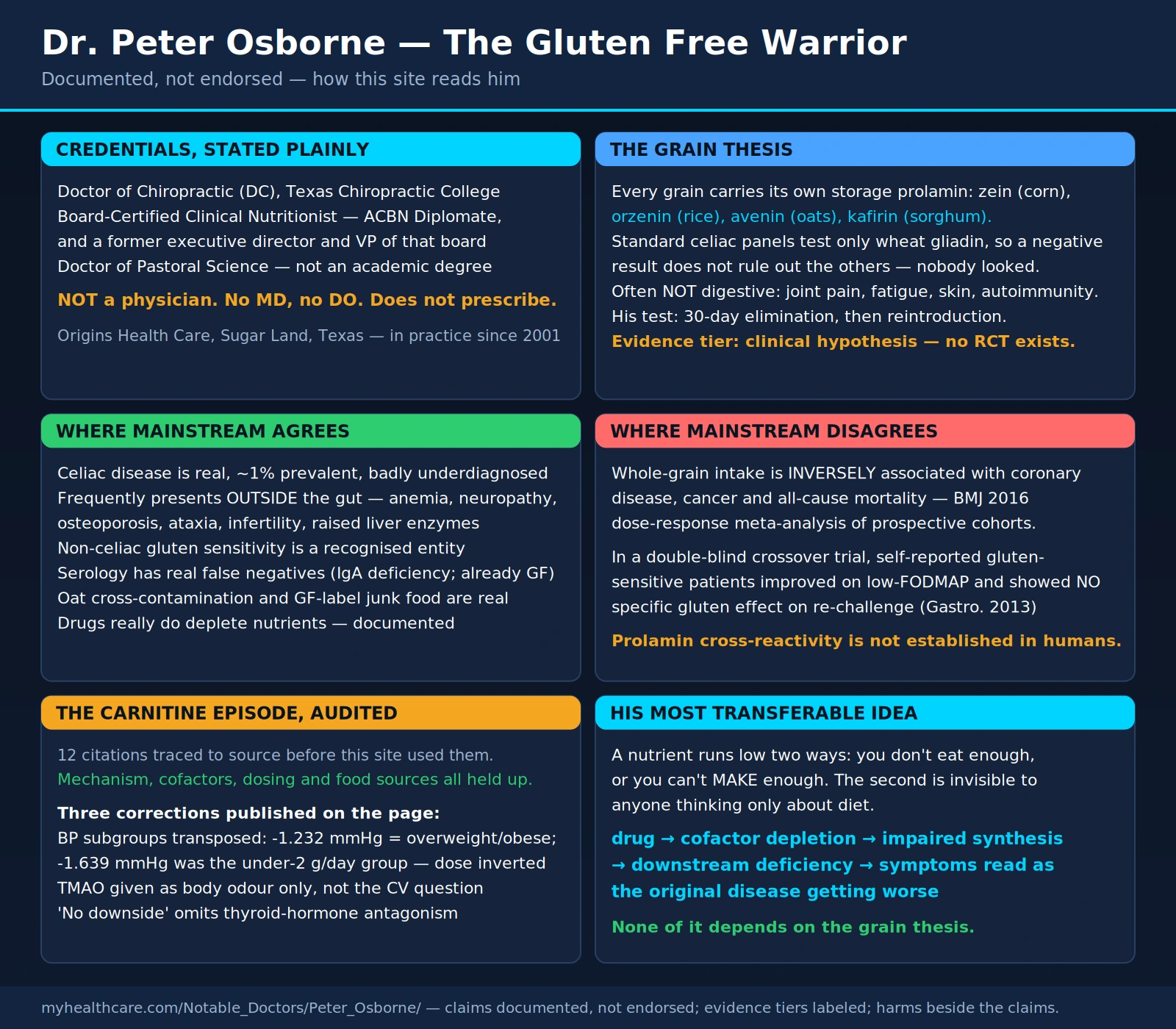
Peter Osborne is a chiropractor and board-certified clinical nutritionist who has spent two decades arguing a single, unfashionable thesis: that a great many people who have been told their chronic pain, fatigue and autoimmunity are idiopathic are in fact reacting to grain — and not only to wheat. He is known online as “The Gluten Free Warrior,” he founded Gluten Free Society in 2010, and he reaches a large audience through his twice-weekly show Dr. Osborne’s Zone.
That thesis is genuinely contested, and this page says so plainly below. But it is not the only thing he does, and it is not why this site has a page for him. His teaching format — a long, slide-driven walk through the actual meta-analyses on a single nutrient — is unusually rigorous for the genre, and one of those episodes is the source document for this site’s Carnitine Deficiency page. When we fact-checked that episode against every paper he cited, the mechanism was right, the evidence tiers were labeled honestly, and we found three corrections worth making. That is a better result than most health content survives.
Source Video
The episode this site built a page from, embedded permanently. Unlike the Featured Videos at the foot of this page, which rotate, this frame is fixed in the page itself.
Dr. Peter Osborne — Ultimate Crash Course on Carnitine, Dr. Osborne’s Zone (42 minutes, 21 February 2024). Fact-checked in full on Carnitine Deficiency: Signs, Causes & Who Is at Risk.
Table of Contents
- Source Video
- Who He Is — Credentials, Stated Plainly
- The Grain Thesis
- Where Mainstream Medicine Agrees
- Where Mainstream Medicine Disagrees
- The Carnitine Episode, Audited
- His Best Idea: Drug–Nutrient Depletion
- Books, Platforms & Practice
- How to Read Him Well
- Key Research Papers
- Live PubMed Searches
- Connections
Who He Is — Credentials, Stated Plainly
This site states practitioner credentials exactly, because the letters after a name determine what a person is trained to do and readers deserve to know without digging.
- Doctor of Chiropractic (DC), Texas Chiropractic College. He is not a physician — not an MD and not a DO. He does not prescribe drugs and does not practice medicine.
- Board-Certified Clinical Nutritionist — a Diplomate of the American Clinical Board of Nutrition, where he has served as executive director and vice president. This is a real credential with a real examination behind it, and it is the one most relevant to the nutrition content he produces.
- Doctor of Pastoral Science (PScD) and a certification in functional medicine. Pastoral-science doctorates are not academic degrees in the ordinary sense and carry no clinical licensure; the title “Dr.” in his case rests on the chiropractic doctorate.
- Clinical director of Origins Health Care in Sugar Land, Texas, in practice since 2001. He has held teaching appointments at Texas Woman’s University and Houston Community College covering anatomy, physiology, neurophysiology and nutrition.
The practical implication: he is well qualified to discuss nutrient biochemistry, which is what the carnitine episode is, and he is offering an opinion rather than a diagnosis when he discusses disease. He is generally careful to say so on camera.
The Grain Thesis
Osborne’s central argument, developed in No Grain, No Pain (Touchstone/Simon & Schuster, 2016) and across Gluten Free Society, runs roughly as follows.
- “Gluten” is too narrow a word. In common usage it means the gliadin fraction of wheat, which is what standard testing looks for. But every grain contains its own storage prolamins — zein in corn, orzenin in rice, avenin in oats, kafirin in sorghum — and Osborne argues these can provoke the same reaction in susceptible people.
- Standard testing therefore under-detects. A negative celiac panel rules out celiac disease; it does not, on his account, rule out a reaction to other grain proteins, because nobody tested for those.
- The presentation is often not digestive. He argues that joint pain, neuropathy, fatigue, skin conditions and autoimmune flares are common presentations, which is why the connection is missed.
- The trial is elimination. His clinical answer is a 30-day removal of all grains, then reintroduction — using the patient as their own control.
Evidence tier: clinical hypothesis supported by case series and mechanistic plausibility. There is no randomized controlled trial of a total-grain elimination diet against a wheat-only elimination diet in a general chronic-pain population. That trial would settle a great deal, and it has not been done.
Where Mainstream Medicine Agrees
- Celiac disease is real, common and badly underdiagnosed. It affects roughly 1% of the population, a substantial fraction remains undiagnosed, and diagnostic delay of years is routine. Osborne is right that the system misses it.
- Celiac disease frequently presents outside the gut. Iron-deficiency anemia, dermatitis herpetiformis, osteoporosis, neuropathy, ataxia, elevated liver enzymes and infertility are all recognized non-digestive presentations. The “classic” malabsorptive child is now the minority picture. His point that the connection is missed because clinicians look only for diarrhea is well taken.
- Non-celiac gluten sensitivity is a recognized entity. A distinct clinical condition — symptoms on gluten exposure without celiac serology or villous atrophy — is accepted in the gastroenterology literature, even though its mechanism is unresolved.
- Serological testing has real limits. Tests can be falsely negative in IgA deficiency, in seronegative celiac disease, and in anyone already eating gluten-free when tested. A negative panel is genuinely less conclusive than patients are usually told.
- Cross-contamination and mislabeling are real. Oats are frequently contaminated with wheat in processing, and “gluten-free” processed foods are often built from refined starches and are not obviously healthier. This is a fair criticism and he makes it often.
- Drugs deplete nutrients. Discussed in its own section below — this is thoroughly documented pharmacology, not a fringe claim.
Where Mainstream Medicine Disagrees
- The whole-grain outcome data point the other way. This is the strongest counter-argument and it deserves to be stated at full strength. A large dose-response meta-analysis in BMJ pooling prospective cohorts found whole grain intake inversely associated with coronary heart disease, cardiovascular disease, total cancer and all-cause mortality, with risk falling as intake rose. If grains as a class were broadly harmful, this is not the pattern the epidemiology would show. Observational data cannot exclude a susceptible subgroup — but they weigh heavily against a population-wide recommendation to eliminate all grains.
- The best trial evidence in non-celiac gluten sensitivity does not implicate gluten. In a rigorous double-blind crossover trial, patients with self-reported gluten sensitivity had their symptoms resolve on a low-FODMAP diet and then showed no specific effect of gluten on re-challenge. The most parsimonious reading of that result is that many people who improve off wheat are responding to fermentable carbohydrates, not to prolamins — which would explain the improvement Osborne observes without requiring his mechanism.
- Cross-reactivity between wheat gliadin and rice or corn prolamins is not established in humans. The idea is mechanistically imaginable and there is some in-vitro work, but the leap to “therefore eliminate rice and corn” is not supported by clinical trial evidence.
- Elimination diets have costs. Removing every grain narrows the diet, reduces fiber and several B vitamins, is socially and financially burdensome, and in some people feeds disordered eating. A 30-day structured trial with reintroduction is a reasonable experiment; permanent elimination on the strength of feeling better for a month is a larger decision than it is usually presented as.
- This site does not follow the no-grain recommendation. Stated for the reader’s benefit rather than to score a point: myhealthcare.com routinely recommends brown rice and other intact whole grains as whole foods, and we think the outcome data support that. We document his position because it is influential and because he argues it seriously, not because we hold it.
The Carnitine Episode, Audited
Because this site built a full reference page from one of his episodes, it is worth reporting what the audit found. Every research claim in the 42-minute carnitine crash course was traced back to the paper it came from and checked against the abstract.
What held up: the carnitine shuttle mechanism; the biosynthesis pathway from lysine and methionine and its four cofactors; the deficiency symptom cluster; the drug-depletion list; the food-source hierarchy; the distinction between L-carnitine and acetyl-L-carnitine and which to use for what; the dosing range; the blood-pressure meta-analysis headline result; the 37-trial weight meta-analysis including the 1.2 kg figure and the 2,000 mg/day optimum; the depression review; and the neuroprotection paper. He also correctly labeled the neuropathy evidence as predominantly animal data rather than overselling it, and his central practical advice — test before you supplement — runs directly against the interest of anyone selling supplements.
What did not: three corrections, documented in full on the Carnitine Deficiency page.
- Two subgroup figures are transposed. He attributes a 1.639 mmHg diastolic reduction to overweight and obese participants at 2 g/day. The source paper reports 1.232 mmHg for the overweight/obesity subgroup, and the 1.639 mmHg figure belongs to the subgroup taking less than 2 g/day — the opposite dose relationship.
- TMAO is presented only as a body-odor problem. The larger question — that gut bacteria convert carnitine to TMAO, which is associated with atherosclerosis in animals and cardiovascular events in humans — goes unmentioned. It is an open question rather than a settled indictment, but it is the thing a viewer would want to know.
- “No downside” overstates the safety case. Carnitine is a documented peripheral antagonist of thyroid hormone action — useful enough in hyperthyroidism to have been trialed as a therapy, and a genuine consideration for anyone on levothyroxine. That interaction is absent from the episode.
None of these is a fabrication and none reverses the episode’s conclusions. They are the kind of errors that come from reading a slide quickly and from optimism about a nutrient one likes.
His Best Idea: Drug–Nutrient Depletion
The most useful thing in the carnitine episode is a piece of reasoning that generalizes far beyond carnitine, and it is worth extracting on its own.
A nutrient can run low for two different reasons: you are not getting enough of it, or you cannot make enough of it. For a conditionally essential nutrient like carnitine, which the body synthesizes through a four-cofactor pathway, the second route is invisible to anyone thinking only about diet. A person eating plenty of beef can still be short of carnitine if they are short of iron, vitamin C, B6 or niacin — and long-term medication is one of the commonest reasons to be short of those.
So the chain runs: drug → cofactor depletion → impaired synthesis → deficiency of the downstream nutrient → symptoms that look like the original disease getting worse. Proton-pump inhibitors and iron. Corticosteroids and vitamin C. Isoniazid and B6. Diuretics and the B vitamins. Valproate, which depletes carnitine directly and is the best-documented example in the whole literature — intravenous levocarnitine is standard toxicology in valproate poisoning, not an alternative therapy.
This is ordinary, well-documented pharmacology that is simply under-taught, and it is a fair criticism of routine practice that a patient on four chronic medications is rarely asked what those medications are costing them nutritionally. It is also the most defensible part of his framework, because none of it depends on the grain thesis.
Books, Platforms & Practice
- No Grain, No Pain: A 30-Day Diet for Eliminating the Root Cause of Chronic Pain (Touchstone / Simon & Schuster, 2016) — his principal book, later adapted into a PBS special.
- The Gluten Free Health Solution and The Glutenology Health Matrix, a digital video and ebook series.
- Gluten Free Society (founded 2010) — his educational organization and the main home of the grain thesis.
- Dr. Osborne’s Zone — the twice-weekly show. The “crash course” episodes are the format worth watching: one nutrient, the actual papers on screen, an hour.
- Origins Health Care, Sugar Land, Texas — his clinical practice.
How to Read Him Well
A practical guide, offered in the spirit of this section’s editorial policy — documented, not endorsed.
- The nutrient crash courses are his strongest work. They are sourced, the papers are on screen, and evidence tiers usually get labeled. The carnitine episode survived a full audit with three corrections.
- Check the subgroup, not just the headline. The one substantive error we found was a transposed subgroup in a meta-analysis. If a number matters to a decision you are making, open the paper — the DOI links on our pages go straight to it.
- Treat “there’s no downside” as a prompt to look up interactions. It was not true for carnitine and the thyroid, and it is rarely true of anything with a pharmacological effect.
- The grain thesis is a hypothesis you can test on yourself cheaply, and should not adopt permanently on a month of data. A 30-day elimination with structured reintroduction is a reasonable self-experiment. Removing every grain for life on the strength of it is not the same decision, and the population-level outcome data run against it.
- He is not a physician. On drug interactions, dosing alongside prescriptions, and anything involving a child, the prescriber is the right person to ask.
Key Research Papers
These are the papers behind the claims discussed above — both the ones supporting his positions and the ones weighing against them.
- Aune D, Keum N, Giovannucci E, et al. Whole grain consumption and risk of cardiovascular disease, cancer, and all cause and cause specific mortality: systematic review and dose-response meta-analysis of prospective studies. BMJ, 2016;353:i2716. (PMID 27301975) — the principal counter-evidence to the grain thesis.
- Biesiekierski JR, Peters SL, Newnham ED, et al. No effects of gluten in patients with self-reported non-celiac gluten sensitivity after dietary reduction of fermentable, poorly absorbed, short-chain carbohydrates. Gastroenterology, 2013;145(2):320–328. (PMID 23648697) — the FODMAP alternative explanation.
- Askarpour M, Hadi A, Dehghani Kari Bozorg A, et al. Effects of L-carnitine supplementation on blood pressure: a systematic review and meta-analysis of randomized controlled trials. Journal of Human Hypertension, 2019;33(10):725–734. (PMID 31481697) — the paper whose subgroups were transposed on air.
- Talenezhad N, Mohammadi M, Ramezani-Jolfaie N, et al. Effects of l-carnitine supplementation on weight loss and body composition: a systematic review and meta-analysis of 37 randomized controlled clinical trials with dose-response analysis. Clinical Nutrition ESPEN, 2020;37:9–23. (PMID 32359762)
- Wang SM, Han C, Lee SJ, et al. A review of current evidence for acetyl-l-carnitine in the treatment of depression. Journal of Psychiatric Research, 2014;53:30–37. (PMID 24607292)
- Benvenga S, Ruggeri RM, Russo A, et al. Usefulness of L-carnitine, a naturally occurring peripheral antagonist of thyroid hormone action, in iatrogenic hyperthyroidism: a randomized, double-blind, placebo-controlled clinical trial. Journal of Clinical Endocrinology & Metabolism, 2001;86(8):3579–3594. (PMID 11502782) — the omitted thyroid caveat.
- Koeth RA, Wang Z, Levison BS, et al. Intestinal microbiota metabolism of L-carnitine, a nutrient in red meat, promotes atherosclerosis. Nature Medicine, 2013;19(5):576–585. (PMID 23563705) — the TMAO question.
- Lheureux PE, Hantson P. Carnitine in the treatment of valproic acid-induced toxicity. Clinical Toxicology, 2009;47(2):101–111. (PMID 19280426) — drug–nutrient depletion as standard toxicology.
- Alhasaniah AH. l-carnitine: nutrition, pathology, and health benefits. Saudi Journal of Biological Sciences, 2023;30(2):103555. (PMID 36632072)
Live PubMed Searches
- non-celiac gluten sensitivity
- celiac disease extraintestinal manifestations
- whole grain intake and mortality
- gluten free diet and chronic pain
- drug-induced nutrient depletion
- prolamin cross-reactivity (gliadin, zein)
Connections
- Carnitine Deficiency: Signs, Causes & Who Is at Risk — built from his carnitine episode
- Carnitine — the topic hub
- Forms and the TMAO Question
- Celiac Disease — the condition his thesis extends from
- Morley Robbins — another mineral-and-cofactor framework, documented the same way
- Dr. Bryan Ardis
- Abram Hoffer — the orthomolecular tradition this style of practice descends from
- Vitamin C — depleted by corticosteroids; carnitine cofactor
- Iron — depleted by acid suppression; carnitine cofactor
- Vitamin B6 — antagonized by isoniazid; carnitine cofactor
- Lysine and Methionine — carnitine’s precursors
- All Notable Doctors