Gerson Lab Tests Explained
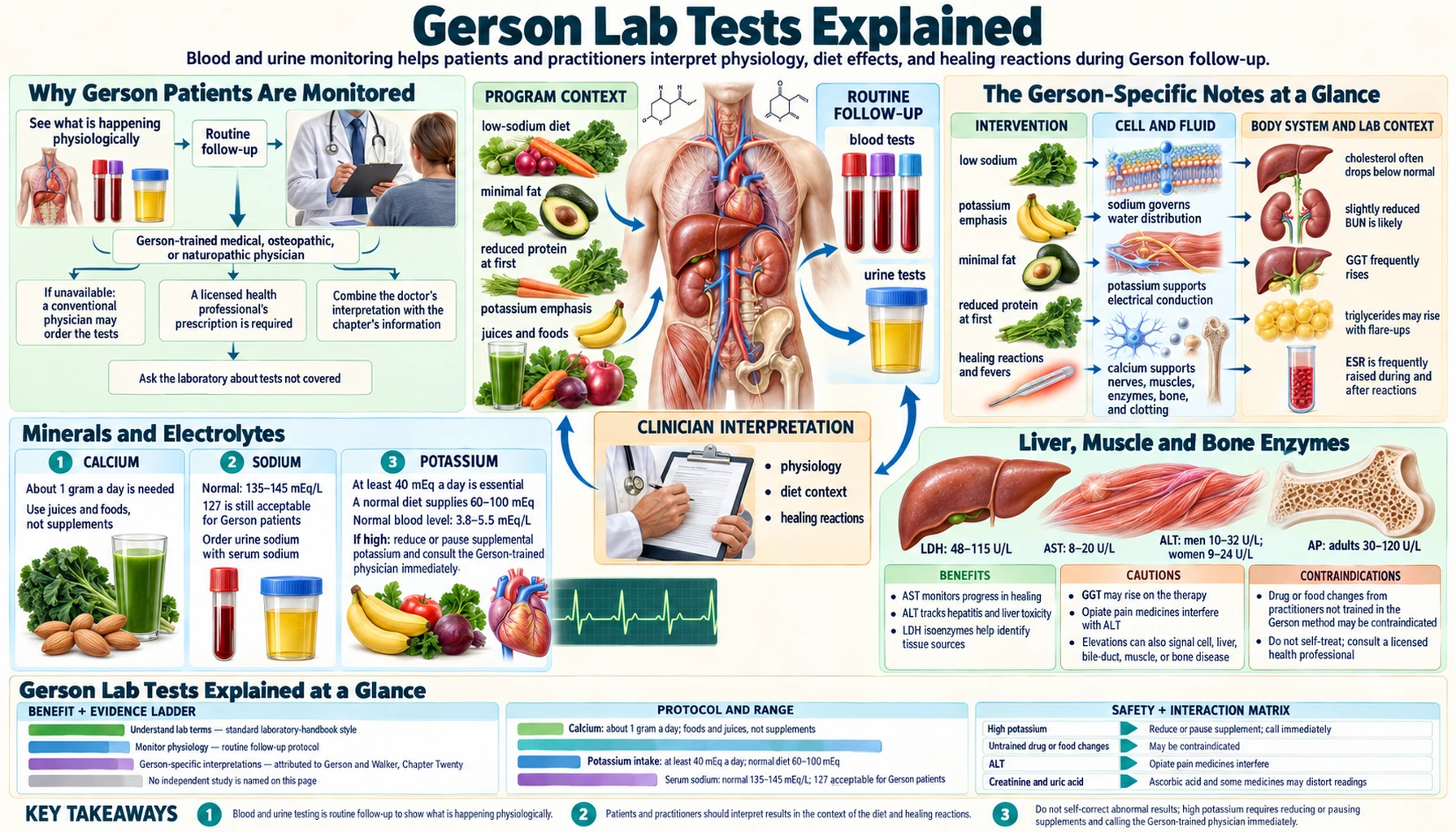
Chapter Twenty of The Gerson Therapy walks patients through the blood and urine tests used to follow healing progress on the Gerson program. The book states that laboratory testing of blood and urine is a standard part of the follow-up protocol used by all Gerson-trained health professionals — medical doctors, osteopathic physicians and naturopathic physicians among them. Its stated purpose is to help readers “feel less intimidated by unfamiliar medical terms” and to understand what the numbers say about a healing body.
Most of the chapter describes each test the way a standard laboratory handbook would: what it measures, its normal range, and what high or low results can mean. Woven through it are short notes that are specific to Gerson patients — for example, that cholesterol often drops below normal, that a rise in GGT or triglycerides can accompany healing reactions, and that sodium as low as 127 is still acceptable. This page gathers those notes and the book’s reference ranges in plain language.
Table of Contents
- 1. Why Gerson Patients Are Monitored
- 2. The Gerson-Specific Notes at a Glance
- 3. Minerals and Electrolytes
- 4. Liver, Muscle and Bone Enzymes
- 5. Serum Bilirubin
- 6. Cholesterol, Lipoproteins and Triglycerides
- 7. Proteins, Kidney Tests and Uric Acid
- 8. Blood Sugar and Iron
- 9. Red Cells, Platelets and White Cells
- 10. Sedimentation Rate and Routine Urinalysis
- Key Research Papers
- Connections
- Featured Videos
1. Why Gerson Patients Are Monitored
The book presents lab work as the way a patient and practitioner see “what is happening physiologically” during healing. Gerson-trained practitioners order these tests as routine follow-up.
If no Gerson practitioner is available
For patients without access to a Gerson-trained health professional, the book says appropriate monitoring is still possible: hire a conventionally practicing physician who is willing to order the tests. A licensed health professional’s prescription is needed to have laboratory tests done. The coauthors write that, from many years of counseling patients with degenerative disease, combining a doctor’s interpretation with the chapter’s information gives the patient a real understanding of the healing process.
The book’s caution
The book adds a caution: suggestions from practitioners who are not trained in the Gerson method to take drugs or change foods “may not be in your best interest and could very well be contraindicated.” For any test not covered, it recommends asking the laboratory that ran it, noting: “It’s your right to know about tissues and other specimens taken from your own body.”
2. The Gerson-Specific Notes at a Glance
These are the places where the chapter says a Gerson patient’s results may differ from the usual pattern, or what to do about them:
| Test | What the book says about Gerson patients |
|---|---|
| Calcium | About 1 gram a day is needed for calcium balance, but it should not be given as supplements — juices and foods contain more than enough. |
| Sodium | Normal is 135–145 mEq/L; for Gerson patients a level of 127 is still acceptable. Truly low sodium from too little intake is rare and does not happen on the low-sodium diet, since some sodium always comes from food. Order a urine sodium at the same time as a serum sodium. |
| Potassium | High potassium is uncommon on the therapy. If it occurs, supplemental potassium should be reduced or temporarily stopped and the Gerson-trained physician consulted immediately. |
| GGT | The immune-stimulating effect of the therapy frequently causes a rise in GGT. |
| Total cholesterol | Often drops below normal, because patients eat an extremely low-fat diet. |
| Lipoproteins | The minimal-fat diet often lowers coronary risk, while still supplying certain essential polyunsaturated fatty acids and fat-soluble vitamins. |
| Triglycerides | Flare-ups and healing reactions are shown by elevated triglycerides. |
| BUN | Because protein intake is lower at first, a slightly reduced BUN is likely. |
| ESR | Frequently raised during and after the reactions and fevers the therapy induces. |
The book’s point is that some “abnormal” numbers are expected on the program and are read in light of the diet and of healing reactions (see Remission and Healing Reactions).
3. Minerals and Electrolytes
Serum calcium
Calcium in the blood tells the practitioner about nerve and muscle activity, enzyme activity, bone development and clotting. It is absorbed from food when enough vitamin D is present; extra is excreted in urine and stool, and bones and teeth release calcium when blood levels fall. The book gives a normal adult range of 8.9 to 10.1 mg/dL (2.25 to 2.75 mmol/L); children run higher.
- High (hypercalcemia) may point to overactive parathyroid glands, Paget’s disease of bone, multiple myeloma, cancer spread, multiple fractures or long immobilization. Symptoms listed include deep bone pain, flank pain from kidney stones, weak muscle tone, nausea, vomiting and dehydration.
- Low (hypocalcemia) may come from underactive parathyroid glands, malabsorption, kidney failure or acute pancreatitis, and may cause numbness and tingling, muscle twitching and spasm, seizures and heart-rhythm problems.
More: Calcium test.
Serum phosphates
Phosphate is the main anion inside cells and is essential for bone formation. Normal adult range: 2.5 to 4.5 mg/dL (0.80 to 1.40 mmol/L); children can reach 7 mg/dL during growth spurts. Calcium and phosphate move in a reciprocal relationship. The book notes that high phosphate can come from drinking too many carbonated beverages and is linked to bone loss and tooth demineralization; low phosphate can come from malnutrition or malabsorption.
Serum sodium
Sodium, the main cation outside cells, governs water distribution: less sodium promotes water loss, more promotes water retention (edema). Normal adult range is 135 to 145 mEq/L — but, as noted above, 127 is still acceptable for Gerson patients. High sodium can come from too little water, severe vomiting or diarrhea, or eating too much salt; signs include thirst, dry mouth, flushed skin, high blood pressure and edema. Low sodium can come from heavy sweating, diuretics, vomiting or diarrhea, and shows as apprehension, lassitude, headache, cramps or tremors.
Serum potassium
Potassium is the body’s major ion inside cells and is vital to electrical conduction in heart and skeletal muscle. The kidneys excrete nearly all potassium eaten, so an intake of at least 40 mEq a day is essential; a normal diet supplies 60 to 100 mEq. Normal blood level: 3.8 to 5.5 mEq/L. The book stresses the see-saw between potassium and sodium — a large intake of one lowers the other — and that while the body conserves sodium readily, it has no efficient way to conserve potassium, so deficiency can develop quickly and is common. This is the background to the potassium emphasis of the saltless diet and the potassium compound.
- High potassium: weakness, nausea, diarrhea, colicky pain, muscle irritability and a slow heartbeat. On the Gerson program, reduce or pause supplemental potassium and call the Gerson-trained physician immediately.
- Low potassium: decreased reflexes, a rapid, weak, irregular pulse, confusion, low blood pressure, poor appetite and muscle weakness; severe cases can affect heart rhythm and breathing.
Serum chloride
Chloride works with sodium to hold osmotic pressure, blood volume and acid-base balance. Normal range: 100 to 108 mEq/L. High levels can follow severe dehydration or kidney shutdown; low levels go with low sodium and potassium after prolonged vomiting, or with fluid overload such as congestive heart failure.
See also: Comprehensive Metabolic Panel.
4. Liver, Muscle and Bone Enzymes
Lactic dehydrogenase (LDH)
LDH converts pyruvic acid to lactic acid in muscle. Many diseases raise total LDH, and its five isoenzymes help tell them apart. The book lists a normal total of 48 to 115 U/L, and is used, it says, to monitor response to some forms of chemotherapy.
| Isoenzyme | Main location | Normal share of total |
|---|---|---|
| LDH1 | Heart, red cells, kidneys | 17.5% to 28.3% |
| LDH2 | Heart, red cells, kidneys | 30.4% to 36.4% |
| LDH3 | Lungs | 19.2% to 24.8% |
| LDH4 | Liver, skeletal muscle | 9.6% to 15.6% |
| LDH5 | Liver, skeletal muscle | 5.5% to 12.7% |
More: LDH test.
AST (SGOT)
AST is found mainly in the liver, heart, skeletal muscle, kidneys, pancreas and red cells, and is released in proportion to cell damage. Adult range: 8 to 20 U/L (infants four times higher). The book says the test “monitors patient progress in healing.” It grades elevations: highest with viral hepatitis or drug-induced liver injury; 10–20 times normal with severe heart attack or alcoholic cirrhosis; 5–10 times with chronic hepatitis; 2–5 times with conditions such as fatty liver or metastatic liver tumors.
ALT (SGPT)
A rise in ALT signals acute liver-cell damage before jaundice appears, and the test tracks treatment progress in hepatitis and liver toxicity. Range: 10 to 32 U/L in men, 9 to 24 U/L in women, twice those in infants. Levels up to 50 times normal suggest viral or drug-induced hepatitis. Opiate pain medicines interfere with the test.
GGT
GGT helps diagnose obstructive jaundice and liver cancer, and is sensitive to drug use and alcohol. Normal: men 18–50, 10 to 39 U/L; older men, 10 to 48 U/L; women, 6 to 29 U/L. Elevation signals a cholestatic liver process — but the book notes that on the Gerson Therapy, its immune-stimulating effect frequently causes GGT to rise. More: GGT test.
Alkaline phosphatase (AP)
AP comes mainly from bone and liver and is sensitive to mild bile-duct obstruction. Usual totals: 30 to 120 U/L in adults and 40 to 200 U/L in children, whose levels run about three times higher during growth. High AP can point to bone disease, bone metastases or liver disease — sometimes before bilirubin changes.
Acid phosphatase
Used to detect prostate cancer; the book notes that successful treatment for prostate cancer decreases acid phosphatase levels. Normal radioimmunoassay range: 0 to 4.0 ng/mL. A high level together with high AP suggests cancer that has spread to bone.
See also: Liver Function Tests.
5. Serum Bilirubin
Bilirubin is the bile pigment left over when hemoglobin is broken down. It travels on albumin to the liver, where it is converted (conjugated) and excreted in bile, so the test reflects the health of the liver and gallbladder. The book gives direct bilirubin in adults as less than 0.5 mg/dL; newborns range from 1 to 12 mg/dL.
- Raised indirect (unconjugated) bilirubin can mean the liver cells can no longer process it, or that red cells are being destroyed, as in severe hemolytic anemia.
- Raised direct (conjugated) bilirubin usually means bile flow is blocked — inside the liver (viral hepatitis, cirrhosis, a drug reaction) or outside it (gallstones, bile-duct disease, gallbladder or pancreatic cancer).
The test helps sort out the causes of jaundice. The Gerson program’s heavy emphasis on supporting the liver — see Coffee Enemas and Detoxification — is why liver tests feature so prominently in this chapter.
6. Cholesterol, Lipoproteins and Triglycerides
Total serum cholesterol
Cholesterol is built into cell membranes and is used to make adrenal hormones, bile salts and sex hormones. The book notes that a diet high in saturated fat raises it and a diet low in saturated fat lowers it. Common range: 150 to 200 mg/dL. Below 200 is desirable; 200 to 240 is borderline; above 250 indicates high cardiovascular risk among other conditions. Low cholesterol is associated with malnutrition, liver-cell damage and an overactive thyroid — yet the book is clear that cholesterol often drops below normal on the Gerson program simply because patients eat an extremely low-fat diet.
Lipoprotein/cholesterol fractionation
This test separates LDL and HDL cholesterol. Lower HDL in a population goes with more coronary artery disease, higher HDL with less. Normal HDL: 29 to 77 mg/100 mL; normal LDL: 62 to 185 mg/100 mL. The book’s note: because the Gerson Therapy offers a minimal amount of fat, it often lowers the risk of coronary artery disease, while still providing an adequate supply of certain essential polyunsaturated fatty acids and fat-soluble vitamins the body cannot make in adequate amounts (the program’s flaxseed oil — see Diet Protocol).
Serum triglycerides
Triglycerides are the body’s main storage fat, making up 95 percent of fatty tissue. The book’s normal values rise with age:
| Age | mg/dL | mmol/L |
|---|---|---|
| 0–29 | 10–140 | 0.1–1.55 |
| 30–39 | 10–150 | 0.1–1.65 |
| 40–49 | 10–160 | 0.1–1.75 |
| 50–59 | 10–190 | 0.1–2.10 |
High values suggest atherosclerosis risk; milder rises can go with bile obstruction, diabetes, kidney disease or alcohol. The Gerson note: on the Gerson diet, flare-ups and healing reactions are shown by elevated triglycerides. More: Lipid Panel.
7. Proteins, Kidney Tests and Uric Acid
Serum protein electrophoresis
An electric field separates albumin and four globulins. Albumin, over half the total, holds fluid inside the capillaries and carries bilirubin, fatty acids, hormones and drugs; alpha-1, alpha-2 and beta globulins are carriers; gamma globulin works in the immune system. The book’s normal ranges:
| Fraction | Normal range |
|---|---|
| Total serum protein | 6.6 to 7.9 g/dL |
| Albumin | 3.3 to 4.5 g/dL |
| Alpha-1 globulin | 0.1 to 0.4 g/dL |
| Alpha-2 globulin | 0.5 to 1.0 g/dL |
| Beta globulin | 0.7 to 1.2 g/dL |
| Gamma globulin | 0.5 to 1.6 g/dL |
A reversed albumin-globulin (A-G) ratio with low total protein points to chronic liver disease; reversed with normal total protein, to certain blood disorders or chronic infections. More: Albumin.
Blood urea nitrogen (BUN)
Urea, made in the liver from ammonia and excreted by the kidneys, reflects protein intake and kidney excretion. Normal: 8 to 20 mg/dL. High BUN follows dehydration, kidney disease or urinary obstruction; low BUN follows severe liver damage, malnutrition or overhydration. Gerson note: because dietary protein is reduced at first, a slightly reduced BUN is likely.
Serum creatinine
A more sensitive measure of kidney damage than BUN, since kidney impairment is virtually the only cause of a raised level. Normal: 0.8 to 1.2 mg/dL in men, 0.6 to 0.9 mg/dL in women. High doses of ascorbic acid, some drugs and athletic muscle mass can raise it with healthy kidneys. More: Kidney Function.
Serum uric acid
Used mainly to detect gout. Normal: 4.3 to 8 mg/dL in men, 2.3 to 6 mg/dL in women. Levels rise in heart failure, some anemias, leukemia, lymphoma, metastatic cancer and psoriasis, and with starvation, a high-purine diet, stress and alcohol. Several medicines and ascorbic acid can distort the reading. More: Uric Acid.
8. Blood Sugar and Iron
Fasting blood sugar (FBS)
After an overnight fast, glucagon raises blood sugar and insulin normally holds it in check; in diabetes, missing or deficient insulin lets glucose stay high. The book’s normal values:
- Fasting serum: 70 to 100 mg/dL
- Fasting whole blood: 60 to 100 mg/dL
- Non-fasting whole blood: 85 to 125 mg/dL over age 50; 70 to 115 mg/dL under 50
Fasting levels of 140 to 150 mg/dL or higher on two or more occasions, or non-fasting levels over 200 mg/dL, are described as diagnostic of diabetes. The test also monitors dietary therapy for diabetics. See Fasting Insulin.
Serum iron and total iron-binding capacity (TIBC)
Two tests measure iron carried on transferrin and the total capacity to carry it; dividing one by the other gives saturation (normally about 30 percent). Together they estimate iron stores, diagnose iron overload, separate iron-deficiency anemia from the anemia of chronic disease, and help evaluate nutritional status.
| Serum iron (mcg/dL) | TIBC (mcg/dL) | Saturation (%) | |
|---|---|---|---|
| Men | 70 to 150 | 300 to 400 | 20 to 50 |
| Women | 80 to 150 | 350 to 450 | 20 to 50 |
In iron deficiency, serum iron falls and TIBC rises; in chronic inflammation such as rheumatoid arthritis, iron is low despite adequate stores; in iron overload, iron rises late. More: Iron Panel.
9. Red Cells, Platelets and White Cells
Red blood cell count, hemoglobin and hematocrit
The red cell count helps diagnose anemia and polycythemia. The book’s adult ranges: 4.5 to 6.2 million per microliter in men and 4.2 to 5.4 million in women. A high count suggests polycythemia or dehydration; a low count, anemia, fluid overload or recent bleeding. The book also notes that with total bed rest, red cell counts drop considerably because the body needs less oxygen.
Hemoglobin measures anemia severity and monitors response to therapy; the book lists roughly 14 to 18 g/dL for adult men and 12 to 16 g/dL for adult women, with higher values in newborns. Hematocrit, the packed-cell volume, runs 40 to 54 percent in men and 37 to 47 percent in women. A practical tip from the book: if a bruise (hematoma) forms where the blood was drawn, apply ice first, then warm soaks later.
Red cell indices
- MCV (average cell size): 84 to 99 femtoliters
- MCH (hemoglobin per cell): 26 to 32 picograms
- MCHC (hemoglobin concentration): 30% to 36%
Low MCV and MCHC point to small, pale-cell anemias such as iron deficiency; a high MCV points to large-cell anemia from folic acid or vitamin B12 deficiency.
Platelet count
Platelets form the plug that stops bleeding. Normal: 130,000 to 370,000 per cubic millimeter. The book warns that below 50,000 spontaneous bleeding can occur, and below 5,000 life-threatening bleeding is possible. The count is vital for monitoring chemotherapy and radiation; the book lists a long series of medications that can lower it.
White blood cell count and differential
The white count (normal 4.1 to 10.9 thousand per microliter) is used to detect infection or inflammation and to follow response to chemotherapy or radiation. High counts signal infection and may indicate other serious illness; low counts show bone-marrow depression from viral infections or toxic exposures, including mercury and other heavy metals, benzene and arsenic. The differential breaks the count into cell types; the book gives adult relative values including lymphocytes 16.2–43%, eosinophils 0.3–7% and basophils 0.3–2%, and stresses that both relative and absolute values must be considered. For the full list it refers readers to Appendix I of the Gerson Therapy Handbook.
More: Complete Blood Count.
10. Sedimentation Rate and Routine Urinalysis
Erythrocyte sedimentation rate (ESR)
ESR times how fast red cells settle in a tube. It is sensitive but nonspecific, rising in widespread inflammation from infection, autoimmune disease or cancer, and it can reveal hidden disease when other signs are normal. Normal: 0 to 20 mm/hour. It also rises in pregnancy and anemia, and falls in polycythemia and sickle cell anemia.
The Gerson note: ESR is frequently raised during and after the reactions and fevers induced by the Gerson Therapy — so a high reading during a flare-up is read in that context. More: ESR Test.
Routine urinalysis
A routine urinalysis checks physical characteristics, specific gravity and pH, protein, glucose and ketones, and examines the sediment for casts, cells and crystals. The book calls it “an exceedingly important test that tells a lot about the internal workings of a person,” with results reflecting how the body is responding to the diet, the time of collection and other factors. It again refers readers to Appendix I of the Gerson Therapy Handbook for detailed interpretation. More: Urinalysis.
Key Research Papers
- Gerson C, Walker M. The Gerson Therapy: The Proven Nutritional Program for Cancer and Other Illnesses. Chapter Twenty, “Gerson Lab Tests Explained.” Kensington Books. (Primary source for every range and note on this page.)