Albumin Test: Serum Albumin — Nutrition, Liver Function, and Critical Illness Marker
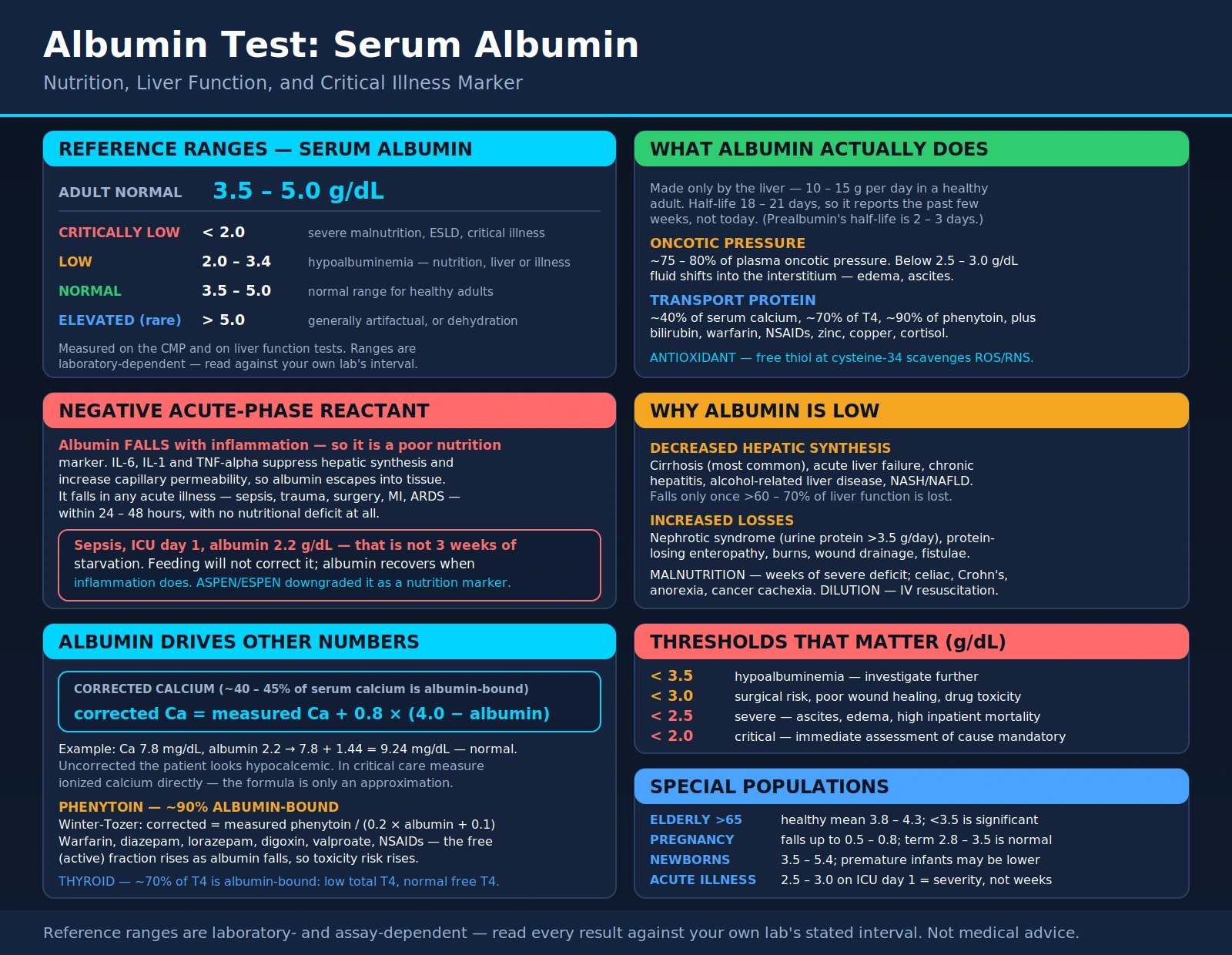
Albumin is the major serum protein and is made by the liver, at a rate of about 10.5 grams per day (about 150 mg per kilogram per day) in normal adults (Levitt 2016). It keeps the fluid part of the blood from leaking out of the blood vessels into other tissues, and it carries hormones, vitamins, enzymes and many other substances through the bloodstream (MedlinePlus). It also provides more than half of the antioxidant activity of normal plasma (Levitt 2016). MedlinePlus describes the albumin blood test as a check on general health and nutrition and on how well the liver and kidneys are working. On nutrition, the research is narrower: a low albumin is a strong signal of illness and of risk, but a 2021 position paper from the American Society for Parenteral and Enteral Nutrition (ASPEN) concluded that albumin reflects inflammation rather than nutrition status (Evans 2021).
Table of Contents
What Albumin Measures
An albumin blood test measures the amount of albumin in the blood. It is often done as part of a group of liver tests (liver function tests, or a liver panel) and is also one of the 14 tests in a comprehensive metabolic panel (CMP). MedlinePlus lists its uses as checking general health and nutrition, seeing how well the liver and kidneys are working, and monitoring treatment for liver or kidney conditions. MedlinePlus also notes that an albumin result alone cannot diagnose a condition; it is read together with other test results.
Albumin turns over slowly. In normal adults its turnover time is about 25 days, which corresponds to a half-time of about 17 days (Levitt 2016). For that reason a low value is often taken to indicate illness of several weeks’ duration, but albumin can also fall quickly when the capillaries become more permeable to protein, as happens in acute illness (Levitt 2016). Prealbumin (transthyretin) has a half-life of two days (Tsegaye 2017) and, in a study of 40 patients receiving nutrition support, changed more rapidly than albumin (Bernstein 1989).
Serum albumin is a strong predictor of illness and death, both in sick people and in people who appear healthy (Levitt 2016).
Albumin Synthesis and Physiology
Albumin is made in the liver. In normal adults, roughly 8.5% of the albumin in plasma and 4% of the body’s total albumin is made each day. About 40% of the body’s albumin is in the blood vessels; the remaining 60% is in the interstitial space of tissues such as muscle, fat, connective tissue and skin. Of the albumin cleared each day, about 6% leaves through the kidneys, about 10% through the gut, and about 84% is broken down in the body (Levitt 2016).
The main physiological roles of albumin:
Colloid osmotic (oncotic) pressure: Albumin provides about 80% to 85% of the colloid osmotic pressure of normal plasma (Levitt 2016), the force that holds fluid inside the blood vessels. MedlinePlus explains that without enough albumin, fluid can leak out of the blood and build up in the lungs, the abdomen or other parts of the body. People born with almost no albumin (congenital analbuminemia) are a notable exception: their globulins and other plasma proteins rise to bring colloid osmotic pressure to about 50% of normal, and they have minimal or no edema and a normal life expectancy (Levitt 2016).
Transport protein: Albumin binds a wide range of compounds: bilirubin and long-chain fatty acids, the divalent cations calcium and magnesium, bile acids, copper, zinc, a wide variety of drugs, and even compounds that have their own specific carrier proteins, such as vitamin D and thyroxine. Binding lowers the free concentration of these compounds, which limits their biological activity, distribution and rate of clearance (Levitt 2016).
Antioxidant: Albumin provides more than 50% of the total antioxidant activity of normal plasma, an activity attributed to its reduced sulfhydryl groups, which scavenge oxygen free radicals including hypochlorous acid and nitric oxide (Levitt 2016). In the interstitium, albumin acts as the main extracellular scavenger and antioxidant and supplies amino acids for cell and matrix synthesis (Soeters 2019).
Reference Ranges
MedlinePlus normal range: 3.4 to 5.4 g/dL (34 to 54 g/L).
Ranges vary by laboratory. MedlinePlus notes that normal value ranges may vary slightly among laboratories and that some labs use different measurements or test different samples; a result is read against the range printed by the laboratory that ran it. Other sources and lab reports often print slightly different limits.
Factors That Shift the Result
- Higher than normal: may be a sign of dehydration, for example from severe diarrhea. Certain medicines, including steroids, insulin and hormones, can raise albumin levels (MedlinePlus).
- Lower than normal without disease: albumin may be lower after 24 to 48 hours without eating, with certain medicines including birth control pills, and during pregnancy (MedlinePlus).
- Sample collection: having a tourniquet on for a long time during the blood draw, and drinking too much water (water intoxication), can affect the result (MedlinePlus).
- An abnormal result is not always a disease: MedlinePlus states that a level outside the normal range does not always mean a medical condition that needs treatment.
Where the Lower Limit Sits
Levitt and Levitt (2016) reviewed mortality data from life-insurance applicants followed for 12 years and found that relative mortality rose as albumin fell below 4.3 g/dL, well inside the conventional normal range. On that basis they argued that the lower limit of normal could be set at 4.3 g/dL rather than 3.5 g/dL. This is an argument in a review, not a laboratory standard.
Causes of Low Albumin (Hypoalbuminemia)
MedlinePlus lists liver disease (including severe cirrhosis), kidney disease, conditions that involve problems using protein from food (such as Crohn’s disease and malabsorption disorders), burns over a large area of the body, and thyroid disease among the causes of a low albumin. Levitt and Levitt (2016) group the mechanisms as follows.
Decreased Liver Synthesis
The best-understood mechanism of chronic hypoalbuminemia is the decreased albumin synthesis of liver disease. In liver disease the fall in albumin is roughly proportional to the fall in synthesis, and albumin falls only to about half of normal even in severe liver disease, which Levitt and Levitt attribute partly to slower albumin breakdown when the level is low. In most disease states other than liver disease, albumin synthesis is normal or increased (Levitt 2016).
Diet Low in Protein but Not in Calories
A very low-protein diet with normal calories reduces albumin synthesis (by 20% to 65% in the studies Levitt and Levitt reviewed), and kwashiorkor, produced by a low-protein, normal-calorie diet in infants and children, is the classic example of hypoalbuminemia from malnutrition. A diet low in both protein and calories, by contrast, does not reduce albumin synthesis: albumin does not fall appreciably during a 6-month near-starvation diet or in chronic anorexia nervosa (Levitt 2016).
Increased Losses
Nephrotic syndrome: defined as any condition with more than 3.5 g/day of protein excreted in the urine. Albumin synthesis rises as urinary losses rise, but in the patients studied it rose by an average factor of only 1.2 (Levitt 2016).
Protein-losing enteropathy (PLE): excessive albumin loss into the gut, seen in conditions such as intestinal lymphangiectasia and Whipple’s disease, and also in conditions where the gut involvement is indirect, such as heart disease, amyloidosis and cystic fibrosis. Levitt and Levitt suggest PLE may be more common than is appreciated. The fecal alpha-1-antitrypsin test used to detect it had a sensitivity of only 58% and a specificity of 80% against radiolabeled-albumin measurement in the data they reviewed (Levitt 2016).
Burns: widespread burns are listed by MedlinePlus among the conditions that lower albumin and for which the test may be performed.
Inflammation and Increased Capillary Leak
Inflammation increases capillary permeability and the escape of albumin from the blood, expands the interstitial space and the volume over which albumin is distributed, and shortens albumin’s half-life. These two factors produce hypoalbuminemia even though fractional synthesis rates in plasma are increased (Soeters 2019). The older explanation, that cytokines such as tumor necrosis factor or interleukin 6 suppress liver albumin synthesis, is supported by many animal studies but by only limited evidence in humans; the strongest human evidence for reduced synthesis comes from studies in dialysis patients, where falls in albumin tracked rises in interleukin 6, C-reactive protein and alpha-1 acid glycoprotein (Levitt 2016).
Albumin and Liver Disease
Albumin is made by the liver, and it is a component of the Child-Pugh score and of the newest version of the MELD score.
Child-Pugh Score
The original Child score combined ascites, hepatic encephalopathy, nutritional status, total bilirubin and albumin. Pugh and colleagues modified it in 1973 by adding prothrombin time (or INR) and removing nutritional status, and the resulting Child-Pugh score is widely used to grade the severity of liver dysfunction (Peng 2016; Pugh 1973).
MELD, MELD-Na and MELD 3.0
The Model for End-Stage Liver Disease (MELD) was first created to predict survival in patients undergoing transjugular intrahepatic portosystemic shunts (Peng 2016) and became an established indicator of short-term survival in end-stage liver disease (Kamath 2001; Kim 2021). The MELD-Na version used for liver-transplant allocation in the United States consists of the INR and serum bilirubin, creatinine and sodium, and does not include albumin. MELD 3.0, developed from all U.S. wait-list registrations from 2016 to 2018, added female sex and serum albumin, with an interaction between albumin and creatinine; it discriminated slightly better than MELD-Na (C-statistic 0.869 vs 0.862) and, in simulation, resulted in fewer wait-list deaths (7,788 vs 7,850) (Kim 2021).
Ascites and the Serum-Ascites Albumin Gradient
The serum-ascites albumin gradient (SAAG) compares the albumin concentration in serum with that in ascitic fluid. In 901 paired serum and ascitic-fluid samples, the gradient correctly separated ascites caused by portal hypertension from ascites with other causes 96.7% of the time, against 55.6% for the older exudate-transudate classification based on ascitic-fluid total protein (Runyon 1992).
Albumin and Nutritional Assessment
Albumin and prealbumin were long used as laboratory measures of nutrition. A 2021 ASPEN position paper concluded that both characterize inflammation rather than nutrition status or protein-energy malnutrition. In critical and chronic illness, inflammation reprioritizes protein synthesis in the liver and increases capillary permeability, and both lower albumin and prealbumin. The paper found an association between inflammation and malnutrition, but not between malnutrition and visceral-protein levels; the proteins track a patient’s risk of adverse outcomes, and ASPEN’s position is that they should not be used as proxies for total body protein or muscle mass or as nutrition markers (Evans 2021).
A review of albumin physiology reached a similar conclusion, stating that albumin is not a useful marker of malnutrition except in a low-protein, normal-calorie diet (Levitt 2016).
Does Feeding Raise Albumin?
In the studies Levitt and Levitt reviewed, 21 days of total parenteral nutrition in oncology patients, and 3 months of dietary protein supplementation in patients with hepatic encephalopathy, had no effect on serum albumin. Preoperative parenteral nutrition in patients with low albumin did not significantly improve surgical mortality, and parenteral nutrition did not change mortality in critically ill patients (Levitt 2016). After the age of 30, muscle mass and function slowly decline, a loss accelerated by other illness and associated with falling albumin; nutrition support cannot fully prevent this but slows it, especially when combined with physical exercise (Soeters 2019).
Albumin Before Surgery
Levitt and Levitt describe low albumin as one of the strongest indicators of high risk for complications after surgery. In a study of 54,000 U.S. Veterans Affairs hospital patients, summarized by Levitt and Levitt, post-surgical mortality rose from under 1% to 29% as preoperative albumin fell from 4.6 g/dL to below 2.1 g/dL (Levitt 2016).
Prealbumin
Prealbumin (transthyretin) has a half-life of two days (Tsegaye 2017). In 40 patients receiving enteral or parenteral nutrition support, prealbumin changed rapidly and reflected current nutritional status more accurately than albumin did (Bernstein 1989). The 2021 ASPEN position applies to prealbumin as well as albumin (Evans 2021). Reference ranges and the test itself are covered on the Prealbumin page in this section.
Critical Illness and the Acute-Phase Response
Critical illness and chronic illness are both characterized by inflammation, which lowers serum albumin and prealbumin (Evans 2021).
Mechanism
Albumin normally escapes from the blood into the tissues at about 5% per hour, more than 10 times the rates of synthesis and breakdown. In one study this transcapillary escape rate rose by more than 300% in patients with septic shock, rose by an average of 100% within 7 hours of cardiac surgery, and was twice the healthy rate in cachectic cancer patients (Fleck 1985). In another study summarized by Levitt and Levitt, albumin had fallen to about 62% of normal within 2 days of the onset of an acute infectious disease. In patients with inflammatory diseases, cachectic cancer, severe head trauma or critical illness, and in patients having laparoscopic surgery for cholecystitis, albumin synthesis was not reduced as much as the albumin level, and in most of these situations synthesis was above normal (Levitt 2016).
What This Means for Interpretation
Soeters and colleagues conclude that hypoalbuminemia results from and reflects the inflammatory state, and the ASPEN position paper found that albumin and prealbumin track a patient’s risk of adverse outcomes rather than protein-energy malnutrition (Soeters 2019; Evans 2021). Rising or falling albumin levels are adequate indicators, respectively, of improvement or deterioration of the clinical state (Soeters 2019).
IV Albumin: What the Trials Found
- Fluid resuscitation in intensive care (SAFE trial): 6,997 intensive-care patients were randomly assigned to 4% albumin or normal saline for fluid resuscitation. Deaths within 28 days were 726 and 729 (relative risk 0.99, 95% CI 0.91 to 1.09), and organ failure, days in intensive care and in hospital, and days of mechanical ventilation did not differ significantly (Finfer 2004).
- Correcting low albumin: a meta-analysis of 9 controlled trials (535 patients) of albumin given to correct hypoalbuminemia suggested that complication rates may be lower when the albumin level reached during treatment exceeds 30 g/L; the authors called for further well-designed trials (Vincent 2003). A later review stated that albumin infusion has not been shown to reduce fluid requirements, infection rates or mortality in the intensive care unit (Soeters 2019).
- Spontaneous bacterial peritonitis: in 126 patients with cirrhosis and spontaneous bacterial peritonitis, adding intravenous albumin (1.5 g per kilogram at diagnosis and 1 g per kilogram on day 3) to the antibiotic cefotaxime reduced renal impairment from 33% to 10%, in-hospital deaths from 29% to 10%, and 3-month mortality from 41% to 22% (Sort 1999).
- Hepatorenal syndrome: in the CONFIRM trial of 300 adults with type 1 hepatorenal syndrome, albumin was strongly recommended in both arms; verified reversal of hepatorenal syndrome occurred in 32% with terlipressin and 17% with placebo. Terlipressin was associated with serious adverse events: death within 90 days from respiratory disorders occurred in 11% of the terlipressin group and 2% of the placebo group (Wong 2021).
Prognostic Value in Acute Illness
A meta-analysis of 90 cohort studies with 291,433 acutely ill patients found hypoalbuminemia to be a potent, dose-dependent, independent predictor of poor outcome: each 10 g/L fall in serum albumin raised the odds of death by 137% and of complications by 89%, and lengthened intensive-care and hospital stays by 28% and 71%. The association appeared independent of both nutritional status and inflammation (Vincent 2003).
Drug and Calcium Correction with Albumin
Because albumin carries calcium and many drugs, a low albumin changes the total amount measured in the blood without necessarily changing the free, active fraction. Formulas exist to adjust for this; the studies below tested how well they work.
Corrected Calcium
About one half of the calcium in the blood is attached to proteins, mainly albumin (MedlinePlus). A total calcium test measures both the bound and the free (ionized) calcium, so a low albumin can lower the total while the ionized calcium stays the same. MedlinePlus lists abnormal blood levels of albumin or immunoglobulins among the reasons for a separate ionized calcium test.
The original formula (Payne 1973). Payne and colleagues studied 200 consecutive specimens sent for liver function tests. Calcium correlated closely with albumin (r = 0.867) and less closely with total protein (r = 0.682), and they derived a formula from the regression of calcium on albumin:
Adjusted calcium = calcium − albumin + 4.0 (calcium in mg/100 mL, albumin in g/100 mL) (Payne 1973)
As published, the formula adds back 1 mg/100 mL of calcium for each 1 g/100 mL that albumin is below 4.0. In their series, the 95% limits of the adjusted values matched the laboratory’s normal range, and the albumin adjustment gave normal calcium values in 39 specimens with raised gamma globulins, which adjustments based on total protein did not (Payne 1973). Other published versions differ: Ladenson and colleagues tested 13 published algorithms in 1978, and the 2018 hospital study below used a modified Payne formula, so a “corrected calcium” on a report depends on the formula the laboratory uses.
How well correction formulas perform.
- 13 published algorithms, 1978: corrected calcium from 13 published methods was compared with measured free calcium in 55 samples from healthy controls and 404 from patients with disorders of calcium metabolism. None produced substantially better agreement with free calcium than uncorrected total calcium did, and the authors concluded that correcting total calcium with other chemistry values does not adequately predict calcium status (Ladenson 1978).
- Hospital patients, 2018: in 13,604 paired results from 5,553 hospitalized patients, albumin-adjusted calcium (from a modified Payne formula) agreed with ionized calcium status in 56.9% of cases. Agreement was worse with kidney failure and low albumin; adjusted calcium overestimated calcium in patients with renal impairment and albumin below 3.0 g/dL, and unadjusted total calcium performed better than adjusted calcium when albumin was below 3.0 g/dL. Stopping the reporting of adjusted calcium below that albumin level improved correct classification from 65.6% to 77.6% (Smith 2018).
- Internal medicine patients, 2022: in 210 hospitalized patients, adjusting total calcium for albumin or protein did not increase, and sometimes decreased, accuracy against ionized calcium. Total calcium, with or without adjustment, detected only 50% of hypocalcemia. The authors argued against using albumin- or protein-adjusted calcium and concluded that ionized calcium measurement should be used to confirm a calcium disorder (Alhenc-Gelas 2022).
The Calcium Test page covers ionized calcium and these studies in more detail.
Drug Levels and Albumin
Albumin binds a wide variety of drugs, and binding lowers a drug’s free concentration, activity, distribution and clearance (Levitt 2016). For phenytoin, an anti-seizure drug, equations of the Sheiner-Tozer (also called Winter-Tozer) type estimate the free drug level from the total level and the albumin. Studies in intensive-care patients found these estimates unreliable:
- In 30 medical intensive-care patients, all four equations tested showed bias and lacked precision; the Sheiner-Tozer equation over-predicted free phenytoin, and recent albumin infusion further reduced the performance of the equations. The authors discouraged using the equations in that population (Parikh 2018).
- In 65 neurointensive-care patients with low albumin, calculated and measured free phenytoin correlated only weakly to moderately (r = 0.45), and the conventional equation failed to predict the free level accurately in 33.85% of patients, more often in older patients (Javadi 2018).
Thyroid Hormone
Thyroxine (T4) has its own specific carrier proteins in serum but is also bound by albumin (Levitt 2016). A total T4 test measures free and bound T4 together; a free T4 test measures only the thyroxine not attached to protein. MedlinePlus notes that the free T4 test is considered more accurate and is used more often, and that free T4 results can be affected by pregnancy, estrogen levels, liver problems, severe body-wide illness and inherited changes in a protein that binds T4.
Key Research Papers
- Doumas BT, Watson WA, Biggs HG. Albumin standards and the measurement of serum albumin with bromcresol green. Clin Chim Acta. 1971;31(1):87-96. — PubMed PMID: 5544065
- Pugh RN, Murray-Lyon IM, Dawson JL, Pietroni MC, Williams R. Transection of the oesophagus for bleeding oesophageal varices. Br J Surg. 1973;60(8):646-649. — PubMed PMID: 4541913
- Soeters PB, Wolfe RR, Shenkin A. Hypoalbuminemia: Pathogenesis and clinical significance. JPEN J Parenter Enteral Nutr. 2019;43(2):181-193. — PubMed PMID: 30288759
- Soeters PB, Schols AM. Advances in understanding and assessing malnutrition. Curr Opin Clin Nutr Metab Care. 2009;12(5):487-494. — PubMed PMID: 19512916
- Vincent JL, Dubois MJ, Navickis RJ, Wilkes MM. Hypoalbuminemia in acute illness: Is there a rationale for intervention? A meta-analysis of cohort studies and controlled trials. Ann Surg. 2003;237(3):319-334. — PubMed PMID: 12616115
- Kamath PS, Wiesner RH, Malinchoc M, et al. A model to predict survival in patients with end-stage liver disease. Hepatology. 2001;33(2):464-470. — PubMed PMID: 11172350
- Bernstein LH, Leukhardt-Fairfield CJ, Pleban W, Rudolph R. Usefulness of data on albumin and prealbumin concentrations in determining effectiveness of nutritional support. Clin Chem. 1989;35(2):271-274. — PubMed PMID: 2492456
- Nicholson JP, Wolmarans MR, Park GR. The role of albumin in critical illness. Br J Anaesth. 2000;85(4):599-610. — PubMed PMID: 11064620
- Runyon BA; AASLD. Introduction to the revised American Association for the Study of Liver Diseases Practice Guideline management of adult patients with ascites due to cirrhosis 2012. Hepatology. 2013;57(4):1651-1653. — PubMed PMID: 23463403
- Gupta D, Lis CG. Pretreatment serum albumin as a predictor of cancer survival: A systematic review of the epidemiological literature. Nutr J. 2010;9:69. — PubMed PMID: 21176210
- Kaysen GA, Rathore V, Shearer GC, Depner TA. Mechanisms of hypoalbuminemia in hemodialysis patients. Kidney Int. 1995;48(2):510-516. — PubMed PMID: 7564120
- Arques S. Human serum albumin in cardiovascular diseases. Eur J Intern Med. 2018;52:8-12. — PubMed PMID: 29680174
- Levitt DG, Levitt MD. Human serum albumin homeostasis: a new look at the roles of synthesis, catabolism, renal and gastrointestinal excretion, and the clinical value of serum albumin measurements. Int J Gen Med. 2016;9:229-255. — PubMed PMID: 27486341
- Evans DC, Corkins MR, Malone A, Miller S, Mogensen KM, Guenter P, Jensen GL; ASPEN Malnutrition Committee. The use of visceral proteins as nutrition markers: an ASPEN position paper. Nutr Clin Pract. 2021;36(1):22-28. — PubMed PMID: 33125793
- Fleck A, Raines G, Hawker F, Trotter J, Wallace PI, Ledingham IM, Calman KC. Increased vascular permeability: a major cause of hypoalbuminaemia in disease and injury. Lancet. 1985;1(8432):781-784. — PubMed PMID: 2858667
- Tsegaye B, Mekasha A, Genet S. Serum transthyretin level as a plausible marker for diagnosis of child acute malnutrition. Biochem Res Int. 2017;2017:9196538. — PubMed PMID: 28932602
- Peng Y, Qi X, Guo X. Child-Pugh versus MELD score for the assessment of prognosis in liver cirrhosis: a systematic review and meta-analysis of observational studies. Medicine (Baltimore). 2016;95(8):e2877. — PubMed PMID: 26937922
- Kim WR, Mannalithara A, Heimbach JK, et al. MELD 3.0: the Model for End-Stage Liver Disease updated for the modern era. Gastroenterology. 2021;161(6):1887-1895.e4. — PubMed PMID: 34481845
- Runyon BA, Montano AA, Akriviadis EA, Antillon MR, Irving MA, McHutchison JG. The serum-ascites albumin gradient is superior to the exudate-transudate concept in the differential diagnosis of ascites. Ann Intern Med. 1992;117(3):215-220. — PubMed PMID: 1616215
- Finfer S, Bellomo R, Boyce N, French J, Myburgh J, Norton R; SAFE Study Investigators. A comparison of albumin and saline for fluid resuscitation in the intensive care unit. N Engl J Med. 2004;350(22):2247-2256. — PubMed PMID: 15163774
- Sort P, Navasa M, Arroyo V, et al. Effect of intravenous albumin on renal impairment and mortality in patients with cirrhosis and spontaneous bacterial peritonitis. N Engl J Med. 1999;341(6):403-409. — PubMed PMID: 10432325
- Wong F, Pappas SC, Curry MP, et al; CONFIRM Study Investigators. Terlipressin plus albumin for the treatment of type 1 hepatorenal syndrome. N Engl J Med. 2021;384(9):818-828. — PubMed PMID: 33657294
- Payne RB, Little AJ, Williams RB, Milner JR. Interpretation of serum calcium in patients with abnormal serum proteins. Br Med J. 1973;4(5893):643-646. — PubMed PMID: 4758544
- Ladenson JH, Lewis JW, Boyd JC. Failure of total calcium corrected for protein, albumin, and pH to correctly assess free calcium status. J Clin Endocrinol Metab. 1978;46(6):986-993. — PubMed PMID: 45478
- Smith JD, Wilson S, Schneider HG. Misclassification of calcium status based on albumin-adjusted calcium: studies in a tertiary hospital setting. Clin Chem. 2018;64(12):1713-1722. — PubMed PMID: 30352866
- Alhenc-Gelas M, Lefevre G, Bachmeyer C, M'Bappe P, Ouahabi S, Grateau G, Letavernier E, Steichen O. Poor performance of albumin or protein-adjusted plasma calcium to diagnose dyscalcemia in hospitalized patients: a confirmatory study in a general internal medicine department. Rev Med Interne. 2022;43(4):206-211. — PubMed PMID: 34953621
- Parikh L, MacLaren R. The predictive performances of equations used to estimate unbound phenytoin concentrations in a medical ICU population and the impact of exogenous albumin administration. J Crit Care. 2018;44:95-100. — PubMed PMID: 29078132
- Javadi SS, Mahjub R, Taher A, Mohammadi Y, Mehrpooya M. Correlation between measured and calculated free phenytoin serum concentration in neurointensive care patients with hypoalbuminemia. Clin Pharmacol. 2018;10:183-190. — PubMed PMID: 30588130
Reference Pages
- MedlinePlus Medical Encyclopedia — Serum albumin (normal range)
- MedlinePlus — Albumin Blood Test
- MedlinePlus Medical Encyclopedia — Calcium blood test
- MedlinePlus Medical Encyclopedia — Calcium, ionized
- MedlinePlus — Thyroxine (T4) Test
- MedlinePlus Medical Encyclopedia — Free T4 test
PubMed Topic Searches
Connections
- All Lab Tests
- Comprehensive Metabolic Panel
- Liver Function Tests
- Kidney Function Tests
- Inflammatory Markers
- Ferritin Test
- High-Sensitivity CRP
- Procalcitonin Test
- Calcium Test
- Homocysteine
- NAFLD
- Cirrhosis
- Chronic Kidney Disease
- Nephrotic Syndrome
- Crohn's Disease
- Celiac Disease
- Beef — dietary protein
- Lysine