Remission and Healing Reactions in the Gerson Therapy
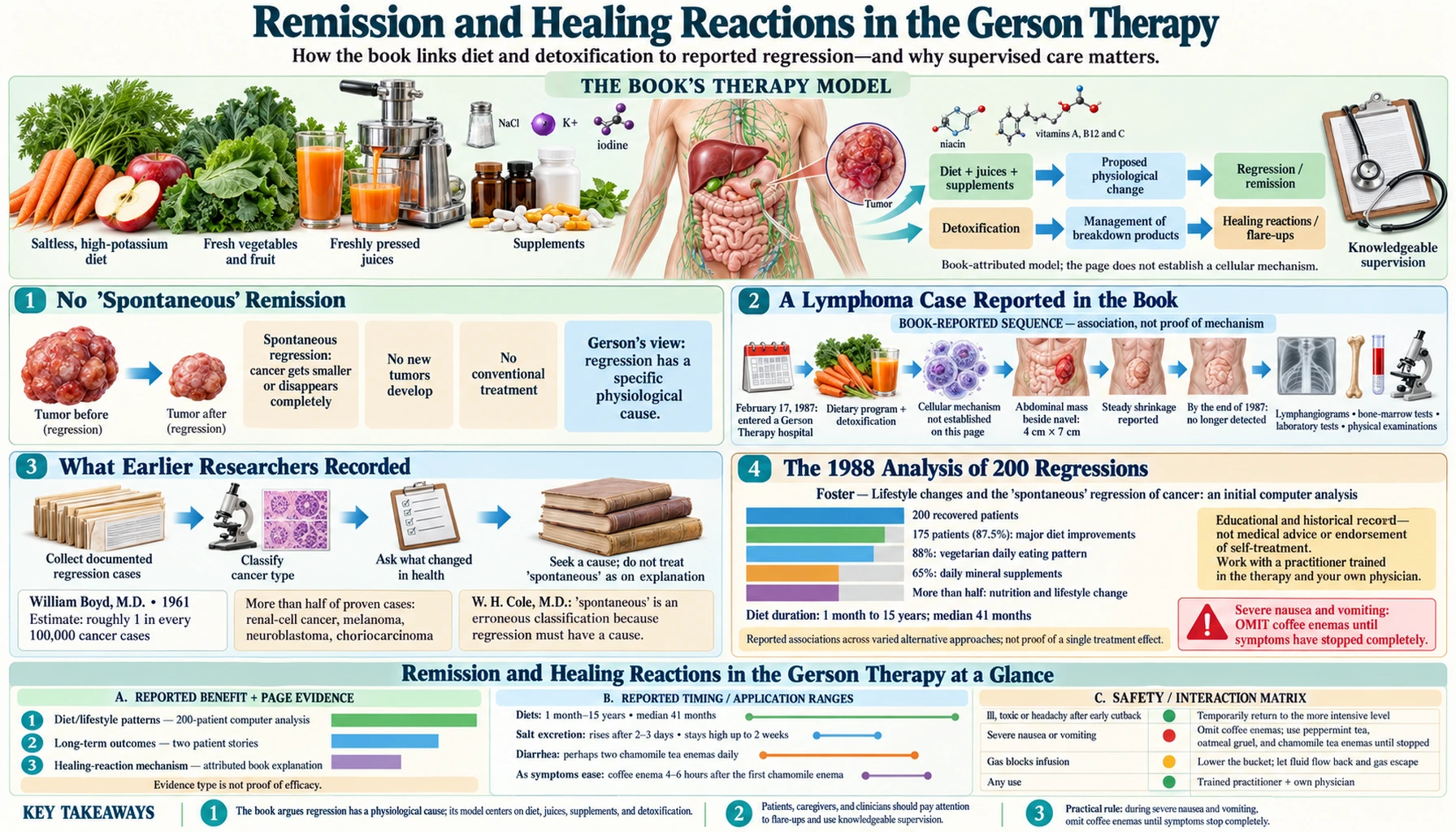
Chapter Five of The Gerson Therapy, titled “Remission—How It Happens,” makes one central argument: there is no such thing as a truly “spontaneous” remission of cancer. Following Dr. Max Gerson, the book states that when a tumor shrinks or disappears, something specific in the patient’s physiology has changed to cause it — and that the most common change is a major shift in diet and detoxification.
This page follows the chapter closely: two long-term patient stories the book tells, a 1988 computer analysis of 200 so-called spontaneous regressions, and the tables of foods those recovered patients avoided and ate. Because the book describes the road to recovery as including “healing reactions” (flare-ups), the page closes with how the book explains and handles those reactions, drawn from its later chapters on the saltless diet and the enemas.
Table of Contents
- 1. No “Spontaneous” Remission
- 2. A Lymphoma Case Reported in the Book
- 3. What Earlier Researchers Recorded
- 4. The 1988 Analysis of 200 Regressions
- 5. Foods the Recovered Patients Avoided
- 6. Foods and Juices They Ate
- 7. Forty Years After the Therapy: A Bone-Cancer Story
- 8. Healing Reactions: What the Book Says They Are
- 9. How the Book Handles Flare-Ups
- 10. Key Takeaways
- Key Research Papers
- Connections
- Featured Videos
1. No “Spontaneous” Remission
The chapter opens with a quotation the authors take from a surgeon’s popular book on patients who heal against the odds: we should pay more attention to the exceptional patients who get well unexpectedly, rather than only to those who die in the usual pattern.
The book defines spontaneous regression (or spontaneous remission) as a cancer that gets smaller or disappears completely, with no new tumors developing, without any conventional treatment. Its position, stated repeatedly by Dr. Gerson in his writings and lectures, is that the word “spontaneous” is misleading. Cancer regression, Gerson held, does not happen by itself; some specific improvement in the patient’s physiology causes the cancer to react favorably.
The authors add that when a patient who has worked hard on the Gerson program recovers, describing that recovery as “just a spontaneous regression” misses the point. In their words about one such patient, “There was no spontaneity to his cancer regression. He worked hard to achieve it.”
2. A Lymphoma Case Reported in the Book
The chapter’s first story concerns John A., a chiropractor practicing in Texas since 1955. The book reports the following timeline:
- 1963, age thirty: surgery found a large, irregular mixed-cell lymphoma in the back of the abdomen, pushing up through the tissue that holds the small bowel. It was judged inoperable; the incision was closed and he received twenty fractions of cobalt radiotherapy. The mass shrank rapidly.
- Twenty-four years of remission followed.
- December 1, 1986: the disease returned, with severe gastrointestinal bleeding, heavy sweating, muscle weakness, gas, belching, indigestion, diarrhea and a rapid heart rate. His hemoglobin was 8 g/dL (the book gives normal as 14–18 g/dL) and his hematocrit 26 mL/dL (normal 40–54 mL/dL).
- Four days later: a surgeon removed about 7 feet of small bowel; the lymphoma involved one-third of the small bowel, and the tumor removed was the size of a cantaloupe.
- January 11, 1987: a course of at least eight chemotherapy treatments with five cytotoxic agents was recommended. He tolerated two; the book lists severe side effects including nausea, vomiting, abdominal pain, chest pain, shortness of breath and a weight loss of 55 pounds in three weeks, and he chose to stop. His surgeon, the book says, told a hospital study group he had perhaps three to six months to live.
- February 17, 1987: still carrying abdominal disease, he entered a Gerson Therapy hospital in Mexico.
According to the book, his two local specialists kept monitoring him. They observed a tumor mass beside the navel shrink steadily from 4 cm by 7 cm to nothing. By the end of 1987 the mass could no longer be detected by any diagnostic method, and the specialists — using lymphangiograms, bone-marrow tests, laboratory tests and physical examinations — considered him cured. His surgeon is quoted as telling him that he “did the right things to bring your health back up, and your weight and strength, and to get some sunshine.”
The book reports that he continued the Gerson eating and detoxification program, kept regular follow-up checkups, began incorporating diet and nutrition into his own practice, and credited the Gerson dietary program as the sole means of saving his life.
3. What Earlier Researchers Recorded
The chapter places Gerson’s view alongside two earlier authorities on regression:
- William Boyd, M.D., a pathologist, collected a large series of documented cases in a book published in 1961. He estimated that roughly 1 in every 100,000 cancer cases shows spontaneous regression. More than half of his proven cases came from four tumor types: kidney (renal-cell) cancer, melanoma, neuroblastoma (a rare childhood cancer) and choriocarcinoma (a rare cancer of the placenta). The other half included one or two examples of almost every other type.
- W. H. Cole, M.D., an oncologist and co-author of the textbook Spontaneous Regression of Cancer, wrote: “The term ‘spontaneous’ is an erroneous classification because there must be a cause of the regression.”
The book notes that many explanations for regression have been proposed, and quotes the geographer and statistician Harold D. Foster, Ph.D.: “What is missing, therefore, is an understanding on the part of those involved of why a major improvement in health is occurring.”
4. The 1988 Analysis of 200 Regressions
In 1988, Dr. Foster, of the University of Victoria in British Columbia, carried out a computer analysis of cancer patients who had undergone so-called spontaneous regressions, published as “Lifestyle changes and the ‘spontaneous’ regression of cancer: an initial computer analysis” in the International Journal of Biosocial Research. The book summarizes his findings:
- He examined 200 recovered patients who had used various alternative approaches — the Gerson Therapy among them, alongside other dietary, herbal and macrobiotic programs.
- More than half had used some form of nutrition and lifestyle change, including detoxification such as coffee enemas, castor oil enemas, colonic irrigation, dry-heat saunas or fasting.
- 175 patients (87.5 percent) had made major improvements in their diets.
- 88 percent had adopted vegetarianism as their daily eating pattern.
- 65 percent took mineral supplements daily, potassium and iodine most often. Other nutrients included niacin, digestive enzymes, bioflavonoids, red clover, and vitamins A, B12 and C.
- The time spent on such diets ranged from one month to fifteen years, with a median of forty-one months.
Foster wrote that these regressions “tended to occur most frequently in vegetarian nonsmokers, who did not use table salt, white flour, or sugar and who avoided canned, smoked, or frozen foods,” who typically avoided alcohol, tea, coffee and cocoa, and who “instead drank freshly pressed fruit and/or vegetable juices.”
The book states that Foster agreed with Gerson’s original finding: “There is really no such process as spontaneous regression.” In his view, dramatic remissions occur “in association with major dietary changes, which must inevitably have resulted in alterations in the availability of bulk and trace elements to both the immune system and to tumors.”
According to the book, Foster found the Gerson program heavily represented among patients “who exceeded their anticipated lengths of survival by at least a factor of ten.” That group included Gerson patients who recovered from brain tumors, lymphosarcoma, basal cell carcinoma, kidney sarcoma, spreading melanoma, breast cancer, spinal cord tumor, metastasized testicular cancer and pituitary cancer. Gerson patients appeared in nearly every category of the study.
The authors also point out that the U.S. National Cancer Institute and the Canadian Cancer Society promote diets intended to reduce cancer incidence, and that many of Foster’s 200 patients followed diets like Gerson’s — stronger forms of what those agencies recommend.
5. Foods the Recovered Patients Avoided
The book reproduces Foster’s Table 5-1, the percentage of the 200 patients who avoided each food or drink. The authors note that these recovered patients closely followed the Gerson dietary recommendations.
| Food or drink avoided | % of patients |
|---|---|
| All canned foods | 80.0 |
| All frozen foods | 80.0 |
| All smoked foods | 80.0 |
| White sugar | 79.5 |
| Meat | 79.5 |
| Pickles | 75.5 |
| Table salt (sodium chloride) | 75.5 |
| Alcoholic beverages | 75.5 |
| Spices | 75.0 |
| Eggs | 70.0 |
| Fish | 67.0 |
| Fats | 65.5 |
| White flour | 65.5 |
| Tea | 65.5 |
| Coffee | 65.5 |
| Chocolate | 63.5 |
| Oils | 62.0 |
| Milk | 62.0 |
| Nuts | 59.5 |
| Soybeans | 49.0 |
| Tomatoes | 38.5 |
| Shellfish | 16.0 |
In the book’s summary, these patients cut alcoholic, fatty, oily, dairy, canned, frozen, smoked, sweet, salted, spiced and pickled foods. Eighty percent stopped eating the canned, frozen and smoked foods, and 79.5 percent no longer took meat and sugar. Spices, eggs, fish, oils and fats, tea, coffee, cocoa, chocolate, white flour, milk and nuts were each avoided by more than half.
6. Foods and Juices They Ate

Table 5-2 in the book lists what the same patients consumed. Fresh vegetables were the only foods eaten by more than 80 percent of them.
| Food or drink eaten | % of patients |
|---|---|
| Broccoli, leeks, cauliflower, onions, legumes, carrots, Brussels sprouts | 84.5 each |
| Beet roots, squash | 82.5 each |
| Apples, pears | 81.5 each |
| Apricots | 77.0 |
| Whole grain cereals | 75.0 |
| Cantaloupe | 73.5 |
| Grapes | 73.0 |
| Tomatoes | 72.5 |
| Lentils | 69.0 |
| Grapefruit juice (freshly made) | 58.0 |
| Alfalfa and other sprouted seeds | 57.5 |
| Orange juice, apple juice (freshly made) | 57.0 each |
| Grape juice, tomato juice (freshly made) | 55.0 each |
| Carrot juice (freshly made) | 53.5 |
| Green leaf juice (freshly made) | 51.5 |
| Liver, raisins | 46.5 each |
| Almonds | 32.0 |
| Pineapples | 26.0 |
| Cottage cheese, churned buttermilk, eggs | 24.5 each |
| Wheatgrass | 22.0 |
| Yogurt | 21.0 |
| Olive oil | 20.5 |
| Sunflower seeds | 19.5 |
| Barley grass, avocados | 18.5 each |
| Kefir | 16.5 |
| Garlic | 14.0 |
| Flax oil | 7.5 |
| Miso | 4.5 |
| Tamari | 2.0 |
The book highlights that 57 percent followed the Gerson recommendation of freshly pressing and drinking apple, carrot and orange juices, and that freshly squeezed carrot juice played a significant role for 53.5 percent of the whole sample. Grapefruit, grape and tomato juices were each drunk by more than half. Whole grains, alfalfa sprouts, cantaloupe, tomatoes, lentils, grapes and apricots were also popular.
7. Forty Years After the Therapy: A Bone-Cancer Story

The chapter’s second story is told in the patient’s own words, from an account she wrote for a 1998 Gerson newsletter. Carla S. was diagnosed at age fifteen with osteogenic sarcoma, a cancer of the bone tissue itself. The book explains that this is the second most common primary malignant bone tumor, most often seen between ages ten and twenty, that about half occur around the knee and femur, and that it tends to spread to the lungs.
Her account, as the book reproduces it:
- After seven months of pain, the tumor was found. In early September 1958 her left leg was amputated at the hip. The cancer had spread to her lymph system, and she was given six months to live. Radiation was not possible because of the tumor’s location; the surgery was expected, at best, to postpone death by thirty to sixty days.
- On the same day as the operation, her mother met Dr. Gerson at his New York office and arranged for her to start the therapy as soon as she left the hospital.
- Her family were dairy farmers in the mountains of western North Carolina. Gerson was usually reluctant to have patients do the therapy at home, especially at first, but he was impressed by her mother’s dedication; she promised to follow the regimen to the letter.
- For five years the family followed the therapy without compromise. The juicer of that era was a heavy grinder with a separate press and linen cloths, and every juice was ground and pressed fresh. Fresh, never-frozen calf’s liver came by bus from a town forty miles away.
- Her father farmed organically, and neighbors set aside pesticide-free plots to grow what they called “Carla’s carrots” and “Carla’s lettuce.”
- Her monthly chest X-rays were consistently clear. A major cancer center’s yearly survey asking whether she was alive kept coming back answered, and in 1988 she realized she had outlived its thirty-year study.
Writing in 1998 at age fifty-five, she said she ate only organic, unprocessed foods with an emphasis on fruits, vegetables and whole grains, swam a mile each morning, and enjoyed good health apart from the wear of forty years on crutches. She kept a “Gerson Folder” in her drawer, and thanked her mother, her father and Dr. Gerson “for MY LIFE!” The book presents her as surviving and thriving more than forty-two years after diagnosis.
8. Healing Reactions: What the Book Says They Are
The book treats the path to remission as active, not passive, and part of that path is what the Gerson Institute calls “healing reactions” or flare-ups. In its chapter on the saltless, high-potassium diet, the book reports Dr. Gerson’s observation that salt excretion increases in tuberculosis, cancer and other chronic diseases after two to three days on the saltless diet, stays high for up to two weeks, then returns to normal.
During this period, the book says, purgative flare-ups sometimes occur, in the form of nausea, diarrhea and nervous disturbances. It attributes them to greater bile secretion and stimulation of the visceral nervous system, and states that after each flare-up, patients feel easier and improve both physically and mentally.
Elsewhere the book describes the coffee enema as helping patients eliminate the toxic breakdown products of dissolving tumor masses and of the “healing reactions of formerly dysfunctional cells.” It reports Gerson’s warning that without detoxification alongside the diet, juices and supplements, a patient may be endangered not by the disease itself but by the liver’s inability to detoxify fast enough. The book also reports the Gerson Institute’s observation that some patients using a low-cost centrifugal juicer had no tumor reductions or healing reactions for weeks, and that when they switched to a grinder-and-press juicer their healing reactions came quickly.
9. How the Book Handles Flare-Ups
The book’s enema chapter gives practical guidance for flare-ups. As always, it presents the therapy as something done under knowledgeable supervision:
- Reducing detox too soon. Enema frequency is reduced over time, but some patients are too toxic for this. If they cut back too soon and feel ill, toxic or headachy, the book advises returning to the more intensive level for a while, then trying to reduce again. Each patient adjusts to his or her own needs.
- New toxic releases. Even when a patient is doing well on fewer enemas, flare-ups may bring increased swelling or pain, headaches or loss of appetite. The book says an extra coffee enema or castor oil treatment “has been known to work wonders.”
- Diarrhea. The book suggests perhaps two chamomile tea enemas daily to cleanse the colon gently. As the diarrhea eases, one chamomile enema, a coffee enema four to six hours later, and another chamomile enema at night; then the regular schedule, with some coffee enemas still mixed with chamomile tea.
- Bile, nausea and vomiting. Some intense flare-ups release so much bile that it flows into the stomach and causes severe nausea and vomiting. The book says to omit coffee enemas at such times, since they stimulate more bile, drink plenty of peppermint tea, eat oatmeal gruel, and use only chamomile tea enemas until the nausea and vomiting have stopped completely.
- Gas. Heavy gas can make infusing difficult; the book suggests lowering the bucket to let fluid flow back and gas escape.
- Hemorrhoid flare-up. Patients with past hemorrhoids may have a flare-up for a few days. The book says not to stop the enemas, to apply zinc oxide ointment locally, and notes it has observed the hemorrhoids shortly disappear.
- Rectal burning from early castor oil enemas is said to fade after two or three treatments; a little petroleum jelly may soothe the area.
These are the book’s own instructions. Anyone considering the therapy should work with a practitioner trained in it and their own physician.
10. Key Takeaways
- The book, following Dr. Gerson, holds that cancer regression is never truly spontaneous — it has a cause in the patient’s physiology.
- A 1988 analysis of 200 regressions, as the book reports it, found 87.5 percent had made major diet changes, 88 percent were vegetarian, and Gerson patients were well represented among long survivors.
- The recovered patients largely avoided canned, frozen, smoked, salted and sugary foods and ate fresh vegetables, fruit, whole grains and freshly pressed juices.
- The two case stories describe a lymphoma patient judged cured by his own specialists and a bone-cancer patient alive and well four decades later.
- The book describes healing reactions as an expected part of recovery and gives step-by-step guidance for managing them.
Key Research Papers
- Gerson C, Walker M. The Gerson Therapy. Chapter Five, “Remission—How It Happens”; also the chapters on the saltless diet and on coffee and castor oil enemas (flare-ups). Primary source for this page.
- Foster HD. Lifestyle changes and the “spontaneous” regression of cancer: an initial computer analysis. International Journal of Biosocial Research. 1988;10(1):17–33. (As cited in the book.)
- Gerson M. The cure of advanced cancer by diet therapy: a summary of 30 years of clinical experimentation. Physiol Chem Phys. 1978;10(5):449–64. PubMed PMID: 751079
- Gerson M. [Cancer a problem of metabolism]. Med Klin. 1954;49(26):1028–32. PubMed PMID: 13202917
PubMed Topic Searches
Connections
Featured Videos