Brown Rice, Whole Grains and Type 2 Diabetes
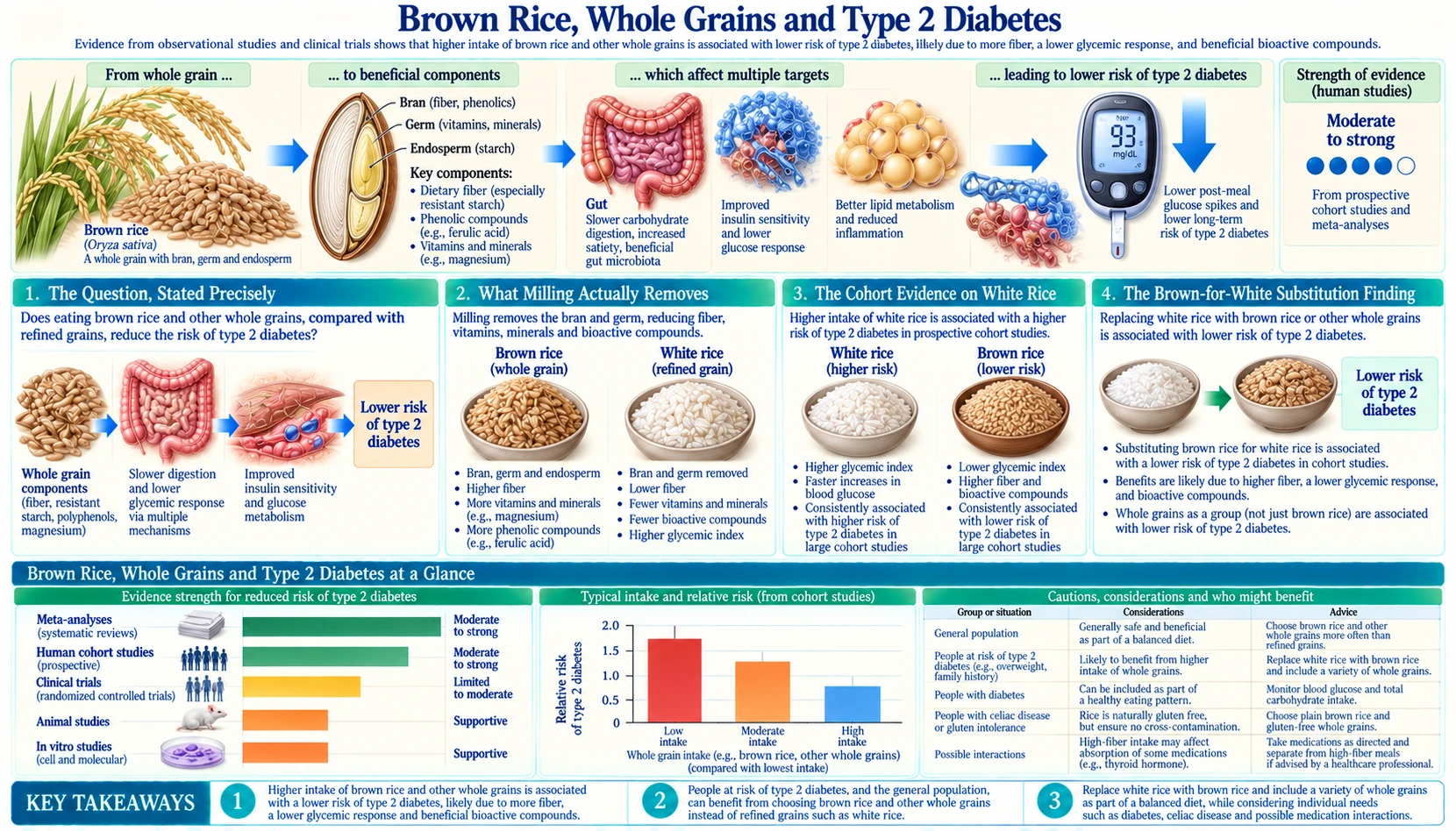
Brown rice and white rice are the same grain. One has the bran and germ left on, the other has them milled off. That makes rice an unusually clean natural experiment in nutrition — and it has been run, repeatedly, in cohorts of hundreds of thousands of people and in controlled trials lasting months. The headline finding from the Harvard cohorts is easy to state: swapping about 50 g of cooked white rice a day for the same amount of brown rice was associated with roughly 16% lower risk of developing type 2 diabetes. The controlled trials, when they came, were much more modest. Both of those results are true, and understanding why they differ tells you more about food and health than either does alone.
Table of Contents
- The Question, Stated Precisely
- What Milling Actually Removes
- The Cohort Evidence on White Rice
- The Brown-for-White Substitution Finding
- PURE: The Same Question in 21 Countries
- The Trials Are More Modest Than the Cohorts
- Glycaemic Index Is Not the Explanation
- Whole Grains and Cardiovascular Risk
- How Much Fibre, and How Much Whole Grain
- What Is Probably Driving the Effect
- Putting It on the Plate
- Where the Evidence Is Weak
- Key Research Papers
- Connections
- Featured Videos
The Question, Stated Precisely
"Is brown rice good for blood sugar" is three different questions wearing one coat, and they have three different answers.
- Does brown rice raise blood glucose less than white rice after a meal? Slightly, and less than you would expect. This is the weakest of the three effects.
- Do people who eat more brown rice, and less white rice, develop less diabetes over years? In large observational cohorts, yes, fairly consistently.
- If you take a group of people and make them eat brown rice instead of white for four months, do their metabolic markers improve? Only a little, and less than the cohorts predict.
Most confusion about rice comes from answering one of those and reporting it as the answer to another. The sections below take them in order.
What Milling Actually Removes
Set the two grains side by side, per 100 g dry, using the same U.S. Department of Agriculture (USDA) reference data the Brown Rice and White Rice pages use. The brown rice figures are from FoodData Central record 169703 ("Rice, brown, long-grain, raw") and the white rice figures from record 169756 ("Rice, white, long-grain, regular, raw, unenriched"):
- Dietary fibre — 3.6 g in brown rice, 1.3 g in white.
- Magnesium — 116 mg against 25 mg.
- Manganese — 2.85 mg against 1.09 mg.
- Thiamine — 0.541 mg against 0.07 mg in unenriched white rice. This is the loss that caused the beriberi epidemics, and it is covered on the history page. The enriched white rice record, FoodData Central 168877 ("Rice, white, long-grain, regular, raw, enriched"), lists 0.576 mg of thiamine; its fibre (1.3 g), magnesium (25 mg) and manganese (1.09 mg) are the same as the unenriched record's.
- Vitamin B6, niacin and phosphorus — vitamin B6 0.477 mg against 0.164 mg, niacin 6.49 mg against 1.6 mg, and phosphorus 311 mg against 115 mg.
- Fat — 3.2 g against 0.66 g, because the germ oil goes with the germ. This is also why brown rice goes rancid and white rice does not.
What is left after milling is close to pure starch with a modest mineral tail. That is not a crime — white rice is easy to digest, keeps for years, and has fed more people than any other food. But the fraction removed is precisely the fraction that everything below is about.
The Cohort Evidence on White Rice
Sun and colleagues analysed three large US cohorts — the Health Professionals Follow-up Study and the two Nurses' Health Studies, together following well over 100,000 people for up to two decades — and published the result in 2010. People eating five or more servings of white rice a week had a modestly higher risk of developing type 2 diabetes than people eating less than one serving a month. People eating two or more servings of brown rice a week had a modestly lower risk.
Hu and colleagues pooled the international literature in the BMJ in 2012 and found the same direction with a dose gradient. Their analysis combined seven cohort analyses from four articles — 352,384 participants and 13,284 new cases of type 2 diabetes, followed for 4 to 22 years. Each additional daily serving of white rice was associated with a relative risk of 1.11 (1.08 to 1.14), roughly 11% higher risk of type 2 diabetes. The association was substantially stronger in Asian (Chinese and Japanese) populations, where rice is the staple and average intakes were three to four servings a day against one to two servings a week in Western populations. Comparing the highest with the lowest white rice intake, the pooled relative risk was 1.55 (95% confidence interval 1.20 to 2.01) in Asian populations and 1.12 (0.94 to 1.33) in Western populations, where it was weak and not statistically reliable.
Nanri and colleagues found the same pattern inside Japan, in the Japan Public Health Center-based Prospective Study: higher rice intake tracked with higher diabetes risk clearly in women (highest against lowest quarter of intake, odds ratio 1.65; 95% CI 1.06 to 2.57). In men the link was unclear, with only a non-significant hint (P for trend = 0.08) among men who did no strenuous physical activity; the authors wrote that this hint in physically inactive men “deserves further investigation”. If it holds up, it would suggest the problem is a large refined-starch load meeting a body that is not using it.
The Brown-for-White Substitution Finding
The most quoted number in this whole literature comes from that 2010 Harvard analysis. Rather than compare high eaters with low eaters, the authors modelled a swap: replacing 50 g a day of cooked white rice — about a third of a standard serving — with the same amount of brown rice. The associated risk of type 2 diabetes was about 16% lower (95% CI 9% to 21%). Substituting whole grains as a broader group for white rice was associated with a larger reduction still (36%; 30% to 42%).
Two things make this a better-framed result than a simple high-versus-low comparison. It holds calories and food role roughly constant, so it is not comparing rice eaters with people who eat something else entirely. And a third of a serving is a small, realistic change — not a diet overhaul.
What it is not is a randomised trial. It is a statistical model built on observational data, and the people in these cohorts who chose brown rice in the 1990s and 2000s were, on average, also more physically active, less likely to smoke, and eating more vegetables. Statistical adjustment can reduce that but not abolish it. Which brings us to the trials.
A 2022 meta-analysis in BMJ Open by Yu and colleagues put the cohorts and the trials side by side: 8 cohort studies and 11 randomised trials (1,034 people). In the cohorts, the highest white rice intakes were associated with a higher risk of type 2 diabetes than the lowest (pooled relative risk 1.16; 95% CI 1.02 to 1.32), and above about 300 g a day each 158 g a day serving was associated with a 13% (11% to 15%) higher risk. The highest brown rice intakes were associated with a lower risk (pooled relative risk 0.89; 95% CI 0.81 to 0.97), and each 50 g a day serving of brown rice with a 13% (6% to 20%) lower risk. In the trials, brown rice raised high-density lipoprotein (HDL) cholesterol by 0.06 mmol/L (0.00 to 0.11 mmol/L) compared with white rice, and no other risk factor differed significantly. The authors rated the strength of the evidence moderate for the cohort studies and moderate and low for the trials.
PURE: The Same Question in 21 Countries
The Prospective Urban Rural Epidemiology (PURE) study followed more than 130,000 people across 21 countries on five continents, and Bhavadharini and colleagues reported its rice findings in Diabetes Care in 2020. Overall, the highest white rice intakes (450 g a day or more, cooked) were associated with a modestly higher incidence of diabetes than the lowest (under 150 g a day): hazard ratio 1.20 (95% CI 1.02 to 1.40).
The interesting part is the geography. The association was strongest in South Asia (hazard ratio 1.61; 95% CI 1.13 to 2.30). It was weaker but still present in the other regions combined — South East Asia, the Middle East, South America, North America, Europe and Africa (hazard ratio 1.41; 95% CI 1.08 to 1.86) — and it was not seen in China (hazard ratio 1.04; 95% CI 0.77 to 1.40). A single global number would have hidden that entirely.
Why the difference? Nobody knows for certain, but the plausible candidates are the sheer quantity eaten, the variety of rice (South Asian intake is heavily polished, and much of it high-glycaemic), what it is eaten with, and the fact that South Asian populations develop diabetes at lower body weights than European ones. It is a reminder that a food's effect depends on the diet it sits in — and that a result found in Boston does not automatically transfer to Chennai or the other way round.
The Trials Are More Modest Than the Cohorts
This is the part most articles about brown rice leave out, and leaving it out is what makes them untrustworthy.
Zhang and colleagues ran a proper randomised trial in China, published in 2011: 202 middle-aged adults with diabetes or at high risk of it, randomly assigned to eat brown rice or white rice for 16 weeks. The result, stated in the paper's own title, is that substituting brown rice for white did not substantially affect metabolic risk factors. Among the participants who already had diabetes, diastolic blood pressure fell more on brown rice than on white (P = 0.02). One result ran the other way: serum low-density lipoprotein (LDL) cholesterol fell more on white rice than on brown rice (P = 0.02), again only among the 47 participants with diabetes. The share of people whose low HDL cholesterol returned to normal was marginally higher on brown rice (14.9% against 6.9%, P = 0.07).
Marshall and colleagues took the wider question — replacing refined grains with whole grains in randomised trials — through a formal meta-analysis with Grading of Recommendations Assessment, Development and Evaluation (GRADE) ratings in 2020. Across 22 meta-analysed trials lasting 2 to 16 weeks, whole-grain oats improved total and LDL cholesterol, whole-grain rice improved triglycerides, and whole grains of all types improved hemoglobin A1c (HbA1c, a measure of long-term blood sugar; standardized mean difference −0.33) and C-reactive protein (standardized mean difference −0.22). The authors found insufficient evidence to recommend whole grains over refined grains for preventing or treating cardiovascular disease. Real, but nothing like what the cohort associations would predict.
How to hold both results at once, honestly:
- Sixteen weeks is short against a disease that takes decades to develop. Cholesterol and blood pressure can move in months; the arterial and pancreatic changes behind diabetes and heart disease do not.
- The cohort effect is partly the eater, not the food. Some of the 16% belongs to the kind of person who chose brown rice.
- The swap is small. Changing one component of a diet while everything else stays the same is a genuinely small intervention.
- One result cuts the other way. In Zhang's trial, LDL cholesterol fell more on white rice than on brown rice among the participants with diabetes (P = 0.02). Otherwise the trials point to a modest benefit that is hard to detect in four months.
Mohan and colleagues did find a clear short-term signal in 2014, in a randomised crossover in 15 overweight Asian Indians without diabetes, each diet eaten for five days and glucose tracked with a continuous glucose monitor. The daily glucose response (the 5-day average incremental area under the curve) was 19.8% lower on brown rice than on white rice (P = 0.004), and 22.9% lower on brown rice eaten with legumes (50 g a day) than on white rice (P = 0.02). The 5-day change in fasting insulin was 57% lower on brown rice and 54% lower on brown rice with legumes, compared with the change on white rice. The responses to brown rice and to brown rice with legumes were not significantly different from each other, so in this small trial adding legumes did not measurably improve on brown rice alone.
In people who already have prediabetes or type 2 diabetes, a 2021 meta-analysis by Abdul Rahim and colleagues of seven trials (417 adults) found that a brown-rice diet in place of white rice did not change HbA1c (p = 0.15) or fasting blood glucose (p = 0.95). Body weight fell (mean difference −2.2 kg) and HDL cholesterol rose (mean difference 0.10; 95% CI 0.02 to 0.17), while waist circumference, blood pressure and LDL cholesterol did not change. The authors note that the benefits of a brown-rice diet on blood-sugar control “may not be detected in short-term studies”, and rated the evidence low to moderate in quality.
A 2022 meta-analysis by Golzarand and colleagues of 13 trials found that ordinary brown rice, compared with white rice, lowered weight (−1.63 kg), body mass index (−0.58 kg/m2) and waist circumference (−2.56 cm), with no significant effect on blood fats or blood-sugar markers. Pre-germinated (sprouted) brown rice lowered weight (−1.75 kg), total cholesterol (−24.22 mg/dl), triglycerides (−43.28 mg/dl), LDL cholesterol (−20.05 mg/dl) and fasting blood glucose (−15.83 mg/dl) compared with white rice. Using the GRADE approach, the authors rated the certainty of this evidence low and very low. Germination is covered on the Phytate, Soaking and Germination page.
Glycaemic Index Is Not the Explanation
Most people assume brown rice helps because it has a much lower glycaemic index. It does not, and this matters.
The international glycaemic index tables compiled by Atkinson and colleagues — the standard reference, updated in 2021 — show brown and white rice with heavily overlapping ranges. The variation within each category dwarfs the difference between them. What actually moves rice's glycaemic index is:
- Amylose content. High-amylose varieties such as basmati and most long-grain rice digest more slowly than low-amylose sticky and short-grain rices. This single factor swamps the brown-versus-white difference.
- How long you cook it. Overcooked, fully gelatinised rice is digested much faster than rice cooked just to tender.
- Whether it has been cooled. Cooking and then chilling rice retrogrades some of the starch into resistant starch, which behaves more like fibre. Reheating keeps much of that.
- What is on the plate with it — fat, protein, acid and especially legumes all slow the response.
For a lower blood-sugar rise, the research summarised above points more to variety (high-amylose long grain), cooking time, cooling, and eating rice with lentils or beans than to the colour of the grain. Brown rice's real advantages lie elsewhere — in the fibre, the minerals and the intact structure.
Whole Grains and Cardiovascular Risk
Brown rice is one member of a category, and the category's evidence is stronger than any single grain's.
Aune and colleagues' 2016 BMJ dose-response meta-analysis is the standard reference. Across 45 prospective studies, each 90 g a day of whole grains — about three servings — was associated with roughly a fifth lower risk of coronary heart disease (relative risk 0.81) and cardiovascular disease (0.78), and a meaningfully lower risk of death from total cancer (0.85) and from all causes (0.83). The benefit curve flattened somewhere in the region of 210 to 225 g a day, so more is better only up to a point. Whole-grain bread, whole-grain breakfast cereals and added bran were linked to lower risks of cardiovascular disease and/or all-cause mortality, “but there was little evidence of an association with refined grains, white rice, total rice, or total grains” — the strongest whole-grain evidence is not specific to rice.
Wu and colleagues found the same in the Harvard cohorts in JAMA Internal Medicine in 2015: higher whole-grain intake was associated with lower total and cardiovascular mortality. Ye and colleagues reached the same conclusion for diabetes, cardiovascular disease and weight gain together.
Marshall's trial-level meta-analysis, as above, gives the sober counterweight: in controlled trials the measurable changes are small. The cohorts are consistent, large and internationally replicated; the trials are short. That is the honest state of the evidence for whole grains as a whole, brown rice included.
How Much Fibre, and How Much Whole Grain
Reynolds and colleagues' 2019 series of systematic reviews and meta-analyses in The Lancet is the most complete answer to "how much". Comparing the highest fibre intakes with the lowest, they found roughly 15 to 30% lower all-cause and cardiovascular mortality, and lower incidence of coronary heart disease, stroke, type 2 diabetes and colorectal cancer. The dose-response curves suggested 25 to 29 g of fibre a day as a sensible target, with signs that more still helps.
For whole grains and diabetes specifically, a 2022 dose-response meta-analysis by Ghanbari-Gohari and colleagues of 11 prospective cohort studies (463,282 participants, 37,249 cases of type 2 diabetes) found the highest whole-grain intakes associated with a 21% lower risk of type 2 diabetes than the lowest. Each additional 50 g of whole grain a day was associated with a 23% lower risk, and the non-linear analysis placed the highest benefit at 60 g of whole grain a day. The authors note that randomised controlled trials are needed to confirm the result.
Where does brown rice fit? A cooked cup is about 195 g and carries roughly 3 g of fibre. That is a useful contribution, not a solution — you are not reaching 29 g on rice. Lentils, beans, oats, barley, vegetables and fruit do the heavy lifting; brown rice's job is to stop the staple part of the plate contributing nothing.
Which is exactly the point. Most people eat a starch with most meals. Whether that starch carries 3 g of fibre and 75 mg of magnesium or 0.8 g and 23 mg, repeated twice a day for forty years, is where the difference accumulates.
What Is Probably Driving the Effect
Several mechanisms are plausible and they are not competing — they are additive.
- Cereal fibre specifically. Cho and colleagues' 2013 review found that when the analyses are separated, cereal fibre and bran carry the clearest inverse association with type 2 diabetes — more consistently than "whole grain" defined as a food category. Bran is the ingredient, not the label.
- Magnesium. Magnesium is a cofactor for enzymes throughout glucose metabolism and for the insulin receptor's own signalling. Fang and colleagues' dose-response meta-analysis of 40 prospective cohort studies found each extra 100 mg a day of dietary magnesium associated with lower risk of type 2 diabetes (relative risk 0.81), stroke (0.93) and heart failure (0.78), though not of total cardiovascular disease (0.99) or coronary heart disease. Whole grains are one of the few staple sources.
- Intact grain structure. A whole rice kernel has cell walls that slow the digestive enzymes' access to the starch inside. Grind a whole grain into flour and you destroy that — which is why wholemeal bread behaves much more like white bread than an intact kernel does. Rice is nearly always eaten intact, so brown rice keeps an advantage that most "whole grain" products give away at the mill.
- Resistant starch. Some of brown rice's starch escapes small-intestinal digestion and is fermented in the colon into short-chain fatty acids, which improve insulin sensitivity in mechanistic studies. Cooling cooked rice increases the fraction.
- The bran's phenolics. Rice bran carries ferulic acid, gamma-oryzanol, tocotrienols and phytosterols. Saji and colleagues review the evidence that these modulate cardiovascular and diabetes risk factors; most of it is mechanistic and animal work rather than clinical outcomes.
- Displacement. The least glamorous and possibly the largest: a bowl of brown rice is a bowl of something else not eaten.
Seal and colleagues' 2021 review adds the gut microbiome to the list — whole-grain substrates shift fermentation patterns in ways refined starch does not — and makes the point that food processing determines how much of any of this survives to the plate.
Putting It on the Plate
- The whole-grain share. The Dietary Guidelines for Americans 2020–2025 call for at least half of total grains to be whole grains, list brown rice among the whole grains, and count ½ cup of cooked rice as one ounce-equivalent of grains.
- Legumes alongside. In Mohan's trial, brown rice with legumes and brown rice alone both lowered the glucose response compared with white rice, and did not differ significantly from each other. Rice and lentils, rice and beans, rice and chickpeas — every rice-eating culture already does this, and it also completes the protein, because rice is short on lysine and legumes are generous with it.
- Cooked ahead and chilled. Cooked and cooled rice carries more resistant starch. Bacillus cereus spores survive cooking and multiply in rice left at room temperature, which is the reason for refrigerating cooked rice within an hour of cooking and reheating it thoroughly.
- Long-grain, high-amylose varieties such as brown basmati digest more slowly, which matters most where blood sugar is the main concern.
- Cooking time. Tender with a little bite digests more slowly than collapsed.
- Excess water, drained — this lowers arsenic, and it also gives separate grains. The arsenic side is covered on Arsenic and Safe Cooking.
- Soaking. Overnight soaking shortens cooking, improves mineral absorption and removes arsenic — covered on Phytate, Soaking and Germination.
- Portion size. Whole grain is not a licence for a larger bowl: the cohort associations are for substitution, not addition.
- Rotation. Barley, oats, buckwheat and quinoa all bring things rice does not, and rotating also limits arsenic exposure.
Where the Evidence Is Weak
Being clear about this is part of being useful.
- Nearly all the diabetes evidence is observational. Diet cohorts cannot fully separate a food from the person who eats it.
- The one good medium-term substitution trial was largely negative. Zhang 2011 is the trial-level counterpart to Sun 2010.
- Food frequency questionnaires are blunt. Most cohorts measured rice intake by asking people to recall it.
- The effect is not uniform across populations. PURE saw it most strongly in South Asia, more weakly in the other regions combined, and not in China.
- Nothing here is about type 1 diabetes, which is an autoimmune disease and a different subject entirely.
- No single food prevents diabetes. Body weight, physical activity, sleep and overall dietary pattern dominate. In the research, brown rice is one whole-grain starch among several, not a treatment.
Key Research Papers
- Sun Q, Spiegelman D, van Dam RM, et al. White rice, brown rice, and risk of type 2 diabetes in US men and women. Archives of Internal Medicine. 2010;170(11):961–969. — doi:10.1001/archinternmed.2010.109
- Hu EA, Pan A, Malik V, Sun Q. White rice consumption and risk of type 2 diabetes: meta-analysis and systematic review. BMJ. 2012;344:e1454. — doi:10.1136/bmj.e1454
- Bhavadharini B, Mohan V, Dehghan M, et al. White rice intake and incident diabetes: a study of 132,373 participants in 21 countries. Diabetes Care. 2020;43(11):2643–2650. — doi:10.2337/dc19-2335
- Nanri A, Mizoue T, Noda M, et al. Rice intake and type 2 diabetes in Japanese men and women: the Japan Public Health Center-based Prospective Study. The American Journal of Clinical Nutrition. 2010;92(6):1468–1477. — doi:10.3945/ajcn.2010.29512
- Zhang G, Pan A, Zong G, et al. Substituting white rice with brown rice for 16 weeks does not substantially affect metabolic risk factors in middle-aged Chinese men and women with diabetes or a high risk for diabetes. The Journal of Nutrition. 2011;141(9):1685–1690. — doi:10.3945/jn.111.142224
- Mohan V, Spiegelman D, Sudha V, et al. Effect of brown rice, white rice, and brown rice with legumes on blood glucose and insulin responses in overweight Asian Indians: a randomized controlled trial. Diabetes Technology & Therapeutics. 2014;16(5):317–325. — doi:10.1089/dia.2013.0259
- Aune D, Keum N, Giovannucci E, et al. Whole grain consumption and risk of cardiovascular disease, cancer, and all cause and cause specific mortality: systematic review and dose-response meta-analysis of prospective studies. BMJ. 2016;353:i2716. — doi:10.1136/bmj.i2716
- Reynolds A, Mann J, Cummings J, Winter N, Mete E, Te Morenga L. Carbohydrate quality and human health: a series of systematic reviews and meta-analyses. The Lancet. 2019;393(10170):434–445. — doi:10.1016/S0140-6736(18)31809-9
- Marshall S, Petocz P, Duve E, et al. The effect of replacing refined grains with whole grains on cardiovascular risk factors: a systematic review and meta-analysis of randomized controlled trials with GRADE clinical recommendation. Journal of the Academy of Nutrition and Dietetics. 2020;120(11):1859–1883. — doi:10.1016/j.jand.2020.06.021
- Wu H, Flint AJ, Qi Q, et al. Association between dietary whole grain intake and risk of mortality: two large prospective studies in US men and women. JAMA Internal Medicine. 2015;175(3):373–384. — doi:10.1001/jamainternmed.2014.6283
- Ye EQ, Chacko SA, Chou EL, Kugizaki M, Liu S. Greater whole-grain intake is associated with lower risk of type 2 diabetes, cardiovascular disease, and weight gain. The Journal of Nutrition. 2012;142(7):1304–1313. — doi:10.3945/jn.113.179473 — PubMed PMID: 22649266
- Cho SS, Qi L, Fahey GC Jr, Klurfeld DM. Consumption of cereal fiber, mixtures of whole grains and bran, and whole grains and risk reduction in type 2 diabetes, obesity, and cardiovascular disease. The American Journal of Clinical Nutrition. 2013;98(2):594–619. — doi:10.3945/ajcn.113.067629
- Atkinson FS, Brand-Miller JC, Foster-Powell K, Buyken AE, Goletzke J. International tables of glycemic index and glycemic load values 2021: a systematic review. The American Journal of Clinical Nutrition. 2021;114(5):1625–1632. — doi:10.1093/ajcn/nqab233
- Ludwig DS, Hu FB, Tappy L, Brand-Miller J. Dietary carbohydrates: role of quality and quantity in chronic disease. BMJ. 2018;361:k2340. — doi:10.1136/bmj.k2340
- Seal CJ, Courtin CM, Venema K, de Vries J. Health benefits of whole grain: effects on dietary carbohydrate quality, the gut microbiome, and consequences of processing. Comprehensive Reviews in Food Science and Food Safety. 2021;20(3):2742–2768. — doi:10.1111/1541-4337.12728
- Fang X, Wang K, Han D, et al. Dietary magnesium intake and the risk of cardiovascular disease, type 2 diabetes, and all-cause mortality: a dose-response meta-analysis of prospective cohort studies. BMC Medicine. 2016;14(1):210. — PubMed PMID: 27927203
- Saji N, Francis N, Schwarz LJ, Blanchard CL, Santhakumar AB. Rice Bran Derived Bioactive Compounds Modulate Risk Factors of Cardiovascular Disease and Type 2 Diabetes Mellitus: An Updated Review. Nutrients. 2019;11(11):2736. — PubMed PMID: 31718066
- Yu J, Balaji B, Tinajero M, et al. White rice, brown rice and the risk of type 2 diabetes: a systematic review and meta-analysis. BMJ Open. 2022;12(9):e065426. — PubMed PMID: 36167362
- Abdul Rahim AF, Norhayati MN, Zainudin AM. The effect of a brown-rice diets on glycemic control and metabolic parameters in prediabetes and type 2 diabetes mellitus: a meta-analysis of randomized controlled trials and controlled clinical trials. PeerJ. 2021;9:e11291. — PubMed PMID: 34123581
- Golzarand M, Toolabi K, Eskandari Delfan S, Mirmiran P. The effect of brown rice compared to white rice on adiposity indices, lipid profile, and glycemic markers: a systematic review and meta-analysis of randomized controlled trials. Critical Reviews in Food Science and Nutrition. 2022;62(27):7395–7412. — PubMed PMID: 33905269
- Ghanbari-Gohari F, Mousavi SM, Esmaillzadeh A. Consumption of whole grains and risk of type 2 diabetes: A comprehensive systematic review and dose-response meta-analysis of prospective cohort studies. Food Science & Nutrition. 2022;10(6):1950–1960. — PubMed PMID: 35702290
PubMed Topic Searches
Connections
- Brown Rice — the main page.
- White Rice — the comparison grain, treated fairly.
- Type 2 Diabetes — the condition itself.
- Prediabetes — where dietary change has most leverage.
- Cardiovascular Disease — the other half of the whole-grain evidence.
- Magnesium — the mineral milling removes most of.
- Resistant Starches — why cooling cooked rice matters.
- Lentils — the legume arm of the Mohan trial, in practice.
- Beans — rice and beans, on every continent that grows rice.
- Barley — the beta-glucan whole grain worth rotating in.
- Oats — the other soluble-fibre staple.
- Quinoa — higher protein, complete amino acid profile.