⚠ Evidence warning: Clinical trials or other evidence do not support the claim that restoring a high-potassium, near-zero-sodium diet re-establishes cell ion gradients and reverses cancer. This page keeps it as a report of what people, websites or other media say.
Gerson Therapy — Mineral Density and Sodium-Potassium
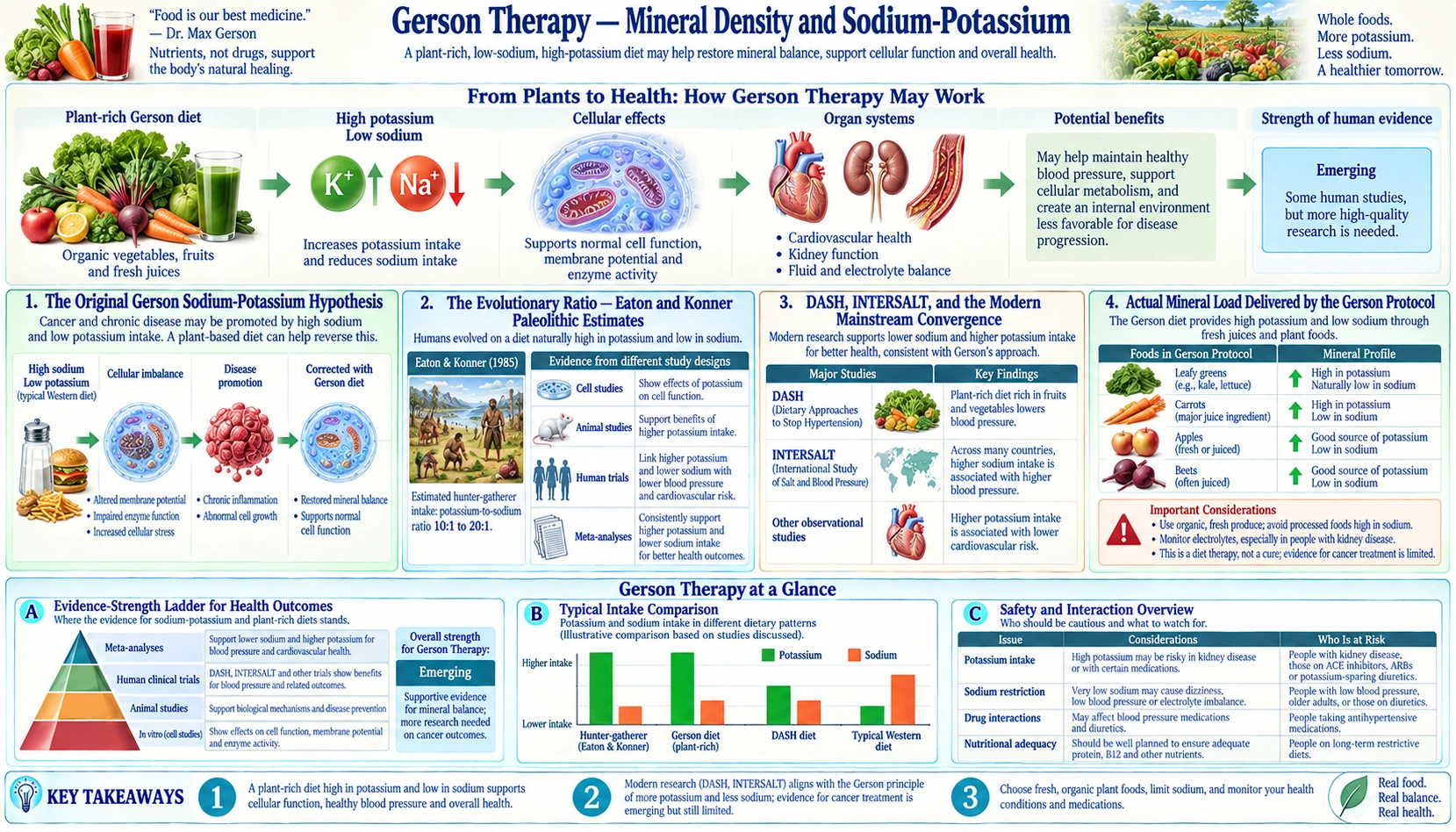
Of the four pillars of the Gerson Therapy, the mineral-density argument is the one that has aged best. Max Gerson's 1958 monograph proposed that chronic disease is preceded and partly driven by an inversion of the evolutionary sodium-potassium ratio — modern processed diets deliver excessive sodium (5,000–10,000 mg/day) and inadequate potassium (1,500–2,500 mg/day) compared to a Paleolithic baseline that ran the opposite direction (sodium under 1,000 mg, potassium above 7,000 mg). The protocol's heavy vegetable juicing, near-zero added salt, and supplemental potassium delivery were designed to restore that ratio. Seven decades later, the WHO 2012 potassium guideline (3,500 mg/day), the DASH trial, the INTERSALT epidemiology, and a substantial body of stroke-prevention research have all moved mainstream nutrition in Gerson's direction — not to the same extremity, but in the same direction. This page presents the original Gerson hypothesis, the modern evidence base, the practical mineral profile of the protocol, and the cautions (notably kidney disease) that the research raises.
Table of Contents
- The Original Gerson Sodium-Potassium Hypothesis
- The Evolutionary Ratio — Eaton and Konner Paleolithic Estimates
- DASH, INTERSALT, and the Modern Mainstream Convergence
- Actual Mineral Load Delivered by the Gerson Protocol
- Cellular Membrane Potential and Mineral Density
- Magnesium, Calcium, and the Other Minerals
- The Renal Contraindication — Hyperkalemia Risk
- Practical Cautions — Diuretics, ACE Inhibitors, and Medication Interactions
- Key Research Papers
- Connections
- Featured Videos
The Original Gerson Sodium-Potassium Hypothesis
Max Gerson articulated the sodium-potassium hypothesis in detail in A Cancer Therapy: Results of Fifty Cases (1958), drawing on earlier observational and experimental work by Carl Schroeder, Henry Schroeder, and others. The hypothesis proceeds in three steps:
- Healthy cells maintain a steep electrochemical gradient across the plasma membrane: intracellular potassium concentration of approximately 140 mEq/L, intracellular sodium concentration of approximately 10–15 mEq/L. The gradient is maintained by the Na+/K+-ATPase pump (the "sodium pump"), discovered by Jens Christian Skou in 1957 (the year before Gerson's monograph) and recognized with the 1997 Nobel Prize in Chemistry.
- Chronic disease, including cancer, is associated with degradation of this gradient — intracellular potassium falls, intracellular sodium rises, and the cell loses its normal differentiated function. Gerson cited tissue-mineral analyses from autopsy specimens of cancer patients showing this pattern.
- Restoring the dietary potassium-to-sodium ratio to evolutionary levels, combined with reducing the cellular toxic load that impairs the Na+/K+-ATPase, allows the gradient to be re-established and the cell to recover its normal function.
The third step is the contested one. The first two are now well-established mainstream cell biology. Cancer cells do show altered intracellular ion composition; the Na+/K+-ATPase is a documented therapeutic target (cardiac glycosides like digoxin work by inhibiting it, and there is active drug-development research on cancer-cell-selective inhibitors). The leap from "ion gradients matter" to "dietary potassium restores them and reverses cancer" is the open question, and nearly seven decades later it remains open in either direction.
The Evolutionary Ratio — Eaton and Konner Paleolithic Estimates
The strongest modern support for the sodium-potassium component of Gerson's argument came from S. Boyd Eaton and Melvin Konner's landmark 1985 New England Journal of Medicine paper, "Paleolithic Nutrition: A Consideration of Its Nature and Current Implications." Eaton and Konner reconstructed estimated Paleolithic dietary intake patterns from a combination of ethnographic studies of contemporary hunter-gatherer populations (San, Ache, Hadza, Inuit) and analyses of wild plant and animal foods.
Their estimates for sodium and potassium intake of Paleolithic humans:
- Sodium: ~700–900 mg/day (essentially all from food matrix; no added salt)
- Potassium: ~7,000–11,000 mg/day (from wild vegetable, fruit, tuber, and animal sources)
- Na:K ratio: approximately 1:10
Compare modern American intake from NHANES surveys:
- Sodium: ~3,400 mg/day average, with substantial right tail to 6,000–10,000 mg/day in heavy processed-food consumers
- Potassium: ~2,500–2,900 mg/day average
- Na:K ratio: approximately 1.3:1 to 1.5:1
The current US intake targets come from the 2019 National Academies of Sciences, Engineering, and Medicine (NASEM) report on sodium and potassium: a potassium Adequate Intake of 3,400 mg/day for men and 2,600 mg/day for women, which the report marks as an updated value compared with its 2005 report, and for sodium an Adequate Intake of 1,500 mg/day, with the chronic-disease target to “reduce intakes if above 2,300 mg/day”.
The directional shift from 1:10 to 1.5:1 represents an order-of-magnitude inversion across approximately 10,000 years of agriculture-and-industrial food processing — a change in dietary composition fast enough that human renal, cardiovascular, and cellular physiology cannot reasonably be expected to have adapted.
Eaton and Konner's argument did not validate Gerson's extrapolation to cancer reversal, but it did validate the underlying observation about the directional shift in mineral intake. That part of the Gerson hypothesis has held up under serious anthropological and nutritional examination.
DASH, INTERSALT, and the Modern Mainstream Convergence
Several large-scale modern studies have moved mainstream cardiology and nutrition substantially in the direction Gerson originally argued, though without crediting him explicitly:
The DASH trial (Dietary Approaches to Stop Hypertension, NEJM 1997). A randomized controlled trial in 459 adults (systolic pressure below 160 mm Hg and diastolic pressure of 80 to 95 mm Hg; 133 of them with hypertension) comparing a control diet, a fruit-and-vegetable-enriched diet, and a combined DASH diet rich in fruits, vegetables and low-fat dairy foods and with reduced saturated and total fat. Sodium intake and body weight were held constant. The DASH diet reduced systolic blood pressure by 11.4 mm Hg and diastolic by 5.5 mm Hg more than the control diet in the hypertensive subjects within 8 weeks — effects comparable to a single antihypertensive medication. The active mineral profile: increased potassium (~4,400 mg/day), increased magnesium, increased calcium; sodium was held constant.
INTERSALT (1988). Cross-sectional epidemiology in 10,079 men and women aged 20–59 at 52 centres across 32 countries, comparing 24-hour urinary sodium and potassium to blood pressure. Within centres, sodium excretion was significantly related to blood pressure in individual people, and potassium excretion was negatively related to blood pressure after adjustment for confounding variables. Four centres with very low sodium excretion had low blood pressure and little or no rise in blood pressure with age. Across the other 48 centres, sodium was related to the rise of blood pressure with age but not to median blood pressure or the prevalence of high blood pressure, and across centres potassium showed no consistent association.
The WHO 2012 potassium guideline. Following systematic review, WHO recommended that adults consume at least 90 mmol (3,510 mg) of potassium per day from food sources, citing reductions in blood pressure, stroke, and cardiovascular mortality. The recommendation specifically encourages potassium from vegetables, fruits, legumes, and unprocessed foods rather than salt-substitute supplements.
Modern stroke epidemiology. A 2013 systematic review and meta-analysis (Aburto and colleagues, BMJ) pooled 11 cohort studies with 127,038 participants. Higher potassium intake was associated with a 24% lower risk of stroke (risk ratio 0.76, 95% confidence interval 0.66 to 0.89); the associations with cardiovascular disease (risk ratio 0.88, 0.70 to 1.11) and coronary heart disease (0.96, 0.78 to 1.19) were not statistically significant. In the same review's 22 randomised trials (1606 participants), increased potassium intake lowered systolic blood pressure by 3.49 mm Hg and diastolic by 1.96 mm Hg in adults, “an effect seen in people with hypertension but not in those without hypertension”, and had no significant adverse effect on kidney function in adults.
A 2016 dose-response meta-analysis of 16 cohort studies (Vinceti and colleagues) found stroke risk lowest at a potassium intake of 90 mmol a day — the same 90 mmol the WHO guideline names — with a risk ratio of 0.78 (95% confidence interval 0.70 to 0.86) in the blood-pressure-adjusted analysis.
A 2022 study (Ma and colleagues, NEJM) pooled six cohorts of generally healthy adults (10,709 participants) in which sodium and potassium were measured from at least two 24-hour urine samples per person, a method the authors describe as accurate. Each daily increment of 1,000 mg in sodium excretion was associated with an 18% higher risk of cardiovascular events (coronary revascularization, heart attack or stroke; hazard ratio 1.18, 95% confidence interval 1.08 to 1.29), and each daily increment of 1,000 mg in potassium excretion with an 18% lower risk (hazard ratio 0.82, 0.72 to 0.94).
None of these studies validates the specific Gerson claim that potassium restoration reverses cancer. They do validate the general claim that modern Western diets are sodium-excessive and potassium-deficient, and that dietary mineral correction produces clinically meaningful benefit for at least cardiovascular endpoints. The directional vindication is partial but real.
Actual Mineral Load Delivered by the Gerson Protocol
The Gerson protocol delivers an unusually high daily mineral load even by the standards of high-vegetable diets. Approximate daily totals from a strict protocol:
- Potassium: 8,000–10,000 mg/day from juice and food, supplemented by 4–6 g/day of "Gerson's potassium compound" (a mix of potassium gluconate, acetate, and monophosphate prescribed at meals)
- Sodium: under 300 mg/day during the initial intensive phase; no added salt at table or in cooking. Sodium gradually re-introduced after several months as patient condition stabilizes.
- Magnesium: 600–900 mg/day from green leafy juice and supplemental magnesium
- Calcium: 1,500–2,000 mg/day from leafy greens (kale, beet tops, cruciferous components)
- Iron: variable; substantial from leafy greens, less from raw than cooked due to oxalate binding
- Zinc, copper, manganese, selenium: variable; mostly food-matrix from the diverse vegetable intake
- Iodine: Lugol's iodine prescribed separately (typically 3–6 drops per day = 18–36 mg total iodine)
The Na:K ratio achieved during the intensive phase is approximately 1:30 — substantially more extreme than the Paleolithic baseline Eaton and Konner estimated. The Gerson Institute's rationale for going beyond the evolutionary baseline is that the protocol is treating active disease in patients with pre-existing tissue mineral derangement, not maintaining health in normal subjects, and the higher ratio is needed temporarily to drive intracellular ion correction.
This is a falsifiable hypothesis that has not been directly tested. The cardiology and nephrology literature on tissue mineral correction in chronic illness is inconclusive on whether intakes substantially above the WHO guideline produce additional benefit, and at the very high end there are documented harms (see the renal-contraindication section).
Cellular Membrane Potential and Mineral Density
The cellular biology underlying Gerson's ion-gradient hypothesis is genuinely mainstream:
Every nucleated cell in the body maintains an electrical potential across its plasma membrane — typically −70 to −90 mV (cell interior negative relative to outside). The gradient is generated and maintained primarily by the Na+/K+-ATPase, which pumps 3 sodium ions out for every 2 potassium ions pumped in, consuming approximately 20–30% of the cell's adenosine triphosphate (ATP) budget in the process. The resulting ion asymmetry drives neuronal action potentials, muscle contraction, renal tubular reabsorption, and countless secondary-active-transport processes.
Cancer cells consistently show derangement of this gradient. The published literature includes:
- Decreased intracellular potassium concentration in many tumor types (breast, lung, colon)
- Increased intracellular sodium concentration (visible on sodium-MRI in some tumors)
- Depolarized resting membrane potential (around −30 to −50 mV in tumor cells vs −70 to −90 mV in their parental tissue)
- Differential expression of Na+/K+-ATPase isoforms in tumor vs normal tissue
- Differential sensitivity to cardiac glycosides (digoxin, ouabain), which inhibit Na+/K+-ATPase — some cancer types show greater sensitivity, supporting an emerging field of "cardiac glycoside repurposing" in oncology
What this body of evidence does not establish is that dietary potassium correction restores the membrane potential of tumor cells or that doing so has therapeutic effect. The intracellular potassium concentration in a cancer cell is controlled by Na+/K+-ATPase activity, not by serum potassium concentration; the Na+/K+-ATPase is well-saturated with substrate at normal serum potassium of 3.5–5.0 mEq/L; raising dietary potassium does not directly raise intracellular potassium in any cell type as long as the pump is functioning. The Gerson argument would require either pump dysfunction reversal (mechanism unclear) or a different therapeutic mechanism entirely.
This is not a refutation of the hypothesis — mechanistic ignorance is not disproof — but it does highlight where the Gerson cellular-biology argument needs more careful articulation than it typically receives in popular accounts.
Magnesium, Calcium, and the Other Minerals
Beyond the sodium-potassium axis, the protocol delivers substantial daily magnesium (600–900 mg) and calcium (1,500–2,000 mg), both well above modern Recommended Dietary Allowance (RDA). The magnesium intake is in the range associated in observational studies with reduced cardiovascular mortality, reduced type 2 diabetes incidence, and reduced colorectal cancer risk. The calcium intake from plant sources (rather than dairy) avoids the controversial saturated-fat and insulin-like growth factor 1 (IGF-1) associations of dairy-source calcium.
The iron delivery is variable. Plant-source iron is non-heme, with substantial bioavailability reduction from oxalate (spinach, beet tops) and phytate (some grains, though the Gerson diet is largely grain-free during the intensive phase). The vitamin C content of the juice probably enhances non-heme iron absorption substantially. Iron deficiency anemia is a documented risk on long-term strict Gerson protocol in pre-menopausal women and is one of the routine monitoring items at the licensed clinics.
The iodine delivery via Lugol's solution (typically 18–36 mg per day) is dramatically higher than the modern Western Recommended Dietary Allowance of 150 mcg, and is the subject of an entirely separate debate about iodine sufficiency, the Iodine Project work of Abraham and Brownstein, and Hashimoto's autoimmune-thyroid risk from high-dose iodine. The 2001 Institute of Medicine (IOM) iodine report sets the adult Tolerable Upper Intake Level at 1,100 µg (1.1 mg) a day, against a Recommended Dietary Allowance of 150 µg; the protocol's 18–36 mg a day is far above that limit. The same report links high iodine intakes with thyroiditis, goiter, hypothyroidism and hyperthyroidism, and states that “certain subpopulations, such as those with autoimmune thyroid disease and iodine deficiency, respond adversely to intakes considered safe for the general population.” People with Hashimoto's thyroiditis or antibody-positive autoimmune thyroid disease are therefore the group the research raises the most concern for with the Lugol's component.
The Renal Contraindication — Hyperkalemia Risk
The most important medical contraindication to the Gerson protocol is chronic kidney disease. Healthy kidneys can excrete dietary potassium loads well in excess of the protocol's 8–10 g/day — the maximum healthy renal potassium excretion capacity is approximately 400–500 mEq/day, well above the 200–250 mEq daily potassium load of the protocol. In kidneys with reduced glomerular filtration rate, this capacity falls, and serum potassium can rise to dangerous levels.
Too much potassium in the blood (medical term: hyperkalemia, serum potassium > 5.5 mEq/L) can cause potentially fatal heart-rhythm problems, including ventricular fibrillation and asystole (the heart stopping). Its early signs — muscle weakness, tiredness and a fluttering or pounding heartbeat (palpitations) — overlap with the general symptoms of advanced disease and can be missed. People on the Gerson protocol whose kidney problems have not been detected are at real risk.
Impaired kidney function is what turns a high-potassium diet into a hazard. A 2026 Japanese cohort study notes that hyperkalemia is common in chronic kidney disease and chronic heart failure, and the 2013 potassium meta-analysis limited its conclusion that more potassium is potentially beneficial to “most people without impaired renal handling of potassium”. Conditions in which the body clears less potassium include:
- Chronic kidney disease
- Acute kidney injury of any cause
- Renal artery stenosis
- Adrenal insufficiency (impaired aldosterone-driven potassium excretion)
- Type 4 renal tubular acidosis
Potassium and kidney function show up on a basic metabolic panel blood test (sodium, potassium, blood urea nitrogen (BUN), creatinine, estimated glomerular filtration rate (eGFR)). Without such tests, a rising potassium level on this protocol can go unnoticed. This is the single most important safety consideration in the entire protocol.
Practical Cautions — Diuretics, ACE Inhibitors, and Medication Interactions
Several common medications dramatically amplify hyperkalemia risk on a high-potassium diet:
- Potassium-sparing diuretics (spironolactone, eplerenone, triamterene, amiloride) directly inhibit renal potassium excretion. Combined with the Gerson dietary load, hyperkalemia can develop within days.
- Angiotensin-converting enzyme inhibitors (ACE inhibitors) (lisinopril, enalapril, ramipril, etc.) reduce angiotensin-II-driven aldosterone secretion, impairing potassium excretion.
- Angiotensin-receptor blockers (losartan, valsartan, irbesartan, etc.) act through the same mechanism.
- Nonsteroidal anti-inflammatory drugs (NSAIDs) (ibuprofen, naproxen, indomethacin) reduce renal prostaglandin synthesis, decreasing potassium excretion.
- Trimethoprim (a common antibiotic) directly inhibits renal potassium excretion.
- Heparin reduces aldosterone synthesis.
- Digoxin — the digoxin tablet label lists low blood potassium (hypokalemia), impaired kidney function, high calcium and low magnesium among the conditions that may predispose to digoxin toxicity, and states that extremely high digoxin levels themselves produce high potassium, especially in people with impaired kidney function. Swings in blood potassium on this diet therefore matter for people taking it.
Each of the drugs above except digoxin lowers the kidneys' potassium excretion on its own; combined with an 8,000–10,000 mg/day potassium diet, the effects add up. The protocol is essentially incompatible with strict use of any potassium-sparing diuretic.
Beyond the potassium issue, the protocol's low sodium (< 300 mg/day during intensive phase) is incompatible with the high-sodium diet required by some forms of dysautonomia treatment (postural orthostatic tachycardia syndrome (POTS), neurogenic orthostatic hypotension) where sodium loading is part of the therapeutic strategy.
Key Research Papers
- Skou JC, Na+/K+-ATPase discovery (1957) — PubMed: Skou Na/K-ATPase
- Eaton SB, Konner M. Paleolithic nutrition. A consideration of its nature and current implications. N Engl J Med, 1985;312(5):283–289 — PubMed PMID: 2981409
- DASH trial — Appel LJ, Moore TJ, Obarzanek E, Vollmer WM, Svetkey LP, Sacks FM, et al. A clinical trial of the effects of dietary patterns on blood pressure. DASH Collaborative Research Group. N Engl J Med, 1997;336(16):1117–1124 — PubMed PMID: 9099655
- Intersalt Cooperative Research Group. Intersalt: an international study of electrolyte excretion and blood pressure. Results for 24 hour urinary sodium and potassium excretion. BMJ, 1988;297(6644):319–328 — PubMed PMID: 3416162
- WHO 2012 potassium intake guideline (3,500 mg/day) — PubMed: WHO potassium guideline
- Aburto NJ, Hanson S, Gutierrez H, Hooper L, Elliott P, Cappuccio FP. Effect of increased potassium intake on cardiovascular risk factors and disease: systematic review and meta-analyses. BMJ, 2013;346:f1378 — PubMed PMID: 23558164
- Vinceti M, Filippini T, Crippa A, de Sesmaisons A, Wise LA, Orsini N. Meta-Analysis of Potassium Intake and the Risk of Stroke. J Am Heart Assoc, 2016;5(10):e004210 — PubMed PMID: 27792643
- Ma Y, He FJ, Sun Q, Yuan C, Kieneker LM, Curhan GC, et al. 24-Hour Urinary Sodium and Potassium Excretion and Cardiovascular Risk. N Engl J Med, 2022;386(3):252–263 — PubMed PMID: 34767706
- Cancer cell membrane potential and Na+/K+-ATPase isoform expression — PubMed: Cancer membrane potential
- Cardiac glycoside repurposing in oncology — PubMed: Cardiac glycoside oncology
- Cope FW. A medical application of the Ling association-induction hypothesis: the high potassium, low sodium diet of the Gerson cancer therapy. Physiol Chem Phys, 1978;10(5):465–468 — PubMed PMID: 751080
- Sada KE, Yamazaki H, Wakita T, Yamamoto Y, Wang J, Onishi Y, et al. Quality of life in hyperkalemia: baseline analysis of a cohort study of management of hyperkalemia in patients with chronic kidney disease or heart failure in Japan. Clin Exp Nephrol, 2026 — PubMed PMID: 42837068
- Xu T, Sun Y, Xu T, Zhang Y. Magnesium intake and cardiovascular disease mortality: a meta-analysis of prospective cohort studies. Int J Cardiol, 2013;167(6):3044–3047 — PubMed PMID: 23200267
- Salt sensitivity of blood pressure and individual variability — PubMed: Salt sensitivity
- National Academies of Sciences, Engineering, and Medicine. Dietary Reference Intakes for Sodium and Potassium. Washington, DC: The National Academies Press, 2019. Summary tables S-1 and S-2 — National Academies Press
- Institute of Medicine. Dietary Reference Intakes for Vitamin A, Vitamin K, Arsenic, Boron, Chromium, Copper, Iodine, Iron, Manganese, Molybdenum, Nickel, Silicon, Vanadium, and Zinc, chapter 8: Iodine. Washington, DC: National Academy Press, 2001 — National Academies Press
- Digoxin tablets, US prescribing information, sections 5.3 and 10 — DailyMed