Gerson Therapy — Benefits Deep Dive
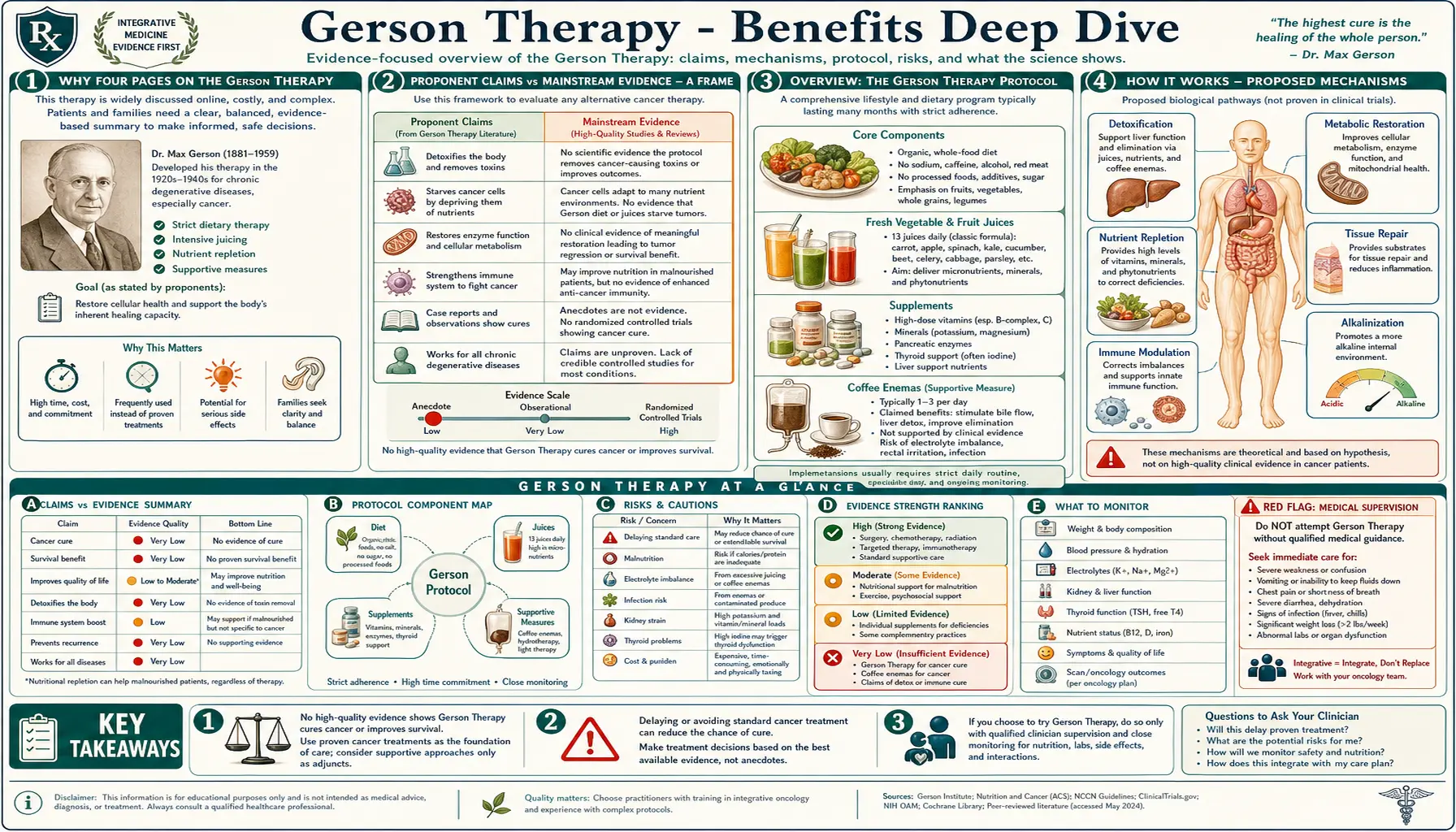
The Gerson Therapy is the nutritional and detoxification protocol developed by the German-American physician Max Gerson (1881–1959) and carried forward by his daughter Charlotte Gerson. Gerson first applied it to his own migraines, then to skin tuberculosis, lung tuberculosis and other chronic illnesses, and later to advanced cancer. This Benefits Deep Dive follows the four pillars as Gerson and the book The Gerson Therapy describe them — the thirteen-glass fresh juicing regimen, the coffee enema, the high-potassium / low-sodium mineral balance, and the documentary record of patients Gerson and his successors report as recovered — with each pillar given its own page.
Deep-Dive Articles
Juicing Protocol
The thirteen 8-ounce glasses of fresh juice taken hourly through the day as the nutritional backbone of the Gerson diet — carrot, carrot-apple, and the signature green-leaf juice. Why Gerson insisted on a grind-and-press juicer, how the juices are prepared fresh for every glass, and the carotenoids, polyphenols, nitrates and potassium the protocol concentrates.
Read the deep dive →Coffee Enema Component
The coffee enema as the Gerson book describes it — taken several times a day in the early months to dilate the bile ducts and help the liver clear the toxins released as tissues heal. Covers the glutathione S-transferase mechanism the book cites from Wattenberg's 1981 work on coffee palmitic acid, Peter Lechner's endoscopic observations in Graz, and how the enema schedule is tapered as patients improve.
Read the deep dive →Mineral Density and Sodium-Potassium
Gerson's sodium-potassium concept of chronic disease — that processed and cooked foods strip potassium and add salt until the cells' mineral balance breaks down. The saltless diet, the potassium compound added to the juices, the salt excretion Gerson observed in the first days of treatment, Freeman Cope's 1978 paper on the high-potassium, low-sodium diet, and the modern potassium and sodium research.
Read the deep dive →Gerson Therapy — The Documentary Record
The documentary record as Max and Charlotte Gerson report it: the 1958 book "A Cancer Therapy: Results of Fifty Cases," the 1946 Pepper-Neely Senate hearings where Gerson presented five recovered cancer patients, Sauerbruch's skin-tuberculosis trial, the Schweitzer family's recoveries from tuberculosis and diabetes, the 1995 Hildenbrand melanoma retrospective, Peter Lechner's work in Graz, and how the book documents its patients.
Read the deep dive →Table of Contents
The Four Pillars of the Gerson Therapy
Gerson treated his protocol as one unit — the saltless organic vegetarian diet, the hourly juices, the coffee enemas and the small set of supplements all working together. The book lists those supplements as a potassium compound, digestive enzymes, thyroid hormone, Lugol's iodine, niacin, vitamin B12 and crude liver extract, each adjusted to the patient. The four pages in this Deep Dive take the pillars one at a time so each can be read in full.
- The juices. The book describes thirteen 8-ounce glasses of raw vegetable and fruit juice a day, taken hourly and pressed fresh for each glass, as the way to flood the body with nutrients while the diet removes salt and processed food. Gerson credited the juices with flushing the kidneys and supplying the potassium and enzymes the damaged tissues need.
- The coffee enemas. According to the book, the coffee enema dilates the bile ducts and stimulates the liver enzyme system glutathione S-transferase, helping the liver clear toxins released as tumours and diseased tissue break down. The book quotes Peter Lechner of Graz citing Wattenberg's 1981 finding that the palmitic acid in coffee raises that enzyme's activity many times over. Enemas are most frequent in the first months and are reduced as the patient improves.
- The mineral balance. Gerson's central idea is that processing, canning and cooking remove potassium and add salt, and that years of excess sodium eventually damage the body's enzyme systems, immune system and liver. Raising potassium and removing added salt is, in his words, what acts against tumour formation. Gerson wrote that salt excretion rises after two to three days on the saltless diet and stays high for up to two weeks.
- The documentary record. The fourth pillar is the record itself: the patients Gerson presented to the U.S. Senate in 1946, the fifty cases in his 1958 book, the Sauerbruch skin-tuberculosis trial, and the later melanoma review by the Gerson Institute team. The documentary page sets this record out in Gerson's and his successors' own terms.
The book stresses that full healing of a long-standing degenerative condition usually takes at least two years on the complete program, and that cutting corners lowers the chance of success.
The Record as Max and Charlotte Gerson Report It
Tuberculosis. The book reports that Professor Ferdinand Sauerbruch in Munich, after long discussions with Gerson, set up a clinical trial of the diet in skin tuberculosis (lupus vulgaris). Of 450 patients considered incurable, the book states, 446 recovered fully, and Sauerbruch described the trial in his autobiography Master Surgeon. Gerson then treated lung, kidney and bone tuberculosis; among his lung-TB patients was Helene Schweitzer, wife of Albert Schweitzer, who the book says recovered completely and lived into her eighties.
The 1946 Senate hearing. From July 1 to 3, 1946, a Senate subcommittee took testimony on Senate Bill 1875, the Pepper-Neely anticancer proposal. The book records that Gerson brought five of his recovered cancer patients, and the records of five more, before the subcommittee — the book presents this as the first time the Senate had invited a physician to demonstrate a therapy for cancer.
Fifty cases. Gerson's 1958 book A Cancer Therapy: Results of Fifty Cases is described in The Gerson Therapy as the largest body of evidence for the treatment. The book states that almost all of the patients had been biopsied at accredited institutions before starting, that all but two were in terminal condition, that they survived at least five years, and that at least a dozen were still alive forty-five years after beginning treatment.
Melanoma. The book reports the 1995 retrospective review by Hildenbrand, Hildenbrand, Bradford and Cavin of 153 adult melanoma patients treated on the Gerson program between 1975 and July 1990, most at Gerson facilities in Tijuana. As the book gives the figures, 100 percent of 14 stage I–II patients survived five years, against 79 percent in the comparison series it cites; 82 percent of 17 stage IIIA patients were alive at five years, against 39 percent in the comparison clinic series; and 71 percent of 33 stage IIIA–IIIB patients, against 41 percent.
Other conditions. Gerson reported that, while treating migraine and tuberculosis, he saw other conditions in the same patients improve as well — high blood pressure, asthma, allergies, kidney damage, arthritis and hardening of the arteries among them — which led him to apply the diet to degenerative illness generally.
Supervision and Healing Reactions
The Gerson book describes the therapy being given in a Gerson hospital, at home under a physician's supervision, or by patients working from Gerson's own book, and the patient stories it tells are mostly of supervised treatment. It warns that the program is not a “paint by numbers” approach: each patient and each diagnosis responds differently, and the supplements are adjusted to the individual.
The book also prepares patients for “healing reactions” or flare-ups — episodes of nausea, diarrhoea and nervous disturbance that it attributes to increased bile secretion as the body releases stored sodium and toxins. It reports that after each flare-up patients feel easier and improve physically and mentally, and it advises increasing the coffee enemas while tumour tissue is breaking down and releasing toxins, with two to three months often passing before they can be reduced to three or four a day. The individual Deep-Dive pages give the book's details on preparing the juices, taking the enemas and handling the potassium supplement.
Key Research Papers
- Gerson MB. Dietary considerations in malignant neoplastic diseases; a preliminary report. Rev Gastroenterol. 1945;12:419-24. — PubMed PMID: 21005988
- Gerson M. Effects of a combined dietary regime on patients with malignant tumors. Exp Med Surg. 1949;7(4):299-317. — PubMed PMID: 15396126
- Gerson M. [No cancer in normal metabolism; results of special therapy]. Med Klin. 1954;49(5):175-9. — PubMed PMID: 13144228
- Gerson M. [Cancer a problem of metabolism]. Med Klin. 1954;49(26):1028-32. — PubMed PMID: 13202917
- Gerson M. The cure of advanced cancer by diet therapy: a summary of 30 years of clinical experimentation. Physiol Chem Phys. 1978;10(5):449-64. — PubMed PMID: 751079
- Cope FW. A medical application of the Ling association-induction hypothesis: the high potassium, low sodium diet of the Gerson cancer therapy. Physiol Chem Phys. 1978;10(5):465-8. — PubMed PMID: 751080
- Hildenbrand GL, Hildenbrand LC, Bradford K, Cavin SW. Five-year survival rates of melanoma patients treated by diet therapy after the manner of Gerson: a retrospective review. Altern Ther Health Med. 1995;1(4):29-37. — PubMed PMID: 9359807
PubMed Topic Searches
- Gerson M, A Cancer Therapy: Results of Fifty Cases (1958 monograph, frequently cited) — PubMed: Gerson 1958 monograph
- Hildenbrand GL et al., Five-year survival rates of melanoma patients treated by diet therapy (Alternative Therapies in Health and Medicine 1995) — PubMed: Hildenbrand melanoma
- Molassiotis A et al., A retrospective analysis of Gerson Therapy patients — PubMed: Molassiotis retrospective
- Cope FW, on the mineral-deficiency hypothesis of cancer (1978, cited by Gerson advocates) — PubMed: Cope mineral hypothesis
- Norwalk-style press juicing and polyphenol preservation versus centrifugal extraction — PubMed: Press vs centrifugal juicing
- Carrot beta-carotene bioavailability and matrix disruption by juicing — PubMed: Carrot juice bioavailability
- Leafy green nitrate, dietary nitric oxide, and endothelial function — PubMed: Leafy-green nitrate and NO
- Apple polyphenols (quercetin, chlorogenic acid) and antioxidant capacity — PubMed: Apple polyphenols
- Sulforaphane and isothiocyanates from cruciferous juice (cabbage, kale) — PubMed: Cruciferous sulforaphane
- Vegetable and fruit intake and cancer incidence: EPIC cohort — PubMed: EPIC vegetable/fruit cohort
- Juice fasting and short-term metabolic effects (gut microbiome shifts) — PubMed: Juice fast microbiome
- Plant-based diet and chronic disease risk — meta-analyses — PubMed: Plant-based diet meta-analyses
- Wattenberg LW and colleagues on coffee palmitates and Phase II enzyme induction — PubMed: Wattenberg palmitate Phase II
- Caffeine and bile flow / cholecystokinin release — PubMed: Caffeine and bile flow
- Coffee enema and serum cortisol / liver enzyme markers — clinical observation — PubMed: Coffee enema enzyme markers
- Glutathione-S-transferase induction by dietary coffee compounds (cafestol, kahweol) — PubMed: Cafestol Phase II induction
- Hepatic glutathione biology and dietary modulation — PubMed: Hepatic glutathione
- WHO 2012 guideline on potassium intake (90 mmol / 3,500 mg per day) — PubMed: WHO potassium guideline
- DASH trial — dietary approaches to stop hypertension — PubMed: DASH trial
- INTERSALT study on cross-national sodium and blood pressure — PubMed: INTERSALT study
- Potassium intake and stroke incidence meta-analysis — PubMed: Potassium and stroke
- Sodium-potassium ratio as cardiovascular risk marker — PubMed: Na/K ratio mortality
- Hyperkalemia risk in chronic kidney disease and potassium-rich diets — PubMed: CKD hyperkalemia
- Magnesium intake and cardiovascular mortality — PubMed: Magnesium and CVD
- Paleolithic dietary potassium and ancestral Na/K ratio estimates — PubMed: Paleolithic Na/K
- Intracellular potassium and membrane potential biology — PubMed: Intracellular potassium
- Salt sensitivity of blood pressure and individual variation — PubMed: Salt sensitivity
External Resources
Connections
- All Remedies
- Gerson Therapy (Main Hub)
- Juicing Protocol
- Coffee Enema Component
- Mineral Density and Sodium-Potassium
- Gerson Therapy — The Documentary Record
- Gerson Diet Protocol
- Gerson Juicing
- Coffee Enemas
- Gerson and Cancer
- Research Evidence Summary
- History of Max Gerson
- Practical Guide
- Detox Protocols
- Liver Cleansing
- Anti-Inflammatory Diet
- Potassium