Jacob, Lwoff & Monod: How Genes Are Switched On and Off
Every cell in your body carries the same DNA. A liver cell and a brain cell read the same instruction manual and become completely different things. The reason is that genes are not simply "on" — they are switched. Three researchers at the Institut Pasteur in Paris worked out the first switch anyone ever understood, in a bacterium, using nothing but genetics and stubbornness. This page explains what they found, why it matters to you, and — just as important — where the parallel to human biology stops.
Table of Contents
- The Prize and the Three Men
- The Question: How Does a Cell Know?
- Lwoff and Lysogeny: A Virus Asleep in the Genome
- The PaJaMa Experiment, 1957–1959
- The Operon, 1961
- Messenger RNA: Predicted, Then Found
- What Carries Over to Humans — and What Does Not
- Where You Meet This in Medicine
- Monod's Philosophy: Chance and Necessity
- "Epigenetics" and What Regulation Does Not License
- Where Mainstream Science Agrees / What Remains Debated
- Key Research Papers
- Connections
- Featured Videos
1. The Prize and the Three Men
The Nobel Prize in Physiology or Medicine for 1965 was awarded jointly — one third each — to François Jacob, André Lwoff and Jacques Monod, "for their discoveries concerning genetic control of enzyme and virus synthesis." All three worked at the Institut Pasteur in Paris, in a cluster of laboratories in the attic of one of its buildings, and all three had arrived there by unusual routes.
André Lwoff (1902–1994) — the senior figure
Lwoff was born in Ainay-le-Château, in the Allier, in May 1902, and joined the Institut Pasteur at the age of nineteen, before he had finished either of his degrees. He took his M.D. in 1927 and his Ph.D. in 1932, and spent the 1930s working on what bacteria and protozoa need in order to grow — the vitamins and coenzymes they cannot make for themselves. He was the first to show that small molecules that one microbe manufactures internally may be an absolute dietary requirement for another, which is the microbiological root of the whole idea of a vitamin. In 1938 he was made head of a new department at the Pasteur, and it was from that position that he later hired, sheltered and argued with the two younger men who would share his prize.
He was also the one who turned the study of dormant bacterial viruses from a confused argument into an experiment, which is section 3 of this page.
Jacques Monod (1910–1976)
Monod was born in Paris in February 1910 and raised in the south of France; he thought of himself as a Southerner rather than a Parisian. His father was a painter in a Huguenot family of doctors and ministers; his mother was American, born in Milwaukee. He took a science degree in 1931 and a doctorate in natural sciences in 1941. His thesis work was on bacterial growth, and it produced the observation that shaped the rest of his career: given two sugars at once, a bacterial culture does not use them at the same time. It consumes one, stops growing for a while, and then resumes on the second. Monod called the two-phase growth curve diauxie. A cell that pauses to retool is a cell that is switching something on and off, and Monod spent the next thirty years asking what.
François Jacob (1920–2013)
Jacob was born in Nancy in June 1920 and began studying medicine in Paris with the intention of becoming a surgeon.
The war — stated plainly
These are unusual biographical facts and they are true, so they belong here rather than in a footnote.
Jacob was in his second year of medicine in June 1940 when France fell. He left the country and joined the Free French Forces in London. He was sent to Africa as a medical officer and saw action in Fezzan, Libya, Tripolitania and Tunisia, where he was wounded. He was later posted to the Second Armoured Division and was severely wounded in Normandy in August 1944. He spent seven months in hospital and was awarded the Croix de la Libération, the highest French military decoration of that war. His injuries meant he could never practise surgery. He finished his medical studies, submitted his thesis in 1947, worked in several unrelated fields, and only then turned to biology — taking a science degree in 1951 and a doctorate in 1954 with a thesis on lysogenic bacteria and the provirus concept. He joined the Institut Pasteur in 1950, under Lwoff. The career that produced the operon existed because a surgical career had been taken away.
Monod joined the Resistance when war broke out and became a senior officer in it, with responsibility for operations; his military decorations included the Croix de Guerre (1945), the Légion d'Honneur (military, 1945) and the American Bronze Star. He joined Lwoff's laboratory at the Institut Pasteur in 1945, after the Liberation.
Lwoff took part in an intelligence-gathering Resistance network during the Occupation and sheltered downed Allied airmen; his laboratory served as a contact point. He was decorated for it.
None of this made their science better, and we are not going to claim that it did. It is worth recording because it is part of the answer to a question readers reasonably ask about mid-century European scientists — what were they doing during the war — and because in Jacob's case the injury is the direct reason he became a researcher at all.
2. The Question: How Does a Cell Know?
Here is the observation that started everything, and it is simple enough to picture.
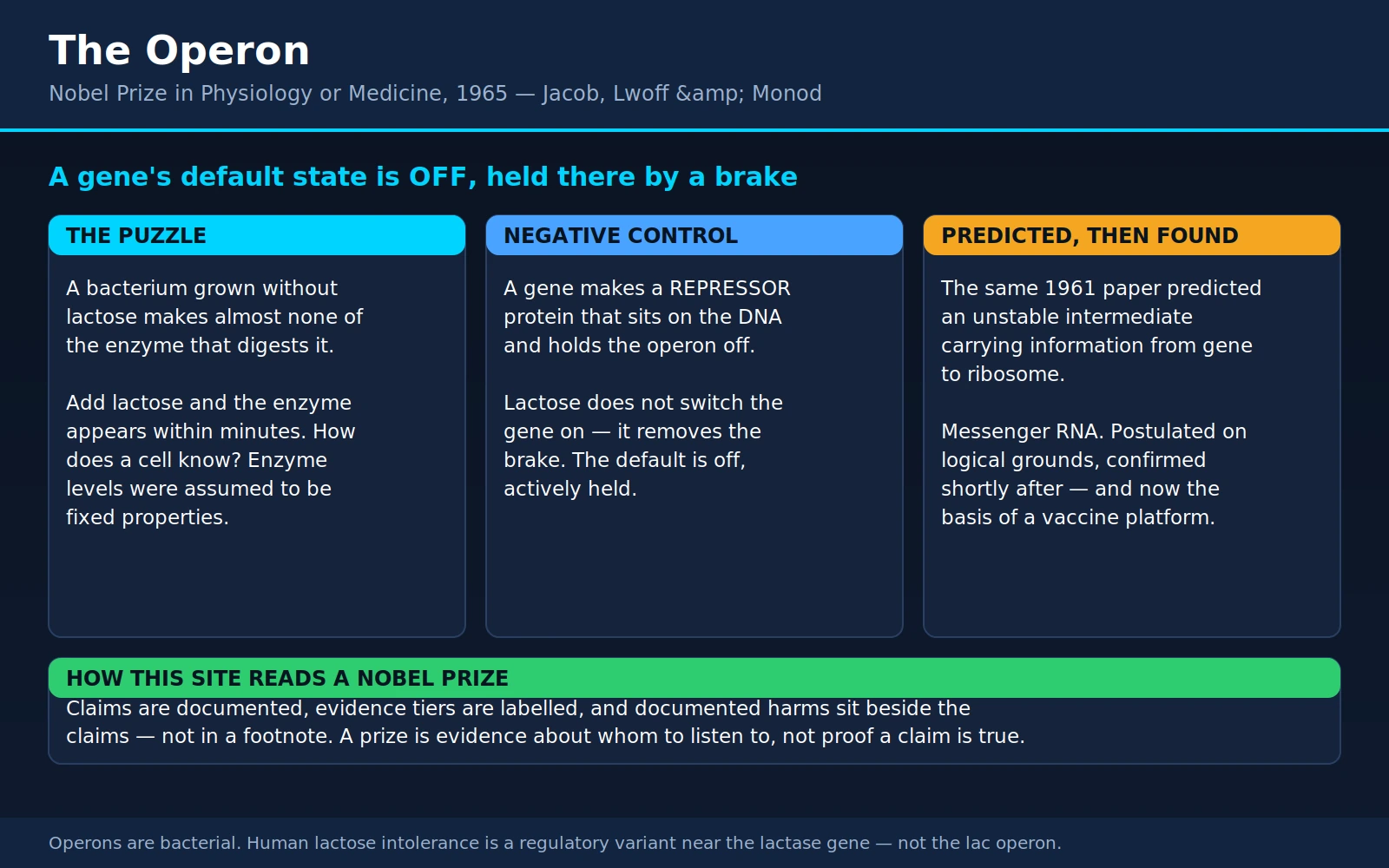
Grow Escherichia coli in a broth with no lactose in it. Break the cells open and look for β-galactosidase, the enzyme that splits lactose into glucose and galactose. You will find almost none — a handful of molecules per cell. Now add lactose to the broth. Within minutes the same cells are making that enzyme in quantity; before long it is one of the more abundant proteins in the cell. Take the lactose away and production stops again.
The bacterium appears to know what is in its environment and to build the tool for the job on demand. Something in the cell is reading the outside world and acting on the genome.
That framing sounds obvious now. It was not obvious then. Through the 1940s and into the 1950s the dominant assumption was that a cell's enzyme complement was more or less a fixed property of that cell — a matter of what it was, not what it was doing. The phenomenon was called enzymatic adaptation, and the favoured explanations were about the enzyme protein itself: perhaps the sugar acted as a template that shaped a general-purpose precursor protein into the right form, or perhaps it stabilised an enzyme that was constantly being made and destroyed. Both of those ideas put the action at the level of the protein. Neither of them said anything about genes being turned on.
Monod's own early attempts ran along similar lines and did not work. What changed the question was the discovery of gratuitous inducers — molecules chemically similar to lactose that switch the enzyme on without being digested by it. IPTG (isopropyl-β-D-thiogalactoside) is the classic example, and it is still in every molecular biology laboratory freezer today. A molecule that induces an enzyme it is not a substrate for demolishes the "the sugar shapes the enzyme" idea in one step. The inducer is not a template. It is a signal.
And once the inducer is a signal, the real question appears: what does the signal talk to?
3. Lwoff and Lysogeny: A Virus Asleep in the Genome
The answer came from a completely different problem, and this is why the 1965 prize went to three people rather than two.
Bacteria have their own viruses, called bacteriophages or simply phages. The obvious thing a phage does is infect a bacterium, hijack it, make hundreds of copies of itself and burst the cell open — lysis. But since the 1920s there had been reports of strange bacterial cultures that produced phage particles continuously, generation after generation, without ever being infected from outside. These were called lysogenic bacteria, and for thirty years the field could not agree whether they were real or an artefact of contaminated cultures. Some of the most respected phage researchers of the era thought the whole thing was a mistake.
Lwoff settled it in the late 1940s by doing something laborious and decisive: he isolated single bacterial cells under a microscope with a micromanipulator, watched them divide, and removed and tested the surrounding fluid at each division. The result was clean. A lysogenic bacterium does not secrete phage as it grows. It divides normally, and its daughters are lysogenic too. Every so often, unpredictably, a single cell in the population bursts and releases a whole crop of phage particles at once. The virus was not being shed. It was being inherited, in silence, and only occasionally breaking out.
Lwoff gave the silent inherited form a name: the prophage. It is the phage genome, carried along as part of the bacterial chromosome, replicated with it, passed to every descendant, and producing no virus particles at all.
Then, in 1950, with Louis Siminovitch and Niels Kjeldgaard, he found the trigger. A brief dose of ultraviolet light — not enough to kill the culture outright — caused essentially the entire lysogenic population to lyse and release phage in unison. The dormant virus could be woken on command. Other DNA-damaging treatments did the same thing.
Read that as a control problem rather than a virology problem and the shape of it is unmistakable:
- There is a set of genes (the phage's lytic program) sitting right there in the chromosome, fully intact.
- They are off, and they stay off through hundreds of cell divisions.
- Something is actively holding them off, because a stimulus that damages DNA releases them all at once.
The modern account of what that something is has held up. The prophage encodes a repressor protein that binds the phage's own DNA and blocks transcription of its lytic genes. Ultraviolet light damages the host's DNA; the damage triggers the bacterium's emergency DNA-repair response; a key protein in that response causes the phage repressor to cleave itself; the brake comes off and the virus goes lytic. A virus that can sense the host is in trouble and evacuate is a virus with better odds.
Jacob joined Lwoff's laboratory in 1950 and spent his doctorate on exactly this. He showed that a lysogenic bacterium is immune to further infection by the same phage — incoming viral genomes are silenced by the same mechanism that silences the resident one. That is a diffusible substance suppressing a gene, demonstrated in 1954, seven years before the operon paper.
If a viral genome living quietly inside a host genome sounds familiar, it should: it is the same architecture readers meet on our page on Baltimore, Temin and Dulbecco and the discovery of reverse transcriptase, where a retrovirus writes itself into human DNA and can persist there indefinitely. Lwoff's bacteria got there first, and by an easier route, and the vocabulary the field still uses — provirus, latency, induction — came out of the Pasteur attic.
4. The PaJaMa Experiment, 1957–1959
In 1957 Arthur Pardee, an American biochemist from Berkeley, came to the Institut Pasteur for a sabbatical year and worked with Jacob and Monod. The experiment the three of them did is universally known as the PaJaMa experiment — Pardee, Jacob, Monod. The nickname is a pun, and it is also a fair statement of authorship: Pardee's name comes first on the paper, and the acronym is a reminder that the third name in a famous pair belongs there. It is worth saying so, because the operon is routinely called "Jacob and Monod's model" and Pardee did the decisive experiment with them.
The trick: bacterial sex
Jacob and his colleague Elie Wollman had spent the mid-1950s working out how E. coli transfers DNA from one cell to another. Bacteria mate: a "male" donor cell attaches to a "female" recipient and injects a copy of its chromosome, gene by gene, in order, over about an hour and a half. Jacob and Wollman turned that into a mapping tool by interrupting the mating at set times — famously in a kitchen blender — and asking which genes had made it across. It is how the circular map of the E. coli chromosome was first drawn.
Pardee, Jacob and Monod used it as a delivery system. They mated a donor carrying a working lactose system into a recipient that had none at all, and then watched, minute by minute, what the freshly delivered gene did on arrival.
What they expected, and what happened
The genetics of the system had already identified two kinds of gene. One, which we now call lacZ, is the structural gene — it encodes β-galactosidase itself. The other, lacI, is a regulator: bacteria with a broken copy of it make β-galactosidase constantly, at full blast, with or without lactose. They are constitutive.
The natural reading of that — and Monod's own preference for a while — was that the regulator gene made an internal inducer, some small molecule that the cell manufactures and that turns the enzyme on. Lactose would then work by boosting the supply of it. Break the regulator, and... no, wait. Break the regulator and you should lose the enzyme, not gain it. The positive model already sat awkwardly with the facts, and PaJaMa broke it.
When the working lacZ gene entered a recipient cell that had no lactose genes of its own, β-galactosidase production began almost immediately and ran at full rate with no inducer present. A gene arriving in a naive cytoplasm is unregulated. It behaves as if it were constitutive.
Then, over the next hour or so, production shut down — unless inducer was added. The shutdown was not instant. It took time, and it took the arrival and expression of the regulator gene.
The conclusion, and why it is the interesting one
Put those together and there is only one arrangement that fits:
- The default state of the structural gene is ON.
- The regulator gene makes a diffusible product — they called it the repressor — that travels through the cytoplasm and turns the structural gene OFF.
- The inducer does not switch the gene on. It removes the repressor, and the gene, released, does what it was always going to do.
Regulation is negative. The cell does not push the accelerator when lactose appears; it takes its foot off a brake that was already pressed. Lactose is not an instruction to start. It is the removal of an instruction to stop.
This is a genuinely counter-intuitive result and it is the intellectual heart of the whole story. It is also exactly the logic Jacob already knew from lysogeny, where a repressor holds a whole viral program silent until something removes it. Jacob's Nobel biography puts the moment plainly: in 1958 the analogy between the genetics of lysogeny and the genetics of induced β-galactosidase synthesis is what pushed him to work with Monod. Two problems that looked unrelated turned out to be the same problem.
The work was published first in a short French note to the Académie des Sciences in 1958 and then in full in 1959, in the second issue of a brand-new journal called the Journal of Molecular Biology.
5. The Operon, 1961
In June 1961 Jacob and Monod published a long review in the Journal of Molecular Biology titled "Genetic regulatory mechanisms in the synthesis of proteins." It is thirty-eight pages, it is written with unusual confidence, and it laid out a model that has held for more than sixty years.
The parts
The operon is a stretch of bacterial chromosome containing:
- Structural genes sitting side by side. In the lactose system there are three: lacZ (β-galactosidase, which splits lactose), lacY (a permease that pulls lactose into the cell) and lacA (a transacetylase). They are transcribed together, as one message, which is why the cell acquires the whole toolkit at once rather than one piece at a time.
- A promoter — the stretch of DNA where the transcribing machinery docks.
- An operator — a short, specific DNA sequence next to the promoter that acts as the switch position.
Sitting elsewhere is the regulator gene, lacI, which is transcribed on its own and makes the repressor. The repressor diffuses through the cell, finds the operator, binds it, and prevents transcription of the structural genes.
The inducer binds the repressor, changes its shape, and makes it let go of the DNA. In the real lactose system the physiological inducer is not lactose itself but allolactose, an isomer that β-galactosidase makes as a side reaction from the small amount of lactose that gets in. That detail matters more than it looks: it means the system needs a trace of its own product to bootstrap itself, and it is why gratuitous inducers like IPTG, which need no such conversion, are so useful in the laboratory.
The word operon itself was coined in a short 1960 paper by Jacob, Perrin, Sánchez and Monod in the Comptes Rendus of the Académie des Sciences, a year before the big review.
How they knew where the switch was — all from genetics
The most impressive thing about the 1961 model is what was not available when it was written. Nobody had isolated a repressor. Nobody had sequenced an operator. Nobody had seen a protein bound to DNA. The model was built out of mutants and mating experiments, and the key piece of reasoning goes like this.
Some constitutive mutants map to the regulator gene lacI. If you give such a cell a second, working copy of lacI — on a separate piece of DNA — the cell becomes normal again. The working copy makes repressor, the repressor diffuses, and it silences the broken cell's genes as well as its own. The regulator's product is diffusible, and its effect works in trans, on any DNA in the cell.
Other constitutive mutants behave completely differently. Give them a second, working copy of everything and they stay constitutive — but only the genes physically attached to the mutant site run unregulated. The genes on the good copy are still controlled normally. The defect only affects DNA on the same molecule. It acts in cis.
A mutation that cannot be rescued by a diffusible product from elsewhere is not a mutation in a diffusible product. It is a mutation in a site — a place on the DNA where something has to bind. That is the operator, deduced entirely from patterns of dominance in bacterial crosses, years before anyone could look at it. It remains one of the most elegant pieces of inference in biology.
The repressor is found, 1966
The obvious criticism of the model in 1961 was that its central character was hypothetical. Jacob and Monod could not say what the repressor was made of, and the paper did not need to.
It took five more years. In 1966 Walter Gilbert and Benno Müller-Hill isolated the lac repressor and showed it was a protein. The reason it took so long is that there is almost none of it — a normal cell contains only a few molecules, which is a vanishing quantity to purify out of a bacterial extract. Gilbert and Müller-Hill got round this using a mutant repressor that binds inducer unusually tightly, radioactive IPTG as a tag, and equilibrium dialysis to detect the binding. Gilbert went on to share a Nobel Prize in Chemistry in 1980 for DNA sequencing.
Thirty years after that, in 1996, Mitchell Lewis and colleagues solved the crystal structure of the repressor on its own, bound to IPTG, and bound to operator DNA — the induced and repressed states, visible. The pictures matched the model. They also revealed something Jacob and Monod had not anticipated: the repressor is a four-part molecule that can grip two operator sites at once, looping the DNA between them, and it works alongside a separate activator protein (CAP) that responds to glucose levels.
The honest caveat: the lac operon is not purely negative
That last point deserves emphasis, because textbooks sometimes leave the impression that Jacob and Monod described the system completely. They did not. The lactose operon is under two controls, not one:
- Negative control by the repressor — lactose present or absent. This is the part Jacob and Monod worked out.
- Positive control by CAP — glucose present or absent. When glucose is plentiful the cell keeps the lactose genes turned down even if lactose is there, because glucose is the easier meal. This is what produces Monod's diauxie, the two-phase growth curve he described in his thesis twenty years earlier, and its mechanism was worked out after 1961.
So the system does both. A gene can be held off by a brake and also require an accelerator. Positive regulation is entirely real, it is the commoner arrangement in humans, and the 1961 model did not include it. That is not a failure of the model; it is what a first model looks like.
6. Messenger RNA: Predicted, Then Found
The 1961 paper did something else, and this is arguably the larger contribution.
By 1960 the field had a problem it could not solve. DNA sits in the chromosome. Protein synthesis happens on ribosomes, elsewhere in the cell. Something must carry the information from one to the other, and the assumption for most of the 1950s was that the ribosome was the intermediate — that each ribosome contained a stable RNA copy of one gene and manufactured that gene's protein indefinitely. One gene, one ribosome, one protein.
Several observations refused to fit. When a phage infects a bacterium, brand-new viral proteins appear within a couple of minutes — far too fast for the cell to have built a fresh set of dedicated ribosomes. Earlier work by Elliot Volkin and Lazarus Astrachan had found that after phage infection the cell makes a small amount of RNA that turns over rapidly and whose base composition resembles the phage's DNA rather than the bacterium's. Nobody knew what to do with that result. And on the regulation side, when the lactose inducer is removed, enzyme production stops within minutes — so whatever carries the instruction must be short-lived. A stable template cannot be switched off quickly.
Jacob and Monod's model required an intermediate with three properties: it must be an RNA copy of the gene, it must be unstable (so that switching the gene off actually stops production), and the ribosome must be a general-purpose machine that reads whichever message it is handed rather than a dedicated one. They named it the messenger.
The idea crystallised in a conversation at Cambridge over Easter 1960 between Jacob, Sydney Brenner and Francis Crick, in which the scattered anomalies suddenly arranged themselves. Brenner and Jacob then went to Caltech that June to test it with Matthew Meselson, whose density-gradient technique could separate old molecules from new ones by weight.
The design is beautiful. Grow bacteria in heavy isotopes so that all their existing ribosomes are heavy. Switch them to light medium and infect with phage. Now ask: does the new, phage-specific RNA end up on brand-new light ribosomes, or does it attach to the pre-existing heavy ones? If ribosomes are dedicated templates, the phage must build its own. If ribosomes are general-purpose readers, the phage will simply feed its message into the machines already there.
The new RNA turned up on the old ribosomes. The result was published in Nature on 13 May 1961 as "An unstable intermediate carrying information from genes to ribosomes for protein synthesis," by Brenner, Jacob and Meselson. Directly after it in the same issue, on the next page, François Gros, Howard Hiatt, Walter Gilbert, Chuck Kurland, Robert Risebrough and James Watson published an independent confirmation from uninfected E. coli using pulse-labelling (Nature 1961;190:581–585). Two laboratories, two methods, same answer, same issue.
It is worth pausing on what happened here, because it is one of the cleanest examples biology has of a molecule being predicted on logical grounds and then found. The messenger was not stumbled upon. It was required by a regulatory model, described in advance in terms of the properties it would have to possess, and then looked for deliberately. Physics does this often. Biology does it rarely.
And the molecule they postulated is now a medicine. The mRNA in a COVID-19 vaccine is exactly the intermediate Jacob and Monod said had to exist: an unstable RNA copy of a gene, handed to your ribosomes, read, and degraded. Getting from the 1961 concept to an injectable product took sixty years and a specific chemical fix to stop the immune system attacking the RNA — that story is on our page on Katalin Karikó and Drew Weissman. Nobody in the Pasteur attic imagined it.
7. What Carries Over to Humans — and What Does Not
This section exists to stop an overclaim, because the overclaim is common and it makes the real finding sound smaller than it is.
What does not carry over: operons
Humans do not have operons in the bacterial sense. That arrangement — several genes for a single job lined up in a row, transcribed as one message, under one switch — is a bacterial (and archaeal) solution. In human cells, genes are essentially always transcribed one at a time, each from its own promoter, into its own message. There is no human equivalent of lacZYA.
Two footnotes, for accuracy. First, operons are not exclusively bacterial: some animals do have them, notably nematode worms such as Caenorhabditis elegans, which resolve multi-gene messages by a splicing trick. Humans do not. Second, human genes are not scattered at random either — related genes do sometimes cluster, and clusters can share regulatory elements. But that is not an operon, and calling it one blurs a real distinction.
So if you read that "the operon explains how your genes work," that is not right. What is right is more interesting.
What does carry over: the principle
Three things generalise from bacteria to you, and all three are foundational:
- Genes are controlled by proteins that bind specific DNA sequences. This is universal. A protein reads a short stretch of DNA sequence and, by being there, changes whether a nearby gene is transcribed. Humans have over 1,600 such transcription factors, with known binding preferences for about two thirds of them. That is roughly 7% of all human genes doing nothing but controlling other genes.
- Regulation is combinatorial. A human gene is not governed by one switch but by many inputs at once, whose combination determines the output. This is why a modest number of regulators can specify an enormous number of cell states.
- Cell identity is regulation. Your neurons and your liver cells contain the same genome. A neuron is not a cell with neuron genes; it is a cell in which a particular set of genes is on and the rest are off. Everything that makes a liver a liver is a pattern of gene expression laid over an identical instruction set. This is the single most important idea in developmental biology and it comes straight out of the operon.
How much more complicated the human version turned out to be
Considerably. It is worth listing, because each item on this list was a surprise:
- Enhancers. Human regulatory sequences do not have to sit next to the gene they control. An enhancer can be tens or hundreds of thousands of DNA letters away, in either direction, or inside a completely different gene, and reach its target by the DNA folding into a loop. There is nothing like this in the lac operon, where the operator is right beside the promoter. Most disease-associated variants found by genome-wide studies fall in regulatory DNA rather than in genes, which means most common genetic risk is regulatory risk.
- Chromatin. Human DNA is wound around histone proteins and packaged at several levels. Whether a stretch of DNA is accessible at all is itself regulated, chemically marked, and heritable through cell division. Bacteria have nothing equivalent in scale. This is the layer people mean when they say "epigenetics," and section 10 has more to say about it.
- Non-coding RNA. Some genes are regulated not by proteins but by small RNAs that pair with a messenger and shut it down. That mechanism was found in a worm, and is the subject of our page on Victor Ambros and Gary Ruvkun and the discovery of microRNA — a whole regulatory layer that did not exist in anyone's model in 1961.
- Mobile and repetitive elements. Long before the operon, Barbara McClintock had described "controlling elements" in maize — pieces of DNA that move and, in moving, switch neighbouring genes on and off. Her work was regulation, and it predated Jacob and Monod's by more than a decade. It was received with far more resistance, partly because maize genetics was harder to follow than bacterial genetics, and she did not receive her Nobel Prize until 1983. The success of the operon is part of what eventually made her results legible to the field.
The honest summary: Jacob, Lwoff and Monod discovered that genes are switched, and they were right. They discovered a switch, and it was the simplest one in biology. The human machine is built on the same principle and is far more elaborate.
8. Where You Meet This in Medicine
Three places, and one correction.
8.1 Antibiotic resistance that is switched on, not switched present
This is the clearest clinical descendant of the operon, and it explains a situation that confuses patients when it happens to them: the laboratory report says the antibiotic should work, and it doesn't.
Several common Gram-negative bacteria — Enterobacter species, Citrobacter freundii, Serratia marcescens and some others — carry a gene on their own chromosome for an enzyme called AmpC β-lactamase, which destroys penicillin-type antibiotics. In an untouched bacterium the gene is kept turned down by a regulator, and the organism looks susceptible when it is tested on a plate. The regulator responds to fragments of the bacterium's own cell wall, which accumulate when a β-lactam antibiotic is attacking it — so the enzyme is inducible: a signal releases a brake, exactly as in the operon.
The clinical trap has two parts, and it is worth stating them separately because they are often run together:
- Some β-lactams are strong inducers and some are weak. Third-generation cephalosporins happen to be poor inducers but good substrates — they do not switch the gene on much, but the enzyme destroys them efficiently once it is on.
- Within a large bacterial population there are always a few mutants that have lost the brake entirely and make the enzyme constantly. Under cephalosporin pressure those mutants are selected, they take over, and treatment fails.
The reviews are explicit about the consequence: this "may lead to clinical failure even if an isolate initially tests susceptible in vitro," a pattern best documented for third-generation cephalosporin treatment of Enterobacter bloodstream infection and meningitis. This is why an infectious-diseases physician may deliberately choose a different drug — cefepime or a carbapenem — from the one the susceptibility report appears to endorse. It is not the laboratory being wrong. It is a regulated gene behaving as a regulated gene.
Two honest qualifications. The risk is best established for Enterobacter; for the other species in the group the evidence for clinical failure is weaker and the reviews say so. And there is no conclusive evidence on which drug is best: carbapenems are often preferred for severe infection, cefepime has substantial supporting evidence as a carbapenem-sparing option, and the question is still open. If you want the wider picture on how resistance arises and spreads, see our bacteria and antimicrobial resistance overview and the interactive antibiotic-resistance visualization.
8.2 Sleeping viruses inside bacteria that make people ill
Lwoff's prophage is not a laboratory curiosity. Several of the most dangerous bacterial toxins in medicine are encoded by prophages, not by the bacterium's own core genome:
- Diphtheria toxin is carried by a phage. A Corynebacterium diphtheriae without the phage does not cause diphtheria.
- Cholera toxin is carried by a filamentous phage. The same applies: the toxin gene is viral cargo.
- Shiga toxin, the cause of the kidney failure (haemolytic uraemic syndrome) that can follow E. coli O157:H7 food poisoning, sits on a prophage — and the toxin is released largely when the prophage is induced.
That last one has a direct treatment implication, and it is a good example of how to hold laboratory evidence and clinical evidence apart.
The laboratory finding is firm: antibiotics that damage DNA or trigger the bacterial emergency-repair response — quinolones in particular — induce the Shiga-toxin prophage, increase toxin production, and increase death in infected mice. The mechanism is Lwoff's, sixty years on.
The clinical evidence is more equivocal, and it should be reported honestly. A 2016 meta-analysis of 17 studies and 1,896 patients found that, taking all studies together, antibiotic use was not significantly associated with developing haemolytic uraemic syndrome (odds ratio 1.33, 95% confidence interval 0.89–1.99). When the analysis was restricted to studies at low risk of bias that used an accepted definition of the syndrome, the association was significant (odds ratio 2.24, 95% confidence interval 1.45–3.46, with no heterogeneity between studies). The authors' conclusion — and standard practice — is that antibiotics are not recommended for Shiga-toxin-producing E. coli infection.
The practical message for a reader: if you or your child has bloody diarrhoea after a suspected food-borne E. coli infection, "why won't they give antibiotics?" has a real answer, and it goes back to a dormant virus in a bacterial chromosome.
8.3 Lactose intolerance is NOT the lac operon — and the confusion is understandable
This page has spent several thousand words on a bacterium switching on lactose-digesting enzymes when lactose appears. A great many readers will make the obvious leap: so that's why some people can drink milk and some can't — their lactose gene is switched on.
That is not how it works in humans, and the difference is worth understanding.
In E. coli, the lactose genes are inducible. Lactose in the environment leads to the enzyme being made. Take the lactose away, the enzyme production stops.
In humans, the enzyme is lactase (lactase-phlorizin hydrolase), made by the gene LCT on chromosome 2. It is not induced by lactose. Every healthy human baby makes plenty of it — you have to, milk is your only food. In most of the world's adults, lactase production declines after weaning regardless of what you eat. That decline is the normal, ancestral human condition; it is called lactase non-persistence, and it is not a disease.
What varies between people is whether the gene keeps running into adulthood, and that is set by inherited DNA, not by diet. In 2002 a Finnish team traced the trait to a single DNA letter change roughly 14,000 bases upstream of the LCT gene — sitting inside a neighbouring gene, in a region that acts as an enhancer. People carrying the variant keep making lactase; people without it wind it down. Later work in African pastoralist populations found different variants in the same regulatory region, arisen independently — the same solution invented more than once, in populations that kept cattle.
So the comparison, side by side:
- Bacterium: an operon — several genes, one operator, switched by the sugar itself, reversible minute to minute.
- Human: a single gene with a distant enhancer — switched by a heritable sequence variant, set for life, indifferent to how much milk you drink.
The practical consequence: drinking more milk will not induce your lactase gene. If you are lactase non-persistent, no amount of dairy training will make you produce the enzyme.
But — and this genuinely does happen — symptoms can improve with regular consumption, by a completely different route. Undigested lactose reaches the colon, where bacteria ferment it; with regular exposure the colonic microbiota shift towards handling it with less gas and less discomfort. This is called colonic adaptation. The clinical benefit is modest, but it is real, and it explains why some people find they tolerate dairy better after sticking with small amounts. It is your bacteria adapting, not your genes.
Two more distinctions worth carrying away, from the current clinical reviews: lactose malabsorption (failing to digest lactose in the small intestine) is not the same thing as lactose intolerance (getting symptoms from it), and whether malabsorption produces symptoms depends on the dose, on residual lactase, on the microbiome, and on gut sensitivity — people with irritable bowel syndrome or visceral hypersensitivity get symptoms at lower doses. Self-reported lactose intolerance also correlates only loosely with test results. Our fuller treatments are on Lactose Intolerance and Milk and Lactose Intolerance.
8.4 Drugs that act on genes rather than proteins
One more consequence, and it is a shift now under way. The overwhelming majority of medicines ever made act on proteins — they block an enzyme, occupy a receptor, or bind a channel. Aspirin, statins, beta blockers, antibiotics, antihistamines: all protein-targeted.
A growing minority act on gene expression instead. Antisense oligonucleotides bind a specific messenger RNA and prevent or redirect its translation; small interfering RNAs destroy a chosen message; mRNA vaccines supply a message. Each of these is only conceivable because of the messenger hypothesis, and each of them treats the flow of information from gene to protein as something you can intervene in.
And there is a quieter, older payoff. The lactose switch is not just a piece of history — it is laboratory equipment. The lac promoter and IPTG induction are the standard way of telling engineered bacteria when to start making a protein, and that arrangement was used in the work that produced the first recombinant human insulin. A great deal of biotechnology runs on Jacob and Monod's switch, used as a tool.
9. Monod's Philosophy: Chance and Necessity
In 1970 Monod — by then about to become director of the Institut Pasteur — published Le Hasard et la Nécessité, translated the following year as Chance and Necessity. It was a bestseller, it was widely discussed outside science, and it is the reason his name appears in philosophy syllabuses as well as biology ones.
What he argued
The book starts from molecular biology and reasons outward. Monod's line of argument, compressed:
- Living things display apparent purposefulness — an eye looks made for seeing. Monod called this teleonomy and insisted it is a real, describable property of organisms, not an illusion.
- But it has a mechanical explanation, and his own field supplied it. Allosteric proteins — molecules that change shape when something binds them, like the lac repressor — can connect any two chemical events with no necessary chemical relationship between them. A gratuitous inducer is the proof: the cell's response to a signal is arbitrary, a matter of which protein happens to bind what. Purpose, on this account, is the accumulated output of arbitrary couplings selected because they worked.
- Variation arises by chance (mutation, which is blind to what the organism needs) and is filtered by necessity (selection, which is not). Neither step contains foresight.
- Therefore, Monod argued, the appearance of life and of ourselves was not written into the universe in advance. His most quoted line in English translation puts it starkly: the universe was not pregnant with life, nor the biosphere with man; our number came up in the Monte Carlo game.
- He then took a further step, into ethics. Objective science, he said, rests on a postulate of objectivity — a systematic refusal to explain nature by purposes or final causes — and that postulate is incompatible with the older systems of meaning, religious and Marxist alike, which he grouped together as "animist." He proposed instead an "ethic of knowledge," with the pursuit of objective truth as the founding value.
How it was received, honestly
Chance and Necessity was influential and it was heavily contested, and it is important to be clear about what kind of claim was contested.
The molecular biology in the book is not in dispute. Allosteric proteins are real, gratuitous inducers are real, the arbitrariness of molecular couplings is real, and Monod helped establish all of it at the bench.
The philosophical conclusions are a different kind of claim, and they were argued with from several directions. Critics pointed out that the move from "biology finds no purpose in its explanations" to "there is no purpose" is a move from a methodological rule to a metaphysical conclusion, and that the rule does not entail the conclusion. The chemist and thermodynamicist Ilya Prigogine, working on how ordered structures arise spontaneously in systems far from equilibrium, replied publicly that self-organisation makes the emergence of order considerably less improbable than Monod's framing allowed — an exchange that historians of science still write about. Theologians and philosophers made their own objections, some good and some not. And subsequent research on prebiotic chemistry has kept the question of how improbable life's origin actually was very much open.
Our position on this page is simple and we will state it rather than imply it: Monod's philosophy is philosophy, not a result. It is a serious argument by a serious person, and it is worth reading. It is not settled science, it was not established by his experiments, and his Nobel Prize confers no authority on it. A reader is entitled to accept the operon and reject Chance and Necessity, or the reverse. Keeping the two apart is not a criticism of Monod — he was explicit that he was writing philosophy — but it is a distinction that gets lost when the book is cited as though molecular biology had settled a metaphysical question.
Jacob wrote his own book that same year, La logique du vivant (The Logic of Life), a history of ideas about heredity from the sixteenth century forward. It is less polemical and, in our view, has aged better.
10. "Epigenetics" and What Regulation Does Not License
This site does not yet have a dedicated page on epigenetics, so the necessary corrective goes here, where the subject arises.
What is real
Gene regulation is real, pervasive and important, and Jacob, Lwoff and Monod are why we know it. Beyond the switching they described, human cells carry chemical marks on DNA and on the histone proteins it wraps around — methyl groups and others — that influence whether a region is accessible and can be copied through cell division. That layer is what "epigenetics" properly refers to. It is genuinely how a liver cell stays a liver cell when it divides. And environment does leave marks: smoking, age, some exposures and some illnesses produce measurable, reproducible changes in DNA methylation patterns.
So the popular slogan — "your genes are not your destiny" — has a real kernel. Having a gene is not the same as expressing it, and expression responds to circumstances. That is a true and useful thing to know.
What does not follow
Almost everything sold on the back of it.
Gene expression does not take instructions. There is no demonstrated way to direct your own gene expression toward a chosen health outcome by thinking, affirming, cleansing or supplementing. The marks that exist are the downstream consequence of physiology, not a control panel with your name on it. "This supplement activates your longevity genes" and "this protocol reprograms your epigenome" are marketing claims, and the standard of evidence behind them is generally a cell-culture result, an unreplicated small study, or nothing at all. A change in a methylation reading is not a change in health.
Consumer "epigenetic age" tests outrun their own technology. Epigenetic clocks — algorithms that estimate biological age from methylation patterns — are legitimate and interesting research tools. They are also noisy in a way that matters enormously when a single number is sold to a single person. A 2022 analysis of six prominent clocks found that technical noise alone produced differences of up to nine years between replicate measurements of the same sample. The authors developed a computational method that brings most replicates within about a year and a half of each other — a real improvement, and evidence of how bad the problem was. If two runs on one blood sample can disagree by years, then a consumer result is not a verdict on your body, and an apparent improvement after some intervention may simply be the assay.
Inherited epigenetic effects in humans are far weaker than the popular story. The claim that your grandparents' experiences are written into your epigenome, and thence into your children's, is repeated far more confidently than the human evidence supports. In mammals, most methylation marks are erased and reset between generations, twice. There are interesting exceptions and a serious research literature, and there are also population-level associations that are hard to interpret because they may reflect shared environment rather than inherited marks. It is an open question, not an established mechanism, and it should not be sold as one.
The honest lesson
What Jacob, Lwoff and Monod actually established is modest and powerful at the same time: genes are switched, and the switches respond to specific molecular signals through specific molecular machinery. That is why the mRNA vaccine platform exists, why an inducible β-lactamase can defeat a cephalosporin, and why a bacterium can decide to digest lactose. It is not a licence to claim that any given product, practice or state of mind flips them.
11. Where Mainstream Science Agrees / What Remains Debated
Agreed — not seriously contested by anyone
- The operon model is correct. Structural genes, operator, promoter, a diffusible repressor protein, an inducer that releases it. Textbook, verified structurally, taught everywhere.
- Regulation of the lac operon is negative (a brake), with a superimposed positive layer (CAP/glucose) discovered later.
- Messenger RNA exists, is unstable, and carries information from gene to ribosome. Demonstrated in 1961 by two laboratories independently; the basis of an entire class of modern medicines.
- Lysogeny is real. Phage genomes persist as prophages in bacterial chromosomes and are induced by DNA damage. Lwoff's finding, mechanism now understood in detail.
- Regulation by sequence-specific DNA-binding proteins is universal across all life, humans included.
- Human lactase persistence is a regulatory variant near LCT, not an operon, and arose independently in more than one population.
- Inducible and derepressed AmpC β-lactamase production is a genuine cause of treatment failure in organisms that initially test susceptible.
Genuinely unsettled
- How human enhancers actually reach their targets. Physical DNA looping, transcriptional condensates, and other proposals are all under active investigation; the mechanism of long-range regulation is not closed.
- Whether antibiotics increase haemolytic uraemic syndrome risk in Shiga-toxin E. coli. The pooled estimate across all studies is not statistically significant; the estimate restricted to low-bias studies is. Practice avoids antibiotics; the evidence base is imperfect and everyone involved says so.
- Which β-lactam is best for AmpC producers. Carbapenem, cefepime and piperacillin-tazobactam all have advocates; the reviews state that there is no conclusive evidence.
- What epigenetic clocks actually measure, whether any of it is causal, and whether changing a clock reading changes anything about a person's health. Their technical reliability is a documented problem with a partial technical fix.
- How much epigenetic information is transmitted between human generations. Real research area, weak human evidence, heavily oversold in popular accounts.
- Monod's philosophical conclusions. Never settled, not settleable by experiment, and disputed by serious people from the day the book appeared.
12. Key Research Papers
Every citation below was checked against the live PubMed or Crossref record for journal, year, volume and pages before being listed, and every finding stated on this page was read in the paper's own abstract or full text. Where a source is a republication of an older paper, or is not indexed in PubMed at all, that is stated rather than hidden. Author names, journal and title are plain text; only the year/volume/pages carries the link.
- Lwoff A, Siminovitch L, Kjeldgaard N. Induction of the production of bacteriophages in lysogenic bacteria. Annales de l'Institut Pasteur 1950;79(6):815–859. The ultraviolet-induction paper. Published in French; no DOI exists for it, so the link is to the PubMed record.
- Lwoff A. Lysogeny. Bacteriological Reviews 1953;17(4):269–337. Lwoff's own 69-page review, which established lysogeny and the prophage as settled facts rather than a disputed curiosity. Free full text via PubMed Central.
- Pardee AB, Jacob F, Monod J. The genetic control and cytoplasmic expression of "inducibility" in the synthesis of β-galactosidase by E. coli. Journal of Molecular Biology 1959;1(2):165–178. The PaJaMa paper. Note: this paper is not indexed in PubMed — the journal's first volume predates its PubMed coverage — so it was verified against the Crossref record instead. A shorter French announcement of the same work appeared in Comptes Rendus in 1958 (PubMed 13547552).
- Jacob F, Perrin D, Sánchez C, Monod J. L'opéron: groupe de gènes à expression coordonnée par un opérateur. Originally C. R. Acad. Sci. Paris 1960;250:1727–1729; republished with a commentary in Comptes Rendus Biologies 2005;328(6):514–520. The paper that coined the word "operon." The 1960 original is not separately indexed; the link is deliberately to the 2005 republication, which is what a search actually returns.
- Brenner S, Jacob F, Meselson M. An unstable intermediate carrying information from genes to ribosomes for protein synthesis. Nature 1961;190:576–581. The messenger RNA experiment. The independent confirmation by Gros, Hiatt, Gilbert, Kurland, Risebrough and Watson appeared in the same issue at Nature 1961;190:581–585 (PubMed 13708983).
- Jacob F, Monod J. Genetic regulatory mechanisms in the synthesis of proteins. Journal of Molecular Biology 1961;3:318–356. The operon paper. The single most cited item on this page, and the one that both set out the operon model and predicted messenger RNA.
- Gilbert W, Müller-Hill B. Isolation of the lac repressor. Proceedings of the National Academy of Sciences USA 1966;56(6):1891–1898. Five years after the model, the hypothetical repressor is purified and shown to be a protein.
- Lewis M, Chang G, Horton NC, Kercher MA, Pace HC, Schumacher MA, Brennan RG, Lu P. Crystal structure of the lactose operon repressor and its complexes with DNA and inducer. Science 1996;271(5253):1247–1254. The induced and repressed states seen directly, plus the DNA looping and the CAP interaction that the 1961 model did not contain.
- Lambert SA, Jolma A, Campitelli LF, Das PK, Yin Y, Albu M, Chen X, Taipale J, Hughes TR, Weirauch MT. The Human Transcription Factors. Cell 2018;172(4):650–665. Source of the figure quoted in section 7: a catalogue of over 1,600 likely human transcription factors, with binding motifs known for about two thirds of them. (An erratum was published at Cell 2018;175(2):598–599; the article of record is the February 2018 paper linked here.)
- Enattah NS, Sahi T, Savilahti E, Terwilliger JD, Peltonen L, Järvelä I. Identification of a variant associated with adult-type hypolactasia. Nature Genetics 2002;30(2):233–237. The C/T−13910 variant roughly 14 kb upstream of LCT on chromosome 2q21 — a regulatory variant, not a change in the lactase gene itself.
- Misselwitz B, Butter M, Verbeke K, Fox MR. Update on lactose malabsorption and intolerance: pathogenesis, diagnosis and clinical management. Gut 2019;68(11):2080–2091. The clinical review behind section 8.3: the malabsorption/intolerance distinction, the roles of dose, microbiome and gut sensitivity, and colonic adaptation as a modest treatment avenue. Free full text.
- Harris PN, Ferguson JK. Antibiotic therapy for inducible AmpC β-lactamase-producing Gram-negative bacilli: what are the alternatives to carbapenems, quinolones and aminoglycosides? International Journal of Antimicrobial Agents 2012;40(4):297–305. Source of the "susceptible in vitro, failure in the patient" statement, and of the caveat that the risk is best characterised for Enterobacter and less clear elsewhere.
- Freedman SB, Xie J, Neufeld MS, Hamilton WL, Hartling L, Tarr PI. Shiga toxin-producing Escherichia coli infection, antibiotics, and risk of developing hemolytic uremic syndrome: a meta-analysis. Clinical Infectious Diseases 2016;62(10):1251–1258. Both odds ratios quoted in section 8.2 come from this paper's abstract. Free full text via PubMed Central.
- Higgins-Chen AT, Thrush KL, Wang Y, Minteer CJ, Kuo PL, et al. A computational solution for bolstering reliability of epigenetic clocks: implications for clinical trials and longitudinal tracking. Nature Aging 2022;2(7):644–661. Source of the nine-year replicate-deviation figure in section 10, and of the principal-component method that reduces it. Free full text via PubMed Central.
Live PubMed Searches
These links run a fresh search on PubMed rather than pointing at a fixed article, so they stay current as new work appears.
- lac operon gene regulation
- messenger RNA discovery
- lysogeny prophage induction
- lactase persistence genetics
- epigenetic clock validity
13. Connections
- All Notable Doctors — the full index of scientists and physicians covered on this site.
- Nobel Prize in Physiology or Medicine — every laureate from 1901 onward, including the 1965 award to Jacob, Lwoff and Monod.
- Barbara McClintock — controlling elements in maize: gene regulation discovered before the operon, and believed long after.
- Nirenberg, Khorana and Holley — cracking the genetic code, the message that the messenger carries.
- Watson, Crick and Wilkins — the double helix, the structure that made a copyable message conceivable.
- Katalin Karikó and Drew Weissman — the molecule Jacob and Monod predicted, turned into a vaccine platform.
- Victor Ambros and Gary Ruvkun — microRNA: a whole layer of gene regulation nobody had imagined in 1961.
- Baltimore, Temin and Dulbecco — reverse transcriptase and the provirus: Lwoff's silent guest, in human cells.
- Hartwell, Hunt and Nurse — the cell cycle, another control system worked out from simple organisms.
- Shinya Yamanaka — four transcription factors that reset a cell's identity, which is the operon idea taken to its limit.
- Genetics — the site's genetics section, including inherited conditions and genetic testing.
- Bacteria and Antimicrobial Resistance — how resistance arises, spreads, and defeats treatment.
- Escherichia coli — the organism this entire discovery was made in, and a serious food-borne pathogen in its own right.
- Lactose Intolerance — the human condition that is not the lac operon, explained properly.
- Milk and Lactose Intolerance — practical dietary guidance for lactase non-persistence.
- Antibiotic Resistance (interactive) — watch selection pressure produce resistance in an animated bacterial population.