Henrik Dam & Edward Doisy: Vitamin K, from Bleeding Chicks to the Newborn Shot
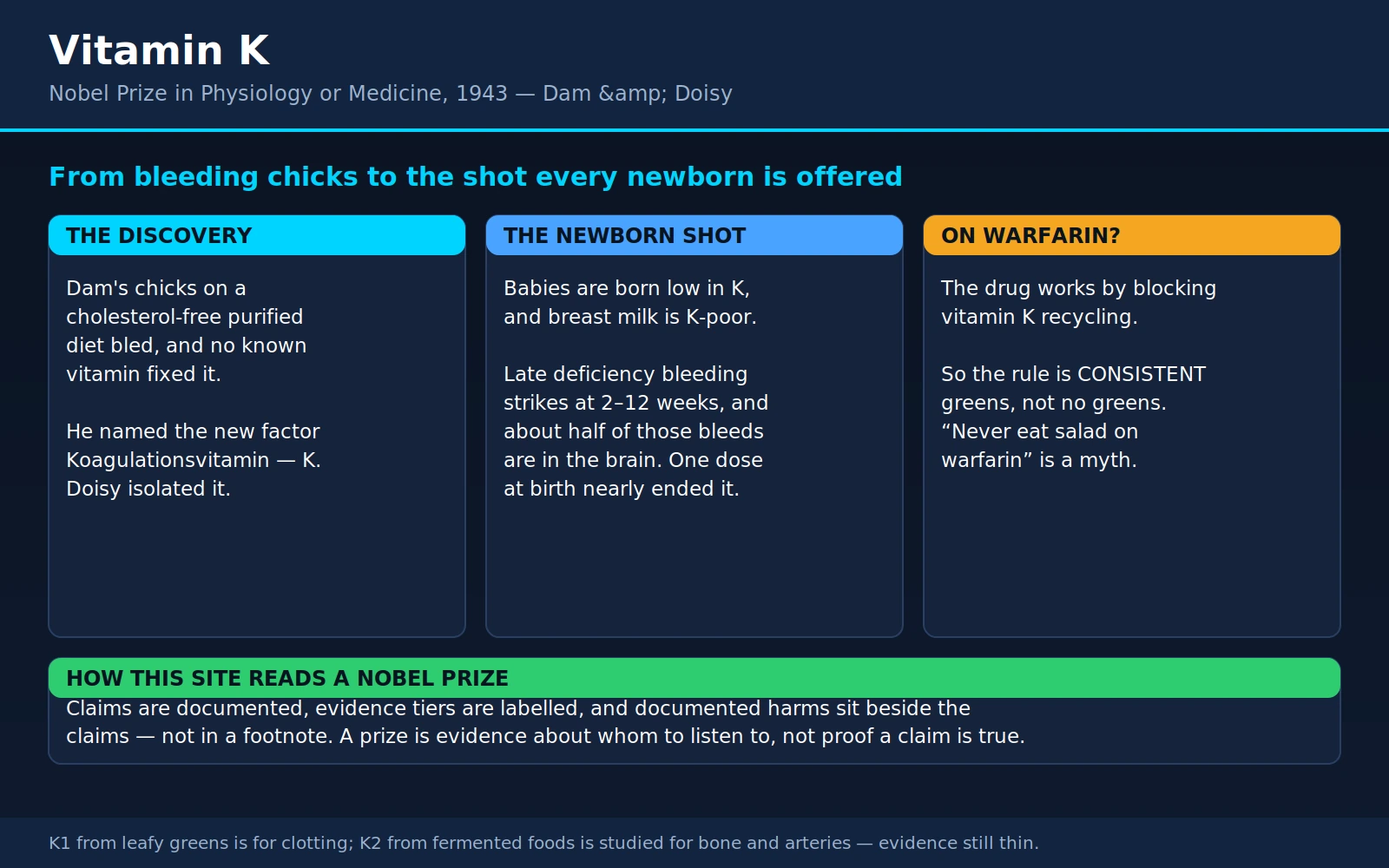
Table of Contents
- The Two Men and the 1943 Prize
- Bleeding Chicks, 1929–1935
- Doisy's Chemistry: From Curiosity to Medicine
- What Vitamin K Actually Does
- The Newborn Shot
- Warfarin: The Other Side of the Coin
- K1 vs K2: The Modern Chapter
- Getting Your K
- Where Mainstream Medicine Agrees / Where Claims Outrun Evidence
- What Dam and Doisy Mean for You Today
- Key Research Papers
- Connections
- Featured Videos
1. The Two Men and the 1943 Prize
Henrik Dam (1895–1976) was a Copenhagen biochemist who noticed something strange in a cholesterol experiment and refused to let it go. Edward Adelbert Doisy (1893–1986) was a biochemist at St. Louis University in Missouri who could take a mysterious biological "factor" and turn it into a pure, named, synthesizable molecule. Between them — the discoverer and the chemist, working an ocean apart and never in the same laboratory — they gave medicine vitamin K, the nutrient your blood cannot clot without. The 1943 Nobel Prize in Physiology or Medicine was split accordingly: Dam's half "for his discovery of vitamin K," Doisy's half "for his discovery of the chemical nature of vitamin K."
The prize itself was a wartime affair. When Germany occupied Denmark in April 1940, Dam happened to be away on a lecture tour of the United States and Canada — and he simply did not go home. He spent the war years in American exile, working at the Woods Hole Marine Biological Laboratory and then at the University of Rochester, which is where the news from Stockholm reached him. Because of the war there was no grand ceremony in Sweden that year; Dam and Doisy received their awards at a ceremony held in New York, and both men traveled to Stockholm in December 1946, after the peace, to deliver the customary Nobel lectures. Dam returned to Denmark that same year as a professor at the Polytechnic Institute in Copenhagen and worked on nutrition — vitamin E, fats, gallstones — until his death in 1976.
For Doisy, the vitamin K prize carried a quiet irony: it was arguably his second Nobel-caliber discovery. In 1929 he had isolated estrone — the first sex hormone ever obtained in pure crystalline form — in a photo-finish with the German chemist Adolf Butenandt, who crystallized it independently within months. When the 1939 Nobel Prize in Chemistry was awarded for sex-hormone chemistry, it went to Butenandt, not Doisy. Doisy went back to work. Four years later the Nobel committee called after all — for a different molecule entirely. He spent essentially his whole career at St. Louis University, chaired its biochemistry department until 1965 (the department is named for him today), and assigned his patent royalties from both the hormone and vitamin work to the university rather than keeping them. He outlived nearly everyone in this story, dying in 1986 at age 92.
Dam and Doisy belong to the great vitamin-hunting generation of the early twentieth century — the era of Christiaan Eijkman and thiamine, and Albert Szent-Györgyi and vitamin C. Their story is worth telling in full because vitamin K is the rare nutrient whose history runs unbroken from a barnyard observation to a shot given in nearly every delivery room on Earth — and because the vitamin's second life, in bones and arteries, is still being written today.
2. Bleeding Chicks, 1929–1935
The discovery began with an experiment that was not about bleeding at all. In 1929, at the University of Copenhagen, Dam was studying whether chicks could synthesize their own cholesterol. To find out, he fed them artificially purified diets from which fats and sterols had been stripped out — and the chicks answered his cholesterol question (yes, they make their own), then handed him a much better one. After a few weeks on the purified feed, the birds began to hemorrhage: bleeding under the skin, into muscle, and around internal organs, and blood drawn from them clotted abnormally slowly.
The obvious first guess was scurvy — bleeding is a classic sign of vitamin C deficiency. So Dam added lemon juice to the feed. Nothing improved. Over the next several years he systematically ruled out everything else known to nutrition science: vitamin C, cod-liver oil (which supplies vitamins A and D), cholesterol itself, and the rest of the alphabet of known vitamins. Nothing prevented the bleeding — yet ordinary foods did. Green leaves, seeds like hempseed, and hog-liver fat protected the chicks completely, and the protective substance dissolved in fat solvents but was clearly not any fat-soluble vitamin already on the books.
By 1935 Dam was confident he had a genuinely new dietary factor, and he named it in print: vitamin K, for Koagulationsvitamin — the coagulation vitamin, spelled with a K as it is in Danish and German. It was a convenient coincidence that K was also an unclaimed letter in the vitamin alphabet. His colleague Fritz Schønheyder pinned down what the bleeding actually was: the deficient chicks were low in prothrombin activity, the blood's clotting precursor — the first solid link between the mysterious food factor and a specific clotting protein. (An American group at Berkeley, Herman Almquist and Robert Stokstad, independently closed in on the same antihemorrhagic factor in alfalfa and putrefied fish meal at almost the same time; publication delays cost them a share of the credit, a near-miss chemists still argue about.)
It is worth pausing on what kind of discovery this was. Dam did not set out to find a vitamin. He was handed an inconvenient side effect — his experimental animals kept bleeding — and instead of treating it as a nuisance ruining his cholesterol study, he treated it as data. Six years of careful exclusion later, the side effect was the discovery. It is one of the clearest examples in nutrition science of the maxim that the experiment you planned is sometimes less valuable than the one nature runs alongside it.
3. Doisy's Chemistry: From Curiosity to Medicine
Naming a factor is not the same as holding it. Through the late 1930s the race was on to isolate pure vitamin K, and Doisy's laboratory in St. Louis — already famous for wringing a few milligrams of estradiol out of literal tons of sow ovaries — was built for exactly this kind of brute-force purification. In 1939 the race ended in a burst. Dam, collaborating with the Swiss chemist Paul Karrer in Zurich, obtained pure vitamin K from alfalfa. That same year Doisy's group isolated two distinct forms: vitamin K1 from alfalfa — a yellow oil now called phylloquinone — and vitamin K2 from putrefied fish meal, a crystalline compound made by bacteria, now called menaquinone. Doisy's team then did what defined his career: they worked out the chemical structures of both, and synthesized K1 in the laboratory.
The structures explained the family resemblance. Both K vitamins are naphthoquinones — a two-ring chemical core — differing only in the tail attached to it: K1 carries a tail suited to the chloroplasts of green plants, K2 a repeating tail built by bacteria. The fish-meal K2 that Doisy purified was, in modern terms, menaquinone-7 (MK-7) — the very same molecule sold in supplement aisles today and delivered abundantly by natto. Nearly ninety years separate Doisy's fish meal from today's MK-7 capsules, and the molecule has not changed.
Why does having the pure molecule matter so much? Because a mystery factor cannot be dosed, and a synthesized one can be manufactured. Within months of the 1939 isolations, vitamin K was already in clinical use. Surgeons had long known that patients with obstructive jaundice — blocked bile flow — bled catastrophically on the operating table; bile, it turns out, is required to absorb this fat-soluble vitamin, so these patients were profoundly deficient. Given vitamin K before surgery, their clotting normalized and a notorious cause of operative death faded. And pediatricians began giving the vitamin to newborns with hemorrhagic disease — the thread this page picks up in section 5. From barnyard curiosity to life-saving drug took roughly a decade; from pure crystal to the operating room took months. That compression is what the Nobel committee was rewarding when it honored the chemistry alongside the discovery.
4. What Vitamin K Actually Does
Vitamin K's job can be said in one sentence: it is the tool that switches clotting proteins on. Your liver manufactures the clotting factors II (prothrombin), VII, IX, and X — but fresh off the assembly line they are duds. Each must be chemically activated by an enzyme that uses vitamin K as its essential cofactor. The enzyme (gamma-glutamyl carboxylase, if you like names) clips a carbon-dioxide group onto specific spots on each protein — a step called gamma-carboxylation. Those added groups act like tiny calcium claws: they let the clotting factor grab calcium and anchor itself to the surface of a wound, where clotting is supposed to happen. No vitamin K, no claws; no claws, no anchoring; no anchoring, no clot. The same activation step also switches on proteins C and S, the natural brakes of the clotting system — vitamin K arms both the accelerator and the brake, which is part of why the system stays balanced.
The body also runs an elegant recycling program. Each time vitamin K activates a protein, the vitamin itself is used up — oxidized into an inactive form called vitamin K epoxide. An enzyme named VKOR (vitamin K epoxide reductase) immediately restores it to the active form, so one vitamin K molecule can be used hundreds of times. This loop — the vitamin K cycle — is why your daily requirement is measured in millionths of a gram, and it is the exact gear that the drug warfarin jams (section 6).
Now the symptoms make sense. Run short of vitamin K and your liver ships out inactive clotting factors; the practical result is bleeding — easy bruising, nosebleeds, blood in urine or stool, oozing that will not stop, and in the worst case bleeding into the brain. On a coagulation panel, deficiency shows up first as a prolonged prothrombin time (PT/INR), because factor VII — the shortest-lived of the four — is the first to run out; the aPTT follows as the others decline. Genuine deficiency is rare in healthy adults eating real food — but there is one group of humans who are all born deficient, and they are the subject of the next section.
5. The Newborn Shot
Every baby is born low on vitamin K. This is not a defect of modern life or of any mother's diet — it is simply how human birth works. The placenta transfers very little vitamin K, a newborn's liver stores are minimal, the gut bacteria that make K2 have not moved in yet, and breast milk — ideal in nearly every other respect — happens to be genuinely poor in vitamin K. The result is a narrow but real window in which a baby's clotting system is running on fumes. When bleeding happens in that window, it is called vitamin K deficiency bleeding (VKDB) — the modern name for what Dam's generation called hemorrhagic disease of the newborn.
VKDB comes in three timings. Early (first 24 hours) is rare and tied to certain medications the mother takes. Classical (days 2–7) shows up as bleeding from the gut, the skin, or the umbilical stump. The one that keeps pediatricians up at night is late VKDB, striking between roughly 2 and 12 weeks of age — almost always in exclusively breastfed babies who did not get vitamin K at birth — because about half of late-VKDB cases are bleeds inside the brain, often arriving with little warning beyond fussiness, poor feeding, or vomiting. Without prophylaxis, early and classical VKDB occur in roughly 0.25 to 1.7 percent of births, and late VKDB in about 4 to 7 per 100,000 infants; an unprotected baby's risk of late VKDB has been estimated at 81 times that of a protected one.
The fix has been in hand for a very long time: a single intramuscular dose of vitamin K1 at birth, standard practice in the United States since the American Academy of Pediatrics recommended it in 1961. One shot, one milligram, and VKDB in all its forms very nearly vanished from countries that adopted it. Measured in lives protected per unit of effort, it is one of the clearest risk–benefit wins in all of pediatrics.
Which is why what happened in Tennessee matters. In 2013, one children's hospital in Nashville treated a cluster of young infants with late VKDB — babies whose parents had declined the birth dose. The CDC's report and the fuller hospital series that followed describe seven vitamin-K-deficient infants in eight months, five of whom developed actual bleeding, including bleeding inside the brain; the infants averaged about ten weeks old, and not one had received vitamin K at birth. Local surveys found a few percent of hospital parents declining the shot — and much higher refusal rates at freestanding birth centers. These were loved, wanted, breastfed babies of attentive parents who had read frightening things online.
The frightening thing most of them had read traces to a single pair of British studies from the early 1990s suggesting a link between the vitamin K shot and childhood leukemia. That claim was taken seriously — which is the system working — and investigated in large studies across several countries. The association was not confirmed. No major pediatric body anywhere concludes that the birth dose causes cancer. What remains true on the other side of the ledger is unchanged since 1961: skipping the shot leaves a baby exposed, for up to three months, to a rare but devastating brain bleed that the shot essentially eliminates. If you are a parent weighing this decision, ask your pediatrician every question you have — and know that this particular question has been asked, studied, and answered as thoroughly as anything in newborn medicine. (Oral vitamin K regimens exist in some countries; they require multiple doses over weeks and protect less reliably against the late, brain-bleed form — especially in babies with undetected liver or bile problems.) Our Vitamin K Deficiency page covers the full clinical picture.
6. Warfarin: The Other Side of the Coin
Everything vitamin K builds, one famous drug is designed to quietly unbuild. Warfarin — born from a 1920s mystery of cattle bleeding to death after eating spoiled sweet-clover hay, isolated by Karl Paul Link's Wisconsin laboratory, sold first as rat poison, and approved for humans in 1954 — works by blocking VKOR, the recycling enzyme of the vitamin K cycle. Jam the recycler and active vitamin K runs out; the liver ships dud clotting factors; blood clots more slowly, on purpose. For people at high risk of dangerous clots — certain heart-rhythm problems, mechanical heart valves, clots in the legs or lungs — that deliberate slowing is protective, and warfarin has prevented untold strokes over seventy years.
Because warfarin and dietary vitamin K sit on opposite ends of the same see-saw, the dose must be tuned to you — and tuned regularly, using the INR blood test (a standardized prothrombin time from the same coagulation panel discussed above; most patients target an INR of 2 to 3). Genetics is part of why doses vary so much between people: common variants in VKORC1 — the gene for the very enzyme warfarin blocks, identified in 2004 — can make one person need a fraction of another's dose, and pharmacogenetic testing now exists for exactly this.
Here is the practical advice warfarin patients actually need, because many are still told the opposite: the goal is a CONSISTENT vitamin K intake, not a low one. The old "no salads on warfarin" instruction is a myth that deserves retirement. If you eat greens steadily, your dose gets titrated to that steady intake and your INR is more stable, not less; the danger is the swing — a kale-smoothie week after a greens-free month, or abruptly quitting vegetables you have always eaten. Eat your greens; just eat them like a metronome, and tell your clinic before any deliberate change. The same consistency rule covers the other moving parts: antibiotics commonly nudge the INR upward (they suppress the gut bacteria that contribute menaquinones, and some interfere with the K cycle directly), while drugs like rifampin push it down; fever, illness, alcohol binges, and starting or stopping any supplement — fish oil, St. John's wort, ginkgo, and yes, vitamin K2 capsules, which directly oppose the drug — can all move the number. None of these are reasons for fear; all of them are reasons to keep your anticoagulation clinic in the loop and your habits boring. (The newer anticoagulants — apixaban, rivaroxaban, dabigatran — block clotting factors directly, involve vitamin K not at all, and need no INR checks or dietary consistency; whether one of them suits you is a conversation for your cardiologist.)
7. K1 vs K2: The Modern Chapter
For half a century after the Nobel, vitamin K meant clotting, full stop. The modern chapter opened when researchers realized the clotting factors are not the only proteins waiting for vitamin K's activation step. Two others changed the conversation: osteocalcin, made by bone-building cells, which needs carboxylation to help bind calcium into the bone matrix; and matrix Gla protein (MGP), made in blood-vessel walls, which needs it to do the opposite job — keep calcium out of places it does not belong. The MGP story announced itself dramatically in 1997, when mice engineered to lack the protein died within weeks as their arteries turned to bone. Vitamin K, it emerged, is not just the clotting vitamin: it is a calcium-traffic-control vitamin, and clotting was simply the first checkpoint discovered.
This is also where the K1/K2 split that Doisy first isolated in 1939 becomes practical. K1 (phylloquinone), from leafy greens, is efficiently captured by the liver and spent mostly on clotting factors. K2 (the menaquinones), from fermented and animal foods, lingers longer in circulation and reaches bone and vessel walls more generously — the long-tailed MK-7 form (natto's form, and Doisy's fish-meal form) stays in the blood for days, versus hours for K1. The short-tailed MK-4 is what your own tissues convert other forms into locally. Hence the modern hypothesis: greens keep you clotting; menaquinones may additionally serve your skeleton and arteries.
What does the evidence actually show? For bones: Japanese researchers have used pharmacological MK-4 (at 45 milligrams a day — a drug dose, hundreds of times dietary levels) as an approved osteoporosis treatment for years, with mixed but real trial support, and a well-run three-year Dutch trial of nutritional-dose MK-7 (180 micrograms daily) in postmenopausal women found meaningfully slower loss of bone mineral density at the spine and femoral neck. Promising — genuinely — but a modest evidence base next to established osteoporosis care. For arteries: the signal that launched a thousand supplement labels is the Rotterdam Study (2004), which followed thousands of Dutch adults and found that those with the highest dietary menaquinone intake had substantially lower coronary heart disease mortality and less aortic calcification — while K1 intake showed no such association; a later Dutch cohort tied menaquinone intake to less coronary calcification. But these are observational findings — people who eat aged cheese may differ in a hundred ways — and the randomized trials that have since tested K2 against hard measures of arterial calcification have so far not confirmed that supplements slow it. Honest summary, per this site's evidence tiers: bone benefit — promising, small-trial-supported, unproven at scale; artery benefit — biologically plausible, observationally suggested, not demonstrated in trials. K2 marketing runs well ahead of that ledger, and readers deserve to know where the ledger actually stands. The full story lives on our Vitamin K Benefits pages.
8. Getting Your K
Vitamin K is one of the easiest nutrients to get from real food — Dam found it in green leaves in 1935, and the advice has barely needed updating since. Adults are advised around 90 to 120 micrograms a day, and a single serving of cooked greens can deliver several times that. Food first:
- Kale, spinach, and collard greens — the K1 heavyweights; one cooked cup of any of them clears several days' worth.
- Broccoli, Brussels sprouts, and cabbage — solidly rich, gentler flavors.
- Natto — the traditional Japanese fermented food, and the richest MK-7 source known by an enormous margin; nothing else is close.
- Hard and aged cheeses — the everyday Western menaquinone source (mostly MK-8 and MK-9, made by the fermenting bacteria).
- Egg yolks, liver, butter, and dark chicken meat — modest but steady MK-4 contributors.
Two practical notes. First, vitamin K is fat-soluble: greens eaten with olive oil, butter, or egg — a dressed salad, greens sautéed in fat — yield several-fold more absorbed vitamin than the same greens eaten dry. Second, who actually runs low: newborns (section 5, solved by the shot); people with fat-malabsorption conditions — celiac disease, Crohn's disease, cystic fibrosis, bile-duct obstruction, or bariatric surgery; and people on long courses of broad-spectrum antibiotics, especially if eating poorly at the same time. A healthy adult eating greens regularly essentially cannot become deficient.
And toxicity — told honestly, because it is unusually reassuring: natural K1 and K2 have no known toxicity ceiling. No tolerable upper intake level has ever been set, because even large supplemental doses have not produced harm in people with normal clotting (the one hard exception: anyone on warfarin, for whom K supplements directly fight the drug — section 6). The cautionary tale belongs to menadione, so-called vitamin K3 — a cheap synthetic once used in infant formulas and injections that damaged red blood cells and injured newborns' brains; it was abandoned for human use decades ago, and its ghost is sometimes invoked to spook people about vitamin K generally. The molecule that earned the fear is not the molecule in your spinach, your natto, or the newborn shot.
9. Where Mainstream Medicine Agrees / Where Claims Outrun Evidence
Where mainstream medicine agrees
- Vitamin K is essential for clotting — the Dam–Doisy core, settled for eighty years and taught in every medical school.
- The newborn intramuscular dose prevents VKDB, including the late brain-bleed form; every major pediatric body worldwide recommends it, and the 1990s leukemia scare was investigated and not confirmed.
- Vitamin K before surgery in obstructive jaundice, and as part of reversing warfarin overdose, are standard, uncontroversial medicine.
- Warfarin patients should keep vitamin K intake consistent, not low — the modern consensus, even if outdated "avoid greens" advice still circulates.
- Menadione (K3) is unsafe for humans — agreed by all sides, and long gone from human medicine.
Where claims outrun evidence
- "K2 cleans out your arteries." The observational Rotterdam signal is real and the MGP mechanism is elegant, but randomized trials have not shown K2 supplements slow arterial calcification. Plausible hypothesis; unproven therapy.
- "K2 supplements prevent fractures." Small trials show slower bone-density loss (MK-7) and Japan uses pharmacological MK-4, but large-scale fracture prevention from over-the-counter K2 is not established.
- "Everyone is K2 deficient and must supplement." There is no accepted test-based definition of K2 deficiency in healthy people, and no body sets a separate K2 requirement; food sources cover the known needs.
- "The newborn shot is toxic / causes leukemia." Studied at scale across countries; not confirmed. Declining it, by contrast, carries a measured, well-documented risk.
- "D3 is dangerous without K2." A marketing pairing stated far more confidently than the data allow; sensible vitamin D doses have not been shown to require K2 co-supplementation for safety.
10. What Dam and Doisy Mean for You Today
Strip the story to what a reader can use, and four things remain. If you are expecting a baby: the vitamin K shot at birth is the direct, living legacy of these two men — a one-time dose that closes a three-month window of real danger, with a safety record examined as closely as anything in pediatrics. Let your newborn have it. If you or someone you love takes warfarin: the drug is vitamin K's mirror image; keep greens steady rather than banished, guard the INR routine, and report every new antibiotic and supplement. If you care about your bones and arteries: eat the actual foods — greens daily with some fat, fermented foods like natto or aged cheese if you enjoy them — and hold K2 supplement claims to the standard this page uses: promising for bone, unproven for arteries. If you care how science works: remember that this entire branch of medicine exists because one researcher in Copenhagen refused to ignore his experiment's side effect, and one chemist in St. Louis insisted on knowing exactly what the molecule was. Curiosity found vitamin K; chemistry made it a medicine; both halves earned the prize.
11. Key Research Papers
- Dam H. The antihaemorrhagic vitamin of the chick — the 1935 papers naming vitamin K (they predate PubMed's index; start here: PubMed search: Dam antihaemorrhagic vitamin chick)
- Ferland G. The discovery of vitamin K and its clinical applications. Ann Nutr Metab 2012;61(3):213-8
- Zetterström R. H. C. P. Dam (1895–1976) and E. A. Doisy (1893–1986): the discovery of antihaemorrhagic vitamin and its impact on neonatal health. Acta Paediatr 2006;95(6):642-4
- Shearer MJ. Vitamin K deficiency bleeding (VKDB) in early infancy. Blood Rev 2009;23(2):49-59
- Centers for Disease Control and Prevention. Notes from the field: late vitamin K deficiency bleeding in infants whose parents declined vitamin K prophylaxis — Tennessee, 2013. MMWR Morb Mortal Wkly Rep 2013;62(45):901-2
- Schulte R, Jordan LC, Morad A, et al. Rise in late onset vitamin K deficiency bleeding in young infants because of omission or refusal of prophylaxis at birth. Pediatr Neurol 2014;50(6):564-8
- Rost S, Fregin A, Ivaskevicius V, et al. Mutations in VKORC1 cause warfarin resistance and multiple coagulation factor deficiency type 2. Nature 2004;427(6974):537-41
- Luo G, Ducy P, McKee MD, et al. Spontaneous calcification of arteries and cartilage in mice lacking matrix GLA protein. Nature 1997;386(6620):78-81
- Geleijnse JM, Vermeer C, Grobbee DE, et al. Dietary intake of menaquinone is associated with a reduced risk of coronary heart disease: the Rotterdam Study. J Nutr 2004;134(11):3100-5
- Knapen MH, Drummen NE, Smit E, et al. Three-year low-dose menaquinone-7 supplementation helps decrease bone loss in healthy postmenopausal women. Osteoporos Int 2013;24(9):2499-507
- Schurgers LJ, Vermeer C. Determination of phylloquinone and menaquinones in food. Effect of food matrix on circulating vitamin K concentrations. Haemostasis 2000;30(6):298-307
Live PubMed Searches
- Vitamin K discovery history
- Vitamin K deficiency bleeding — newborn
- Vitamin K2 menaquinone — bone
- Matrix Gla protein — vascular calcification
- Warfarin — vitamin K interaction
Connections
- All Notable Doctors
- Nobel Prize in Medicine — the full wing of laureate stories on this site
- Christiaan Eijkman — beriberi, thiamine, and the birth of the vitamin idea
- Albert Szent-Györgyi — vitamin C isolated, the other great vitamin Nobel
- Frederick Banting — insulin: another discovery that went from lab to lifesaving in months
- Vitamin K — the site's full topic hub: forms, dosing, food tables
- Vitamin K Benefits — bone, heart, and clotting evidence in depth
- Vitamin K Deficiency — who runs low, symptoms, and testing
- Coagulation Panel — PT/INR and the tests vitamin K status shows up on
- aPTT — the companion clotting time explained
- Hematology — blood and clotting disorders across the site
- Kale — a K1 heavyweight, profiled
- Spinach — everyday K1 with a full nutrient profile
- Natto — the MK-7 champion Doisy's fish meal foreshadowed