Fire & Mello: RNA Interference, and the Drugs It Became
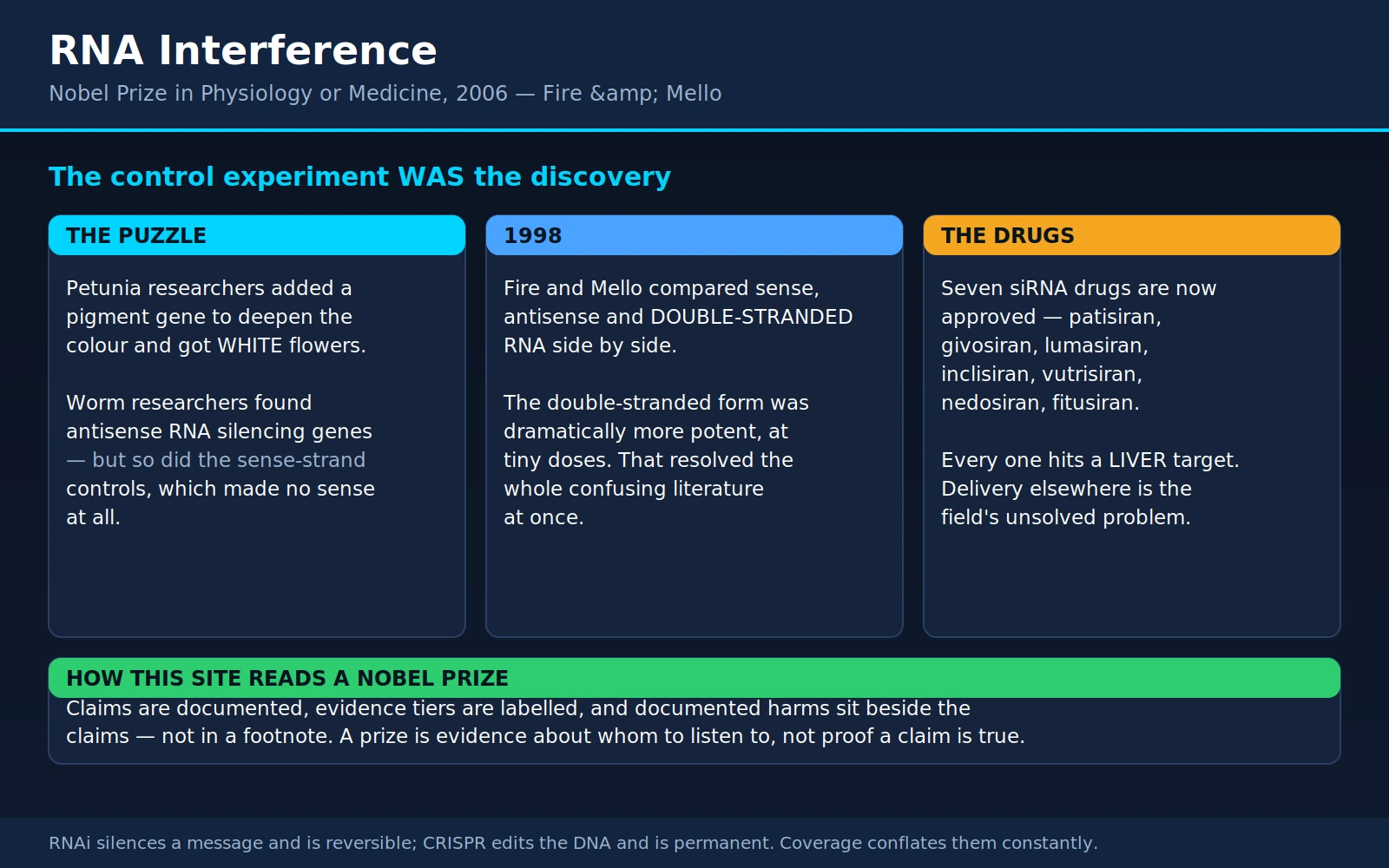
Table of Contents
- The Prize and the Two Scientists
- The Puzzle They Inherited
- The 1998 Experiment
- How RNA Interference Actually Works
- RNAi Versus MicroRNA
- What It Did for Research Immediately
- The Drugs It Became
- What Is Not Yet Solved
- RNAi in Agriculture, and the "Eating RNA" Question
- Gene Silencing Versus Gene Editing
- Where Mainstream Medicine Agrees — and What Remains Debated
- Key Research Papers
- Connections
- Featured Videos
1. The Prize and the Two Scientists
On 2 October 2006, the Nobel Assembly at the Karolinska Institute awarded the Nobel Prize in Physiology or Medicine jointly to Andrew Z. Fire and Craig C. Mello "for their discovery of RNA interference — gene silencing by double-stranded RNA." The paper that earned it had been published on 19 February 1998. Eight years, start to finish.
That is startlingly fast, and it is worth pausing on, because this site's Peyton Rous page records the opposite extreme. Rous showed in 1911 that a cell-free filtrate from a chicken tumour could transmit cancer to another chicken. He received his Nobel in 1966 — fifty-five years later, at the age of eighty-seven. The prize committee is not usually in a hurry. It gave Fire and Mello eight years because by 2006 the consequences of their result were already unmistakable: RNA interference had gone from an oddity in a soil nematode to a technique running in essentially every molecular biology laboratory on the planet, and the first attempts to turn it into medicine were already in clinical trials.
Andrew Fire was born in Palo Alto, California, in 1959. He took a mathematics degree at Berkeley in 1978, then a PhD at MIT in 1983 in the laboratory of Phillip Sharp — who would himself share the 1993 Nobel Prize for the discovery of split genes. Fire then trained with Sydney Brenner at the Laboratory of Molecular Biology in Cambridge, England, and in 1986 took a position at the Carnegie Institution of Washington's Department of Embryology in Baltimore. That is the address on the 1998 paper. In 2003 he moved to Stanford University School of Medicine, where he is a professor of pathology and of genetics.
Craig Mello was born in New Haven, Connecticut, in 1960, the son of a paleontologist. He took his degree at Brown, did his PhD at Harvard, and did postdoctoral work in Seattle with Jim Priess at the Fred Hutchinson Cancer Research Center. In 1994 he set up his own laboratory at the University of Massachusetts Medical School in Worcester, where he still works and where he became a Howard Hughes Medical Institute investigator in 2000.
Both men worked on Caenorhabditis elegans, a transparent soil roundworm about a millimetre long that Sydney Brenner had proposed in the 1960s as a model organism precisely because it was small, fast-breeding, and had a fixed and countable number of cells. It is the same animal that gave us microRNA a few years earlier, in the hands of Victor Ambros and Gary Ruvkun, and the same animal on which the 2002 prize for programmed cell death was awarded. For a worm nobody had heard of in 1960, C. elegans has been extraordinarily productive.
What follows is the story of one clean experiment that resolved a decade of confusing results, the mechanism it exposed, and — the part that matters most to a reader who is not a molecular biologist — the seven approved drugs that exist today because of it.
2. The Puzzle They Inherited
Fire and Mello did not stumble on RNA interference out of a clear sky. They walked into a mess and cleaned it up. Understanding what the mess was makes the 1998 experiment far more impressive than it looks in summary.
The petunias that came out white
In 1990, a group at what was then the DNA Plant Technology Corporation in Oakland, California — Carolyn Napoli, Christine Lemieux and Richard Jorgensen — set out to do something that should have been simple. Petunia flowers get their purple colour from pigments made by an enzyme called chalcone synthase. The researchers reasoned that if one copy of the chalcone synthase gene gives you a purple flower, then adding extra copies should give you a deeper, more intensely purple flower. Ornamental horticulture would be pleased.
They inserted a chimeric chalcone synthase gene into petunias. A striking fraction of the resulting plants produced flowers that were white — or white with purple sectors, or purple with white sectors, in patterns that varied plant to plant. Adding a pigment gene had switched pigment off.
Worse, from the point of view of anyone hoping for a tidy explanation, the added gene had not merely failed. It had silenced the plant's own resident copy as well. Both the introduced gene and the endogenous gene had gone quiet together. Napoli, Lemieux and Jorgensen named the phenomenon co-suppression and reported that it was reversible — later generations could recover their colour.
This was a genuinely bizarre result. Under the genetics of the time, extra copies of a gene meant more product. Nothing in the standard model predicted that a gene could sense the presence of an identical sequence elsewhere in the cell and shut both of them down.
Plant biologists ran into related phenomena repeatedly through the early 1990s, under a proliferation of names: co-suppression, post-transcriptional gene silencing, quelling (in the fungus Neurospora), and virus-induced gene silencing. Plants infected with a virus could become resistant to related viruses in a sequence-specific way. Something in plants was recognising particular sequences and destroying them, and nobody could say what.
The control experiment that behaved like the treatment
Meanwhile, in the worm, a different puzzle was building.
The standard way to shut off a gene experimentally in the early 1990s was antisense RNA. The logic is intuitive. A gene is transcribed into messenger RNA — the "sense" strand, which carries the coding message to the ribosome. If you introduce an RNA molecule with the complementary sequence — the "antisense" strand — it should base-pair with the message and physically block the ribosome from reading it. A molecular gag.
Fire himself had published on this in 1991, showing with colleagues in Development that antisense RNA injected into C. elegans could specifically inhibit muscle gene expression. The technique worked, more or less, and people used it.
Any careful antisense experiment includes a control: you also inject the sense strand, the one with the same sequence as the messenger RNA. Sense RNA should do nothing. It cannot base-pair with a message it is identical to. It is the negative control that proves your antisense effect was really about base-pairing.
The sense controls kept working.
The clearest published instance came in 1995, from Su Guo and Kenneth Kemphues at Cornell. Their paper was about par-1, a gene that establishes the front-to-back polarity of the C. elegans embryo, and the title says nothing about RNA at all — it is a paper about a serine/threonine kinase. But in the course of the work they used RNA injection to knock par-1 down, and they reported that the sense-strand control silenced the gene just as effectively as the antisense RNA did.
Under the simple antisense model, that is impossible. Yet it was not a one-off. Worm laboratories talked about it; it appeared in the margins of papers; people invented ad hoc explanations. Perhaps the injected RNA preparations were contaminated. Perhaps a cellular polymerase was copying the sense strand into antisense inside the cell. Perhaps something about the injection procedure was non-specific.
Why this pattern was a signal, not a nuisance
This is the part worth dwelling on, because it generalises far beyond molecular biology.
A control experiment exists to produce a null result. When it produces the same result as the treatment, the honest interpretations divide into two families. Either the experiment is broken — contamination, artefact, a mistake in the protocol — or the model behind the control is wrong. The control was designed on an assumption, and the assumption has just been contradicted.
The overwhelmingly common response is to assume the first. It is usually correct. Most anomalies really are artefacts, and a scientist who chases every one of them will never finish anything. So people did what people do: they noted the oddity, cleaned up their RNA preparations, and moved on to the question they had actually set out to answer.
But an artefact should be erratic. It should come and go with the preparation, the batch, the operator, the season. The sense-strand effect was not erratic. It kept happening, in different laboratories, with different genes. A reproducible anomaly is a much stronger signal than an occasional one, because reproducibility is exactly what an artefact usually lacks.
And there was a second signal, one that only becomes visible if you are willing to look across fields. The petunia people and the worm people were seeing the same shape of result — sequence-specific silencing that did not fit the antisense model — in organisms separated by roughly a billion years of evolution. Two unrelated groups of researchers, working on unrelated organisms with unrelated techniques, do not usually generate the same artefact.
What Fire and Mello did was take the anomaly at face value and design an experiment whose entire purpose was to find out what the active agent actually was.
3. The 1998 Experiment
The experiment is beautiful because it is so plain. It asks one question and answers it.
Fire, Mello and their colleagues — SiQun Xu, Mary Montgomery, Stephen Kostas and Samuel Driver were the other four authors — injected RNA into adult C. elegans and scored the effect on the target gene. The variable was the form of the RNA:
- Sense RNA alone — the strand matching the messenger.
- Antisense RNA alone — the complementary strand, the one everyone assumed was doing the work.
- Both strands mixed and annealed — double-stranded RNA.
The result, in the paper's own words: "To our surprise, we found that double-stranded RNA was substantially more effective at producing interference than was either strand individually. After injection into adult animals, purified single strands had at most a modest effect, whereas double-stranded mixtures caused potent and specific interference."
That single comparison dissolved a decade of confusion. The sense controls had been working because single-strand preparations made by in-vitro transcription are never perfectly pure — they carry a small amount of the complementary strand, enough to form a trace of duplex. The trace was the whole effect. The antisense strand had never been the active agent. Double-stranded RNA was.
Once you know that, everything falls into place. Co-suppression in petunias, quelling in fungi, virus-induced silencing in plants, the erratic antisense results in worms — all of it is one mechanism, triggered by double-stranded RNA, that had been showing up in fragments across half a dozen fields.
The three properties that made it more than a curiosity
The paper reported three further observations, and each one told the field that this was not simple chemistry.
It was catalytic, not stoichiometric. If double-stranded RNA worked by physically sticking to messenger RNA and blocking it, you would need at least one RNA molecule per message. Fire and Mello calculated that only a few molecules of injected double-stranded RNA were required per affected cell — far too few to mop up the target message one-for-one. Their conclusion, stated carefully in the abstract, was that there "could be a catalytic or amplification component in the interference process." Something in the cell was using the injected RNA as information, not as a reagent. That is the difference between handing someone a lock and handing them a description of what to break.
It spread. RNA injected into one part of the animal silenced the target gene in tissues far from the injection site, including tissues the needle never approached. The silencing signal was moving between cells. (The transporter responsible in the worm, a channel protein called SID-1, was identified a few years later by Craig Hunter's laboratory; most mammals lack a functional equivalent, which is one reason systemic RNAi is harder in us than in worms.)
It was inherited. The effects, the paper reports, "were evident in both the injected animals and their progeny." Inject the parent, and the offspring — which were never injected — are born with the gene silenced. In C. elegans this inheritance can persist for several generations. Mello's laboratory has spent much of the subsequent quarter-century working out how, and the answer involves a specialised class of small RNAs and modifications laid down in the germ line.
None of this is how a chemical inhibitor behaves. It is how a system behaves — a pathway the cell already had, which the experimenters had accidentally learned how to program.
4. How RNA Interference Actually Works
Here is the pathway in plain language. It was assembled between 1999 and 2004 by many laboratories, several of which could reasonably have been included in the prize.
Step 1: the dsRNA is chopped up
Long double-stranded RNA in the cytoplasm is recognised by an enzyme called Dicer — a ribonuclease identified in 2001 by Emily Bernstein, Amy Caudy, Scott Hammond and Gregory Hannon at Cold Spring Harbor, who named it for exactly what it does. Dicer cuts the duplex into short fragments of a very consistent length: 21 to 23 nucleotides, with a characteristic two-nucleotide overhang at each 3′ end.
That number was pinned down first by Andrew Hamilton and David Baulcombe, who in 1999 found small RNAs of about 25 nucleotides in silenced plants — the first direct sighting of the intermediate — and then by Phillip Zamore, Thomas Tuschl, Phillip Sharp and David Bartel, who showed in 2000 that double-stranded RNA directs cleavage of the target message at intervals of 21 to 23 nucleotides. The regular spacing was the giveaway: the cell was not attacking the message at random, it was attacking it with a ruler.
These fragments are called small interfering RNAs, or siRNAs.
Step 2: one strand is loaded as a guide
An siRNA duplex is handed to a protein complex called RISC — the RNA-Induced Silencing Complex. At the heart of RISC is a protein from the Argonaute family. RISC discards one strand of the duplex (the "passenger") and keeps the other (the "guide"), loaded into a groove that leaves the guide's bases exposed and ready to pair.
Step 3: RISC hunts and cuts
The loaded complex now moves through the cytoplasm sampling messenger RNAs. When it finds one whose sequence is complementary to its guide across the full length, Argonaute's catalytic core cleaves the message in two. The severed message is degraded by ordinary cellular exonucleases. No protein is made from it.
Then — and this is the catalytic part Fire and Mello inferred without seeing — RISC releases the fragments and goes looking for the next matching message. One loaded complex destroys many copies. That is why a few molecules per cell were enough.
Why this is worth calling programmable
Almost every drug you have ever taken works by shape. A statin fits into the active site of HMG-CoA reductase because its three-dimensional shape complements that particular pocket — a fact that runs directly out of the enzymology worked out by Konrad Bloch and Feodor Lynen. Finding such a molecule means screening enormous chemical libraries and hoping. For most human proteins nobody has ever found one, which is where the phrase "undruggable target" comes from.
RNA interference does not work by shape. It works by sequence. The machinery — Dicer, Argonaute, RISC — is the same regardless of the target. What changes is the guide sequence, twenty-one letters long, which functions as the search term. If you know the sequence of the message you want gone, you can in principle write the guide on paper.
This is a categorical difference. It is the difference between having to invent a new key for every lock and having a locksmith who takes instructions. It is also why the drug programmes described in section 7 move so much faster from target to candidate than conventional small-molecule programmes do — the design step that normally takes years is, for an siRNA, largely a matter of choosing a sequence and optimising its chemistry.
Where the system came from
Cells do not build elaborate machinery for the convenience of experimenters. RNA interference existed long before anyone injected anything, and the strong consensus is that it is an ancient antiviral immune system.
The reasoning is straightforward. Long double-stranded RNA is essentially absent from the normal life of an animal cell. Your own genes are transcribed into single-stranded messages. But double-stranded RNA is the unavoidable signature of a replicating RNA virus — either as the virus's own genome or as the replication intermediate it must pass through. So "long double-stranded RNA is present" is a nearly unambiguous alarm signal meaning "a virus is copying itself in here." A system that detects that signal, reads the sequence, and then destroys every message matching it, is a sequence-specific antiviral defence with a built-in memory.
The evidence for this is not merely inferential. RNAi is demonstrably the primary antiviral defence in plants, insects, fungi and nematodes. Plant and insect viruses carry dedicated suppressor proteins whose job is to disable the host's RNAi machinery — an arms race only makes sense if the defence is real. Vertebrates, which evolved interferon responses and adaptive immunity, appear to lean less heavily on RNAi for antiviral purposes, and the extent to which it still functions that way in mammals remains genuinely debated.
The practical consequence for medicine is large and shows up in section 8: because long double-stranded RNA is an alarm signal, injecting it into a mammal risks setting off the innate immune system. Therapeutic siRNAs sidestep this partly by being short — 21 nucleotides, already Dicer-sized, so they skip the step that triggers the sensors — and partly by carrying chemical modifications that make them look less like a virus. That problem, and its solution, is a recurring theme in the history of both siRNA drugs and the modified-nucleoside mRNA vaccines.
5. RNAi Versus MicroRNA
Two Nobel Prizes sit next to each other here, and readers routinely conflate them. Fire and Mello were honoured in 2006 for RNA interference. Ambros and Ruvkun were honoured in 2024 for microRNA. Both prizes are about short RNA molecules silencing genes. They are not the same thing, and the difference is worth having straight.
They run on the same machinery. Dicer processes both. Argonaute carries both. RISC executes both. In a cell, a microRNA and a therapeutic siRNA are loaded into the same kind of complex.
What differs is origin, match, and consequence.
The dimmer switch: microRNA
- Endogenous. A microRNA is encoded in your own genome. Your cells make hundreds of them on purpose, as part of normal development and physiology.
- Imperfectly matched. A microRNA pairs with its targets through a short stretch — roughly nucleotides 2 to 8, the "seed" — and tolerates mismatches elsewhere. A six-to-eight-letter match happens by chance often, so a single microRNA has many targets, sometimes hundreds.
- It tunes. Because the match is partial, Argonaute usually cannot cleave. Instead the complex represses translation and destabilises the message, typically reducing protein output by a modest fraction rather than abolishing it.
A microRNA is a dimmer. It turns many lights down a bit.
The switch: siRNA
- Usually exogenous. A therapeutic siRNA is designed and manufactured, then delivered. (Endogenous siRNAs do exist in plants, worms and flies; in human medicine, siRNA means a drug.)
- Perfectly matched. The guide is complementary to its target across its whole length. That degree of match is essentially unique in a human transcriptome — which is the point.
- It destroys. Full complementarity licenses Argonaute to cut. The message is severed and degraded. Knockdown of 80–95 percent is routine.
An siRNA is a switch. It turns one light off.
Why the distinction has clinical consequences
The many-targets property is exactly what has made microRNA-based therapeutics so difficult — a drug that nudges hundreds of genes is hard to make safe, and the Ambros/Ruvkun page records the failures honestly, including the phase 1 trial of the miR-34a mimic MRX34 that was halted for serious immune-related adverse events.
The one-target property is exactly what has made siRNA therapeutics tractable. You pick a single protein, you knock down the message that makes it, and you can measure the protein in blood to confirm you did. Seven such drugs are approved. None of the microRNA-based candidates has reached approval.
Same machinery. Very different engineering problem.
6. What It Did for Research Immediately
Before 1998, finding out what a gene did meant, in practice, breaking it — making a mutant, or building a knockout animal. In a mouse that took a year or more and a great deal of money. In human cells it was close to impossible.
RNA interference collapsed that. Feed a worm bacteria expressing double-stranded RNA against a gene and it silences that gene — you can do a genome-wide screen in Petri dishes. Fly cells took up double-stranded RNA from the culture medium directly. And once Sayda Elbashir, Thomas Tuschl and colleagues showed in 2001 that synthetic 21-nucleotide siRNA duplexes silence genes in cultured mammalian cells without setting off the interferon alarm that long double-stranded RNA triggers, the technique arrived in human biology.
That 2001 paper is the hinge. Long double-stranded RNA cannot be used in mammalian cells — the innate immune system reads it as viral and shuts down protein synthesis globally. Short, pre-diced duplexes slip under that threshold. Everything downstream, including every siRNA drug in section 7, descends from it.
Within a few years, libraries of siRNAs covering every gene in the human genome were commercially available. You could run a screen: knock down each of 20,000 genes in turn, and see which knockdowns make cancer cells die, or make a virus stop replicating, or make a neuron survive a toxin. Ten years earlier this would have sounded like science fiction.
The honest part: the off-target problem
A great deal of what those screens produced did not hold up, and it is worth being straightforward about why.
The design assumption was that a 21-nucleotide guide is specific, because a 21-letter sequence is essentially unique. The assumption was wrong in an instructive way. As Aimee Jackson and colleagues at Rosetta Inpharmatics showed in 2003 by expression profiling, siRNAs also silence unintended genes — and they do it through the seed. An siRNA's first several nucleotides can act like a microRNA seed, and a seed match is short enough to occur in many messages by chance. So each siRNA behaves partly like a designed switch and partly like an accidental dimmer, nudging down dozens of genes nobody intended to touch.
The failure mode this creates is nasty because it looks like success. If you knock down gene X and the cells die, the obvious inference is that gene X is essential. But if your particular siRNA also happens to seed-match a genuinely essential gene, the cells die for a reason having nothing to do with X. The experiment worked, the readout was clean, and the conclusion was false.
This was not a marginal problem. A substantial share of the RNAi-screening literature from roughly 2003 to 2013 has not replicated. William Kaelin — himself later a Nobel laureate, for the oxygen-sensing work — wrote a blunt commentary in Science in 2012 titled "Use and abuse of RNAi to study mammalian gene function," arguing that a great many published RNAi conclusions rested on a single reagent with no adequate control. Some highly cited cancer targets identified by RNAi screens were later shown, using cleaner methods, not to be required at all.
The field's response was two-part and largely successful. First, better controls became standard: use several independent siRNAs against the same gene and require that they agree; include a rescue experiment in which you re-introduce a version of the gene that the siRNA cannot recognise and show the phenotype disappears; and design guides to avoid promiscuous seeds. Second, and more decisively, CRISPR-based screening arrived after 2013 and largely displaced RNAi for this purpose. Cutting a gene out of the genome does not have a seed effect, and side-by-side comparisons found CRISPR screens considerably cleaner.
Two things follow, and both are worth holding at once. RNAi as a discovery screening tool in mammalian cells has been substantially superseded. RNAi as a therapeutic has not — because a drug is one carefully optimised sequence, tested for years in animals and humans, with the actual clinical endpoint as the readout, not a single reagent scored in a dish. The off-target problem that wrecked screens is a manageable design constraint in drug development. Section 7 is what that looks like.
7. The Drugs It Became
This is the part that matters most, and the part most often described in the future tense when it should be described in the past. RNA interference is not a promising avenue. It is an approved drug class with seven members on the US market, some of them a decade old in clinical experience, and one of them prescribed to ordinary outpatients for high cholesterol.
The delivery problem, which took twenty years
The biology was solved in 1998 and reduced to practice in human cells by 2001. The first approval came in 2018. Seventeen years went into one problem: getting the siRNA into the right cell.
A naked siRNA injected into a person is in serious trouble immediately. It is degraded within minutes by nucleases in blood. It is small enough to be filtered out by the kidneys and excreted. It carries a strong negative charge along its phosphate backbone, and cell membranes — also negatively charged — repel it. If any of it does reach the target tissue, it cannot cross the membrane on its own. And whatever survives risks tripping the innate immune sensors described in section 4.
Two engineering solutions eventually worked.
Lipid nanoparticles. Package the siRNA inside a tiny fat bubble built from ionisable lipids — molecules that are neutral in blood but pick up positive charge in the acidic interior of an endosome, which helps the particle break out and release its cargo into the cytoplasm. Lipid nanoparticles given intravenously accumulate in the liver, because the liver's fenestrated blood vessels and its job of clearing particles from blood make it the default destination for anything particulate. Patisiran, the first approved siRNA drug, uses this. The chemistry and its clinical translation are recounted by Akinc and colleagues in Nature Nanotechnology in 2019 — and the same lipid-nanoparticle lineage went on to carry the mRNA in the COVID-19 vaccines. That is not a coincidence of history; it is the same delivery technology, developed for RNAi, applied to a different cargo.
GalNAc conjugation. This is the more elegant solution, and it is why the field looks the way it does today. Liver cells — hepatocytes specifically, not the liver's other cell types — display enormous numbers of a receptor called the asialoglycoprotein receptor, whose normal job is to pull ageing glycoproteins out of blood by recognising exposed galactose sugars. Attach three N-acetylgalactosamine (GalNAc) sugars to one end of an siRNA and you have made a molecule that this receptor grabs on sight. The receptor internalises its cargo and recycles back to the surface in about fifteen minutes, so it can do this over and over.
The result is a drug you can inject under the skin, in a small volume, which then finds hepatocytes by itself. The design was demonstrated by Jayaprakash Nair and colleagues at Alnylam in 2014; Springer and Dowdy's 2018 review in Nucleic Acid Therapeutics is a good account of how it took over the field. Combined with backbone chemistry — 2′-O-methyl and 2′-fluoro sugar modifications, phosphorothioate linkages at the ends — that resists nucleases, GalNAc conjugation produces drugs with an astonishing duration of action inside the cell: months from a single dose.
And here is the boundary of the entire field, stated plainly: nearly every approved siRNA drug treats a disease caused by a protein made in the liver. Not because liver diseases are the most important, but because GalNAc solved delivery to hepatocytes and nothing has yet solved delivery anywhere else with comparable reliability. The drug list below is, in effect, a list of well-chosen liver targets.
The approved drugs
Patisiran (Onpattro), approved August 2018 — the first. For the polyneuropathy of hereditary transthyretin-mediated amyloidosis, a rare inherited disease in which a misfolded liver protein, transthyretin, deposits as amyloid in nerves and heart. Patisiran silences the transthyretin message in hepatocytes so the misfolded protein is not made in the first place. In the APOLLO trial, 225 patients were randomised 2:1 to intravenous patisiran or placebo every three weeks. At 18 months the neuropathy impairment score had improved by 6.0 points in the patisiran group while worsening by 28.0 points on placebo — a 34-point separation. Quality-of-life scores, walking speed and nutritional status all moved the same way. For a relentlessly progressive disease, halting and partially reversing the course was a genuine first. Patisiran requires intravenous infusion and premedication, because it is a lipid nanoparticle; every drug after it is a subcutaneous GalNAc conjugate.
Givosiran (Givlaari), approved November 2019. For acute hepatic porphyria — a disorder in which a bottleneck in the liver's haem synthesis pathway causes toxic intermediates to accumulate, producing attacks of excruciating abdominal pain, vomiting, seizures and psychiatric disturbance. Givosiran silences ALAS1, the enzyme at the top of the pathway, turning down production upstream of the blockage. In the ENVISION trial, 94 patients were randomised to monthly subcutaneous givosiran or placebo. Among the 89 with acute intermittent porphyria, the annualised attack rate was 3.2 with givosiran versus 12.5 with placebo — a 74 percent reduction — with less hospitalisation, less intravenous haemin, and lower daily pain scores. The trial also reported more frequent liver-enzyme elevations and changes in kidney function in the treated group, which is on the label.
Lumasiran (Oxlumo), approved November 2020. For primary hyperoxaluria type 1, in which the liver overproduces oxalate, which crystallises in the kidneys and destroys them. Lumasiran silences glycolate oxidase, an enzyme upstream of oxalate, so less substrate reaches the faulty step. In ILLUMINATE-A, 39 patients were randomised 2:1. Twenty-four-hour urinary oxalate fell 65.4 percent with lumasiran, a difference of 53.5 percentage points against placebo; 84 percent of treated patients reached near-normal levels by six months, versus none on placebo. That the trial had 39 participants tells you how rare the disease is — and rare diseases with a single, liver-expressed causal protein are precisely where this technology has had the easiest run.
Inclisiran (Leqvio), approved in the EU in December 2020 and in the US in December 2021. The one that reaches ordinary patients, and the subject of the next subsection.
Vutrisiran (Amvuttra), approved June 2022, indication expanded March 2025. The GalNAc-conjugated successor to patisiran: same target, transthyretin, but injected under the skin once every three months instead of infused every three weeks. Approved first for hereditary transthyretin amyloidosis with polyneuropathy on the basis of HELIOS-A, then in March 2025 for transthyretin amyloid cardiomyopathy — a far more common condition — on the basis of HELIOS-B. That second trial deserves attention: 655 patients, followed up to 36 months, with a primary endpoint of death from any cause plus recurrent cardiovascular events. Vutrisiran reduced that composite by 28 percent (hazard ratio 0.72, 95% CI 0.56 to 0.93), and all-cause mortality through 42 months by 35 percent (hazard ratio 0.65, 95% CI 0.46 to 0.90). That is an RNAi drug reducing deaths in a randomised trial. Whatever else is unsettled about this class, that endpoint is not.
Nedosiran (Rivfloza), approved September 2023. Also for primary hyperoxaluria, targeting a different enzyme — hepatic lactate dehydrogenase A, the final step in oxalate production. Its pivotal study, PHYOX2, was again small, as such trials must be.
Fitusiran (Qfitlia), approved March 2025. The most conceptually interesting of the set. It treats haemophilia A or B — including patients who have developed inhibitors against conventional factor replacement, who are the hardest to treat — by silencing antithrombin, a natural anticoagulant made in the liver. Rather than replacing the missing clotting factor, it removes a brake on clotting, rebalancing haemostasis from the other side. Dosing can be as infrequent as six injections a year. It carries a boxed warning for thrombotic events and gallbladder disease, and requires liver monitoring — which is what you would expect from a drug that deliberately tilts the clotting balance.
Inclisiran, and what twice-yearly dosing means
Inclisiran is the concrete illustration, because unlike the others it treats something millions of people have.
It silences the message for PCSK9, a liver-secreted protein that binds the LDL receptor and sends it to be degraded. The LDL receptor is the protein whose discovery earned Michael Brown and Joseph Goldstein the 1985 Nobel Prize; it is the hepatocyte's vacuum cleaner for LDL particles. More PCSK9 means fewer receptors and higher LDL cholesterol. Silence PCSK9 and the receptors survive longer, the liver clears more LDL, and blood levels fall.
Two other classes already exploit this. Statins raise LDL-receptor numbers by inhibiting cholesterol synthesis, exploiting the feedback loop Bloch and Lynen mapped. The monoclonal antibodies evolocumab and alirocumab mop up PCSK9 protein circulating in blood. Inclisiran attacks the same node one step earlier, at the message.
The dosing is the point. A statin is a daily tablet. A PCSK9 antibody is an injection every two to four weeks. Inclisiran is given as a subcutaneous injection on day one, a second injection at about three months, and then once every six months thereafter — two injections a year, administered in a clinic. The GalNAc conjugate is taken up by hepatocytes and slowly released from an intracellular depot, so a single dose keeps working for months after the drug has vanished from blood.
Why that matters is not glamour, it is adherence. Roughly half of patients prescribed a daily statin are no longer taking it a year later — not because they refuse, but because chronic daily medication for an asymptomatic condition is genuinely hard to sustain over decades. A drug that works if you show up twice a year removes the daily decision entirely. This is not a small thing; adherence is one of the largest modifiable determinants of whether lipid-lowering actually prevents anything.
The efficacy is well established. In the ORION-10 and ORION-11 trials — 1,561 and 1,617 patients respectively, all on maximally tolerated statin therapy, mean baseline LDL about 105 mg/dL — inclisiran reduced LDL cholesterol by 52.3 percent and 49.9 percent at day 510 versus placebo. Injection-site reactions were more common with inclisiran (2.6 percent versus 0.9 percent in ORION-10; 4.7 percent versus 0.5 percent in ORION-11) and were generally mild. Other adverse events were similar between groups.
So: about a halving of LDL, from two injections a year, on top of a statin. Whether that translates into fewer heart attacks is the subject of the next section, and the honest answer is not yet the one most coverage implies.
8. What Is Not Yet Solved
Delivery beyond the liver
This is the central unsolved problem, and it is not a detail. Look again at the seven approved drugs: transthyretin (liver), ALAS1 (liver), glycolate oxidase (liver), PCSK9 (liver), transthyretin again (liver), lactate dehydrogenase A (liver), antithrombin (liver). Every one.
That is not a statement about which diseases matter. It is a statement about which cells have a high-capacity, rapidly recycling receptor that binds a cheap sugar. Hepatocytes do. Neurons, cardiac myocytes, skeletal muscle, immune cells, and the great majority of solid tumours do not — or at least, no equivalent ligand-receptor pair has yet been engineered into a drug with the same reliability.
The consequences are concrete. An siRNA could in principle silence the mutant huntingtin message in Huntington's disease, or a toxic protein in a motor neuron, or an oncogene in a pancreatic tumour. The molecule is easy to design; the sequences are known. Getting enough of it into those particular cells, and only those cells, is what stands in the way. Work on this is active and reviewed thoroughly — conjugates to other receptor ligands, antibody-siRNA conjugates, lipid formulations tuned for different organs, direct administration into the eye or the spinal fluid to bypass the circulation entirely — and some of it is in clinical trials. None of it has yet produced a second GalNAc.
Until it does, the sensible expectation is that the next several approved siRNA drugs will also be liver drugs.
Immune activation
Section 4 explained why: double-stranded RNA is the cell's signature for "virus present." Toll-like receptors 3, 7 and 8, along with cytoplasmic sensors, watch for it. Unmodified siRNA can trigger interferon and inflammatory cytokine responses, and early lipid-nanoparticle formulations required premedication with corticosteroids and antihistamines to manage infusion reactions — patisiran still does.
Chemical modification has largely tamed this. Extensive 2′-O-methyl substitution in particular both stabilises the molecule and dampens immune recognition, for reasons closely related to why pseudouridine-modified mRNA is tolerated. It is managed, not abolished. Long-term immune consequences of repeat dosing over decades — which is what a lifelong cholesterol drug implies — are still accumulating.
Durability, and the flip side of durability
A GalNAc siRNA silencing a gene for six months is a marvel of pharmacology and also a liability. If a patient develops an adverse effect, there is no antidote and no way to reverse the silencing; you wait. If a patient becomes pregnant, the drug's effect persists. If a drug interaction emerges, dose reduction is not available in the ordinary sense. Compare a daily statin, where stopping the tablet reverses the effect within days.
This is a real trade-off, not a rhetorical one, and it argues for the conservatism regulators have shown about extending these drugs into large, healthy, primary-prevention populations before hard outcome data exist.
Cost
The rare-disease drugs are priced as rare-disease drugs. Patisiran launched at a US list price of roughly $450,000 per year. Prices in that range are defensible for a disease affecting a few thousand people and indefensible as a template for anything common.
Inclisiran is priced differently — roughly $3,250 per injection at wholesale acquisition cost, so on the order of $6,500 per year at the steady twice-yearly schedule, before rebates — because it is aimed at a large population and competes with generic statins costing a few dollars a month. It is nonetheless orders of magnitude more expensive than a statin, and health systems have been appropriately cautious about where it belongs. Whether the price is justified depends heavily on the outcome data discussed next.
The honest position on inclisiran and cardiovascular outcomes
This deserves its own treatment, because it is routinely got wrong.
What is established: inclisiran lowers LDL cholesterol by roughly 50 percent, durably, with two injections a year. That is not in doubt. It was the basis of approval, under the long-standing regulatory principle that LDL reduction is an accepted surrogate for cardiovascular benefit.
What is not yet established: that taking inclisiran reduces heart attacks, strokes or cardiovascular deaths. As of August 2026, no completed cardiovascular outcomes trial of inclisiran has reported.
The evidence that exists is one pooled analysis, and its limitations are stated by its own authors. Ray and colleagues published a patient-level pooled analysis of the phase 3 ORION-9, -10 and -11 trials in the European Heart Journal in 2023. Across 3,655 patients over 18 months, they reported a lower rate of a composite major adverse cardiovascular event endpoint with inclisiran — odds ratio 0.74, 95% confidence interval 0.58 to 0.94. But: the endpoint was prespecified as exploratory; the events were not independently adjudicated, being drawn from a standard safety-reporting dictionary basket rather than a clinical events committee; and the individual components did not reach significance — myocardial infarction odds ratio 0.80 (0.50 to 1.27), stroke 0.86 (0.41 to 1.81). The authors' own conclusion is that the analysis "offers early insights" and that the findings "await confirmation in the larger CV outcomes trials of longer duration." A non-adjudicated exploratory safety-basket endpoint is a hypothesis, not a result. Citing it as evidence that inclisiran prevents heart attacks overstates it considerably.
Two trials will settle the question.
ORION-4 (also called HPS-4/TIMI 65), run by Oxford Population Health with the TIMI Study Group, randomised 16,124 participants with established atherosclerotic cardiovascular disease in the UK and the US between 2019 and 2023. Mean age 70, 30 percent female, 85 percent on statin therapy, mean baseline LDL 96 mg/dL. Participants are followed until the median follow-up is at least five years and at least 1,700 have had an adjudicated major adverse cardiovascular event. The design paper published in August 2026 states flatly that "the efficacy and safety of inclisiran have not been proven in a cardiovascular outcomes trial," and reports that follow-up completes during 2026 with results expected in early 2027.
VICTORION-2 Prevent, the manufacturer-sponsored outcomes trial in patients with established cardiovascular disease, published its design in 2026 and is likewise still running.
The reasonable expectation is that inclisiran will show benefit, because the relationship between LDL lowering and cardiovascular events is one of the most robust in cardiology and holds across statins, ezetimibe and PCSK9 antibodies. Expecting is not the same as knowing, and the history of surrogate endpoints in cardiology contains enough reversals — drugs that improved the number and harmed the patient — that the distinction is worth keeping.
It is also worth noting what this does not mean. The RNAi drug class as a whole is not waiting on hard outcomes: HELIOS-B showed vutrisiran reducing all-cause mortality and cardiovascular events in a randomised trial, and that has reported. The open question is specific to inclisiran in atherosclerotic disease.
9. RNAi in Agriculture, and the "Eating RNA" Question
RNA interference works in insects, and agriculture noticed. Two products are worth knowing about because they are what usually sits underneath alarming claims online.
RNAi in the plant. Certain genetically modified maize varieties produce a double-stranded RNA targeting a gene called DvSnf7 in the western corn rootworm, a beetle larva that eats maize roots. A rootworm feeding on the plant ingests the double-stranded RNA, its own RNAi machinery dices it, and an essential beetle gene is silenced. The mechanism is species-specific by sequence, which is the appeal: unlike a broad-spectrum insecticide, a sequence chosen from the target insect's genome should not affect a bee, a ladybird or a person.
Sprayable RNAi. More recently, a sprayed double-stranded RNA product (ledprona, sold as Calantha) has been registered in the United States against the Colorado potato beetle, targeting the beetle's proteasome subunit beta type-5. It is applied like a conventional pesticide but works by gene silencing rather than by poisoning a nerve or a gut.
These are real technologies with real regulatory files, and their existence is the seed of a claim that circulates widely: if crops are engineered to silence insect genes, and you eat those crops, the RNA will silence your genes too.
The claim deserves a precise answer rather than a dismissive one, because the underlying question — can RNA in food regulate genes in the eater? — is a legitimate scientific question that was seriously investigated, and the investigation is instructive.
What was actually claimed, and what happened to it
In 2012, a group at Nanjing University led by Chen-Yu Zhang reported in Cell Research that a plant microRNA, MIR168a, was detectable in the blood and liver of people and mice who had eaten rice, and that it appeared to bind and regulate a mammalian gene, LDLRAP1, involved in LDL cholesterol handling. If correct, this would mean that eating a plant delivers functional gene-regulatory molecules into your cells. It was a genuinely startling claim and it was taken seriously.
It did not hold up. As set out in more detail on the Ambros and Ruvkun page, replication attempts failed. A group at Monsanto led by Bryan Dickinson fed mice diets very high in plant microRNAs and found no detectable oral bioavailability, publishing the negative result in Nature Biotechnology in 2013. Kenneth Witwer's laboratory at Johns Hopkins, using quantitative and droplet digital PCR, found little evidence of general uptake of dietary plant microRNAs in mammalian blood. Reanalyses of public sequencing data showed that much of the apparent plant RNA in mammalian samples was contamination introduced during sample preparation and sequencing. Witwer and Hirschi's 2014 review in BioEssays summarised the position: the concept was in search of corroboration it had not received.
Why the biology is against it
Four independent barriers, each substantial:
- Digestion. RNA is food. Your pancreas secretes ribonucleases specifically to degrade dietary nucleic acid, and the stomach's acidity degrades it further. RNA in a meal is broken down to nucleotides and absorbed as raw material, the same as protein is absorbed as amino acids. Eating a gene does not transfer a gene, for the same reason that eating a cow's muscle does not give you cow muscle.
- Absorption. The intestinal wall does not have a transport mechanism for taking up intact double-stranded RNA into the bloodstream. Mammals also lack a functional counterpart of SID-1, the channel that lets C. elegans import silencing RNA from its environment — which is precisely why worms can be fed dsRNA to silence genes and mammals cannot.
- Stoichiometry. Even granting that a few molecules survive digestion and cross the gut, the numbers are hopeless. Effective silencing requires enough guide molecules to load a meaningful fraction of the Argonaute complexes in a given cell. Measurements of purported dietary RNA in blood have found quantities orders of magnitude below that threshold — typically far less than one molecule per cell. This is the same arithmetic that constrains claims about circulating microRNAs generally, and it is not a close call.
- The therapeutic drugs prove the point. This is the strongest argument, and it is worth stating plainly. If dietary RNA readily reached human cells and silenced genes, siRNA drugs would be pills. Instead, seven approved drugs all require injection, all require extensive chemical modification to survive in blood, and six of the seven require a targeting ligand to get into a cell at all. Alnylam, Novartis and their competitors have spent well over a billion dollars on this problem. The difficulty of oral RNAi delivery is not a theoretical objection — it is the industry's largest unsolved engineering challenge, documented in failure after failure.
Being precise rather than dismissive
Precision cuts in both directions here, and a few points genuinely remain open:
- Cross-kingdom RNA transfer is real in some contexts. It is well documented between plants and the fungi that infect them, and between some parasites and their hosts, where the RNA is delivered by direct cell contact or in vesicles rather than by being eaten. The general claim is not absurd; the specific claim about diet is what failed.
- "Not established" is not "proven impossible." The scientific position is that the evidence for functional dietary RNA uptake in humans does not support it, and that positive reports have not replicated. That is a strong position, but it is a statement about evidence.
- Safety review of RNAi crops was done on the specific molecules, not on the principle. Repeat-dose oral toxicology and ecological risk assessments were published for DvSnf7 RNA before approval. Reasonable people can debate the adequacy of any specific regulatory package. What is not reasonable is asserting a mechanism — dietary silencing of human genes — that four independent lines of evidence contradict.
- The strongest real objection to RNAi pesticides is ecological, not human-health. Whether a sequence chosen from a pest genome might match a gene in a non-target insect closely enough to harm it, and whether pests will evolve resistance (a dsRNA-resistant western corn rootworm population has already been produced in the laboratory), are legitimate questions being studied. Those are the questions worth asking. "It will silence your genes" is not.
10. Gene Silencing Versus Gene Editing
These two are conflated constantly in news coverage, and the confusion causes real anxiety. They are different technologies doing different things with different risk profiles.
The difference in one line
RNA interference silences a message. CRISPR edits the book.
Think of your genome as a printed instruction manual and messenger RNA as photocopies made from a page and sent out to the workshop.
An siRNA drug intercepts and shreds the photocopies. The manual is untouched. The page is still there, still being copied. As long as you keep intercepting, less of that instruction reaches the workshop; the moment you stop, the copies get through again.
CRISPR goes to the manual and changes the page — cuts it, corrects a letter, or defaces it so it can no longer be copied. Once done, it is done, in that cell and in every cell descended from it.
What follows from that
- What is targeted. RNAi: messenger RNA, in the cytoplasm. CRISPR: DNA, in the nucleus.
- Is the genome changed? RNAi: no, never. CRISPR: yes, that is the point.
- How long the effect lasts. RNAi: weeks to months per dose. CRISPR: permanently, in the edited cell and every cell descended from it.
- Reversible? RNAi: yes — stop dosing and expression returns. CRISPR: no.
- Dosing. RNAi: repeated, indefinitely. CRISPR: in principle once.
- If something goes wrong. RNAi: stop the drug and wait for washout. CRISPR: there is no undo.
- Size of the effect. RNAi: partial knockdown, typically 80–95 percent, never total. CRISPR: can be complete.
- Passed to your children? RNAi: no. CRISPR: only if germ cells or embryos are edited — which is what the ethical controversy is about, and is not what any approved therapy does.
Both were recognised by Nobel Prizes: RNA interference in Physiology or Medicine in 2006, CRISPR–Cas9 in Chemistry in 2020, to Emmanuelle Charpentier and Jennifer Doudna.
Why the choice between them is a real clinical decision
Reversibility is not automatically a weakness. It is the safety valve. For a chronic, non-fatal condition — high cholesterol being the obvious case — a treatment you can stop is worth a great deal, and the requirement to return twice a year is a modest price for the ability to change your mind. For a rapidly fatal disease with no alternative, permanence looks quite different, and a one-time treatment may be exactly right.
Both approaches are, notably, being pursued against the same target. Inclisiran silences the PCSK9 message twice a year. Separate clinical programmes are testing base editing of the PCSK9 gene in the liver as a one-time procedure. Same biology, same protein, same organ — and a genuinely different bargain about permanence, risk and control.
Two further points readers often need:
Neither of these is what an mRNA vaccine does. An mRNA vaccine delivers a message to be read and translated into a protein, which the immune system then learns to recognise; the message is degraded within days and never enters the nucleus. That is a third, separate technology, covered on the Karikó and Weissman page. RNAi destroys a message; mRNA vaccines supply one; CRISPR edits DNA.
Approved gene editing does not touch inherited DNA. The editing therapies on the market act on a patient's own somatic cells — blood stem cells, liver cells — and are not passed to children. Editing embryos or germ cells is a separate, internationally condemned practice, and the distinction is routinely blurred in coverage that treats "gene editing" as one undifferentiated thing.
11. Where Mainstream Medicine Agrees — and What Remains Debated
Settled
- Double-stranded RNA triggers sequence-specific gene silencing. The 1998 finding has been reproduced in every eukaryotic lineage examined. It is not in dispute anywhere.
- The mechanism is Dicer → siRNA → Argonaute/RISC → message cleavage. Each step has been demonstrated biochemically, genetically and structurally.
- RNAi is an ancient antiviral defence in plants, fungi, insects and nematodes. Demonstrated directly, and confirmed by the existence of viral suppressor proteins evolved to defeat it.
- siRNA drugs work in humans. Seven are approved in the United States. Their target proteins fall measurably in blood, and the clinical endpoints move: neuropathy scores, porphyria attack rates, urinary oxalate, LDL cholesterol, bleeding rates.
- Vutrisiran reduces death and cardiovascular events in transthyretin amyloid cardiomyopathy. HELIOS-B was a randomised, placebo-controlled trial with a hard primary endpoint, and it reported.
- GalNAc conjugation delivers siRNA to hepatocytes, and to hepatocytes specifically. This is the enabling technology for the class, and its tissue restriction is the defining constraint on it.
- Inclisiran lowers LDL cholesterol by roughly half with two injections a year. Consistent across the ORION programme.
- Off-target seed effects are a genuine limitation of RNAi as a screening tool. The field acknowledged this, changed its controls, and largely moved to CRISPR for genome-wide screens.
- Dietary RNA does not meaningfully silence human genes. Tested directly; the positive reports did not replicate.
Genuinely open
- Whether inclisiran prevents cardiovascular events. Not established. ORION-4 (16,124 participants) is due to report in early 2027; VICTORION-2 Prevent is running. Everything before that is surrogate-endpoint reasoning plus one non-adjudicated exploratory pooled analysis.
- Whether siRNA delivery beyond the liver can be solved. The single largest question in the field. Brain, muscle, heart, kidney, tumour — all remain hard. Many approaches are in trials; none has yet produced a general solution.
- How much RNAi contributes to antiviral defence in mammals. Clear in plants and insects; contested in vertebrates, where interferon and adaptive immunity dominate.
- Long-term safety of chronic siRNA dosing over decades. The oldest approved drug in the class dates to 2018. Twenty- and thirty-year data do not exist yet and cannot.
- Whether the cost of this class can come down enough for population-scale use. A question about manufacturing, competition and health policy as much as about science.
- The full mechanism of multigenerational RNAi inheritance in C. elegans. Real, reproducible, and still being worked out; its relevance to mammals is unclear.
Not supported
- That eating a food — genetically modified or otherwise — delivers RNA that silences your genes.
- That siRNA drugs edit or alter your DNA. They do not enter the nucleus and do not touch the genome.
- That any oral, over-the-counter or supplement product uses RNA interference therapeutically in humans. Every approved siRNA drug is an injection, and delivery is the reason.
- That inclisiran has been shown to reduce heart attacks or cardiovascular deaths. It has been shown to reduce LDL cholesterol. The outcomes trials have not reported.
- That RNAi and CRISPR are the same technology, or that either is what an mRNA vaccine does.
12. Key Research Papers
- Fire A, Xu S, Montgomery MK, Kostas SA, Driver SE, Mello CC. Potent and specific genetic interference by double-stranded RNA in Caenorhabditis elegans. Nature 1998;391(6669):806-11 — the Nobel paper.
- Napoli C, Lemieux C, Jorgensen R. Introduction of a Chimeric Chalcone Synthase Gene into Petunia Results in Reversible Co-Suppression of Homologous Genes in trans. Plant Cell 1990;2(4):279-289 — the white petunias.
- Guo S, Kemphues KJ. par-1, a gene required for establishing polarity in C. elegans embryos, encodes a putative Ser/Thr kinase that is asymmetrically distributed. Cell 1995;81(4):611-20 — the paper is about a kinase; the sense-strand control result that puzzled the field is reported in the body of the work.
- Hamilton AJ, Baulcombe DC. A species of small antisense RNA in posttranscriptional gene silencing in plants. Science 1999;286(5441):950-2 — the first sighting of the small RNA intermediate.
- Zamore PD, Tuschl T, Sharp PA, Bartel DP. RNAi: double-stranded RNA directs the ATP-dependent cleavage of mRNA at 21 to 23 nucleotide intervals. Cell 2000;101(1):25-33
- Bernstein E, Caudy AA, Hammond SM, Hannon GJ. Role for a bidentate ribonuclease in the initiation step of RNA interference. Nature 2001;409(6818):363-6 — the identification of Dicer.
- Elbashir SM, Harborth J, Lendeckel W, Yalcin A, Weber K, Tuschl T. Duplexes of 21-nucleotide RNAs mediate RNA interference in cultured mammalian cells. Nature 2001;411(6836):494-8 — the paper that made human application possible.
- Jackson AL, Bartz SR, Schelter J, et al. Expression profiling reveals off-target gene regulation by RNAi. Nat Biotechnol 2003;21(6):635-7 — the off-target problem, documented early.
- Nair JK, Willoughby JLS, Chan A, et al. Multivalent N-acetylgalactosamine-conjugated siRNA localizes in hepatocytes and elicits robust RNAi-mediated gene silencing. J Am Chem Soc 2014;136(49):16958-61 — the GalNAc delivery breakthrough.
- Adams D, Gonzalez-Duarte A, O'Riordan WD, et al. Patisiran, an RNAi Therapeutic, for Hereditary Transthyretin Amyloidosis. N Engl J Med 2018;379(1):11-21 — APOLLO, the first approved siRNA drug.
- Balwani M, Sardh E, Ventura P, et al. Phase 3 Trial of RNAi Therapeutic Givosiran for Acute Intermittent Porphyria. N Engl J Med 2020;382(24):2289-2301 — ENVISION.
- Garrelfs SF, Frishberg Y, Hulton SA, et al. Lumasiran, an RNAi Therapeutic for Primary Hyperoxaluria Type 1. N Engl J Med 2021;384(13):1216-1226 — ILLUMINATE-A.
- Ray KK, Wright RS, Kallend D, et al. Two Phase 3 Trials of Inclisiran in Patients with Elevated LDL Cholesterol. N Engl J Med 2020;382(16):1507-1519 — ORION-10 and ORION-11.
- Ray KK, Raal FJ, Kallend DG, et al. Inclisiran and cardiovascular events: a patient-level analysis of phase III trials. Eur Heart J 2023;44(2):129-138 — the pooled exploratory analysis discussed in section 8; the endpoint was exploratory and not independently adjudicated, and the authors state the findings await confirmation.
- Mafham M, Zayed M, Collins R, et al. HPS-4/TIMI 65/ORION-4: A double-blind randomized placebo-controlled trial assessing the effects of inclisiran on clinical outcomes among people with atherosclerotic cardiovascular disease: Trial design, recruitment, and baseline characteristics. Am Heart J 2026 Aug 7 (online ahead of print) — 16,124 participants; results expected early 2027. This is a design and baseline-characteristics paper, not an outcomes report.
- Fontana M, Berk JL, Gillmore JD, et al. Vutrisiran in Patients with Transthyretin Amyloidosis with Cardiomyopathy. N Engl J Med 2025;392(1):33-44 — HELIOS-B, the trial in which an RNAi drug reduced all-cause mortality.
Further reading referenced in the text: Springer AD, Dowdy SF, Nucleic Acid Ther 2018;28(3):109-118 on GalNAc conjugates; Akinc A, Maier MA, Manoharan M, et al., Nat Nanotechnol 2019;14(12):1084-1087 on lipid nanoparticles; Kaelin WG Jr, Science 2012;337(6093):421-2 on the misuse of RNAi in mammalian gene-function studies; Lee JW, Kim SH, et al., Adv Drug Deliv Rev 2023;201:115073 on extrahepatic delivery; Adams D, Tournev IL, Taylor MS, et al., Amyloid 2023;30(1):1-9 for HELIOS-A; Baum MA, Langman C, Cochat P, et al., Kidney Int 2023;103(1):207-217 for PHYOX2; and on dietary RNA, Zhang L, Hou D, Chen X, et al., Cell Res 2012;22(1):107-26, Dickinson B, Zhang Y, Petrick JS, et al., Nat Biotechnol 2013;31(11):965-7, and Witwer KW, Hirschi KD, Bioessays 2014;36(4):394-406.
Live PubMed Searches
- RNA interference double stranded RNA
- siRNA therapeutics GalNAc delivery
- patisiran transthyretin amyloidosis
- inclisiran LDL cholesterol
- RNAi off target effects
Connections
- Notable Doctors — the full index of physicians and scientists profiled on this site.
- Nobel Prize in Physiology or Medicine — every laureate from 1901 to 2025, including the 2006 award to Fire and Mello.
- Ambros & Ruvkun — microRNA, the adjacent 2024 prize, and the dietary-RNA dispute in full.
- Karikó & Weissman — modified mRNA, and the lipid nanoparticles that RNAi research developed first.
- Watson, Crick & Wilkins — the double helix, and base pairing, which is the whole basis of sequence-directed silencing.
- Barbara McClintock — jumping genes; RNAi is one of the systems that keeps transposons in check.
- Goldstein & Brown — the LDL receptor, the target inclisiran works through by silencing PCSK9.
- Bloch & Lynen — how the body builds cholesterol, and how statins interrupt it.
- Rous & Huggins — the fifty-five-year Nobel delay that makes the eight-year RNAi prize remarkable.
- Genetics — inherited disease, gene expression, and the conditions siRNA drugs treat.
- Lipid Panel — the test that measures what inclisiran changes.
- Apolipoprotein B (ApoB) — the particle-count measure that arguably tracks risk better than LDL cholesterol alone.
- Cholesterol Management — where siRNA therapy sits among statins, ezetimibe and PCSK9 antibodies.