Delbrück, Hershey and Luria: Why Antibiotic Resistance Was Inevitable
In 1969 the Nobel Prize in Physiology or Medicine went to Max Delbrück, Alfred Hershey and Salvador Luria — "for their discoveries concerning the replication mechanism and the genetic structure of viruses." That citation sounds like something for a virology seminar. It is not. One of those discoveries is the reason your doctor is careful about writing you an antibiotic prescription, the reason a cancer drug that works beautifully for eleven months suddenly stops working in month twelve, the reason HIV is treated with three drugs at once instead of one, and the reason malaria is treated with a combination rather than artemisinin alone.
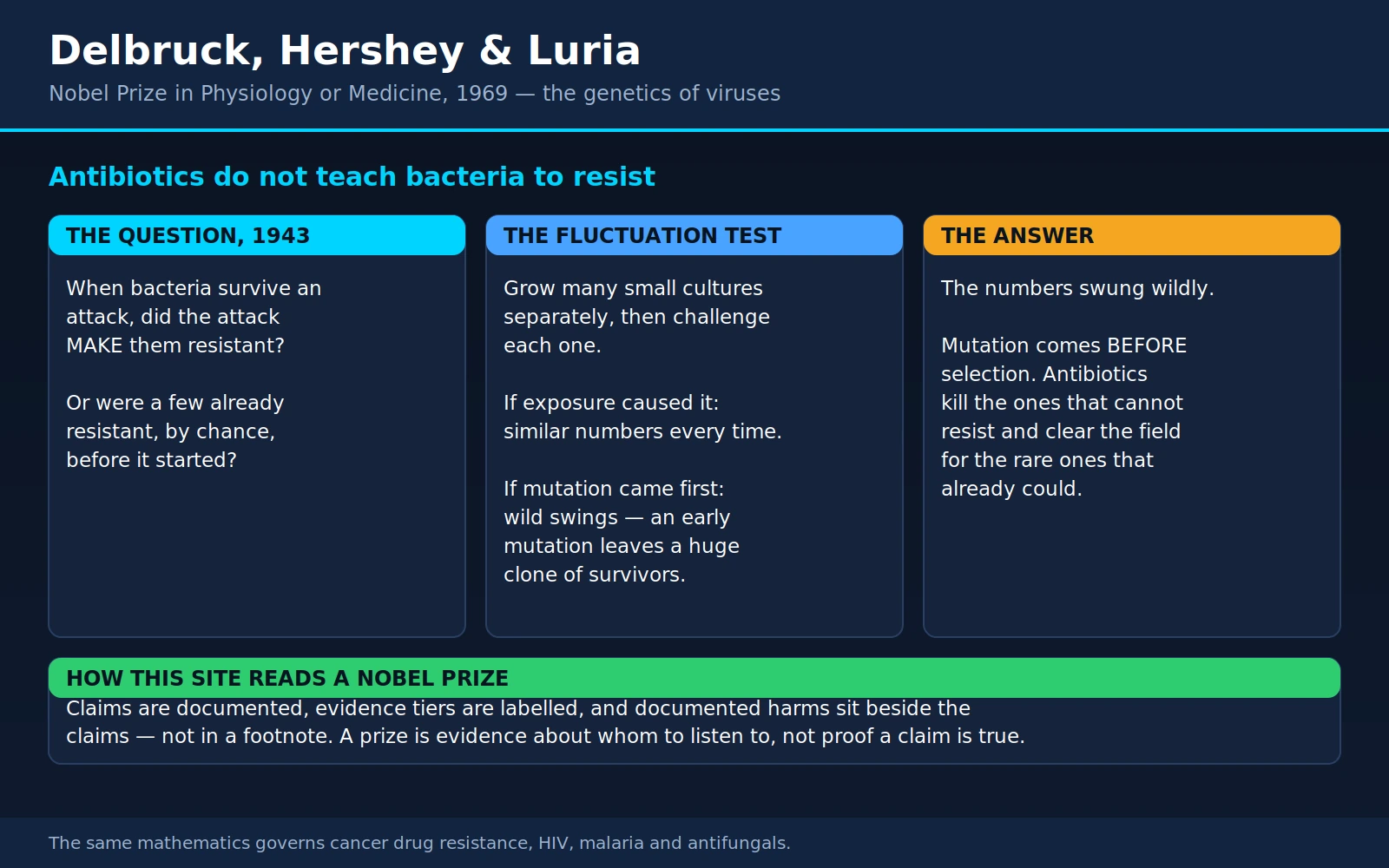
The experiment is called the Luria–Delbrück fluctuation test. It was done in 1943, in a small laboratory, with glass tubes and a bacterial broth, and it cost almost nothing. It answered a question that sounds philosophical and turns out to be intensely practical: when a population survives something that should have killed it, where did the survivors come from?
The answer — the survivors were already there, by chance, before the killing started — is why antibiotic resistance was never a surprise, never a failure of some individual patient's willpower, and never something that could be avoided by simply inventing better drugs. It is arithmetic. This page walks through that arithmetic slowly, because once you see it, a great deal of confusing medical advice suddenly makes sense.
Table of Contents
- The Phage Group: Physicists Looking for New Laws
- The Fluctuation Test: The Experiment at the Heart of This Page
- Why That One Result Explains Antibiotic Resistance
- The Hershey–Chase Blender, 1952
- Delbrück's Other Legacy: Being Wrong Productively
- Restriction, Modification, and the Long Road to CRISPR
- Phage Therapy: Promising, Unproven, and Genuinely Difficult
- What Resistance Actually Looks Like in a Person
- What a Course of Antibiotics Costs Your Microbiome
- Resistance Beyond Bacteria: Cancer, HIV, Malaria, Fungi
- Where Mainstream Medicine Agrees — and What Remains Debated
- Key Research Papers
- Connections
- Featured Videos
1. The Phage Group: Physicists Looking for New Laws
Max Delbrück came to biology from theoretical physics. He had worked in the orbit of Niels Bohr in Copenhagen during the years when quantum mechanics was being built, and he arrived at a conviction that shaped everything he did afterwards: that living things, examined closely enough, would turn out to obey laws that physics did not yet know. Bohr had suggested that life might be "complementary" to physics in the same way that the wave and particle descriptions of light are complementary — each true, neither reducible to the other. Delbrück took that seriously and went looking.
If you are hunting for new laws, you want the simplest possible system that still does the thing you care about. Delbrück decided the thing he cared about was self-replication — the property that makes life different from chemistry — and that the simplest thing that self-replicates is a bacteriophage: a virus that infects bacteria. A phage is a package of genetic material in a protein shell. It lands on a bacterium, gets its genes inside, and roughly twenty minutes later the bacterium bursts and a hundred new phages come out. Nothing else in biology is that stripped down and that fast.
Salvador Luria arrived at the same object from a very different direction. He was an Italian physician, trained in medicine in Turin, who had become interested in radiation biology in Rome. He was Jewish, and in 1938 Mussolini's racial laws made an academic career in Italy impossible. He left for Paris, then fled Paris ahead of the German advance in 1940 — by bicycle, in the general exodus south — and reached the United States as a refugee. He and Delbrück met at a physics meeting in Philadelphia at the end of 1940, discovered they were both obsessed with the same virus, and began working together almost immediately. Alfred Hershey, an American bacteriologist working in St. Louis, was doing careful quantitative phage work on his own and joined the correspondence.
An informal school with no building
What grew out of that was the Phage Group: not a department, not an institute, not a funded program, but a network of people who wrote to each other, sent each other strains, and converged every summer on Cold Spring Harbor Laboratory on Long Island. Delbrück consciously modeled it on the Copenhagen circle he had known in physics — a small, argumentative, intensely social community in which nobody was allowed to be vague and everybody read everybody else's work before it was published.
From 1945 Delbrück ran a summer phage course at Cold Spring Harbor. It was three weeks of hands-on work, taught to people who mostly had no background in bacteriology — physicists, chemists, physicians. It was the single most efficient recruitment device in twentieth-century biology. James Watson took it. So did a long list of people who went on to build molecular biology. The course kept running for decades. Its function was less to teach technique than to convert people: you arrived thinking genes were an abstraction and you left thinking of them as objects you could count on an agar plate.
The phage treaty: an act of deliberate standardization
Here Delbrück did something that deserves more attention than it usually gets. By the early 1940s, phage research was a mess — not because the work was bad, but because every laboratory had its own favourite phage isolated from its own local sewage, growing on its own favourite bacterial host. Two labs could report flatly contradictory results and both be right, because they were not studying the same thing.
In 1944 Delbrück imposed what became known as the phage treaty. Members of the group — and, in practice, everyone who took the phage course — agreed to work on a single bacterial host, Escherichia coli strain B, and on a defined set of seven phages, designated T1 through T7 (the "T" for "type"), chosen from an existing collection. Everything else was to be set aside.
This was a real sacrifice. People gave up organisms they had spent years characterizing. What they bought with it was comparability: from 1944 onward, a result from one lab could be checked, extended or contradicted by another lab without an argument about whether the two were even talking about the same virus. Progress in the field visibly accelerated. It is one of the clearest demonstrations in the history of science that choosing a common model system is itself a scientific act, and that the value of a shared standard can exceed the value of the particular thing standardized on. Modern biology repeated the lesson many times over — with the fruit fly, the nematode C. elegans, the mouse, the thale cress, and the small handful of human cell lines that carry an enormous fraction of all cell-biology results — but Delbrück's treaty was the deliberate, negotiated version.
It also came with a cost that is worth naming, because it applies to every model system since. Standardizing on seven phages and one bacterial strain meant that anything peculiar to other phages and other hosts became temporarily invisible. Delbrück was famously unenthusiastic about lysogeny — the phenomenon in which a phage integrates into the bacterial chromosome and sits quietly instead of bursting the cell — partly because the T-phages he had chosen do not do it. That work went forward elsewhere, largely in Paris, and eventually earned its own Nobel Prize. A shared standard buys you comparability and charges you a blind spot.
2. The Fluctuation Test: The Experiment at the Heart of This Page
This section is the core of the page. Read it slowly. It contains no mathematics harder than counting, and if you follow it you will understand something that a great many people with medical degrees have never had properly explained to them.
The observation that needed explaining
Take a flask of E. coli growing happily in broth. Add a phage that kills E. coli. Within a couple of hours the culture goes from cloudy to clear — billions of bacteria have been destroyed. But if you leave it, the culture often turns cloudy again. Something grew back. And when you test what grew back, it is resistant: this new population shrugs off the same phage that wiped out its ancestors.
Everyone in the field knew this happened. The question was where the resistant bacteria came from, and in 1943 there were two live answers.
- The adaptation hypothesis. Contact with the phage caused some bacteria to become resistant. The attack itself induced the change — the way a callus forms because of friction, or a suntan forms because of sunlight. On this view, the phage is an instructor: exposure teaches resistance. Before exposure, no bacterium in the flask was resistant.
- The mutation hypothesis. Resistance arose by random mutation, at some low rate, during ordinary growth, entirely independent of the phage — which had not yet been added and could not have influenced anything. The phage does not teach; it merely selects. It kills everything sensitive and leaves behind whichever rare cells happened, by accident, to already be resistant.
Both hypotheses predict exactly the same visible outcome: a cleared culture that regrows resistant. Looking harder at a single flask cannot distinguish them. You need an experiment whose two possible worlds differ in something you can actually measure.
Luria's insight, and the slot machine
The idea came to Luria in February 1943, shortly after he had moved to Indiana University. The story he told — in his 1984 autobiography, which is actually titled A Slot Machine, A Broken Test Tube — is that he was at a faculty dance at the local country club, standing near a slot machine during a break in the music, watching a colleague feed it dimes. Most pulls returned nothing. Occasionally a small payout. Very rarely, a jackpot. The pattern was not "everyone gets roughly the same modest return"; it was "almost nothing, almost nothing, almost nothing, enormous."
Luria realised that if resistance arose by random mutation during growth, then a bank of independently grown bacterial cultures should behave exactly like a bank of slot machines. We flag this as the account Luria himself gave, retold ever since; it is his own recollection rather than a laboratory record, and the experiment stands or falls on its data, not on its origin story. But the analogy is genuinely the right one, and it is the fastest way to see the logic.
The design
Here is what Luria and Delbrück did. It is almost aggressively simple.
- Start with a bacterial culture containing no resistant cells.
- Split it into many small, separate tubes — each seeded with a tiny number of bacteria, each grown completely independently of the others. Twenty tubes, fifty tubes. The independence is the whole trick.
- Let every tube grow up to a large population — hundreds of millions of cells per tube — with no phage anywhere near them.
- Then plate the entire contents of each tube onto agar covered with phage.
- Count the colonies that grow on each plate. Each colony is one resistant bacterium that survived. Write down the number for every tube.
They also ran a control that makes the comparison airtight: take one large culture, mix it thoroughly, and plate many separate samples from that same culture. Any variation between those plates is pure sampling noise — the ordinary randomness of scooping a spoonful out of a bucket.
What each hypothesis predicts
If the phage induces resistance (adaptation), then at the moment of plating, every tube is identical: none of them contains any resistant cells, because none has met a phage. Resistance is then conferred by the encounter on the plate, at some small fixed probability per cell. Each surviving colony is an independent lucky event with the same low chance. Counts generated that way follow a Poisson distribution, and the defining property of a Poisson distribution is that its variance equals its mean. In plain terms: if the average tube yields 10 survivors, the tubes will cluster tightly around 10 — 7, 12, 9, 11, 8, 13. You will not see a 400. The spread will look just like the control plates from the single mixed culture.
If resistance arises by random mutation during growth, something entirely different happens — and this is the part worth pausing on.
Each tube grows from a handful of cells to hundreds of millions by repeated doubling. Somewhere during that growth, in some tubes, a mutation to resistance occurs. When it occurs is what matters, because a mutant cell keeps dividing, and all of its descendants inherit the mutation.
- A mutation in the last division before plating leaves you with 1 or 2 resistant cells.
- A mutation 10 divisions before the end leaves roughly 1,000 resistant descendants (210).
- A mutation 20 divisions before the end leaves roughly 1,000,000.
- Many tubes will get no mutation at all and yield zero survivors.
So the count in each tube is not a lottery ticket — it is a lottery ticket multiplied by however long ago it was bought. An early mutation founds an enormous resistant clone. The result is a set of numbers that lurches: 0, 0, 1, 0, 5, 0, 3, 0, 0, 107, 2, 0, 0, 561, 1, 0. Luria called the big ones jackpots, and the name stuck.
The result, and why variance was the answer
The tubes fluctuated wildly. The variance of the counts was enormously larger than the mean — not by 20 percent, but by orders of magnitude — while the control plates taken from a single mixed culture behaved exactly as Poisson sampling predicts, clustering tightly around their average. Two measurements of the same thing, differing only in whether the cultures had grown independently, gave two completely different distributions.
That single contrast settles it. Wild fluctuation between independent cultures is a signature that nothing but pre-existing, inherited, clonally amplified mutation can produce. Induction on contact cannot generate jackpots, because under induction there is no history for a jackpot to accumulate in: every cell meets the phage at the same instant, with the same odds.
Notice what has happened here. Luria and Delbrück could not observe a single mutation. They had no microscope that could see one, no sequencing, no idea what a gene was made of — DNA was not yet accepted as the genetic material. They inferred the existence and the timing of invisible events purely from the shape of the scatter in a column of numbers. The paper — Mutations of Bacteria from Virus Sensitivity to Virus Resistance, Genetics, November 1943 — is also where quantitative statistical reasoning entered microbiology for good. Delbrück did the mathematics; the distribution of jackpot sizes still carries his name, and biologists still use "fluctuation analysis" to measure mutation rates today.
Two independent confirmations
An argument this consequential should not rest on one experimental design, and it does not.
In 1949 Howard Newcombe published a beautifully economical variation in Nature (Nature 1949;164(4160):150). He spread bacteria on plates, let them grow into invisible microcolonies, and then — on half the plates — simply respread the cells with a glass rod before adding phage. Respreading does nothing except break up clumps: it takes clones that were sitting on top of each other and scatters them across the plate. If resistant cells already existed in clumps, respreading turns each clump into many separately countable survivors, and the respread plates should yield far more colonies. If resistance were induced by the phage, spreading could not possibly matter. The respread plates yielded dramatically more survivors. Same conclusion, completely different experiment, no statistics required.
In 1952 Joshua and Esther Lederberg closed the case with replica plating. They grew colonies on a master plate with no antibiotic and no phage, pressed a velvet pad onto it to pick up a faithful copy of the colony pattern, and stamped that pattern onto selective plates. The few colonies that survived selection could then be traced back to their exact positions on the original, never-selected master plate — and cells picked from those positions, which had never in their history encountered the selecting agent, were already resistant. You could hold the resistant ancestors in your hand before the selection existed. Esther Lederberg developed the replica-plating technique and is first author with her husband on the paper; her contributions to bacterial genetics, including the discovery of phage lambda, were substantial and for many years underacknowledged.
Three experiments, three logics — statistical, geometric, and physical — one answer. Mutations arise before selection, not because of it.
3. Why That One Result Explains Antibiotic Resistance
Now substitute an antibiotic for the phage. Nothing else in the argument changes.
A typical bacterial infection involves an enormous number of organisms — commonly billions or more. Mutation rates per gene per division are low, roughly one in a hundred million to one in ten billion, but "low" multiplied by "billions" is not zero. In a population that large, cells carrying a mutation that happens to blunt a given antibiotic are very often already present before the first dose is swallowed. They are a vanishing fraction — perhaps one in ten million — and they are irrelevant while their ordinary neighbours are outcompeting them, because resistance mutations frequently carry a fitness cost and grow slightly slower in the absence of the drug.
Then the antibiotic arrives and inverts the ranking. The 9,999,999 sensitive cells die. The one resistant cell now has an empty field, no competitors, and a food supply that belonged to ten million other organisms. It divides. Twenty-four hours later there are billions of it.
Every course of antibiotics is a selection event. Not a risk of one, not a possible one — a selection event, unavoidably, by construction. Resistance is not evidence that something went wrong. It is the predicted output of applying a killing agent to a large population with heritable variation. Delbrück, Hershey and Luria did not warn about antibiotic resistance in 1943; they proved that the mechanism producing it is a general property of reproducing populations. Alexander Fleming, for his part, did warn about it — explicitly, in his 1945 Nobel lecture, describing how easy it was to make microbes resistant in the laboratory by underdosing them, and predicting the same thing would happen in the body. See Alexander Fleming.
Consequence 1: bacteria you are not treating are also being selected
An antibiotic does not know which bacteria you are angry at. It reaches your gut, your skin, your mouth, your nose, your urinary tract, and it applies exactly the same selection everywhere. A course aimed at a chest infection selects for resistance in the organisms living quietly in your intestine. Those organisms can pass resistance genes horizontally — on plasmids, small loops of DNA that move between species — so a resistance gene selected in a harmless gut bacterium can end up in a dangerous one later. Resistance is a community property, not a personal one.
Consequence 2: antibiotics for a viral illness are worse than useless
This follows directly and is worth stating bluntly. Colds, most sore throats, most sinus congestion, most coughs and influenza are caused by viruses. Antibiotics do not touch viruses. They have no mechanism by which they could.
What such a prescription does accomplish: it applies a full selection event to every bacterial population in your body, for no benefit whatsoever; it exposes you to side effects; and it disrupts your microbiome (see section 9). A Cochrane systematic review of randomised trials of antibiotics for the common cold and acute purulent rhinitis — eleven studies — found no evidence of benefit and clear evidence of harm: adverse effects were significantly more common with antibiotics than with placebo (Cochrane Database Syst Rev 2013;(6):CD000247). Green or yellow nasal mucus, incidentally, is not evidence of bacterial infection — the colour comes from your own immune cells, and the same review found no benefit for purulent rhinitis specifically.
The practical version, for a patient: it is entirely reasonable to ask a clinician "do you think this is bacterial, and what makes you think so?" It is not reasonable to request an antibiotic for a cold because you have a wedding on Saturday. Patient expectation is one of the documented drivers of unnecessary prescribing, and it is one of the few levers an ordinary person actually holds.
Consequence 3: the same logic governs every drug that kills a reproducing population
Antivirals, antifungals, antiparasitics, herbicides, insecticides and cancer drugs are all in the same mathematical situation. Anywhere you have (a) a large population, (b) heritable variation, and (c) an agent that kills the unvaried, you get the fluctuation-test outcome. Section 10 works through the medical cases in detail.
Consequence 4: the honest state of "always finish the course"
This deserves care, because it is easy to get wrong in a dangerous direction.
For decades, patients were told that stopping antibiotics early causes resistance — that the surviving "weakened" bacteria would come back tougher. Read the fluctuation test again and you will see the problem with that framing: bacteria are not toughened by partial exposure; the resistant ones were already there. The traditional rationale had the mechanism backwards.
In 2017 a group of British infection specialists published an analysis in the BMJ under the deliberately provocative title "The antibiotic course has had its day" (BMJ 2017;358:j3418). Their argument: the "complete the course" message is not supported by good evidence for most infections; the durations in common use were largely inherited from convention and round numbers rather than trials; and because every extra day of antibiotic is an extra day of selection pressure on your whole microbial flora, longer is not automatically safer. This was an opinion and analysis piece rather than a trial, and it was contested in print at the time — the BMJ published responses arguing it risked being misread by patients.
Where the evidence has actually gone since is not "take fewer days than you were told" but "the right number of days is an empirical question per infection, and for several infections the trials show it is shorter than tradition assumed." A randomised non-inferiority trial of 604 hospitalised patients with uncomplicated Gram-negative bloodstream infection found 7 days was non-inferior to 14 days for the composite outcome at 90 days (Clin Infect Dis 2019;69(7):1091–1098). Similar shorter-course trials have now been done in community-acquired pneumonia, urinary tract infection, intra-abdominal infection and others, several of them supporting shorter durations.
4. The Hershey–Chase Blender, 1952
The third laureate's contribution is a different kind of classic: an experiment so cleanly designed that it changed a whole field's mind in a single stroke.
The question
By 1952 it was clear that phages inject something into a bacterium and that this something contains the instructions to build a hundred new phages. A phage is made of essentially two substances: protein (the shell) and DNA (the payload). Which one carried the genetic instructions?
Most biologists at the time backed protein. Proteins are built from twenty different amino acids and can be arranged in endlessly varied ways; DNA has only four building blocks and was widely regarded as a monotonous structural molecule, too boring to encode anything. That intuition was wrong, but it was reasonable.
The trick with the isotopes
Alfred Hershey and Martha Chase exploited a chemical accident: protein contains sulphur but essentially no phosphorus, and DNA contains phosphorus but no sulphur.
So they grew two batches of phage. One batch was grown in medium containing radioactive sulphur-35, which labelled only the protein coats. The other was grown with radioactive phosphorus-32, which labelled only the DNA. Now each batch carried a radioactive tag on exactly one of the two candidate molecules.
The blender
They let each labelled batch of phage attach to bacteria and infect them. Then — and this is the part everyone remembers — they poured the mixture into an ordinary kitchen blender (a Waring blender) and ran it. The shear forces were violent enough to knock the spent phage particles off the outside of the bacterial cells but gentle enough not to destroy the bacteria themselves. Spinning the mixture in a centrifuge then separated the heavy bacterial cells, which formed a pellet at the bottom, from the light sheared-off phage debris, which stayed in the liquid above.
Now simply ask where the radioactivity ended up.
- With the sulphur-35 (protein-labelled) phage, the radioactivity was almost all in the liquid — in the discarded coats. The protein had stayed outside.
- With the phosphorus-32 (DNA-labelled) phage, a large fraction of the radioactivity was in the bacterial pellet — and, critically, it was passed on to the next generation of phage particles produced by those cells. The DNA had gone in.
The paper — Independent functions of viral protein and nucleic acid in growth of bacteriophage, Journal of General Physiology, 1952 — is a model of restraint. Its own conclusions are stated cautiously, and the separation was not perfect (some protein got in, some DNA stayed out). But the direction was unmistakable, and the field moved. Within a year Watson and Crick published the double helix, in a paper that made sense of how a four-letter molecule could store information at all (see Watson, Crick & Wilkins).
The honest history: this was not the first evidence, and it was not the best
Hershey–Chase is usually taught as the experiment that proved DNA is the genetic material. That is not accurate, and the inaccuracy costs three scientists their due.
Eight years earlier, at the Rockefeller Institute, Oswald Avery, Colin MacLeod and Maclyn McCarty published Studies on the chemical nature of the substance inducing transformation of pneumococcal types (J Exp Med 1944;79(2):137–158). Building on Frederick Griffith's 1928 finding that dead virulent pneumococci could permanently transform harmless live ones into virulent ones, Avery's group set out to purify whatever substance was doing the transforming. They did it exhaustively: they removed protein, removed lipid, removed polysaccharide, and the transforming activity stayed with the DNA fraction. Then they did the decisive control — they applied enzymes. Protein-digesting enzymes did not destroy the activity. Ribonuclease did not destroy the activity. Deoxyribonuclease abolished it completely.
By any fair reading, that is cleaner evidence than the blender. It is more chemically rigorous and the enzyme control is more specific. Yet the field largely did not accept it. Objections were raised that a trace protein contaminant might be the real active agent; the "protein is the only molecule complex enough" intuition was strong; and Avery, a modest man in his mid-sixties, did not campaign for his result.
Why did Hershey–Chase persuade where Avery had not? Partly timing — eight more years of accumulating evidence had softened the ground. Partly the audience: the blender experiment was done in phage, on the Phage Group's own home turf, published in the language and idiom of the community that would go on to build molecular biology. And partly sheer rhetorical clarity: radioactive tracers and a kitchen appliance make a story that a lecture hall remembers.
Avery, MacLeod and McCarty never received a Nobel Prize. It stands as one of the most frequently cited omissions in the history of the award. See Nobel Prizes That Aged Badly for the broader pattern of what the prize has got wrong, both by commission and by omission.
Martha Chase
Martha Chase's name is on the 1952 paper as the second of two authors. She did the experimental work alongside Hershey. When the Nobel Prize was awarded in 1969, it went to Delbrück, Hershey and Luria. Chase did not share it.
Two things are true at once and both should be said. The 1969 citation was for a body of work spanning three decades, and the prize's rules limit it to three living recipients, so the omission is not a straightforward injustice in the way that leaving out Avery was. But it is also part of a pattern that recurs through the history of this prize — a junior collaborator, frequently a woman, whose hands did the work on the experiment everyone remembers, and whose name survives only in the hyphenated shorthand. Rosalind Franklin's is the most famous instance in the DNA story. Esther Lederberg, who developed replica plating (section 2), is another. Chase's later career was difficult and she died in 2003. She is not a footnote to this page; the experiment is named for her.
5. Delbrück's Other Legacy: Being Wrong Productively
Delbrück came to biology on a specific bet: that a sufficiently careful study of living things would expose paradoxes that physics could not resolve, and that resolving them would require new physical law — something as fundamental as complementarity had been in quantum mechanics. This was not a vague hope. It was his motivating hypothesis, argued explicitly in his 1949 essay "A Physicist Looks at Biology," and it was the reason he had left a promising career in theoretical physics for bacterial viruses.
He was wrong. Everything the Phage Group uncovered — replication, mutation, recombination, the identification of DNA as the genetic material, and eventually the genetic code itself — turned out to be ordinary chemistry and ordinary physics, remarkable in its organisation but requiring no amendment to the laws. There was no paradox. There was a mechanism.
Delbrück said so himself. His 1969 Nobel lecture was published under the title A physicist's renewed look at biology: twenty years later (Science 1970;168(3937):1312–1315), and it is, among other things, an accounting of a hypothesis that did not survive contact with its own evidence.
This is worth dwelling on, because it inverts the way scientific biography is usually told. A researcher's guiding idea failed completely, and in the course of failing it produced: a new model system, a new community, a new statistical method, a training course that seeded a generation, and a chain of results that founded molecular biology. The bet was wrong. The consequences of taking the bet seriously were enormous. Being wrong about why a question matters is entirely compatible with being right that it matters.
Delbrück did not stop looking, either. From the early 1950s he moved away from phage genetics — a field that had, in his view, become merely successful — and spent the rest of his career on Phycomyces, a fungus whose spore-bearing stalk bends towards light with striking sensitivity. He chose it as a minimal system for sensory transduction: how a living thing converts a physical stimulus into a biological response. He hoped, again, that the deepest analysis of the simplest possible case might turn up something physics did not expect. Again it did not, and the Phycomyces programme never produced anything comparable to the phage work. But it established real sensory physiology, and it says something about him that after a Nobel Prize he went back to a hard problem he expected to lose on.
The other half of his legacy is entirely social. The phage course, the summer meetings, the practice of circulating results before publication, the insistence that biologists learn to think quantitatively, the willingness to demolish a colleague's argument at a seminar and then go swimming with him — that culture propagated far beyond phage. A great deal of what modern molecular biology takes for granted about how a research community should behave was assembled at Cold Spring Harbor by a physicist chasing a hypothesis that turned out not to exist.
6. Restriction, Modification, and the Long Road to CRISPR
Luria made one further observation whose consequences he could not possibly have anticipated.
Working with Mary Human, he noticed that a phage grown on one strain of bacteria would often grow poorly — sometimes catastrophically poorly — when transferred to a different strain. But the few phages that did manage to grow on the new strain were now perfectly at home there, and had correspondingly lost their ability to grow well on the original host. The change was not a mutation: it reversed on transfer back, and it did not breed true as a genetic change would. Luria called it a non-hereditary, host-induced variation (J Bacteriol 1952;64(4):557–569). Something the host was doing to the phage's genetic material was being stamped onto it, temporarily, without changing the underlying genes.
It took another decade for Werner Arber and Daisy Dussoix to work out what (J Mol Biol 1962;5:18–36). Bacteria run a defence system with two halves:
- A restriction enzyme that recognises a specific short sequence of DNA and cuts the DNA there — destroying any incoming phage genome carrying that sequence.
- A modification enzyme that chemically marks (methylates) that same sequence in the bacterium's own DNA, so the restriction enzyme leaves the host chromosome alone.
Self-marked DNA is spared; unmarked foreign DNA is chopped. A phage grown on strain A carries strain A's marks, so strain B's enzymes shred it — unless a rare particle slips through and gets marked with B's pattern, at which point its descendants thrive on B and fail on A. Luria's puzzle, exactly.
The consequences ran in two directions.
Direction one: molecular cloning. Werner Arber, Daniel Nathans and Hamilton Smith shared the 1978 Nobel Prize for restriction enzymes and their application to molecular genetics. An enzyme that reliably cuts DNA at a defined sequence is a pair of molecular scissors — and once you can cut DNA predictably, you can paste it. Restriction enzymes are the basis of recombinant DNA technology, and therefore of insulin produced in bacteria, of genetic testing, of the entire biotechnology industry. A bacterial anti-virus defence became the standard toolkit of molecular biology.
Direction two: CRISPR. Decades later, a second and far more sophisticated bacterial anti-phage system was recognised. CRISPR is an adaptive immune system: a bacterium that survives a phage attack stores short fragments of the phage's DNA in an array in its own chromosome, transcribes them into guide RNAs, and uses those guides to direct a nuclease that destroys any matching DNA on a future encounter. It is a genuine immunological memory in an organism with no immune system. The demonstration that CRISPR confers acquired resistance against phage came from work on Streptococcus thermophilus, a bacterium used in yogurt manufacture (Science 2007;315(5819):1709–1712) — the practical problem being phage contamination of dairy cultures.
CRISPR-Cas9 became the gene-editing tool that won the 2020 Nobel Prize in Chemistry. The lineage is direct and slightly absurd when laid out end to end: a puzzle in a phage laboratory in 1952 → a defence mechanism in 1962 → a Nobel Prize and an industry in 1978 → a second, adaptive defence mechanism found in yogurt cultures → the ability to edit human genes.
Both directions have the same shape, and it is the shape of this whole page. Bacteria have been fighting viruses for billions of years and have evolved elaborate machinery to do it. Every tool we have described here — restriction enzymes, CRISPR — is a weapon we took off a bacterium. Delbrück picked phage because it was the simplest system he could find. It turned out to be the site of the oldest arms race on Earth.
7. Phage Therapy: Promising, Unproven, and Genuinely Difficult
If phages kill bacteria, and antibiotics are failing, the obvious question is: why not treat infections with phages?
People have. The idea is older than antibiotics.
The history
Bacteriophages were described independently by Frederick Twort (1915) and Félix d'Hérelle (1917), and d'Hérelle immediately began using them therapeutically. In 1923 the Georgian microbiologist George Eliava, who had worked with d'Hérelle at the Pasteur Institute, founded a bacteriology institute in Tbilisi dedicated to phage research and production. The Eliava Institute became the centre of Soviet phage therapy, supplying preparations across the USSR, where phages were a routine part of hospital practice for decades. Eliava himself was executed in 1937 during Stalin's purges, denounced as an "enemy of the people"; the institute survived him.
In Poland, phage therapy took root after the Second World War around Ludwik Hirszfeld, and the Hirszfeld Institute of Immunology and Experimental Therapy in Wrocław has run phage work continuously ever since, opening a formal Phage Therapy Unit in 2005 — the first ethically approved facility of its kind in Europe. Neither country ever abandoned the approach.
Why the West dropped it
Three reasons, and it is worth being honest that they were mostly good ones at the time.
Antibiotics arrived and were simply easier. Penicillin and its successors were broad-spectrum: one drug treated many organisms without knowing exactly which one you had. A phage is exquisitely specific, often to a single strain of a single species — you have to identify the pathogen first and then find a phage that kills that particular isolate.
Early results were inconsistent and often uncontrolled. Much early phage therapy predated modern trial methodology. Preparations varied wildly in potency, some were contaminated, some had been inactivated in storage, and success and failure were both reported without the controls that would let anyone tell which was which. Commercial phage preparations sold in the United States in the 1930s and 1940s performed poorly and were withdrawn.
The Cold War split the literature. A large body of Soviet and Polish clinical experience was published in Russian and Polish, in journals Western clinicians did not read, and much of it was case-series rather than randomised. Some of it may well be valuable; it has never been fully assessed by contemporary standards.
Where it actually stands now
Interest revived precisely because of the problem this page is about. The honest summary is encouraging case reports, thin randomised evidence, real regulatory obstacles.
The most striking modern case is a 15-year-old cystic fibrosis patient with a disseminated, drug-resistant Mycobacterium abscessus infection after a lung transplant, treated with a cocktail of three genetically engineered phages — one of them modified to make it lytic — selected against her own isolate. She improved substantially (Nat Med 2019;25(5):730–733). It is a single patient, with no control, and the authors say so. It is also a genuinely remarkable piece of personalised medicine and it is one of the reasons the field is being taken seriously again.
The randomised evidence is much less flattering. PhagoBurn, a phase 1/2 randomised controlled trial across nine burn centres in France and Belgium, tested a cocktail of twelve anti-Pseudomonas phages against standard silver sulfadiazine cream on infected burn wounds. It was stopped early for insufficient efficacy: the phage arm reduced bacterial burden more slowly than standard care (Lancet Infect Dis 2019;19(1):35–45).
But the reason matters enormously and is a lesson in itself. The phage preparation lost potency after manufacture: patients received roughly 102 plaque-forming units per millilitre instead of the intended 106 — a ten-thousand-fold underdose. Only 27 patients were enrolled. The trial did not show that phage therapy does not work; it showed that a badly underdosed phage preparation does not work, and it exposed how hard the manufacturing is. That distinction is exactly the kind of thing that gets lost when a result is summarised in a headline.
The obstacles are real, not political
- Specificity cuts both ways. A phage that kills your infection may not kill your neighbour's infection with the "same" organism. Effective use often requires testing the patient's own isolate against a phage bank — a "phagogram" — before treatment. That is slow and requires infrastructure most hospitals do not have.
- Regulation does not fit. Drug approval is built around a fixed molecule made to a fixed specification. A phage is a self-replicating biological entity that may need to be swapped per patient and may itself evolve during treatment. Regulators are not obstructing it out of malice; the existing framework genuinely does not have a category for it.
- Bacteria evolve phage resistance too. This is the same mathematics as section 2 — it is, in fact, literally the experiment Luria and Delbrück did. PhagoBurn's own ancillary analysis found that bacteria isolated from treatment failures were resistant to the low phage doses used. Phages are not a way around evolution; they are another selective agent, though one that can itself evolve in response.
- Manufacturing and stability are unsolved at scale, as PhagoBurn demonstrated the hard way.
Balanced against those: phages are extremely narrow, so they largely spare the rest of your microbiome; they multiply at the site of infection rather than being diluted through the body; they can penetrate biofilms that antibiotics struggle with; and there are enormous numbers of them available to isolate. Several controlled trials are under way.
8. What Resistance Actually Looks Like in a Person
Abstractions about selection pressure become concrete in a hospital. Here is the landscape in plain language.
The scale of the problem
The most comprehensive estimate to date, the Global Research on Antimicrobial Resistance (GRAM) study, estimated that in 2019 there were 4.95 million deaths associated with bacterial antimicrobial resistance worldwide, including 1.27 million deaths directly attributable to it (Lancet 2022;399(10325):629–655). The burden falls hardest on low-resource settings — the highest attributable death rate was in western sub-Saharan Africa. Six organisms accounted for most of it: E. coli, Staphylococcus aureus, Klebsiella pneumoniae, Streptococcus pneumoniae, Acinetobacter baumannii and Pseudomonas aeruginosa. Methicillin-resistant S. aureus alone caused more than 100,000 attributable deaths.
These are modelled estimates with wide uncertainty intervals, built from incomplete surveillance — the authors are explicit that data gaps in low-income settings are severe. Treat the figures as the best available order of magnitude, not as a census.
The named organisms, translated
- MRSA — methicillin-resistant Staphylococcus aureus. Staph is a normal skin and nose resident in a large minority of healthy people. MRSA is a strain that has acquired resistance to the whole penicillin-related family. It causes skin and soft-tissue infections, and when it gets into blood, bone or a surgical wound it is much harder to treat.
- VRE — vancomycin-resistant Enterococcus. Enterococci live in the gut and are not usually aggressive, but they are hardy, they persist on hospital surfaces, and they cause bloodstream and urinary infections in vulnerable patients. Vancomycin was one of the fallback drugs.
- ESBL organisms — "extended-spectrum beta-lactamase" producers, mostly E. coli and Klebsiella. Beta-lactamases are enzymes that chew up penicillin-family antibiotics; "extended-spectrum" ones destroy most cephalosporins too. Frequently the reason an ordinary urinary tract infection stops responding to ordinary tablets.
- CRE / carbapenem-resistant organisms — carbapenems are among the last broadly reliable antibiotics for serious Gram-negative infection. Organisms resistant to them (Klebsiella, Acinetobacter, Pseudomonas) leave clinicians choosing between older, more toxic drugs and newer, very expensive ones.
- Drug-resistant tuberculosis — multidrug-resistant TB requires far longer, more toxic and more expensive regimens than standard TB, and is one of the single largest contributors to the global resistance burden.
- Drug-resistant gonorrhoea — Neisseria gonorrhoeae has worked through nearly every antibiotic class deployed against it, one after another. It is a textbook illustration of sequential selection.
C. difficile: the infection caused by the treatment
Clostridioides difficile deserves separate mention because it is a different kind of failure. C. diff is not primarily a story about a resistant organism outliving a drug. It is a story about what happens when you remove the competition.
Your colon contains a dense, competitive community of hundreds of bacterial species, and one of the things that community does is occupy the space and eat the food, leaving nothing for an invader. That is called colonisation resistance. A broad-spectrum antibiotic flattens that community. C. difficile — which may already be present in small numbers, or may be picked up from a contaminated surface as spores — then finds an empty gut and expands, producing toxins that inflame the colon. The result ranges from unpleasant diarrhoea to life-threatening colitis, and it recurs in a substantial minority of patients because the microbiome is still not back.
The most striking evidence that this is fundamentally an ecological problem rather than a pharmacological one comes from a randomised trial in which faecal microbiota transplantation — infusing a healthy donor's stool into the patient's small intestine — was compared with vancomycin for recurrent C. difficile. The trial was stopped early because the transplant was so much more effective (N Engl J Med 2013;368(5):407–415). The cure for the damage an antibiotic did was not another antibiotic; it was putting the ecosystem back.
What an ordinary person actually controls
Most of the levers here are policy levers, not personal ones, and it is dishonest to imply otherwise. But some are genuinely yours.
- Do not request antibiotics for viral illness — colds, most sore throats, flu. This is the single most direct thing you control. Ask what the clinician thinks is causing it; accept "this is viral, it will pass" as an answer.
- Take a prescribed course as prescribed, and do not stockpile leftovers. Do not use antibiotics left over from a previous illness, do not take someone else's, and do not buy them without a prescription where that is possible. Partial or inappropriate self-treatment applies selection pressure while frequently failing to treat anything.
- Vaccination reduces antibiotic use, and this is underappreciated. Preventing an infection prevents the prescription. Pneumococcal and influenza vaccination both reduce antibiotic consumption — influenza vaccination partly by preventing the illnesses that lead to unnecessary antibiotics, and partly by preventing the genuine bacterial pneumonias that follow flu.
- Hand hygiene and food hygiene reduce transmission of resistant organisms as much as susceptible ones. Unglamorous, but it is how resistant strains move between people.
- Agricultural antibiotic use is a policy question, not a personal one. A large share of global antibiotic tonnage goes to food animals, historically much of it for growth promotion rather than treatment. Individual purchasing choices are a weak lever here; regulation is a strong one. The European Union banned antibiotic growth promoters in 2006 and the United States ended the use of medically important antibiotics for growth promotion in 2017. Whether these have been sufficient is actively debated.
For a hands-on illustration of the selection process, the site has an interactive animation: How Bacteria Beat Antibiotics.
9. What a Course of Antibiotics Costs Your Microbiome
This section is about a real cost that is often either dismissed or wildly overstated. The evidence supports something in between.
The disruption is measurable and fast
A careful study followed three people through two separate courses of ciprofloxacin over ten months, sequencing their gut bacteria from more than fifty stool samples each (Proc Natl Acad Sci U S A 2011;108 Suppl 1:4554–4561). The findings:
- The effect was profound and rapid — a loss of diversity and a shift in community composition within 3–4 days of starting the drug.
- Recovery began about a week after the course ended, but was often incomplete.
- Responses were highly individual — the same drug in the same dose did noticeably different things to different people, and even to the same person on two occasions.
- By the end of the study each person's microbiome had stabilised, but at a composition different from where it started.
That is three people, which is a small study, but it is unusually dense sampling and the direction has been broadly reproduced. The reasonable summary: a course of broad-spectrum antibiotics causes real, measurable disruption; most of it recovers over weeks to months; some of it may not fully return to baseline; and the extent varies a lot between individuals and between drugs.
What we do not have is good evidence about what the residual difference means for long-term health. Associations have been reported between early-life antibiotic exposure and later conditions, but associations of that kind are notoriously confounded — children who receive more antibiotics are children who get more infections, and both may reflect something else entirely. This is genuinely unresolved and anyone who tells you otherwise is ahead of the data.
Probiotics afterwards: the evidence disagrees with itself
The intuitive move — you killed the bacteria, so put bacteria back — is not as well supported as the shelf space in a pharmacy suggests.
Some things probiotics do have reasonable evidence for. Certain strains reduce the incidence of antibiotic-associated diarrhoea in some populations, and this is among the better-supported probiotic indications, although trial quality is uneven and effects vary by strain, dose and setting. Strain matters: "probiotic" is not a single intervention any more than "antibiotic" is.
Then there is a finding that genuinely complicates the picture. An Israeli group ran an unusually invasive study, sampling the gut mucosa by endoscopy rather than relying on stool, in people and in mice, after a course of antibiotics. They compared three approaches: spontaneous recovery with no intervention, a multi-strain probiotic, and autologous faecal transplant (the participants' own stool, banked before the antibiotics and returned afterwards). The result (Cell 2018;174(6):1406–1423):
- Probiotics colonised well after antibiotics — better than in an undisturbed gut, since there was space.
- But compared with just letting it recover on its own, probiotics produced a markedly delayed and persistently incomplete return of the person's own native microbiome and of gut gene expression toward its normal configuration.
- Autologous faecal transplant produced a rapid and near-complete recovery within days.
- In laboratory experiments, soluble factors secreted by Lactobacillus inhibited the native community — a plausible mechanism.
A companion paper published alongside it by the same group found that whether probiotics colonise the gut at all is highly person-specific, and that stool sampling can miss what is happening at the mucosal surface entirely — people who looked like non-colonisers by stool were sometimes colonised on the gut wall, and vice versa.
These were small, invasive human studies plus mouse work, from a single group, using one particular multi-strain product. They have not been replicated at scale and they should not be treated as the last word. But they are high-quality work published in a major journal, and they make a specific and uncomfortable point: taking a generic probiotic after antibiotics may slow your own microbiome's return rather than speed it. That is the opposite of what most people believe they are buying.
10. Resistance Beyond Bacteria: Cancer, HIV, Malaria, Fungi
The fluctuation test is not a result about bacteria. It is a result about populations. Its three ingredients — a large number of individuals, heritable variation arising randomly, and an agent that kills the unvaried — occur in several other places in medicine, and everywhere they occur you get the same outcome and the same solution.
Cancer: why single-agent targeted therapy usually fails
A tumour of one gram contains roughly a billion cells. Those cells are dividing, their DNA repair is often defective, and their mutation rate is frequently elevated. That is a fluctuation-test flask.
Give a targeted drug — one that blocks a specific mutated protein driving the tumour — and it can work spectacularly. Tumours shrink, symptoms resolve, and the response can look like a cure. Then, typically after months, it stops working. The tumour regrows and the new tumour does not respond.
The reason is the one Luria and Delbrück established. In colorectal cancers treated with antibodies against EGFR, resistant subclones carrying KRAS mutations could be detected in patients' blood months before the tumour visibly regrew, and mathematical modelling of the timing indicated the resistant cells were present before treatment began, not created by it (Nature 2012;486(7404):537–540). The drug did not cause resistance. It revealed a pre-existing minority and handed it the whole tumour.
This is exactly why combination therapy exists. A mathematical analysis of the problem makes the reasoning crisp (eLife 2013;2:e00747). If roughly one cell in ten million already resists drug A, and independently one in ten million already resists drug B, then a cell resisting both requires two independent rare events in the same lineage — one in a hundred trillion. In a tumour of a billion cells, single-agent resistance is close to guaranteed and dual resistance is unlikely. The same analysis makes a second, less obvious point: the two drugs must be given simultaneously rather than in sequence. Giving A until it fails and then switching to B lets the A-resistant population expand to enormous size first, and B is then facing a much larger population in which a B-resistance mutation is far more likely to already exist.
HIV: the clearest demonstration in medicine
HIV is a nearly perfect fluctuation-test system. An untreated infected person produces on the order of a billion new virions a day, and the enzyme copying its genome, reverse transcriptase, has no proofreading — it makes errors at a high rate. The result is that at any moment, the viral population in an untreated person very probably already contains variants resistant to any single drug you might choose.
The history bore this out with brutal clarity. Early monotherapy with AZT produced a real but temporary benefit: viral load fell, then resistance emerged and it rose again. Two drugs did better and still failed. What changed the disease was three drugs at once, hitting different viral targets simultaneously. The pivotal trial added a protease inhibitor to two nucleoside analogues and found a substantial reduction in progression to AIDS and death compared with two drugs alone (N Engl J Med 1997;337(11):725–733). Combination antiretroviral therapy turned HIV from a terminal illness into a manageable chronic condition inside a few years.
The arithmetic is the same as in cancer. Resistance to one drug is common in the existing viral swarm; simultaneous resistance to three drugs with different targets requires several independent rare events in one lineage, and if the drugs suppress replication hard enough there are not enough replication cycles left for those events to accumulate. This is also why adherence matters so much in HIV: missed doses let the virus replicate at drug concentrations high enough to select but too low to suppress, which is the ideal condition for resistance to emerge.
Malaria: why artemisinin is never given alone
The same reasoning drives malaria treatment policy. Artemisinin, isolated from sweet wormwood by Tu Youyou, is the fastest-acting antimalarial known. It is deliberately never used as a single agent for uncomplicated malaria. The World Health Organization standard is artemisinin-based combination therapy (ACT): artemisinin, which kills the great majority of parasites very rapidly, paired with a longer-acting partner drug that clears the remainder over the following days.
The design is deliberately anti-evolutionary. Artemisinin's job is to crash the parasite population to a small enough number that the probability of a partner-drug-resistant parasite being present among the survivors is low; the partner drug then finishes them off. Using artemisinin alone would leave survivors that only artemisinin resistance need explain — and artemisinin resistance has in fact emerged in Southeast Asia and, more recently, in parts of Africa. Tu Youyou's own page covers that story in detail.
Antifungals and Candida auris
Fungi are the same story with fewer available drugs. The human antifungal armoury is small — a handful of classes — because fungi are eukaryotes like us, so it is far harder to find something that kills them without harming the patient.
Candida auris is the emblematic case. It was first identified in 2009 and then appeared, apparently independently, on three continents. Whole-genome sequencing showed that the isolates from South Asia, South America and South Africa were not a single spreading clone but distinct populations that emerged near-simultaneously and separately (Clin Infect Dis 2017;64(2):134–140). It is frequently resistant to fluconazole, sometimes to multiple antifungal classes, it persists on hospital surfaces in a way most Candida species do not, and it is difficult to identify with standard laboratory methods.
The independent emergence on three continents is the point. Nothing spread. Selection pressure was applied in three places at once, and three places at once produced the same answer — because the answer was already latent in the populations.
The general law
Every one of those four strategies is a direct application of what two men worked out from a column of wildly scattered colony counts in 1943.
11. Where Mainstream Medicine Agrees — and What Remains Debated
Settled, and not seriously contested by anyone
- Mutations arise randomly with respect to the selection that later acts on them. This is one of the most thoroughly confirmed results in biology, established by three independent experimental designs (fluctuation test, Newcombe's respreading, replica plating) and confirmed innumerable times since by direct sequencing.
- Antibiotics select for resistance; they do not induce it in the Lamarckian sense. Directly follows.
- DNA is the genetic material, established by Avery/MacLeod/McCarty in 1944 and confirmed by Hershey–Chase in 1952.
- Antimicrobial resistance is a major and growing cause of death worldwide, though the precise numbers carry wide uncertainty.
- Antibiotics are ineffective for viral upper respiratory infections and cause net harm when used for them.
- Combination therapy is the correct response to predictable resistance in HIV, TB, malaria and much of oncology.
- Antibiotics disrupt the gut microbiome, substantially and quickly.
Genuinely debated
Whether bacteria can raise their mutation rate under stress — and what that means. This is the most interesting live question, and it is easy to misrepresent in both directions.
In 1988 John Cairns and colleagues reported experiments suggesting bacteria under non-lethal selection produced useful mutations at higher-than-expected rates, and floated "directed mutation" as a possible explanation (Nature 1988;335(6186):142–145). That set off a long and productive argument. What emerged from it is now called stress-induced mutagenesis: under stress, bacteria can switch on error-prone DNA repair and other mechanisms that increase the overall rate of random mutation, which raises the chance that something useful turns up (reviewed in Annu Rev Cancer Biol 2017;1:119–140).
Note carefully what this is and is not. It is a mechanism for generating more randomness when things are going badly. It is not a mechanism for generating the specific mutation the organism needs. Nothing about it rescues the adaptation hypothesis Luria and Delbrück tested; the fluctuation test's conclusion — that in their system, resistant mutants pre-existed the phage — stands untouched. The nuance is real, it matters for how resistance evolves during treatment, and it does not overturn anything on this page. It is a good example of a finding that is genuinely interesting and routinely oversold.
Optimal antibiotic course length for most infections. Actively researched and shifting. Shorter courses have proved non-inferior in a growing list of conditions, but the list is specific, not universal, and "shorter for pneumonia" tells you nothing about osteomyelitis.
How much routine probiotic use helps or hinders after antibiotics. Discussed in section 9. The evidence conflicts, strain and indication matter enormously, and the mucosal studies raise a real question that has not been settled.
Whether phage therapy will become a standard treatment. Genuinely open. Case reports are encouraging, randomised evidence is thin and the one substantial completed trial was confounded by an underdose. Manufacturing and regulation are unsolved.
The long-term health significance of an incompletely recovered microbiome. Much associational literature, little causal evidence, high confounding.
How much agricultural antibiotic use contributes to human resistance relative to human medical use. Both clearly contribute; the proportions, and how much specific restrictions have achieved, remain contested.
Things sometimes claimed that the evidence does not support
- "Stopping antibiotics early makes bacteria stronger." The mechanism as usually stated is wrong — bacteria are not toughened by exposure. That said, stopping early can leave an infection incompletely treated, which for some infections is dangerous in itself and can select for resistance by leaving a large surviving population under sub-killing drug levels. Follow the prescribed course; take up the duration question with the prescriber, not with the bottle.
- "Resistance only happens in hospitals." Community-acquired resistant infections are common, and resistance genes move freely between environments.
- "Phage therapy is a proven cure being suppressed." It is a real approach with real historical use, real modern case reports, real technical obstacles and thin randomised evidence.
- "Natural antimicrobials don't cause resistance." There is no mechanism by which the source of a killing agent would exempt it from selection. Penicillin is a mould product. If a substance kills bacteria and is used widely at sub-lethal doses, it selects.
12. Key Research Papers
Every citation below was verified against its PubMed record at the time of writing — journal, year, volume, pages and publication type checked, and the abstract read for every finding stated on this page. Where a claim rests on a small study or a contested interpretation, that is stated in the text rather than hidden here.
- Luria SE, Delbrück M. Mutations of Bacteria from Virus Sensitivity to Virus Resistance. Genetics 1943;28(6):491-511 — the fluctuation test. The original 1943 paper is indexed in PubMed and is freely available in full text at PubMed Central (PMC1209226).
- Lederberg J, Lederberg EM. Replica plating and indirect selection of bacterial mutants. J Bacteriol 1952;63(3):399-406 — the independent physical confirmation: resistant cells recovered from a master plate that never met the selecting agent.
- Hershey AD, Chase M. Independent functions of viral protein and nucleic acid in growth of bacteriophage. J Gen Physiol 1952;36(1):39-56 — the blender experiment.
- Avery OT, MacLeod CM, McCarty M. Studies on the chemical nature of the substance inducing transformation of pneumococcal types. J Exp Med 1944;79(2):137-158 — the earlier and chemically cleaner demonstration that DNA is the transforming principle. No Nobel Prize.
- Delbrück M. A physicist's renewed look at biology: twenty years later. Science 1970;168(3937):1312-1315 — the published 1969 Nobel lecture, in which Delbrück reviews the fate of his own motivating hypothesis.
- Antimicrobial Resistance Collaborators. Global burden of bacterial antimicrobial resistance in 2019: a systematic analysis. Lancet 2022;399(10325):629-655 — the GRAM study. 4.95 million deaths associated with bacterial AMR, 1.27 million attributable. Modelled estimates with wide uncertainty intervals; the author list is a named collaboration rather than individuals.
- Llewelyn MJ, Fitzpatrick JM, Darwin E, et al. The antibiotic course has had its day. BMJ 2017;358:j3418 — the challenge to "always finish the course." Indexed as an editorial/analysis piece, not a trial; it drew published responses in the same journal.
- Yahav D, Franceschini E, Koppel F, et al. Seven Versus 14 Days of Antibiotic Therapy for Uncomplicated Gram-negative Bacteremia: A Noninferiority Randomized Controlled Trial. Clin Infect Dis 2019;69(7):1091-1098 — 604 patients; 7 days non-inferior to 14 in patients who were clinically stable by day 7.
- Kenealy T, Arroll B. Antibiotics for the common cold and acute purulent rhinitis. Cochrane Database Syst Rev 2013;(6):CD000247 — 11 studies; no benefit, significantly more adverse effects. A later update of this review has since been published.
- Dethlefsen L, Relman DA. Incomplete recovery and individualized responses of the human distal gut microbiota to repeated antibiotic perturbation. Proc Natl Acad Sci U S A 2011;108 Suppl 1:4554-4561 — three subjects, two ciprofloxacin courses, ten months of dense sampling. Small but unusually detailed.
- Suez J, Zmora N, Zilberman-Schapira G, et al. Post-Antibiotic Gut Mucosal Microbiome Reconstitution Is Impaired by Probiotics and Improved by Autologous FMT. Cell 2018;174(6):1406-1423.e16 — the probiotic-delay finding. Note the companion paper published in the same issue (Zmora et al., Cell 2018;174(6):1388-1405.e21), on person-specific probiotic colonisation; the two are frequently confused. The finding cited on this page is from the Suez paper.
- van Nood E, Vrieze A, Nieuwdorp M, et al. Duodenal infusion of donor feces for recurrent Clostridium difficile. N Engl J Med 2013;368(5):407-415 — the randomised trial stopped early for superiority of faecal transplant over vancomycin. (A short correspondence item by the same authors appeared later in the same volume; this entry is the trial.)
- Dedrick RM, Guerrero-Bustamante CA, Garlena RA, et al. Engineered bacteriophages for treatment of a patient with a disseminated drug-resistant Mycobacterium abscessus. Nat Med 2019;25(5):730-733 — indexed as a case report. One patient, no control group.
- Jault P, Leclerc T, Jennes S, et al. Efficacy and tolerability of a cocktail of bacteriophages to treat burn wounds infected by Pseudomonas aeruginosa (PhagoBurn): a randomised, controlled, double-blind phase 1/2 trial. Lancet Infect Dis 2019;19(1):35-45 — stopped early for insufficient efficacy; 27 patients enrolled; the phage preparation lost potency after manufacture and was delivered at roughly a ten-thousandth of the intended titre.
- Bozic I, Reiter JG, Allen B, et al. Evolutionary dynamics of cancer in response to targeted combination therapy. eLife 2013;2:e00747 — the mathematics of why two drugs must be given simultaneously rather than sequentially.
- Hammer SM, Squires KE, Hughes MD, et al. A controlled trial of two nucleoside analogues plus indinavir in persons with human immunodeficiency virus infection and CD4 cell counts of 200 per cubic millimeter or less (ACTG 320). N Engl J Med 1997;337(11):725-733 — the trial that established three-drug combination antiretroviral therapy.
Live PubMed Searches
- Fluctuation test bacterial mutation
- Antimicrobial resistance global burden
- Antibiotic course duration trial
- Bacteriophage therapy clinical
- Antibiotics gut microbiome recovery
13. Connections
- All Notable Doctors
- Alexander Fleming — penicillin, and the most important companion page to this one: Fleming used his 1945 Nobel lecture to warn, explicitly and correctly, that underdosing would breed resistant microbes
- Nobel Prize in Physiology or Medicine — the complete roll of laureates, 1901 to the present
- Watson, Crick & Wilkins — the double helix, published a year after Hershey–Chase, and Rosalind Franklin's place in it
- Nobel Prizes That Aged Badly — including the omissions: Avery, MacLeod and McCarty are among the most cited
- Selman Waksman — streptomycin and the soil-microbe antibiotics, and the first cure for tuberculosis, now itself a leading resistance problem
- Beadle, Tatum & Lederberg — Joshua Lederberg's replica plating independently confirmed that resistant bacteria pre-exist selection
- Jacob, Lwoff & Monod — lysogeny and gene regulation: the phage biology the T-phage treaty made temporarily invisible
- Tu Youyou — artemisinin, and why it is given only as a combination therapy
- Barry Marshall & Robin Warren — H. pylori, ulcers, and another case of a field refusing a correct result for years
- Bacteria — Pathogens, Infections and Antimicrobial Resistance — the full index of bacterial pages
- Staphylococcus aureus — the organism behind MRSA, and the single largest attributable-death pathogen-drug combination in the GRAM estimates
- Escherichia coli — Delbrück's standardised laboratory host, and the leading pathogen in the global resistance burden
- Clostridium difficile — what happens when antibiotics clear the competition out of your colon
- Enterococcus — the organism behind VRE
- Mycobacterium tuberculosis — where finishing the course genuinely is not negotiable
- Infectious Disease — the wider category
- Probiotics — strains, indications, and where the evidence after antibiotics actually stands
- How Bacteria Beat Antibiotics — an interactive animation of the selection process described in section 3
- All Diseases