Dr. Abram Hoffer and Orthomolecular Medicine
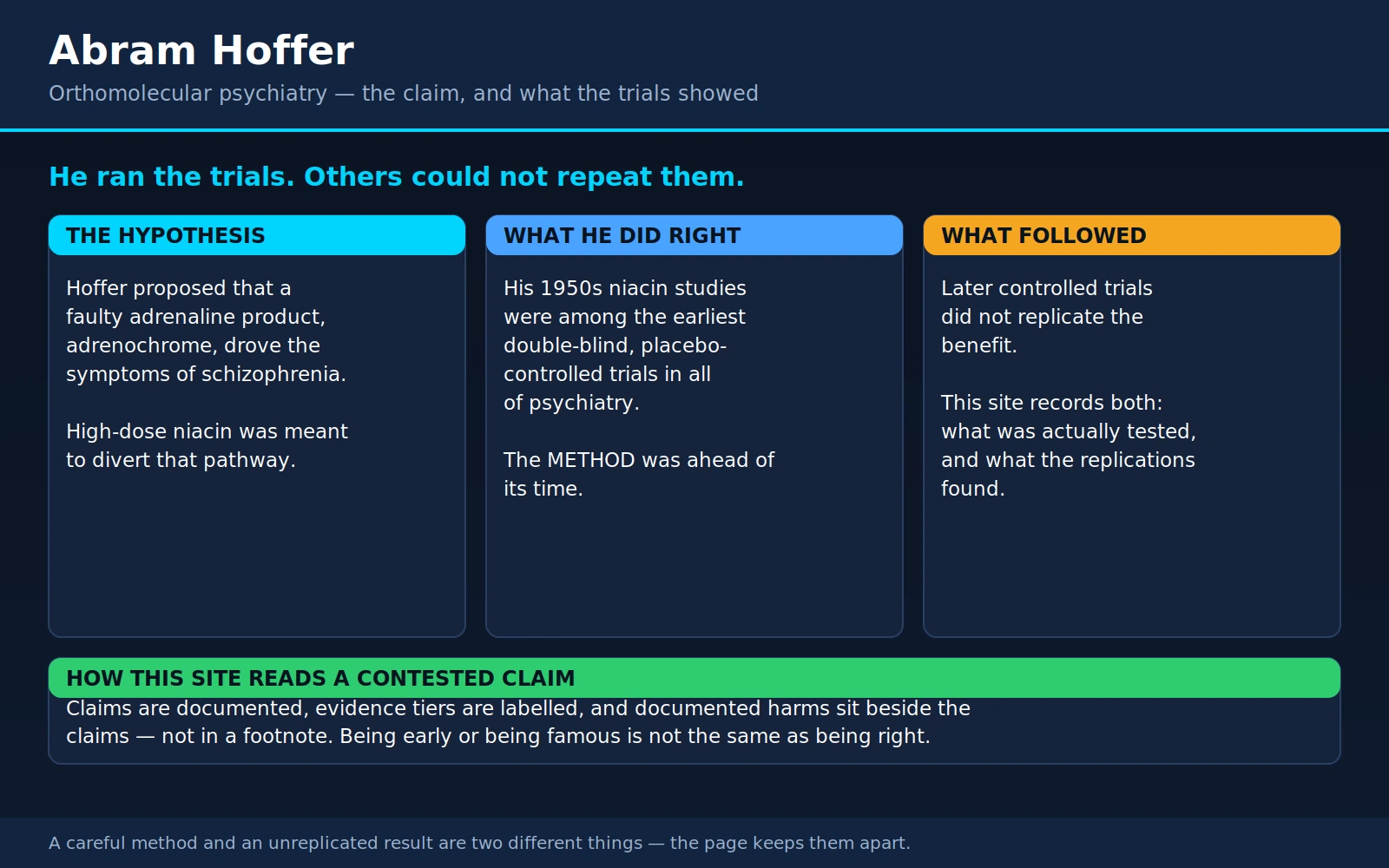
Table of Contents
- Overview
- Who Was Abram Hoffer?
- The Adrenochrome Hypothesis
- The Niacin Trials — What Was Actually Tested
- Vitamin C in Hoffer's Psychiatric Practice
- Hoffer, Pauling, and Cancer
- What Controlled Trials Later Showed
- Where Mainstream Medicine Agrees
- Where Mainstream Medicine Disagrees
- Safety Notes on High-Dose Niacin and Vitamin C
- Legacy and Influence
- Key Research Papers
- Connections
- Featured Videos
1. Overview
Dr. Abram Hoffer (1917–2009) was a Canadian psychiatrist and biochemist best known as one of the founders of orthomolecular psychiatry — and, with Linus Pauling, of the broader movement called orthomolecular medicine. His central idea was that some illnesses might be influenced by altering the concentrations of substances naturally present in the body, especially vitamins and minerals, used at doses far above ordinary nutritional requirements. His work focused particularly on niacin (vitamin B3) and vitamin C.
Hoffer's historical importance is substantial: he was one of the earliest researchers to treat vitamins as pharmacologically active drugs worth testing in controlled trials, and one of the first psychiatrists anywhere to run double-blind, placebo-controlled experiments. At the same time, his stronger claims — especially about schizophrenia and cancer — remain controversial, and they need to be carefully distinguished from what modern controlled clinical evidence has established. This page tells both halves of that story honestly: what Hoffer claimed and why, what he actually tested, and what held up.
2. Who Was Abram Hoffer?
Hoffer was born in 1917 in rural Saskatchewan, Canada. Unusually for a psychiatrist of his era, he came to medicine through biochemistry: he earned a PhD studying B vitamins in cereal grains before completing medical training and specializing in psychiatry. That double background — nutrient chemistry first, psychiatry second — explains nearly everything distinctive about his career.
In 1950 he was appointed to direct psychiatric research for the province of Saskatchewan, where he teamed up with Dr. Humphry Osmond, a British-trained psychiatrist then running the provincial hospital in Weyburn (Osmond is also remembered for coining the word “psychedelic”). Through the 1950s the two ran an ambitious research program on the biochemistry of schizophrenia. In 1967 Hoffer left institutional research for private practice and founded the journal that became the Journal of Orthomolecular Medicine; he later practiced in Victoria, British Columbia, where he continued seeing patients and writing until near his death in 2009 at age 91.
Two things about Hoffer surprise people on both sides of the orthomolecular debate. First, he was methodologically ahead of his time early on — his group ran placebo-controlled, double-blind trials in the early 1950s, before that design was standard anywhere in psychiatry. Second, he was a co-discoverer of a genuinely mainstream drug effect: in 1955 his group in Saskatoon, with anatomist Rudolf Altschul, showed that gram doses of niacin lower serum cholesterol — a finding that put niacin into conventional cardiology for half a century.
3. The Adrenochrome Hypothesis
In the early 1950s, Hoffer and Osmond developed what they called the adrenochrome hypothesis of schizophrenia. Building on a 1952 proposal by Osmond and John Smythies that a mescaline-like metabolite of adrenaline might produce psychotic experiences, they suggested that excessive oxidation of adrenaline (epinephrine) into adrenochrome — a chemically unstable, psychoactive oxidation product — could contribute to the hallucinations and thought disorder of schizophrenia.
The hypothesis directly motivated their two signature nutrients:
- Niacin (vitamin B3) was proposed as a “methyl acceptor” that would reduce the body's production of adrenaline in the first place, upstream of adrenochrome.
- Vitamin C, because it is a reducing agent and antioxidant, was proposed to limit the oxidation step itself — less adrenaline oxidized, less adrenochrome formed. This is why Hoffer hypothesized that large doses of vitamin C could be therapeutic.
Evidence label: historically influential hypothesis, never established. The adrenochrome hypothesis was a serious, testable biochemical idea in 1952, and it helped launch biological psychiatry's interest in oxidative chemistry. But it was not confirmed by subsequent research, and mainstream psychiatric neuroscience moved on to dopamine- and glutamate-centered models of schizophrenia. The full trial history, including the methylation chemistry and the niacin-flush observations, is covered on our dedicated page: Niacin & Schizophrenia.
4. The Niacin Trials — What Was Actually Tested
Starting in 1952, Hoffer and Osmond ran a series of trials in Saskatchewan giving acute schizophrenia patients gram doses of nicotinic acid or nicotinamide alongside standard care. Their 1957 report in the Journal of Clinical and Experimental Psychopathology described double-blind, placebo-controlled methodology, and their 1964 paper in Acta Psychiatrica Scandinavica reported a ten-year follow-up claiming markedly better recovery rates in niacin-treated patients. These reports made megavitamin therapy famous, and the claim — 3,000 mg a day of a cheap, safe vitamin doubling recovery rates — drew enormous public attention.
A point Hoffer himself acknowledged, and which matters for understanding his vitamin C claims: his controlled schizophrenia trials primarily tested vitamin B3, not vitamin C. Vitamin C was commonly given together with niacin in his clinical practice — but the trials were designed around the niacin question, so the vitamin C component rode along untested. His belief that vitamin C improved psychiatric outcomes was therefore a clinical impression consistent with his hypothesis, not a result established by his own controlled trials.
The replication story that followed in the 1970s — independent trials by Wittenborn and by the Canadian Mental Health Association collaborative program led by Thomas Ban and Heinz Lehmann, none of which confirmed the Saskatchewan results, and the 1973 American Psychiatric Association task force report that followed — is told in full on the Niacin & Schizophrenia page. The short version: the effect did not replicate under independent, controlled conditions, and megavitamin therapy for schizophrenia never entered mainstream practice.
5. Vitamin C in Hoffer's Psychiatric Practice
Because vitamin C is a reducing agent, Hoffer reasoned that saturating the body with it would shift adrenaline chemistry away from oxidation to adrenochrome. He therefore gave psychiatric patients vitamin C together with vitamin B3 as a routine part of his regimen. In his own accounts, he commonly described doses of around 3 grams per day of vitamin C — roughly 30–40 times the recommended dietary allowance — although substantially larger amounts were sometimes used for some patients.
To be precise about what this practice rested on:
- The rationale was mechanistic — an antioxidant argument derived from the adrenochrome hypothesis, which itself was never confirmed.
- The dose was tolerable for most people — 3 g/day of oral vitamin C is below the level at which most adults hit gastrointestinal limits, which is part of why the practice persisted for decades without obvious harm.
- The efficacy claim was never isolated in a trial — because vitamin C was always the companion, never the tested variable, in his controlled work.
6. Hoffer, Pauling, and Cancer
Hoffer's interests later expanded well beyond psychiatry. After studying the work of Linus Pauling and Scottish surgeon Ewan Cameron — whose 1976 report from the Vale of Leven hospital described terminal cancer patients on 10 g/day of supplemental ascorbate surviving several times longer than matched controls — Hoffer began recommending high-dose vitamin C to many of his own patients with advanced cancer. His typical recommendation became at least 12 grams per day orally, sometimes increasing the dose according to gastrointestinal (bowel) tolerance, embedded in a broader nutritional program that also included B vitamins, vitamin E, selenium, and zinc.
Crucially — and this matters medically — Hoffer recommended this regimen in addition to conventional cancer treatment, not as its replacement. His patients were generally receiving surgery, radiation, or chemotherapy as indicated; the nutritional program was adjunctive. Whatever one concludes about efficacy, this stance distinguished Hoffer from practitioners who steer patients away from oncology altogether.
Hoffer subsequently collaborated with Pauling on observational analyses of his patient series, published in the Journal of Orthomolecular Medicine in 1990 and updated in the 1990s, applying a biostatistical method associated with physicist Hardin Jones. These analyses reported substantially longer survival among the cancer patients who followed the nutritional regimen than among those who did not — differences the authors described as large multiples, not marginal effects.
Evidence label: observational, not randomized — a limitation Hoffer himself explicitly acknowledged. Patients were not randomly assigned to the regimen; those who followed it were self-selected, tended to be well enough to swallow gram doses daily, and differed from non-followers in ways no statistical adjustment can fully repair (survivorship, lead-time, and compliance biases all run in the regimen's favor). Consequently, these studies cannot establish that vitamin C caused the reported survival differences. They are best read as hypothesis-generating clinical observations from a committed practitioner — the same tier as Cameron's original Vale of Leven series, and subject to the same critique.
7. What Controlled Trials Later Showed
The randomized evidence on oral high-dose vitamin C in advanced cancer came from the Mayo Clinic. Two double-blind, placebo-controlled trials — Creagan and colleagues in 1979, and Moertel and colleagues in 1985, the second designed specifically to answer the Cameron–Pauling claim in chemotherapy-naïve patients — found no survival or symptom benefit of 10 g/day oral vitamin C over placebo. After 1985, mainstream oncology considered the question closed for oral dosing.
Two decades later, pharmacokinetic work by Padayatty, Levine, and colleagues at the NIH showed that oral and intravenous vitamin C are pharmacologically different interventions: intestinal absorption caps the plasma concentrations reachable by mouth, while IV infusion can produce plasma levels ten-fold to a hundred-fold higher. This reopened a research question about IV ascorbate — but it is a question about IV therapy, and it does not retroactively validate the oral regimens Hoffer and Pauling recommended. The modern IV story, including current trials and their mixed results, is covered on our IV High-Dose Vitamin C & Cancer page.
In psychiatry, the niacin replication failures of the 1970s (Wittenborn; the Ban–Lehmann Canadian collaborative studies) were described in section 4. No subsequent controlled trial has established either B3 or C as an effective treatment for schizophrenia, and a 2008 review by L. John Hoffer — Abram Hoffer's son, himself a professor of medicine and clinical nutrition researcher — gives a careful, sympathetic-but-critical account of why the vitamin-therapy claims failed to convince, while arguing some questions were left genuinely unresolved by the quality of the replications.
8. Where Mainstream Medicine Agrees
- Niacin is a real drug at gram doses. The 1955 Altschul–Hoffer–Stephen discovery that nicotinic acid lowers serum cholesterol was confirmed, mechanistically elaborated, and used clinically for decades. Hoffer's core methodological instinct — that a vitamin can act as a pharmacological agent at high doses — is simply correct.
- Nutrient deficiency can produce psychiatric illness. Pellagra — niacin deficiency — causes a dementia-psychosis that resolves with niacin; B12 deficiency can cause depression and psychosis. Hoffer's insistence that psychiatry take biochemistry seriously was vindicated in these established cases.
- Early double-blind methodology. Running placebo-controlled psychiatric trials in the early 1950s was genuinely pioneering, whatever one concludes about the later replication record.
- Adjunct, not replacement. His rule that nutritional therapy accompanies — never substitutes for — conventional cancer treatment is exactly the stance mainstream integrative oncology takes toward supplements today.
- Vitamin C at moderate supplemental doses is inexpensive and generally safe for people without specific risk factors, which is why the research question stayed alive long enough to be re-asked properly in the IV era.
9. Where Mainstream Medicine Disagrees
- Megavitamin therapy for schizophrenia. Independent randomized trials in the 1970s failed to reproduce the Saskatchewan results, and the 1973 APA task force on megavitamin therapy concluded the evidence did not support the claims. Niacin is not part of any mainstream schizophrenia guideline.
- The adrenochrome hypothesis. Not confirmed; superseded by dopamine-, glutamate-, and neurodevelopment-centered models. It survives mainly as an important episode in the history of biological psychiatry.
- Vitamin C for psychiatric outcomes. Never isolated in a controlled trial by Hoffer's group; no independent controlled evidence established it; not part of any treatment guideline.
- Vitamin C and cancer survival. The Hoffer–Pauling survival analyses were observational and cannot show causation; the randomized Mayo trials of comparable oral doses were negative. Modern IV-ascorbate research is a separate, still-unsettled question that does not rescue the oral-megadose claims.
- Breadth of application. Late in his career Hoffer applied the orthomolecular framework to a wide range of conditions largely on the strength of case series. Mainstream medicine regards uncontrolled case series — from any practitioner, however experienced — as the weakest tier of clinical evidence.
10. Safety Notes on High-Dose Niacin and Vitamin C
Because readers encounter Hoffer's dosing numbers (3,000 mg/day niacin; 3–12+ g/day vitamin C) and may be tempted to self-experiment, the documented harms belong right here beside the claims:
- Niacin (nicotinic acid) at gram doses: intense flushing and itching (immediate-release), liver injury — particularly with sustained-release formulations — elevated blood glucose, uric acid elevation and gout flares, and stomach irritation. Gram-dose niacin is a drug with real hepatotoxicity risk and should not be taken chronically without liver-enzyme monitoring by a clinician.
- Vitamin C at multi-gram oral doses: osmotic diarrhea and cramping at bowel-tolerance limits, increased urinary oxalate with kidney-stone risk in predisposed people, iron-overload concern in hemochromatosis, and falsely altered glucose-meter readings at very high blood levels. Very-high-dose IV ascorbate can trigger hemolysis in G6PD deficiency.
- In cancer care specifically: any high-dose antioxidant program must be disclosed to and coordinated with the oncology team — interactions between antioxidants and specific chemotherapy or radiation regimens are a live, debated research area, and oncologists cannot manage what they do not know about. Hoffer's own adjunct-only rule already implies this.
11. Legacy and Influence
Pauling coined the word “orthomolecular” in a 1968 Science paper that leaned heavily on the niacin work of Hoffer and Osmond, giving the movement its name and its most famous advocate. Hoffer supplied the movement's clinical program: the journal he founded in 1967 (today's Journal of Orthomolecular Medicine), the International Schizophrenia Foundation, dozens of books, and a worldwide network of practitioners he mentored personally. The through-line from Hoffer to today's high-dose IV vitamin C clinics, functional-medicine niacin protocols, and nutrient-first psychiatry movements is direct.
A fair summary of the man: he was an early, methodologically serious advocate for studying high-dose nutrients as pharmacologically active interventions — particularly B3 and vitamin C — who was right that vitamins can be drugs, right that deficiency can masquerade as psychiatric disease, and co-discoverer of a cholesterol therapy cardiology used for fifty years. But his stronger claims — especially regarding schizophrenia and cancer — were not confirmed when tested under controlled conditions, and they should be clearly distinguished from what modern controlled clinical evidence has established. Both halves of that sentence are true at once; that is what makes Hoffer worth reading about.
12. Key Research Papers
- Osmond H, Smythies J. Schizophrenia: a new approach. J Ment Sci 1952;98(411):309-15
- Hoffer A, Osmond H, Smythies J. Schizophrenia; a new approach. II. Result of a year's research. J Ment Sci 1954;100(418):29-45
- Hoffer A, Osmond H, Callbeck MJ, Kahan I. Treatment of schizophrenia with nicotinic acid and nicotinamide. J Clin Exp Psychopathol 1957;18(2):131-58
- Hoffer A, Osmond H. Treatment of schizophrenia with nicotinic acid. A ten year follow-up. Acta Psychiatr Scand 1964;40(2):171-89
- Pauling L. Orthomolecular psychiatry. Varying the concentrations of substances normally present in the human body may control mental disease. Science 1968;160(3825):265-71
- Wittenborn JR, Weber ES, Brown M. Niacin in the long-term treatment of schizophrenia. Arch Gen Psychiatry 1973;28(3):308-15
- Luchins D, Ban TA, Lehmann HE. A review of nicotinic acid, N-methylated indoleamines and schizophrenia. Int Pharmacopsychiatry 1978;13(1):16-33
- Petrie WM, Ban TA, Ananth JV. The use of nicotinic acid and pyridoxine in the treatment of schizophrenia. Int Pharmacopsychiatry 1981;16(4):245-50
- Cameron E, Pauling L. Supplemental ascorbate in the supportive treatment of cancer: Prolongation of survival times in terminal human cancer. Proc Natl Acad Sci USA 1976;73(10):3685-9
- Creagan ET, Moertel CG, O'Fallon JR, et al. Failure of high-dose vitamin C (ascorbic acid) therapy to benefit patients with advanced cancer. A controlled trial. N Engl J Med 1979;301(13):687-90
- Moertel CG, Fleming TR, Creagan ET, et al. High-dose vitamin C versus placebo in the treatment of patients with advanced cancer who have had no prior chemotherapy. A randomized double-blind comparison. N Engl J Med 1985;312(3):137-41
- Padayatty SJ, Sun H, Wang Y, Riordan HD, et al. Vitamin C pharmacokinetics: implications for oral and intravenous use. Ann Intern Med 2004;140(7):533-7
- Hoffer LJ. Vitamin therapy in schizophrenia. Isr J Psychiatry Relat Sci 2008;45(1):3-10
- Hoffer A, Pauling L. Hardin Jones biostatistical analysis of mortality data for cohorts of cancer patients with a large fraction surviving at the termination of the study who received or did not receive ascorbate and other micronutrients. J Orthomolecular Medicine 1990;5(3):143-154. (Not PubMed-indexed; the journal is not in MEDLINE.)
Live PubMed Searches
- Hoffer niacin schizophrenia
- Orthomolecular psychiatry
- Adrenochrome and schizophrenia
- Vitamin C and cancer survival
- IV ascorbate cancer clinical trials
- Niacin hepatotoxicity
Connections
- All Notable Doctors
- Dr. Bryan Ardis — the nicotine hypothesis and COVID-era protocols
- Morley Robbins — the Root Cause Protocol and mineral balancing
- Linus Pauling — the collaborator who named the field and carried vitamin C to the world
- Vitamin B3 (Niacin) — the vitamin Hoffer's trials were built on
- Niacin & Schizophrenia — the Saskatchewan trials, replications, and the niacin-flush test in full
- Vitamin C — Hoffer's second signature nutrient
- IV High-Dose Vitamin C & Cancer — Cameron–Pauling, the Mayo trials, and the IV-era reopening
- Vitamin C Benefits — the full vitamin C evidence hub
- Schizophrenia — the illness Hoffer spent his career on
- NAD+ and NMN — the modern chapter of niacin biochemistry
- Gerson Therapy — another physician-named nutritional protocol, and its evidence record
- All Remedies