 — February 6, 2026
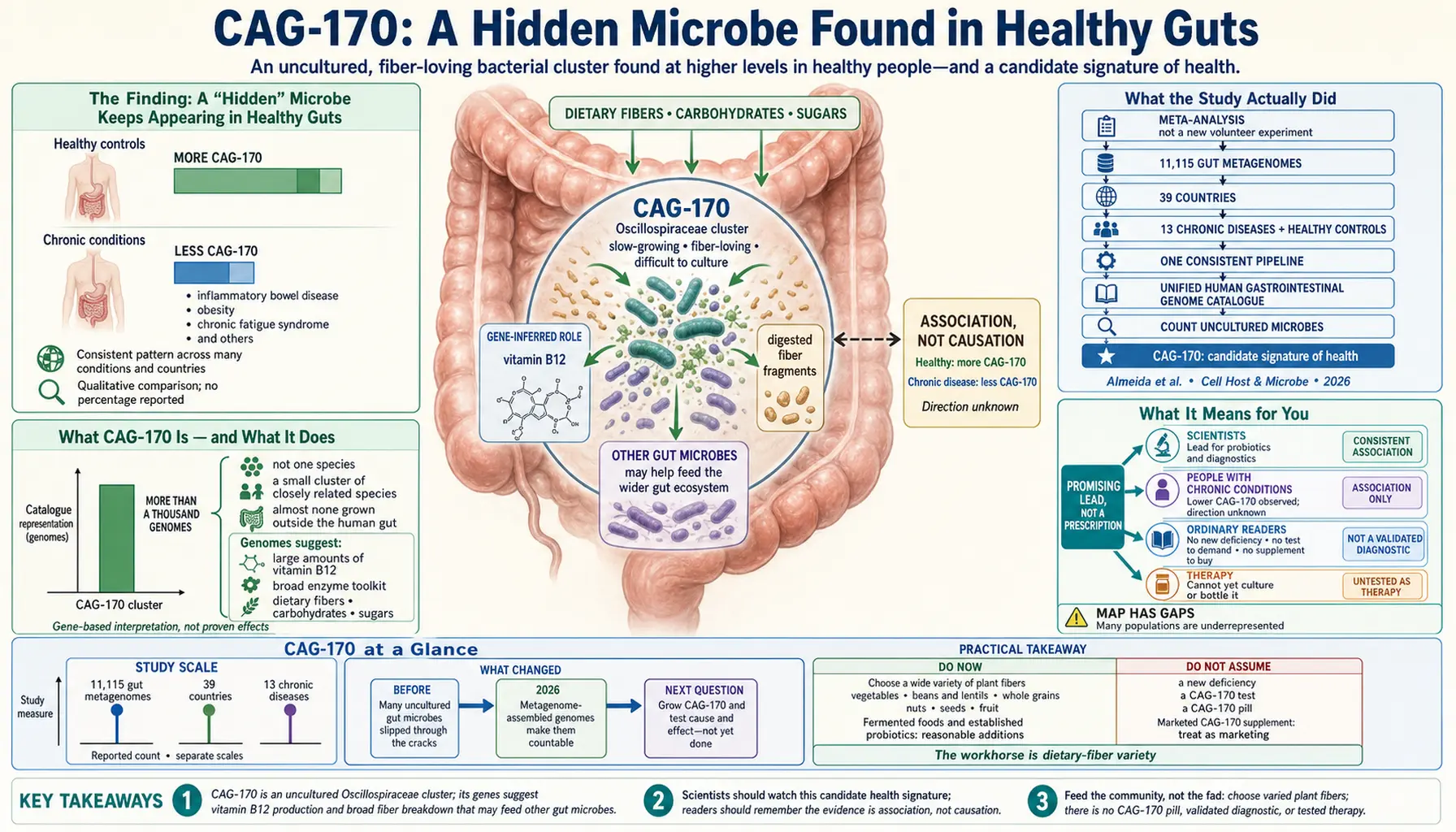
A large global meta-analysis of the gut microbiome, published in February 2026, reached a headline that is unusually simple for a field that loves complexity: across 11,115 gut samples from 39 countries, a single, little-known group of gut bacteria kept showing up in larger numbers in healthy people than in people with disease. Researchers have never managed to grow most of these microbes in a lab. Below: what the study found, what it does not prove, and what remains unknown.
Table of Contents
- 1. The Finding: A “Hidden” Microbe Keeps Appearing in Healthy Guts
- 2. What the Study Actually Did
- 3. What CAG-170 Is — and What It Does
- 4. What the Findings Show
- 5. Honest Caveats
- 6. Questions the Research Leaves Open
- Sources
- Key Research Papers
- Featured Videos
1. The Finding: A “Hidden” Microbe Keeps Appearing in Healthy Guts
A team led by Dr. Alexandre Almeida at the University of Cambridge, with Ana C. da Silva as first author, published the study in the journal Cell Host & Microbe (online 9 February 2026; March 2026 issue) under a carefully worded title: “a candidate signature of health.” The word candidate is doing real work there, and the caveats below come back to it. The finding itself is easy to state. When the researchers pooled 11,115 gut metagenomes from 39 countries and asked which microbes were linked with health and which with disease, one group rose to the top — a bacterial genus known, unglamorously, as CAG-170, which the paper calls “the strongest health-associated lineage across multiple diseases and geographies.”
People living with a range of chronic conditions — inflammatory bowel disease, obesity, chronic fatigue syndrome, and others — consistently carried less CAG-170 in their guts, according to the University of Cambridge’s announcement. Healthy people carried more. What makes the result striking is not any single disease link but the consistency: the pattern held across many different conditions and across many different countries.
2. What the Study Actually Did
This was a meta-analysis — the researchers did not run a new experiment on new volunteers. Instead they gathered 11,115 gut metagenomes (deep DNA readouts of everything living in a stool sample) from 39 countries, spanning 13 noncommunicable diseases plus healthy controls, and analyzed them together. Across that pool they identified 317 species linked to distinct clinical states, and uncultured bacteria were over-represented in the healthy subjects. That scale is the study’s main strength: a pattern that holds across samples from 39 countries is harder to dismiss as a fluke of one lab, one diet, or one population than a result from a single cohort.
The other key choice was how they counted microbes. The paper notes that over 60% of gut species remain uncultured — never grown in a laboratory dish — so they are easy to miss. By comparing each sample against a reference library rich in metagenome-assembled genomes — the Unified Human Gastrointestinal Genome (UHGG) catalogue, built by Almeida’s team (its 2021 description lists 204,938 genomes from 4,644 gut prokaryote species, more than 70% of them without a cultured representative) — the team could count the “uncultured” microbes that culture-based methods miss. In the catalogue’s current release (v2.0.2), CAG-170 is represented by 1,055 genomes across 15 species, and each of those 15 species is represented by a genome assembled from stool DNA rather than from a cultured isolate.
3. What CAG-170 Is — and What It Does
CAG-170 belongs to the Oscillospiraceae, a family of gut bacteria whose members have proved difficult to culture: a 2024 study of 114 Colombian adults described culturing bacteria in this family as challenging, and found that the diversity of the genus CAG-170 was lower in people with a higher body mass index. CAG-170 is not one species but a genus of closely related ones, and most of them have never been grown in a lab.
Because the researchers could read its genes, they could make an educated guess about its job — these are predictions from genome sequences, not measurements in living bacteria. The functional predictions point to two things: a greater capacity for vitamin B12 biosynthesis (the university’s announcement describes a capacity to produce high levels of B12), and enzymes that break down a wide range of dietary fibers, carbohydrates, and sugars. The researchers think the B12 likely supports other species of gut bacteria rather than the human host, and the paper describes CAG-170 as having “cross-feeding potential.” In ecological network models of healthy populations it was the most central taxon (the preprint version called it the top candidate keystone genus) — less a lone hero than a quiet contributor that may help the wider gut ecosystem run.
4. What the Findings Show
The study identifies a promising lead, not a treatment: a specific microbe whose levels track with health across many diseases and countries, a candidate marker for researchers working on future probiotics and diagnostics. It suggests that a healthy gut may depend not only on the well-known microbes already used in probiotic products, but also on quiet, uncultured “background” species that help feed the rest of the ecosystem. The authors write that their findings “shed light on the underexplored role of uncultured gut species in health and disease”; the wider subject is covered on the gut health page.
What the study does not do is define a CAG-170 deficiency, validate a clinical test, or test any supplement. It studied no CAG-170 product, and because most CAG-170 species have never been grown in a lab, none has been given to people as a probiotic.
5. Honest Caveats
Several limits of the study are worth stating plainly.
- Association is not causation. This is the big one. The study is observational — it compares sick and healthy people in existing datasets. It did look at change over time: CAG-170 was temporally stable, and its abundance and subspecies diversity were negatively correlated with gut imbalance over time. But it cannot tell whether low CAG-170 helps cause disease, or whether disease (or the diet changes, medications, and inflammation that come with it) lowers CAG-170. The arrow could point either way, or both.
- “Candidate signature” means exactly that. The authors chose cautious language. A marker that correlates with health is not the same as a validated diagnostic test, and it is certainly not a treatment.
- The map has gaps. Even at 39 countries, the samples come primarily from Europe, North America, and Asia, according to the university’s announcement. Other regions contribute fewer samples, including non-industrialized populations, whose gut microbiomes can differ markedly: a 2012 comparison of people in the Venezuelan Amazonas, rural Malawi and US metropolitan areas found pronounced differences in bacterial communities and gene repertoires between the US residents and the other two groups. A “global” signature is only as global as the stool samples behind it.
- It is largely uncultured, so it is untested as a therapy. Until scientists can grow CAG-170, it cannot be given to volunteers in a trial. That experiment — the one that would actually test cause and effect — has not been run.
6. Questions the Research Leaves Open
Does diet change CAG-170 levels? The study did not examine diet. Its genome predictions describe CAG-170 as a fiber degrader, carrying enzymes for a wide range of carbohydrates, sugars and fibers, and the 2024 Colombian study found genes for carbohydrate-active enzymes, suggesting fiber degradation, in a related Oscillospiraceae genus (Vescimonas). Almeida’s own summary is that these bacteria appear to matter “likely by helping us to digest the main components of our food.” Whether a wider variety of plant fibers — vegetables, beans and lentils, whole grains, nuts, seeds, and fruit — raises CAG-170 in people, and whether fermented foods or existing probiotics affect it, was not tested.
Will there be a CAG-170 probiotic? The University of Cambridge announcement says the findings “open the door to developing new probiotics specifically designed to support and maintain healthy levels of CAG-170 in the gut,” and quotes Almeida that “probiotics aimed at supporting them could have a much greater health benefit” — a hypothesis, not a tested result. The study itself tested no product, so a supplement marketed as “CAG-170” or as boosting a “health-signature microbe” would not be backed by this research. The study’s central finding is narrower: gut health may rest on a whole community of uncultured, fiber-degrading microbes, of which CAG-170 was the strongest health-associated genus in this analysis.
Sources
- da Silva AC, Lapkin J, Yin Q, Muller E, Almeida A. Meta-analysis of the uncultured gut microbiome across 11,115 global metagenomes reveals a candidate signature of health. Cell Host & Microbe. 2026. DOI: 10.1016/j.chom.2026.01.013
- Article page (journal): Cell Host & Microbe — full text
- University of Cambridge press release (9 February 2026): “Hidden” bugs in our gut appear key to good health, finds global study
- ScienceDaily summary: Scientists discover a hidden gut bacterium linked to good health
- Unified Human Gastrointestinal Genome catalogue, MGnify (EMBL-EBI): UHGG v2.0.2 genome catalogue (source of the CAG-170 genome and species counts)
Key Research Papers
Each entry was checked against PubMed and Crossref before it was written down.
- da Silva AC, Lapkin J, Yin Q, Muller E, Almeida A (2026). Meta-analysis of the uncultured gut microbiome across 11,115 global metagenomes reveals a candidate signature of health. Cell Host & Microbe 34(3):379-392.e5. — PubMed PMID: 41666920
- da Silva AC, Lapkin J, Yin Q, Muller E, Almeida A (2025). Meta-analysis of the uncultured gut microbiome across 11,115 global metagenomes reveals a new candidate biomarker of health. bioRxiv, preprint of the paper above. — DOI: 10.1101/2025.09.09.675081
- Almeida A, Nayfach S, Boland M, Strozzi F, Beracochea M, Shi ZJ, et al. (2021). A unified catalog of 204,938 reference genomes from the human gut microbiome. Nature Biotechnology 39(1):105-114. — PubMed PMID: 32690973
- Salazar-Jaramillo L, de la Cuesta-Zuluaga J, Chica LA, Cadavid M, Ley RE, Reyes A, Escobar JS (2024). Gut microbiome diversity within Clostridia is negatively associated with human obesity. mSystems 9(8):e0062724. — PubMed PMID: 39012154
- Yatsunenko T, Rey FE, Manary MJ, Trehan I, Dominguez-Bello MG, Contreras M, et al. (2012). Human gut microbiome viewed across age and geography. Nature 486(7402):222-227. — PubMed PMID: 22699611