Tremella for Brain & Nerve Health
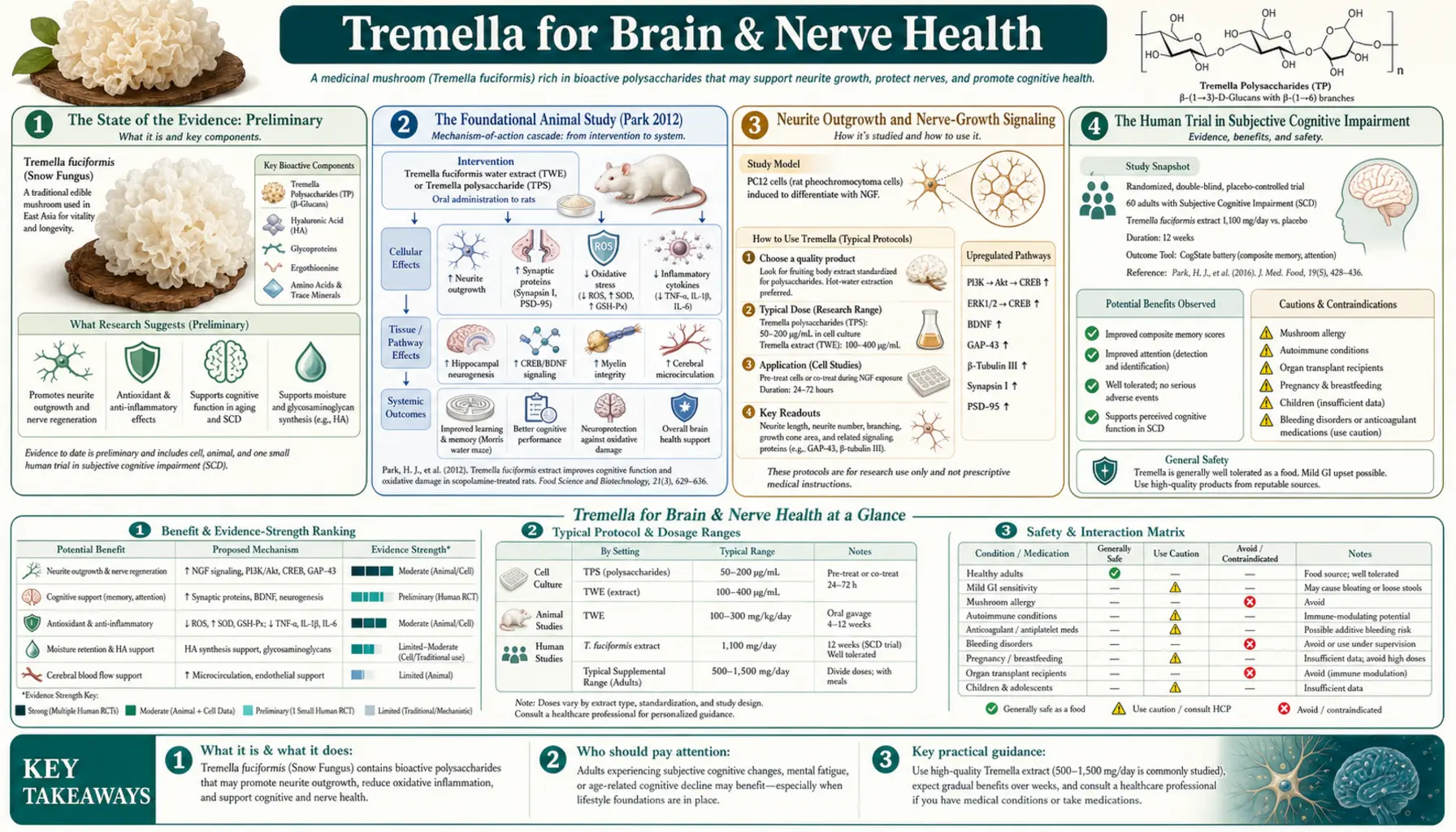
This is the most preliminary of Tremella's benefit stories, and we want that stated plainly before anything else. The idea that Tremella supports the brain rests mainly on one influential animal study (nerve-cell outgrowth and reversal of memory impairment in rats), one small human trial in older adults with mild memory complaints, and a scattering of nerve-regeneration and brain-injury experiments in the laboratory. It is genuinely interesting early research — enough to justify serious study — but it is nowhere near proof that Tremella improves memory, prevents dementia, or heals nerves in people. This page walks through each study, what it actually showed, and the large gaps that remain, so the promise is not mistaken for an established treatment.
Table of Contents
- The State of the Evidence: Preliminary
- The Foundational Animal Study (Park 2012)
- Neurite Outgrowth and Nerve-Growth Signaling
- The Human Trial in Subjective Cognitive Impairment
- The Combination-Supplement Cognition Trial
- Nerve Regeneration: The Polylactide Conduit
- Neuroinflammation and Brain-Injury Models
- How It Might Work (Proposed Mechanisms)
- Tremella vs Lion's Mane for Cognition
- Honest Bottom Line
- Key Research Papers
- Connections
- Featured Videos
The State of the Evidence: Preliminary
It is worth being explicit about what "preliminary" means here, because it changes how every result below should be read. The Tremella brain literature consists of:
- A handful of cell and animal studies (rats, cultured nerve cells), which can suggest mechanisms but cannot establish a human benefit.
- One small human randomized controlled trial in people with subjective cognitive impairment — the single most relevant piece of evidence, but small and not yet replicated.
- One combination-supplement human trial in which Tremella (snow fungus) was only one of several ingredients, so any benefit cannot be attributed to Tremella specifically.
- Laboratory nerve-regeneration and brain-injury models that are far from clinical application.
No large, replicated human trials exist. Tremella is not an approved or evidence-established treatment for any neurological condition. Nothing on this page should be used to self-treat memory loss, dementia, neuropathy, or nerve injury, or to delay proper medical care. With that firmly in mind, the individual studies are genuinely worth understanding.
The Foundational Animal Study (Park 2012)
The paper most often cited for Tremella and the brain is Park and colleagues (2012). Working with both cultured nerve cells and live rats, they reported two linked findings:
- In cultured PC12 cells (a standard neuron-like cell line), Tremella fuciformis extract promoted neurite outgrowth — the growth of the branching projections that neurons use to form connections.
- In rats, Tremella reversed memory impairment that had been induced by trimethyltin (a neurotoxin used to model hippocampal damage). The behavioral improvement was accompanied by activation of CREB (a transcription factor central to memory formation) and of the cholinergic system (the acetylcholine-based signaling that is deficient in Alzheimer's disease).
This is a well-constructed study that ties a behavioral result (better memory) to plausible molecular mechanisms (CREB, cholinergic signaling). It is the strongest single reason Tremella is discussed in the cognition space. But it is an animal-plus-cell study using a chemically induced injury model — a model of damage, not of normal human aging — and animal memory results frequently fail to reproduce in human trials. It earns Tremella a place on the research agenda; it does not establish a human cognitive benefit.
Neurite Outgrowth and Nerve-Growth Signaling
The neurite-outgrowth finding deserves a closer look because it is the mechanistic heart of the "brain mushroom" idea. When neurons extend neurites and form new connections, the brain is doing the cellular work of learning and repair. Compounds that encourage this in a dish are of interest for both cognition and nerve regeneration.
Tremella's promotion of neurite outgrowth in PC12 cells places it, mechanistically, in loose company with the far more famous Lion's Mane mushroom, whose hericenones and erinacines are studied for stimulating nerve growth factor (NGF). Importantly, Tremella and Lion's Mane are different fungi with different active compounds, and Lion's Mane has substantially more neuroscience research behind it. Tremella's neurite effect is real in the cell model reported, but it is a single line of preclinical evidence, not a proven route to human brain benefit.
The Human Trial in Subjective Cognitive Impairment
The most directly relevant evidence is a randomized controlled trial by Ban and colleagues (2018) testing Tremella fuciformis in adults with subjective cognitive impairment — people who notice their own memory slipping but do not yet have measurable dementia (an early, at-risk stage). Participants were randomized to Tremella or placebo, and cognitive performance and safety were assessed.
The trial reported improvements on some cognitive measures in the Tremella group compared with placebo, and Tremella was well tolerated. That is a genuinely encouraging signal — a proper randomized, placebo-controlled human design pointing in a positive direction. The essential caveats:
- It was a single, relatively small trial. Small early trials frequently show effects that shrink or disappear when larger studies are run.
- It has not been widely replicated by independent groups.
- The population was people with subjective complaints, not diagnosed dementia; results cannot be extrapolated to Alzheimer's disease or to healthy people seeking enhancement.
Read fairly, this trial makes Tremella a legitimate candidate worth larger study for early cognitive concerns — not a proven cognitive treatment.
The Combination-Supplement Cognition Trial
A second human study (Lin and colleagues, 2023) was a randomized, double-blind, placebo-controlled trial of a supplement combining fish roe, snow fungus (Tremella), and yeast for cognitive function. The combination showed cognitive benefits versus placebo.
This is useful supporting context, but it has a built-in limitation that must be stated: because Tremella was one of three active ingredients, the trial cannot tell us how much (if any) of the benefit came from Tremella specifically versus the fish roe (a source of brain-relevant phospholipids and omega-3s) or the yeast. A positive combination result is consistent with Tremella helping, but it is not evidence that Tremella alone does anything. Combination-supplement trials are common in this field and are the reason single-ingredient claims should be made cautiously.
Nerve Regeneration: The Polylactide Conduit
On the peripheral-nerve side, one striking experiment used Tremella polysaccharide not as a supplement but as a biomaterial. Researchers built nerve-guidance conduits from polylactide and immobilized Tremella fuciformis polysaccharide on their surface, then used them to bridge a 15 mm critical-size gap in an injured nerve in an animal model. Over the long term, the Tremella-coated conduits supported nerve regeneration and functional recovery across the gap.
This is fascinating tissue-engineering research suggesting the polysaccharide can create a favorable environment for nerve regrowth. But note carefully what it is and is not: it is a surgical biomaterial experiment in animals, in which the polysaccharide is physically bonded to an implanted device at the site of injury. It says nothing about eating Tremella or taking it as a supplement to help nerve pain or neuropathy. The delivery method is the whole point, and it is not something a consumer can replicate. For nerve conditions, see Neurology.
Neuroinflammation and Brain-Injury Models
More recent animal work has examined Tremella polysaccharides in acute brain injury. In an experimental model of subarachnoid hemorrhage (bleeding around the brain), Tremella polysaccharides reduced early brain injury, an effect the authors attributed to dampening an inflammatory signaling pathway (P38 MAPK/NF-κB). This fits the broader picture of Tremella polysaccharides as anti-inflammatory in various tissues, consistent with the antioxidant and immune-modulating themes discussed on the Antioxidant and Immune Support pages.
As with everything here, this is a rodent model of a serious acute condition, studied to understand mechanisms. It is not evidence that Tremella prevents or treats stroke, brain hemorrhage, or any neurological emergency in humans, and it should never substitute for emergency care.
How It Might Work (Proposed Mechanisms)
Pulling the threads together, the proposed ways Tremella might influence the nervous system are:
- Cholinergic support and CREB activation — the memory-relevant mechanisms seen in the Park rat study; acetylcholine signaling and CREB are both central to learning.
- Neurite outgrowth promotion — encouraging neurons to extend and connect, seen in PC12 cells.
- Antioxidant protection — the brain is highly vulnerable to oxidative stress, and Tremella polysaccharides are antioxidant in other tissues.
- Anti-inflammatory / anti-neuroinflammatory action — dampening inflammatory signaling implicated in cognitive decline and brain injury.
These are plausible and internally consistent, which is what makes Tremella an interesting research target. But a plausible mechanism is a hypothesis to test, not a benefit to claim. The mechanisms are drawn largely from cell and animal work; whether they operate meaningfully in the living human brain after oral Tremella is unknown.
Tremella vs Lion's Mane for Cognition
Because both are marketed as "brain mushrooms," a comparison is fair. Lion's Mane has a larger and more specific cognitive-research base, including several human trials and a well-defined NGF-related mechanism from its hericenones and erinacines. Tremella's cognitive evidence is thinner: essentially the Park animal study plus the small Ban human trial and the combination trial.
If cognitive support is the specific goal, Lion's Mane is the better-studied choice today, though it too is far from definitively proven. Tremella's distinctive, best-grounded use remains skin hydration. Presenting Tremella as an equal to Lion's Mane for the brain overstates its evidence.
Honest Bottom Line
- What exists: a solid animal study (memory, neurite outgrowth, CREB, cholinergic), one small positive human trial in subjective cognitive impairment, a positive combination-supplement trial, and nerve-regeneration and brain-injury models — all preclinical or small/preliminary.
- What does not exist: large, replicated human trials; evidence that Tremella prevents dementia, improves memory in healthy people, or treats any neurological disease or nerve injury.
- Reasonable stance: Tremella is a promising but early research candidate for cognitive aging. Treat any product marketed for "brain health" with Tremella as unproven, and never use it in place of evaluation and treatment for real neurological symptoms.
- Safety: Tremella has been well tolerated in the human trial and as a traditional food; see the main Tremella page for cautions.
Key Research Papers
- Park HJ, et al. (2012). Tremella fuciformis enhances the neurite outgrowth of PC12 cells and restores trimethyltin-induced impairment of memory in rats via activation of CREB transcription and cholinergic systems. Behavioural Brain Research. — PubMed 22185695
- Ban S, et al. (2018). Efficacy and safety of Tremella fuciformis in individuals with subjective cognitive impairment: a randomized controlled trial. Journal of Medicinal Food. — PubMed 29319408
- Lin YK, et al. (2023). Effectiveness of fish roe, snow fungus, and yeast supplementation for cognitive function: a randomized, double-blind, placebo-controlled clinical trial. Nutrients. — PubMed 37836504
- Hsu SH, et al. (2013). Long-term regeneration and functional recovery of a 15 mm critical nerve gap bridged by Tremella fuciformis polysaccharide-immobilized polylactide conduits. Evidence-Based Complementary and Alternative Medicine. — PubMed 24027599
- Wan YH, et al. (2025). Tremella fuciformis polysaccharides alleviate early brain injury in experimental subarachnoid hemorrhage by inhibiting the KDR-mediated P38 MAPK/NF-κB pathway. Molecular Neurobiology. — PubMed 40263235
- Yang D, et al. (2019). Tremella polysaccharide: the molecular mechanisms of its drug action. Progress in Molecular Biology and Translational Science. — PubMed 31030755
- Wu YJ, et al. (2019). Structure, bioactivities and applications of the polysaccharides from Tremella fuciformis mushroom: a review. International Journal of Biological Macromolecules. — PubMed 30342120
PubMed Topic Searches
- Tremella memory and cognition
- Tremella neurite outgrowth PC12
- Tremella nerve regeneration
- Tremella neuroprotective
- Tremella subjective cognitive impairment
- Mushroom neurite / nerve growth factor
External Authoritative Resources
- PubMed — Tremella cognition research
- PubMed Central — free full-text neuroprotection papers
- ClinicalTrials.gov — Tremella cognition trials
Connections
- Tremella Mushroom (Main Page)
- Tremella Benefits Hub
- Tremella for Immune Support
- Tremella Antioxidant & Anti-Aging
- Lion's Mane Mushroom
- Cordyceps Mushroom
- L-Theanine
- Neurology
- Alzheimer's Disease
- Parkinson's Disease
- Antioxidants
- All Medicinal Mushrooms