Tremella Antioxidant & Anti-Aging Research
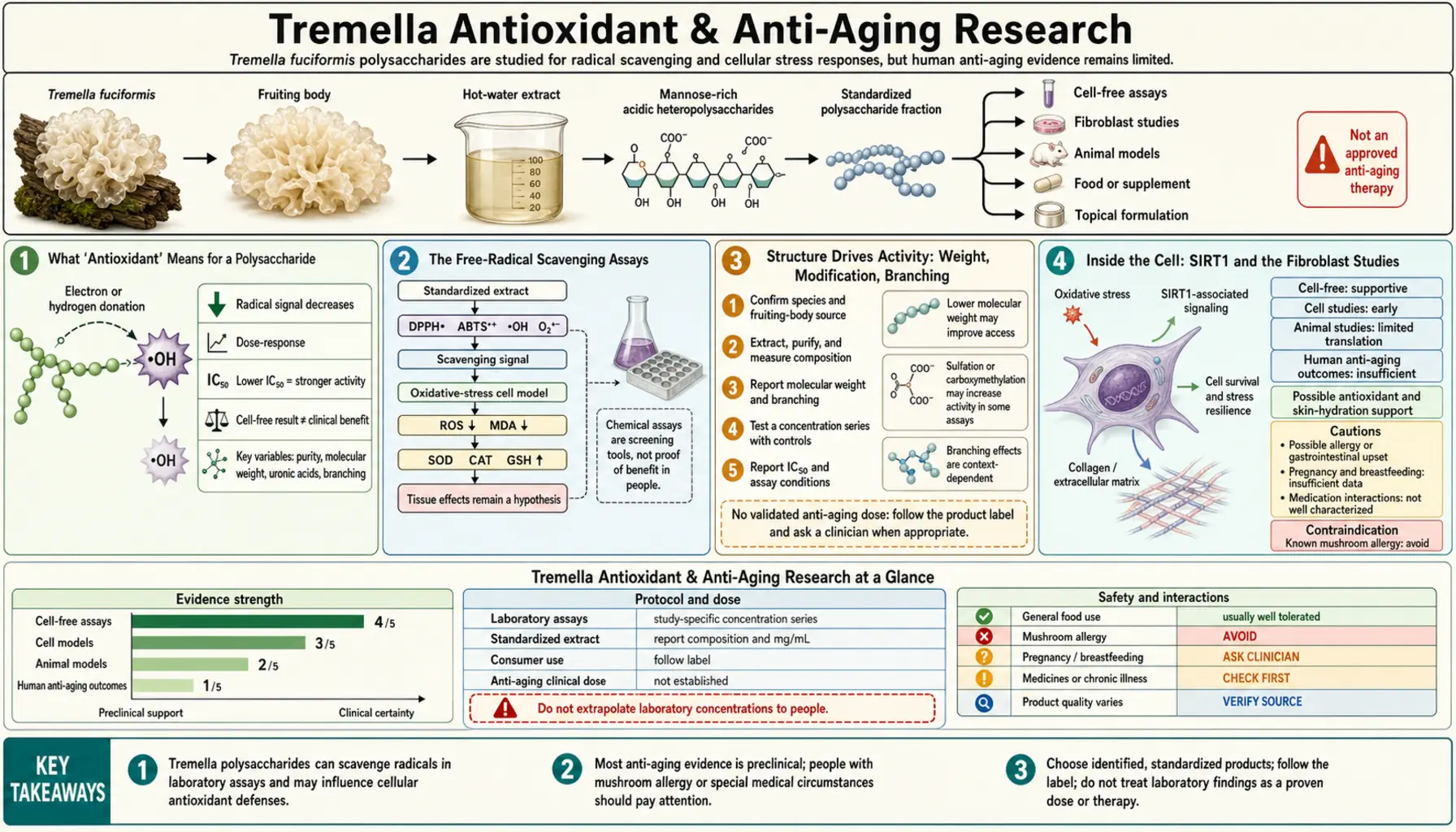
Tremella polysaccharides are reliably "antioxidant" in the laboratory: they scavenge free radicals in chemical assays and, in cultured cells, nudge protective pathways such as SIRT1 and Nrf2/Keap1. That is real and repeatable. The honest question is what it means for a person. Antioxidant activity in a test tube is one of the easiest results to obtain in all of natural-product chemistry and one of the hardest to translate into a proven human anti-aging effect. This page lays out what the antioxidant and cellular studies actually found, why the structure of the molecule changes its activity, and exactly where the evidence stops — so you can separate genuine cellular science from the "anti-aging superfood" story built on top of it.
Table of Contents
- What "Antioxidant" Means for a Polysaccharide
- The Free-Radical Scavenging Assays
- Structure Drives Activity: Weight, Modification, Branching
- Inside the Cell: SIRT1 and the Fibroblast Studies
- Nrf2/Keap1 and Photoaging Defense
- What "Anti-Aging" Does and Does Not Mean Here
- Tremella in the Context of Dietary Antioxidants
- The In-Vitro-to-Human Gap
- Practical Takeaways
- Key Research Papers
- Connections
- Featured Videos
What "Antioxidant" Means for a Polysaccharide
An antioxidant is simply a molecule that can neutralize reactive oxygen species (ROS) — unstable, oxygen-containing molecules such as the hydroxyl radical or superoxide that damage lipids, proteins, and DNA when they accumulate. The body produces ROS constantly as a byproduct of normal metabolism and mounts its own antioxidant defenses (enzymes such as superoxide dismutase, catalase, and glutathione peroxidase).
Most dietary antioxidants people know are small molecules — vitamin C, vitamin E, polyphenols. Tremella's antioxidant is different: it is a large polysaccharide. It can act in two broad ways: (1) direct scavenging, where chemical groups on the sugar chain donate electrons or hydrogen atoms to quench a radical, and (2) indirect / signaling effects, where the polysaccharide, sensed by cells, up-regulates the cell's own antioxidant defense machinery. Tremella research reports both, and it is worth keeping them separate because they carry different burdens of proof.
The Free-Radical Scavenging Assays
The workhorse evidence for "Tremella is an antioxidant" comes from standard chemical assays: DPPH, ABTS, hydroxyl-radical, and superoxide scavenging tests, plus reducing-power and metal-chelation measurements. Across many papers, purified Tremella polysaccharides show dose-dependent scavenging in these assays — the more polysaccharide you add, the more radical it quenches.
Two honest points about these assays:
- They are genuinely informative about chemistry. A molecule that consistently quenches radicals across several independent assay types really does have redox activity. Tremella clears that bar.
- They are weak evidence about the human body. These tests are performed in a cuvette, often at concentrations far higher than any tissue would see, and they measure a chemical reaction, not a health outcome. Almost every plant and fungal extract ever tested is "antioxidant" by DPPH. That is why regulators and serious reviewers treat in-vitro antioxidant numbers as a screening tool, not proof of benefit.
Researchers have also shown that combining or modifying Tremella polysaccharide changes its scavenging power — for instance, grafting catechin (a tea polyphenol) onto the Tremella polysaccharide chain markedly increased its antioxidant activity, and building protein–polysaccharide complexes altered both structure and antioxidant behavior. These are elegant chemistry results; they also underline that the "antioxidant" figure attached to a Tremella product depends heavily on exactly how it was made.
Structure Drives Activity: Weight, Modification, Branching
One of the more scientifically solid themes in Tremella research is that structure determines activity. The same species can yield polysaccharides with very different potency depending on strain, growing conditions, and extraction method.
- Molecular weight. A low-molecular-weight fraction of Tremella polysaccharide was found to have stronger antioxidant and immunomodulatory activity than the high-molecular-weight form. Breaking the long chains into shorter ones can increase activity — probably by exposing more reactive groups and improving solubility and cell access.
- Chemical modification. Carboxymethylation raised both antioxidant and moisture-preserving activity; catechin grafting raised antioxidant activity; other derivatizations (sulfation, acetylation) similarly change the profile.
- Extraction method. Novel extraction approaches such as pressure-controlled steam explosion alter the polysaccharide's structure and, with it, its measured bioactivity.
The practical implication is important and rarely stated in marketing: there is no single "Tremella antioxidant." A supplement's real activity depends on which fraction it contains and how it was processed, and most consumer products do not disclose this. Two Tremella extracts can differ several-fold in laboratory activity.
Inside the Cell: SIRT1 and the Fibroblast Studies
More interesting than cuvette chemistry are studies in living cells. In one, Tremella polysaccharide protected human skin fibroblasts against hydrogen-peroxide-induced injury, and the protection was linked to up-regulation of SIRT1 — a "sirtuin" enzyme involved in cellular stress resistance, DNA repair, and metabolic regulation that has become a focus of longevity research. In this model, treated cells survived oxidative stress better and showed markers consistent with reduced cellular senescence.
This is a genuine mechanistic finding and the reason Tremella gets discussed alongside anti-aging science rather than just moisturizing. SIRT1 up-regulation is a plausible route to a real protective effect. But note the setting precisely: isolated human fibroblasts, in culture, exposed directly to purified polysaccharide and then challenged with a strong oxidant. That tells us the molecule can engage a longevity-associated pathway under controlled conditions. It does not tell us that eating Tremella, or applying it to skin, raises SIRT1 in living human tissue or slows aging in a person.
Nrf2/Keap1 and Photoaging Defense
A second cellular mechanism appears in a UVA-photodamage model: Tremella polysaccharide protected human dermal fibroblasts from UVA-induced damage by activating the Nrf2/Keap1 pathway. Nrf2 is a master transcription factor that, when released from its inhibitor Keap1, switches on a whole battery of the cell's own antioxidant and detoxification genes. Many of the most credible "antioxidant" plant compounds work this indirect way — not by scavenging radicals themselves, but by teaching cells to build stronger defenses.
If Tremella genuinely activates Nrf2 in human skin, that would be a more meaningful anti-photoaging mechanism than simple surface hydration, because photoaging (from UV exposure) is a major driver of wrinkles and skin damage. This is a promising lead. It is also, once again, a cultured-cell result: a reason to run human studies, not a demonstration that Tremella prevents photoaging in people. We discuss the skin-surface and cosmetic-formulation side of this on the Skin & Hydration page.
What "Anti-Aging" Does and Does Not Mean Here
"Anti-aging" is one of the most abused phrases in wellness marketing. For Tremella it is worth pinning down what is and is not claimed:
- Cellular anti-aging signals (supported in vitro): SIRT1 up-regulation, Nrf2 activation, and reduced oxidative injury in cultured cells. Real, but cell-level and preliminary.
- Cosmetic anti-aging (partially supported): as a humectant, Tremella improves skin-surface hydration, which can temporarily soften the appearance of fine lines. This is a moisturizing effect, not structural rejuvenation.
- Systemic anti-aging / longevity (not supported): there is no human evidence that consuming Tremella extends lifespan, slows biological aging, or measurably lowers age-related disease. Claims to that effect extrapolate from cell and animal data far beyond what has been shown.
Keeping these three tiers distinct is the single most useful thing a reader can do with the Tremella anti-aging literature.
Tremella in the Context of Dietary Antioxidants
It helps to place Tremella among antioxidants that have been studied far more thoroughly in humans. Compounds such as curcumin, resveratrol, EGCG, and the body's master antioxidant glutathione all show strong in-vitro antioxidant activity too — and each has run into the same hard lesson: impressive test-tube antioxidant numbers frequently fail to produce the expected clinical benefits, because of poor absorption, rapid metabolism, and the fact that the body tightly regulates its own redox balance. Some large antioxidant supplement trials have even shown no benefit or, for isolated high-dose antioxidants in specific groups, harm.
Tremella is at a much earlier stage than any of those compounds, with essentially no human antioxidant-outcome trials. So the honest framing is: Tremella belongs to a well-studied category whose central lesson is caution about translating in-vitro antioxidant activity into human health claims. That context should temper, not inflate, expectations. For a broader look at how antioxidants are evaluated, see the Antioxidants overview.
The In-Vitro-to-Human Gap
The recurring theme of this page is a gap, so it is worth naming exactly why it exists for Tremella:
- Dose. Cell studies bathe tissue in polysaccharide concentrations that oral intake is unlikely to reach in the bloodstream or skin.
- Absorption. Eaten Tremella polysaccharide is a large fiber molecule; it is largely fermented by gut bacteria rather than absorbed intact, so it may never reach cells in the form tested.
- Regulation. The body actively defends its redox set-point; flooding it with an external antioxidant does not straightforwardly translate to "less aging."
- Missing trials. The decisive experiments — randomized human trials measuring oxidative-stress biomarkers or aging endpoints with Tremella — have largely not been done.
None of this means Tremella is worthless; it means the specific claim "Tremella is a proven human antioxidant / anti-aging agent" is not yet supported. The cellular mechanisms are a legitimate reason for interest and further study.
Practical Takeaways
- Tremella polysaccharides have consistent, dose-dependent antioxidant activity in chemical assays and can engage protective cellular pathways (SIRT1, Nrf2) in cultured human skin cells.
- Activity depends strongly on molecular weight, chemical modification, and extraction — there is no single fixed "Tremella antioxidant strength."
- These are preclinical findings. There are no human trials showing Tremella lowers oxidative stress, prevents photoaging, or slows aging in people.
- As a food, Tremella is a healthy, low-calorie, high-fiber addition to the diet; enjoy it on those grounds rather than as a proven anti-aging supplement.
- Topically, its demonstrated benefit is hydration (see Skin & Hydration); deeper antioxidant repair claims remain unproven in humans.
Key Research Papers
- Shen T, et al. (2017). Tremella fuciformis polysaccharide suppresses hydrogen peroxide-triggered injury of human skin fibroblasts via upregulation of SIRT1. Molecular Medicine Reports. — PubMed 28627707
- Fu H, et al. (2021). Tremella fuciformis polysaccharides inhibit UVA-induced photodamage of human dermal fibroblast cells by activating up-regulating Nrf2/Keap1 pathways. Journal of Cosmetic Dermatology. — PubMed 33686752
- Lee Q, et al. (2024). Low molecular weight polysaccharide of Tremella fuciformis exhibits stronger antioxidant and immunomodulatory activities than high molecular weight polysaccharide. International Journal of Biological Macromolecules. — PubMed 39353518
- Liu J, et al. (2016). Structure, physical property and antioxidant activity of catechin grafted Tremella fuciformis polysaccharide. International Journal of Biological Macromolecules. — PubMed 26589582
- Chen X, et al. (2022). Study on effects of preparation method on the structure and antioxidant activity of protein–Tremella fuciformis polysaccharide complexes. Food Chemistry. — PubMed 35257997
- Ge X, et al. (2020). Production, structure, and bioactivity of polysaccharide isolated from Tremella fuciformis XY. International Journal of Biological Macromolecules. — PubMed 31917978
- Qiang Y, et al. (2024). Pressure-controlled steam explosion as pretreatment for efficient extraction of Tremella fuciformis polysaccharide: structure and bioactivity. International Journal of Biological Macromolecules. — PubMed 39299434
- Deng C, et al. (2026). Different modified polysaccharides from Tremella fuciformis and their protective effects on oxidative damage. Food Chemistry. — PubMed 41512812
- Wu YJ, et al. (2019). Structure, bioactivities and applications of the polysaccharides from Tremella fuciformis mushroom: a review. International Journal of Biological Macromolecules. — PubMed 30342120
- Yang D, et al. (2019). Tremella polysaccharide: the molecular mechanisms of its drug action. Progress in Molecular Biology and Translational Science. — PubMed 31030755
PubMed Topic Searches
- Tremella fuciformis antioxidant
- Tremella SIRT1 senescence
- Tremella polysaccharide Nrf2
- Molecular weight and antioxidant activity
- Mushroom polysaccharide oxidative stress
- Fungal polysaccharide anti-aging
External Authoritative Resources
- PubMed — Tremella antioxidant research
- PubMed Central — free full-text antioxidant papers
- Wikipedia — Sirtuins (SIRT1 family)
Connections
- Tremella Mushroom (Main Page)
- Tremella Benefits Hub
- Tremella for Skin & Hydration
- Tremella for Brain & Nerve
- Antioxidants Overview
- Curcumin
- Resveratrol
- EGCG
- Glutathione
- Vitamin E
- Chaga Mushroom
- All Medicinal Mushrooms