Tremella Mushroom (Tremella fuciformis) -- Snow Fungus
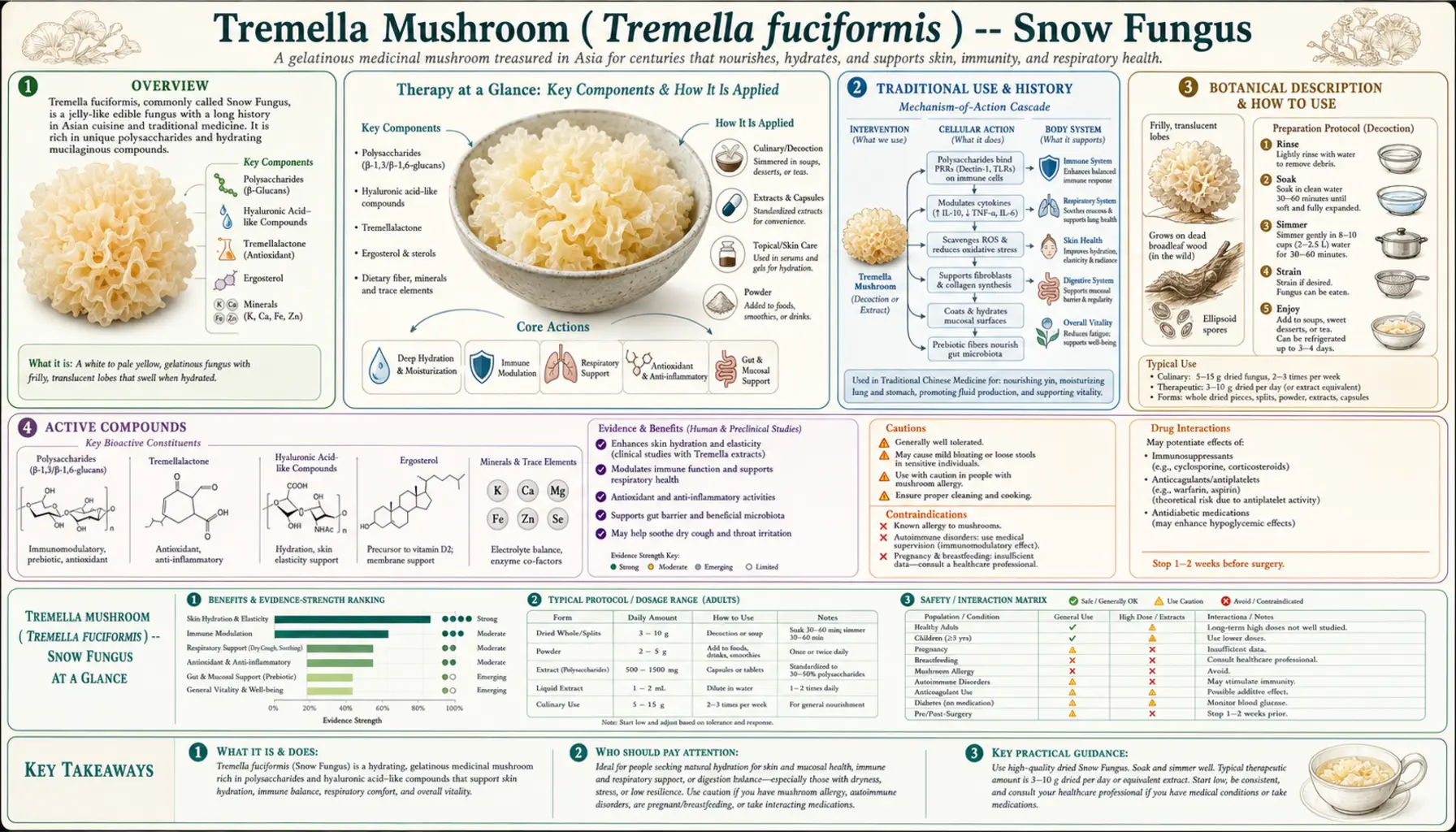
Tremella fuciformis — known in English as snow fungus, silver ear, or white jelly mushroom — is a translucent, gelatinous fungus that has been eaten and prized in China for well over a thousand years, both as a delicate dessert food and as a traditional yin and beauty tonic. Today it is best known to a global audience for one striking property: its main polysaccharide holds water almost as effectively as hyaluronic acid, which has earned it the nickname “natural hyaluronic acid” in the cosmetics world. This page separates the long, genuine culinary and traditional record from what modern laboratory and clinical science can — and cannot yet — say about Tremella's benefits.
Table of Contents
- Overview
- Traditional Use & History
- Botanical Description
- Active Compounds
- Skin Hydration & “Natural Hyaluronic Acid”
- Antioxidant Effects
- Neuroprotection & Cognition
- Immune Modulation
- Blood Sugar & Lipids
- Gut & Prebiotic Fiber
- Culinary Use & Nutrition
- Forms & Dosage
- Safety & Cautions
- Research Papers
- Connections
- Featured Videos
Overview
Tremella is a soft, white, frilly jelly fungus that grows on dead or dying hardwood. Unlike the dense, woody medicinal mushrooms such as Reishi or Chaga, Tremella is genuinely a food first: in China it is simmered into sweet soups and double-boiled desserts, and only secondarily framed as a tonic. Its modern reputation rests on the Tremella polysaccharides that make up the bulk of its dry weight — long, branched sugar chains that swell into a gel and trap large amounts of water.
It is important to be honest about the state of the evidence. Most published research on Tremella is preclinical (test-tube and animal studies) or examines topical (skin-applied) extracts. A small number of human trials exist — most notably a randomized controlled trial in people with subjective cognitive impairment — but the clinical literature is thin compared with mushrooms like Lion's Mane or Turkey Tail. Throughout this page, laboratory and animal findings are clearly labeled as such, and oral “beauty from within” claims are treated as unproven rather than established.
Traditional Use & History
Tremella has been recorded in Chinese texts for centuries. In Traditional Chinese Medicine (TCM) — this is a Chinese tradition, not an Ayurvedic one — snow fungus is classified as a cooling, moistening tonic. It is said to nourish yin, moisten the Lung and stomach, and generate fluids, which is why it was traditionally given for dry coughs, dry throat, and the dryness associated with convalescence or aging. The herb's category in TCM — a fluid-generating yin tonic — maps neatly onto its real, measurable water-holding chemistry, which is part of why it captured the modern cosmetic imagination.
Snow fungus also carries a strong beauty and longevity reputation in Chinese folklore. The most famous legend attaches it to Yang Guifei, the celebrated Tang-dynasty imperial consort renowned for her radiant complexion, who is said to have eaten Tremella soup regularly to preserve her skin. Whether or not the legend is literally true, it captures how the fungus has long been understood in China: as a food for moist, supple skin and graceful aging. For most of its history Tremella was a rare wild delicacy reserved for the wealthy; only after cultivation methods improved in the twentieth century did it become an affordable, everyday ingredient.
Its enduring role as a dessert food is central to its identity. The classic preparation — snow fungus simmered with rock sugar, dried longan, lotus seeds, goji berries, and red dates — is eaten across China and the Chinese diaspora as a soothing, lightly sweet soup, served warm in winter or chilled in summer.
Botanical Description
Within the fungal kingdom, Tremella fuciformis belongs to the jelly fungi (order Tremellales). Its fruiting body is a gelatinous, translucent-white rosette of thin, wavy, brain-like lobes, typically a few centimeters across, with a soft, slippery, almost cartilaginous texture. When dried it shrinks to a brittle, pale-yellow chip; when rehydrated it expands dramatically and turns soft and silvery, which gives rise to its common names — “snow fungus” and “silver ear.”
One biological quirk sets Tremella apart from cultivated edibles like Shiitake or Oyster mushrooms. In nature it is partly parasitic: its white fruiting body cannot efficiently digest wood on its own and depends on a companion fungus — species of Annulohypoxylon (formerly grouped under Hypoxylon) — which breaks down the wood and supports the Tremella's growth. Commercial cultivation reproduces this relationship by co-inoculating both fungi onto sawdust substrate or hardwood logs, which is why farmed snow fungus is now widely and cheaply available year-round.
Active Compounds
The defining constituents of Tremella are its polysaccharides, which can account for a very large share of the dry fruiting body. The principal one is an acidic glucuronoxylomannan — a branched chain built on a mannose backbone, decorated with xylose side groups and bearing glucuronic acid residues. Those acidic, charged groups are chemically important: they attract and bind water, giving Tremella polysaccharide its exceptionally high water-holding capacity. Structural reviews describe these polysaccharides, their molecular weight ranges, and the laboratory bioactivities attributed to them.
Other components include additional polysaccharide fractions, a modest amount of protein, and trace minerals. From a whole-food standpoint, the practical point is that Tremella is, in large part, a soluble dietary fiber — a viscous, fermentable polysaccharide gel rather than a source of starch, fat, or concentrated micronutrients. Most of the “active compound” story for Tremella is therefore really a story about one remarkable class of water-loving fibers.
Skin Hydration & “Natural Hyaluronic Acid”
The claim that earns Tremella the most attention is that it is a “natural hyaluronic acid.” The honest, mechanistic explanation is this: Tremella polysaccharide is a humectant — a substance that attracts and holds water — and laboratory measurements show its water-retention capacity is comparable in magnitude to that of hyaluronic acid. Both work by the same basic physics: large, hydrophilic molecules form a hydrated network that slows water loss. This is a genuine, reproducible property of the molecule, not marketing.
What this does not mean is that eating snow fungus is proven to hydrate or rejuvenate your skin. The strongest evidence is for topical and in-vitro use: Tremella extract forms a moisturizing film, retains water on a surface, and has been formulated into skincare and even moisturizing hand products. A study comparing a related jelly fungus (white-strain Auricularia) characterized antioxidant activity, moisture retention, film formation, and viscosity stability of the water extract — the kind of bench data that underpins cosmetic use. Animal work has also reported “skin-aging protective” effects of Tremella polysaccharides in mice with chemically induced aging. But these are animal and laboratory findings; well-controlled human trials of oral Tremella for skin hydration, elasticity, or wrinkles are limited and do not yet establish a clear benefit. Treat topical hydration as plausible and oral skin benefits as unproven.
Antioxidant Effects
Tremella polysaccharides show antioxidant activity in laboratory assays — they scavenge free radicals (such as DPPH and hydroxyl radicals) and reduce oxidative markers in test-tube and cell systems. Processing methods that modify the polysaccharides — for example ultrasonic- and enzyme-assisted extraction — have been shown to change their physicochemical characteristics and enhance their antioxidant and hypoglycemic activities, which tells us the activity is real but depends heavily on how the extract is prepared.
As with most mushroom antioxidant data, the caveat is that radical-scavenging in a tube does not automatically translate into a clinically meaningful antioxidant effect in the human body, where absorption, metabolism, and the body's own antioxidant defenses (and dietary nutrients like the mushroom-derived antioxidant ergothioneine) all intervene. The fairest summary is that Tremella extracts have measurable antioxidant chemistry, with human outcome data still lacking.
Neuroprotection & Cognition
This is one of the few areas where Tremella has reached a human trial. A randomized controlled trial tested Tremella fuciformis in individuals with subjective cognitive impairment and reported effects on cognitive measures with a good safety profile. That is a meaningful signal — but it is a single, relatively small study, and one positive trial is not the same as established efficacy.
The supporting evidence is otherwise preclinical. In cell and rodent studies, Tremella has promoted neurite outgrowth in PC12 nerve-like cells and improved measures of memory in rats, and a specific neuritogenic compound has been isolated from the fungus. These point to a plausible mechanism — support for nerve-cell growth and connectivity — but the gap between “promotes neurite outgrowth in a dish” and “protects human memory” is large. People interested in mushrooms for cognition should regard Tremella as preliminary and promising rather than proven, and should note that the better-studied cognitive mushroom on this site is Lion's Mane.
Immune Modulation
Like many medicinal fungi, Tremella polysaccharides can modulate the immune system in laboratory and animal models — for example by influencing the activity of immune cells such as macrophages and the cytokines they release. Beta-glucan and acidic polysaccharide fractions from edible fungi are a well-recognized class of immune-active fibers, and structural reviews of Tremella catalog immunomodulatory activity among its reported bioactivities.
The honest qualifier is the same one that applies to most mushroom “immune support” claims: modulating immune cells in a model system is not the same as preventing infection or treating disease in people, and human immune-outcome trials for Tremella are sparse. The mushroom with the strongest human immune/oncology-support data on this site is Turkey Tail, not Tremella.
Blood Sugar & Lipids
Several animal and laboratory studies suggest Tremella polysaccharides may help with metabolic measures. In high-fat-diet mice, Tremella-derived polysaccharides reduced obesity and altered the gut microbiota; in diabetic-model mice, they produced hypoglycemic and triglyceride-lowering effects accompanied by changes in gut bacteria and gene expression. There is also a neat food-science mechanism: acidic polysaccharides from silver-ear and black-ear mushrooms slowed the release and transport of glucose from starch during simulated digestion — consistent with the way a viscous soluble fiber blunts blood-sugar spikes.
These results are biologically coherent and point in a favorable direction, but they remain preliminary: nearly all of the blood-sugar and lipid data are from animals or test tubes, not from clinical trials in people with diabetes. Tremella should not be used as a treatment for diabetes or high cholesterol, and it is not a substitute for prescribed therapy.
Gut & Prebiotic Fiber
Because so much of Tremella is a fermentable soluble polysaccharide, it behaves as a prebiotic fiber: it largely resists digestion in the small intestine and is fermented by gut bacteria in the colon. The metabolic animal studies above repeatedly show that Tremella polysaccharides shift the gut microbiota, and the proposed benefits on weight, blood sugar, and lipids are frequently attributed, at least in part, to these microbiome changes and to the short-chain fatty acids that fiber fermentation produces.
For a person eating snow fungus as food, the practical takeaway is simpler and well grounded: it is a gentle source of viscous soluble fiber that adds bulk and a satisfying gel-like texture for very few calories. The dramatic, disease-modifying microbiome claims, by contrast, rest on animal data and should be read cautiously.
Culinary Use & Nutrition
As a food, Tremella is notably light: it is very low in calories, has near-zero fat, contains little protein, and is composed largely of soluble fiber and water once rehydrated. It has almost no flavor of its own — its appeal is texture: a delicate, slightly crunchy-then-silky gel that absorbs the flavors around it.
The signature dish is the Chinese snow-fungus dessert soup: dried Tremella is soaked until it blooms, trimmed of its tough base, torn into florets, and double-boiled with rock sugar plus some combination of dried longan, red dates (jujube), lotus seeds, goji berries, pears, or papaya. The result is a soothing, lightly sweet soup eaten as a dessert or tonic. Savory uses exist too — it can be added to clear soups and stir-fries — but the sweet-soup tradition is by far the most iconic. Because it carries flavor and adds body without fat, it is also a popular ingredient in lighter, plant-forward cooking.
Forms & Dosage
Tremella is available in three broad forms:
- Dried whole fruiting body — the traditional culinary form. A small handful (often a single dried “flower,” roughly 10–25 g dry) makes a large pot of soup once rehydrated, since it expands several-fold. This is the most time-tested way to consume it.
- Polysaccharide extracts — powders and capsules standardized (loosely) to Tremella polysaccharide content, marketed for “skin hydration” or general wellness. Doses vary widely by product because there is no established clinical dose; follow the manufacturer's directions and be skeptical of strong “beauty” claims, which outrun the human evidence.
- Topical / cosmetic — Tremella extract is used as a botanical humectant in serums, creams, and masks, where the moisture-retention and film-forming data are most directly relevant.
Because no dose has been shown to deliver a specific oral health benefit in humans, there is no authoritative recommended amount. Treating it primarily as a food — enjoyed for its texture and fiber — is the most defensible approach.
Safety & Cautions
Tremella has an excellent culinary safety record and is generally well tolerated as a food by healthy people; it has been eaten in China for centuries. As with any high-fiber food, eating large amounts of the gel may cause mild bloating or loose stools in some people.
The main theoretical cautions come from its bioactivity rather than from documented harm:
- Anticoagulant / bleeding: some fungal polysaccharides have mild anticoagulant or anti-platelet activity in laboratory models. As a precaution, people taking blood thinners (such as warfarin or other anticoagulants/antiplatelets) or facing surgery should be cautious with concentrated extracts and discuss them with a clinician.
- Immunomodulatory interactions: because Tremella polysaccharides can modulate immune activity in models, people on immunosuppressant drugs or with autoimmune conditions should be cautious with high-dose extracts.
- Blood sugar: given the hypoglycemic signals in animal studies, anyone using extracts alongside diabetes medication should monitor for additive effects.
- Allergy and sourcing: mushroom allergies, while uncommon, do occur. Buy from reputable suppliers; wild-foraged jelly fungi can be misidentified.
Educational disclaimer: This article is for general educational purposes only and is not medical advice. Much of the science behind Tremella's reputed benefits is preclinical (animal or test-tube) or limited to topical use, and oral “beauty” and disease claims remain unproven. Nothing here is intended to diagnose, treat, cure, or prevent any disease. Talk with a qualified healthcare professional before using Tremella supplements, especially if you are pregnant or nursing, take medication, or have a medical condition.
Research Papers
Selected peer-reviewed literature. Links resolve to PubMed or DOI.
- Wu YJ, Wei ZX, Zhang FM, et al. Structure, bioactivities and applications of the polysaccharides from Tremella fuciformis mushroom: A review. Int J Biol Macromol. 2019;121:1005-1010.
- Ban S, Lee SL, Jeong HS, et al. Efficacy and Safety of Tremella fuciformis in Individuals with Subjective Cognitive Impairment: A Randomized Controlled Trial. J Med Food. 2018;21(4):400-407.
- Kim JH, Ha HC, Lee MS, et al. Effect of Tremella fuciformis on the neurite outgrowth of PC12h cells and the improvement of memory in rats. Biol Pharm Bull. 2007;30(4):708-714.
- Zhang Y, Pei L, Gao L, et al. A neuritogenic compound from Tremella fuciformis. Zhongguo Zhong Yao Za Zhi. 2011;36(17):2358-2360.
- Li Y, He Y, Zhang H, et al. Effects of ultrasonic-enzymatic-assisted ethanol precipitation method on the physicochemical characteristics, antioxidant and hypoglycemic activities of Tremella fuciformis polysaccharides. Ultrason Sonochem. 2023;101:106682.
- Xu Y, Liu X, Guan J, et al. iTRAQ-Based Proteomic Profiling of Skin Aging Protective Effects of Tremella fuciformis-Derived Polysaccharides on D-Galactose-Induced Aging Mice. Molecules. 2024;29(21).
- Lourith N, Pungprom S, Kanlayavattanakul M. Formulation and efficacy evaluation of the safe and efficient moisturizing snow mushroom hand sanitizer. J Cosmet Dermatol. 2021;20(2):554-560.
- Xu X, Liu X, Liu L, et al. Metagenomic and transcriptomic profiling of the hypoglycemic and hypotriglyceridemic actions of Tremella fuciformis-derived polysaccharides in high-fat-diet- and streptozotocin-treated mice. Food Funct. 2024;15(22):11096-11114.
- He G, Chen T, Huang L, et al. Tremella fuciformis polysaccharide reduces obesity in high-fat diet-fed mice by modulation of gut microbiota. Front Microbiol. 2022;13:1073350.
- Tu J, Adhikari B, Brennan MA, et al. Acidic polysaccharides from black ear and silver ear mushrooms modulated the release and transport of glucose from gelatinised sorghum starch during digestion. Food Chem. 2023;411:135426.
- PubMed topic search: Tremella fuciformis polysaccharide antioxidant.
- PubMed topic search: Tremella fuciformis polysaccharide immune.
Connections
- Medicinal Mushrooms (overview)
- Reishi Mushroom
- Lion's Mane Mushroom
- Chaga Mushroom
- Turkey Tail Mushroom
- Ergothioneine
- Herbs
- Remedies
- Vitamins
- Minerals
- Food