Agaricus blazei Mushroom (Agaricus subrufescens) -- Almond Mushroom
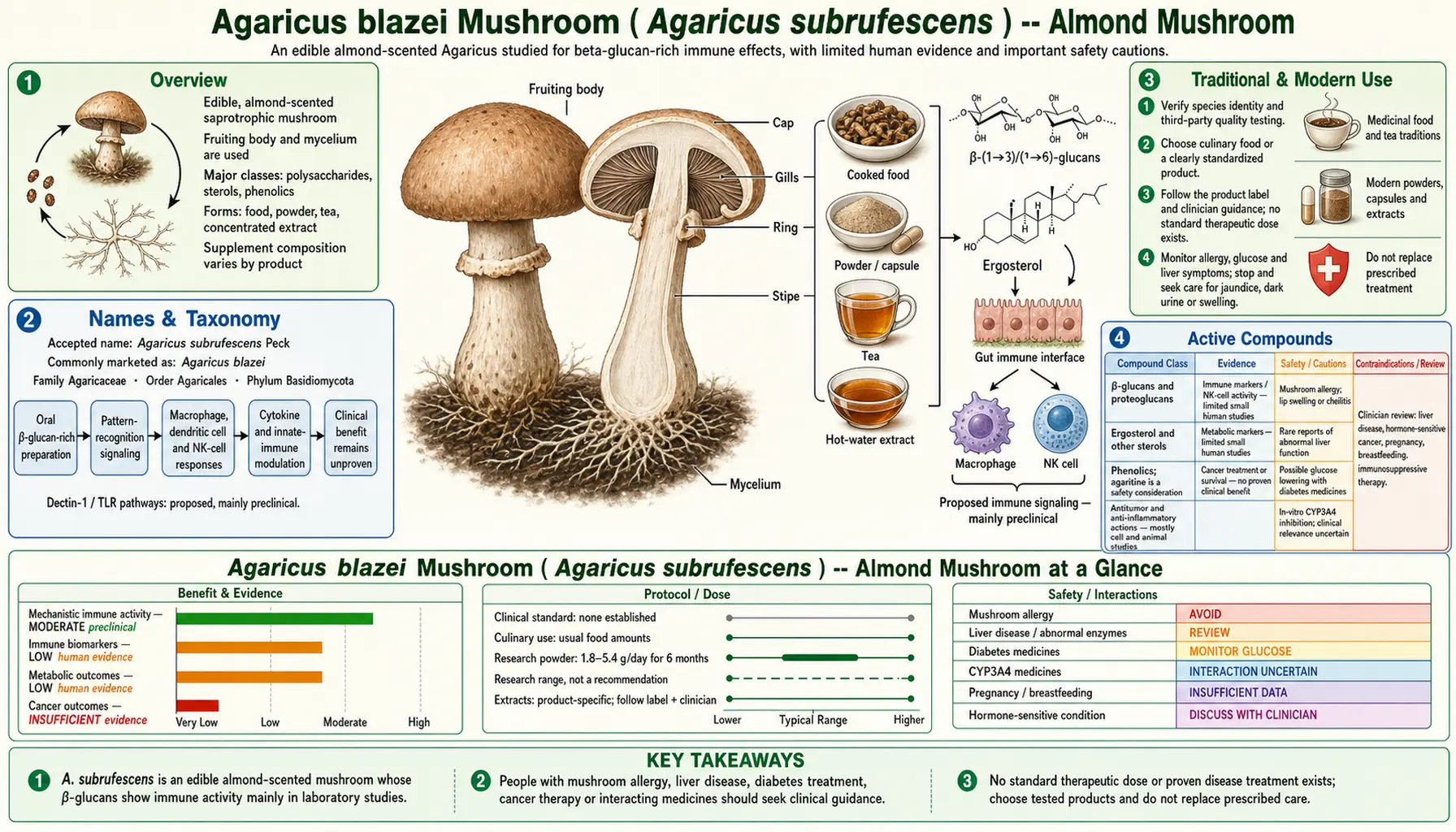
The almond mushroom — sold commercially as Agaricus blazei Murill (ABM) and known in Brazil as the “sun mushroom” and in Japan as himematsutake — is a culinary-medicinal fungus prized for its sweet, almond-anise aroma and for cell-wall beta-glucans that activate the innate immune system in laboratory and animal studies. It is one of the most heavily marketed mushrooms in the world, yet the evidence behind it is uneven: strong in cell and animal models, modest and preliminary in people. This page explains what is reasonably well supported, what is still speculative, and the real safety considerations — including the natural compound agaritine and rare reports of liver injury — that any honest summary must include.
Table of Contents
- Overview
- Names & Taxonomy
- Traditional & Modern Use
- Active Compounds
- Immune Modulation
- Cancer-Care Quality of Life
- Antioxidant & Anti-inflammatory
- Allergy & Th1/Th2 Modulation
- Cardiometabolic, Blood Sugar & Liver
- Forms & Dosage
- Safety & Cautions
- Research Papers
- Connections
- Featured Videos
Overview
Agaricus blazei is a gilled mushroom in the same genus as the common white button and portobello (Agaricus bisporus). What sets it apart commercially is its reputation as an immune-supporting health food, built largely on Japanese laboratory research from the 1980s and 1990s. Like many medicinal mushrooms — Reishi, Turkey Tail, Maitake — its signature actives are polysaccharides, especially beta-glucans, that the immune system recognizes as “non-self” patterns and responds to by mobilizing defensive cells.
It is important to set expectations honestly. The most robust data are preclinical (cell cultures and rodents): in those models, Agaricus extracts activate macrophages, natural killer (NK) cells, and dendritic cells. Human evidence is limited — a small number of clinical and immunologic studies, several from a single research group, plus quality-of-life data in cancer patients undergoing chemotherapy. None of this establishes Agaricus as a treatment for any disease. It is best understood as a food-grade mushroom with measurable immunologic activity and a plausible — but unproven — supportive role.
Names & Taxonomy
The naming around this mushroom is genuinely confusing, and getting it right matters when you read labels or search the literature.
- “Agaricus blazei Murill” / “ABM” — the popular commercial name, used on nearly all products and in most older papers.
- Agaricus subrufescens Peck (1893) — the correct, accepted scientific name. Taxonomists determined that the mushroom cultivated and sold as “A. blazei” is in fact this older species. The name “A. blazei” in the strict sense refers to a different North American mushroom.
- Agaricus brasiliensis — a name proposed in the early 2000s for the cultivated strain; now treated as a synonym of A. subrufescens.
In plain terms: ABM, “Agaricus blazei,” Agaricus subrufescens, and Agaricus brasiliensis all refer to the same cultivated mushroom. This page uses the familiar “Agaricus blazei” for readability while noting that A. subrufescens is the botanically correct name. The common English name almond mushroom comes from its distinctive sweet, marzipan-like (almond / anise / benzaldehyde) aroma.
Traditional & Modern Use
Unlike Reishi or many herbs, Agaricus blazei does not have a long Asian medicinal tradition, and it is not part of Ayurveda. Its story is much more recent and is essentially a Brazilian + Japanese health-food phenomenon.
The mushroom grows wild in the mountainous Piedade region of São Paulo state, Brazil, where it earned folk names such as Cogumelo do Sol (“mushroom of the sun”) and Cogumelo de Deus (“mushroom of God”) for its reputed health-giving qualities. In the 1960s–70s samples were sent to Japan, where researchers cultivated it and gave it the names himematsutake and kawariharatake. Japanese laboratory studies on its polysaccharides drove a commercial boom, and Brazil and Japan remain the major producers and consumers.
Today it is taken almost entirely as a dietary supplement or functional food — dried powder, capsules, or hot-water extracts — rather than as a traditional remedy with codified preparation rules. Honest framing matters here: claims that wrap Agaricus in ancient-medicine language are marketing, not history.
Active Compounds
The biological activity attributed to Agaricus blazei centers on a few classes of molecules:
- Beta-glucans — the headline actives. Agaricus is notable for highly branched (1→6)-(1→3)-beta-D-glucans, a branching pattern thought to make them especially good at engaging immune receptors such as Dectin-1 and complement receptor 3. These water-soluble polysaccharides are why hot-water extracts are the preferred preparation.
- Other polysaccharides and proteoglycans — including mannans and protein-bound polysaccharide complexes that also show immunologic activity in models.
- Ergosterol and ergosterol derivatives — the fungal version of a sterol; the precursor to vitamin D2 and the subject of antioxidant and anti-angiogenic research.
- Blazein — a steroid isolated from the mushroom that induced apoptosis (programmed cell death) in human lung and stomach cancer cell lines in laboratory work — a cell-culture finding, not a clinical result.
- Agaritine — an aromatic hydrazine derivative found across the genus Agaricus (including button mushrooms). It is relevant to safety rather than benefit, and is discussed below; cooking and processing reduce its levels.
Immune Modulation
Immune modulation is the best-characterized property of Agaricus blazei, and the mechanism is well established in the laboratory. Beta-glucans are recognized by pattern-recognition receptors on innate immune cells; binding triggers activation of:
- Macrophages — increased phagocytosis and release of signaling cytokines;
- Natural killer (NK) cells — enhanced cytotoxic activity against abnormal or infected cells;
- Dendritic cells — maturation and improved antigen presentation, which bridges innate and adaptive immunity.
In cell and animal studies this translates into shifts in cytokine output (for example interferon-gamma and various interleukins). A review by Mizuno and colleagues catalogs the immunomodulating compounds of basidiomycete mushrooms including Agaricus, and a comprehensive review by Hetland and colleagues summarizes how ABM extracts modulate innate immunity in experimental models. The crucial caveat: most of this is preclinical. Human immunologic data exist but are limited in size and number, and changes in a lab marker do not automatically mean a clinical benefit.
Cancer-Care Quality of Life
This is the area most prone to overstatement, so it deserves careful framing. The most cited human study is a randomized trial by Ahn and colleagues (2004) in women with cervical, ovarian, or endometrial cancer who were undergoing chemotherapy. Participants who took an Agaricus blazei Murill extract alongside their chemotherapy showed higher NK-cell activity and reported fewer chemotherapy-associated side effects and better quality of life (appetite, emotional stability, general weakness) than the control group.
What this does — and does not — mean:
- It supports a possible adjunctive, supportive role: better tolerance of chemotherapy and an immunologic signal (NK activity).
- It is NOT evidence that Agaricus treats or shrinks cancer. The study did not test tumor response or survival, the sample was small, and findings have not been confirmed in large independent trials.
- Laboratory findings on isolated compounds (such as blazein causing apoptosis in cancer cell lines) are mechanistic curiosities, not clinical proof.
Anyone with cancer should regard Agaricus only as a possible supportive food to discuss with their oncology team — never as a substitute for treatment, and with attention to the liver-safety notes below, since the supportive trial population was itself receiving liver-stressing chemotherapy.
Antioxidant & Anti-inflammatory
Agaricus blazei extracts show antioxidant activity in standard chemical assays, attributed in part to phenolic compounds and to ergosterol-related sterols. A food-science study by Corrêa and colleagues optimized extraction of an ergosterol-based ingredient from Agaricus blazei, documented its bioactive (including antioxidant) properties, and incorporated it into yogurt — illustrating the food-ingredient angle rather than a therapeutic claim.
On the anti-inflammatory side, the same beta-glucan–driven immune modulation that activates defenses can also help rebalance over-active inflammatory signaling in some models, and a hydroalcoholic extract was gastroprotective against ethanol-induced gastric ulcers in mice (Câmara Neto and colleagues). These are encouraging but preclinical signals; human anti-inflammatory outcome data are lacking.
Allergy & Th1/Th2 Modulation
A recurring theme in Agaricus research is the idea of rebalancing the immune system rather than simply revving it up. The immune response can lean toward a Th1 profile (cell-mediated, antiviral/antitumor) or a Th2 profile (antibody-driven, and over-active in allergy). The review by Hetland and colleagues describes how ABM appears, in experimental settings, to nudge an over-active Th2 (allergic) skew back toward Th1, with potential relevance to allergy and inflammation.
This is a genuinely interesting hypothesis with a plausible mechanism, but the supporting evidence is largely animal and in-vitro. There is no basis for recommending Agaricus as an allergy treatment in people. It is included here because the Th1/Th2 framing is central to how researchers think about the mushroom — not because the clinical case is settled.
Cardiometabolic, Blood Sugar & Liver
Animal studies hint at cardiometabolic effects. De Miranda and colleagues reported a hypolipidemic (cholesterol-lowering) effect of edible Agaricus blazei in rats fed a high-cholesterol diet, and various rodent studies suggest possible improvements in glucose handling — consistent with the general metabolic effects of mushroom fiber and beta-glucan. If real in humans, blood-sugar effects raise a practical point: combining Agaricus with diabetes medication could have additive glucose-lowering effects, so people on such drugs should monitor and consult their clinician.
The liver is the most important — and most double-edged — organ in the Agaricus story. Some research explores protective or beneficial metabolic effects (for example da Silva and colleagues studied beta-glucan effects on gene expression and metabolism in HepG2 liver cells). At the same time, rare reports of liver injury have been linked to certain ABM supplement products, covered directly in the next section. Overall the cardiometabolic and liver picture is mixed and preclinical-leaning, and the liver-safety signal means caution rather than enthusiasm.
Forms & Dosage
Because the prized actives are water-soluble beta-glucans, the most evidence-aligned preparations are extracts and well-processed powders:
- Hot-water extracts — concentrate beta-glucans and are the form most used in research; often standardized to a beta-glucan percentage.
- Dried fruiting-body powder / capsules — whole-mushroom material; potency depends on the raw material and processing.
- Liquid extracts and combination “mushroom complex” products — common in the supplement market; quality varies widely.
There is no established, evidence-based therapeutic dose. Supplement labels commonly suggest on the order of 1–3 grams of extract or powder daily, and the Ahn quality-of-life study used a specific commercial extract at the manufacturer’s dose. Practical guidance: choose products that disclose beta-glucan content and undergo third-party testing for heavy metals and contaminants (mushrooms readily concentrate metals from their substrate), favor cooked or properly extracted material over raw powder, and start low.
Safety & Cautions
Agaricus blazei is widely consumed as a food and is generally well tolerated, but several real cautions belong on any honest page:
- Agaritine. Like other Agaricus mushrooms, Agaricus blazei naturally contains agaritine, an aromatic hydrazine derivative with genotoxic potential in some laboratory tests. Levels fall substantially with cooking, drying, and hot-water extraction, which is one reason raw, unprocessed mushroom powder is less desirable than cooked or extracted material. The Firenzuoli review specifically examines these pharmaco-toxicological questions.
- Rare liver injury (hepatotoxicity). There are case reports of severe hepatic dysfunction associated with some ABM extract products — notably Mukai and colleagues describing liver injury in cancer patients taking Agaricus blazei. Such events are uncommon and product-dependent, but they are real. Use caution if you have liver disease, are taking other liver-stressing drugs, or are undergoing chemotherapy, and stop and seek care if you develop jaundice, dark urine, or unexplained fatigue.
- Autoimmune conditions and immunosuppressants. An immune-activating mushroom is theoretically unhelpful for people with autoimmune disease and could counteract immunosuppressant medication (for example after transplant, or for autoimmune therapy). Avoid unless cleared by your clinician.
- Diabetes medication. Possible additive blood-sugar lowering — monitor glucose if combining.
- Pregnancy, breastfeeding, and children. Insufficient safety data — best avoided.
- Contaminants. Mushrooms concentrate heavy metals; choose tested products.
Educational disclaimer: This page is for general information only and is not medical advice, diagnosis, or treatment. Agaricus blazei is not an approved treatment for any disease, and the human evidence for most claimed benefits is limited or preliminary. Talk with a qualified healthcare professional before using it — especially if you have liver disease or an autoimmune condition, are pregnant or breastfeeding, are receiving cancer treatment, or take prescription medication including immunosuppressants or diabetes drugs.
Research Papers
Selected peer-reviewed literature. Links resolve to PubMed or DOI.
- Ahn WS, et al. Natural killer cell activity and quality of life were improved by consumption of a mushroom extract, Agaricus blazei Murill Kyowa, in gynecological cancer patients undergoing chemotherapy. Int J Gynecol Cancer. 2004;14(4):589-94.
- Hetland G, et al. The Mushroom Agaricus blazei Murill Elicits Medicinal Effects on Tumor, Infection, Allergy, and Inflammation through Its Modulation of Innate Immunity and Amelioration of Th1/Th2 Imbalance and Inflammation. Adv Pharmacol Sci. 2011;2011:157015.
- Mizuno M, et al. Immunomodulating compounds in Basidiomycetes. J Clin Biochem Nutr. 2013;52(3):202-7.
- Firenzuoli F, et al. The Medicinal Mushroom Agaricus blazei Murrill: Review of Literature and Pharmaco-Toxicological Problems. Evid Based Complement Alternat Med. 2008;5(1):3-15.
- Mukai H, et al. An alternative medicine, Agaricus blazei, may have induced severe hepatic dysfunction in cancer patients. Jpn J Clin Oncol. 2006;36(12):808-10.
- da Silva AF, et al. Effects of β-glucan extracted from Agaricus blazei on the expression of ERCC5, CASP9, and CYP1A1 genes and metabolic profile in HepG2 cells. Hum Exp Toxicol. 2013;32(6):647-54.
- Itoh H, et al. Blazein of a new steroid isolated from Agaricus blazei Murrill (himematsutake) induces cell death and morphological change indicative of apoptotic chromatin condensation in human lung cancer LU99 and stomach cancer KATO III cells. Oncol Rep. 2008;20(6):1359-61.
- de Miranda AM, et al. Hypolipidemic effect of the edible mushroom Agaricus blazei in rats subjected to a hypercholesterolemic diet. J Physiol Biochem. 2014;70(1):215-24.
- Corrêa RCG, et al. A natural food ingredient based on ergosterol: optimization of the extraction from Agaricus blazei, evaluation of bioactive properties and incorporation in yogurts. Food Funct. 2018;9(3):1465-1474.
- Câmara Neto JF, et al. Gastroprotective effect of hydroalcoholic extract from Agaricus blazei Murill against ethanol-induced gastric ulcer in mice. J Ethnopharmacol. 2022;292:115191.
Connections
- Medicinal Mushrooms (overview)
- Reishi Mushroom
- Lion's Mane Mushroom
- Chaga Mushroom
- Turkey Tail Mushroom
- Ergothioneine
- Herbs
- Remedies
- Vitamins
- Minerals
- Food