Zinc for Skin Health
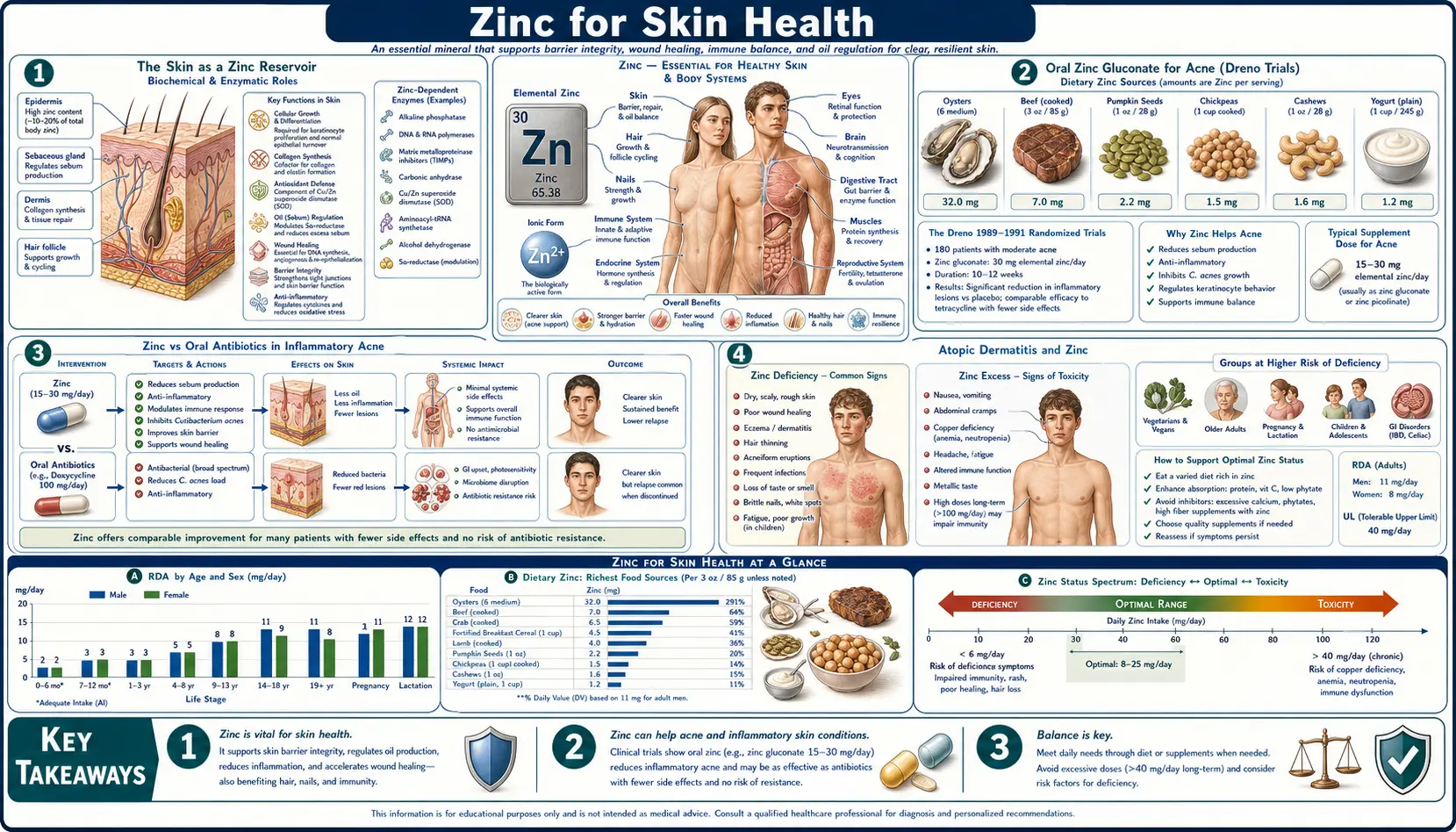
The skin holds about 5% of the body's zinc, and zinc is more concentrated in the epidermis than in the dermis (Ogawa 2018). Zinc's role in skin is clearest in acrodermatitis enteropathica, an inherited disorder of zinc absorption whose skin, hair and other signs clear with oral zinc (Gupta 2014). For common skin conditions the evidence is more limited. Oral zinc gluconate (30 mg of zinc a day) reduced inflammatory acne more than placebo in a 1989 trial, but in a 2001 head-to-head trial it was less effective than the antibiotic minocycline, with clinical success in 31.2% versus 63.4% of patients (Dreno 2001). Studies of oral zinc in atopic dermatitis, rosacea and psoriasis are few and their results mixed. On the skin surface, zinc oxide is a UV filter in sunscreens and a barrier ingredient in diaper-rash pastes, and zinc pyrithione is an antidandruff agent.
Table of Contents
- The Skin as a Zinc Reservoir
- Oral Zinc for Acne: The Trials
- Zinc Compared With an Oral Antibiotic in Acne
- Atopic Dermatitis and Zinc
- Topical Zinc Oxide for Sunscreen and Diaper Rash
- Zinc-Dependent Matrix Metalloproteinases in Skin Remodeling
- Acrodermatitis Enteropathica — The Lesson of Severe Deficiency
- The Zinc–Vitamin A Interaction
- Seborrheic Dermatitis and Zinc Pyrithione
- Psoriasis, Rosacea, and Other Conditions
- Doses Used in Studies, and Safety Findings
- Key Research Papers
- Connections
- Featured Videos
The Skin as a Zinc Reservoir
A 2018 review by Ogawa and colleagues states that the human body contains 2–3 g of zinc, about 5% of it in the skin, and that zinc is more concentrated in the epidermis (the outer layer) than in the dermis and subcutaneous tissue. The authors suggest this may reflect the zinc needed by keratinocytes as they actively divide and differentiate. A 2017 review by Lin and colleagues gives the epidermal zinc content as 50–70 µg per gram of dry weight.
The epidermis renews itself continuously: basal keratinocytes divide, move upward through the spinous and granular layers, and finally cornify to form the protective stratum corneum. Ogawa's review covers zinc's roles in forming the stratum corneum and the tight junctions that together make up the epidermal barrier, and in the Langerhans cells of the epidermis. Schwartz and colleagues' 2005 review describes skin's continual renewal as placing a high demand on zinc-based enzymes and proteins, a need that is especially evident in wound healing and inflammation.
Lin's review notes that, because zinc is abundant in the epidermis, mild zinc deficiency is associated with roughened skin and impaired wound healing. Severe deficiency produces the acrodermatitis enteropathica picture described below.
Oral Zinc for Acne: The Trials
Oral zinc has been studied in acne since the 1970s. Several of the trials came from the dermatology group of Brigitte Dréno in Nantes, France.
- Michaëlsson et al. 1977 (Arch Dermatol) — zinc sulfate (135 mg of zinc a day), alone or with vitamin A (300,000 IU a day), was compared with vitamin A alone and with placebo. After four weeks, papules, pustules and infiltrates had decreased significantly in the zinc-treated groups; zinc plus vitamin A was no better than zinc alone. After 12 weeks the mean acne score had fallen from 100% to 15%. The authors wrote that the mechanism was not known.
- Dreno et al. 1989 (Acta Derm Venereol) — a double-blind trial in patients with inflammatory acne used 200 mg a day of zinc gluconate (30 mg of zinc) and found a significant difference from placebo in the inflammatory score (p<0.02). The authors suggested that zinc may act on inflammatory cells, especially granulocytes.
- Dreno et al. 2001 (Dermatology) — a multicentre randomized double-blind trial in 332 patients compared 30 mg of zinc a day with 100 mg of minocycline a day for three months. Clinical success at day 90 (a decrease of more than two-thirds in inflammatory lesions) was 31.2% with zinc and 63.4% with minocycline; this trial is covered in the next section.
- Yee et al. 2020 (Dermatol Ther) — a systematic review and meta-analysis found that people with acne had significantly lower serum zinc than controls, and that patients treated with zinc had a significant improvement in mean inflammatory papule count compared with those not treated with zinc. Side effects did not differ significantly between zinc and comparators. The authors concluded that zinc is effective for acne, particularly for inflammatory papules, as monotherapy or as an add-on treatment.
Zinc salts differ in how much zinc they contain, so trials report the zinc content: in the 1989 trial, 200 mg of zinc gluconate supplied 30 mg of zinc. Doses used in the trials are gathered in the doses and safety section, together with the copper-deficiency findings that apply to long-term high zinc intake.
Zinc Compared With an Oral Antibiotic in Acne
The 2001 trial by Dreno and colleagues set out to evaluate where zinc gluconate stands in relation to antibiotics, noting that zinc might be an alternative to tetracyclines for the inflammatory lesions of acne. Its primary result favoured the antibiotic:
- Clinical success at three months — 31.2% of patients with zinc and 63.4% with minocycline.
- Mean change in lesion count — minocycline was 9% better at one month and 17% better at three months.
- Side effects — in both groups most side effects were gastrointestinal and moderate; 5 patients dropped out on zinc and 4 on minocycline.
- Authors' conclusion — both treatments were effective in inflammatory acne, but minocycline had the superior effect, evaluated at 17% in the study.
Antibiotic resistance in acne bacteria is one reason non-antibiotic options continue to be studied. A 2010 survey of 273 acne patients in 43 centres across France, by the same research group, found that 75.1% carried strains of Propionibacterium acnes (now Cutibacterium acnes) resistant to erythromycin and 9.5% carried strains resistant to tetracycline; all of the tetracycline-resistant strains were also resistant to doxycycline. The authors reported the tetracycline and doxycycline figures as lower than in other European countries (Dumont-Wallon 2010).
No trial cited on this page compares zinc with an antibiotic other than minocycline, or tests zinc in combination regimens.
Atopic Dermatitis and Zinc
Atopic dermatitis (eczema) is a chronic relapsing inflammatory skin condition marked by an impaired epidermal barrier and intense itch. The main evidence on zinc comes from a 2019 systematic review and meta-analysis by Gray and colleagues, which included 14 observational studies and two randomized trials.
- Zinc levels — people with atopic dermatitis had significantly lower serum, hair and red-cell zinc than controls.
- Zinc deficiency and the risk of atopic dermatitis — pooled unadjusted data from three studies showed higher odds of atopic dermatitis with zinc deficiency, but the difference was not significant (odds ratio 1.50, 95% CI 0.71–3.16).
- Supplementation trials — one randomized trial of oral zinc in patients with atopic dermatitis and zinc deficiency found improvement in the extent and severity of the disease; the other, among all patients with atopic dermatitis, found no significant improvement.
- Quality — all the included studies were of low or moderate quality, and the authors wrote that this makes the results hard to interpret. They called for high-quality observational studies and for randomized trials of zinc for treating or preventing atopic dermatitis.
- Barrier biology — Ogawa's 2018 review describes zinc's roles in the stratum corneum and tight junctions of the epidermal barrier, the structures that are impaired in atopic dermatitis. Whether oral zinc changes these structures in people with the condition has not been shown in trials.
The 2019 meta-analysis covered oral zinc only; topical zinc products for eczema were outside its scope.
Topical Zinc Oxide for Sunscreen and Diaper Rash
Topical zinc preparations such as zinc oxide, calamine and zinc pyrithione have long been used as photoprotective and soothing agents and in antidandruff shampoos (Gupta 2014). Zinc oxide is also used in barrier pastes and in medicated bandages.
Zinc oxide as a sunscreen ingredient. In its February 2019 proposed rule for over-the-counter sunscreens (84 FR 6204), the US Food and Drug Administration proposed that zinc oxide and titanium dioxide are generally recognized as safe and effective (GRASE, Category I) for use in sunscreens at concentrations of up to 25 percent. It proposed that two other ingredients, aminobenzoic acid (PABA) and trolamine salicylate, are not GRASE, concluding that their risks outweigh their benefits, and placed the other listed sunscreen ingredients in Category III, meaning that additional data are needed. The rule was a proposal. It states that zinc oxide's insolubility precludes systemic absorption from sunscreen beyond a de minimis amount, and notes that nanomaterial forms of zinc oxide and titanium dioxide have been used in marketed sunscreens.
A 2010 study by Gulson and colleagues tested this under real conditions: 20 people applied sunscreen containing zinc oxide labelled with the stable isotope zinc-68 outdoors for five consecutive days, using either a nanoparticle (19 nm) or a larger-particle (over 100 nm) formulation. The overwhelming majority of the applied zinc was not absorbed, but blood and urine from every participant showed small increases in the tracer; after five days the tracer in blood amounted to about one-thousandth of the total zinc in blood. The authors could not tell whether the zinc was absorbed as particles, as dissolved zinc, or both.
Zinc oxide filters both UVB and UVA light; a reference cited in the FDA's 2019 rule describes microfine zinc oxide as a photostable UVA/UVB sunblock agent. Larger particles leave a visible white film on the skin; micronized and nanoparticle forms are less visible.
Zinc oxide for diaper dermatitis. Zinc oxide paste has been used for diaper dermatitis for a long time, and Gupta's 2014 review lists topical zinc oxide paste among treatments found effective in diaper dermatitis and hand eczema. The paste forms a physical barrier between the skin and moisture, urine and stool.
Other topical zinc oxide applications:
- Calamine lotion — zinc oxide with ferric oxide in a liquid suspension, used as a soothing agent (Gupta 2014).
- Unna boot — a gauze bandage impregnated with zinc oxide paste, used for venous leg ulcers. Lin's 2017 review cites a meta-analysis of zinc oxide paste dressings (6–15% zinc) for chronic venous leg ulcers that found improved healing, while noting that the studies were small and of sub-optimal quality.
- Zinc oxide ointments — common over-the-counter skin protectants for minor irritation and chafing.
Zinc-Dependent Matrix Metalloproteinases in Skin Remodeling
Skin is in a constant state of extracellular matrix remodeling — turnover of collagen, elastin, fibrillin, and glycosaminoglycans — carried out in part by a family of zinc-dependent enzymes called matrix metalloproteinases (MMPs). MMPs take part in normal skin renewal and wound healing, and in photoaging, scarring, and the invasion of skin cancers.
- MMP active site — MMPs share a conserved catalytic zinc ion held by three histidine residues; the zinc ion activates a water molecule that cleaves the target peptide bond, so the enzymes need zinc to work.
- MMP-1 (collagenase-1) — the principal collagenase of skin, cutting fibrillar type I and III collagens, after which gelatinases (MMP-2 and MMP-9) continue the degradation.
- MMP-9 (gelatinase B) — induced during inflammation; involved in the movement of white cells into skin and of keratinocytes during re-epithelialization.
- MMP-3 (stromelysin) — broad substrate range, degrading proteoglycans, laminin and fibronectin, and activating other pro-MMPs.
- Tissue inhibitors (TIMPs) — the body's own protein inhibitors of MMPs; the balance between MMPs and TIMPs determines net matrix breakdown.
Sunlight and MMPs. In a 1996 study in human skin, Fisher and colleagues found that matrix-degrading metalloproteinases were induced within hours of UVB exposure, at doses well below those that redden the skin, and that all-trans retinoic acid applied before irradiation substantially reduced this induction. The authors proposed that collagen and elastin breakdown by these enzymes, repeated over a lifetime of low-dose sun exposure, contributes to premature skin ageing (photoageing).
That MMPs need zinc does not by itself show that zinc intake changes photoageing or wound remodeling; no trial of that question is cited on this page. The Vitamin A skin page covers retinoids and photoageing.
Acrodermatitis Enteropathica — The Lesson of Severe Deficiency
Acrodermatitis enteropathica (AE) is a rare autosomal recessive disorder of zinc deficiency. The defective gene has been identified as SLC39A4, which encodes the zinc transporter Zip4 (Maverakis 2007). Gupta's 2014 review states that symptoms usually begin around 4–6 weeks after weaning, or even earlier in infants who are not breastfed. In a 1974 letter to The Lancet, Moynahan described AE as “a lethal inherited human zinc-deficiency disorder”.
Features described in Gupta's review include:
- Dermatitis around the body openings and on the hands and feet (periorificial and acral), some lesions burn-like, oozing or psoriasis-like, around the mouth, cheeks, ears, nostrils, buttocks and anus and on the backs of the hands, feet, fingers, toes and heels.
- Inflammation around the nails (paronychia), nail dystrophy, and hair loss.
- Delayed wound healing, angular stomatitis, conjunctivitis, blepharitis, and increased susceptibility to infection.
- Irritability, withdrawal and photophobia in the infant.
- In untreated cases: anorexia, pica, growth impairment, hypogonadism, impaired taste and smell, night blindness, and neuropsychiatric symptoms.
The same review states that oral zinc at 2–3 mg/kg/day cures all the clinical manifestations within 1–2 weeks, and that zinc needs to be continued into adulthood for a favourable long-term prognosis. Maverakis and colleagues describe diagnosis by clinical presentation together with histopathology and laboratory tests, and their review also covers acquired zinc deficiency, which can produce a similar skin picture.
AE matters beyond the few people who have it: it is the clearest demonstration in humans that the skin depends on zinc.
The Zinc–Vitamin A Interaction
Vitamin A leaves the liver bound to retinol-binding protein. In a 1973 study in rats deficient in both zinc and vitamin A, Smith and colleagues showed that zinc was necessary for the normal mobilization of vitamin A from the liver; they suggested that low plasma vitamin A that does not respond to vitamin A therapy might respond to zinc. This was an animal study.
A 1998 review by Christian and West lists two proposed mechanisms: zinc's role in vitamin A transport through protein synthesis, and the zinc-dependent retinol dehydrogenase enzyme that converts retinol to retinal. Their reading of the evidence was cautious:
- Animal studies — inconclusive, mainly because control animals gained more weight than zinc-deficient ones, making it hard to separate zinc deficiency from general malnutrition.
- Human cross-sectional studies — more often than not showed only a weak link between vitamin A and zinc status.
- Randomized trials — failed to show a consistent effect of zinc supplementation on vitamin A status.
- Liver disease — where liver function is severely compromised, serum zinc and vitamin A tend to be positively correlated.
The review concluded that clear evidence of synergy between the two nutrients in humans, and of its public-health significance, is lacking. In the 1977 acne trial, adding vitamin A to zinc gave no better result than zinc alone (Michaëlsson 1977).
Seborrheic Dermatitis and Zinc Pyrithione
Seborrheic dermatitis is a chronic relapsing inflammatory condition of sebum-rich areas — scalp (dandruff), face (especially the folds beside the nose), eyebrows, ear canals, and central chest. It involves an inflammatory response to the skin's resident Malassezia yeasts, shaped by sebum, skin barrier function, and individual immune susceptibility.
Zinc pyrithione is the active ingredient most commonly used in antidandruff treatments (Reeder 2011). Laboratory work by Reeder and colleagues, published in 2011, found that it inhibits fungal growth by raising the copper content of fungal cells, which damages iron–sulphur proteins essential to fungal metabolism; the authors noted that this mechanism was worked out more than 50 years after the ingredient was introduced.
Gupta's 2014 review describes zinc pyrithione 1% as a proven treatment for pityriasis versicolor, a superficial yeast infection of the skin, and lists zinc pyrithione among the long-used antidandruff ingredients.
Psoriasis, Rosacea, and Other Conditions
- Psoriasis — a 2019 meta-analysis of 42 studies found no notable difference in serum zinc between people with psoriasis and controls, but higher zinc in psoriatic lesion tissue (Chen 2019). Gupta's 2014 review reports that oral zinc sulphate did not produce clinically significant improvement in plaque psoriasis; that topical 0.25% zinc pyrithione cream applied twice daily was effective for localized plaque psoriasis in one randomized double-blind trial; and that oral zinc sulphate was effective for psoriatic arthritis in a double-blind crossover trial against placebo in 24 patients.
- Rosacea — two small randomized trials disagree. In a double-blind crossover trial, 25 patients were enrolled and 19 completed it; severity scores fell while patients were on zinc sulfate 100 mg three times a day and stayed high on placebo, and 3 patients (12%) had mild stomach upset (Sharquie 2006). A later double-blind trial of zinc sulfate 220 mg twice a day for 90 days, in which 44 patients completed (22 per group), found that rosacea improved in both groups with no difference between zinc and placebo (P=0.284), even though serum zinc rose in the zinc group (Bamford 2012).
- Hidradenitis suppurativa — a 2007 pilot study treated 22 patients, in whom earlier treatments had failed, with 90 mg of zinc a day as zinc gluconate. The authors reported a clinical response in all, with 8 complete and 14 partial remissions; 4 of the 22 had side effects, mainly gastrointestinal (Brocard 2007). The study had no control group, and the dose is well above the level at which the copper effects described below have been reported.
- Wilson's disease — zinc is used as a treatment for this inherited copper-overload disorder precisely because it lowers copper absorption (Prasad 2013), the same effect that causes copper deficiency when zinc is taken in excess.
- Hair loss (alopecia) — severe zinc deficiency, as in AE, causes hair loss (Gupta 2014). Gupta's review also describes a randomized, investigator-blinded trial in androgenetic alopecia in which a topical 1% zinc pyrithione solution produced considerable hair growth, though less than 5% minoxidil lotion.
Doses Used in Studies, and Safety Findings
Reference values and the doses used in the studies on this page:
- Recommended Dietary Allowance — 11 mg/day for adult men and 8 mg/day for adult women. The adult Tolerable Upper Intake Level is 40 mg/day from food and supplements combined; it was set on the basis of zinc's effect on copper status and does not apply to people receiving zinc as medical treatment (NIH Office of Dietary Supplements).
- Acne trials — 30 mg of zinc a day as zinc gluconate for three months (Dreno 1989; Dreno 2001); 135 mg of zinc a day as zinc sulfate (Michaëlsson 1977).
- Acrodermatitis enteropathica — 2–3 mg/kg/day, continued into adulthood (Gupta 2014).
- Rosacea trials — zinc sulfate 100 mg three times a day (Sharquie 2006) and 220 mg twice a day (Bamford 2012).
- Hidradenitis suppurativa pilot — 90 mg of zinc a day as zinc gluconate (Brocard 2007).
- Topical zinc oxide in sunscreens — up to 25 percent in the FDA's 2019 proposed rule.
- Zinc pyrithione — 1% preparations in pityriasis versicolor and androgenetic alopecia, and a 0.25% cream in plaque psoriasis (Gupta 2014).
Long-term high-dose zinc and copper deficiency. The NIH Office of Dietary Supplements states that zinc doses of 50 mg or more, if used for weeks, can interfere with copper absorption. Zinc may induce intestinal metallothionein, which binds copper and keeps it from passing into the blood (Prasad 2013). Findings reported in zinc-induced copper deficiency include anemia and neutropenia (Willis 2005; Hoffman 1988) and neurological disease (Willis 2005; Nations 2008). One of the three patients in the 2005 report was a 21-year-old man taking zinc for acrodermatitis enteropathica (Willis 2005), and a 2008 series described four patients who had used very large amounts of zinc-containing denture cream for years (Nations 2008). In a 1988 case, copper deficiency after 10 months of excessive oral zinc corrected only after intravenous copper (Hoffman 1988). The AREDS eye-disease trial paired 80 mg of zinc with 2 mg of copper, which Prasad's review describes as added to prevent zinc-induced copper deficiency (AREDS Research Group 2001; Prasad 2013). Some of the doses listed above, such as those in the 1977 acne trial and the hidradenitis pilot, are above the 50 mg level.
Other findings:
- Gastrointestinal effects — the most common side effects with zinc gluconate in the acne trial, mostly moderate (Dreno 2001).
- Antibiotic interactions — in a crossover study in seven volunteers, 45 mg of zinc taken together with 500 mg of tetracycline reduced tetracycline blood levels and urinary excretion by about 30%; doxycycline absorption was not significantly affected, and the authors judged the clinical importance limited (Penttilä 1975). In twelve volunteers, a multivitamin with zinc lowered ciprofloxacin absorption (area under the curve 11.3 versus 14.5 µg·h/ml without it); the authors noted that which component was responsible needed more study (Polk 1989).
- Thiazide diuretics — in a randomized study, urinary zinc concentration rose by 30% and total urinary zinc excretion by 60% during thiazide treatment (Wester 1980).
- Intranasal zinc and loss of smell — a 2006 case series described 17 patients with anosmia or reduced smell after using an intranasal zinc gluconate gel sold as a cold remedy; the authors attributed it to exposure of the olfactory lining to zinc (Alexander 2006).
This content is provided for information only and is not medical advice. Decisions about high-dose or long-term zinc, and about the treatment of any skin condition, belong with a clinician.
Key Research Papers
- Dreno B, Amblard P, Agache P, Sirot S, Litoux P (1989). Low doses of zinc gluconate for inflammatory acne. Acta Derm Venereol 69(6):541-543. — PubMed PMID: 2575335
- Dreno B, Moyse D, Alirezai M, Amblard P, Auffret N, Beylot C, Bodokh I, Chivot M, Daniel F, Humbert P, Meynadier J, Poli F (2001). Multicenter randomized comparative double-blind controlled clinical trial of the safety and efficacy of zinc gluconate versus minocycline hydrochloride in the treatment of inflammatory acne vulgaris. Dermatology 203(2):135-140. — PubMed PMID: 11586012
- Maverakis E, Fung MA, Lynch PJ, Draznin M, Michael DJ, Ruben B, Fazel N (2007). Acrodermatitis enteropathica and an overview of zinc metabolism. J Am Acad Dermatol 56(1):116-124. — PubMed PMID: 17190629
- Kucukgoncu S, Zhou E, Lucas KB, Tek C (2017). Alpha-lipoic acid (ALA) as a supplementation for weight loss: results from a meta-analysis of randomized controlled trials. Obes Rev 18(5):594-601. — PubMed PMID: 28295905 (An alpha-lipoic acid weight-loss paper, previously listed here beside a zinc and atopic dermatitis search; it is not about zinc or skin and is not relied on. The zinc and atopic dermatitis review is Gray 2019, below.)
- Schwartz JR, Marsh RG, Draelos ZD (2005). Zinc and skin health: overview of physiology and pharmacology. Dermatol Surg 31(7 Pt 2):837-847. — PubMed PMID: 16029676
- Gupta M, Mahajan VK, Mehta KS, Chauhan PS (2014). Zinc therapy in dermatology: a review. Dermatol Res Pract 2014:709152. — PubMed PMID: 25120566
- Mrowietz U, Kedem TH, Keynan R, Eini M, Tamarkin D, Rom D, et al. (2018). A phase II, randomized, double-blind clinical study evaluating the safety, tolerability, and efficacy of a topical minocycline foam, FMX103, for the treatment of facial papulopustular rosacea. Am J Clin Dermatol 19(3):427-436. — PubMed PMID: 29396702 (A topical minocycline trial in rosacea, previously listed here beside a zinc pyrithione search; it does not study zinc and is not relied on. The zinc pyrithione paper is Reeder 2011, below.)
- Brocard A, Knol AC, Khammari A, Dréno B (2007). Hidradenitis suppurativa and zinc: a new therapeutic approach. A pilot study. Dermatology 214(4):325-327. — PubMed PMID: 17460404
- Michaëlsson G, Juhlin L, Vahlquist A (1977). Effects of oral zinc and vitamin A in acne. Arch Dermatol 113(1):31-36. — PubMed PMID: 137693 (This entry previously named a 1989 paper by Sanchez et al. that could not be found in PubMed; it is replaced by the 1977 trial it referred to.)
- Yee BE, Richards P, Sui JY, Marsch AF (2020). Serum zinc levels and efficacy of zinc treatment in acne vulgaris: a systematic review and meta-analysis. Dermatol Ther 33(6):e14252. — PubMed PMID: 32860489
- Dumont-Wallon G, Moyse D, Blouin E, Dréno B (2010). Bacterial resistance in French acne patients. Int J Dermatol 49(3):283-288. — PubMed PMID: 20465665
- Gray NA, Dhana A, Stein DJ, Khumalo NP (2019). Zinc and atopic dermatitis: a systematic review and meta-analysis. J Eur Acad Dermatol Venereol 33(6):1042-1050. — PubMed PMID: 30801794
- Ogawa Y, Kinoshita M, Shimada S, Kawamura T (2018). Zinc in keratinocytes and Langerhans cells: relevance to the epidermal homeostasis. J Immunol Res 2018:5404093. — PubMed PMID: 30622978
- Lin PH, Sermersheim M, Li H, Lee PHU, Steinberg SM, Ma J (2017). Zinc in wound healing modulation. Nutrients 10(1):16. — PubMed PMID: 29295546
- US Food and Drug Administration (2019). Sunscreen drug products for over-the-counter human use: proposed rule. Federal Register 84 FR 6204 (February 26, 2019). — Federal Register 2019-03019
- Gulson B, McCall M, Korsch M, Gomez L, Casey P, Oytam Y, et al. (2010). Small amounts of zinc from zinc oxide particles in sunscreens applied outdoors are absorbed through human skin. Toxicol Sci 118(1):140-149. — PubMed PMID: 20705894
- Fisher GJ, Datta SC, Talwar HS, Wang ZQ, Varani J, Kang S, Voorhees JJ (1996). Molecular basis of sun-induced premature skin ageing and retinoid antagonism. Nature 379(6563):335-339. — PubMed PMID: 8552187
- Moynahan EJ (1974). Acrodermatitis enteropathica: a lethal inherited human zinc-deficiency disorder (letter). Lancet 2(7877):399-400. — PubMed PMID: 4136854
- Smith JC Jr, McDaniel EG, Fan FF, Halsted JA (1973). Zinc: a trace element essential in vitamin A metabolism. Science 181(4103):954-955. — PubMed PMID: 4730448 (rat study)
- Christian P, West KP Jr (1998). Interactions between zinc and vitamin A: an update. Am J Clin Nutr 68(2 Suppl):435S-441S. — PubMed PMID: 9701158
- Reeder NL, Xu J, Youngquist RS, Schwartz JR, Rust RC, Saunders CW (2011). The antifungal mechanism of action of zinc pyrithione. Br J Dermatol 165(Suppl 2):9-12. — PubMed PMID: 21919897
- Chen W, Zhou X, Zhu W (2019). Trace elements homeostatic imbalance in psoriasis: a meta-analysis. Biol Trace Elem Res 191(2):313-322. — PubMed PMID: 30648223
- Sharquie KE, Najim RA, Al-Salman HN (2006). Oral zinc sulfate in the treatment of rosacea: a double-blind, placebo-controlled study. Int J Dermatol 45(7):857-861. — PubMed PMID: 16863527
- Bamford JT, Gessert CE, Haller IV, Kruger K, Johnson BP (2012). Randomized, double-blind trial of 220 mg zinc sulfate twice daily in the treatment of rosacea. Int J Dermatol 51(4):459-462. — PubMed PMID: 22435439
- Prasad AS (2013). Discovery of human zinc deficiency: its impact on human health and disease. Adv Nutr 4(2):176-190. — PubMed PMID: 23493534
- Willis MS, Monaghan SA, Miller ML, et al. (2005). Zinc-induced copper deficiency: a report of three cases initially recognized on bone marrow examination. Am J Clin Pathol 123(1):125-131. — PubMed PMID: 15762288
- Hoffman HN 2nd, Phyliky RL, Fleming CR (1988). Zinc-induced copper deficiency. Gastroenterology 94(2):508-512. — PubMed PMID: 3335323
- Nations SP, Boyer PJ, Love LA, et al. (2008). Denture cream: an unusual source of excess zinc, leading to hypocupremia and neurologic disease. Neurology 71(9):639-643. — PubMed PMID: 18525032
- Age-Related Eye Disease Study Research Group (2001). A randomized, placebo-controlled, clinical trial of high-dose supplementation with vitamins C and E, beta carotene, and zinc for age-related macular degeneration and vision loss: AREDS report no. 8. Arch Ophthalmol 119(10):1417-1436. — PubMed PMID: 11594942
- Penttilä O, Hurme H, Neuvonen PJ (1975). Effect of zinc sulphate on the absorption of tetracycline and doxycycline in man. Eur J Clin Pharmacol 9(2-3):131-134. — PubMed PMID: 786686
- Polk RE, Healy DP, Sahai J, Drwal L, Racht E (1989). Effect of ferrous sulfate and multivitamins with zinc on absorption of ciprofloxacin in normal volunteers. Antimicrob Agents Chemother 33(11):1841-1844. — PubMed PMID: 2610494
- Wester PO (1980). Urinary zinc excretion during treatment with different diuretics. Acta Med Scand 208(3):209-212. — PubMed PMID: 7001863
- Alexander TH, Davidson TM (2006). Intranasal zinc and anosmia: the zinc-induced anosmia syndrome. Laryngoscope 116(2):217-220. — PubMed PMID: 16467707
PubMed Topic Searches
Connections
- All Minerals
- Zinc Overview
- Zinc Benefits Hub
- Zinc for Immune Function
- Zinc for Wound Healing
- Zinc for Testosterone
- Copper (Critical Antagonist)
- Vitamin A (RBP Partner)
- Vitamin A for Skin
- Vitamin C (Collagen)
- Vitamin D3
- Acne
- Atopic Dermatitis (Eczema)
- Psoriasis
- Alopecia (Hair Loss)
- Rosacea
- Deficiency
- Toxicity
- History
- Sources