Zinc for Wound Healing
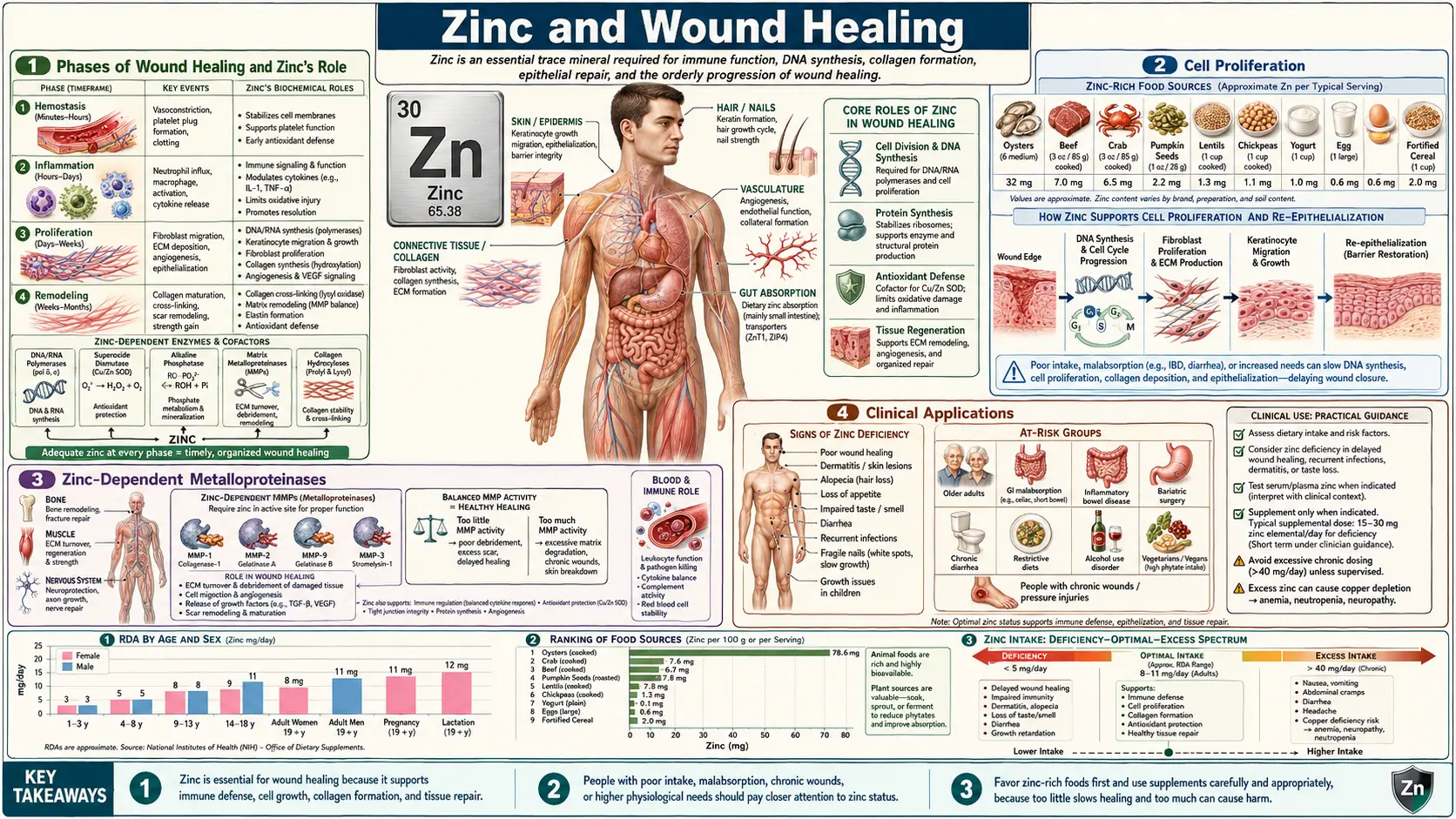
Zinc takes part in every phase of wound repair, from clotting and inflammation through new tissue formation to the final remodeling of the scar, according to a 2017 review (Lin 2017). The skin holds about 5% of the body's zinc, and zinc is more concentrated in the epidermis than in the dermis (Ogawa 2018). Zinc deficiency is linked to delayed wound healing. Whether extra zinc speeds healing in people who are not deficient is less clear: a Cochrane review found no evidence that oral zinc improves the healing of arterial or venous leg ulcers (Wilkinson 2014).
Table of Contents
Phases of Wound Healing and Zinc's Role
Wound healing proceeds through four overlapping phases: hemostasis, inflammation, proliferation, and remodeling. Zinc contributes to each of these phases through distinct biochemical mechanisms.
- Hemostasis (minutes to hours) — Immediately after injury, platelets aggregate at the wound site and form a clot. Lin's 2017 review describes zinc as enhancing platelet activity and aggregation; in laboratory studies, zinc added at millimolar concentrations entered platelets and triggered protein tyrosine phosphorylation through protein kinase C. The fibrin clot also serves as a provisional matrix for the cells that carry out later repair.
- Inflammation (hours to days) — Neutrophils and macrophages enter the wound to clear debris and fight infection. Neutrophil chemotaxis and phagocytosis are reduced during zinc deficiency (Gammoh 2017). Zinc also takes part in regulating the intensity of inflammation, notably through the NF-κB pathway described below.
- Proliferation (days to weeks) — This phase involves the formation of granulation tissue, angiogenesis (new blood vessel growth), re-epithelialization, and wound contraction. It depends on rapid cell division, and zinc is required for DNA synthesis and cell division. Zinc has been shown to increase keratinocyte migration during re-epithelialization (Lin 2017).
- Remodeling (weeks to months) — The final phase involves the maturation and reorganization of collagen within the wound, producing a scar with greater tensile strength. Zinc-dependent matrix metalloproteinases (MMPs) take part in this phase by degrading and reorganizing the extracellular matrix.
Collagen Synthesis
Collagen is the most abundant protein in the human body and the primary structural component of wound repair tissue. Several steps in making and remodeling collagen involve zinc-dependent proteins, alongside other nutrients such as vitamin C and copper.
- Gene transcription — Zinc is a cofactor in numerous transcription factors and enzyme systems (Lansdown 2007). Collagen genes such as COL1A1 and COL1A2 (type I collagen) and COL3A1 (type III collagen) are regulated by transcription factors, some of them zinc-finger proteins; no study cited on this page measured collagen-gene expression under zinc deficiency.
- Procollagen processing — After procollagen chains are synthesized in the endoplasmic reticulum, they must be processed by procollagen peptidases to form mature collagen molecules. Some of these processing enzymes, including bone morphogenetic protein-1 (BMP-1), are zinc-dependent metalloproteinases.
- Post-translational modification — Collagen undergoes hydroxylation of proline and lysine residues, which is needed for triple-helix formation and cross-linking. Vitamin C is the cofactor for prolyl and lysyl hydroxylases; in mice unable to make vitamin C, vitamin C supply improved wound matrix deposition and organisation (Mohammed 2016, an animal study).
- Cross-linking and maturation — Lysyl oxidase, a copper-dependent enzyme, catalyzes the cross-linking of collagen and elastin fibers. Proper cross-linking gives collagen fibers their tensile strength, which is critical for wound integrity.
- Collagen type transition — Early wound healing is characterized by type III collagen deposition, which is gradually replaced by type I collagen during remodeling, a process in which MMPs take part.
Cell Proliferation
The proliferative phase of wound healing demands rapid cell division to generate the cells needed for tissue repair. Zinc is required for DNA synthesis and cell division.
- DNA synthesis — Zinc is required for DNA synthesis and cell division, and Lin's 2017 review lists cell proliferation among the processes for which zinc-dependent metalloenzymes are needed.
- Fibroblast proliferation and function — Fibroblasts produce the extracellular matrix components of granulation tissue, including collagen, fibronectin, and glycosaminoglycans. Zinc's effect on fibroblast proliferation and collagen output is described mainly from laboratory studies.
- Keratinocyte migration and proliferation — Re-epithelialization requires keratinocytes at the wound margins to proliferate and migrate across the wound surface. Zinc has been shown to increase keratinocyte migration, and laboratory work cited in Lin's review found that zinc, copper and manganese enhanced keratinocyte migration by modulating keratinocyte integrins (Lin 2017). Zinc-dependent MMPs also assist keratinocyte migration (Lansdown 2007).
- Angiogenesis — The formation of new blood vessels to supply the growing granulation tissue requires endothelial cell proliferation and migration. Growth factors such as vascular endothelial growth factor (VEGF) trigger the activation of MMPs (Lin 2017); a direct effect of zinc intake on wound angiogenesis in people has not been shown in the studies cited here.
Inflammatory Response Modulation
A properly regulated inflammatory response is essential for effective wound healing. Too little inflammation allows infection to take hold, while excessive or prolonged inflammation causes tissue damage and delays repair. Zinc is one of the factors involved in regulating this response.
- Neutrophil recruitment and function — In the first hours after injury, neutrophils are recruited to the wound by chemotactic signals. Neutrophil chemotaxis and phagocytosis are reduced during zinc deficiency and increased with zinc supplementation; the NADPH oxidase that generates the respiratory burst has been shown to be inhibited by both zinc deficiency and zinc excess (Gammoh 2017).
- Macrophage phenotype switching — Macrophages play a dual role in wound healing: pro-inflammatory (M1) macrophages clear debris and pathogens early, and immune-regulatory (M2) macrophages take part in later repair. In a study of a human monocyte cell line described in Lin's review, both zinc deficiency and zinc supplementation promoted the M1 phenotype and inhibited M2 differentiation (Lin 2017), so the effect of zinc on this switch is not simple.
- NF-kB pathway regulation — Zinc modulates the NF-κB signaling pathway, which controls the expression of many pro-inflammatory genes. Induction of A20, a zinc-finger protein that inhibits NF-κB activation, has been shown to be zinc-dependent in cell studies (Gammoh 2017).
- Reactive oxygen species balance — Some ROS production is needed for antimicrobial defense, but excessive ROS damage wound tissue. Zinc is part of Cu/Zn superoxide dismutase, and the cysteine-rich metallothioneins may protect epithelial cells against reactive oxygen species (Lansdown 2007).
Immune Defense at the Wound Site
Wounds represent a breach in the body's primary defense barrier, creating an entry point for pathogens. Local immune defense at the wound site helps prevent infection.
- Antimicrobial peptide production — Keratinocytes and immune cells at the wound site produce antimicrobial peptides such as human beta-defensins and cathelicidin (LL-37). In rats, topical zinc oxide reduced bacterial growth in wound granulation tissue in normal animals but not in diabetic animals (Agren 1991, an animal study).
- Nutritional immunity — Nutritional immunity is the body's strategy of withholding essential metals from invading pathogens. Neutrophils release calprotectin, which sequesters zinc and so deprives bacteria of an essential metal; some bacteria have evolved zinc-uptake systems that evade it (Lin 2017; Gammoh 2017).
- Biofilm resistance — Chronic wounds are frequently colonized by bacterial biofilms, which resist antibiotics and immune clearance. Lansdown's 2007 review describes topical zinc as reducing superinfections and necrotic material in wounds; trials of zinc against wound biofilms are not cited on this page.
Zinc-Dependent Metalloproteinases
Matrix metalloproteinases (MMPs) are a family of zinc-dependent endopeptidases that play essential roles in wound healing by degrading and remodeling the extracellular matrix.
- Structure and mechanism — All MMPs contain a catalytic domain with a zinc ion at the active site, coordinated by three histidine residues. The zinc ion is essential for the hydrolytic cleavage of peptide bonds in extracellular matrix substrates. A second structural zinc ion and calcium ions provide additional stability to the enzyme.
- MMP-1 (collagenase-1) — Cleaves fibrillar collagens (types I, II, and III) during the remodeling phase. MMP-1 is produced by keratinocytes, fibroblasts, and macrophages and is essential for keratinocyte migration across the collagen-rich wound bed during re-epithelialization.
- MMP-2 (gelatinase A) and MMP-9 (gelatinase B) — These gelatinases degrade type IV collagen (the main component of basement membranes), gelatin, and other matrix components. MMP-2 is constitutively expressed and contributes to baseline matrix turnover, while MMP-9 is induced during inflammation and is critical for leukocyte migration into the wound.
- MMP-3 (stromelysin-1) — Has broad substrate specificity and degrades proteoglycans, laminin, fibronectin, and several collagen types. MMP-3 also activates other pro-MMPs, serving as a regulatory node in the MMP cascade.
- MMP-7 (matrilysin) — Expressed by epithelial cells, MMP-7 processes antimicrobial peptides and contributes to re-epithelialization. It plays a role in both wound defense and tissue repair.
- Tissue inhibitors of metalloproteinases (TIMPs) — The activity of MMPs is tightly regulated by TIMPs, endogenous inhibitors that bind to the zinc-containing active site. The balance between MMPs and TIMPs determines the net proteolytic activity in the wound. In chronic non-healing wounds, this balance is often disrupted, with excessive MMP activity leading to degradation of newly formed matrix and growth factors.
- Clinical implications — Aberrant levels of host and bacterial proteases are described in chronic wounds such as diabetic foot ulcers, venous leg ulcers, and pressure injuries (Lin 2017). That MMPs need zinc does not by itself show that zinc intake changes wound remodeling; no trial of that question is cited on this page.
Zinc Deficiency and Delayed Healing
Zinc deficiency is linked to delayed wound healing in clinical observations and animal studies.
- Clinical signs — Delayed wound healing is one of the signs of moderate zinc deficiency (Prasad 2013). In 46 patients undergoing elective surgery, wound complications were associated with low leucocyte zinc levels (Senapati 1990), and in a prospective study of 80 total hip arthroplasties, low preoperative serum zinc predicted delayed wound healing (Zorrilla 2006). In rats, zinc accumulated in healing abdominal wounds during the maturation phase, and mild deficiency greatly reduced this accumulation (Senapati 1985, an animal study).
- Acrodermatitis enteropathica — This rare inherited disorder, caused by mutations in the SLC39A4 gene encoding the zinc transporter ZIP4, is the clinical model of severe zinc deficiency (Maverakis 2007). Affected individuals develop dermatitis around the body openings and on the hands and feet, diarrhea, alopecia, and impaired wound healing; the features respond to zinc treatment.
- Chronic wounds — Low serum zinc has been reported in critically ill patients (Lin 2017). For chronic leg ulcers, the Cochrane review found no evidence that oral zinc sulphate improves healing (Wilkinson 2014), so lower zinc status in such patients has not been shown to be a cause that supplementation corrects.
- Burns — Trace element deficiencies, including of zinc, have repeatedly been described after major burns, from losses in wound exudate and other biological fluids, low intakes, dilution by resuscitation fluids, and redistribution from plasma to tissues during inflammation (Berger 2007).
- Surgical healing — Lansdown's 2007 review concluded that oral zinc may be beneficial in zinc-deficient leg-ulcer patients but that its place in surgical patients needs further clarification. Lin's 2017 review notes that treating zinc deficiency improves healing, while the effect of zinc supplementation in people who are not deficient is less well known.
- Populations at risk — Conditioned zinc deficiency has been observed in people with malabsorption (including Crohn's disease), liver disease, chronic renal disease, and sickle cell disease, and severe deficiency was reported in people on long-term total parenteral nutrition without zinc; elderly people are at higher risk of inadequate zinc intake (Prasad 2013).
Clinical Applications
Zinc has been studied in wound care both as oral or intravenous supplementation and as topical application.
- Systemic zinc supplementation — The evidence for oral zinc is strongest for people who are zinc-deficient; there are very few well-done clinical studies in people who are not, and what is available is inconsistent (Lin 2017). A Cochrane review of six small trials (183 participants) found no evidence that oral zinc sulphate improves the healing of arterial or venous leg ulcers, and noted that all the trials were small and at unclear risk of bias (Wilkinson 2014). A 2015 white paper on the 2014 international pressure-ulcer nutrition guidelines reviews nutrition strategies for pressure-ulcer healing (Posthauer 2015). Forms used in trials include zinc sulfate, zinc gluconate, and zinc acetate.
- Topical zinc preparations — Zinc has been used therapeutically for several thousand years (Schwartz 2005). Lansdown's 2007 review describes topical zinc as reducing superinfections and necrotic material and stimulating epithelialization, and zinc oxide paste bandages (Unna boots) as protecting and soothing inflamed skin around leg ulcers. Lin's 2017 review cites a meta-analysis of zinc oxide paste dressings (6–15% zinc) for chronic venous leg ulcers that found improved healing, while noting that the studies were small and of sub-optimal quality. Zinc oxide is also a common ingredient in barrier creams for diaper dermatitis, and calamine lotion is a mixture of zinc oxide and ferric oxide.
- Zinc in wound dressings — Wound dressings incorporating zinc have been developed for sustained local zinc delivery, including zinc-impregnated alginate dressings, zinc-containing hydrogels, and zinc oxide nanoparticle dressings. Lin's 2017 review notes that zinc oxide nanoparticles still need in-depth pharmacodynamic and toxicology studies before widespread use.
- Burn wound management — The 2013 ESPEN-endorsed recommendations on nutrition in major burns made a strong recommendation for early trace element and vitamin substitution (Rousseau 2013). In a randomized, placebo-controlled trial in 21 patients with major burns, intravenous copper, selenium, and zinc for 14–21 days raised skin zinc and selenium, lowered the number of infections, and reduced the need for regrafting (Berger 2007, Am J Clin Nutr). In 23 hospitalized burn patients given 50 mg of zinc daily by mouth or tube, 19 had normal serum zinc at discharge, serum copper was not affected, and no gastrointestinal side effects were seen; the study had no control group (Caldis-Coutris 2012).
- Perioperative supplementation — Low zinc status before surgery has been associated with wound complications and delayed healing in observational studies (Senapati 1990; Zorrilla 2006), but whether supplementing before surgery improves outcomes has not been established in the trials cited here (Lansdown 2007).
- Assessment of zinc status — Serum or plasma zinc is the most commonly used clinical biomarker of zinc status, although it has limitations. Plasma zinc falls during critical illness and inflammation partly through redistribution from plasma to tissues (Berger 2007), so it may not reflect tissue zinc stores. Other measures include dietary intake analysis, leucocyte or erythrocyte zinc, and hair zinc, though none is a perfect indicator.
- Safety findings — The NIH Office of Dietary Supplements states that zinc doses of 50 mg or more, if used for weeks, can interfere with copper absorption, and the adult Tolerable Upper Intake Level of 40 mg/day from food and supplements combined was set on the basis of zinc's effect on copper status; it does not apply to people receiving zinc as medical treatment. Zinc may induce intestinal metallothionein, which binds copper and keeps it from passing into the blood (Prasad 2013). Case reports describe zinc-induced copper deficiency with anemia, neutropenia, and neurological disease; this is covered on the Zinc Toxicity pages.
Key Research Papers
- Lin PH, Sermersheim M, Li H, Lee PHU, Steinberg SM, Ma J (2017). Zinc in wound healing modulation. Nutrients 10(1):16. — PubMed PMID: 29295546
- Lansdown AB, Mirastschijski U, Stubbs N, Scanlon E, Agren MS (2007). Zinc in wound healing: theoretical, experimental, and clinical aspects. Wound Repair Regen 15(1):2-16. — PubMed PMID: 17244314
- Agren MS, Soderberg TA, Reuterving CO, Hallmans G, Tengrup I (1991). Effect of topical zinc oxide on bacterial growth and inflammation in full-thickness skin wounds in normal and diabetic rats. Eur J Surg 157(2):97-101. — PubMed PMID: 1676317
- Andrews M, Gallagher-Allred C (1999). The role of zinc in wound healing. Adv Wound Care 12(3):137-138. — PubMed PMID: 10655793
- Mohammed BM, Fisher BJ, Kraskauskas D, Ward S, Wayne JS, Brophy DF, Fowler AA 3rd, Yager DR, Natarajan R (2016). Vitamin C promotes wound healing through novel pleiotropic mechanisms. Int Wound J 13(4):572-584. — PubMed PMID: 26290474 (mouse study)
- Senapati A, Thompson RP (1985). Zinc deficiency and the prolonged accumulation of zinc in wounds. Br J Surg 72(7):583-584. — PubMed PMID: 4016546 (rat study)
- Maverakis E, Fung MA, Lynch PJ, Draznin M, Michael DJ, Ruben B, Fazel N (2007). Acrodermatitis enteropathica and an overview of zinc metabolism. J Am Acad Dermatol 56(1):116-124. — PubMed PMID: 17190629
- Schwartz JR, Marsh RG, Draelos ZD (2005). Zinc and skin health: overview of physiology and pharmacology. Dermatol Surg 31(7 Pt 2):837-847. — PubMed PMID: 16029676
- Wilkinson EA (2014). Oral zinc for arterial and venous leg ulcers. Cochrane Database Syst Rev (9):CD001273. — PubMed PMID: 25202988
- Posthauer ME, Banks M, Dorner B, Schols JM (2015). The role of nutrition for pressure ulcer management: national pressure ulcer advisory panel, European pressure ulcer advisory panel, and pan pacific pressure injury alliance white paper. Adv Skin Wound Care 28(4):175-188. — PubMed PMID: 25775201
- Gammoh NZ, Rink L (2017). Zinc in infection and inflammation. Nutrients 9(6):624. — PubMed PMID: 28629136
- Ogawa Y, Kinoshita M, Shimada S, Kawamura T (2018). Zinc in keratinocytes and Langerhans cells: relevance to the epidermal homeostasis. J Immunol Res 2018:5404093. — PubMed PMID: 30622978
- Prasad AS (2013). Discovery of human zinc deficiency: its impact on human health and disease. Adv Nutr 4(2):176-190. — PubMed PMID: 23493534
- Senapati A, Slavin BM, Thompson RP (1990). Zinc depletion and complications of surgery. Clin Nutr 9(6):341-346. — PubMed PMID: 16837383
- Zorrilla P, Gómez LA, Salido JA, Silva A, López-Alonso A (2006). Low serum zinc level as a predictive factor of delayed wound healing in total hip replacement. Wound Repair Regen 14(2):119-122. — PubMed PMID: 16630099
- Berger MM, Shenkin A (2007). Trace element requirements in critically ill burned patients. J Trace Elem Med Biol 21(Suppl 1):44-48. — PubMed PMID: 18039496
- Berger MM, Baines M, Raffoul W, Benathan M, Chiolero RL, Reeves C, Revelly JP, Cayeux MC, Sénéchaud I, Shenkin A (2007). Trace element supplementation after major burns modulates antioxidant status and clinical course by way of increased tissue trace element concentrations. Am J Clin Nutr 85(5):1293-1300. — PubMed PMID: 17490965
- Rousseau AF, Losser MR, Ichai C, Berger MM (2013). ESPEN endorsed recommendations: nutritional therapy in major burns. Clin Nutr 32(4):497-502. — PubMed PMID: 23582468
- Caldis-Coutris N, Gawaziuk JP, Logsetty S (2012). Zinc supplementation in burn patients. J Burn Care Res 33(5):678-682. — PubMed PMID: 22245802
PubMed Topic Searches
- PubMed: Zinc and wound healing
- PubMed: Zinc and collagen synthesis
- PubMed: Zinc and matrix metalloproteinases
- PubMed: Zinc deficiency and skin
- PubMed: Topical zinc oxide in wound care
- PubMed: Zinc supplementation and pressure ulcers
- PubMed: Zinc and diabetic foot ulcer
- PubMed: Acrodermatitis enteropathica
- PubMed: Zinc in burn injury nutrition
- PubMed: Zinc and keratinocyte migration
- PubMed: Zinc and fibroblast proliferation
- PubMed: Calprotectin and nutritional immunity