Zinc for Testosterone and Male Reproductive Health
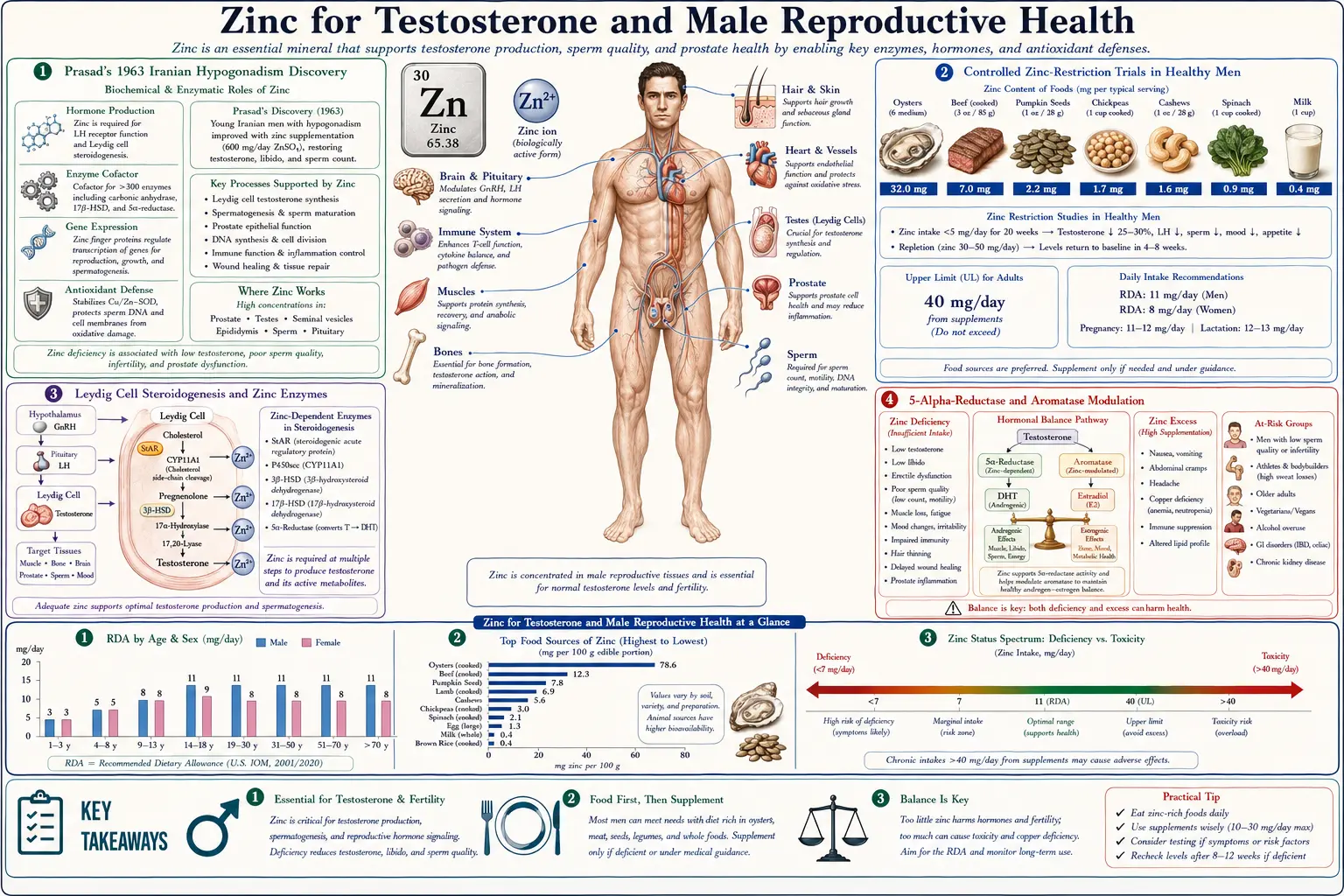
The connection between zinc and male reproductive endocrinology goes back to Ananda Prasad's reports of the early 1960s, which described young men in Iran and Egypt with severe growth failure and hypogonadism; in the Egyptian studies, zinc supplementation was followed by growth and by normal genital development within months. Later work linked zinc status to serum testosterone: in a small 1996 study, 20 weeks of dietary zinc restriction in four healthy young men was followed by a fall in serum testosterone. The prostate holds extremely high zinc levels, and seminal zinc is lower on average in infertile men than in fertile controls. Trials in men who already eat enough zinc, however, have mostly found no rise in testosterone, and the largest fertility trial found no benefit. This deep-dive walks through the historical evidence, the mechanisms (5-alpha-reductase, aromatase, sperm function), the zinc–magnesium–B6 combination studies, the fertility trials, and the copper trade-off at high intakes.
Table of Contents
- Prasad's 1963 Iranian Hypogonadism Discovery
- Controlled Zinc-Restriction Trials in Healthy Men
- Leydig Cell Steroidogenesis and Zinc Enzymes
- 5-Alpha-Reductase and Aromatase Modulation
- Exercise Studies in Wrestlers and Sedentary Men
- Zinc–Magnesium–B6 Combinations, Sleep, and Strength
- The Prostate, Semen, and Sperm Parameters
- Zinc Deficiency in Male Infertility
- Why Oysters? The Nutritional Density Argument
- Intake Levels, the Upper Limit, and Copper
- Key Research Papers
- Connections
- Featured Videos
Prasad's 1963 Iranian Hypogonadism Discovery
In his own later account, Ananda Prasad describes the case that started the story: at a medical-center grand rounds in Shiraz, Iran, he was shown a 21-year-old man who looked like a 10-year-old boy. The man was severely anemic, his genitalia were infantile, and he had rough, dry skin, mental lethargy, an enlarged liver and spleen, and geophagia — he ate only bread made from whole-wheat flour, no animal protein, and about 0.5 kg of clay a day. He was severely iron deficient without blood loss, and Prasad later found that the syndrome was common in the villages around Shiraz. Prasad wrote that iron deficiency alone could not account for all of the features, and proposed that the phytate-rich diet and the clay eating had reduced the availability of both iron and zinc. The syndrome was published in 1961 in the American Journal of Medicine.
Prasad and colleagues then studied young men with the same picture in Egypt. In Prasad's summary of that work, zinc supplementation was followed by 12.7–15.2 cm of growth in one year, and the genitalia became normal within 3–6 months. The Egyptian findings appeared in 1963 in the Journal of Laboratory and Clinical Medicine and Archives of Internal Medicine, and an endocrine follow-up appeared in 1967. Prasad dates the recognition that zinc is essential for humans to 1963.
How zinc deficiency produces hypogonadism has since been studied mostly in animals. In a 1996 rat study, a zinc-deficient diet lowered serum luteinizing hormone (LH) and testosterone compared with both freely fed and pair-fed control rats, which points to effects on the pituitary signal as well as on the testis itself.
Controlled Zinc-Restriction Trials in Healthy Men
The Iranian and Egyptian cases involved severe, long-standing deficiency in malnourished young men. A different question is whether a milder shortfall in otherwise healthy men changes testosterone. Prasad's group at Wayne State University in Detroit addressed this in a 1996 paper in Nutrition with three parts:
- Cross-sectional — in 40 healthy men aged 20 to 80, serum testosterone correlated with zinc concentrations inside lymphocytes (r = 0.43) and granulocytes (r = 0.30).
- Restriction — in four healthy young men (mean age 27.5), 20 weeks of dietary zinc restriction was followed by a fall in mean serum testosterone from 39.9 to 10.6 nmol/L.
- Supplementation — in nine older men (mean age 64) who were marginally zinc deficient, 3 to 6 months of zinc gluconate (459 µmol of zinc a day) was followed by a rise in mean serum testosterone from 8.3 to 16.0 nmol/L.
The authors concluded that zinc may play an important role in modulating serum testosterone in normal men.
Several caveats apply:
- The groups were very small (four men in the restriction arm, nine in the supplementation arm), and the supplementation arm had no placebo group.
- In 1981, among 37 men with long-standing idiopathic infertility, zinc raised testosterone only in the subgroup whose testosterone was low to begin with; in men with normal baseline testosterone it did not change.
- In a 2009 study of 14 regularly exercising men whose diets already supplied 11.9–23.2 mg of zinc a day, a zinc–magnesium supplement raised serum zinc but did not change serum total or free testosterone.
Taken together, these studies point to an effect of zinc on testosterone in men who are short of zinc, not in men whose zinc intake is already adequate. Prasad's reviews list the conditions that predispose to zinc deficiency: diets high in phytate-rich cereal protein, alcoholism, malabsorption, sickle cell disease, chronic kidney disease, and chronic debilitating illness. The NIH Office of Dietary Supplements adds that vegetarians, and especially vegans, usually have lower zinc intakes and lower serum zinc than non-vegetarians.
Leydig Cell Steroidogenesis and Zinc Enzymes
Testosterone is made in the Leydig cells of the testis from cholesterol, through a series of enzymatic steps:
- StAR protein (steroidogenic acute regulatory protein) — moves cholesterol from the outer to the inner mitochondrial membrane, the rate-limiting step of steroid synthesis.
- CYP11A1 (cholesterol side-chain cleavage enzyme) — a heme-containing enzyme that converts cholesterol to pregnenolone.
- 3-beta-hydroxysteroid dehydrogenase (3-beta-HSD) — converts pregnenolone to progesterone and DHEA to androstenedione.
- 17-beta-hydroxysteroid dehydrogenase (17-beta-HSD) — converts androstenedione to testosterone in the final step.
- Androgen receptor (AR) — the nuclear receptor that carries out testosterone's actions in target tissues. Like other steroid receptors, it binds DNA through two zinc fingers in its DNA-binding domain.
Prasad's 2013 review notes that more than 300 enzymes and more than 1,000 transcription factors are now known to require zinc. Exactly which steps of human testosterone synthesis are limited by zinc status has not been worked out. The animal evidence is clearer: in zinc-deficient rats, serum LH and testosterone were lower than in pair-fed controls, and the liver held fewer androgen binding sites (6.7 versus 11.3 fmol/mg protein) and more estrogen receptors.
5-Alpha-Reductase and Aromatase Modulation
Beyond testosterone synthesis, zinc has been studied for its effects on two enzymes that convert testosterone into other hormones.
5-alpha-reductase converts testosterone to dihydrotestosterone (DHT), the more potent androgen involved in prostate growth, male-pattern hair loss and sebaceous gland activity; it is the target of the prescription drugs finasteride and dutasteride. In laboratory studies, zinc sulphate at millimolar concentrations was a potent inhibitor of 5-alpha-reductase in human skin samples (1988), and in tissue from enlarged (hyperplastic) human prostates, low zinc concentrations slightly increased the conversion while higher concentrations inhibited it (1984). The prostate study found no correlation between the tissue's own zinc content and its capacity to make DHT. The test-tube results run in the opposite direction from the whole-animal data: zinc-deficient rats converted less testosterone to DHT in the liver, not more, and in the 1981 infertility study zinc raised plasma DHT. Whether zinc intake changes DHT in a way that matters for hair or prostate in people has not been shown.
Aromatase (CYP19A1) converts testosterone to estradiol and is the main source of estrogen in men; it is expressed in fat tissue, brain, bone and the gonads. In zinc-deficient rats, the liver converted more testosterone to estradiol than in control rats. No human trial on this page measured estradiol in response to zinc, and the aromatase inhibitors used in medicine are drugs (anastrozole, letrozole), not nutrients.
Exercise Studies in Wrestlers and Sedentary Men
The exercise studies most often cited for zinc and testosterone come from one group at Selçuk University in Konya, Turkey.
- Kilic and colleagues, 2006 — ten licensed male wrestlers (mean age 18.7) took zinc sulphate at 3 mg per kg of body weight per day for 4 weeks on top of their normal diet. Before supplementation, an exhaustion test lowered thyroid hormones and total and free testosterone. After 4 weeks, both resting and post-exhaustion testosterone and several thyroid hormone values were higher than before supplementation, and the authors concluded that zinc prevented the exercise-induced drop.
- Kilic, 2007 — the same design in ten sedentary young men (mean age 19.5) with a fatiguing bicycle test produced the same pattern.
- Cinar and colleagues, 2011 — a related study from the same group tested magnesium, not zinc: 4 weeks of magnesium (10 mg per kg per day) in tae kwon do athletes and sedentary men was followed by higher free and total testosterone, with larger increases in the athletes.
All three studies were small and compared the same men before and after supplementation; the zinc studies had no placebo group, and baseline zinc status was not reported in the abstracts. They show that hormone levels were higher after 4 weeks of zinc, but cannot separate the effect of zinc from training, season or repeated testing. None of the three abstracts reports a strength or performance outcome.
Zinc–Magnesium–B6 Combinations, Sleep, and Strength
A fixed combination of zinc, magnesium and vitamin B6 has been sold as a sports supplement since the late 1990s. Three trials tested it:
- Brilla and Conte, 2000 (Journal of Exercise Physiology Online) — 27 NCAA Division II football players took a nightly combination of 30 mg zinc (as zinc monomethionine aspartate), 450 mg magnesium aspartate and 10.5 mg vitamin B6 (12 men) or placebo (15 men) for 8 weeks of spring training. Total and free testosterone, IGF-1 and muscle strength rose in the supplement group compared with placebo. The paper discloses that the company making the supplement funded the study and that one author held an equity interest in it. The journal is not indexed in PubMed.
- Wilborn and colleagues, 2004 (Journal of the International Society of Sports Nutrition) — 42 resistance-trained men took the combination or a dextrose placebo 30–60 minutes before sleep for 8 weeks of standardized training. Serum zinc rose 11–17%, which was not statistically significant, and there were no differences between groups in anabolic or catabolic hormones, body composition, strength, muscular endurance or anaerobic capacity.
- Koehler and colleagues, 2009 (European Journal of Clinical Nutrition) — in 14 regularly exercising men whose diets already supplied enough zinc, the combination raised serum zinc and urinary zinc excretion but did not change serum total or free testosterone or the urinary pattern of testosterone metabolites.
The positive result therefore comes from the one industry-funded trial; the two independent trials in men who were not zinc deficient found no hormonal effect. Better sleep is often claimed for the combination, but none of these three trials measured sleep, and no sleep trial of the combination is cited on this page. Magnesium and zinc both act on NMDA receptors in the brain, which is the mechanism usually put forward for a sleep effect.
The Prostate, Semen, and Sperm Parameters
The human prostate contains extremely high levels of zinc, held in the specialized zinc-accumulating epithelial cells of its peripheral zone. A 2016 review by Costello and Franklin describes these cells as having evolved to produce and secrete extremely large amounts of citrate, which the high zinc level makes possible by inhibiting the cells' mitochondrial citrate oxidation (at the enzyme m-aconitase). Loss of this zinc accumulation is described in the same review as the most consistent hallmark of prostate cancer, and as an essential early event in its development.
Roles of zinc in semen and sperm described in reviews of male fertility (Fallah 2018) include:
- Antioxidant protection — zinc is part of the antioxidant defenses of seminal plasma; raised reactive oxygen species in the semen of infertile men who smoke are linked with changes in seminal zinc.
- Spermatogenesis — zinc deficiency impairs sperm production and is linked with sperm abnormalities and lower serum testosterone.
- Epithelial integrity — zinc is described as essential for maintaining the lining of the reproductive organs.
- Capacitation and the acrosome reaction — zinc may regulate the timing of capacitation and the acrosome reaction, the changes that make sperm able to fertilize an egg.
- Protection against heavy metals — zinc counters some toxic effects of heavy metals and of inflammatory agents from cigarette smoke.
A 2016 meta-analysis of 20 studies (2,600 infertile men and 867 controls) found lower seminal zinc in infertile men than in fertile men, and found that zinc supplementation increased semen volume, sperm motility and the percentage of normally shaped sperm. The authors noted that further studies are needed.
Zinc Deficiency in Male Infertility
The 2022 Cochrane review of antioxidants for male subfertility cites the estimate that a male factor accounts for up to half of infertility cases. Zinc is one of the most studied nutrients in this setting, and the results differ sharply between small studies and large trials.
- Seminal zinc and sperm quality — the 2016 meta-analysis above found lower seminal zinc in infertile men, and pooled small trials in which zinc improved semen volume, motility and morphology.
- Netter, 1981 — among 37 men with idiopathic infertility of more than five years, the 22 men with low testosterone saw testosterone, DHT and sperm count rise on oral zinc, and nine of their wives became pregnant. In the 15 men with normal testosterone, testosterone and sperm count did not change and there were no pregnancies. The study had no placebo group.
- FAZST trial (JAMA, 2020) — the largest randomized trial of zinc for male fertility enrolled 2,370 couples planning infertility treatment at four U.S. centers. The men took 30 mg of elemental zinc plus 5 mg of folic acid, or placebo, daily for 6 months. Live birth did not differ (34% versus 35%), and most semen measures did not differ. Sperm DNA fragmentation was slightly higher in the supplement group (29.7% versus 27.2%), and abdominal pain, nausea and vomiting were more common. The authors concluded that the findings do not support folic acid and zinc supplementation by male partners in the treatment of infertility. The trial enrolled a general population of couples seeking treatment, not men selected for low zinc.
- MOXI trial (Fertility and Sterility, 2020) — 174 men with male-factor infertility were randomized to an antioxidant formulation containing 20 mg of zinc together with vitamin C, vitamin E, selenium, L-carnitine, folic acid and lycopene, or placebo. The formulation did not improve sperm morphology, motility or DNA fragmentation, and cumulative live birth at 6 months was 15% with antioxidants versus 24% with placebo. The authors concluded that antioxidants do not improve semen parameters or DNA integrity in men with male-factor infertility.
- Cochrane review (2022) — across 90 studies of 20 different antioxidants in 10,303 subfertile men, very low-certainty evidence suggested antioxidants may increase live birth; when studies at high risk of bias were removed, there was no evidence of increased live birth. The reviewers called the evidence inconclusive and said larger well-designed trials are still needed.
- Lifestyle context — smoking and heavy-metal exposure are among the factors the 2018 fertility review links with altered seminal zinc and sperm damage.
In summary: seminal zinc is lower on average in infertile men, and small trials report better semen measures with zinc, while the two large placebo-controlled trials found no improvement in semen quality or live birth. Neither large trial selected men for low zinc, so whether zinc helps men who are actually deficient remains an open question. Decisions about supplements belong with a clinician.
Why Oysters? The Nutritional Density Argument
Oysters have a long reputation as an aphrodisiac. What is measurable is their zinc content. According to the NIH Office of Dietary Supplements (ODS), oysters contain more zinc per serving than any other food: 3 ounces of raw farmed Eastern oysters provide 32 mg (291% of the Daily Value), and 3 ounces of cooked Pacific oysters provide 28.2 mg (256%).
For comparison, the ODS table lists 3.8 mg in 3 ounces of roasted beef bottom sirloin, 2.2 mg in 1 ounce of roasted pumpkin seeds, and 1.3 mg in half a cup of boiled lentils. Because beef is eaten so often, it supplies about 20% of the zinc in the U.S. diet.
The ODS also notes that zinc from beans, nuts and whole grains is less bioavailable than zinc from animal foods, because these plant foods contain phytates that bind zinc in the intestine and inhibit its absorption. Whether the folk reputation of oysters has anything to do with their zinc content is not established.
Safety findings about oysters:
- Raw oysters can carry Vibrio bacteria and norovirus; thorough cooking kills them.
- Oysters from polluted waters can accumulate heavy metals such as cadmium.
Intake Levels, the Upper Limit, and Copper
Reference values and the amounts used in the studies on this page:
- RDA — 11 mg/day for men aged 14 and over (NIH ODS). Average intake from food among U.S. men over 19 is 13 mg/day.
- Tolerable Upper Intake Level (UL) — 40 mg/day for adults from food and supplements combined. The Food and Nutrition Board set it on the basis of intakes that have an adverse effect on copper status. The UL does not apply to people receiving zinc as medical treatment.
- Amounts used in trials — 459 µmol/day as zinc gluconate (Prasad 1996); zinc sulphate at 3 mg per kg of body weight per day (Kilic 2006, 2007); 30 mg zinc in the zinc–magnesium–B6 combination (Brilla 2000, Wilborn 2004); 30 mg elemental zinc with 5 mg folic acid (FAZST 2020); 20 mg zinc in a multi-antioxidant formulation (MOXI 2020).
Copper is the main trade-off at high intakes. According to the ODS, doses of 50 mg of zinc or more taken for weeks can interfere with copper absorption and cause low copper status, and can also reduce immune function and lower HDL cholesterol; very high doses (142 mg/day) may also disrupt magnesium balance. The usual explanation is that high zinc intake induces metallothionein in intestinal cells, which binds copper and holds it until the cells are shed.
Copper deficiency from excess zinc has been reported to cause:
- Anemia.
- Neurologic disease, including sensory ataxia and myelopathy (damage to the spinal cord that can resemble vitamin B12 deficiency).
Case reports describe both in people who used very large amounts of zinc-containing denture cream for years: a 2008 series of four patients found 17,000–34,000 µg of zinc per gram in the creams they used, and two patients improved mildly with copper after stopping the cream. Many denture creams have since been reformulated without zinc. The FAZST trial also recorded more gastrointestinal symptoms with 30 mg of zinc plus folic acid than with placebo.
Key Research Papers
- Prasad AS, Halsted JA, Nadimi M (1961). Syndrome of iron deficiency anemia, hepatosplenomegaly, hypogonadism, dwarfism and geophagia. Am J Med 31:532-546. — PubMed PMID: 14488490
- Prasad AS, Miale A Jr, Farid Z, Sandstead HH, Schulert AR (1963). Zinc metabolism in patients with the syndrome of iron deficiency anemia, hepatosplenomegaly, dwarfism, and hypogonadism. J Lab Clin Med 61:537-549. — PubMed PMID: 13985937
- Prasad AS, Mantzoros CS, Beck FW, Hess JW, Brewer GJ (1996). Zinc status and serum testosterone levels of healthy adults. Nutrition 12(5):344-348. — PubMed PMID: 8875519
- Cinar V, Polat Y, Baltaci AK, Mogulkoc R (2011). Effects of magnesium supplementation on testosterone levels of athletes and sedentary subjects at rest and after exhaustion. Biol Trace Elem Res 140(1):18-23. — PubMed PMID: 20352370
- Kilic M, Baltaci AK, Gunay M, Gokbel H, Okudan N, Cicioglu I (2006). The effect of exhaustion exercise on thyroid hormones and testosterone levels of elite athletes receiving oral zinc. Neuro Endocrinol Lett 27(1-2):247-252. — PubMed PMID: 16648789
- Brilla LR, Conte V (2000). Effects of a novel zinc-magnesium formulation on hormones and strength. J Exerc Physiol Online 3(4):26-36. — JEPonline full text (ASEP)
- Wilborn CD, Kerksick CM, Campbell BI, Taylor LW, Marcello BM, Rasmussen CJ, Greenwood MC, Almada A, Kreider RB (2004). Effects of zinc magnesium aspartate (ZMA) supplementation on training adaptations and markers of anabolism and catabolism. J Int Soc Sports Nutr 1(2):12-20. — PubMed PMID: 18500945
- Steiner AZ, Hansen KR, Barnhart KT, et al.; Reproductive Medicine Network (2020). The effect of antioxidants on male factor infertility: the Males, Antioxidants, and Infertility (MOXI) randomized clinical trial. Fertil Steril 113(3):552-560.e3. — PubMed PMID: 32111479
- Schisterman EF, Sjaarda LA, Clemons T, et al. (2020). Effect of folic acid and zinc supplementation in men on semen quality and live birth among couples undergoing infertility treatment: a randomized clinical trial (FAZST). JAMA 323(1):35-48. — PubMed PMID: 31910279
- Fallah A, Mohammad-Hasani A, Colagar AH (2018). Zinc is an essential element for male fertility: a review of zinc roles in men's health, germination, sperm quality, and fertilization. J Reprod Infertil 19(2):69-81. — PubMed PMID: 30009140
- Costello LC, Franklin RB (2016). A comprehensive review of the role of zinc in normal prostate function and metabolism; and its implications in prostate cancer. Arch Biochem Biophys 611:100-112. — PubMed PMID: 27132038
- Spallholz JE, Boylan LM, Larsen HS (1990). Advances in understanding selenium's role in the immune system. Ann N Y Acad Sci 587:123-139. (A review of selenium in immunity; it does not study zinc or testosterone.) (Plus follow-on work on Se-Zn synergy in male reproductive endocrinology.) — PubMed PMID: 2193564
- Sandstead HH, Prasad AS, Schulert AR, Farid Z, Miale A Jr, Bassilly S, Darby WJ (1967). Human zinc deficiency, endocrine manifestations and response to treatment. Am J Clin Nutr 20(5):422-442. — PubMed PMID: 6023853
- Prasad AS, Miale A Jr, Farid Z, Sandstead HH, Schulert AR, Darby WJ (1963). Biochemical studies on dwarfism, hypogonadism, and anemia. Arch Intern Med 111:407-428. — PubMed PMID: 13985936
- Prasad AS (2013). Discovery of human zinc deficiency: its impact on human health and disease. Adv Nutr 4(2):176-190. — PubMed PMID: 23493534
- Prasad AS (1991). Discovery of human zinc deficiency and studies in an experimental human model. Am J Clin Nutr 53(2):403-412. — PubMed PMID: 1989405
- Kilic M (2007). Effect of fatiguing bicycle exercise on thyroid hormone and testosterone levels in sedentary males supplemented with oral zinc. Neuro Endocrinol Lett 28(5):681-685. — PubMed PMID: 17984944
- Koehler K, Parr MK, Geyer H, Mester J, Schänzer W (2009). Serum testosterone and urinary excretion of steroid hormone metabolites after administration of a high-dose zinc supplement. Eur J Clin Nutr 63(1):65-70. — PubMed PMID: 17882141
- Netter A, Hartoma R, Nahoul K (1981). Effect of zinc administration on plasma testosterone, dihydrotestosterone, and sperm count. Arch Androl 7(1):69-73. — PubMed PMID: 7271365
- Om AS, Chung KW (1996). Dietary zinc deficiency alters 5 alpha-reduction and aromatization of testosterone and androgen and estrogen receptors in rat liver. J Nutr 126(4):842-848. — PubMed PMID: 8613886
- Stamatiadis D, Bulteau-Portois MC, Mowszowicz I (1988). Inhibition of 5 alpha-reductase activity in human skin by zinc and azelaic acid. Br J Dermatol 119(5):627-632. — PubMed PMID: 3207614
- Leake A, Chisholm GD, Habib FK (1984). The effect of zinc on the 5 alpha-reduction of testosterone by the hyperplastic human prostate gland. J Steroid Biochem 20(2):651-655. — PubMed PMID: 6200703
- Zhao J, Dong X, Hu X, Long Z, Wang L, Liu Q, Sun B, Wang Q, Wu Q, Li L (2016). Zinc levels in seminal plasma and their correlation with male infertility: a systematic review and meta-analysis. Sci Rep 6:22386. — PubMed PMID: 26932683
- de Ligny W, Smits RM, Mackenzie-Proctor R, Jordan V, Fleischer K, de Bruin JP, Showell MG (2022). Antioxidants for male subfertility. Cochrane Database Syst Rev 5:CD007411. — PubMed PMID: 35506389
- Nations SP, Boyer PJ, Love LA, Burritt MF, Butz JA, Wolfe GI, Hynan LS, Reisch J, Trivedi JR (2008). Denture cream: an unusual source of excess zinc, leading to hypocupremia and neurologic disease. Neurology 71(9):639-643. — PubMed PMID: 18525032
- National Institutes of Health, Office of Dietary Supplements. Zinc: Fact Sheet for Health Professionals (updated September 28, 2022). — ods.od.nih.gov
PubMed Topic Searches
- PubMed: Selenium + zinc + male reproduction
- PubMed: Zinc + testosterone + RCT
- PubMed: Zinc deficiency + hypogonadism (Prasad)
- PubMed: Zinc–magnesium–B6 combinations + athletes
- PubMed: Zinc + 5-alpha-reductase
- PubMed: Zinc + aromatase
- PubMed: Seminal zinc + sperm motility
- PubMed: Zinc-induced copper deficiency
- PubMed: Oyster zinc bioavailability
Connections
- All Minerals
- Zinc Overview
- Zinc Benefits Hub
- Zinc for Immune Function
- Zinc for Wound Healing
- Zinc for Skin Health
- Copper (Critical Antagonist)
- Magnesium (ZMA Partner)
- Selenium (Sperm Quality)
- Vitamin B6 (ZMA Partner)
- Vitamin D3 (Testosterone)
- Testosterone Test
- Infertility
- Low Testosterone
- Benign Prostatic Hyperplasia
- Deficiency
- Toxicity
- History
- Sources