Fluoride Toxicity
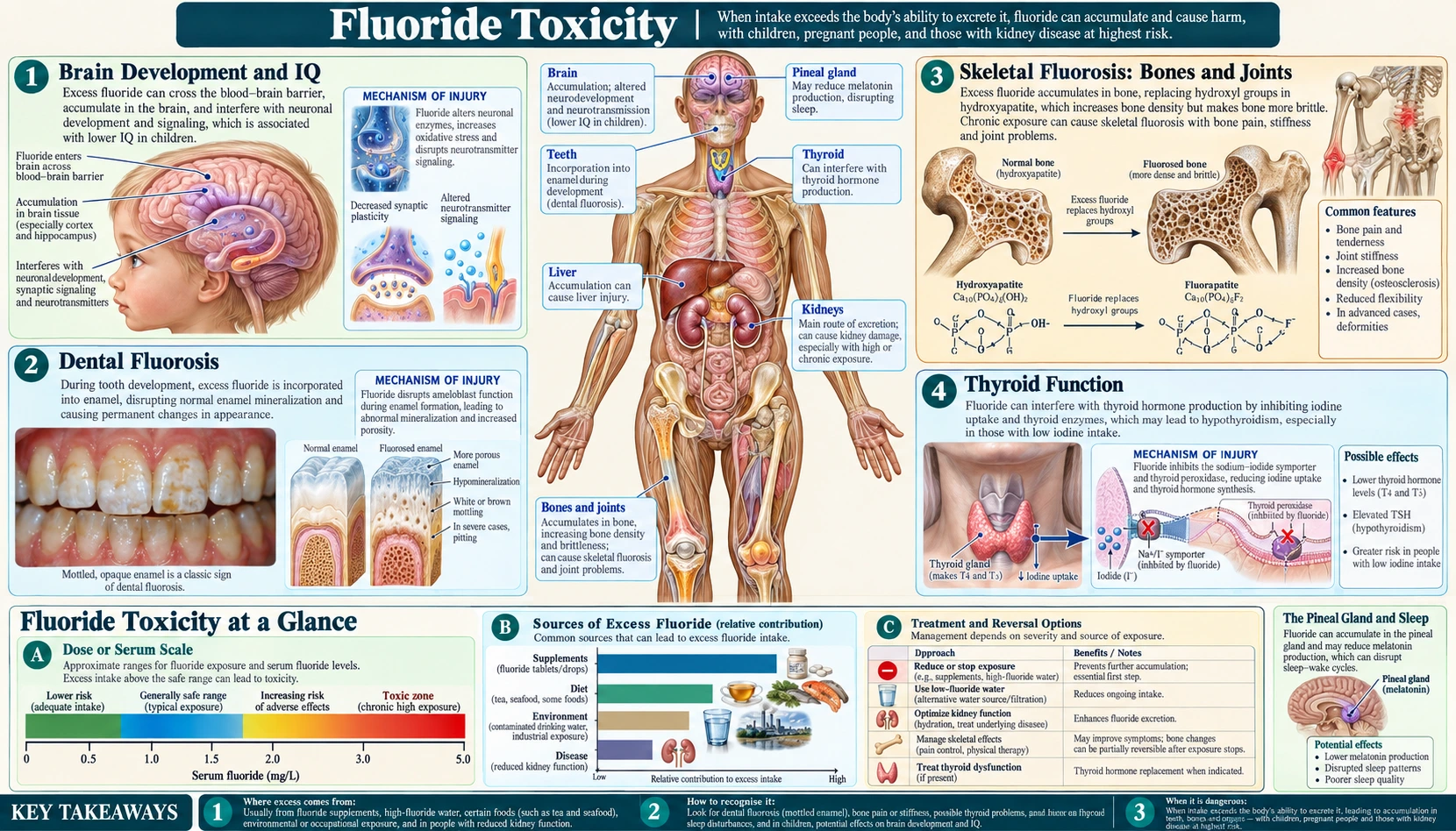
Fluoride is not poisonous or safe. It is dose-dependent, like almost everything else the body absorbs — and the entire public argument, on both sides, is really an argument about where the line sits and who gets to draw it. This page is the map. It separates what is settled from what is genuinely contested from what is simply unsupported, links every claim to the research, and points to the specific organ pages underneath it.
Table of Contents
- Deep-Dive Articles
- What “Toxicity” Means Here
- The Numbers the Argument Turns On
- Acute Poisoning vs Chronic Accumulation
- Water Is Not the Only Source
- Who Absorbs and Retains the Most
- Settled, Contested, Unsupported
- Fluoride Elsewhere on This Site
- Reducing Exposure Without Losing the Benefit
- Key Research Papers
- Connections
- Featured Videos
Deep-Dive Articles
Each organ system gets its own page, because the strength of the evidence is different for each one and lumping them together is how both sides of this argument mislead people.
Brain Development and IQ
The most contested claim about fluoride, handled honestly: what the 2024 NTP monograph actually concluded, what the 2025 JAMA Pediatrics meta-analysis found, and why “above 1.5 mg/L” is the sentence that matters.
Read the deep dive →Dental Fluorosis
The one fluoride injury nobody disputes — white streaks to brown pitting on permanent teeth, caused only during the years the teeth are forming. About 41% of U.S. adolescents in the 1999–2004 national survey; higher in later ones.
Read the deep dive →Skeletal Fluorosis: Bones and Joints
What decades of high fluoride intake do to bone: stiffness, joint pain, denser but more brittle bone, and in advanced endemic cases a spine that fuses. Rare in the U.S., common in parts of India and China.
Read the deep dive →Thyroid Function
Fluoride was once prescribed to suppress an overactive thyroid. What that history does and does not tell us about drinking water, and why iodine status keeps turning up as the modifier.
Read the deep dive →Kidneys and Liver
The kidney is the organ that clears fluoride, which makes it both the main defence and the main casualty. Why chronic kidney disease turns an ordinary intake into an accumulating one.
Read the deep dive →The Pineal Gland and Sleep
Fluoride genuinely does concentrate in pineal calcification — the measurements are real. What follows for melatonin and sleep in humans is not established, and this page says so plainly.
Read the deep dive →What “Toxicity” Means Here
Fluoride is a halide ion. It is not a nutrient in the sense that iron or iodine are — there is no fluoride deficiency disease, no metabolic process that requires it, and no recommended dietary allowance. What there is instead is an Adequate Intake, a figure built entirely around cavity prevention rather than around any biological requirement.
That matters for how you read the word toxicity. With iron, toxicity means overwhelming a system that needs iron. With fluoride, there is no requirement to overwhelm. The body handles it the way it handles most small ions it has no use for: absorbs it readily from the gut, circulates it, filters most of it out through the kidneys within hours, and deposits a fraction of the remainder in the tissues that take up calcium — bone, developing tooth enamel, and calcified structures such as the pineal gland.
So chronic fluoride toxicity is a storage problem. Roughly half of a daily intake is excreted and roughly half is retained in the skeleton in a growing child. Skeletal fluoride is measured in decades, not days. This is why the meaningful question is almost never “is one glass of water harmful” and almost always “what does a lifetime of a given concentration, from all sources combined, add up to.”
The Numbers the Argument Turns On
Most disagreements about fluoride dissolve once these figures are on the same page. They are not in dispute; what is in dispute is what they imply.
| Figure | Value | What it is |
|---|---|---|
| U.S. fluoridation target | 0.7 mg/L | The level public water systems aim for. Lowered from a 0.7–1.2 range in 2015, specifically because dental fluorosis had become more common. |
| WHO guideline | 1.5 mg/L | The upper guideline value for drinking water. |
| EPA enforceable limit | 4.0 mg/L | The legal maximum, set to prevent skeletal fluorosis. It is a health-based standard, not a target. |
| EPA secondary standard | 2.0 mg/L | Non-enforceable, set to limit dental fluorosis. Treated as cosmetic. |
| NTP’s stated threshold | > 1.5 mg/L | The exposure level above which the 2024 monograph reported moderate confidence of an association with lower IQ in children. |
| Probably toxic dose (acute) | ~5 mg/kg body weight | The single-swallow figure poison centres use. For a 15 kg toddler that is about 75 mg — reachable from a large squeeze of adult toothpaste. |
Read the table again and the shape of the real disagreement appears. The regulatory limit that is enforceable (4.0 mg/L) was built around bone disease. The number the neurodevelopment research keeps landing on (1.5 mg/L) sits well below it. And the level most Americans actually drink (0.7 mg/L) sits below that. Whether the gap between 0.7 and 1.5 is a comfortable safety margin or an uncomfortably thin one is the honest crux, and it is not settled by either side shouting the word “science.”
Acute Poisoning vs Chronic Accumulation
These are different injuries and conflating them is the most common error in fluoride writing.
Acute
A large single dose irritates the stomach directly and binds calcium in the blood. Nausea, vomiting, abdominal pain and drooling come first; a serious dose can drop blood calcium far enough to cause tetany and cardiac arrhythmia. In practice, U.S. acute cases are overwhelmingly small children swallowing toothpaste or a fluoride rinse, and are overwhelmingly mild (Shulman & Wells, 1997). Fluoridated tap water cannot produce an acute dose; the concentration is orders of magnitude too low.
Chronic
Everything else on this page. Chronic fluoride toxicity is cumulative, silent for years, and shows up first in the tissues that were forming while the exposure was happening — which is why dental fluorosis is a childhood-exposure disease that you only see on adult teeth, and why the neurodevelopment research concentrates on pregnancy and early childhood rather than on adults.
Water Is Not the Only Source
Public argument fixates on the tap because that is what is voted on. But a person’s total fluoride intake is a sum, and for many people water is not the largest term in it:
- Toothpaste. Standard adult paste is 1,000–1,500 ppm — roughly a thousand times the concentration of fluoridated water. Young children reliably swallow a meaningful fraction of what goes on the brush.
- Tea. The tea plant is a fluoride accumulator. Strong or long-brewed black tea, and especially cheap brick tea, can contribute more fluoride in a day than the water it was brewed with. See Green Tea.
- Processed food and drinks made with fluoridated municipal water — which carries the fluoride of its city into places that do not fluoridate.
- Infant formula reconstituted with fluoridated tap water, which is the single highest fluoride intake per kilogram of body weight that most people ever experience.
- Dental treatments, varnishes and rinses.
- Certain medications and industrial exposures, and in some regions naturally high groundwater that has nothing to do with public policy at all.
This is the strongest technical objection to fluoridation as a delivery method, and it is separate from the ethical objection about consent. A dose delivered through the water supply cannot be titrated. A labourer drinking five litres a day in a hot climate receives several times the dose of an office worker in the same city, from the same tap, at the same concentration.
Who Absorbs and Retains the Most
- Infants on reconstituted formula — highest intake per kg of body weight.
- Children under about 8 — the window in which permanent teeth are forming, and the only window in which dental fluorosis can be caused.
- Pregnant women — fluoride crosses the placenta, and this is where the neurodevelopment research is concentrated.
- People with chronic kidney disease — the clearance route is impaired, so ordinary intake becomes accumulating intake. See Kidneys and Liver.
- People with low iodine intake — the thyroid signal in the literature is consistently stronger in iodine-deficient groups. See Thyroid Function and Iodine.
- Heavy water drinkers — outdoor workers, athletes, people with diabetes insipidus, anyone in a hot climate.
- People drinking naturally high-fluoride groundwater, where concentrations can exceed the U.S. limit several times over.
Settled, Contested, Unsupported
This site is free, carries no advertising and has nothing to sell you in either direction, so it can afford to be blunt about which is which.
| Claim | Status | Detail |
|---|---|---|
| Fluoride causes dental fluorosis | Settled | Dose-dependent, documented for a century, and the reason the U.S. target was lowered in 2015. About 41% of U.S. adolescents aged 12–15 in the 1999–2004 survey, rising in later surveys; mostly very mild or mild. |
| Chronic high intake causes skeletal fluorosis | Settled | Well documented in endemic regions of India and China. Rare in the U.S. at 0.7 mg/L. |
| Fluoride reduces cavities | Settled, but shrinking | Real. The 2024 Cochrane review found the benefit in studies since 1975 much smaller than in the classic mid-century studies — because fluoride toothpaste is now nearly universal, so the water adds less on top. |
| Fluoride above 1.5 mg/L is associated with lower child IQ | Contested, but the strongest version of the concern | The NTP monograph (2024) reported moderate confidence for this association and explicitly stated it could not determine whether 0.7 mg/L affects IQ. |
| Fluoride at 0.7 mg/L lowers IQ | Unresolved | Some analyses in the 2025 JAMA Pediatrics meta-analysis found associations below 1.5 mg/L; the authors and their critics disagree about confounding and study quality. Anyone who tells you this is settled — either way — is overselling. |
| Fluoride affects thyroid function | Contested | Biologically plausible, with real historical precedent, and observed most consistently where iodine is low. Not established at U.S. water levels in iodine-sufficient people. |
| Fluoride accumulates in the pineal gland | Measured | The accumulation is real and documented in human autopsy tissue. |
| That pineal accumulation harms sleep or melatonin in humans | Unsupported | No human outcome data establishes this. It is an inference from a measurement, and it is presented as fact far more often than the evidence allows. |
| Fluoride causes cancer | Not supported | Repeatedly examined, including for osteosarcoma. Large reviews have not established a causal link at drinking-water levels. |
Fluoride Elsewhere on This Site
Fluoride touches enough subjects that its coverage was scattered. Everything already written is gathered and classified here.
The fluoride case itself
- News: Fluoride Without Consent (Aug 27, 2026) — the Ninth Circuit vacates the landmark ruling, the case heads toward the Supreme Court question, and the state-by-state push to end fluoridation.
- Fluoride in Water — the main overview: history of fluoridation, the dental argument, exposure sources, which countries rejected it, and how to test your own water.
- Water Fluoridation and Informed Consent — the ethical and legal argument: treating the water versus treating the person, and why an untitratable dose delivered to everyone is a different kind of medicine.
The other side of the ledger — teeth
- Tooth Decay (Dental Caries) — what fluoride is actually for, and how much of the benefit is topical rather than swallowed.
- How Cavities Form — animation — watch demineralisation and remineralisation happen, which is the mechanism the whole fluoride argument rests on.
- Hydroxyapatite vs Fluoride Toothpaste — the main fluoride-free alternative, and what the comparative trials show.
- The Oral Microbiome — the ecological view of decay, in which killing bacteria is not the only lever.
- Oil Pulling — an adjunct that is frequently oversold; the page says where the evidence stops.
Interactions and related exposures
- Iodine — the halide whose status keeps modifying the thyroid findings.
- Otosclerosis — abnormal bone growth in the middle ear, and one of the few conditions for which fluoride has been used as a treatment.
- Tamarind, Fluoride, Liver Health and Safety — the small literature on tamarind and fluoride excretion, kept in proportion.
- Green Tea — a fluoride accumulator, and an under-counted contributor to total intake.
- Toxic Minerals — the wider category.
Reducing Exposure Without Losing the Benefit
Because most of fluoride’s anti-cavity effect is topical — it works on the surface of the tooth, not through the bloodstream — it is possible to keep most of the benefit while lowering the swallowed dose. That distinction is the practical heart of the matter, and it is not controversial.
- Do not swallow toothpaste. A pea-sized amount for children over three, a rice-grain smear under three, supervised, and spit rather than rinse.
- Reconsider formula water. Using low-fluoride bottled or filtered water for reconstituting infant formula is a mainstream recommendation, not a fringe one.
- Know your water. Your utility publishes an annual Consumer Confidence Report with the number in it. Private wells are not tested for you.
- Filtration that actually works. Reverse osmosis, activated alumina and distillation remove fluoride. Ordinary activated-carbon pitcher filters largely do not — a common and expensive misconception.
- Watch strong tea if you drink a great deal of it, particularly brick tea.
Not medical advice. If you have kidney disease, are pregnant, or are choosing what to give an infant, these are decisions to make with a clinician who knows your water supply and your labs.
Key Research Papers
Every citation below was resolved against PubMed rather than recalled; the year links to the record so you can check it yourself.
- National Toxicology Program. NTP monograph on the state of the science concerning fluoride exposure and neurodevelopment and cognition: a systematic review. NTP Monogr. 2024. — PubMed PMID: 39172715
- Taylor KW, Eftim SE, Sibrizzi CA, et al. Fluoride exposure and children's IQ scores: a systematic review and meta-analysis. JAMA Pediatr. 2025. — PubMed PMID: 39761023
- Choi AL, Sun G, Zhang Y, Grandjean P. Developmental fluoride neurotoxicity: a systematic review and meta-analysis. Environ Health Perspect. 2012. — PubMed PMID: 22820538
- Cantoral A, Tellez-Rojo MM, Malin AJ, et al. Domain-specific effects of prenatal fluoride exposure on child IQ at 4, 5, and 6-12 years in the ELEMENT cohort. Environ Res. 2022. — PubMed PMID: 35276192
- Grandjean P, et al. Addressing critiques of the evidence linking fluoride and children's IQ. Ann Glob Health. 2025. — PubMed PMID: 41393310
- Iheozor-Ejiofor Z, Walsh T, Lewis SR, et al. Water fluoridation for the prevention of dental caries. Cochrane Database Syst Rev. 2024. — PubMed PMID: 39362658
- Neurath C, Limeback H, Osmunson B, et al. Dental fluorosis trends in US oral health surveys: 1986 to 2012. JDR Clin Trans Res. 2019. — PubMed PMID: 30931722
- Susheela AK, Bhatnagar M. Prevention & control of fluorosis & linked disorders: developments in the 21st century. Indian J Med Res. 2018. — PubMed PMID: 30666981
- Barberio AM, Hosein FS, Quinonez C, McLaren L. Fluoride exposure and thyroid function among adults living in Canada: effect modification by iodine status. Environ Int. 2018. — PubMed PMID: 30316182
- Hall M, Lanphear B, Chevrier J, et al. Fluoride exposure and hypothyroidism in a Canadian pregnancy cohort. Sci Total Environ. 2023. — PubMed PMID: 36764861
- Malin AJ, Lesseur C, Busgang SA, et al. Fluoride exposure and kidney and liver function among adolescents in the United States: NHANES, 2013-2016. Environ Int. 2019. — PubMed PMID: 31402058
- Malin AJ, et al. Urinary fluoride and dental fluorosis in relation to kidney and liver function in adolescents and young adults in the United States. Environ Health. 2025. — PubMed PMID: 41174754
- Shulman JD, Wells LM. Acute fluoride toxicity from ingesting home-use dental products in children, birth to 6 years of age. J Public Health Dent. 1997. — PubMed PMID: 9383753
PubMed Topic Searches
- PubMed: Fluoride, neurotoxicity and child IQ
- PubMed: Dental fluorosis prevalence
- PubMed: Skeletal fluorosis
- PubMed: Fluoride and thyroid function
- PubMed: Fluoride and kidney function
- PubMed: Fluoride, pineal gland and melatonin
- PubMed: Water fluoridation and caries
- PubMed: Measuring fluoride exposure
Connections
- Fluoride Chelation — natural ways people remove fluoride: boron, iodine displacement, calcium, herbs, amino acids, binders
- Deep dives: Brain and IQ · Dental Fluorosis · Skeletal Fluorosis · Thyroid · Kidneys and Liver · Pineal Gland
- Fluoride in Water
- Water Fluoridation and Informed Consent
- Toxic Minerals
- Toxins
- Tooth Decay
- Iodine
- Lab Tests