Skeletal Fluorosis: Bones and Joints
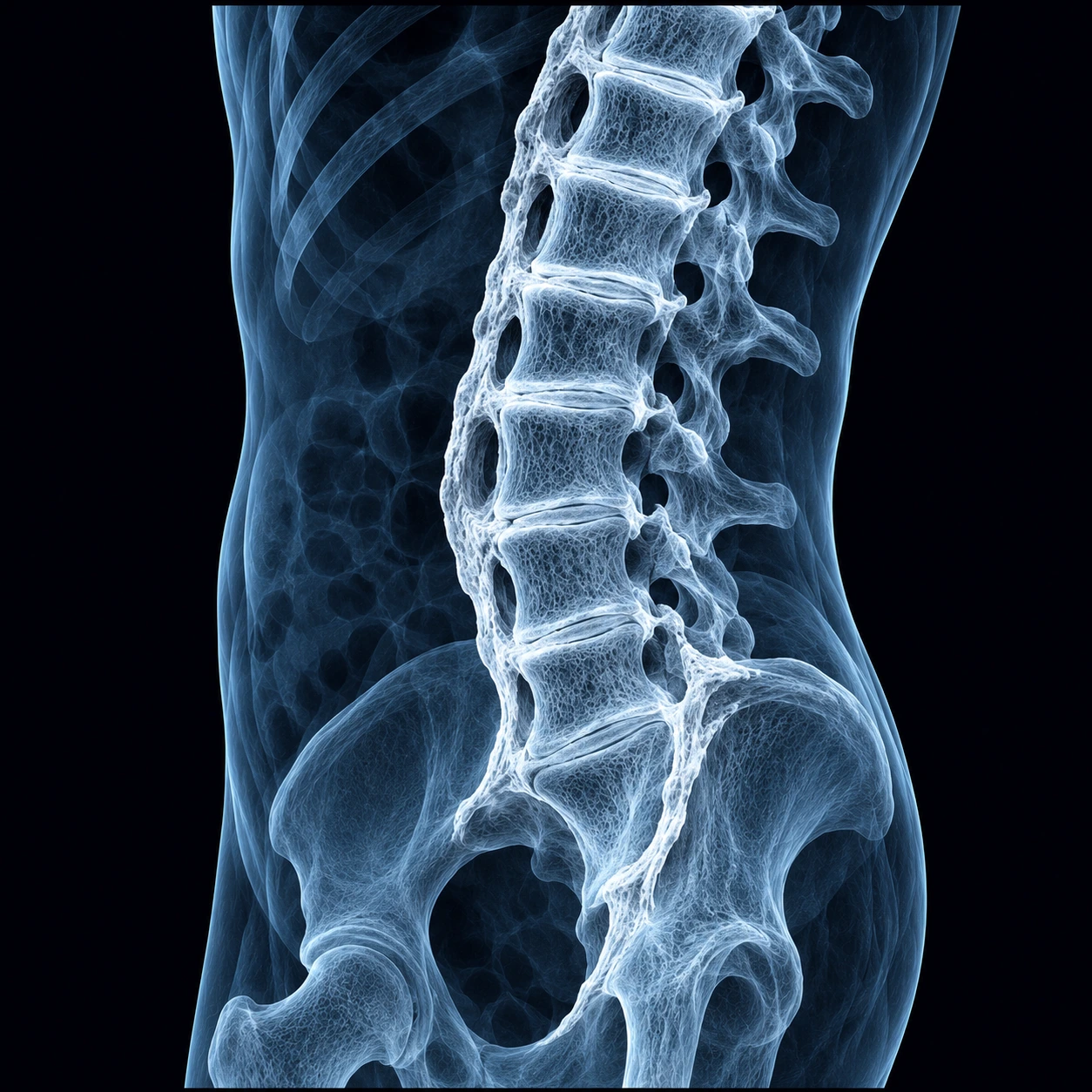
Skeletal fluorosis is the disease the U.S. legal limit on fluoride in water was written to prevent. It is not controversial, it is not rare worldwide, and it has a feature that makes it unusually instructive: fluoride reliably makes bone denser while making it weaker. We know that not from animal studies but from clinical trials in which fluoride was deliberately given to people with osteoporosis — and it backfired.
Table of Contents
- What Fluoride Does to Bone
- The Stages of Skeletal Fluorosis
- The Osteoporosis Trials: Denser Bone, More Fractures
- Where It Is Endemic
- How People Get It in Countries That Do Not Have It
- Fracture Risk at Ordinary Water Levels
- Why Calcium and Nutrition Change the Picture
- Diagnosis and Reversibility
- Key Research Papers
- Connections
- Featured Videos
What Fluoride Does to Bone
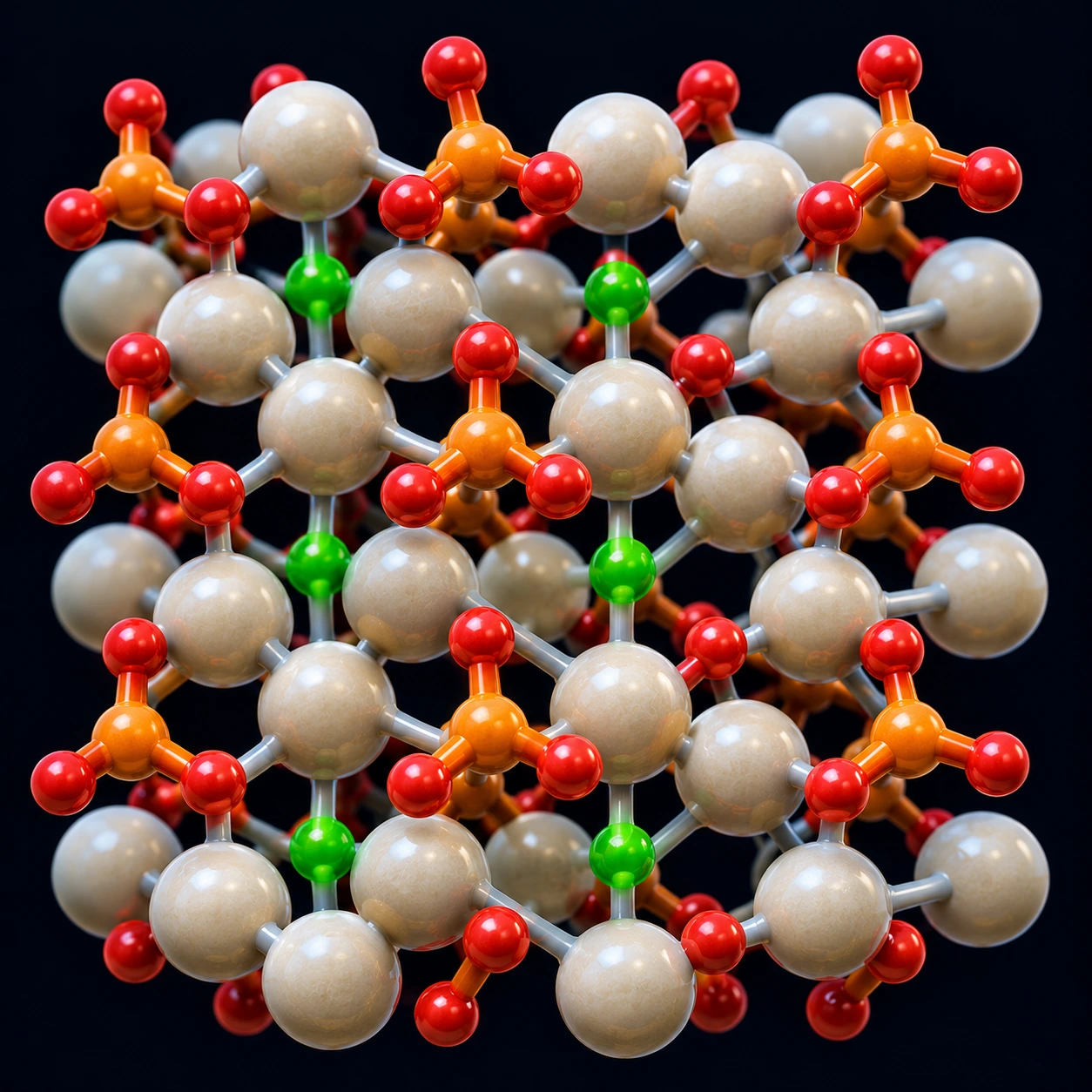
Bone mineral is hydroxyapatite, a calcium phosphate crystal with a hydroxyl group in it. Fluoride swaps into that hydroxyl position, producing fluorapatite. Fluorapatite is harder and less soluble than hydroxyapatite — which, in tooth enamel, is precisely why fluoride resists acid attack and prevents cavities.
In the skeleton the same chemistry has a different consequence. Fluoride also stimulates osteoblasts, the cells that build bone. The result is more bone, and mineral that resists resorption — so bone mineral density on a scan goes up. But the bone produced under fluoride stimulation is laid down faster than it can be properly organised and mineralised. The collagen architecture is disordered and there is often a mineralisation defect alongside it.
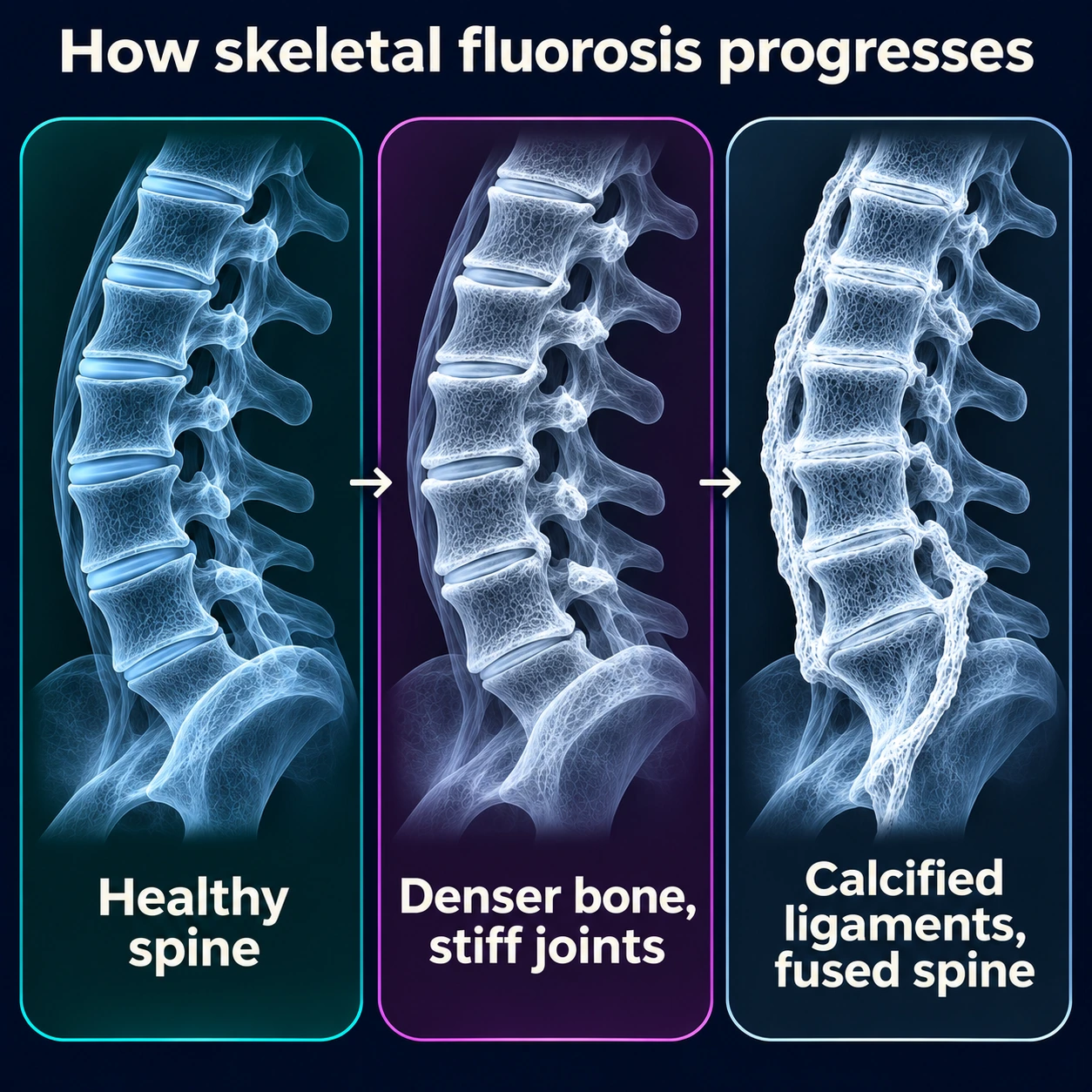
The outcome is bone that measures as strong and behaves as brittle. In advanced disease the skeleton also lays down mineral where it should not be at all — in the ligaments and tendon insertions along the spine and pelvis — which is what eventually fuses joints.
The Stages of Skeletal Fluorosis
| Stage | What the person experiences | What is visible |
|---|---|---|
| Preclinical | Nothing. | Fluoride accumulating in bone; detectable only on bone fluoride measurement. |
| Clinical stage I | Sporadic joint pain, stiffness, a vague sense of aching in the back and limbs. Frequently mistaken for arthritis or “getting older”. | Slight increase in bone density on X-ray. |
| Clinical stage II | Chronic joint pain, stiff spine, reduced range of movement. Work becomes difficult. | Clear osteosclerosis, calcification beginning in ligaments. |
| Clinical stage III (crippling) | Severe deformity, fused spine, limb deformity. Where calcified ligaments narrow the spinal canal, compression of the cord causes weakness or paralysis. | Dense, chalky bone; extensive ligament calcification; deformity. |
The important clinical point is how unremarkable the early stages look. Stage I is indistinguishable from ordinary joint complaints, which is why endemic fluorosis is under-diagnosed even in regions where it is common.
The Osteoporosis Trials: Denser Bone, More Fractures
This is the part of the fluoride story that deserves to be far better known, because it is direct, deliberate, human evidence rather than an inference from villages with bad groundwater.
Because fluoride raises bone mineral density, it was an obvious candidate treatment for osteoporosis, and from the 1980s it was given to patients at high doses for exactly that purpose. The bone density results were excellent. The fracture results were not. Trials found that fracture rates did not fall in proportion, and in several trials non-vertebral fractures increased. A Cochrane review of fluoride for postmenopausal osteoporosis concluded that while fluoride increases bone mineral density at the spine, it does not deliver a corresponding reduction in vertebral fracture, and at higher doses the risk of non-vertebral fracture rises. Later work with lower, sustained-release dosing was more favourable, but fluoride never became a standard osteoporosis therapy.
The numbers behind that summary: the Cochrane review pooled 11 randomized trials in 1,429 postmenopausal women. Spine bone density rose 8.1% more than in the comparison groups after two years and 16.1% more after four years, yet new spine (vertebral) fractures were not significantly reduced (relative risk 0.90 at four years). Fractures elsewhere in the skeleton (non-vertebral fractures) were 1.85 times as common in the fluoride groups at four years, “especially if used at high doses and in a non slow release form”. The later slow-release trial was a 42-month study of 85 women aged 65 or older who already had a spine fracture: sustained-release sodium fluoride with calcium citrate and vitamin D3 cut the rate of new vertebral fractures to about a third of the rate on calcium and vitamin D3 alone (relative risk 0.32), with no difference in side effects between the groups.
The lesson generalises well beyond osteoporosis: fluoride’s effect on bone density is not a proxy for its effect on bone strength. Any argument that treats denser bone as self-evidently better has this literature to answer.
Where It Is Endemic
Endemic skeletal fluorosis is a disease of geology, not of public policy. It occurs where groundwater passes through fluoride-rich rock and communities drink it for a lifetime.
- India — the largest affected population, across many states, with tens of millions estimated to be at risk from naturally high groundwater.
- China — both from drinking water and, distinctively, from coal-burning fluorosis: high-fluoride coal burned indoors to dry and cure food, so fluoride is inhaled and eaten rather than drunk.
- The East African Rift Valley, and parts of the Middle East, North Africa, Sri Lanka and Argentina.
In these settings water fluoride commonly runs several times the U.S. enforceable limit, and dental and skeletal fluorosis appear together — severe dental fluorosis in a population is a reliable early signal that skeletal disease is present too.
How People Get It in Countries That Do Not Have It
Skeletal fluorosis is genuinely rare in the United States at 0.7 mg/L. When it does appear, it is almost always from an unusual concentrated source rather than from tap water:
- Extreme tea consumption. The tea plant concentrates fluoride from soil. Case reports describe skeletal fluorosis in people drinking very large daily volumes of strong tea for years — and brick tea, made from mature leaves, is far higher in fluoride than ordinary leaf tea. See Green Tea.
- Inhalant abuse. Huffing fluorinated hydrocarbons delivers large fluoride loads; several published cases were diagnosed this way.
- Industrial exposure — aluminium smelting, phosphate fertiliser production, glass and ceramics, where fluoride dust or hydrogen fluoride is inhaled.
- Certain medications, notably long courses of fluoride-containing drugs such as the antifungal voriconazole, which release fluoride as they are metabolised.
- Chronic kidney disease. Not a source but a multiplier — if clearance is impaired, an ordinary intake becomes a retained one. See Kidneys and Liver.
- Naturally high private wells, which nobody tests unless the owner does.
A 2021 review gathered 19 published non-endemic cases in which the fluoride source was found: 11 came from drinking large amounts of black tea and/or from fluoride toothpaste, 1 from eating fluoride-rich soil, and 7 from “recreational” inhaling of fluorine-containing vapours (huffing). The authors found that how severe the bone disease was seemed to reflect the total fluoride taken in over time, kidney function, and calcium and vitamin D status.
Some of these cases also show secondary hyperparathyroidism — the parathyroid glands ramping up in response to the disturbed calcium handling, which complicates both the picture and the recovery. In the same 2021 review, parathyroid hormone was measured in 14 of the 19 people and was raised in 4 of them (markedly in 2, mildly in 2).
Fracture Risk at Ordinary Water Levels
Given what fluoride does to bone at high dose, the natural question is whether ordinary fluoridated water measurably raises fracture risk. The honest answer is that the studies do not agree.
- A 2015 meta-analysis of 14 observational studies (13 cohort studies and one case-control study) found that fluoride in drinking water did not significantly increase hip fractures overall (relative risk 1.05, 95% CI 0.96–1.15); its authors noted possible confounding and exposure misclassification and called for larger, better studies.
- A 2021 Swedish study followed 4,306 postmenopausal women whose drinking water carried 1 mg/L of fluoride or less — the population you would expect to be most sensitive. Women in the highest third of urine fluoride had about 1.5 times the rate of hip fracture of women in the lowest third (hazard ratio 1.50, 95% CI 1.04–2.17); for fluoride from diet and water the figure was 1.59 (1.10–2.30). Bone density at the start was slightly higher in the high-exposure women. The authors concluded that high consumption of water at about 1 mg/L “may increase both BMD and skeletal fragility in older women”.
- Studies in genuinely high-fluoride areas more consistently report increased fracture risk, which is what the mechanism predicts.
Taken together, the pooled observational studies have not shown a large population-level hip fracture effect at ordinary water levels, while the 2021 Swedish cohort found a raised hip fracture rate among older women with the highest fluoride intake at water levels of about 1 mg/L. At several times that concentration, over decades, bone is unambiguously affected.
Why Calcium and Nutrition Change the Picture
Endemic fluorosis is consistently more severe where diets are low in calcium, and this is not incidental. Calcium in the gut binds fluoride and reduces how much is absorbed; adequate calcium, magnesium and vitamin C intake are associated with milder disease at the same water fluoride level. Work from India describing fluorosis as an interaction between chronic fluoride exposure and dietary calcium deficiency reflects a real and practically important effect.
That Indian work studied 45,725 children who had drunk high-fluoride water since birth (average fluoride intake about 9.5 mg a day), surveyed from 1963 to 1997. Among children eating less than 300 mg of calcium a day, more than 90% had bone disease or leg deformities (knock-knees, bow legs and similar), compared with under 25% of children eating more than 800 mg a day. In calcium-poor children, toxic effects appeared even at fluoride intakes just above 2.5 mg a day.
The implication cuts both ways. It means a well-nourished population tolerates a given fluoride level better than a poorly nourished one — and it means that comparing a malnourished endemic village to a well-fed Western city is not a like-for-like comparison in either direction.
Diagnosis and Reversibility
Diagnosis rests on exposure history plus imaging — increased bone density, coarsened trabecular pattern, and calcification of the interosseous membranes and spinal ligaments — supported by urinary and where relevant bone fluoride measurement. Serum fluoride reflects recent intake, not accumulated burden, which is a common source of confusion.
X-rays often pick the disease up only once it is advanced. A 2026 study of 1,309 people from China’s three main fluorosis settings (coal-burning, drinking water and brick tea) built a prediction model for how severe skeletal fluorosis was; the strongest predictors were the person’s joint pain score, joint function, age and urine fluoride level.
Partial reversal is possible. Removing the source lets bone remodelling slowly replace fluorapatite over years, and early-stage symptoms often improve. Established deformity and calcified ligaments do not resolve. In endemic regions the intervention that works is the obvious one: a different water source, with nutritional support alongside it.
Key Research Papers
Every PMID below was resolved against PubMed while writing this page.
- Haguenauer D, Welch V, Shea B, Tugwell P, Wells G. Fluoride for treating postmenopausal osteoporosis. Cochrane Database Syst Rev. 2000;(4):CD002825. — PubMed PMID: 11034769
- Rubin CD, Pak CY, Adams-Huet B, Genant HK, Li J, Rao DS. Sustained-release sodium fluoride in the treatment of the elderly with established osteoporosis. Arch Intern Med. 2001;161(19):2325-33. — PubMed PMID: 11606148
- Cook FJ, Seagrove-Guffey M, Mumm S, Veis DJ, McAlister WH, Bijanki VN, Wenkert D, Whyte MP. Non-endemic skeletal fluorosis: causes and associated secondary hyperparathyroidism (case report and literature review). Bone. 2021;145:115839. — PubMed PMID: 33418099
- Mohideen H, Dahiya DS, Parsons D, Hussain H, Ahmed RS. Skeletal fluorosis: a case of inhalant abuse leading to a diagnosis of colon cancer. J Investig Med High Impact Case Rep. 2022;10:23247096221084919. — PubMed PMID: 35343855
- Susheela AK, Toteja GS. Prevention & control of fluorosis & linked disorders: developments in the 21st century – reaching out to patients in the community & hospital settings for recovery. Indian J Med Res. 2018;148(5):539-547. — PubMed PMID: 30666981
- Teotia M, Teotia SP, Singh KP. Endemic chronic fluoride toxicity and dietary calcium deficiency interaction syndromes of metabolic bone disease and deformities in India: year 2000. Indian J Pediatr. 1998;65(3):371-81. — PubMed PMID: 10771988
- Yin XH, Huang GL, Lin DR, Wan CC, Wang YD, Song JK, Xu P. Exposure to fluoride in drinking water and hip fracture risk: a meta-analysis of observational studies. PLoS One. 2015;10(5):e0126488. — PubMed PMID: 26020536
- Helte E, Donat Vargas C, Kippler M, Wolk A, Michaëlsson K, Åkesson A. Fluoride in drinking water, diet, and urine in relation to bone mineral density and fracture incidence in postmenopausal women. Environ Health Perspect. 2021;129(4):47005. — PubMed PMID: 33822648
- Wang XL, Ming J, Qiu B, Liao YF, Liao YD, Wei SF, Tu CL, Pan XL. Relationship between fluoride exposure, orthopedic injuries and bone formation markers in patients with coal-burning fluorosis. Ying Yong Sheng Tai Xue Bao. 2019;30(1):43-48. — PubMed PMID: 30907524
- Long H, Zeng J, Wei S, Hu T, Lu Y, Jia Q, Li J, Ye H, Gao Y, Zhang Z, Luo P. Predicting skeletal fluorosis severity using machine learning across diverse fluoride-exposed populations in China. Sci Rep. 2026;16(1):13858. — PubMed PMID: 41844864
- Sy MH, Sene P, Diouf MM, Diouf S. Two cases of skeletal fluorosis in the hand. Ann Chir Main Memb Super. 1996;15(2):109-14. — PubMed PMID: 8816093
PubMed Topic Searches
Connections
- Fluoride Chelation — natural ways people remove fluoride: boron, iodine displacement, calcium, herbs, amino acids, binders
- Fluoride Toxicity — the overview
- Dental Fluorosis — the visible early warning in a population
- Kidneys and Liver — impaired clearance turns intake into accumulation
- Calcium
- Phosphorus and Bone Mineralization
- Green Tea — an under-counted fluoride source
- Otosclerosis — where fluoride’s bone effect was used deliberately
- Fluoride in Water