Silver Nanoparticles: History and Discovery
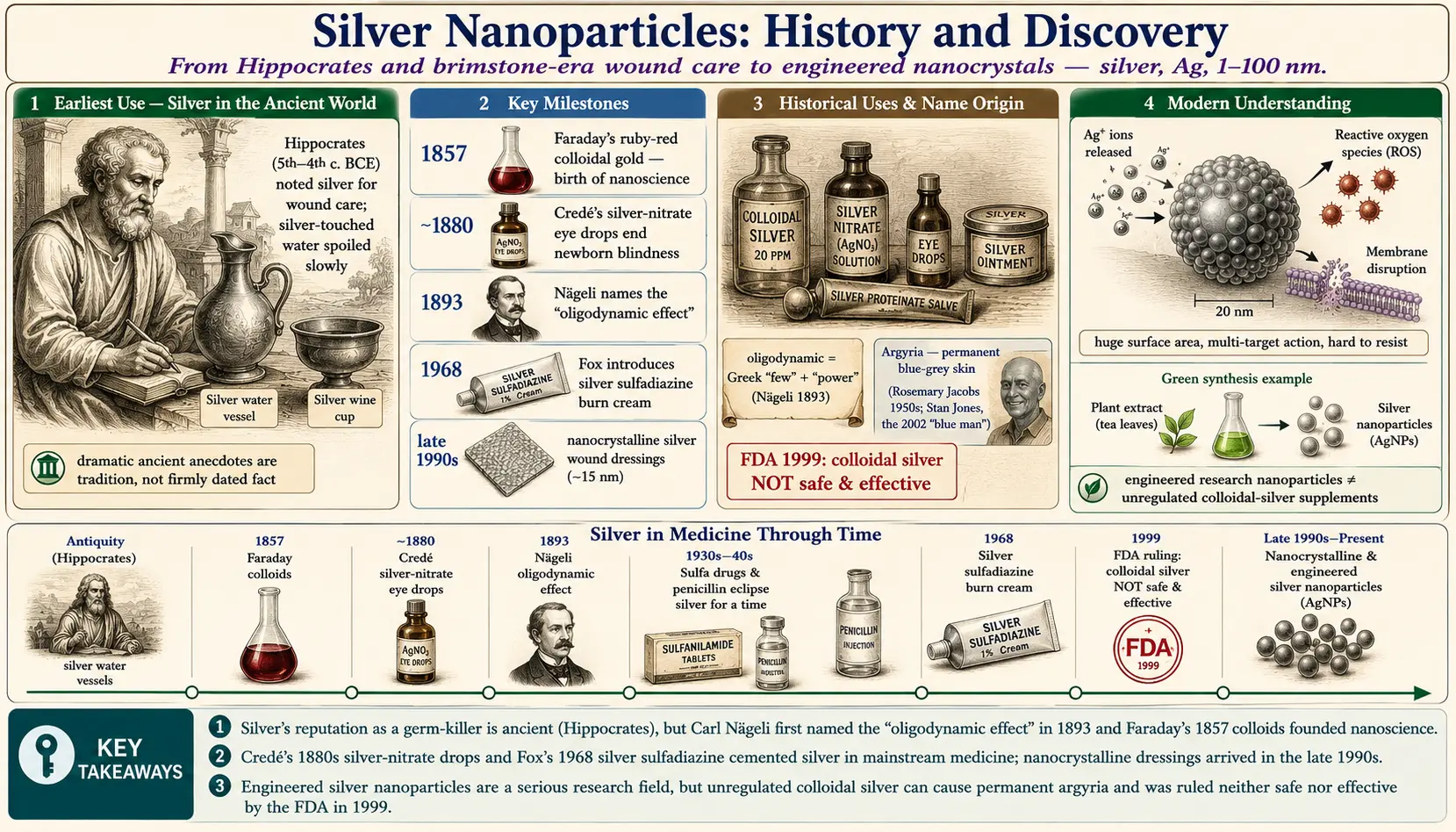
The story of silver nanoparticles is really two stories joined together. The first is ancient: for thousands of years people noticed that silver kept water fresh and helped wounds heal, long before anyone could say why. The second is modern and scientific: a chain of named discoveries — Michael Faraday's ruby-coloured gold in 1857, Carl Nägeli's naming of the "oligodynamic effect" in 1893, the burn dressings of the twentieth century, and finally the engineered nanoparticles of today — that slowly turned an old folk practice into a measurable branch of science. This article follows that thread honestly. Where a discoverer and a date are firmly documented, we name them. Where a claim is ancient legend, a popular retelling, or a story that historians still treat with caution, we say so rather than dress it up as fact. And throughout we keep one distinction clear: precisely engineered silver nanoparticles studied in laboratories are not the same thing as the unregulated colloidal-silver products that have caused real harm.
Table of Contents
- Silver in the Ancient World
- Nägeli and the Oligodynamic Effect (1893)
- Credé's Silver Nitrate and Modern Medicine
- Faraday's Colloids: The Birth of Nanoscience (1857)
- The Rise and Fall of Colloidal Silver
- Argyria and the FDA Ruling of 1999
- Silver Returns: Burn Dressings and Nanocrystalline Silver
- The Modern Nanoparticle Era
- Research Papers and References
- Connections
- Featured Videos
Silver in the Ancient World
Silver has been used by people for adornment, money, and medicine for thousands of years, and its reputation as something that "keeps things clean" is genuinely ancient. The most reliably documented strand of this history is medical: Hippocrates, the Greek physician of the fifth and fourth centuries BCE often called the father of Western medicine, is widely reported to have noted silver's helpful properties for wound care and tissue repair. That Hippocratic association is a recurring fixture of the scholarly reviews of silver in medicine, and it marks silver as one of the oldest materials humans turned to when faced with infected wounds.
Alongside the medical record sits a body of older, more folkloric tradition: stories that ancient peoples stored water, wine, and other perishables in silver vessels, dropped silver coins into water barrels and milk to keep them from spoiling, and prized silver for its apparent power to ward off illness. These practices are real and well attested in later centuries, and the underlying observation — that silver-touched water spoiled more slowly — was sound. But the most dramatic ancient anecdotes (for example, claims about specific kings or armies carrying silver water-vessels) are best treated as tradition rather than firmly dated fact; they are repeated widely in popular and even academic sources without always being pinned to a verifiable original. What the historical record does support is the broad picture: across many cultures, over a very long time, silver earned a reputation as a preserver and a healer, entirely by observation and centuries before any theory could explain it.
That gap — between a thing that plainly worked and any understanding of why — is the central tension of silver's whole history, and closing it is what the next sections are about.
Nägeli and the Oligodynamic Effect (1893)
The first real scientific name for what silver was doing came at the very end of the nineteenth century. The Swiss botanist Carl Wilhelm von Nägeli (1817–1891) studied how tiny amounts of certain metals — silver, copper, and others — could kill or inhibit microorganisms even when present in vanishingly small concentrations. This work appeared in 1893, published posthumously two years after his death, under the title "Über oligodynamische Erscheinungen in lebenden Zellen" ("On oligodynamic phenomena in living cells"), and the term he coined — oligodynamic, from the Greek for "few" and "power" — is still used today. It captures exactly what made silver special: a powerful germ-killing action from only a trace of the metal.
It is worth being precise about what Nägeli did and did not do. He gave the phenomenon a name and described it carefully, but he did not fully explain the mechanism — the modern understanding that silver ions disrupt microbial membranes, proteins, and enzymes, and that nanoscale silver multiplies this effect through its enormous surface area, came much later. Nägeli's achievement was conceptual: he took an old, vague intuition that "silver is clean" and turned it into a defined, repeatable scientific observation that other researchers could test. His 1893 paper is the moment silver's antimicrobial power stopped being folklore and became science.
One small but important correction often gets lost: Nägeli is usually credited with the term in 1893, and his broader interest in how microbes related to disease and hygiene ran back into the 1870s. This page follows the standard reference works in dating the coining of "oligodynamic" to 1893.
Credé's Silver Nitrate and Modern Medicine
While Nägeli was naming the effect, silver was already being put to one of its most consequential medical uses. The German obstetrician Carl Siegmund Franz Credé (1819–1892), working in Leipzig, introduced the practice of placing a dilute solution of silver nitrate into the eyes of newborn babies to prevent a devastating eye infection — gonococcal ophthalmia neonatorum — that was then a leading cause of infant blindness. Credé began the practice in his clinic around 1880 and published his results in a series of papers in Archiv für Gynäkologie in the early 1880s.
The impact was immediate and dramatic. In settings where a large fraction of newborns had been developing the infection — with many losing their sight — the silver-nitrate drops drove the rate down toward zero. The procedure, known as Credé's prophylaxis, was adopted across Europe and the United States and was written into law in many jurisdictions, remaining a standard of newborn care for the better part of a century. It stands as one of the clearest demonstrations in all of medicine that a simple silver compound, used correctly, could prevent enormous suffering.
Credé's work matters to the nanoparticle story for two reasons. First, it cemented silver's place in mainstream, evidence-based medicine rather than folk practice. Second, it was a story about ionic silver delivered as a salt — a useful reminder that "silver in medicine" has always come in several distinct chemical forms (ions, salts, colloids, and now engineered nanoparticles), each with different properties. Keeping those forms straight is essential to reading the rest of this history accurately.
Faraday's Colloids: The Birth of Nanoscience (1857)
The scientific lineage of the nanoparticle — as opposed to silver ions or salts — runs through one of the great experimentalists of the nineteenth century. On 5 February 1857, the English scientist Michael Faraday delivered a Bakerian Lecture to the Royal Society of London titled "Experimental relations of gold (and other metals) to light." Faraday had made suspensions of finely divided gold so small that they no longer looked metallic but glowed a deep ruby red, and he correctly reasoned that the colour came from gold particles far too tiny to see — particles we now know averaged only a few nanometres across.
Faraday's gold was not silver, and he was not thinking about medicine. But his 1857 work is rightly called the birth of modern colloid science and, by extension, nanoscience: it was the first careful demonstration that a metal broken into nanoscale particles behaves completely differently from the bulk metal, including in its colour and its interaction with light. Some of the gold colloids Faraday himself prepared in the 1850s survive, sealed, to this day. The principle he uncovered — that "the same metal, made small enough, becomes a new material" — is precisely the principle that silver nanoparticles exploit, where shrinking silver to 1–100 nanometres transforms its surface area, reactivity, and biological punch.
So the modern field has two distinct ancestors that did not meet until the twentieth and twenty-first centuries: silver's ancient reputation as a germ-killer, and Faraday's nineteenth-century discovery of how matter behaves at the nanoscale. Silver nanoparticles are the place those two lines finally cross.
The Rise and Fall of Colloidal Silver
In the decades around 1900 — the era before antibiotics — silver was one of the most useful tools medicine had. Colloidal silver (suspensions of fine silver particles in liquid) and various silver salts were manufactured and prescribed widely, used as drops, salves, and internal preparations for eye infections, wounds, and a long list of internal ailments. For a generation of physicians, silver was simply part of the standard pharmacy.
That changed abruptly in the 1930s and 1940s. The arrival of sulfa drugs and then penicillin gave doctors antibacterial agents that were cheaper, easier to dose, and far more powerful against systemic infection than swallowing silver. Internal silver preparations fell out of mainstream use, surviving mainly in topical forms. Crucially, the older colloidal-silver products had never been standardised the way modern nanoparticles are: their particle sizes, concentrations, and quality varied enormously from bottle to bottle, which made both their effects and their risks unpredictable.
Colloidal silver did not vanish, though. It persisted at the margins of medicine and, from the late twentieth century, enjoyed a vigorous revival in the alternative-health market, often marketed with sweeping claims that it could treat almost any infection. This is the point in the history where caution becomes essential: the modern research on engineered, characterised silver nanoparticles is a serious scientific field, but it should not be confused with the unregulated colloidal-silver supplements sold to the public — a confusion that has had real and permanent consequences, as the next section describes.
Argyria and the FDA Ruling of 1999
The chief danger of taking silver internally has been recognised for a very long time. Argyria — a permanent, irreversible blue-grey discoloration of the skin caused by silver accumulating in the body — was understood by physicians by the mid-nineteenth century. It is not usually life-threatening, but it is disfiguring and does not fade, even after a person stops taking silver.
Two modern cases made argyria publicly famous. Rosemary Jacobs was given colloidal-silver nose drops as a child in the 1950s and developed lifelong grey skin, going on to become a prominent campaigner warning others against silver products. And Stan Jones, a Montana political candidate, drew international attention in 2002 as the "blue man" after years of drinking homemade colloidal silver turned his skin a striking blue-grey. These were not freak accidents; they were the predictable result of consuming silver in poorly characterised, unregulated products.
Regulators acted. In 1999, the U.S. Food and Drug Administration issued a final rule (published in the Federal Register, August 17, 1999) declaring that over-the-counter drug products containing colloidal silver or silver salts were not recognised as safe and effective for treating any disease or condition. The FDA has continued to warn that colloidal silver taken as a supplement carries real risks — including argyria and possible interference with the absorption of some medicines — without proven benefit. This is the firm, official position to keep in mind whenever silver's antimicrobial promise is discussed: an interesting laboratory science does not license swallowing an unregulated product.
Silver Returns: Burn Dressings and Nanocrystalline Silver
Even as colloidal silver fell from grace, silver itself made a powerful comeback in one area where it was genuinely superb: the treatment of serious burns. In 1968, the American physician Charles L. Fox Jr., working at Columbia University, introduced silver sulfadiazine — a compound combining silver with the sulfa drug sulfadiazine — as a topical cream for preventing and treating infection in burn wounds. It proved so effective against Pseudomonas and other dangerous burn-wound bacteria that it became, and long remained, a gold-standard burn treatment used in hospitals worldwide. Fox and his colleague Shanta Modak later detailed how the silver, rather than the sulfa component, was the key antibacterial actor, with the silver ion binding to and disabling bacteria.
The decisive bridge to the nanoparticle age came in the late 1990s with the arrival of nanocrystalline silver wound dressings — the best-known early example being a dressing that coated fabric with a layer of silver nanocrystals only about fifteen nanometres across. By deliberately engineering silver at the nanoscale, these dressings released silver in a sustained, controlled way over several days and worked at lower silver loads than older products. This was a watershed: for the first time, the antimicrobial power of silver and the nanoscale physics that Faraday had glimpsed in 1857 were intentionally combined into a real, regulated medical product. Silver nanotechnology had moved from theory to the bedside.
The Modern Nanoparticle Era
From the late 1990s onward, silver nanoparticles became one of the most intensely studied materials in all of nanoscience. Researchers learned to make them in controlled sizes and shapes, to coat their surfaces with stabilisers such as citrate or polymers, and to tune their behaviour for specific tasks. A major theme of the twenty-first-century literature is the development of "green synthesis" — growing silver nanoparticles using plant extracts, bacteria, or fungi instead of harsh chemicals — which has become an enormous research area in its own right.
What drives all this attention is the same property silver always had, now amplified and made precise. Because a nanoparticle has an immense surface area relative to its size, and because it attacks microbes through several mechanisms at once — releasing silver ions, generating reactive oxygen species, and physically disrupting membranes — it is potent at low concentrations and makes it unusually hard for bacteria to develop resistance. That combination is exactly why silver nanoparticles are being investigated against drug-resistant bacteria, biofilms, fungi, and certain viruses, and why they now appear in wound dressings, coatings, and medical devices.
The honest summary of where the history has arrived is this: silver nanoparticles sit at the meeting point of a very old observation and a very modern science. The ancient intuition that "silver fights infection" turned out to be real, and nanotechnology has given researchers a precise, tunable way to harness it. But the field is still maturing — questions of human safety, environmental impact, and clinical effectiveness are active areas of study — and engineered research nanoparticles remain a world apart from the unregulated colloidal-silver products that the FDA has cautioned against. The mechanisms, evidence, dosing questions, and safety considerations are covered in the companion Silver Nanoparticles Benefits articles and on the main Silver Nanoparticles page; this history is concerned only with how we got here.
Research Papers and References
The list below combines key peer-reviewed and historical sources on silver in medicine and nanoscience with curated PubMed topic-search links into the history, mechanism, and safety literature. Historical primary works (Nägeli's 1893 paper, Faraday's 1857 Bakerian Lecture, and Credé's 1880s papers) are named in the article as historical sources. Author names, titles, and journals are given as plain text; only the stable DOI, PMID, archive, or official link is hyperlinked, and each opens in a new tab.
- Fox CL Jr, Modak SM. Mechanism of silver sulfadiazine action on burn wound infections. Antimicrobial Agents and Chemotherapy. 1974;5(6):582-588. — doi:10.1128/aac.5.6.582
- Alexander JW. History of the medical use of silver. Surgical Infections. 2009;10(3):289-292. — doi:10.1089/sur.2008.9941
- Barillo DJ, Marx DE. Silver in medicine: a brief history BC 335 to present. Burns. 2014;40(Suppl 1):S3-S8. — doi:10.1016/j.burns.2014.09.009
- Klasen HJ. Historical review of the use of silver in the treatment of burns. I. Early uses. Burns. 2000;26(2):117-130. — doi:10.1016/S0305-4179(99)00108-4
- Lansdown ABG. Silver in health care: antimicrobial effects and safety in use. Current Problems in Dermatology. 2006;33:17-34. — doi:10.1159/000093928
- Thompson DT. Michael Faraday's recognition of ruby gold: the birth of modern nanotechnology. Gold Bulletin. 2007;40(4):267-269. — doi:10.1007/BF03215598
- Over-the-counter drug products containing colloidal silver ingredients or silver salts; final rule. Federal Register, U.S. Food and Drug Administration, Vol. 64, No. 158, August 17, 1999. — govinfo: FR-1999-08-17 (99-21253)
- Silver in medicine and the oligodynamic effect — history — PubMed: history of silver in medicine
- Silver nanoparticles synthesis, mechanism, and biomedical applications — PubMed: silver nanoparticle synthesis and applications
External Authoritative Resources
- NCCIH — Colloidal Silver
- FDA Final Rule (1999) — colloidal silver, Federal Register
- PubMed — All research on silver nanoparticles
Connections
- All Minerals
- Silver Nanoparticles
- Silver Nanoparticles Benefits
- Copper
- Zinc
- Selenium
- Garlic
- Immune Boosting