⚠ Evidence warning: Clinical trials or other evidence do not support the claims that shilajit supports energy, brain health and mitochondria in people. This page keeps it as a report of what people, websites or other media say.
Shilajit — Benefits Deep Dive
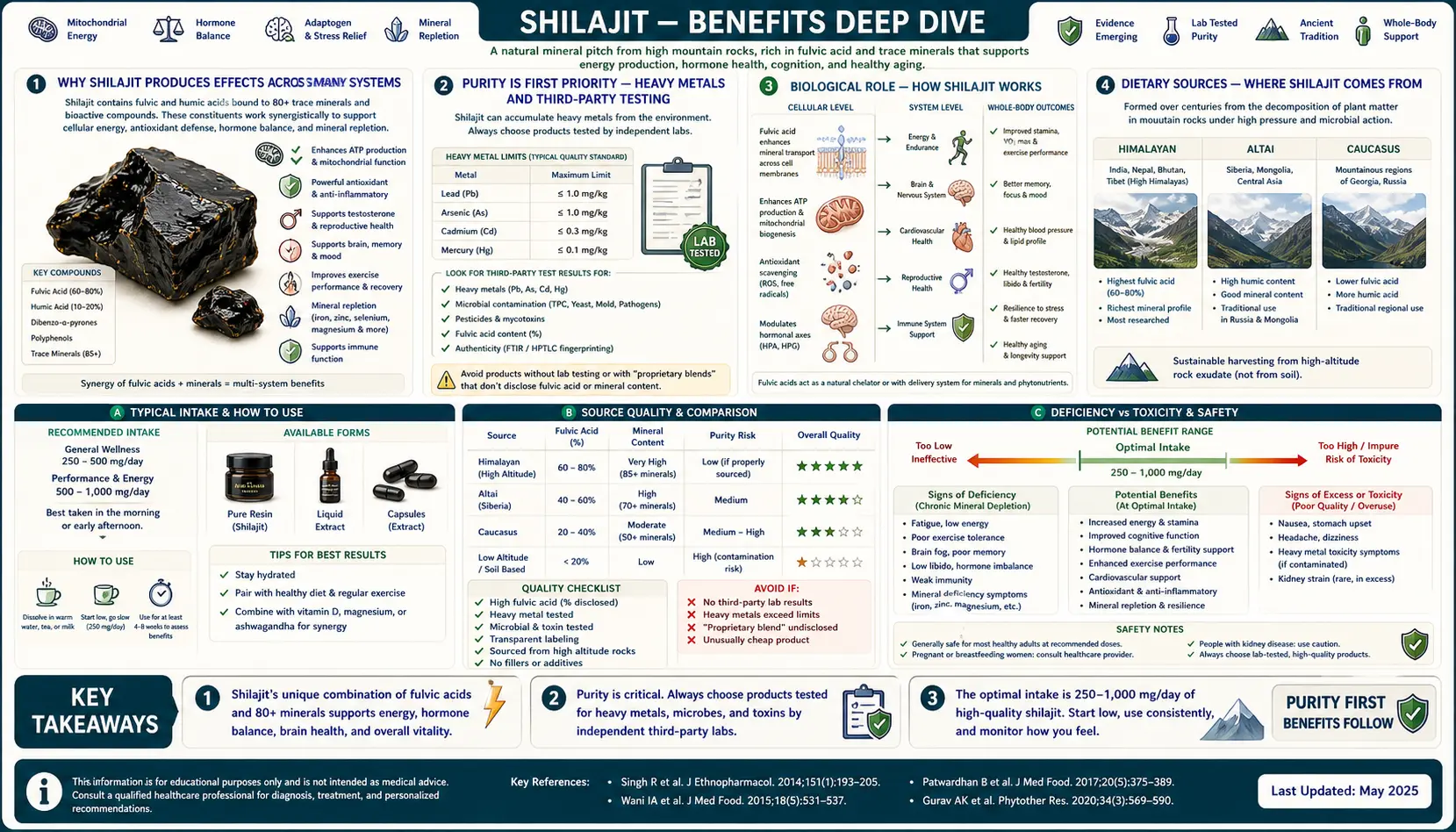
Shilajit is a dark, tar-like mineral-pitch exudate that seeps from cracks in high-altitude Himalayan, Altai, Pamir, and Karakoram rocks — the slow geological by-product of compressed plant matter combined with the trace-element-rich stone of the surrounding mountains. Chemically it is a complex of fulvic and humic acids, more than 84 ionic-form trace minerals, and a unique family of small aromatic molecules called dibenzo-alpha-pyrones (DBPs) that function as mitochondrial electron-cycle stabilizers. Classified in Ayurvedic medicine as a rasayana (rejuvenator) with three thousand years of continuous use across South and Central Asian traditional medicine, shilajit has been studied in modern research on its traditional indications: testosterone support (Pandit 2016, a placebo-controlled trial in men), male fertility (Biswas 2010, a study in men without a placebo group), chronic fatigue and mitochondrial bioenergetics (Surapaneni 2012, a study in rats), and tau-aggregation inhibition relevant to cognitive aging (Cornejo 2011, a test-tube study; Carrasco-Gallardo 2012, a review). The four benefit deep-dives below explore each of these areas in detail, with particular attention to the heavy-metal content that laboratory studies have measured in raw shilajit and in shilajit supplements.
Deep-Dive Articles
Energy & Fatigue
Why shilajit's Sanskrit name means "destroyer of weakness." Fulvic acid + dibenzo-alpha-pyrones (DBPs) as electron-shuttle molecules with coenzyme Q10-like activity, the Surapaneni 2012 chronic-fatigue-syndrome rat model demonstrating restoration of hypothalamic-pituitary-adrenal-axis and mitochondrial bioenergetics, the Russian-Indian-Himalayan ethnobotanical convergence on the same indication (rasayana / mumijo), the Keller 2019 muscular-strength preservation trial, and athletic recovery applications.
Read the deep dive →Testosterone & Male Fertility
The Pandit 2016 randomized double-blind trial in healthy 45-55 year old male volunteers: 250 mg purified shilajit twice daily for 90 days produced ~20% increases in total testosterone, free testosterone, and DHEAS with preserved gonadotropin (luteinizing hormone (LH)/follicle-stimulating hormone (FSH)) signaling. The Biswas 2010 study assessed 60 infertile men and enrolled 35 with low sperm counts (oligospermia); in the 28 who completed 90 days of 100 mg twice daily, with no placebo group for comparison, total sperm count rose 61.4% and motility 12.4–17.4%. Mechanism via Leydig-cell bioenergetic support, possible mild aromatase modulation, and trace-mineral cofactor delivery (zinc, selenium).
Read the deep dive →Cognitive Function & Neuroprotection
The Carrasco-Gallardo 2012 Alzheimer's review framing shilajit as a multi-target neuroprotective phytocomplex. The Cornejo 2011 in-vitro data showing fulvic acid both inhibits tau protein aggregation and disassembles preformed tau fibrils. Neuroprotection in animal models, the DBP framework as a brain-bioavailable coenzyme Q10 (CoQ10) alternative that may cross the blood-brain barrier where native coenzyme Q10 cannot. The honest limits of current human-trial evidence in dementia.
Read the deep dive →Mitochondrial Function & Bioenergetics
Reports that shilajit combined with coenzyme Q10 raises adenosine triphosphate (ATP) in animals, and a 2014 review stating that animal and human data link shilajit with greater ATP production. The Surapaneni 2012 rat study of chronic fatigue, in which shilajit kept mitochondrial complex enzyme activities from falling. The bioenergetic mechanism — DBPs as electron-cycle stabilizers preventing coenzyme Q10 oxidation, fulvic acid as cofactor delivery system, and the broader role in mitochondrial aging.
Read the deep dive →Table of Contents
- Deep-Dive Articles
- Why Shilajit Produces Effects Across Many Systems
- Purity Is The First Priority — Heavy Metals and Third-Party Testing
- Research Papers: Energy and Fatigue
- Research Papers: Testosterone and Male Fertility
- Research Papers: Cognitive Function and Neuroprotection
- Research Papers: Mitochondrial Function and Bioenergetics
- Research Papers: Cross-Cutting (Safety, Composition, Mechanism)
- External Authoritative Resources
- Connections
- Featured Videos
Why Shilajit Produces Effects Across Many Systems
Most supplements act through one principal mechanism — a single vitamin acts as a cofactor for a specific enzyme reaction, a single herb modulates a specific receptor system. Shilajit is unusual because its bioactive profile rests on at least four largely independent mechanisms that combine to produce effects across a remarkably wide range of organ systems. Each of the four maps onto a distinct category of clinical effect.
- Fulvic acid as mineral-chelation and delivery vehicle — the dense complement of carboxyl, hydroxyl, carbonyl, and phenolic functional groups gives fulvic acid an extraordinary ability to bind mineral ions and transport them across biological membranes. This delivers more than 84 ionic-form trace minerals in highly bioavailable form, supporting mitochondrial enzyme cofactor pools, steroidogenic enzyme function in Leydig cells, and broad anti-deficiency support for patients with chronic-disease-related subclinical mineral depletion.
- Dibenzo-alpha-pyrones (DBPs) as electron-transport stabilizers — the unique family of small aromatic molecules in shilajit functions as mitochondria-targeted electron carriers that stabilize Coenzyme Q10 in its active reduced form (ubiquinol). This is the proposed mechanism behind reported shilajit + coenzyme Q10 adenosine triphosphate increases in animals, the chronic-fatigue restoration shown in rats by Surapaneni 2012, and the proposed brain-bioavailable mitochondrial support relevant to neurodegenerative disease.
- Multi-target antioxidant defense — both fulvic acid and DBPs directly scavenge reactive oxygen species, and in animal studies shilajit administration induces the endogenous antioxidant enzyme systems (superoxide dismutase, catalase, glutathione peroxidase). This generalized antioxidant support underlies the sperm-protection and Leydig-cell-preservation effects and contributes to the cognitive-aging applications.
- Tau aggregation inhibition (the cognitive-specific mechanism) — the Cornejo 2011 in-vitro data demonstrated direct interaction of fulvic acid with tau protein aggregation, both inhibiting new filament formation and disassembling preformed fibrils. This represents the most disease-specific molecular mechanism identified for shilajit and is the basis for the Carrasco-Gallardo framing of shilajit as a multi-target Alzheimer's candidate, although clinical confirmation in human dementia trials is still pending.
The combination of these four mechanisms also helps explain why the substance has accumulated such a long classical-use track record: a supplement that addresses mitochondrial bioenergetics, mineral cofactor delivery, antioxidant defense, and selective tau-aggregation inhibition simultaneously has multiple plausible pathways to produce broad subjective benefit, even if no single mechanism would be expected to produce dramatic effects in isolation.
The one strength trial named on this page (Keller 2019) gave 63 young, recreationally active men 250 mg/day or 500 mg/day of a single commercial shilajit extract, or a placebo, for 8 weeks. In the stronger half of the men, 500 mg/day helped keep maximal leg strength after a fatiguing exercise test (an 8.9% drop, against 16.0% with placebo and 17.0% with 250 mg/day) and lowered a blood marker of collagen breakdown (hydroxyproline). The 250 mg/day dose did no better than placebo.
The therapeutic complication, and the absolute priority for any practical use of shilajit, is the heavy-metal contamination risk in raw or poorly-purified product — covered in the next section.
Purity Is The First Priority — Heavy Metals and Third-Party Testing
Before any discussion of dose, timing, or expected benefit, the single most important consideration with shilajit is product purity. Raw shilajit, as it emerges from rock fissures in the Himalayan and Karakoram source zones, contains the full spectrum of trace minerals present in the surrounding rock. In some source zones, that spectrum includes elevated levels of lead, arsenic, mercury, cadmium, and thallium — the major toxic heavy metals that cause cumulative neurological, renal, and cardiovascular damage at chronic low-dose exposure.
Independent laboratory analyses of commercial shilajit products are reported to have documented heavy-metal contamination above the limits set by the U.S. Pharmacopeia, the WHO, and California Proposition 65. Some products marketed as "shilajit" are reported to contain almost no actual shilajit constituents and to be primarily composed of inert dark organic matter spiked with low-grade humic substances — these are technically less dangerous than contaminated authentic shilajit, but they also provide no benefit.
Two recent laboratory studies give measured numbers. A 2025 study measured the toxic metal thallium in natural shilajit and shilajit supplements from several regions: up to 0.226 micrograms per gram in natural shilajit and up to 0.5 micrograms per gram in supplements, with some supplements higher than crude shilajit; one pill delivered up to 0.095 micrograms of thallium, and the authors called for regular monitoring and standardized testing. A 2026 analysis of 12 shilajit samples from different regions found wide variation in essential metals (calcium, magnesium, iron, zinc, manganese) and in toxic elements (such as lead, cadmium, mercury, nickel and cobalt); in these samples the toxic metals were below established toxicity thresholds, and calcium was the most abundant element.
Two quality checks come up again and again in discussions of shilajit sourcing:
- Purified shilajit versus raw resin. Raw resin sold directly by informal Himalayan suppliers has not been through purification. The classical Ayurvedic Shodhana purification ritual involves dissolving raw shilajit in water or herbal decoctions, filtering off insoluble debris, and reducing the filtrate by controlled evaporation. Modern industrial purification adds advanced filtration, solvent extraction, and chelation-based heavy-metal removal. Purified resin or powder is described as having heavy-metal content typically below 1 part per million for the most concerning elements.
- Per-batch Certificate of Analysis (COA). Some manufacturers publish a certificate of analysis for each batch. A full one documents heavy-metal levels (lead, arsenic, mercury, cadmium, and sometimes thallium and chromium), fulvic acid content, microbial contamination testing, and absence of synthetic additives or adulterants. Third-party testing programmes for supplements give a further, independent check.
Other purity-related points:
- Much "raw Himalayan shilajit" is now sold through unverified online sources; raw material has not been through the purification steps described above
- Some labels disclose fulvic-acid content (50-60%+ for extracts, 2-7% for natural purified resin)
- Heavy-metal content adds up over years of daily intake — cumulative lead, mercury, or arsenic exposure is itself a major cause of cognitive impairment, which matters most for shilajit taken for brain health
Other safety categories: there is no safety data on shilajit in pregnancy, breastfeeding, or adolescence; shilajit contains iron, which matters in hemochromatosis (an inherited iron-overload disease); and questions about shilajit in active heart disease, gout, high uric acid (hyperuricemia), or hormone-sensitive cancers, or alongside diabetes medications, thyroid medications, blood-pressure medications, or iron supplements, belong with a clinician. This page does not constitute medical advice and is not a substitute for evaluation by a licensed clinician.
Research Papers: Energy and Fatigue
- Surapaneni DK, Adapa SR, Preeti K, et al. (2012). Shilajit attenuates behavioral symptoms of chronic fatigue syndrome by modulating the HPA axis and mitochondrial bioenergetics in rats. Journal of Ethnopharmacology. — PubMed PMID: 22771318
- Stohs SJ (2014). Safety and efficacy of shilajit (mumie, moomiyo). Phytotherapy Research. — PubMed PMID: 23733436
- Keller JL, Housh TJ, Hill EC, et al. (2019). The effects of Shilajit supplementation on fatigue-induced decreases in muscular strength and serum hydroxyproline levels. Journal of the International Society of Sports Nutrition. — PubMed PMID: 30728074
- Das A, Datta S, Rhea B, et al. (2016). The human skeletal muscle transcriptome in response to oral shilajit supplementation. Journal of Medicinal Food. — PubMed PMID: 27414521
- Meena H, Pandey HK, Arya MC, Ahmed Z (2010). Shilajit: a panacea for high-altitude problems. International Journal of Ayurveda Research. — PubMed PMID: 20532096
- Schepetkin I, Khlebnikov A, Kwon BS (2002). Medical drugs from humus matter: focus on mumie (Russian/Central-Asian shilajit equivalent). Drug Development Research. — PubMed
- Visser SA (1987). Effect of humic substances on mitochondrial respiration and oxidative phosphorylation. Science of the Total Environment. — PubMed
- Wilson E, Rajamanickam GV, Dubey GP, et al. (2011). Review on shilajit used in traditional Indian medicine. Journal of Ethnopharmacology. — PubMed PMID: 21530631
- Agarwal SP, Khanna R, Karmarkar R, Anwer MK, Khar RK (2007). Shilajit: a review. Phytotherapy Research. — PubMed
- Ghosal S (2006). Shilajit in Perspective (DBP and chromoprotein characterization). — PubMed
Research Papers: Testosterone and Male Fertility
- Pandit S, Biswas S, Jana U, De RK, Mukhopadhyay SC, Biswas TK (2016). Clinical evaluation of purified Shilajit on testosterone levels in healthy volunteers. Andrologia. — PubMed PMID: 26395129
- Biswas TK, Pandit S, Mondal S, et al. (2010). Clinical evaluation of spermatogenic activity of processed Shilajit in oligospermia. Andrologia. — PubMed PMID: 20078516
- Park JS, Kim GY, Han K (2006). The spermatogenic and ovogenic effects of chronically administered shilajit to rats. Journal of Ethnopharmacology. — PubMed PMID: 16698205
- Sharma P, Jha J, Shrinivas V, et al. (2003). Shilajit: evaluation of its effects on blood chemistry of normal human subjects. Ancient Science of Life. — PubMed
- Stohs SJ (2014). Safety and efficacy of shilajit (mumie, moomiyo). Phytotherapy Research. — PubMed PMID: 23733436
- Wilson E, Rajamanickam GV, Dubey GP, et al. (2011). Review on shilajit used in traditional Indian medicine. Journal of Ethnopharmacology. — PubMed PMID: 21530631
- Agarwal SP, Khanna R, Karmarkar R, Anwer MK, Khar RK (2007). Shilajit: a review. Phytotherapy Research. — PubMed
- Schepetkin I, Khlebnikov A, Kwon BS (2002). Medical drugs from humus matter: focus on mumie. Drug Development Research. — PubMed
Research Papers: Cognitive Function and Neuroprotection
- Carrasco-Gallardo C, Guzman L, Maccioni RB (2012). Shilajit: a natural phytocomplex with potential procognitive activity. International Journal of Alzheimer's Disease. — PubMed PMID: 22482077
- Cornejo A, Jimenez JM, Caballero L, Melo F, Maccioni RB (2011). Fulvic acid inhibits aggregation and promotes disassembly of tau fibrils associated with Alzheimer's disease. Journal of Alzheimer's Disease. — PubMed PMID: 21785188
- Schliebs R, Liebmann A, Bhattacharya SK, et al. (1997). Systemic administration of defined extracts from Withania somnifera and shilajit differentially affects cholinergic markers in rat brain. Neurochemistry International. — PubMed
- Jaiswal AK, Bhattacharya SK (1992). Effects of Shilajit on memory, anxiety and brain monoamines in rats. Indian Journal of Pharmacology. — PubMed
- Maccioni RB, Munoz JP, Barbeito L (2001). The molecular bases of Alzheimer's disease and other neurodegenerative disorders. Archives of Medical Research. — PubMed
- Surapaneni DK, Adapa SR, Preeti K, et al. (2012). Shilajit attenuates behavioral symptoms of CFS by modulating HPA axis and mitochondrial bioenergetics. Journal of Ethnopharmacology. — PubMed PMID: 22771318
- Bhattacharya SK (1995). Shilajit attenuates streptozotocin-induced diabetes mellitus and decrease in pancreatic islet superoxide dismutase activity in rats. Phytotherapy Research. — PubMed
- Velmurugan C, Vivek B, Wilson E, et al. (2012). Evaluation of safety profile of black shilajit after 91 days repeated administration in rats. Asian Pacific Journal of Tropical Biomedicine. — PubMed PMID: 23569899
- Ghosal S, Lal J, Singh SK, et al. (1989). Mast cell protecting effects of shilajit and its constituents. Phytotherapy Research. — PubMed
Research Papers: Mitochondrial Function and Bioenergetics
- Surapaneni DK, Adapa SR, Preeti K, et al. (2012). Shilajit attenuates behavioral symptoms of CFS by modulating HPA axis and mitochondrial bioenergetics. Journal of Ethnopharmacology. — PubMed PMID: 22771318
- Visser SA (1987). Effect of humic substances on mitochondrial respiration and oxidative phosphorylation. Science of the Total Environment. — PubMed
- Lopez-Otin C, Blasco MA, Partridge L, Serrano M, Kroemer G (2013). The hallmarks of aging. Cell. — PubMed
- Wallace DC (2005). A mitochondrial paradigm of metabolic and degenerative diseases, aging, and cancer. Annual Review of Genetics. — PubMed
- Lesnefsky EJ, Hoppel CL (2006). Oxidative phosphorylation and aging. Ageing Research Reviews. — PubMed
- Mortensen SA, Rosenfeldt F, Kumar A, et al. (2014). The effect of CoQ10 on morbidity and mortality in chronic heart failure: Q-SYMBIO. JACC: Heart Failure. — PubMed
- Keller JL, Housh TJ, Hill EC, et al. (2019). The effects of Shilajit supplementation on fatigue-induced decreases in muscular strength and serum hydroxyproline levels. Journal of the International Society of Sports Nutrition. — PubMed PMID: 30728074
- Das A, Datta S, Rhea B, et al. (2016). Human skeletal muscle transcriptome response to shilajit. Journal of Medicinal Food. — PubMed PMID: 27414521
- Stohs SJ (2014). Safety and efficacy of shilajit (mumie, moomiyo). Phytotherapy Research. — PubMed PMID: 23733436
Research Papers: Cross-Cutting (Safety, Composition, Mechanism)
- Ghosal S (2006). Shilajit in Perspective — comprehensive DBP and chromoprotein characterization. — PubMed
- Velmurugan C, Vivek B, Wilson E, et al. (2012). Safety profile of black shilajit after 91 days repeated administration in rats. Asian Pacific Journal of Tropical Biomedicine. — PubMed PMID: 23569899
- Ghosal S, Singh SK, Kumar Y, Srivastava R (1988). Antiulcerogenic activity of fulvic acids and 4-methoxy-6-carbomethoxybiphenyl isolated from shilajit. Phytotherapy Research. — PubMed
- Pant K, Singh B, Thakur N. Shilajit: a humic matter panacea for cancer. International Journal of Toxicological and Pharmacological Research. — PubMed
- Khanna R, Witt M, Khalid Anwer M, et al. (2008). Spectroscopic characterization of fulvic acids extracted from the rock exudate shilajit. Organic Geochemistry. — PubMed
- Kamgar E, Zembrzuska J, Zembrzuski W, Kaykhaii M (2025). Quantifying of thallium in Shilajit and its supplements to unveil the potential risk of consumption of this popular traditional medicine. BMC Chemistry;19(1):20. — PubMed PMID: 39827344
- Kamgar E, Angaïts A, Zembrzuska J, Kaykhaii M, Szpunar J (2026). Characterization of metal composition and molecular weight distribution in Shilajit. Journal of Trace Elements in Medicine and Biology;96:127913. — PubMed PMID: 42364294
- Vucskits AV, Hullar I, Bersenyi A, et al. (2010). Effect of fulvic and humic acids on performance, immune response and thyroid function in rats. Journal of Animal Physiology and Animal Nutrition. — PubMed
- Trckova M, Matlova L, Hudcova H, et al. (2005). Peat as a feed supplement for animals: a review. Veterinarni Medicina. — PubMed
- Ghosal S, Reddy JP, Lal VK (1976). Shilajit I: Chemical constituents. Journal of Pharmaceutical Sciences. — PubMed
External Authoritative Resources
- PubMed — All shilajit research (~400+ papers)
- PubMed — Fulvic acid research
- PubMed — Mumijo / mumiyo (Russian shilajit equivalent)
- Third-party testing programmes for supplements — independent quality testing and certification of supplement products, some of which publish heavy-metal results
- USP (United States Pharmacopeia) — standards organization for supplement purity and labeling accuracy
- MedlinePlus — Shilajit (general overview from the U.S. National Library of Medicine)
- PMC: Shilajit a Natural Phytocomplex with Potential Procognitive Activity (Carrasco-Gallardo 2012, full text)
Connections
- All Minerals
- Shilajit (Main Page)
- Shilajit for Energy and Fatigue
- Shilajit for Testosterone and Male Fertility
- Shilajit for Cognitive Function
- Shilajit and Mitochondrial Function
- Magnesium
- Iron
- Zinc
- Copper
- Selenium
- Testosterone Test
- Ashwagandha
- Rhodiola Rosea
- Glutathione
- Oxidative Stress
- Copper-Iron Dysregulation
- Fatigue
- Alzheimer's Disease
- Heavy Metals
- Lead
- Mercury
- Cadmium
- History