Shilajit for Testosterone and Male Fertility
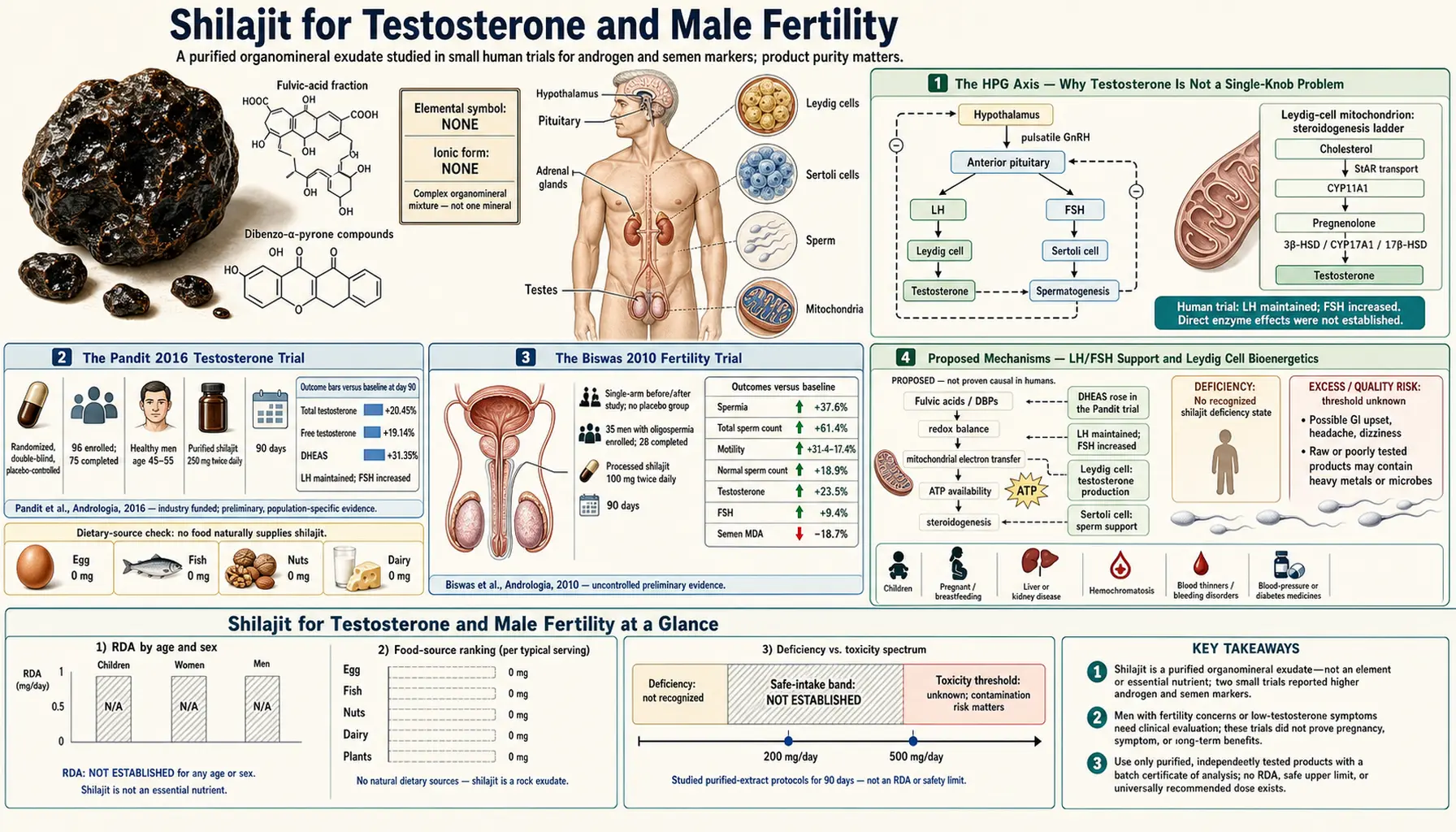
Two small clinical studies from one research group in Kolkata are the human evidence usually cited for shilajit and male hormones. The Pandit 2016 randomized, double-blind, placebo-controlled trial in Andrologia gave a purified shilajit extract at 250 mg twice a day for 90 days to healthy men aged 45-55; its abstract reports significant increases in total testosterone, free testosterone and DHEAS compared with placebo, with LH and FSH levels “well maintained.” The trial was funded by the manufacturer of the extract it tested. The earlier Biswas 2010 study gave processed shilajit at 100 mg twice daily for 90 days to men with oligospermia; it had no placebo group, and the 28 men who completed it showed improvements in sperm count, motility and serum testosterone compared with their own baseline. Reviews describe the controlled human evidence for shilajit as limited.
Table of Contents
- The HPG Axis — Why Testosterone Is Not a Single-Knob Problem
- The Pandit 2016 Testosterone Trial
- The Biswas 2010 Fertility Trial
- Proposed Mechanisms — LH/FSH Support and Leydig Cell Bioenergetics
- The Aromatase Question
- Zinc, Selenium, and Cofactor Delivery
- What the Trials Used
- Limits and Caveats of the Evidence
- Cautions and Safety Findings
- Key Research Papers
- Connections
- Featured Videos
The HPG Axis — Why Testosterone Is Not a Single-Knob Problem
Male testosterone production is governed by the hypothalamic-pituitary-gonadal (HPG) axis, a three-tier feedback loop that is more complex than the common consumer-supplement framing suggests. The hypothalamus releases gonadotropin-releasing hormone (GnRH) in pulses. GnRH stimulates the anterior pituitary to release luteinizing hormone (LH) and follicle-stimulating hormone (FSH). LH acts on the Leydig cells of the testes to drive testosterone synthesis, while FSH acts on the Sertoli cells to support spermatogenesis. Circulating testosterone and its aromatase-derived metabolite estradiol then feed back negatively on both the hypothalamus and the pituitary to throttle GnRH and LH/FSH release.
This means that "low testosterone" in any given man can have at least four distinct etiologies:
- Primary hypogonadism — the Leydig cells are damaged or dysfunctional. LH is high (trying to push harder) but testosterone remains low. Common causes: aging-related Leydig-cell decline, prior chemotherapy or radiation, Klinefelter syndrome, undescended testicles.
- Secondary hypogonadism — the pituitary or hypothalamus is not signaling adequately. LH is low or inappropriately normal alongside low testosterone. Common causes: chronic illness, opioid use, obesity-related HPG suppression, pituitary adenoma, severe systemic stress.
- Excess aromatization — testosterone is being produced but converted too aggressively to estradiol by adipose-tissue aromatase. Total testosterone may be normal but free testosterone is low and estradiol is elevated. Common in obesity and metabolic syndrome.
- SHBG (sex-hormone-binding globulin) excess — total testosterone is normal but most of it is bound and biologically inactive. Free testosterone is low. Common in aging, hyperthyroidism, and certain liver disease.
The relevance of this taxonomy to shilajit is that the Pandit 2016 abstract reports increases in total testosterone, free testosterone and DHEAS, with LH and FSH levels “well maintained”. Exogenous testosterone and anabolic steroids work the other way: they suppress LH and FSH through negative feedback and reduce the body's own production. The trial was not designed to show which tissue (Leydig cells, adrenals) or mechanism accounts for the rise; the explanations proposed are covered in the mechanisms section below. For more on testosterone testing, see Testosterone Test.
The Pandit 2016 Testosterone Trial
The Pandit 2016 study — published as Pandit S, Biswas S, Jana U, De RK, Mukhopadhyay SC, Biswas TK, "Clinical evaluation of purified Shilajit on testosterone levels in healthy volunteers" in Andrologia, 2016;48(5):570-575 — is the randomized trial usually cited for the male hormonal indication. The design, as given in the abstract:
- Population: healthy male volunteers aged 45-55 years (the abstract does not give the number of participants)
- Design: randomized, double-blind, placebo-controlled
- Intervention: purified shilajit 250 mg twice a day, or placebo
- Duration: 90 consecutive days
- Measured: total testosterone, free testosterone, DHEAS, LH and FSH
- Funding: the publisher's funding record lists the manufacturer of the purified shilajit extract as the funder; the product was a commercially produced, branded extract, so results may not transfer to other shilajit products
Reported results:
- Total testosterone, free testosterone and DHEAS (the sulfated form of dehydroepiandrosterone, the major adrenal androgen) increased significantly compared with placebo (P < 0.05)
- LH and FSH levels were “well maintained” — they did not fall
- The abstract does not report the size of the changes, adverse events or safety laboratory results
The “LH and FSH maintained” finding is the methodologically important piece. Exogenous testosterone raises serum testosterone but suppresses endogenous LH and FSH through negative feedback, which can reduce sperm production; anabolic steroids do the same. In the Pandit trial the rise in testosterone was not accompanied by that suppression. The trial did not test the mechanism, and the tissue-level explanations below remain hypotheses.
A 2024 systematic review of 52 studies of products marketed as “testosterone boosters” (Morgado 2024) found that most failed to increase total testosterone, and classed a purified shilajit extract as “possibly effective” for men with late-onset hypogonadism.
The Biswas 2010 Fertility Trial
The earlier Biswas 2010 study — Biswas TK, Pandit S, Mondal S, Biswas SK, Jana U, Ghosh T, Tripathi PC, Debnath PK, Auddy RG, Auddy B, "Clinical evaluation of spermatogenic activity of processed Shilajit in oligospermia" in Andrologia, 2010;42(1):48-56 — gave processed shilajit as a 100 mg capsule twice daily after major meals for 90 days. Of 60 infertile men assessed, the 35 with total sperm counts below 20 million per mL were enrolled, and 28 completed treatment. The study had no placebo or control group: every result is a change from the men's own baseline, which is a major methodological limitation. The endpoints were laboratory measurements (semen analysis and blood hormones) rather than self-reported symptoms.
Reported results in the 28 men who completed treatment, compared with baseline:
- Total sperm count +61.4% and spermia +37.6% (P < 0.001)
- Motility +12.4% to +17.4% at different time points
- Normal sperm count +18.9%, with fewer pus and epithelial cells in semen
- Semen malondialdehyde (a marker of oxidative stress) −18.7%
- Serum testosterone +23.5% (P < 0.001) and FSH +9.4% (P < 0.05)
- Liver and kidney profiles were unaltered; the abstract does not report pregnancy outcomes
The fall in semen malondialdehyde fits an oxidative-stress explanation, although an uncontrolled study cannot show cause and effect. Sperm are highly dependent on mitochondria — the mid-piece of a mature spermatozoon is packed with mitochondria that power the flagellar movement needed for motility — and their membranes are rich in polyunsaturated fatty acids while their cytoplasmic antioxidant defenses are limited, which makes them vulnerable to oxidative damage.
A 2019 expert review (Agarwal 2019) reports that 30% to 80% of infertile men have elevated seminal reactive oxygen species and proposes the term Male Oxidative Stress Infertility (MOSI); the same review states that current antioxidant treatment protocols are not evidence-based. A 2014 review (Stohs 2014) describes antioxidant activity for shilajit in research studies, attributed mainly to its dibenzo-α-pyrones and fulvic acids, while a 2011 review (Wilson 2011) found that the in vivo antioxidant work had used an irrelevant dose and no positive control. In a rat study (Park 2006), six weeks of oral shilajit increased sperm numbers in the testes and epididymides compared with controls.
Proposed Mechanisms — LH/FSH Support and Leydig Cell Bioenergetics
How shilajit might raise testosterone without lowering gonadotropins has not been established. The explanations below are hypotheses drawn from general Leydig-cell biology; none has been tested in human studies of shilajit:
- Leydig cell bioenergetics — testosterone synthesis begins in the mitochondria, where the enzyme CYP11A1 converts cholesterol to pregnenolone; the later steps (3-beta-HSD, CYP17A1, 17-beta-HSD) take place largely in the endoplasmic reticulum. Age-related decline in Leydig-cell output has been linked in laboratory research to mitochondrial and oxidative changes. Proponents propose that shilajit's dibenzo-α-pyrones and fulvic acids support these processes.
- StAR protein — the rate-limiting step in steroidogenesis is the transport of cholesterol into the inner mitochondrial membrane by steroidogenic acute regulatory (StAR) protein. Laboratory work links StAR expression to oxidative status; StAR has not been measured in men taking shilajit.
- Hypothalamic and pituitary signaling — the maintained LH/FSH levels in the Pandit trial indicate that shilajit did not suppress upstream signaling in that study; whether it supports that signaling is unknown.
- Antioxidant protection of the Leydig cell — cytochrome-P450 reactions in steroid synthesis generate reactive oxygen species, and it is proposed that an antioxidant could help preserve Leydig-cell function over time.
None of these mechanisms has been isolated in human studies of shilajit; each is an extrapolation from independent research on Leydig-cell biology and mitochondrial steroidogenesis.
The Aromatase Question
A frequently raised question is whether shilajit acts as an aromatase inhibitor — suppressing the enzyme that converts testosterone to estradiol. The Pandit 2016 abstract does not report estradiol, so the trial data cannot answer the question, and no published study of shilajit's effect on aromatase was identified for this page.
The combination of shilajit with testosterone replacement therapy, or with drugs that alter estrogen activity (raloxifene, tamoxifen, hormone therapies for prostate cancer), has not been studied; any interaction is theoretical.
Whether estradiol changes alongside testosterone in men taking shilajit is a question the published trials leave open.
Zinc, Selenium, and Cofactor Delivery
Two trace minerals often discussed alongside shilajit and male hormonal health are zinc and selenium; both are involved in testosterone synthesis and sperm production. Shilajit contains a wide range of elements: a 2022 analysis of Indian and Pakistani shilajit samples (Aldakheel 2022) detected zinc and selenium among more than twenty elements, alongside toxic metals. How much of either mineral a typical dose supplies, and in what chemical form, is not established in the research cited here.
Zinc is a cofactor for many enzymes. Severe and moderate zinc deficiency is associated with hypogonadism in men. In a 1996 study (Prasad 1996), serum testosterone correlated with cellular zinc in 40 healthy men; it fell in four young men after 20 weeks of dietary zinc restriction, and rose in nine marginally zinc-deficient older men after zinc supplementation. Zinc is also concentrated in the prostate and seminal fluid. See the Zinc page for detailed coverage of the zinc-testosterone relationship.
Selenium is required for the glutathione peroxidases, selenoproteins that protect cell membranes — including sperm membranes — against lipid peroxidation. See the Selenium page for more.
Zinc and selenium status are independent of shilajit; whole-food sources of zinc include oysters and organ meats, and Brazil nuts are a concentrated source of selenium.
What the Trials Used
The two trials cited on this page used the following. These describe the studies, not a regimen:
- Dose — Pandit 2016: purified shilajit 250 mg twice a day. Biswas 2010: processed shilajit 100 mg capsules twice daily after major meals. The two trials did not use the same dose.
- Form — Pandit tested a commercially produced purified extract made by the trial's funder; Biswas tested a “processed shilajit” capsule. Neither tested raw shilajit, and results from these specific preparations may not transfer to other products. Analyses of shilajit samples report varying metal contents (Hussain 2024).
- Duration — 90 days in both trials; shorter and longer courses were not tested for hormonal outcomes.
- Timing — Biswas gave doses after major meals; the Pandit abstract does not state timing. No study has compared morning and evening dosing.
- Measurements — Pandit measured total and free testosterone, DHEAS, LH and FSH; Biswas measured semen parameters, testosterone, LH, FSH, semen malondialdehyde and liver and kidney markers. Both trials judged effect by laboratory values before and after treatment.
- Other factors — sleep deprivation, obesity, chronic alcohol use, opioid use and chronic illness are associated with lower testosterone independently of any supplement. The 2018 American Urological Association guideline (Mulhall 2018) covers the evaluation and management of testosterone deficiency.
Limits and Caveats of the Evidence
The Pandit abstract reports statistically significant increases compared with placebo but does not give the size of the change, and shilajit has not been compared with testosterone replacement therapy (TRT) in a trial. Points from the research:
- Not studied as a treatment for diagnosed hypogonadism. Pandit enrolled healthy men aged 45-55; Biswas enrolled men with oligospermia. The 2018 AUA guideline bases the diagnosis of testosterone deficiency on total testosterone levels together with symptoms and signs. No trial has tested shilajit in place of medically indicated TRT.
- Primary hypogonadism. The proposed mechanisms all depend on functioning Leydig cells; no study has examined shilajit in men whose testes cannot produce testosterone.
- The fertility evidence is uncontrolled. The Biswas results are before-and-after changes in 28 men with no control group, and the abstract does not report pregnancies. Severe oligospermia and azoospermia were not studied separately.
- Timeline. Both trials measured hormonal outcomes at 90 days; Biswas reported motility at several time points.
- Laboratory endpoints. Both trials measured laboratory values; neither abstract reports symptom outcomes, so whether men noticed a difference is not known.
- One research group, small samples. Both trials came from the same Kolkata research unit, and the Pandit trial was funded by the extract's manufacturer. The 2014 Stohs review states that relatively few well-controlled human studies of shilajit have been conducted and calls for more using standardized products; the 2011 Wilson review concluded that shilajit's bioactivity lacks substantial evidence.
Cautions and Safety Findings
- Hormone-sensitive cancers — no study has examined shilajit in men with prostate cancer, testicular cancer or other hormone-sensitive cancers. Because the Pandit trial reported a rise in testosterone, the research raises a theoretical concern for these men; decisions belong with their oncologist.
- Men on TRT — the combination of shilajit with prescribed testosterone therapy has not been studied.
- Iron overload — elemental analyses detect iron in shilajit (Aldakheel 2022); no study has examined shilajit in people with hemochromatosis or other iron-overload conditions.
- Heart disease — the cardiac effects of shilajit have not been characterized in men with heart disease.
- Diabetes medicines — no study has examined shilajit together with insulin or sulfonylureas, and its effect on blood glucose in people with diabetes has not been established in human trials.
- Heavy-metal contamination — the best-documented hazard. A 2008 JAMA study (Saper 2008) analyzed 193 Ayurvedic medicines bought online and found that 20.7% contained detectable lead, mercury or arsenic; a US-manufactured shilajit product was among the metal-containing products (lead 10.5 µg/g), and every metal-containing product exceeded one or more standards for acceptable daily intake of toxic metals. A 2022 analysis of Indian and Pakistani shilajit samples (Aldakheel 2022) found lead, arsenic, mercury and other metals in amounts exceeding standard permissible limits. A 2024 review (Hussain 2024) found that most reported metal levels in shilajit were below WHO and FDA limits, with exceedances in a few studies. Purified and raw shilajit have not been compared for metal content in the studies cited here.
- Pregnancy and breastfeeding — there is no safety data on shilajit in pregnancy or breastfeeding.
- Adolescent males — shilajit has not been studied in adolescents, whose HPG axis is still developing.
The 2014 Stohs review states that the safety of shilajit is well documented in animal and human studies while calling for more well-controlled human studies with standardized products; the 2011 Wilson review reached a more skeptical conclusion about its evidence base. Decisions about supplements belong with a clinician.
Key Research Papers
- Pandit S, Biswas S, Jana U, De RK, Mukhopadhyay SC, Biswas TK (2016). Clinical evaluation of purified Shilajit on testosterone levels in healthy volunteers. Andrologia 48(5):570-575. — PubMed PMID: 26395129
- Biswas TK, Pandit S, Mondal S, et al. (2010). Clinical evaluation of spermatogenic activity of processed Shilajit in oligospermia. Andrologia 42(1):48-56. — PubMed PMID: 20078516
- Stohs SJ (2014). Safety and efficacy of shilajit (mumie, moomiyo). Phytotherapy Research 28(4):475-479. — PubMed PMID: 23733436
- Park JS, Kim GY, Han K (2006). The spermatogenic and ovogenic effects of chronically administered Shilajit to rats. Journal of Ethnopharmacology 107(3):349-353. — PubMed PMID: 16698205
- Wilson E, Rajamanickam GV, Dubey GP, et al. (2011). Review on shilajit used in traditional Indian medicine. Journal of Ethnopharmacology 136(1):1-9. — PubMed PMID: 21530631
- Agarwal SP, Khanna R, Karmarkar R, Anwer MK, Khar RK (2007). Shilajit: a review. Phytotherapy Research 21(5):401-405. — PubMed PMID: 17295385
- Carrasco-Gallardo C, Guzman L, Maccioni RB (2012). Shilajit: a natural phytocomplex with potential procognitive activity. International Journal of Alzheimer's Disease 2012:674142. — PubMed PMID: 22482077
- Ghosal S (2006). Shilajit in Perspective. — PubMed
- Aiken JM, McKenzie D, Zhou Z, Aiken CT (2014). Animal models of androgen and testosterone supplementation. Comparative Medicine. — PubMed — Editorial note: no paper matching this citation was found in PubMed or Crossref; the link is a topic search only.
- Agarwal A, Sengupta P, Durairajanayagam D (2018). Role of L-carnitine in female infertility. Reproductive Biology and Endocrinology 16:5. — PubMed PMID: 29373970 — Editorial note: this review concerns female infertility; the sperm oxidative-stress statements on this page rest on Agarwal 2019 below.
- Sharma P, Jha J, Shrinivas V, et al. (2003). Shilajit: evaluation of its effects on blood chemistry of normal human subjects. Ancient Science of Life 23(2):114-119. — PubMed PMID: 22557121
- Schepetkin I, Khlebnikov A, Kwon BS (2002). Medical drugs from humus matter: focus on mumie. Drug Development Research 57:140-159. — doi:10.1002/ddr.10058
- Morgado A, Tsampoukas G, Sokolakis I, Schoentgen N, Urkmez A, Sarikaya S (2024). Do "testosterone boosters" really increase serum total testosterone? A systematic review. International Journal of Impotence Research 36(4):348-364. — PubMed PMID: 37697053
- Saper RB, Phillips RS, Sehgal A, et al. (2008). Lead, mercury, and arsenic in US- and Indian-manufactured Ayurvedic medicines sold via the Internet. JAMA 300(8):915-923. — PubMed PMID: 18728265
- Aldakheel RK, Gondal MA, Alsayed HN, Almessiere MA, Nasr MM, Shemsi AM (2022). Rapid determination and quantification of nutritional and poisonous metals in vastly consumed Ayurvedic herbal medicine (rejuvenator Shilajit) by humans using three advanced analytical techniques. Biological Trace Element Research 200(9):4199-4216. — PubMed PMID: 34800280
- Hussain A, Saeed A (2024). Hazardous or advantageous: uncovering the roles of heavy metals and humic substances in Shilajit (phyto-mineral) with emphasis on heavy metals toxicity and their detoxification mechanisms. Biological Trace Element Research 202(12):5794-5814. — PubMed PMID: 38393486
- Prasad AS, Mantzoros CS, Beck FW, Hess JW, Brewer GJ (1996). Zinc status and serum testosterone levels of healthy adults. Nutrition 12(5):344-348. — PubMed PMID: 8875519
- Agarwal A, Parekh N, Panner Selvam MK, et al. (2019). Male Oxidative Stress Infertility (MOSI): proposed terminology and clinical practice guidelines for management of idiopathic male infertility. World Journal of Men's Health 37(3):296-312. — PubMed PMID: 31081299
- Mulhall JP, Trost LW, Brannigan RE, et al. (2018). Evaluation and management of testosterone deficiency: AUA guideline. Journal of Urology 200(2):423-432. — PubMed PMID: 29601923