Mineral Compounds and Supplement Forms
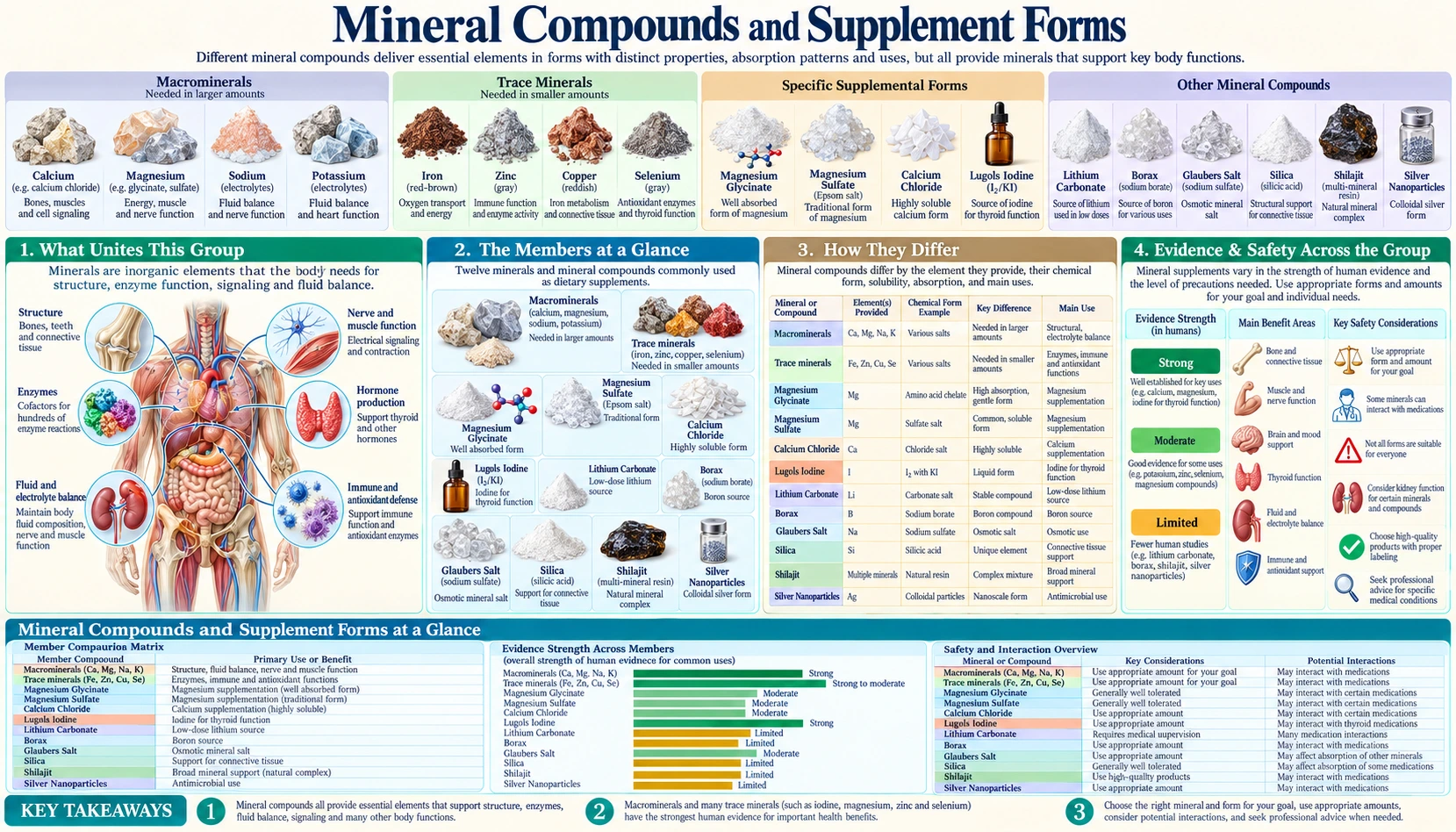
Mineral Compounds and Supplement Forms on This Site
Magnesium Glycinate
Magnesium chelated to glycine — the form usually chosen for daily repletion because it is well absorbed and least laxative.
Read the deep dive →Magnesium Sulfate
Epsom salt: the laxative and the bath, and the intravenous drug used in eclampsia.
Read the deep dive →Baking Soda
Sodium bicarbonate: the kitchen leavener and old antacid, and a kidney-disease treatment with real trial evidence.
Read the deep dive →Calcium Chloride
A soluble calcium salt used industrially and clinically; not the form used for dietary supplementation.
Read the deep dive →Lugols Iodine
Iodine and potassium iodide in solution, the traditional strong iodine preparation.
Read the deep dive →Lithium Carbonate
The pharmaceutical lithium salt, distinct from the trace amounts discussed as a nutrient.
Read the deep dive →Borax
Sodium tetraborate — a boron compound with a long domestic history and a genuinely contested safety literature.
Read the deep dive →Glaubers Salt
Sodium sulfate decahydrate, historically a purgative.
Read the deep dive →Silica
Silicon dioxide: the form silicon is usually encountered and supplemented in.
Read the deep dive →Shilajit
A Himalayan resinous exudate sold as a mineral supplement — a mixture rather than a defined compound, which is the main thing to know about it.
Read the deep dive →Silver Nanoparticles
Colloidal and nanoparticulate silver. Silver has no nutritional role; this page covers the research literature and the risks.
Read the deep dive →These are not elements. They are the salts, preparations and supplement forms that minerals actually arrive in — and the form very often decides whether the mineral is absorbed, tolerated, or useful at all.
Magnesium is the clearest case: the same element as oxide, glycinate or sulfate behaves like three different products. A page here covers the preparation; the element it carries has its own page under macrominerals or trace minerals.