Macrominerals
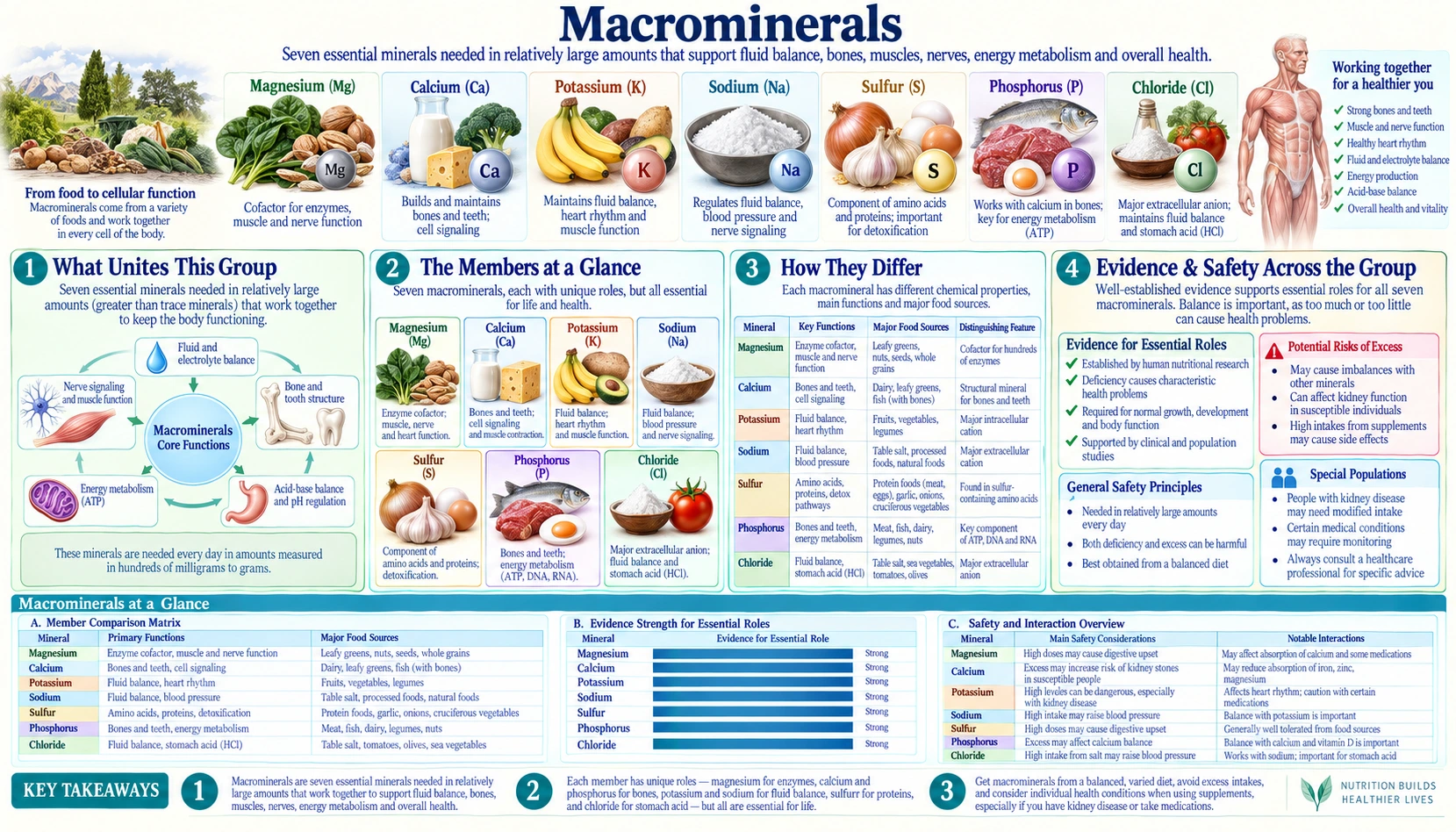
Macrominerals on This Site
Magnesium
A cofactor for hundreds of enzymes including every reaction that uses ATP; depletion is common in poorly controlled diabetes and with long-term PPI or diuretic use.
Read the deep dive →Calcium
The skeleton's mineral, and a signalling ion in every cell — the balance between bone reservoir and blood level is hormonally defended.
Read the deep dive →Potassium
The principal cation inside the cell. The one macromineral most people fall short of, and the one whose excess is most dangerous in kidney impairment.
Read the deep dive →Sodium
The principal cation outside the cell. Its relationship to blood pressure is real and more individual than the public advice suggests.
Read the deep dive →Sulfur
Not given an RDA, because it arrives inside methionine and cysteine. Central to glutathione, collagen crosslinks and phase II detoxification.
Read the deep dive →Phosphorus
Bone with calcium, the backbone of DNA, and the P in ATP. Rarely deficient in ordinary diets, and a problem in kidney disease for the opposite reason.
Read the deep dive →Chloride
The anion that accompanies sodium and supplies stomach acid; usually silent, and informative when a blood gas goes wrong.
Read the deep dive →The seven minerals the body needs in more than 100 mg a day — in most cases far more. They do the structural and electrical work: calcium and phosphorus build the skeleton, sodium, potassium, chloride and magnesium carry the charge that fires nerves and contracts muscle, and sulfur is built into the amino acids and connective tissue that hold the rest together.
Because the requirements are large, macromineral problems usually come from losses rather than intake — sweat, diuretics, vomiting, diarrhoea, kidney disease — and they show up as electrolyte disturbances rather than as slow deficiency syndromes.