HOMA-IR (Insulin Resistance)
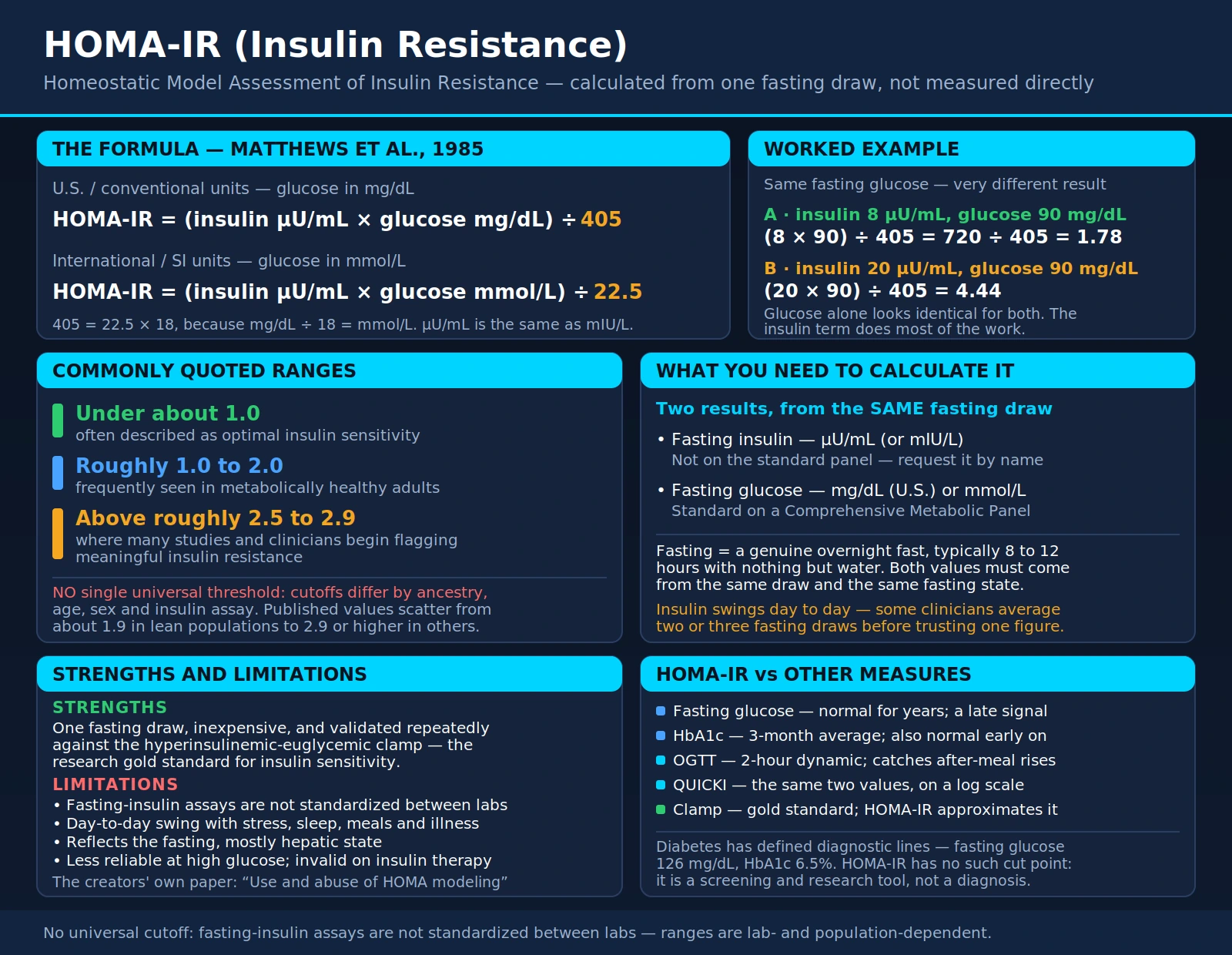
HOMA-IR stands for the Homeostatic Model Assessment of Insulin Resistance. It is not a test tube of blood you send to the lab — it is a simple number you calculate from two ordinary fasting results: your fasting insulin and your fasting glucose. Multiply them together, divide by a constant, and you get a single figure that estimates how hard your body is working to keep your blood sugar normal. A low number suggests your cells respond briskly to insulin; a higher number suggests they have grown a little deaf to it, so your pancreas has to shout louder.
This page explains what HOMA-IR is, the exact formula in both the U.S. and international unit systems, what "insulin resistance" actually means in plain terms, how to get the two numbers you need, and — honestly — how to read the result. We will be straight with you about its limits: there is no single magic cutoff that works for every population, and the fasting-insulin measurement it depends on is famously variable between labs. Used thoughtfully, though, HOMA-IR is one of the most useful early-warning signals for metabolic trouble that ordinary blood work can give you.
Table of Contents
- What HOMA-IR Is
- The Formula (Both Unit Systems)
- What Insulin Resistance Means
- How to Get the Numbers
- Interpreting Your HOMA-IR
- Strengths and Limitations
- HOMA-IR vs Other Measures
- What Raises or Lowers It
- Related Tests & Next Steps
- Research Papers
- Connections
- Featured Videos
What HOMA-IR Is
HOMA-IR is a calculated index, not a single blood-draw analyte. Nobody measures "HOMA-IR" directly the way they measure your sodium or your cholesterol. Instead, it is a small piece of arithmetic that combines two fasting values into one number that stands in for insulin resistance.
The idea goes back to 1985, when Robert Turner's group in Oxford — David Matthews first author — published a mathematical model of the feedback loop between the liver, the pancreas, and blood glucose. In a healthy person that loop is a quiet conversation: glucose rises a little, insulin nudges it back down, and both settle at a comfortable resting level overnight. Matthews and colleagues showed that if you know the resting (fasting) level of both glucose and insulin, you can work backward and estimate two things: how sensitive the tissues are to insulin (captured by HOMA-IR) and how well the beta cells of the pancreas are secreting it (a companion figure called HOMA-%B).
Because it needs only a single fasting blood draw, HOMA-IR became enormously popular in research and, increasingly, in everyday preventive care. It is cheap, it does not require an infusion or a multi-hour test, and it can be run on results your doctor may already have ordered. Think of it as a back-of-the-envelope estimate of insulin resistance — not a precise measurement, but a genuinely useful one.
The Formula (Both Unit Systems)
The formula looks intimidating but is really just "multiply the two fasting numbers and divide by a constant." The only tricky part is that the constant depends on which units your glucose is reported in.
U.S. / conventional units (glucose in mg/dL):
- HOMA-IR = (fasting insulin in µU/mL × fasting glucose in mg/dL) ÷ 405
International / SI units (glucose in mmol/L):
- HOMA-IR = (fasting insulin in µU/mL × fasting glucose in mmol/L) ÷ 22.5
The two versions give the same answer — they only differ because glucose is reported in different units around the world. To convert glucose from mg/dL to mmol/L you divide by 18, and 405 is simply 22.5 × 18, so the constants are matched to the units. (One more unit note that trips people up: fasting insulin in µU/mL is numerically the same as mIU/L, so if your lab reports insulin in mIU/L you can plug that number straight in.)
A worked example. Suppose your fasting insulin is 8 µU/mL and your fasting glucose is 90 mg/dL. Then HOMA-IR = (8 × 90) ÷ 405 = 720 ÷ 405 = 1.78. Now suppose someone else has the same glucose but a fasting insulin of 20 µU/mL: (20 × 90) ÷ 405 = 4.44. Same blood sugar, but the second person's body is spending far more insulin to hold it there — and that is exactly the hidden strain HOMA-IR is designed to reveal.
Notice that glucose alone would have looked identical for both people. It is the insulin term that does most of the work in the formula, which is why a fasting-insulin result matters so much and why glucose-only screening can miss early insulin resistance entirely.
What Insulin Resistance Means
Insulin is the hormone that tells your cells to take glucose out of the bloodstream and either burn it or store it. The classic analogy is a key opening a lock: insulin is the key, and receptors on your muscle, fat, and liver cells are the locks. When everything works well, a small amount of insulin opens plenty of locks and blood sugar drops back to normal after a meal.
Insulin resistance is when those locks get stiff. The cells still respond — but only sluggishly, so the same amount of insulin has less effect. To compensate, the pancreas secretes more insulin to force the doors open and keep blood sugar in range. This is why, in the early years of insulin resistance, blood sugar can look completely normal: the pancreas is quietly working overtime behind the scenes to keep it that way. Fasting insulin climbs first; fasting glucose stays flat until the pancreas can no longer keep up.
That compensation stage can last many years, and it is precisely the window where HOMA-IR shines. Because HOMA-IR includes insulin, it can flag the rising effort long before a fasting glucose or an HbA1c would budge. Eventually, if resistance keeps worsening and the beta cells tire, glucose starts to drift up — first into the prediabetes range, then potentially into type 2 diabetes. Insulin resistance also travels with high triglycerides, low HDL, higher blood pressure, extra belly fat, and fatty liver, a cluster often called metabolic syndrome.
How to Get the Numbers
You need two results, both drawn in the same fasting blood sample:
- Fasting insulin — measured in µU/mL (or the equivalent mIU/L).
- Fasting glucose — measured in mg/dL (U.S.) or mmol/L (most other countries).
"Fasting" here means a genuine overnight fast, typically 8 to 12 hours with nothing but water. Both numbers must come from the same draw and the same fasting state, because HOMA-IR assumes the glucose–insulin system is at its quiet resting equilibrium. A "fasting" glucose paired with an insulin drawn after breakfast would be meaningless.
Fasting glucose is a standard part of a Comprehensive Metabolic Panel and almost any routine check-up, so you likely already have it. Fasting insulin is the piece more often missing — it is not on the standard panel and usually has to be requested by name. If you are asking your clinician for the workup, "fasting insulin and fasting glucose, same morning draw" is the phrase to use. Some labs and direct-to-consumer services will even calculate HOMA-IR for you once both values are in hand.
Because insulin can bounce around from day to day, some clinicians average two or three fasting draws taken a few days apart, or draw a couple of samples five minutes apart, before trusting a single HOMA-IR figure — especially if the first result sits near a decision point.
Interpreting Your HOMA-IR
Here is where honesty matters most: there is no single universal HOMA-IR threshold. Cutoffs that flag "insulin resistance" differ by ancestry, age, sex, the insulin assay a lab uses, and the population a study was built on. A value that is average in one group can be high in another. Anyone who quotes you one exact line for the whole human race is oversimplifying.
With that caveat firmly in mind, here are the ranges people commonly encounter:
- Under about 1.0 — often described as optimal insulin sensitivity.
- Roughly 1.0 to 2.0 — frequently seen in metabolically healthy adults, though "normal" shades upward with age and body weight.
- Above roughly 2.5 to 2.9 — the range where many studies and clinicians begin flagging meaningful insulin resistance.
Published cutoffs in the research literature scatter widely, from about 1.9 in some lean populations up to 2.9 or higher in others, precisely because of the population dependence described above. Large studies such as the Spanish EPIRCE cohort have shown the "normal" upper limit shifting with sex and age, and metabolic-syndrome studies in different countries have landed on different optimal thresholds. So treat any number you read online, including the ones on this page, as a general guidepost rather than a diagnosis.
The practical takeaway: a HOMA-IR that is trending up over time in your own results is often more informative than a single value compared against a population cutoff. And HOMA-IR is a screening and research tool, not a formal diagnostic criterion — unlike, say, a fasting glucose of 126 mg/dL or an HbA1c of 6.5%, which are defined diagnostic lines for diabetes. If your HOMA-IR is elevated, it is a prompt for a fuller conversation and confirmatory testing, not a verdict.
Strengths and Limitations
Its strengths are real. HOMA-IR is inexpensive, needs only one fasting draw, and has been validated repeatedly against the gold-standard method for measuring insulin sensitivity — the hyperinsulinemic-euglycemic clamp, an involved research procedure that infuses insulin and glucose for hours. In studies spanning a wide range of glucose tolerance, HOMA-IR tracks clamp results closely enough to be genuinely useful for screening and for population research. That is a lot of information from two numbers.
Its limitations deserve equal billing:
- Fasting-insulin assay variability. Insulin measurements are not well standardized between laboratories; the same blood can yield different insulin numbers on different platforms, and that variability flows straight into HOMA-IR. Comparing a HOMA-IR from one lab to a cutoff derived on another lab's assay is genuinely apples-to-oranges.
- Biological day-to-day swing. Fasting insulin varies with stress, sleep, recent meals, and illness, so a single value can mislead.
- It reflects the fasting, mostly hepatic state. HOMA-IR is dominated by liver insulin sensitivity in the fasting condition and does not directly capture how muscle handles glucose after a meal.
- It breaks down in some situations. The original linear formula is less reliable at high glucose levels and is not valid for people on insulin therapy; the updated computer-based HOMA2 model was developed partly to address those cases.
The team that created HOMA published a paper titled, pointedly, "Use and abuse of HOMA modeling," precisely to warn against over-reading a single number. That is good advice: HOMA-IR is a useful estimate, not a precise instrument.
HOMA-IR vs Other Measures
HOMA-IR is one of several ways to look at glucose and insulin metabolism, and each answers a slightly different question:
- Fasting glucose tells you where blood sugar sits after an overnight fast. It is simple and standardized, but it stays normal for years while insulin resistance builds, so on its own it is a late signal.
- HbA1c (hemoglobin A1c) reflects average blood sugar over roughly the past three months. It is excellent for diagnosing and tracking diabetes, but like fasting glucose it can remain normal during the early, insulin-compensated phase that HOMA-IR is built to catch. See Hemoglobin A1C.
- Oral glucose tolerance test (OGTT) measures how your body handles a standardized sugary drink over two hours. It is more dynamic and can reveal after-meal problems HOMA-IR misses, but it takes hours and is less pleasant.
- QUICKI (the Quantitative Insulin Sensitivity Check Index) uses the very same fasting glucose and insulin, but combines them on a logarithmic scale. It measures sensitivity rather than resistance and correlates tightly with HOMA-IR; the two are close cousins.
- Hyperinsulinemic-euglycemic clamp is the research gold standard for insulin sensitivity — the most accurate, and the most laborious and expensive. HOMA-IR is essentially the affordable, single-draw approximation of what a clamp would show.
Used together, they form a picture: fasting insulin and HOMA-IR flag the early, hidden strain; fasting glucose, HbA1c, and an OGTT show how far things have progressed once the pancreas can no longer fully compensate.
What Raises or Lowers It
Because HOMA-IR reflects insulin resistance, it responds to the same everyday factors that drive metabolic health — which is genuinely good news, because most of them are within your influence.
What tends to raise HOMA-IR:
- Excess body fat, especially visceral fat around the abdomen and in the liver.
- A sedentary routine — muscle that is not being used takes up glucose less readily.
- Diets heavy in refined starches, sugary drinks, and ultra-processed food.
- Short or poor-quality sleep, and chronic stress (partly through the hormone cortisol).
- Some medications and conditions, including corticosteroids and polycystic ovary syndrome.
What tends to lower HOMA-IR:
- Losing excess weight — even a modest loss of body fat can meaningfully improve insulin sensitivity.
- Regular movement — both aerobic exercise and resistance training make muscle more insulin-sensitive, an effect that starts within days.
- Dietary quality — shifting toward whole foods, fiber, and fewer refined carbohydrates and sugary drinks.
- Consistent, sufficient sleep and stress reduction.
Large trials of lifestyle change, such as the Diabetes Prevention Program, have shown that modest weight loss and regular activity sharply reduce the odds of progressing to type 2 diabetes — the very outcome that a rising HOMA-IR warns about. The encouraging part is that HOMA-IR often improves relatively quickly once these habits shift, which makes it a satisfying number to re-check a few months into a change.
Related Tests & Next Steps
If your HOMA-IR is elevated, or you simply want the fuller metabolic picture, a few companion tests are worth discussing with your clinician:
- Fasting insulin on its own — the key ingredient, useful to watch as a trend.
- HbA1c and fasting glucose — to see whether blood sugar itself has started to rise.
- C-peptide — another window on how much insulin your pancreas is actually producing.
- Lipid panel — insulin resistance often shows up as high triglycerides and low HDL.
- Fructosamine — a shorter-term average blood-sugar marker, useful in some situations.
- A continuous glucose monitor — to see how your real-world meals move your blood sugar.
Just as importantly, an elevated HOMA-IR is an invitation to act early rather than a reason to panic. It is a marker measured while the situation is still highly reversible. Pairing the number with the everyday changes above — movement, food quality, sleep, and, where relevant, weight — and then re-checking in a few months is a sensible, empowering plan. Always interpret your results with a clinician who knows your full history; this page is educational and not a substitute for medical advice.
Research Papers
- Matthews DR, Hosker JP, Rudenski AS, Naylor BA, Treacher DF, Turner RC. Homeostasis model assessment: insulin resistance and beta-cell function from fasting plasma glucose and insulin concentrations in man. Diabetologia. 1985;28(7):412-419. doi:10.1007/BF00280883 — the original paper that defined the HOMA model and its formula.
- DeFronzo RA, Tobin JD, Andres R. Glucose clamp technique: a method for quantifying insulin secretion and resistance. Am J Physiol. 1979;237(3):E214-E223. doi:10.1152/ajpendo.1979.237.3.E214 — describes the clamp, the gold standard HOMA-IR is validated against.
- Reaven GM. Banting lecture 1988. Role of insulin resistance in human disease. Diabetes. 1988;37(12):1595-1607. doi:10.2337/diab.37.12.1595 — landmark lecture linking insulin resistance to a cluster of metabolic disease.
- Levy JC, Matthews DR, Hermans MP. Correct homeostasis model assessment (HOMA) evaluation uses the computer program. Diabetes Care. 1998;21(12):2191-2192. doi:10.2337/diacare.21.12.2191 — introduces the updated HOMA2 computer model over the simple linear formula.
- Bonora E, Targher G, Alberiche M, et al. Homeostasis model assessment closely mirrors the glucose clamp technique in the assessment of insulin sensitivity. Diabetes Care. 2000;23(1):57-63. doi:10.2337/diacare.23.1.57 — shows HOMA tracks clamp results across a wide range of glucose tolerance.
- Katz A, Nambi SS, Mather K, et al. Quantitative insulin sensitivity check index: a simple, accurate method for assessing insulin sensitivity in humans. J Clin Endocrinol Metab. 2000;85(7):2402-2410. doi:10.1210/jcem.85.7.6661 — introduces QUICKI, the close cousin of HOMA-IR.
- Ascaso JF, Pardo S, Real JT, Lorente RI, Priego A, Carmena R. Diagnosing insulin resistance by simple quantitative methods in subjects with normal glucose metabolism. Diabetes Care. 2003;26(12):3320-3325. doi:10.2337/diacare.26.12.3320 — explores practical HOMA-IR cutoffs in people with normal glucose.
- Wallace TM, Levy JC, Matthews DR. Use and abuse of HOMA modeling. Diabetes Care. 2004;27(6):1487-1495. doi:10.2337/diacare.27.6.1487 — the creators' own guide to using HOMA correctly and its pitfalls.
- Muniyappa R, Lee S, Chen H, Quon MJ. Current approaches for assessing insulin sensitivity and resistance in vivo: advantages, limitations, and appropriate usage. Am J Physiol Endocrinol Metab. 2008;294(1):E15-E26. doi:10.1152/ajpendo.00645.2007 — a balanced review comparing HOMA-IR with clamps and other indices.
- Esteghamati A, Ashraf H, Khalilzadeh O, et al. Optimal cut-off of homeostasis model assessment of insulin resistance (HOMA-IR) for the diagnosis of metabolic syndrome. Nutr Metab (Lond). 2010;7:26. doi:10.1186/1743-7075-7-26 — illustrates how a HOMA-IR cutoff is derived in one national population.
- Gayoso-Diz P, Otero-Gonzalez A, Rodriguez-Alvarez MX, et al. Insulin resistance (HOMA-IR) cut-off values and the metabolic syndrome in a general adult population: effect of gender and age (EPIRCE study). BMC Endocr Disord. 2013;13:47. doi:10.1186/1472-6823-13-47 — large study showing how cutoffs shift with sex and age.
- Gutch M, Kumar S, Razi SM, Gupta KK, Gupta A. Assessment of insulin sensitivity/resistance. Indian J Endocrinol Metab. 2015;19(1):160-164. doi:10.4103/2230-8210.146874 — a plain-language overview of the main methods, including HOMA-IR.
Connections
- All Lab Tests
- Fasting Insulin
- C-Peptide
- Hemoglobin A1C
- Comprehensive Metabolic Panel
- Lipid Panel
- Fructosamine Test
- Continuous Glucose Monitor (CGM)
- Type 2 Diabetes
- Endocrinology
- Insulin Resistance: Diet & Blood-Sugar Strategies — the food, fasting, and exercise levers that lower the resistance HOMA-IR estimates.