Creatine Kinase (CK)
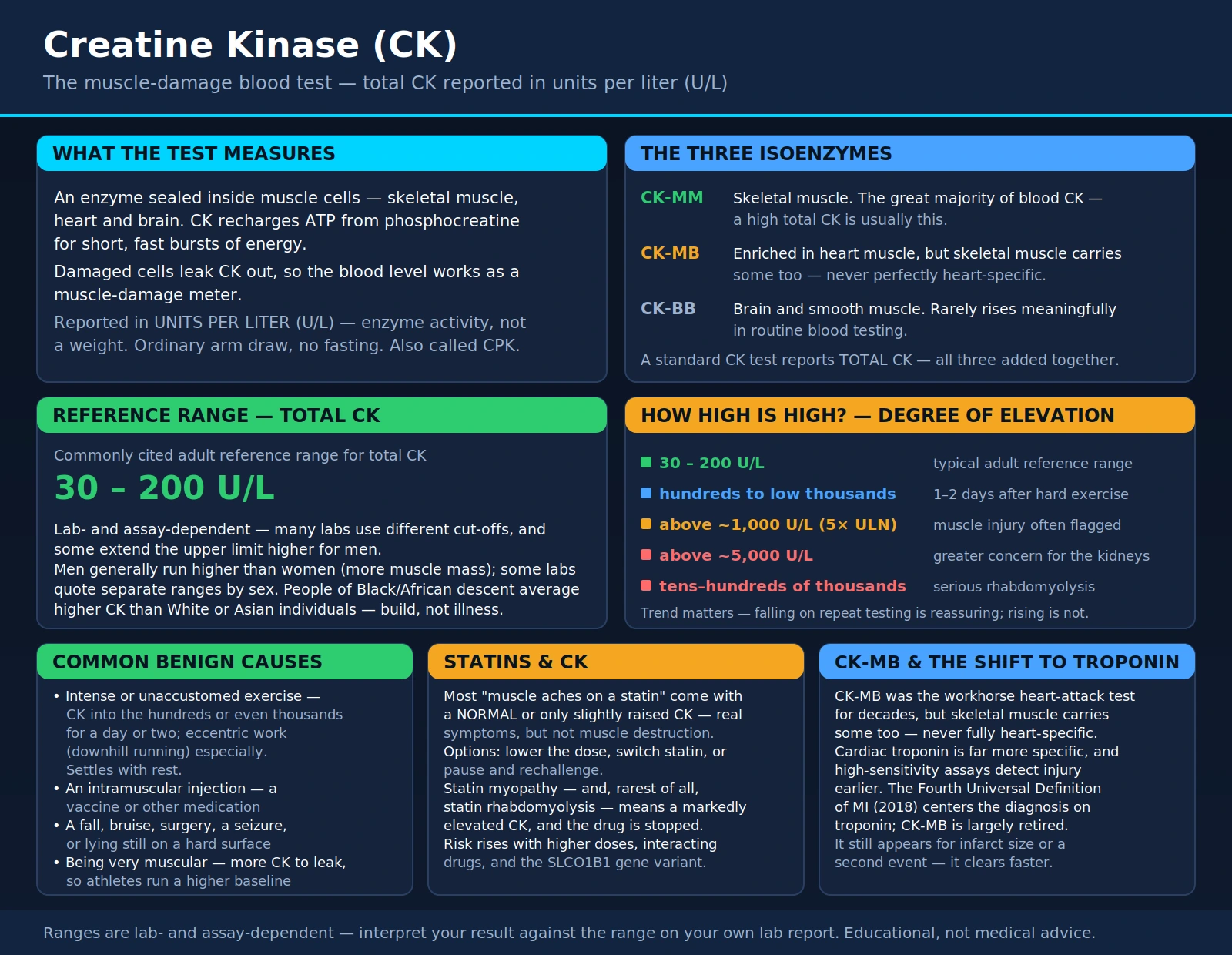
Creatine kinase — often written CK, and sometimes called CPK (creatine phosphokinase) — is a simple blood test that tells your doctor whether muscle is being damaged. CK is an enzyme that lives inside muscle cells. When those cells are stressed or injured, CK spills out into the bloodstream, so a high level in the blood is a signal that muscle somewhere is breaking down. The test is inexpensive, widely available, and usually part of investigating muscle pain, muscle weakness, dark urine, a suspected drug reaction, or a possible muscle disease.
This page explains, in plain language, what CK actually measures, why a doctor might order it, what can push the number up (including harmless things like a hard workout), what a high result can mean, and how CK fits alongside newer tests like troponin. CK is a genuinely useful test, but it is also easily misread — a single high number does not automatically mean something is wrong, and the context matters enormously. We will keep the evidence honest and point you to when a result truly deserves urgent attention.
Table of Contents
- What Creatine Kinase Is
- Why the Test Is Ordered
- How It Is Measured & What Raises It
- Normal Ranges
- What a High CK Means
- Statins & CK
- CK-MB & the Shift to Troponin
- Related Tests
- When to Talk to a Doctor
- Research Papers
- Connections
- Featured Videos
What Creatine Kinase Is
Creatine kinase is an enzyme — a protein that speeds up a chemical reaction. Its job is to help manage energy inside cells that work hard and need power in short, fast bursts: skeletal muscle, heart muscle, and brain. CK sits at the center of what scientists call the phosphocreatine circuit. When a muscle needs a sudden surge of energy, CK rapidly transfers a high-energy phosphate from phosphocreatine onto ADP to regenerate ATP, the cell's main energy currency. In effect, phosphocreatine acts like a small rechargeable battery, and CK is the switch that lets muscle draw on it instantly.
Because CK normally lives sealed inside the muscle cell, healthy blood contains only a modest amount of it — the trickle that leaks out during ordinary wear and tear. The membrane of a muscle cell is like the wall of a water balloon: keep it intact and the contents stay put; stretch, tear, or rupture it and the contents pour out. When muscle cells are injured — by trauma, extreme exertion, a toxin, a drug, or a disease — their membranes become leaky or burst, and CK floods into the bloodstream. That is why a blood CK level works as a muscle-damage meter: the more muscle is breaking down, the higher the number climbs.
The three isoenzymes: CK-MM, CK-MB, and CK-BB
CK is not a single molecule but a family of three closely related forms, called isoenzymes. Each is built from two subunits — an "M" (muscle) type and a "B" (brain) type — combined in different pairs:
- CK-MM — the skeletal-muscle form. This makes up the great majority of the CK in your blood, so when your total CK is high, it is usually CK-MM, pointing to skeletal muscle as the source.
- CK-MB — enriched in heart muscle. Historically, a rise in CK-MB was used to detect a heart attack, because damaged heart cells release proportionally more of this form. Small amounts also come from skeletal muscle, which is part of why CK-MB was never perfectly specific to the heart.
- CK-BB — found mainly in brain and smooth muscle. It rarely rises meaningfully in routine blood testing, so it is seldom useful in everyday practice.
A standard CK test reports total CK — all three forms added together. Only when there is a specific question (classically, "is this chest pain a heart attack?") does a lab break out the CK-MB fraction. As you will see below, that particular use has largely been handed over to a better test.
Why the Test Is Ordered
Doctors reach for a CK level when they suspect muscle is being injured or when they want to monitor a condition that damages muscle. The main reasons include:
- Rhabdomyolysis — a serious, sometimes dangerous breakdown of skeletal muscle. CK is the central test used to diagnose it and to track how severe it is. This is probably the single most important reason CK is ordered urgently.
- Statin-related muscle problems — cholesterol-lowering statin drugs occasionally cause muscle aches, and rarely a more serious muscle injury (myopathy). CK helps sort a harmless ache from something that needs the drug stopped.
- Muscle diseases — inherited conditions such as the muscular dystrophies (Duchenne and Becker, for example) and inflammatory muscle diseases such as myositis (polymyositis, dermatomyositis) typically raise CK, sometimes dramatically. CK helps flag these conditions and follow how active they are.
- Unexplained muscle pain, weakness, cramps, or dark urine — CK is a first-line test when the story suggests the muscle itself is the problem.
- Heart attack — historically — for decades, CK and its CK-MB fraction were the workhorse blood tests for diagnosing a heart attack. That role has now been largely replaced by troponin, which is both more specific to the heart and detectable earlier. We explain this shift honestly in its own section below, because you may still see CK-MB ordered in some settings and it helps to know why troponin took over.
How It Is Measured & What Raises It
CK is measured from an ordinary blood sample drawn from a vein in the arm — no fasting or special preparation is usually required. The lab reports the result in units per liter (U/L), a measure of enzyme activity rather than an absolute weight. Results usually come back the same day or next day.
Here is the part that trips people up: plenty of ordinary, harmless things raise CK, and a mildly elevated number in a well person often means nothing worrying at all. Before assuming a high CK signals disease, a good clinician asks what the person has been doing. Common benign causes of a raised CK include:
- Intense or unaccustomed exercise — a hard workout, heavy weightlifting, a long run, or simply a new exercise routine can push CK into the hundreds or even thousands for a day or two. Eccentric exercise (the muscle-lengthening part of a movement, like running downhill) is especially good at raising it. This is normal and resolves with rest.
- An intramuscular injection — any shot into a muscle (a vaccine, some medications) causes local muscle trauma and can nudge CK up.
- A fall, a bruise, surgery, or any physical trauma — even minor muscle injury releases some CK.
- Being very muscular — people with a large amount of muscle mass simply have more CK to leak, so their baseline runs higher than average.
- Certain medical procedures — a recent surgery, a seizure, or prolonged lying still on a hard surface can all elevate CK.
Why sex, muscle mass, and ancestry matter
Normal CK is not one number for everyone. On average, men have higher CK than women, largely because they carry more muscle mass. CK also differs by ancestry: several studies, including a large analysis of the U.S. population, found that people of Black/African descent tend to have higher average CK than White or Asian individuals, again reflecting differences in body composition and muscle rather than any illness. This is why a "high" CK must be read against the right yardstick — a value that is genuinely abnormal for one person can be perfectly ordinary for a muscular young man or an athlete after training. Good laboratories and thoughtful clinicians take sex, build, ethnicity, and recent activity into account before calling a result abnormal.
Normal Ranges
There is no single universal "normal" CK. The reference range depends on the laboratory, the exact assay used, and the person's sex — so always interpret your result against the range printed on your own lab report. That said, some general figures help set expectations:
- A commonly cited adult reference range for total CK is roughly 30 to 200 U/L, but many labs use somewhat different cut-offs, and some extend the upper limit higher for men.
- Men generally sit higher than women, reflecting greater muscle mass. Some labs quote separate ranges by sex.
- Athletes and very muscular people can have a resting CK above the standard range without anything being wrong.
- After vigorous exercise, CK can rise transiently into the many hundreds or low thousands and still be entirely benign, returning to baseline within days of rest.
Because of all this variation, a single "high" number is rarely diagnostic on its own. What clinicians watch for is the degree of elevation and the trend over repeated tests. As a rough guide, doctors often flag muscle injury when CK rises above about five times the upper limit of normal (very roughly over 1,000 U/L in an average adult), and they take it seriously when the number climbs into the tens of thousands, which points toward significant muscle breakdown such as rhabdomyolysis. A number that is falling on repeat testing is reassuring; one that keeps climbing is not.
What a High CK Means
Once benign causes such as recent exercise or an injection have been considered, a markedly or persistently high CK points toward muscle that is genuinely being damaged. The three big categories are acute muscle breakdown (rhabdomyolysis), muscle disease, and drug-related muscle injury.
Rhabdomyolysis: the classic high-CK story
Rhabdomyolysis is the rapid breakdown of skeletal muscle, and CK is the test that defines and tracks it. When large amounts of muscle break down, they release not only CK but also a protein called myoglobin and a flood of potassium and other cell contents into the blood. Myoglobin is what can turn urine dark — the classic tea-, cola-, or cranberry-colored urine — and, crucially, it can injure the kidneys. Rhabdomyolysis is one of the recognized causes of acute kidney injury, which is why a very high CK is treated as a medical situation, not just a lab curiosity.
Common triggers of rhabdomyolysis include:
- Crush injury or prolonged pressure — being trapped under weight, or lying immobile for hours (after a fall, a stroke, or unconsciousness) so that a person's own body weight starves and crushes muscle.
- Extreme exertion — unusually intense exercise, especially in heat or in someone unaccustomed to it (sometimes called exertional rhabdomyolysis, seen in new recruits, spin-class newcomers, and endurance events).
- Drugs and toxins — including some prescription medications (statins being the best-known example), alcohol, and certain illicit drugs.
- Seizures — a prolonged seizure or repeated seizures make muscles contract violently and can release large amounts of CK.
- Severe infections, heatstroke, and certain metabolic muscle disorders.
In serious rhabdomyolysis, CK can reach the tens of thousands or even hundreds of thousands of U/L. The general principle is that the higher the CK — particularly above roughly 5,000 U/L — the greater the concern for kidney injury, though the risk depends on the whole picture, not the number alone. Treatment centers on generous intravenous fluids to protect the kidneys, correcting dangerous electrolyte shifts (especially high potassium), and addressing the underlying cause. Repeated CK measurements are used to confirm the level is falling.
Muscle diseases: dystrophies and myositis
Chronically elevated CK, rather than a single dramatic spike, often points to a muscle disease. In the inherited muscular dystrophies — Duchenne and Becker being the classic examples — CK is frequently very high, sometimes even before obvious weakness appears, because the fragile muscle membrane leaks CK continuously. CK is one of the early clues that prompts genetic and other specialized testing. In the inflammatory muscle diseases known as myositis (such as polymyositis and dermatomyositis), the immune system attacks muscle, and CK typically rises along with muscle weakness; the level is often used to gauge how active the disease is and how well treatment is working. A steadily elevated CK with weakness — not just soreness — is exactly the kind of pattern that deserves a referral to a neurologist or rheumatologist.
Statins & CK
Statins are among the most widely prescribed medicines in the world, and for most people they are safe and life-extending. But muscle complaints are the side effect patients ask about most, so it is worth being clear and honest about how CK fits in.
A large share of people who report "muscle aches on a statin" have mild symptoms with a normal or only slightly raised CK. These statin-associated muscle symptoms are real and can be uncomfortable, but they are not the same as muscle destruction. In this common situation, doctors often check CK to make sure nothing serious is happening, and if it is normal they may continue the statin, lower the dose, switch to a different statin, or pause and rechallenge to see whether the drug is truly the culprit — because studies show that some muscle aches blamed on statins occur just as often on a placebo.
At the other, much rarer end of the spectrum is statin myopathy and, at its most severe, statin-induced rhabdomyolysis — genuine muscle injury with a markedly elevated CK. This is uncommon, but it is the reason clinicians take a very high CK or severe weakness on a statin seriously and will stop the drug. The risk goes up with higher statin doses, with certain drug interactions (some medications slow the breakdown of statins and raise their levels), and with individual genetics. A well-known example is a common variation in the SLCO1B1 gene, which affects how the liver takes up certain statins; people carrying it have a higher risk of statin-related muscle problems, especially at high doses of simvastatin.
Practical takeaways for patients: mild aches with a normal CK usually do not require stopping a statin outright, and options exist to manage them. But severe muscle pain or weakness, especially with dark urine, warrants prompt medical attention and a CK check. Never stop a statin abruptly on your own for a serious cardiac indication without talking to your doctor — the goal is to manage the muscle issue without losing the drug's protection unnecessarily.
CK-MB & the Shift to Troponin
For much of the late twentieth century, the CK-MB fraction was the best blood test available for diagnosing a heart attack. Because heart muscle is relatively rich in CK-MB, a rise in that fraction — especially as a proportion of total CK — suggested the heart was the source of the damage. It worked, but it had real limitations: skeletal muscle also contains some CK-MB, so the test was not perfectly specific to the heart, and CK-MB was not the earliest or most sensitive signal of a small heart injury.
Cardiac troponin changed everything. Troponin is a protein found in heart muscle in a form so specific that a rise in blood troponin is a far more reliable flag for heart-muscle injury than CK-MB ever was. Modern high-sensitivity troponin assays can detect very small amounts very early, allowing faster and more accurate diagnosis. As a result, the major cardiology guidelines — including the international Universal Definition of Myocardial Infarction — now define heart attack around troponin, and troponin has become the standard-of-care blood test for suspected heart attack. CK-MB has largely been retired from that role.
Why mention CK-MB at all, then? Because you may still encounter it. Some hospitals continue to use CK-MB in specific situations — for example, to help estimate the size of a heart injury or to detect a second event soon after a first, since CK-MB clears from the blood faster than troponin. But for the everyday question "is this chest pain a heart attack?", troponin is the test, and total CK or CK-MB is no longer the front-line answer. If you are having CK measured today, it is far more likely to be about skeletal muscle than about your heart.
Related Tests
CK rarely stands alone. Depending on the question, it is often ordered or interpreted alongside:
- Troponin — the modern, heart-specific test for suspected heart attack that has replaced CK-MB in that role.
- Aldolase — another enzyme released by damaged muscle; sometimes used together with CK when a muscle disease such as myositis is suspected, occasionally elevated even when CK is not.
- Lactate dehydrogenase (LDH) — a general marker of tissue breakdown that can rise in muscle injury among many other causes.
- Basic and comprehensive metabolic panels — in rhabdomyolysis these track kidney function (creatinine, urea) and dangerous electrolyte shifts, especially potassium, which can rise to hazardous levels as muscle breaks down.
- Urine myoglobin and urinalysis — help confirm muscle breakdown and assess the risk to the kidneys; myoglobin is what darkens the urine.
- Liver enzymes (AST and ALT) — often assumed to reflect the liver, but muscle also contains AST (and some ALT), so muscle injury can raise them; a high CK helps explain "liver" numbers that are really coming from muscle.
- Specialized muscle testing — when a primary muscle disease is suspected, CK may be followed by genetic testing, electromyography (EMG), a muscle biopsy, or antibody panels, arranged by a specialist.
When to Talk to a Doctor
CK is a lab value, not a verdict — but a few patterns deserve prompt attention. Seek medical care, and expect a CK to be checked, if you have:
- Muscle pain or weakness together with dark, tea-, cola-, or cranberry-colored urine. This combination is the classic warning sign of significant muscle breakdown that can threaten the kidneys, and it warrants urgent evaluation.
- Severe, spreading, or unexplained muscle pain — especially after a crush injury, extreme exertion, a prolonged period lying immobile, a seizure, or a new or high-dose statin.
- Muscle weakness that is getting worse, rather than the ordinary soreness that eases with rest, which may point to a muscle disease worth investigating.
- Any new severe muscle symptoms on a statin — contact your prescriber before deciding what to do about the drug.
On the reassuring side: a modestly elevated CK a day or two after a hard workout, a new gym routine, or a vaccine is usually nothing to worry about and settles with rest. If your only finding is a slightly high CK on a routine test and you feel well, the sensible step is to repeat it after avoiding strenuous exercise for a few days, rather than to assume the worst. As always, use your own lab's reference range and your clinician's judgment — this page is educational and is not a substitute for personal medical advice.
Research Papers
- Bosch X, Poch E, Grau JM. Rhabdomyolysis and acute kidney injury. New England Journal of Medicine. 2009;361(1):62-72. doi:10.1056/NEJMra0801327 — a definitive clinical review of how muscle breakdown injures the kidneys and how it is diagnosed and treated.
- Chavez LO, Leon M, Einav S, Varon J. Beyond muscle destruction: a systematic review of rhabdomyolysis for clinical practice. Critical Care. 2016;20(1):135. doi:10.1186/s13054-016-1314-5 — summarizes causes, the central role of CK, and evidence-based management of rhabdomyolysis.
- Brancaccio P, Lippi G, Maffulli N. Biochemical markers of muscular damage. Clinical Chemistry and Laboratory Medicine. 2010;48(6):757-767. doi:10.1515/CCLM.2010.179 — reviews CK and other markers of muscle injury and how to interpret them.
- Wallimann T, Wyss M, Brdiczka D, Nicolay K, Eppenberger HM. Intracellular compartmentation, structure and function of creatine kinase isoenzymes in tissues with high and fluctuating energy demands: the 'phosphocreatine circuit' for cellular energy homeostasis. Biochemical Journal. 1992;281(1):21-40. doi:10.1042/bj2810021 — the foundational description of what CK does inside the muscle cell.
- Baird MF, Graham SM, Baker JS, Bickerstaff GF. Creatine-kinase- and exercise-related muscle damage implications for muscle performance and recovery. Journal of Nutrition and Metabolism. 2012;2012:960363. doi:10.1155/2012/960363 — explains why exercise raises CK and why an elevated post-workout value is usually benign.
- George MD, McGill NK, Baker JF. Creatine kinase in the U.S. population: impact of demographics, comorbidities, and body composition on the normal range. Medicine (Baltimore). 2016;95(33):e4344. doi:10.1097/MD.0000000000004344 — documents how sex, ancestry, and muscle mass shift the normal CK range.
- Stroes ES, Thompson PD, Corsini A, et al. Statin-associated muscle symptoms: impact on statin therapy — European Atherosclerosis Society Consensus Panel Statement. European Heart Journal. 2015;36(17):1012-1022. doi:10.1093/eurheartj/ehv043 — a practical consensus on assessing and managing statin muscle complaints.
- Link E, Parish S, Armitage J, et al (SEARCH Collaborative Group). SLCO1B1 variants and statin-induced myopathy — a genomewide study. New England Journal of Medicine. 2008;359(8):789-799. doi:10.1056/NEJMoa0801936 — identified a common gene variant that raises the risk of statin-related muscle injury.
- Newman CB, Preiss D, Tobert JA, et al. Statin safety and associated adverse events: a scientific statement from the American Heart Association. Arteriosclerosis, Thrombosis, and Vascular Biology. 2019;39(2):e38-e81. doi:10.1161/ATV.0000000000000073 — an authoritative review putting statin muscle risk in honest, evidence-based perspective.
- Zatz M, Rapaport D, Vainzof M, et al. Serum creatine-kinase (CK) and pyruvate-kinase (PK) activities in Duchenne (DMD) as compared with Becker (BMD) muscular dystrophy. Journal of the Neurological Sciences. 1991;102(2):190-196. doi:10.1016/0022-510X(91)90068-I — shows the markedly elevated CK characteristic of muscular dystrophy.
- Thygesen K, Alpert JS, Jaffe AS, et al. Fourth universal definition of myocardial infarction (2018). Circulation. 2018;138(20):e618-e651. doi:10.1161/CIR.0000000000000617 — the guideline that centers heart-attack diagnosis on troponin rather than CK-MB.
- Apple FS, Sandoval Y, Jaffe AS, Ordonez-Llanos J. Cardiac troponin assays: guide to understanding analytical characteristics and their impact on clinical care. Clinical Chemistry. 2017;63(1):73-81. doi:10.1373/clinchem.2016.255109 — explains why high-sensitivity troponin outperformed CK-MB for detecting heart injury.
Connections
- All Lab Tests
- Cardiac Troponin
- LDH (Lactate Dehydrogenase)
- Comprehensive Metabolic Panel
- Kidney Function Tests
- Liver Function Tests
- Uric Acid
- Cardiology
- Nephrology & Hepatology
- Neurology
- Rheumatology