Blood Type (ABO and Rh)
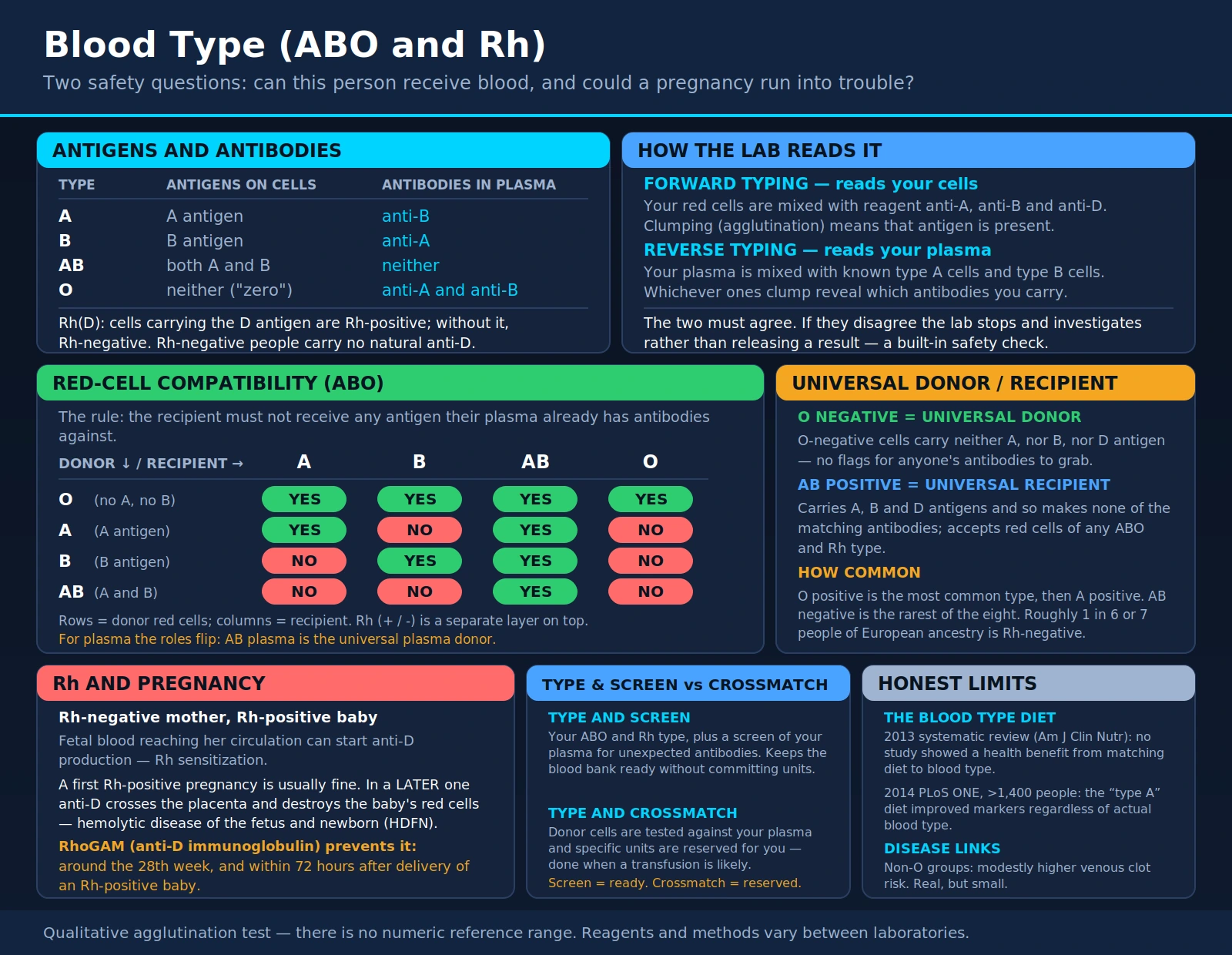
Your blood type is one of the simplest and most durable facts about your body: for practical purposes it is set for life, it comes from the genes you inherited from your parents, and a small tube of blood can settle it in minutes. But behind that simple label are two of the most important safety questions in all of medicine — can this person safely receive a blood transfusion, and could a pregnancy run into trouble because the mother and baby have different blood? Blood typing exists to answer those two questions, and it has quietly saved a very large number of lives. This page explains what the ABO and Rh systems actually are, how a lab reads your type, why compatibility matters so much, and how one particular injection prevents a once-common and deadly complication of pregnancy. It also takes an honest look at the popular "eat right for your blood type" diet, which sounds scientific but is not supported by the evidence. The goal is to give you an accurate, plain-language picture — useful whether you are donating blood, expecting a baby, or just curious what your card means.
Table of Contents
- What Blood Type Actually Is
- How Blood Typing Is Done
- Why It Is Tested
- Transfusion Compatibility
- Rh and Pregnancy
- Type and Screen, Type and Crossmatch
- How Common Each Type Is
- The Blood Type Diet: An Honest Look
- Blood Type and Disease: Small, Honest Associations
- When This Test Matters
- Research Papers
- Connections
- Featured Videos
What Blood Type Actually Is
Every red blood cell is coated with tiny molecular markers called antigens. Think of them as flags flying on the surface of the cell. Your immune system learns early in life which flags are "yours," and it treats any unfamiliar flag as an intruder to be attacked. Blood typing is simply the job of reading which flags your red cells fly. Of the many antigen systems that have been discovered, two matter most in everyday medicine: the ABO system and the Rh system.
The ABO system: A, B, AB, and O
The ABO system is built on two possible antigens, cleverly named A and B. Which ones sit on your red cells decides your ABO type:
- Type A — the A antigen is present.
- Type B — the B antigen is present.
- Type AB — both A and B antigens are present.
- Type O — neither A nor B is present. (The "O" is best thought of as "zero.")
At the genetic level, the A and B genes each carry instructions for an enzyme that adds a particular sugar to a common backbone molecule on the cell surface; the O version of the gene makes no working enzyme, so the backbone is left bare. This molecular story was worked out in 1990 and is one of the tidiest examples in genetics of how a single gene produces a visible, medically vital trait.
The naturally occurring antibodies
Here is the feature that makes ABO uniquely dangerous to get wrong. Without ever being transfused, you already carry antibodies against whichever ABO antigen you lack. These are called naturally occurring antibodies (or isohemagglutinins), and they appear in the first months of life, probably in response to look-alike molecules on the harmless bacteria and foods in our environment. The pattern is strict:
- Type A blood carries anti-B antibodies.
- Type B blood carries anti-A antibodies.
- Type O blood carries both anti-A and anti-B.
- Type AB blood carries neither.
Because these antibodies are already loaded and waiting, an ABO-mismatched transfusion causes an immediate, violent reaction — there is no delay while the immune system "learns." That is the whole reason ABO typing must be right the first time.
The Rh factor: positive or negative
The plus or minus sign after your type — as in "O positive" or "A negative" — comes from the Rh system, and specifically from a single powerful antigen called D. If your red cells carry the D antigen, you are Rh-positive; if they do not, you are Rh-negative. Rh differs from ABO in one crucial way: an Rh-negative person does not naturally carry anti-D antibodies. They only make anti-D after being exposed to Rh-positive blood — through a transfusion or, importantly, through pregnancy. That single fact is the key to understanding the pregnancy section below.
How Blood Typing Is Done
Blood typing rests on one visible phenomenon: agglutination, which is just the clumping that happens when an antibody meets its matching antigen and glues red cells together. A clump you can see means "match found." Labs use this in two complementary ways, and a proper ABO type does both and checks that they agree.
- Forward typing (front typing) reads your cells. Technologists mix a sample of your red cells with known reagent anti-A, and separately with known anti-B. Clumping with anti-A means you carry the A antigen; clumping with anti-B means you carry B. A third test with reagent anti-D reveals your Rh status.
- Reverse typing (back typing) reads your plasma. Your plasma is mixed with known type A cells and, separately, with known type B cells. Whichever ones clump reveal which antibodies you carry — and, because of the strict pattern above, that independently confirms your ABO type.
The elegance is that forward and reverse typing must tell the same story. A person who types as group A on the cells must show anti-B in the plasma. If the two disagree, the lab stops and investigates rather than releasing a result — a built-in safety check. Modern blood banks often run these reactions in automated gel or microplate systems, but the underlying principle is the same clump-or-no-clump readout that has been used for over a century.
Why It Is Tested
Blood typing is not a general "wellness" number you go looking for. It is ordered when the answer will actually change what happens to you, and two situations dominate:
- Transfusion safety. Before you can safely receive donated red cells — during surgery, after major bleeding, for severe anemia, or during cancer treatment — the blood bank must know your ABO and Rh type so it can issue compatible units.
- Pregnancy. Blood type is checked at the first prenatal visit, chiefly to identify Rh-negative mothers who may need protection against Rh sensitization, and to flag other antibodies that could affect the baby.
Beyond these, typing is done to match organ and stem-cell transplants, to work up newborns with unexplained jaundice, and whenever a hospital admits someone who might foreseeably need blood. The rest of this page walks through each of these in turn.
Transfusion Compatibility
Matching donor and recipient is the original reason blood typing exists. The rule for red cells follows directly from the antibodies described above: the recipient must not receive any antigen their plasma already has antibodies against. Give type B red cells to a type A person, whose plasma is full of anti-B, and those antibodies attack the transfused cells at once.
The universal donor and universal recipient
Two special types get nicknames worth understanding:
- O negative is the "universal donor" for red cells. O-negative cells carry neither A, nor B, nor D antigens — no flags for anyone's antibodies to grab. That is why O-negative blood is grabbed off the shelf in emergencies when there is no time to type the patient, and why it is chronically in short supply.
- AB positive is the "universal recipient." An AB-positive person carries A, B, and D antigens and therefore makes none of the corresponding antibodies, so their plasma will accept red cells of any ABO and Rh type.
One honest wrinkle worth knowing: for plasma (rather than red cells), the roles flip — AB plasma has no anti-A or anti-B and is the universal plasma donor, while O is the universal red-cell donor. The takeaway is simply that "universal" depends on which blood component you are giving. In practice the blood bank handles all of this; you do not need to memorize it.
Why a mismatch is dangerous
An ABO-incompatible red-cell transfusion can trigger an acute hemolytic transfusion reaction. The recipient's antibodies coat the incoming cells, activate a cascade of blood proteins, and rupture the donor cells inside the bloodstream. Symptoms can begin within minutes — fever, chills, pain in the back or flank, dark urine, a falling blood pressure — and severe cases can cause kidney injury, dangerous clotting throughout the body, and death. Sobering fact: most serious reactions are not laboratory failures at all but identification errors — the right blood given to the wrong patient. That is why bedside identity checks, wristband verification, and double-checks are treated as seriously as the typing itself.
Rh and Pregnancy
This is the part of blood typing that changed obstetrics forever, so it is worth slowing down for. The whole issue arises from one specific pairing: an Rh-negative mother carrying an Rh-positive baby (the baby can inherit Rh-positive status from an Rh-positive father).
How sensitization happens
During pregnancy and especially at delivery, small amounts of the baby's blood can cross into the mother's circulation. If the baby is Rh-positive and the mother is Rh-negative, her immune system encounters the D antigen for the first time and may begin manufacturing anti-D antibodies. This one-time immune "education" is called Rh sensitization. Crucially, a first Rh-positive pregnancy is usually fine, because sensitization typically happens as the pregnancy ends — too late to harm that baby.
Why the next pregnancy is the danger
The problem surfaces in a later Rh-positive pregnancy. Now the mother already carries anti-D, and those antibodies are small enough to cross the placenta and attack the new baby's red cells. The result is hemolytic disease of the fetus and newborn (HDFN): the baby's red cells are destroyed faster than they can be replaced, causing fetal anemia, jaundice after birth, and in severe cases a life-threatening condition called hydrops. Before this was understood, HDFN was a common cause of stillbirth and newborn death.
The RhoGAM shot that prevents it
The prevention is one of modern medicine's quiet triumphs. Rh-negative mothers are given an injection of anti-D immunoglobulin — widely known by the brand name RhoGAM. It works by a neat trick: the injected antibodies quietly clear any stray Rh-positive fetal cells from the mother's circulation before her own immune system notices them, so she never becomes sensitized in the first place. It is typically given around the 28th week of pregnancy, again within 72 hours after delivery of an Rh-positive baby, and after any event that could mix fetal and maternal blood — miscarriage, amniocentesis, abdominal trauma, or bleeding. Randomized-trial evidence, summarized in Cochrane reviews, shows this routine prophylaxis markedly reduces the chance of sensitization, and it has turned HDFN from a frequent tragedy into a rare one. When a pregnancy is already affected, specialists can monitor the baby with ultrasound (Doppler measurement of blood flow) and, if needed, treat severe fetal anemia with an intrauterine transfusion — giving the baby compatible blood before birth.
Type and Screen, Type and Crossmatch
You may hear these two phrases before surgery, and they describe two levels of preparation:
- Type and screen determines your ABO and Rh type and then screens your plasma for unexpected antibodies against the many other red-cell antigens beyond A, B, and D (people can develop these from past transfusions or pregnancies). This is the standard preparation when a transfusion is possible but not certain — it lets the blood bank act fast if blood is suddenly needed, without committing specific units.
- Type and crossmatch goes a step further and reserves specific donor units for you. In the crossmatch, a sample of the actual donor cells is tested against your plasma to confirm they are compatible. This is done when a transfusion is likely or planned, such as before major surgery.
The distinction is practical: a screen keeps you ready; a crossmatch sets aside the exact blood with your name on it.
How Common Each Type Is
Blood types are not evenly distributed, and their frequencies vary considerably by ancestry and region — a well-documented fact captured in large surveys of donors. Speaking roughly and for the United States overall:
- O positive is the most common type, followed closely by A positive. Together these two account for the majority of people.
- B positive is considerably less common, and AB positive less common still.
- The Rh-negative types are the minority in every ABO group — roughly one in six or seven people of European ancestry is Rh-negative, and the proportion is lower in many Asian and African populations.
- AB negative is the rarest of the eight combinations.
Because these frequencies differ across populations, blood centers actively recruit donors from many communities to keep the shelves matched to the patients who need blood. If you are curious about exact percentages, treat any single figure as an approximation — the honest answer is "it depends on the population."
The Blood Type Diet: An Honest Look
Because "blood type" sounds scientific, it has been borrowed to sell a diet. The Blood Type Diet — popularized in the 1996 book Eat Right 4 Your Type — claims that each ABO group should eat a specific way: type O people are told to eat like "hunters" with lots of meat, type A people to eat mostly vegetarian, and so on, based on the idea that food proteins called lectins react differently with each blood type. It is a tidy story. Unfortunately, when researchers actually tested it, it did not hold up.
Two lines of evidence matter here, and both point the same way:
- A systematic review published in The American Journal of Clinical Nutrition in 2013 searched the literature for any study demonstrating a health benefit from matching diet to blood type. It found none — not because the diets were proven harmful, but because the central claim had never been supported by a single properly designed trial.
- A 2014 study in PLoS ONE put the idea to a direct test in more than 1,400 people. Following the "type A" diet (more plant-based) or the "type AB" diet was indeed linked to better cardiometabolic markers — but the improvement appeared regardless of the person's actual blood type. In other words, the benefit came from the healthier eating pattern itself, not from any match to ABO group. Your genes did not care.
The honest bottom line is encouraging rather than disappointing: eating more vegetables, legumes, and whole foods and less ultra-processed food is good for most people — and you do not need to know your blood type, or pay for a test, to benefit from it. Any success a "type A vegetarian" plan produced was the vegetables doing the work, not the letter A. Choosing a diet by blood type adds cost and false precision without adding benefit.
Blood Type and Disease: Small, Honest Associations
People often ask whether their blood type affects their health, and the fair answer is: a little, on average, across whole populations — but not enough to act on as an individual. Large studies have found modest statistical associations, and it is worth stating them plainly and keeping them in proportion:
- Clotting. People with non-O types (A, B, or AB) tend to have slightly higher levels of a clotting protein called von Willebrand factor, and meta-analyses link non-O groups to a modestly higher risk of venous blood clots. This is the best-established of the associations, but the increase in any one person's risk is small.
- Heart and vascular disease and certain cancers. Some large genetic studies report that non-O groups carry a slightly higher average risk of coronary events, and group A has been linked to a small excess risk of a few cancers such as stomach and pancreatic cancer. Group O, by contrast, shows a slightly higher tendency toward bleeding and peptic ulcer in some data.
Two cautions keep this honest. First, these are relative risks measured across thousands of people; the effect on your personal odds is minor and swamped by things you can actually influence — not smoking, diet, blood pressure, activity, and screening. Second, association is not destiny: nobody should change a medical decision, or worry, because of their ABO letter. Your blood type is genuinely useful for transfusion and pregnancy; it is a poor crystal ball for your future health.
When This Test Matters
Pulling it together, blood typing earns its place in a handful of clear situations:
- Before a transfusion or major surgery, so compatible blood can be issued safely and quickly.
- Early in every pregnancy, to identify Rh-negative mothers who benefit from anti-D (RhoGAM) and to screen for antibodies that could affect the baby.
- For organ and stem-cell transplants, where ABO matching is part of donor selection.
- For newborns with jaundice or when the mother is Rh-negative or group O, to check for hemolytic disease.
- When donating blood, where your type is determined so units are labeled correctly.
A few practical notes. Your ABO and Rh type does not change over your lifetime, so once known it is known — yet hospitals deliberately re-type a fresh sample before each transfusion, because the cost of a mislabeled tube is far too high to trust memory or old records. And unless you fall into one of the situations above, there is no medical reason to seek out a blood-type test for diet or "wellness." When it matters, it matters enormously; the rest of the time, it is simply a fact on a card.
Research Papers
- Cusack L, De Buck E, Compernolle V, Vandekerckhove P. Blood type diets lack supporting evidence: a systematic review. The American Journal of Clinical Nutrition. 2013;98(1):99–104. doi:10.3945/ajcn.113.058693 — a formal search of the literature found no study demonstrating any health benefit from matching diet to blood type.
- Wang J, García-Bailo B, Nielsen DE, El-Sohemy A. ABO genotype, 'blood-type' diet and cardiometabolic risk factors. PLoS ONE. 2014;9(1):e84749. doi:10.1371/journal.pone.0084749 — in >1,400 people the "type A" diet improved markers regardless of actual blood type, showing the benefit was the healthy diet itself.
- Yamamoto F, Clausen H, White T, Marken J, Hakomori S. Molecular genetic basis of the histo-blood group ABO system. Nature. 1990;345(6272):229–233. doi:10.1038/345229a0 — the landmark paper identifying the enzyme genes behind A, B, and O.
- Franchini M, Bonfanti C. Evolutionary aspects of ABO blood group in humans. Clinica Chimica Acta. 2015;444:66–71. doi:10.1016/j.cca.2015.02.016 — reviews why ABO variation persists across human populations.
- Garratty G, Glynn SA, McEntire R. ABO and Rh(D) phenotype frequencies of different racial/ethnic groups in the United States. Transfusion. 2004;44(5):703–706. doi:10.1111/j.1537-2995.2004.03338.x — documents how blood-type frequencies vary substantially by ancestry.
- Carson JL, Guyatt G, Heddle NM, Grossman BJ, et al. Clinical practice guidelines from the AABB: red blood cell transfusion thresholds and storage. JAMA. 2016;316(19):2025–2035. doi:10.1001/jama.2016.9185 — the professional guideline governing when and how red cells are transfused.
- Delaney M, Wendel S, Bercovitz RS, Cid J, et al. Transfusion reactions: prevention, diagnosis, and treatment. The Lancet. 2016;388(10061):2825–2836. doi:10.1016/S0140-6736(15)01313-6 — a clinical review of transfusion reactions, including ABO-incompatibility hemolysis.
- de Haas M, Thurik FF, Koelewijn JM, van der Schoot CE. Haemolytic disease of the fetus and newborn. Vox Sanguinis. 2015;109(2):99–113. doi:10.1111/vox.12265 — a thorough modern review of HDFN and its prevention.
- McBain RD, Crowther CA, Middleton P. Anti-D administration in pregnancy for preventing Rhesus alloimmunisation. Cochrane Database of Systematic Reviews. 2015;(9):CD000020. doi:10.1002/14651858.CD000020.pub3 — systematic review confirming that anti-D (RhoGAM) prophylaxis reduces Rh sensitization.
- Zwiers C, van Kamp I, Oepkes D, Lopriore E. Intrauterine transfusion and non-invasive treatment options for hemolytic disease of the fetus and newborn. Expert Review of Hematology. 2017;10(4):337–344. doi:10.1080/17474086.2017.1305265 — how affected pregnancies are monitored and treated when prevention was not enough.
- Wu O, Bayoumi N, Vickers MA, Clark P. ABO(H) blood groups and vascular disease: a systematic review and meta-analysis. Journal of Thrombosis and Haemostasis. 2008;6(1):62–69. doi:10.1111/j.1538-7836.2007.02818.x — the best-characterized disease link: non-O groups and a modestly higher clotting risk.
- Groot HE, Villegas Sierra LE, Said MA, Lipsic E, et al. Genetically determined ABO blood group and its associations with health and disease. Arteriosclerosis, Thrombosis, and Vascular Biology. 2020;40(3):830–838. doi:10.1161/ATVBAHA.119.313658 — a genetic analysis keeping the modest disease associations in honest proportion.
Connections
- All Lab Tests
- Complete Blood Count (CBC)
- Iron Panel
- Reticulocyte Count
- Hematology
- Anemia
- Reproductive Medicine
- Karl Landsteiner — the Nobel laureate who discovered the blood groups this test reports
- Edelman & Porter — anti-D immunoglobulin — an antibody given to prevent immunisation