Anti-Smith (Anti-Sm) Antibody Test
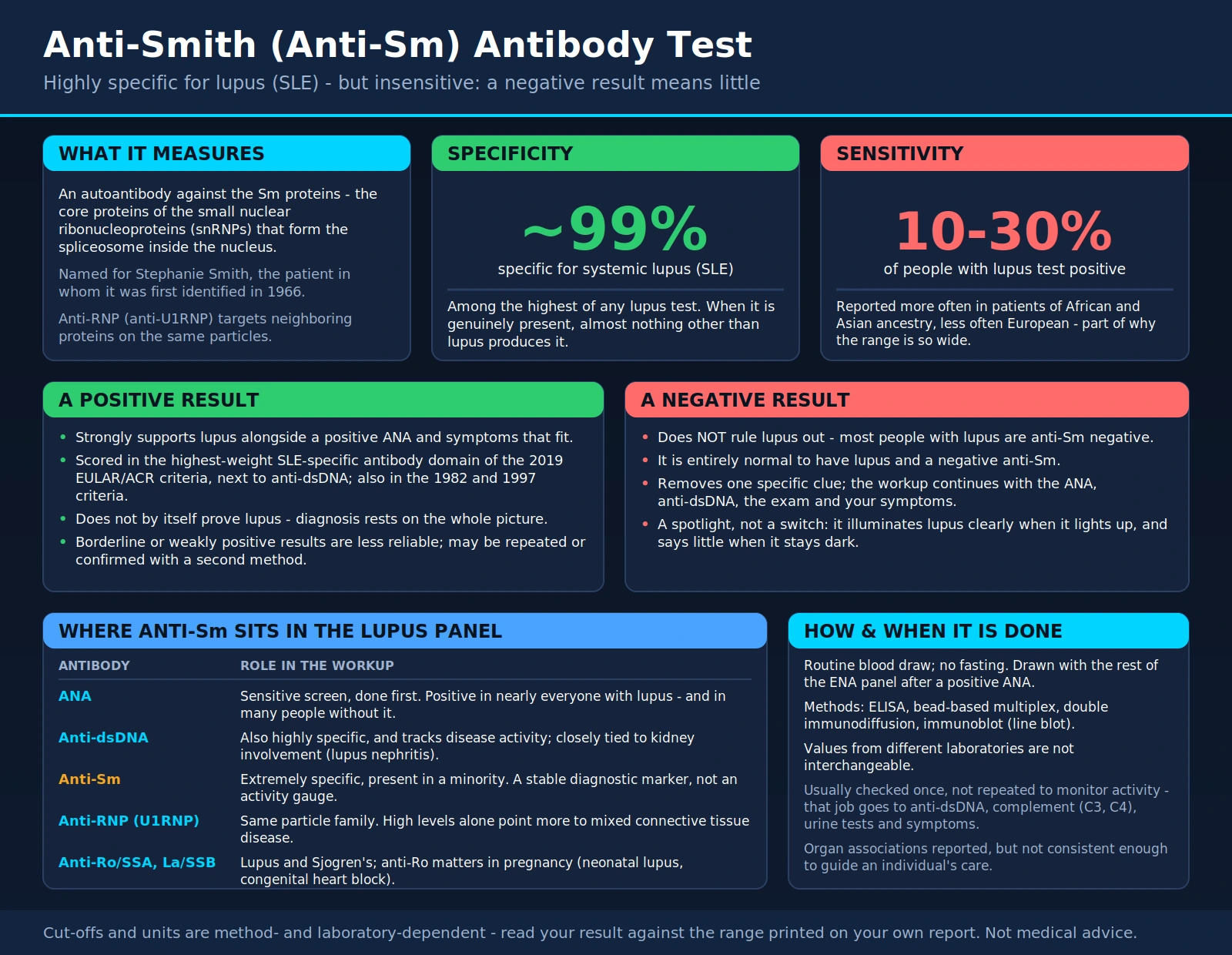
The anti-Smith antibody — almost always written anti-Sm — is a blood test for a very particular autoantibody: one your immune system makes against a cluster of proteins that live inside the nucleus of your own cells. Its odd name has nothing to do with a scientist; it comes from Stephanie Smith, the patient in whom the antibody was first identified in 1966. What makes anti-Sm worth knowing about is a single, powerful fact: it is one of the most specific antibodies for systemic lupus erythematosus (SLE, or lupus). When it is genuinely present, lupus becomes a very strong explanation, because almost nothing else produces it.
But there is an equally important second fact that keeps this test honest, and it is the part patients most need to hear: anti-Sm is highly specific but has low sensitivity. It shows up in only a minority of people with lupus — roughly 10–30% — so a negative anti-Sm does not rule lupus out. This page explains, in plain language, what the antibody is, why it carries so much weight when positive, how it fits alongside the other lupus antibodies (especially anti-dsDNA), when doctors order it, how to read a positive or negative result, what the test involves, and the honest limits of what one number can tell you. Above all: a lupus diagnosis is made by putting your symptoms and several tests together, never by a single antibody.
Table of Contents
- What the Anti-Smith Antibody Is
- Why It Matters: The Most Specific Lupus Antibody
- Specific but Not Sensitive: The Honest Trade-Off
- Where Anti-Sm Fits in the Lupus Antibody Panel
- When Anti-Sm Is Ordered
- Reading a Positive or Negative Result
- Possible Organ Associations
- How the Test Is Done
- What to Ask Your Doctor
- Research Papers
- Connections
- Featured Videos
What the Anti-Smith Antibody Is
Deep inside every cell, in the nucleus, sits the machinery that reads and edits your genetic instructions. Part of that machinery is a family of tiny particles called small nuclear ribonucleoproteins, usually shortened to snRNPs (spoken as “snurps”). Each snRNP is a bundle of small RNA molecules wrapped in a set of core proteins. Those core proteins — known as the Sm proteins — are the target of the anti-Smith antibody. In other words, anti-Sm is an autoantibody: an antibody that, instead of attacking a germ, turns inward and binds a normal part of your own cells.
The snRNPs that carry the Sm proteins do essential work. They are the heart of the spliceosome, the cellular editor that trims the raw copies of your genes into finished messages the cell can use. This is housekeeping every cell depends on, which is one reason the immune system is not supposed to target it. When tolerance — the body’s learned habit of leaving its own tissues alone — breaks down in lupus, some people begin producing antibodies against these interior structures.
A closely related antibody, anti-RNP (anti-U1RNP), targets a neighboring set of proteins on the same family of particles. Because anti-Sm and anti-RNP point at overlapping structures, they frequently appear together, and labs usually measure them side by side. The distinction matters, though: as you will see, anti-Sm is the far more specific flag for lupus, while anti-RNP alone points in other directions.
One more piece of background helps explain why anti-Sm is treated as a genuine marker rather than background noise. In people who later develop lupus, these autoantibodies can appear in the blood years before any symptoms — a landmark study following stored blood samples found that lupus-related antibodies, including anti-Sm, often showed up well ahead of diagnosis, with anti-Sm tending to appear relatively late in that build-up. That tells us the antibody reflects a real, unfolding autoimmune process, not a random blip.
Why It Matters: The Most Specific Lupus Antibody
The reason doctors care about anti-Sm comes down to one word: specificity. Some antibodies are found in many conditions and even in healthy people, so a positive result raises questions without answering them. Anti-Sm is the opposite. It is so tightly bound to lupus that when it is truly present, lupus is very likely the reason. Studies put its specificity for SLE at around 99% — among the highest of any lupus test. That is why it earns the description “the most specific antibody for lupus,” a phrase you may see in your own records.
This is also why anti-Sm is written into the formal classification criteria that experts use to define lupus. In the widely used 2019 EULAR/ACR criteria, a positive ANA is the required entry point, and then various features are scored. Anti-Sm sits in the highest-value antibody group — the same “SLE-specific antibody” domain as anti-dsDNA — and a positive result there adds substantial weight toward classifying someone as having lupus. It held a similar place in the earlier 1982 and 1997 criteria. So although anti-Sm is present in only a minority of patients, when it is there, it counts heavily.
It is worth being clear about what “specific” does and does not mean. A specific test rarely raises a false alarm — a positive anti-Sm is hard to explain by anything other than lupus. But specificity says nothing about how often the test catches lupus. That is a separate quality, sensitivity, and it is exactly where anti-Sm is weak — the subject of the next section.
Specific but Not Sensitive: The Honest Trade-Off
Here is the caveat that keeps anti-Sm honest, and it is the single most important thing to understand about this test. Anti-Sm is highly specific but has low sensitivity. Sensitivity is a test’s ability to find the people who truly have the disease. A very sensitive test rarely misses cases. Anti-Sm misses most of them: it is found in only roughly 10–30% of people with lupus, depending on the population studied and the laboratory method used.
The practical consequence follows directly:
- A positive anti-Sm carries a lot of weight. Because so few things other than lupus produce it, a genuine positive strongly supports the diagnosis.
- A negative anti-Sm settles almost nothing. Since most people with lupus never test positive for it, a negative result cannot rule lupus out. It is entirely normal to have lupus and a negative anti-Sm.
That asymmetry is the whole point of the test, and missing it causes real distress. A negative anti-Sm is not an all-clear; it simply means this one specific clue was not found, and the search continues with the ANA result, the other antibodies, the physical exam, and how you actually feel. There is also a known pattern in who tends to test positive: anti-Sm is reported more often in patients of African and Asian ancestry and less often in those of European ancestry, which is part of why the “10–30%” figure spans such a wide range. None of this changes the core message — positive means a lot, negative means little.
Where Anti-Sm Fits in the Lupus Antibody Panel
Anti-Sm is almost never ordered by itself. It belongs to a small family of antibodies that doctors read together, usually as part of an extractable nuclear antigen (ENA) panel, after a positive ANA has opened the question of lupus. Each member of the panel answers a slightly different question:
- ANA (antinuclear antibody) — the sensitive screen that comes first. Nearly everyone with lupus has a positive ANA, but so do many people without it, so a positive ANA raises the question rather than answering it. See ANA Test.
- Anti-dsDNA — the other highly specific lupus antibody. Crucially, anti-dsDNA also tends to track disease activity and is closely tied to kidney involvement (lupus nephritis), so doctors follow its rising and falling levels over time. See Anti-dsDNA.
- Anti-Sm — extremely specific, but present in a minority, and generally a stable diagnostic marker rather than an activity gauge (more on that below).
- Anti-RNP (anti-U1RNP) — targets a neighboring part of the same particle as anti-Sm. On its own, at high levels, it points more toward mixed connective tissue disease than classic lupus.
- Anti-Ro/SSA and anti-La/SSB — seen in lupus but also strongly in Sjögren’s syndrome; anti-Ro also matters in pregnancy because of its link to neonatal lupus and congenital heart block.
The most useful contrast to hold in mind is anti-Sm versus anti-dsDNA. Both are specific enough to help confirm lupus, but they play different roles. Anti-dsDNA is a moving number: it commonly climbs during flares and falls with treatment, and it is one of the flags watched for kidney trouble, so it is measured repeatedly over the years. Anti-Sm is more of a fixed number: once you are positive you tend to stay positive, and its level generally does not rise and fall in step with flares. That makes anti-Sm a strong diagnostic marker — a clue about whether you have lupus — but a poor monitoring tool. Doctors do not usually repeat anti-Sm to gauge how active your disease is; that job falls to anti-dsDNA, complement (C3 and C4), urine testing, and your symptoms.
When Anti-Sm Is Ordered
Anti-Sm testing has a fairly narrow, logical place in the workup, and knowing it can make a string of blood draws feel less arbitrary.
- After a positive ANA, when lupus is on the table. The usual trigger is a positive ANA in someone whose symptoms could fit lupus — for example a butterfly-shaped facial rash, joint pain, unexplained fatigue, mouth sores, hair loss, sun-sensitive rashes, or kidney findings. At that point the doctor orders the lupus-specific antibodies, and anti-Sm is typically part of that ENA panel alongside anti-dsDNA, anti-RNP, and anti-Ro/La.
- To help confirm or firm up a diagnosis. Because a positive anti-Sm is so specific, it can be the piece that turns a “probably lupus” into a much more confident picture, especially when the case is otherwise ambiguous.
- Usually once, not repeatedly. Unlike anti-dsDNA, anti-Sm is generally checked to answer the diagnostic question rather than to monitor activity, so it is not typically repeated at every visit. A doctor might recheck it in specific situations, but routine serial anti-Sm testing is not the norm.
In short, anti-Sm is a confirmatory move that follows a positive screen, interpreted next to the rest of the panel and, above all, next to your actual symptoms and exam.
Reading a Positive or Negative Result
Reference ranges and cutoffs vary by laboratory and method, so your report will state its own definition of “negative,” “equivocal,” and “positive.” Read your result against the range printed on your report. With that in mind, here is how to think about the common outcomes — remembering always that antibodies are clues, not verdicts.
- A clearly positive anti-Sm strongly supports lupus, particularly alongside a positive ANA and symptoms that fit. It does not, by itself, prove lupus — diagnosis still rests on the whole picture — but among lab clues it is one of the more decisive ones.
- A negative anti-Sm does not rule out lupus. This bears repeating because it is so often misunderstood. Most people with lupus are anti-Sm negative. A negative result removes one specific clue; it does not close the case. Plenty of people carry a confident lupus diagnosis with a negative anti-Sm, resting instead on their ANA, anti-dsDNA, clinical features, and other findings.
- A borderline or weakly positive result is worth interpreting cautiously. Depending on the method, low-level signals can be less reliable, so a doctor may repeat the test, confirm it with a second method, or simply weigh it lightly against the stronger evidence in your chart.
- A positive anti-Sm without lupus symptoms is uncommon given how specific the antibody is, but no test is perfect. In that situation the result is interpreted in context; it may prompt closer follow-up rather than an immediate diagnosis.
The honest summary is that anti-Sm behaves like a spotlight, not a switch. When it lights up, it illuminates lupus clearly. When it stays dark, it simply has not found this particular clue — and the search goes on using everything else your doctor has gathered.
Possible Organ Associations
Beyond diagnosis, researchers have long asked whether a positive anti-Sm predicts which parts of the body lupus will affect. This is an area where honesty matters more than a tidy answer, because the findings are genuinely mixed.
Some studies — including large patient cohorts — have reported links between anti-Sm and particular features, such as kidney involvement (lupus nephritis), effects on the nervous system (neuropsychiatric lupus), and other manifestations. Other studies find weaker connections or none at all, and the patterns differ across ethnic groups and across the different laboratory methods used to measure the antibody. Review articles that have weighed this literature describe the associations as real in places but not consistent or strong enough to guide the care of an individual.
The practical takeaway is deliberately modest. A positive anti-Sm is a meaningful diagnostic clue, but it is not a reliable crystal ball for predicting your personal course, and it should not be read as a forecast that any specific organ will be harmed. Your doctor watches for organ involvement directly — with kidney (urine and blood) tests, blood counts, complement levels, anti-dsDNA trends, and a careful history and exam — rather than inferring it from anti-Sm alone. If you see anti-Sm mentioned in connection with a particular complication, treat it as one small strand of evidence, not a prediction.
How the Test Is Done
For you, the test is straightforward: a routine blood draw from a vein in the arm, usually taken at the same time as the other lupus antibodies so a single sample covers the whole panel. No special preparation — such as fasting — is generally required, though you should follow whatever instructions your own clinic gives.
Behind the scenes, the laboratory can measure anti-Sm in more than one way, and the method influences the result:
- ELISA and modern multiplex assays. Most labs today use an enzyme-linked immunosorbent assay (ELISA) or a bead-based multiplex platform that measures several ENA antibodies at once. These are automated, convenient, and give a numeric result, but different kits can disagree at the margins.
- Immunodiffusion and immunoblot (line blot). Older techniques such as double immunodiffusion are very specific and were long considered a reference standard; line/immunoblot assays remain in use and report a banded pattern for each antibody. Some labs confirm a positive screening result with one of these more specific methods.
Because methods differ, a couple of practical points follow. First, a numeric value from one laboratory is not directly interchangeable with a value from another. Second, when a result is borderline or does not match the clinical picture, labs and clinicians may cross-check with a second method before acting on it. And because anti-Sm is used mainly to help make a diagnosis rather than to track activity, it does not usually need the repeated, same-lab-over-time follow-up that anti-dsDNA does.
What to Ask Your Doctor
Anti-Sm is ordered and interpreted by a clinician — often a rheumatologist — and the result is never meant to stand alone. It is worth having a real conversation, and these questions can help:
- “What does my anti-Sm result mean in the context of my ANA, my anti-dsDNA, and my symptoms?” The panel is read as a whole, not one line at a time.
- “If my anti-Sm is negative, does that make lupus less likely?” The honest answer is usually “not by much,” because the test misses most cases — a good doctor will explain why.
- “Will you repeat this test?” Typically anti-Sm is not repeated to monitor disease; if activity needs tracking, that is anti-dsDNA, complement, urine tests, and your symptoms.
- “What are we watching for going forward, and which tests actually track my disease over time?” This shifts the focus from a single label to ongoing, practical monitoring.
The reassuring bottom line is worth holding onto: a lupus diagnosis is made clinically and serologically together — by combining your history, your physical exam, and a set of blood tests — never by one antibody in isolation. Anti-Sm is a strong and distinctive clue when it is positive, and a quiet non-answer when it is negative. Understanding that difference is one small way to walk into the conversation better informed and a little less alone. Bring your questions; a good clinician will welcome them.
Research Papers
- Aringer M, Costenbader K, Daikh D, et al. 2019 European League Against Rheumatism/American College of Rheumatology classification criteria for systemic lupus erythematosus. Arthritis & Rheumatology. 2019;71(9):1400–1412. doi:10.1002/art.40930 — the current classification criteria; anti-Sm sits in the highest-weight antibody domain alongside anti-dsDNA.
- Tan EM, Cohen AS, Fries JF, et al. The 1982 revised criteria for the classification of systemic lupus erythematosus. Arthritis & Rheumatism. 1982;25(11):1271–1277. doi:10.1002/art.1780251101 — the classic criteria set that first embedded anti-Sm as an immunologic marker for lupus.
- Benito-Garcia E, Schur PH, Lahita R; American College of Rheumatology Ad Hoc Committee on Immunologic Testing Guidelines. Guidelines for immunologic laboratory testing in the rheumatic diseases: anti-Sm and anti-RNP antibody tests. Arthritis Care & Research. 2004;51(6):1030–1044. doi:10.1002/art.20836 — the dedicated guideline on when and how anti-Sm testing is genuinely useful.
- Migliorini P, Baldini C, Rocchi V, Bombardieri S. Anti-Sm and anti-RNP antibodies. Autoimmunity. 2005;38(1):47–54. doi:10.1080/08916930400022715 — a focused review of what anti-Sm and anti-RNP target and how they relate clinically.
- Kavanaugh A, Tomar R, Reveille J, Solomon DH, Homburger HA. Guidelines for clinical use of the antinuclear antibody test and tests for specific autoantibodies to nuclear antigens. Archives of Pathology & Laboratory Medicine. 2000;124(1):71–81. doi:10.5858/2000-124-0071-GFCUOT — a foundational guideline on how ANA and specific autoantibody tests should be ordered and read.
- Fanouriakis A, Kostopoulou M, Alunno A, et al. 2019 update of the EULAR recommendations for the management of systemic lupus erythematosus. Annals of the Rheumatic Diseases. 2019;78(6):736–745. doi:10.1136/annrheumdis-2019-215089 — management guidance that frames how lupus antibodies inform diagnosis and monitoring.
- Arbuckle MR, McClain MT, Rubertone MV, et al. Development of autoantibodies before the clinical onset of systemic lupus erythematosus. New England Journal of Medicine. 2003;349(16):1526–1533. doi:10.1056/NEJMoa021933 — showed lupus antibodies, including anti-Sm, can appear in the blood years before symptoms.
- Ni JD, Yao X, Pan HF, Li XP, Xu JH, Ye DQ. Clinical and serological correlates of anti-Sm autoantibodies in Chinese patients with systemic lupus erythematosus: 1,584 cases. Rheumatology International. 2009;29(11):1323–1326. doi:10.1007/s00296-009-0855-1 — a large cohort examining which clinical features do and do not track with anti-Sm.
- Rahman A, Isenberg DA. Systemic lupus erythematosus. New England Journal of Medicine. 2008;358(9):929–939. doi:10.1056/NEJMra071297 — a clear, comprehensive overview of lupus and its autoantibodies.
- Tsokos GC. Systemic lupus erythematosus. New England Journal of Medicine. 2011;365(22):2110–2121. doi:10.1056/NEJMra1100359 — a mechanism-focused review of how lupus arises and injures tissue.
- Yaniv G, Twig G, Shor DB, et al. A volcanic explosion of autoantibodies in systemic lupus erythematosus: a diversity of 180 different antibodies found in SLE patients. Autoimmunity Reviews. 2015;14(1):75–79. doi:10.1016/j.autrev.2014.10.003 — maps where anti-Sm sits among the many antibodies seen in lupus.
- Hahn BH. Antibodies to DNA. New England Journal of Medicine. 1998;338(19):1359–1368. doi:10.1056/NEJM199805073381906 — a classic review of lupus autoantibodies that contrasts anti-DNA with the more specific anti-Sm.
Connections
- All Lab Tests
- Anti-dsDNA (Lupus Antibody)
- ANA Test (Antinuclear Antibody)
- Complement (C3, C4, CH50)
- Immunoglobulins (IgG, IgA, IgM)
- Anti-Cardiolipin Antibodies
- Rheumatoid Factor (RF)
- Lupus (SLE)
- ANA, dsDNA, and Lupus Autoantibodies
- ACR/EULAR 2019 Classification Criteria for SLE
- All Rheumatology
- Immunology