ACE Level (Angiotensin-Converting Enzyme)
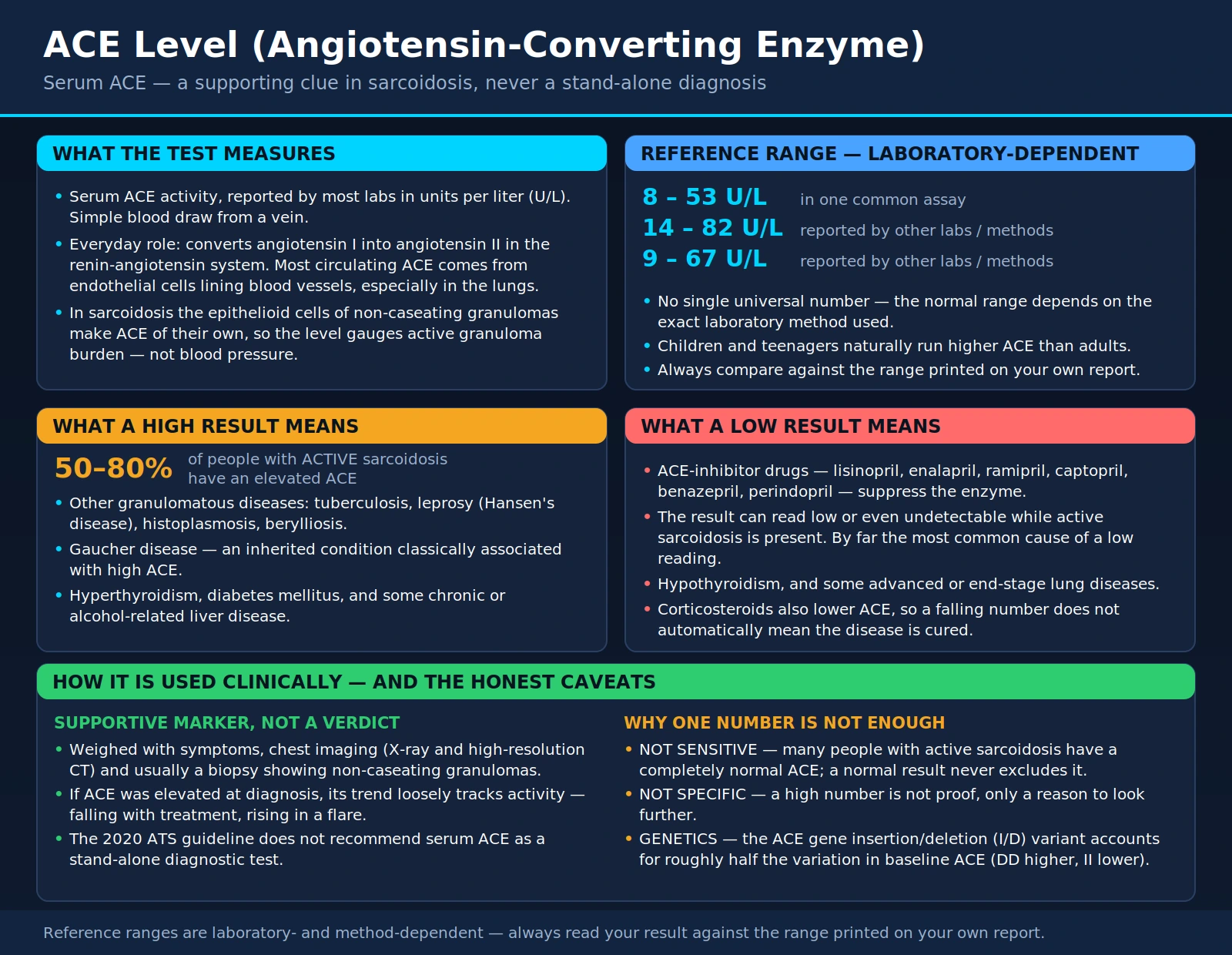
An ACE test is a simple blood test that measures the amount of angiotensin-converting enzyme (ACE) circulating in your bloodstream. You may recognize the name ACE from blood-pressure medicines called ACE inhibitors — but this test is a different thing entirely. It is not a drug, and it is not a heart or blood-pressure test. Instead, doctors most often order a serum ACE level to help evaluate sarcoidosis, an inflammatory condition in which small clusters of immune cells called granulomas form in the lungs, lymph nodes, skin, eyes, and other organs. Those granulomas produce extra ACE, so the blood level tends to rise when sarcoidosis is active. Here is the honest part, and the single most important thing to take from this page: ACE is a helpful supporting clue, not a stand-alone answer. A normal result does not rule sarcoidosis out, a high result does not prove it, and several unrelated conditions — plus certain medicines — can push the number up or down. This page explains what the enzyme is, why the test is used, how to read the result sensibly, and which other tests round out the picture.
Table of Contents
- What ACE Actually Is
- The Test vs. the Drug: A Quick Clarification
- Why the Test Is Ordered: Sarcoidosis
- How the Test Is Done and What the Numbers Mean
- How to Interpret Your Result: The Honest Caveats
- Other Conditions That Change ACE Levels
- Using ACE to Track Disease Activity
- Related and Complementary Tests
- When to Talk with a Doctor
- Research Papers
- Connections
- Featured Videos
What ACE Actually Is
An enzyme is a protein that speeds up a chemical reaction in the body. Angiotensin-converting enzyme has a well-known day job in the renin-angiotensin system, the hormone loop that manages blood pressure and fluid balance. It takes a molecule called angiotensin I and converts it into angiotensin II — a powerful hormone that narrows blood vessels, nudges the kidneys to hold onto salt and water, and raises blood pressure. In its everyday role, most of the ACE in your blood comes from the endothelial cells that line your blood vessels, especially the enormous capillary network of the lungs.
So why would a blood-pressure enzyme be used as a marker for an inflammatory disease? Because the amount of ACE in the blood can reflect something quite separate from blood pressure. When granulomas form, the epithelioid cells that make up those granulomas — activated immune cells derived from macrophages — manufacture and release ACE of their own. The more active, widespread granulomatous tissue a person has, the more ACE spills into the circulation. In this setting, a serum ACE level is being read as a rough gauge of how much granuloma tissue is present and active, not as a measure of blood pressure at all. That is the key idea behind the test.
The Test vs. the Drug: A Quick Clarification
Because the names collide, this is worth spelling out. ACE inhibitors — lisinopril, enalapril, ramipril, captopril, benazepril, perindopril, and others — are prescription drugs that block the enzyme in order to lower blood pressure and protect the heart and kidneys. The serum ACE test measures the enzyme itself. They are related in one practical way that matters a great deal: if you take an ACE-inhibitor drug, it suppresses the enzyme's activity, so the blood test reads falsely low (more on this below).
But the two are not used for the same purpose. The ACE test is not a way to check whether your blood-pressure medicine is "working," and a high or low ACE level is never a reason to start or stop an ACE inhibitor on your own. If you are on one of these medicines, the important thing is simply that your clinician knows, so the result can be read correctly.
Why the Test Is Ordered: Sarcoidosis
Sarcoidosis is the headline reason a serum ACE level gets drawn. It is an inflammatory disease of unknown cause in which the immune system builds tiny nodules of cells — non-caseating granulomas — in one or more organs. The lungs and the lymph nodes in the chest are involved most often, which is why coughing, breathlessness, and fatigue are common, but sarcoidosis can also affect the skin, eyes, heart, liver, and nervous system.
Because the granuloma cells produce ACE, the blood level is elevated in a large share of people with active sarcoidosis — studies generally put the figure somewhere around 50 to 80 percent. That makes the test genuinely useful as a supportive marker: one more piece of evidence that, combined with a person's symptoms, chest imaging, and usually a tissue biopsy, helps build the overall case. In someone whose diagnosis is already established and whose ACE started out high, the level can also be followed over time as a loose signal of how the disease is behaving and whether treatment is helping.
The word to hold onto is supportive. ACE is an adjunct — a helper — and never the whole story. No responsible clinician diagnoses or excludes sarcoidosis from an ACE number alone, and the reasons why are the subject of the next two sections.
How the Test Is Done and What the Numbers Mean
The test itself is easy. A technician draws blood from a vein in your arm, and the sample is measured for ACE activity in the laboratory. Most labs report the result in units per liter (U/L). Usually no special preparation is needed, though your lab may give specific instructions — and if you take an ACE inhibitor, tell the ordering clinician rather than skipping a dose on your own.
Reference ranges are where people get tripped up, because there is no single universal number. The normal range depends on the exact laboratory method used, so different labs publish different cut-offs. As a rough sense of scale, adult reference ranges reported by clinical labs often fall somewhere in the region of:
- Roughly 8–53 U/L in one common assay,
- and other labs report ranges such as 14–82 U/L or 9–67 U/L depending on the method.
Two practical points follow from this. First, always compare your result against the reference range printed on your own report — not against a number you found online. Second, children and teenagers naturally run higher ACE than adults, so a pediatric result must be read against age-appropriate ranges or it will look alarmingly (and misleadingly) "high." A result just above or below the line is rarely meaningful on its own; the trend and the clinical context matter far more than a single value.
How to Interpret Your Result: The Honest Caveats
This is the most important section on the page. ACE has real limitations, and understanding them prevents a lot of needless worry and false reassurance alike.
It is not sensitive enough to rule sarcoidosis out
A substantial number of people with sarcoidosis — including many with genuinely active disease — have a completely normal ACE level. So a normal result never excludes the diagnosis. If your symptoms and imaging point toward sarcoidosis, a normal ACE does not close the door.
It is not specific enough to rule sarcoidosis in
ACE rises in a long list of other conditions (see the next section), so a high number is not proof of anything by itself. On its own, an elevated ACE is a reason to look further, not a diagnosis.
ACE-inhibitor drugs mask the result
This is a big, practical point that is easy to miss. If you take an ACE inhibitor such as lisinopril or enalapril, the drug directly suppresses the enzyme, so your measured ACE can read low or even undetectable even when active sarcoidosis is present. In other words, the medicine can hide a value that would otherwise be high. Your clinician needs your complete, current medication list to interpret the test — and you should not stop a prescribed medicine on your own to "get a truer" reading. If timing matters, that is a conversation to have with your doctor.
Your genes set part of your baseline
The ACE gene carries a common insertion/deletion (I/D) variation. People with the DD version naturally run higher ACE levels, while those with the II version run lower — and this genetic difference accounts for roughly half of the person-to-person variation in baseline ACE. That is why some researchers have proposed genotype-corrected reference ranges. In everyday terms, it means one person's "high-normal" could be another person's mild elevation, which further blunts the value of a single number read in isolation.
The bottom line: a serum ACE level is interpreted alongside chest imaging, tissue biopsy, and the full clinical picture — never as a stand-alone verdict.
Other Conditions That Change ACE Levels
Part of why ACE is not specific is that many conditions besides sarcoidosis can move the number. Elevated ACE has been reported in:
- Other granulomatous diseases — tuberculosis, leprosy (Hansen's disease), fungal infections such as histoplasmosis, and berylliosis (chronic beryllium disease). These, like sarcoidosis, build granulomas that make ACE.
- Gaucher disease — an inherited metabolic condition classically associated with high ACE.
- Endocrine and metabolic conditions — hyperthyroidism and diabetes mellitus, among others.
- Some liver conditions — certain forms of chronic liver disease and alcohol-related liver injury.
And several things push ACE down, which can produce a falsely reassuring low value:
- ACE-inhibitor medicines — by far the most common and important cause of a low reading.
- Hypothyroidism, and some advanced or end-stage lung diseases.
None of this makes the test useless — it simply means the number has to be read with the rest of the clinical picture in view, not on its own.
Using ACE to Track Disease Activity
Beyond the initial work-up, ACE has a second, more limited role: monitoring. In a person with confirmed sarcoidosis whose ACE was elevated at diagnosis, the trend over time can loosely mirror how active the disease is. ACE often falls as treatment (for example, corticosteroids) brings inflammation under control, and it may climb again during a flare. Watching that line can add supporting information about whether therapy is helping.
The caveats matter here too. Corticosteroids and related treatments can lower ACE partly through their effect on the granulomas and the enzyme itself, so a falling number does not automatically mean the disease is cured. The correlation between ACE and a person's actual symptoms, lung function, and imaging is loose rather than tight, and current guidelines do not endorse ACE as a stand-alone measure of disease activity. Used sensibly, it is one supporting trend line watched together with how you feel, breathing tests, and pictures of the lungs — not a scoreboard on its own.
Related and Complementary Tests
Because ACE is only a supporting clue, it is almost always ordered as part of a broader evaluation. Depending on the situation, that can include:
- Chest imaging — a chest X-ray and, more sensitively, a high-resolution CT scan of the chest. Imaging is often the most informative single step, showing patterns such as enlarged lymph nodes at the center of the chest and characteristic lung changes.
- Biopsy — sampling affected tissue to look for non-caseating granulomas (with infections and other causes excluded) remains the closest thing to a diagnostic gold standard for sarcoidosis.
- Calcium levels — sarcoidosis granulomas can overproduce active vitamin D, which raises blood and urine calcium. Hypercalcemia matters for kidney and bone health and is checked routinely.
- Inflammatory markers — the ESR and CRP are non-specific gauges of overall inflammation that help round out the picture.
- Other granuloma-related biomarkers — serum lysozyme and the soluble interleukin-2 receptor (sIL-2R) are alternative or add-on markers, each carrying the same specificity limits as ACE.
- Organ-specific tests — depending on symptoms, an eye examination, heart testing (ECG or cardiac MRI), and pulmonary function tests may be added.
When to Talk with a Doctor
See a clinician if you have unexplained symptoms that could point toward sarcoidosis or another granulomatous condition — a persistent dry cough, shortness of breath, ongoing fatigue, swollen lymph nodes, red or painful eyes, or certain skin rashes and joint aches. These deserve a proper evaluation rather than a self-diagnosis based on any single blood test.
If you have already had an ACE level drawn, a few good questions help you make sense of it:
- What is my lab's reference range, and where does my result fall within it?
- Do I take any medicine — especially an ACE inhibitor — that could be raising or lowering the number?
- How does this result fit with my imaging, biopsy, and other tests?
Because a normal ACE does not rule sarcoidosis out and a high one does not confirm it, treat the number as a conversation starter, not a final answer. Bring your full medication list, and let the whole clinical picture — not one value — guide what happens next.
Research Papers
- Lieberman J. Elevation of serum angiotensin-converting-enzyme (ACE) level in sarcoidosis. The American Journal of Medicine. 1975;59(3):365–372. doi:10.1016/0002-9343(75)90395-2 — the original report linking a high serum ACE to sarcoidosis, which launched the test into clinical use.
- Silverstein E, Friedland J, Lyons HA, Gourin A. Elevation of angiotensin-converting enzyme in granulomatous lymph nodes and serum in sarcoidosis: clinical and possible pathogenic significance. Annals of the New York Academy of Sciences. 1976;278:498–513. doi:10.1111/j.1749-6632.1976.tb47062.x — showed the granuloma tissue itself is the source of the extra enzyme.
- Studdy PR, Bird R. Serum angiotensin converting enzyme in sarcoidosis—its value in present clinical practice. Annals of Clinical Biochemistry. 1989;26(1):13–18. doi:10.1177/000456328902600102 — an early, honest appraisal of how much the test actually helps in practice.
- Rigat B, Hubert C, Alhenc-Gelas F, et al. An insertion/deletion polymorphism in the angiotensin I-converting enzyme gene accounting for half the variance of serum enzyme levels. Journal of Clinical Investigation. 1990;86(4):1343–1346. doi:10.1172/JCI114844 — established that genetics set roughly half of a person's baseline ACE.
- Gilbert S, Steinbrech DS, Landas SK, Hunninghake GW. Amounts of angiotensin-converting enzyme mRNA reflect the burden of granulomas in granulomatous lung disease. American Review of Respiratory Disease. 1993;148(2):483–486. doi:10.1164/ajrccm/148.2.483 — tied ACE production directly to how much granuloma tissue is present.
- American Thoracic Society, European Respiratory Society, World Association of Sarcoidosis and Other Granulomatous Disorders. Statement on sarcoidosis. American Journal of Respiratory and Critical Care Medicine. 1999;160(2):736–755. doi:10.1164/ajrccm.160.2.ats4-99 — the international consensus statement; positions ACE as supportive rather than diagnostic.
- Tomita H, Sato S, Matsuda R, et al. Serum lysozyme levels and clinical features of sarcoidosis. Lung. 1999;177(3):161–167. doi:10.1007/PL00007637 — examines a companion granuloma marker with strengths and limits much like ACE.
- Iannuzzi MC, Rybicki BA, Teirstein AS. Sarcoidosis. New England Journal of Medicine. 2007;357(21):2153–2165. doi:10.1056/NEJMra071714 — a widely cited clinical review of the disease and how it is worked up.
- Kruit A, Grutters JC, Gerritsen WBM, et al. ACE I/D-corrected Z-scores to identify normal and elevated ACE activity in sarcoidosis. Respiratory Medicine. 2007;101(3):510–515. doi:10.1016/j.rmed.2006.06.025 — used ACE genotype to make the reference range fairer for each individual.
- Baughman RP, Culver DA, Judson MA. A concise review of pulmonary sarcoidosis. American Journal of Respiratory and Critical Care Medicine. 2011;183(5):573–581. doi:10.1164/rccm.201006-0865CI — a practical modern overview of diagnosis and monitoring.
- Ungprasert P, Carmona EM, Crowson CS, Matteson EL. Diagnostic utility of angiotensin-converting enzyme in sarcoidosis: a population-based study. Lung. 2016;194(1):91–95. doi:10.1007/s00408-015-9826-3 — quantified the test's modest sensitivity and specificity in a real-world population.
- Crouser ED, Maier LA, Wilson KC, et al. Diagnosis and detection of sarcoidosis: an official American Thoracic Society clinical practice guideline. American Journal of Respiratory and Critical Care Medicine. 2020;201(8):e26–e51. doi:10.1164/rccm.202002-0251ST — the current guideline; does not recommend serum ACE as a stand-alone diagnostic test.
Connections
- All Lab Tests
- Sarcoidosis
- Cardiac Sarcoidosis
- Pulmonology (Lung Conditions)
- Immunology
- Tuberculosis
- Berylliosis
- Inflammatory Markers (ESR & CRP)
- Calcium (Hypercalcemia in Sarcoidosis)
- Vitamin D
- All Conditions