White Peony Root (Bai Shao): History and Traditional Use
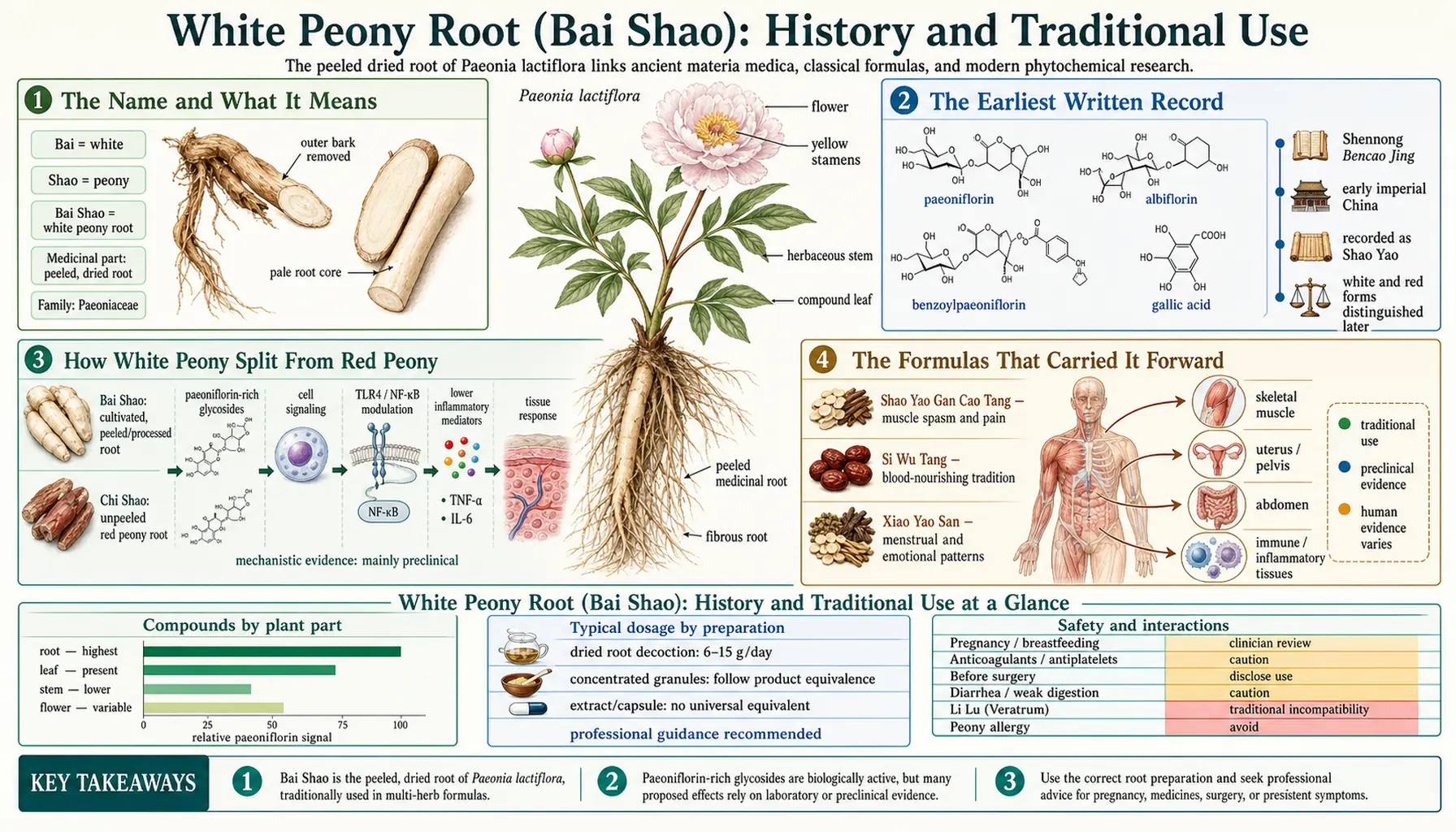
Peony has been in the Chinese medicine cabinet for roughly two thousand years, and in the Chinese garden for longer than that. Along the way one plant — Paeonia lactiflora — became two distinct drugs separated only by how the root is processed, was renamed by a German naturalist working for the Russian crown, became the most popular cut flower of nineteenth-century Paris, and ended up as the raw material for an approved pharmaceutical. This page follows that thread from the earliest written record to the modern trial literature, and is honest about which parts of the story are documented and which are traditional attribution.
Table of Contents
- The Name and What It Means
- The Earliest Written Record
- How White Peony Split From Red Peony
- The Formulas That Carried It Forward
- How the Root Was Prepared
- Botanical Naming: Pallas and the Russian Expeditions
- Cultivation and the Regional Appellations
- Spread to Japan, Korea and Vietnam
- The European Peony: A Completely Different Tradition
- How It Entered Modern Research
- What Modern Science Confirmed — and What It Did Not
- Key Research Papers
- Connections
- Featured Videos
The Name and What It Means
The Chinese name for peony root is 芯药 sháo yào. The second character, 药 yào, simply means "medicine" — the same character used in the modern Chinese word for a pharmacy. The first character is harder to pin down; classical commentators offered several glosses, and the etymology is genuinely uncertain rather than settled.
The word appears strikingly early. A poem in the Shijing — the Book of Songs, the oldest anthology of Chinese verse, whose material dates to roughly the eleventh through seventh centuries BCE — describes young people meeting at a spring festival by the Zhen and Wei rivers and parting with the gift of a shaoyao. Whether the plant in that poem is the same species used medicinally is debated by philologists; it may have been a different flower entirely. What the poem does establish is that a plant of that name was culturally significant in China long before any surviving medical text mentions it.
Once the two drugs were separated, the names became descriptive: 白芯 bái sháo, "white peony," for the peeled root, and 赤芯 chì sháo, "red peony," for the unpeeled one. The colours refer to the appearance of the prepared root, not to the colour of the flower — a point that confuses gardeners constantly, since white-flowered and red-flowered cultivars can both yield either drug depending on how they are handled.
The genus name Paeonia comes from a different world entirely. In Greek myth, Paeon (or Paian) was physician to the gods; one telling has him healing Pluto of a wound with a root given to him by Leto, and being turned into the flower that carries his name to protect him from a jealous Asclepius. That myth belongs to the European peony tradition, which — as the section below explains — used the plant for something completely different.
The Earliest Written Record
Peony root enters the medical record in the Shen Nong Ben Cao Jing (神農本草經), the Divine Farmer's Classic of Materia Medica — the foundational Chinese drug text, traditionally attributed to the mythical emperor Shennong but in fact compiled from earlier oral and written material around the first to second century CE, in the Han dynasty. It lists 365 substances, one for each day of the year, sorted into three grades. Shao yao is there, described in terms that already emphasise pain relief and the resolution of abdominal masses and cramping.
Crucially, the Shen Nong Ben Cao Jing lists one peony, not two. The white/red distinction that governs modern practice does not exist yet in the earliest text.
Almost contemporaneously, peony appears in the single most influential clinical text in Chinese medical history: the Shang Han Za Bing Lun of Zhang Zhongjing, written around the turn of the third century CE and later split into the Shang Han Lun (Treatise on Cold Damage) and the Jin Gui Yao Lue (Essentials from the Golden Cabinet). Peony is in a remarkable number of Zhang's formulas. Two matter most for this page:
- Gui Zhi Tang (桂枝汤), the cinnamon-twig decoction that opens the Shang Han Lun — peony paired with cinnamon twig, ginger, jujube and licorice.
- Shao Yao Gan Cao Tang (芯药甘草汤) — peony and licorice alone, in equal parts, prescribed for cramping and spasm of the legs and abdomen.
That second formula is the historical anchor of everything modern research has done on peony and muscle cramps. It is roughly eighteen hundred years old, contains two ingredients, and is still dispensed daily in Japanese hospitals under the name Shakuyaku-kanzo-to. Very few prescriptions in any medical tradition have that kind of continuity.
The Jin Gui Yao Lue contributed Dang Gui Shao Yao San (当归芯药散), peony with dong quai, ligusticum, poria, atractylodes and alisma, used for lower-abdominal pain in pregnancy — a formula that remains in wide use in Japanese gynaecology today.
How White Peony Split From Red Peony
The division of one plant into two drugs is the most interesting thing in peony's history, and it happened gradually.
The commentator Tao Hongjing (456–536 CE), a Daoist scholar-physician who produced the Ben Cao Jing Ji Zhu — Collected Commentaries on the Classic of Materia Medica — around the year 500, is generally credited with the first note that more than one kind of shao yao was in circulation and that they were not equivalent. His remarks are brief and their exact interpretation is argued over, but they mark the point at which Chinese practitioners began recording that peony was not a single uniform drug.
The clear, formal separation came later. By the Song dynasty (960–1279 CE) — the era in which China built state pharmacies, printed standardised formularies and produced illustrated materia medica such as Su Song's Ben Cao Tu Jing of 1061 — white and red peony are listed as distinct entries with distinct indications. From that point onward the split is permanent:
- Bai shao — the cultivated root, boiled and peeled. A blood tonic: nourishes blood, softens the liver, preserves yin, relieves spasm and cramping pain.
- Chi shao — the wild or unprocessed root, bark left on. A blood mover: breaks up stasis, clears heat, disperses swelling.
What makes this fascinating from a modern standpoint is that the distinction is real chemistry arrived at empirically. The root bark carries most of the plant's gallotannins; boiling and peeling strips them out and leaves a starchier, less astringent root dominated by monoterpene glucosides. Analytical chemistry using modern instrumentation confirms that white and red peony have measurably different constituent profiles. Song-dynasty physicians had no way to know why the two behaved differently — but they were not imagining the difference.
Li Shizhen consolidated the picture in the Ben Cao Gang Mu (本草綱目), completed in 1578 and printed in 1596, the great synthesis of Chinese materia medica. His treatment of peony — describing cultivation, the processing that produces each drug and the separate indications — is essentially the account still taught today.
The Formulas That Carried It Forward
Bai shao's importance in Chinese medicine is less about the herb alone than about which formulas it anchors. Two Song-dynasty compilations did more than anything else to fix its role, above all the Tai Ping Hui Min He Ji Ju Fang — the Imperial Grace Formulary of the Great Peace and Benevolent Dispensary, the state pharmacy's official formula book, first issued in the late eleventh century and expanded through the twelfth. Two of its formulas made peony ubiquitous:
- Si Wu Tang (四物汤), the Four Substance Decoction: peony, dong quai, rehmannia and ligusticum. This is the base formula for "blood deficiency" in Chinese medicine and the ancestor of an enormous family of gynaecological prescriptions. Its components appear in earlier Tang-era sources, but the Song formulary is what standardised and spread it.
- Xiao Yao San (逾遥散), the Free and Easy Wanderer: peony with bupleurum, dong quai, atractylodes, poria, licorice, ginger and mint. Prescribed for the constellation of irritability, premenstrual tension, flank discomfort and digestive upset attributed to "liver qi constraint." It remains one of the most-prescribed formulas in the Chinese-speaking world.
The pattern across all these formulas is consistent enough to be worth stating plainly: wherever the classical literature describes cramping, gripping pain, tight tendons, spasm or menstrual pain, peony is in the prescription. Two thousand years of physicians reaching for the same herb for the same complaint is not proof of efficacy — traditional use never is — but it is a strong observational signal about an antispasmodic, and it is the signal that modern pharmacology went looking for and largely found.
How the Root Was Prepared
Traditional processing (pao zhi) is not incidental in Chinese pharmacy; it is treated as changing what the drug does. For peony the steps are:
- Growing. Plants are cultivated for three to four years so the storage roots thicken. Flower buds are often removed to push growth into the root rather than the bloom.
- Lifting. Roots are dug in summer or autumn, washed, and the crown end and fine rootlets trimmed away.
- Boiling and peeling. The roots are briefly boiled in water and the thin brown outer bark is scraped off — or peeled first and then boiled, depending on regional custom. Either way, this is the step that creates bai shao. Skip it and you have chi shao.
- Drying and slicing. Sun-dried, then cut crosswise into pale discs.
Further processing produced variants with their own traditional indications. Chao bai shao (炒白芯) is dry stir-fried until faintly yellow and was considered gentler on the digestion, preferred when there was loose stool. Jiu bai shao is stir-fried with wine, cu bai shao with vinegar, each said to direct the herb differently. Modern analytical work on stir-frying confirms that heating measurably alters the root's metabolite profile — again, an empirical tradition that turns out to have a chemical basis, even if the traditional rationale for each variant remains untested.
Botanical Naming: Pallas and the Russian Expeditions
The plant received its scientific name from outside China entirely.
Peter Simon Pallas (1741–1811) was a German naturalist recruited by Catherine the Great to the Imperial Academy of Sciences in St Petersburg. Between 1768 and 1774 he led one of the great scientific expeditions of the eighteenth century across Russia and Siberia, and published the results as Reise durch verschiedene Provinzen des Russischen Reichs — Travels Through Various Provinces of the Russian Empire. In the third volume, published in 1776, he described the wild peony he had encountered in Dauria and Siberia and named it Paeonia lactiflora. The formal citation recorded by the International Plant Names Index is precise: Paeonia lactiflora Pall., Reise durch verschiedene Provinzen des Russischen Reichs 3(1): 286, 1776.
The epithet lactiflora means "milk-flowered." It is a name that only makes sense if you have seen the wild plant: the wild form bears simple, single, creamy-white flowers, nothing like the enormous double blooms of garden cultivars. Pallas was describing a Siberian wildflower and had no reason to connect it to a Chinese pharmacy article that had been in use for fifteen centuries.
Because European taxonomy was slow to reconcile plants described from different regions, the species accumulated synonyms — Paeonia albiflora Pall. among them — which is why older herbals and some supplement labels still use names other than P. lactiflora. The accepted name today is Paeonia lactiflora Pall., and the standard author abbreviation "Pall." on a peony label is Pallas.
The related species matter here too. Paeonia veitchii Lynch, described from western China and named for the Veitch nursery dynasty that funded much late-Victorian plant collecting, is an accepted botanical source of red peony alongside wild P. lactiflora. And Paeonia suffruticosa, the woody tree peony, supplies an entirely separate drug — mu dan pi, the root bark, whose marker compound is paeonol rather than paeoniflorin.
Cultivation and the Regional Appellations
Chinese herbal commerce has long recognised dao di yao cai (道地药材) — "authentic regional medicinals," the idea that a herb from its traditional home region is superior. For bai shao that produced a set of trade names that function much like wine appellations:
- Hang bai shao — from the Hangzhou region of Zhejiang province. Historically the most prestigious and the most expensive.
- Bo bai shao — from Bozhou in Anhui province. Bozhou is the site of China's largest herbal wholesale market and dominates volume today.
- Chuan bai shao — from Sichuan.
- Shandong and several other provinces also produce commercially significant quantities.
Modern chemical analysis does find measurable differences in paeoniflorin content between production regions and between cultivation practices. What does not exist is any clinical trial comparing one region's root against another's in patients. The appellation system is real commerce and real chemistry; the claim that one region's root works better in people remains untested.
Spread to Japan, Korea and Vietnam
Chinese medical texts travelled with Buddhism and with diplomatic exchange, and peony travelled with them.
In Japan, Chinese medicine was absorbed from roughly the sixth and seventh centuries onward and gradually adapted into a distinct system: Kampo (漢方, "the Han method"). Japanese practice diverged from Chinese in an important way — it stayed unusually close to Zhang Zhongjing's original Han-dynasty formulas rather than following later Chinese theoretical elaborations. Peony, as shakuyaku, is central to Kampo, and Shao Yao Gan Cao Tang survives there under its Japanese reading as Shakuyaku-kanzo-to.
Kampo nearly died after the Meiji Restoration of 1868, when Japan reorganised its medical system on the German model and restricted licensure to Western-trained physicians. Its twentieth-century revival is what makes Japan unusual today: beginning in the late 1960s and expanding substantially in 1976, a defined list of Kampo extract formulas was approved for reimbursement under Japan's national health insurance. Manufacturers — Tsumura most prominently, whose products carry the familiar TJ- codes — produce them as standardised granule extracts to pharmaceutical manufacturing standards. Shakuyaku-kanzo-to is TJ-68. This is why the muscle-cramp research on peony is overwhelmingly Japanese: the formula is a routinely prescribed, insurance-covered, manufacturing-controlled product there, not a supplement.
In Korea, the same root is jakyak (작약) and is used throughout traditional Korean medicine in essentially the Chinese formulas. In Vietnam, it is bạch thược — a direct phonetic descendant of bai shao through Sino-Vietnamese vocabulary — and occupies the same place in the northern Vietnamese thuốc bắc ("northern medicine") tradition.
The European Peony: A Completely Different Tradition
Europe had its own peony medicine, and it is worth describing because it demonstrates how little traditional use alone guarantees.
Dioscorides, in De Materia Medica in the first century CE, describes peony — the European species Paeonia officinalis and its relatives — and the use that dominated European practice for the next fifteen hundred years was for epilepsy, "the falling sickness." Medieval and early modern European herbals repeat it: peony root, often worn as beads around the neck of a child rather than swallowed, was the standard amulet against convulsions. Galen endorsed it. It appears in English herbals into the seventeenth century.
That use has no modern support whatever. A root worn around the neck delivers no dose. The European peony tradition was long, continuous, endorsed by the highest medical authorities of its day — and wrong.
The contrast with the Chinese tradition is instructive rather than triumphal. Chinese practice used a different species, prepared it into a specific pharmaceutical form, gave it orally in gram quantities within multi-herb decoctions, and directed it at cramping and menstrual pain. That set of choices happens to have produced something modern pharmacology can partly validate. The European tradition used a related plant in a way that could not possibly work. Both were "traditional use." Only one of them survived contact with evidence. This is precisely why traditional use is a reason to investigate a plant, never a reason to believe a claim about it.
Meanwhile, the Chinese peony conquered European gardens on its looks alone. P. lactiflora reached Britain in the late eighteenth century, and by the mid-nineteenth century French nurserymen — the Lemoine, Calot and Cröusse families among them — were breeding the enormous double cultivars that define the garden peony today. Victor Lemoine's 'Sarah Bernhardt', introduced in 1906, is still one of the world's best-selling cut flowers. Almost none of the gardeners growing it know they are growing a pharmacopoeial drug plant.
How It Entered Modern Research
The scientific study of peony root followed a recognisable arc: isolate the compound, then build a drug around it.
The 1960s: chemistry. Japanese natural-product chemists isolated and determined the structure of paeoniflorin, an unusual monoterpene glycoside built on a cage-like skeleton with no close analogues elsewhere in the plant kingdom. Having a named marker compound made everything downstream possible — it gave analysts something to quantify and pharmacologists something to test in isolation.
The 1970s to 1990s: pharmacology and the Kampo revival. With Kampo formulas brought under Japanese insurance coverage and manufactured to fixed specifications, Japanese researchers had standardised products to study. Work in this period produced the animal pharmacology of paeoniflorin — antispasmodic, analgesic, anti-inflammatory effects — and the first small clinical studies of Shakuyaku-kanzo-to in muscle cramps. It also produced the small Japanese studies of peony-and-licorice in polycystic ovarian disease, including the 1994 report of TJ-68 in polycystic ovarian disease that is still, three decades later, the study most often cited for the PCOS claim.
1998: the drug. Chinese pharmaceutical researchers took a different route — not a single purified molecule, but a standardised fraction. Total Glucosides of Paeony (TGP), a white peony root extract normalised to roughly 40% or more paeoniflorin, was approved in China in 1998 as a prescription drug for rheumatoid arthritis and marketed under the brand name Pafulin. That approval is the pivot point in peony's modern history. It moved the herb out of the supplement category and into a regulatory framework with fixed manufacturing specifications, batch assay and mandatory adverse-event reporting.
2000 to today: the trial literature. Because TGP is a registered drug in a country with a large rheumatology population, it accumulated randomized controlled trials — enough for meta-analyses in rheumatoid arthritis, systemic lupus erythematosus, Sjögren's syndrome, psoriasis and oral lichen planus. In parallel, the Chinese Pharmacopoeia fixed the quality standard for the raw herb at a minimum of 1.6% paeoniflorin, giving buyers an objective specification for the first time in two thousand years.
What Modern Science Confirmed — and What It Did Not
Traditional use is a hypothesis generator. Here is how peony's hypotheses actually scored.
Substantially supported:
- Antispasmodic and analgesic activity. The oldest and most consistent traditional claim. Paeoniflorin relaxes skeletal and smooth muscle in laboratory models and has reproducible analgesic effects in animal pain studies, with adenosine A1 receptor involvement identified in more than one line of work. The classical indication and the pharmacology point the same way.
- Immune modulation in autoimmune disease. Not something the classical texts could have described in those terms, but the modern extract has a genuine randomized-trial literature in rheumatoid arthritis, and a distinctive replicated finding: TGP added to methotrexate and leflunomide reduces the liver-enzyme elevations those drugs cause. That is a real, measurable human benefit.
- The white/red distinction itself. Instrumental analysis confirms that peeled and unpeeled peony root differ chemically. A processing rule recorded in the Song dynasty holds up under HPLC.
Promising but not established:
- Muscle cramps in cirrhosis and dialysis. Decades of routine Japanese clinical use and a set of small, mostly open-label studies. Consistent direction, thin formal evidence.
- Lupus, Sjögren's, psoriasis, oral lichen planus. Real meta-analysed trial data, but overwhelmingly Chinese-language, moderate quality, and almost always add-on rather than standalone designs.
- Liver protection. Strong and reproducible in rodent models of toxic liver injury and fibrosis. The only solid human data is the narrower methotrexate-tolerability finding.
Weak, preliminary, or unsupported:
- PCOS and hyperandrogenism. The evidence is small, old, Japanese and preliminary — a handful of studies in very small numbers of women, largely from the late 1980s and early 1990s, never replicated in a modern randomized trial. The claim is widely marketed and thinly supported.
- Generic "white peony" capsules delivering the trial results. They do not. Shelf supplements are typically powdered root or a modest concentrate at a small fraction of TGP's paeoniflorin content. The research does not transfer to them.
- European peony for epilepsy. Fifteen centuries of continuous use, no support of any kind.
And one thing history added that tradition never warned about: the licorice half of Shao Yao Gan Cao Tang causes pseudoaldosteronism — potassium loss, sodium retention and rising blood pressure — with prolonged use. Japanese pharmacovigilance data document the signal clearly, and case reports of severe hypokalemia from licorice-containing Kampo formulas are not rare. An eighteen-hundred-year-old prescription had a real adverse effect nobody could identify until serum electrolytes could be measured. See the Cautions section on the main White Peony page.
Key Research Papers
- Mu X, Luan R, Gao Y, et al. The Traditional Applications, Phytochemistry, Pharmacology, Pharmacokinetics, Quality Control and Safety of Paeoniae Radix Alba: A Review. The American Journal of Chinese Medicine. 2024;52(8):2337–2376.
- Ma W, Ren H, Meng X, et al. A review of the ethnopharmacology, phytochemistry, pharmacology, pharmacokinetics and quality control of Paeonia lactiflora Pall. Journal of Ethnopharmacology. 2024;335:118616.
- Parker S, May B, Zhang C, et al. A Pharmacological Review of Bioactive Constituents of Paeonia lactiflora Pallas and Paeonia veitchii Lynch. Phytotherapy Research. 2016;30(9):1445–1473.
- Fan Z, Liu J, Wang X, et al. Paeoniae Radix Rubra: A Review of Ethnopharmacology, Phytochemistry, Pharmacological Activities and Therapeutic Mechanism for Blood Stasis Syndrome. Chemistry & Biodiversity. 2024;21(8):e202401119.
- Liu J, Chen L, Fan CR, et al. Qualitative and quantitative analysis of major constituents of Paeoniae Radix Alba and Paeoniae Radix Rubra by HPLC-DAD-Q-TOF-MS/MS. Zhongguo Zhong Yao Za Zhi (China Journal of Chinese Materia Medica). 2015;40(9):1762–1770.
- Jiang DL, Ding YF, Wang MR, et al. Effects of different stir-frying durations on non-volatile metabolites and sensory quality of stir-fried Paeoniae Radix Alba. Zhongguo Zhong Yao Za Zhi (China Journal of Chinese Materia Medica). 2025;50(21):5915–5927.
- Takahashi K, Kitao M. Effect of TJ-68 (Shakuyaku-kanzo-to) on polycystic ovarian disease. International Journal of Fertility and Menopausal Studies. 1994;39(2):69–76.
- Hinoshita F, Ogura Y, Suzuki Y, et al. Effect of orally administered Shao-Yao-Gan-Cao-Tang (Shakuyaku-kanzo-to) on muscle cramps in maintenance hemodialysis patients: a preliminary study. The American Journal of Chinese Medicine. 2003;31(3):445–453.
- Ota K, Fukui K, Nakamura E, et al. Effect of Shakuyaku-kanzo-to in patients with muscle cramps: A systematic literature review. Journal of General and Family Medicine. 2020;21(3):56–62.
- Liu B, Meng X, Ma Y, et al. Clinical safety of total glucosides of paeony adjuvant therapy for rheumatoid arthritis treatment: a systematic review and meta-analysis. BMC Complementary Medicine and Therapies. 2021;21(1):102.
- Nakao S, Liao J, Ino Y, et al. Evaluation of the association of pseudoaldosteronism with licorice-containing herbal medicine using the Japanese adverse drug event report (JADER) database. Journal of Ethnopharmacology. 2026;360:121202.
- Li M, Zhu X, Zhang M, et al. The analgesic effect of paeoniflorin: A focused review. Open Life Sciences. 2024;19(1):20220905.
Live PubMed Searches
- Paeonia lactiflora — ethnopharmacology
- Paeoniae Radix Alba — traditional processing
- White vs. red peony root — comparative chemistry
- Kampo medicine — history in Japan
- Shakuyaku-kanzo-to — clinical studies
- Xiao Yao San — clinical trials
- Si Wu Tang — pharmacology
- Dang Gui Shao Yao San
- Paeoniflorin — isolation and structure
- Total glucosides of paeony — development
External Resources
- Plants of the World Online — Paeonia lactiflora Pall. — Kew's accepted-name, synonym and distribution record.
- International Plant Names Index — Paeonia lactiflora Pall. — the primary-literature record: Reise Russ. Reich. 3(1): 286, 1776.
- Biodiversity Heritage Library — scanned originals of Pallas's Reise and the early European herbals.
Connections
- All Herbs
- White Peony Root (Bai Shao) — the main research article
- White Peony Root Benefits
- Rheumatoid Arthritis and Autoimmunity
- Menstrual Health and PCOS
- Muscle Cramps and Spasm
- Liver Protection
- Licorice — peony's partner in Shao Yao Gan Cao Tang since the third century
- Dong Quai — co-star in Si Wu Tang and Xiao Yao San
- Codonopsis — qi tonic often formulated with peony
- Atractylodes — the spleen herb of Xiao Yao San and Dang Gui Shao Yao San
- Chasteberry — the European counterpart tradition for menstrual complaints
- Black Cohosh — a North American herb with its own long traditional record
- Rheumatology — the conditions TGP is prescribed for in China