White Peony Root (Bai Shao) Benefits
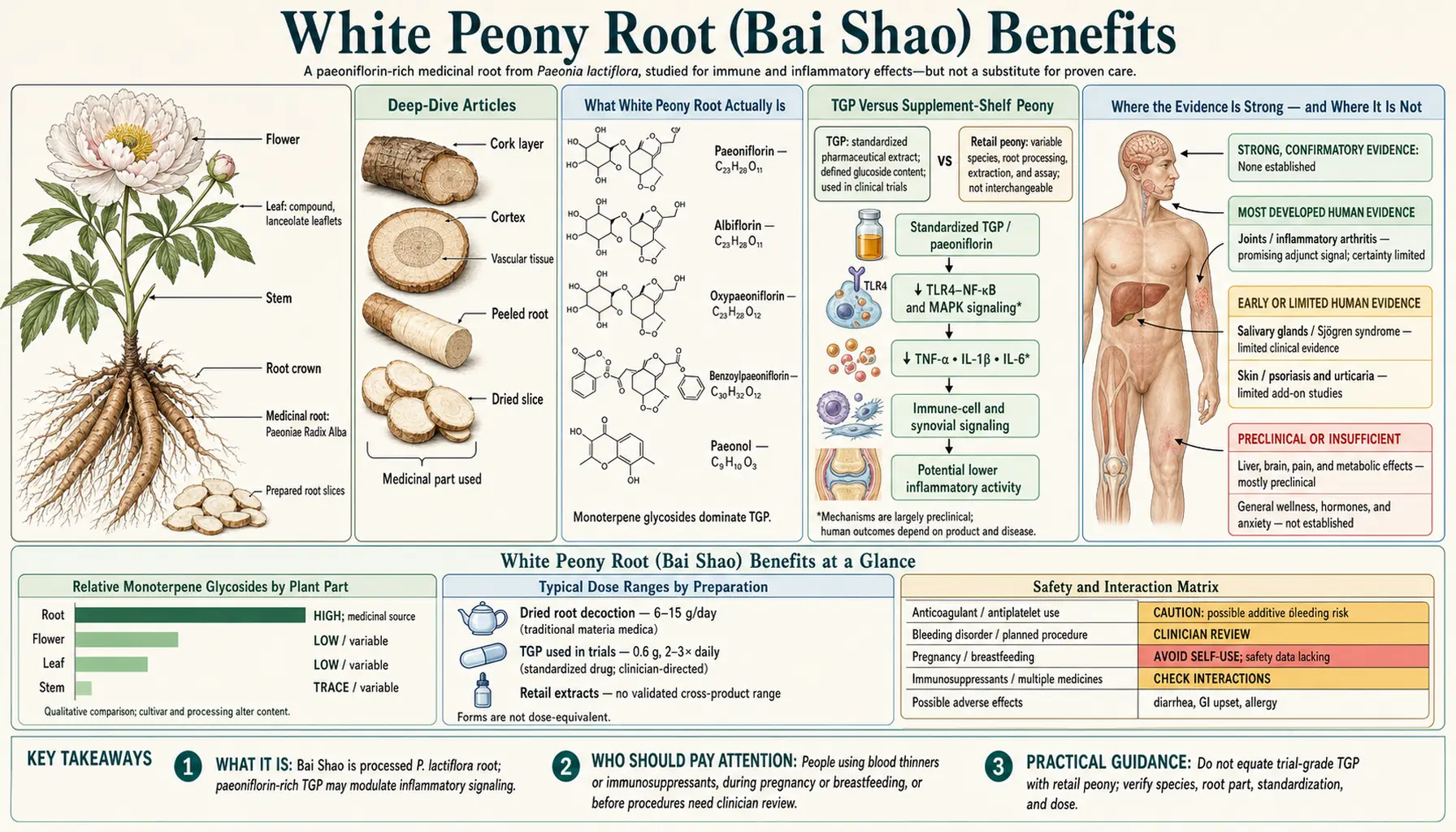
White peony root — Radix Paeoniae Alba, 白芍 bái sháo in Chinese, bạch thược in Vietnamese — is the boiled and peeled root of Paeonia lactiflora Pall., a cultivated garden peony in the family Paeoniaceae. It has been a workhorse of East Asian herbal formulas for well over a thousand years, and it is one of the very few traditional herbs that produced a genuine, government-approved pharmaceutical: Total Glucosides of Paeony (TGP), a standardized extract licensed in China since 1998 for rheumatoid arthritis.
That split — a real drug on one side, a loosely defined botanical capsule on the other — is the single most important thing to understand before you read anything else about this herb. Almost every impressive clinical number attached to “peony” comes from TGP at a controlled dose. It does not automatically transfer to a bottle of white peony root powder from a supplement shelf.
Table of Contents
- Deep-Dive Articles
- What White Peony Root Actually Is
- TGP Versus Supplement-Shelf Peony
- Where the Evidence Is Strong — and Where It Is Not
- The Licorice Problem
- Key Research Papers
- External Resources
- Connections
- Featured Videos
Deep-Dive Articles
Four in-depth articles cover the areas where white peony root has been studied most seriously. Start with rheumatoid arthritis — that is where the evidence is real and the rest is context.
Rheumatoid Arthritis and Autoimmunity
The strongest evidence on this page: what TGP is, its approved 600 mg dose, what the meta-analyses actually report, and the honest limits of a trial literature that is almost entirely Chinese-language.
Menstrual Health and PCOS
Peony sits inside the classic gynecological formulas Xiao Yao San and Dang Gui Shao Yao San. The peony-and-licorice hyperandrogenism studies are small, old, and preliminary — here is what they did and did not show.
Muscle Cramps and Spasm
Shakuyaku-kanzo-to for cramps in liver cirrhosis and haemodialysis, the antispasmodic pharmacology of paeoniflorin, and the documented risk of potassium loss and rising blood pressure with daily licorice.
Liver Protection
Hepatoprotective animal data, the paeoniflorin mechanism work, and a frank verdict: this is a promising laboratory story with far thinner human evidence than the arthritis indication.
What White Peony Root Actually Is
The peony you see in a florist’s window and the peony in a Chinese pharmacy drawer are the same genus, but herbal medicine draws sharp lines between three different drugs that all come from peonies. Confusing them is the most common error in English-language writing about this herb.
- Bai Shao (白芍), white peony root — the cultivated root of Paeonia lactiflora, boiled and then peeled. Boiling deactivates enzymes and softens the root; peeling removes the outer bark. This processing is not cosmetic — it is what defines the drug and shifts its chemistry away from the tannin-rich outer layer.
- Chi Shao (赤芍), red peony root — typically wild-collected P. lactiflora or P. veitchii, left unpeeled and unprocessed. Traditional theory treats Chi Shao as blood-moving and cooling, while Bai Shao is treated as blood-nourishing and softening. They are not interchangeable substitutes for one another.
- Mu Dan Pi (牡丹皮), tree peony bark — the root bark of Paeonia suffruticosa, a different species entirely, with the phenol paeonol as its marker compound rather than paeoniflorin.
The signature constituent of white peony root is paeoniflorin, a monoterpene glucoside built on the unusual “pinane” cage skeleton characteristic of the genus. Paeoniflorin is both the pharmacological workhorse and the official quality marker: the Chinese Pharmacopoeia sets a minimum content of roughly 1.6 percent paeoniflorin for the crude drug. Alongside it sit albiflorin, oxypaeoniflorin, benzoylpaeoniflorin, and a substantial fraction of gallotannins (including paeoniflorin’s relatives and free gallic acid derivatives).
Traditional decoction dosing is roughly 6–15 g of dried root per day, almost never alone. Peony is a formula herb. It appears in Si Wu Tang (the foundational blood-nourishing formula), Xiao Yao San (the classic “free and easy wanderer” formula used for irritability and menstrual irregularity), Gui Zhi Tang (the first formula in the Shang Han Lun), Dang Gui Shao Yao San, and — paired with licorice alone — Shao Yao Gan Cao Tang, known in Japan as shakuyaku-kanzo-to.
TGP Versus Supplement-Shelf Peony
Here is the distinction that decides whether the research on this page applies to the product in your hand.
Total Glucosides of Paeony (TGP) is a purified, standardized extract of Paeonia lactiflora root, concentrated to roughly 40 percent or more paeoniflorin and supplied as 300 mg capsules. In China it is a prescription drug, not a supplement — approved in 1998 and marketed most widely under the brand name Pafulin (帕夫林). The typical studied regimen is 600 mg two to three times daily, i.e. 1,200–1,800 mg per day, taken for months.
A generic “white peony root” capsule sold as a dietary supplement in the United States, Europe or Australia is usually one of the following, none of which is TGP:
- Milled whole dried root, with paeoniflorin content around the pharmacopeial floor of about 1.6 percent — roughly one twenty-fifth the concentration of TGP.
- A modest hot-water or hydroalcoholic extract, often labelled “10:1” or “standardized,” with no stated paeoniflorin percentage at all.
- A blended formula in which peony is one of six or eight herbs, at an undisclosed per-herb dose.
Doing the arithmetic makes the gap concrete. To match the paeoniflorin delivered by 1,800 mg/day of TGP at 40 percent — about 720 mg of paeoniflorin — you would need roughly 45 grams of crude root per day at 1.6 percent. That is three to seven times the entire traditional decoction dose, and it is not a dose anyone has tested for safety. There is no honest way to read a TGP arthritis trial as evidence for a 500 mg peony capsule.
What to look for on a label
| Label element | What a meaningful product states | Red flag |
|---|---|---|
| Species | Paeonia lactiflora Pall. | “Peony” with no species, or an unnamed “peony blend” |
| Part and processing | Root, peeled (Bai Shao / Radix Paeoniae Alba) | “Peony flower,” “peony extract,” unspecified aerial parts |
| Marker compound | Paeoniflorin, stated as a percentage and in milligrams per capsule | “Standardized extract” with no marker or percentage named |
| Strength claim | A number you can multiply out (e.g. “150 mg paeoniflorin per capsule”) | “Ratio 10:1” alone — a ratio is not a dose |
| Licorice content | Disclosed, with the glycyrrhizin amount if present | Licorice hidden inside a proprietary blend |
| Third-party testing | Named lab, certificate of analysis available on request | “GMP” logo only, no testing claim |
If a product does not tell you how much paeoniflorin it contains, you cannot compare it to any trial in the literature. That is not a technicality — it is the whole comparison.
Where the Evidence Is Strong — and Where It Is Not
A quick, honest map of the four topics covered in the deep-dive articles:
| Use | Best available evidence | Honest verdict |
|---|---|---|
| Rheumatoid arthritis (TGP) | Dozens of randomized trials plus systematic reviews and meta-analyses; an approved drug indication in China | The one genuinely substantial indication — but the trial base is single-country, largely unblinded, and mostly published in Chinese |
| Sjögren’s, lupus, oral lichen planus, psoriasis (TGP) | Smaller randomized trials and pooled reviews, mostly Chinese | Suggestive and plausible; far less mature than the RA data |
| Muscle cramps (shakuyaku-kanzo-to) | Small Japanese trials in cirrhosis and haemodialysis; strong antispasmodic pharmacology | Reasonable for occasional use; the licorice component makes daily use a real safety problem |
| PCOS and hyperandrogenism | A handful of small Japanese studies, mostly from the 1980s–1990s | Preliminary. Not a substitute for a proper PCOS evaluation |
| Liver protection | Extensive rodent and cell work on paeoniflorin; limited and heterogeneous human data | A mechanism story, not an established treatment |
The Licorice Problem
Peony is frequently paired with licorice root (Glycyrrhiza uralensis or G. glabra), and the pairing is genuinely synergistic for cramping. But licorice carries a well-documented, dose-dependent hazard that has nothing to do with peony.
Glycyrrhizin and its metabolite glycyrrhetinic acid inhibit the enzyme 11β-hydroxysteroid dehydrogenase type 2 in the kidney. That enzyme normally converts cortisol into inactive cortisone before it can reach the mineralocorticoid receptor. Block it, and ordinary cortisol starts acting like aldosterone: the body retains sodium and water, dumps potassium, and blood pressure rises. The result is called pseudoaldosteronism — the picture of high aldosterone with aldosterone levels that are actually suppressed.
In practice this can produce hypokalaemia (low potassium), hypertension, fluid retention and swelling, and in severe cases muscle weakness or dangerous heart-rhythm disturbance. The cruel irony is that low potassium causes muscle cramps — so a licorice-containing cramp remedy taken daily can eventually worsen the very symptom it was meant to relieve.
Practical rules that appear throughout these articles:
- Treat peony-and-licorice combinations as intermittent remedies, not daily supplements.
- If you take one regularly for more than a few weeks, have potassium and blood pressure checked.
- People on diuretics, digoxin, corticosteroids, or with heart failure, kidney disease, or existing hypertension should avoid licorice-containing formulas unless a clinician is supervising.
- Deglycyrrhizinated licorice (DGL) does not carry this risk — but it is also not what was used in the cramp studies.
Key Research Papers
Every numbered identifier below was checked live against NCBI E-utilities — author, title, journal and year all had to match before a PMID was printed. Where an identifier could not be confirmed that way, the entry keeps a PubMed topic search instead of a number that might point at the wrong paper.
Rheumatoid arthritis and Total Glucosides of Paeony
- Zhang W, Dai SM. Mechanisms involved in the therapeutic effects of Paeonia lactiflora Pallas in rheumatoid arthritis. International Immunopharmacology. 2012;14(1):27–31.
- Luo J, Jin DE, Yang GY, et al. Total glucosides of paeony for rheumatoid arthritis: a systematic review of randomized controlled trials. Complementary Therapies in Medicine. 2017;34:46–56.
- Huang Y, Wang H, Chen Z, et al. Efficacy and safety of total glucosides of paeony combined with methotrexate and leflunomide for active rheumatoid arthritis: a meta-analysis. Drug Design, Development and Therapy. 2019;13:1969–1984.
Other autoimmune conditions
- Feng Z, Zhang BQ, Zhu YM, et al. The effectiveness and safety of total glucosides of paeony in primary Sjögren’s syndrome: a systematic review and meta-analysis. Frontiers in Pharmacology. 2019;10:550.
- Wang M, Wang Z, Liu Y, et al. The effectiveness and safety of total glucosides of paeony in systemic lupus erythematosus: a systematic review and meta-analysis. Medicine (Baltimore). 2022;101(50):e32029.
- Zheng Q, Jiang W, Sun X, et al. Total glucosides of paeony for the treatment of psoriasis: a systematic review and meta-analysis of randomized controlled trials. Phytomedicine. 2019;62:152940. For oral lichen planus, see Zhou L, Cao T, Wang Y, et al. Clinical observation on the treatment of oral lichen planus with total glucosides of paeony capsule combined with corticosteroids. International Immunopharmacology. 2016;36:106–110.
Menstrual health, PCOS and hyperandrogenism
- Takeuchi T, Nishii O, Okamura T, Yaginuma T. Effect of paeoniflorin, glycyrrhizin and glycyrrhetic acid on ovarian androgen production. American Journal of Chinese Medicine. 1991;19(1):73–78.
- Takahashi K, Kitao M. Effect of TJ-68 (shakuyaku-kanzo-to) on polycystic ovarian disease. International Journal of Fertility and Menopausal Studies. 1994;39(2):69–76.
- Lee HW, Jun JH, Kil KJ, Ko BS, Lee CH, Lee MS. Herbal medicine (Danggui Shaoyao San) for treating primary dysmenorrhea: a systematic review and meta-analysis of randomized controlled trials. Maturitas. 2016;85:19–26.
Muscle cramps, spasm and the licorice caution
- Ota K, Fukui K, Nakamura E, et al. Effect of Shakuyaku-kanzo-to in patients with muscle cramps: a systematic literature review. Journal of General and Family Medicine. 2020;21(3):56–62.
- Antispasmodic and neuromuscular actions of paeoniflorin on smooth and skeletal muscle. PubMed search.
- Stewart PM, Wallace AM, Valentino R, Burt D, Shackleton CH, Edwards CR. Mineralocorticoid activity of liquorice: 11-beta-hydroxysteroid dehydrogenase deficiency comes of age. The Lancet. 1987;2(8563):821–824.
Chemistry, pharmacology and liver effects
- Zhou YX, Gong XH, Zhang H, Peng C. A review on the pharmacokinetics of paeoniflorin and its anti-inflammatory and immunomodulatory effects. Biomedicine & Pharmacotherapy. 2020;130:110505.
- Hepatoprotective effects of paeoniflorin and Paeonia lactiflora extracts in experimental liver injury. PubMed search.
- Ma W, Ren H, Meng X, et al. A review of the ethnopharmacology, phytochemistry, pharmacology, pharmacokinetics and quality control of Paeonia lactiflora Pall. Journal of Ethnopharmacology. 2024;335:118616.
Live PubMed Searches
- Paeonia lactiflora
- Total glucosides of paeony
- Paeoniflorin immunomodulation
- Albiflorin pharmacology
- Shakuyaku-kanzo-to
- Xiao Yao San
- Paeoniflorin adverse effects
- Glycyrrhizin and 11β-HSD2
External Resources
- PubMed — Paeonia lactiflora literature
- LiverTox — NIH database of drug and herbal liver injury
- PubChem — paeoniflorin compound record
- NCCIH — Herbs at a Glance
- World Flora Online — Paeonia lactiflora Pall. taxonomy
- ClinicalTrials.gov — registered peony trials
Connections
- All Herbs
- White Peony Root (Bai Shao)
- White Peony Root: History and Traditional Use
- Licorice — the partner herb, and the safety limit
- Dong Quai — peony’s companion in Si Wu Tang
- Chasteberry — another herb used for cycle irregularity
- Codonopsis — a tonic herb in overlapping formulas
- Rheumatology — conditions TGP has been studied in