White Peony Root for Muscle Cramps and Spasm
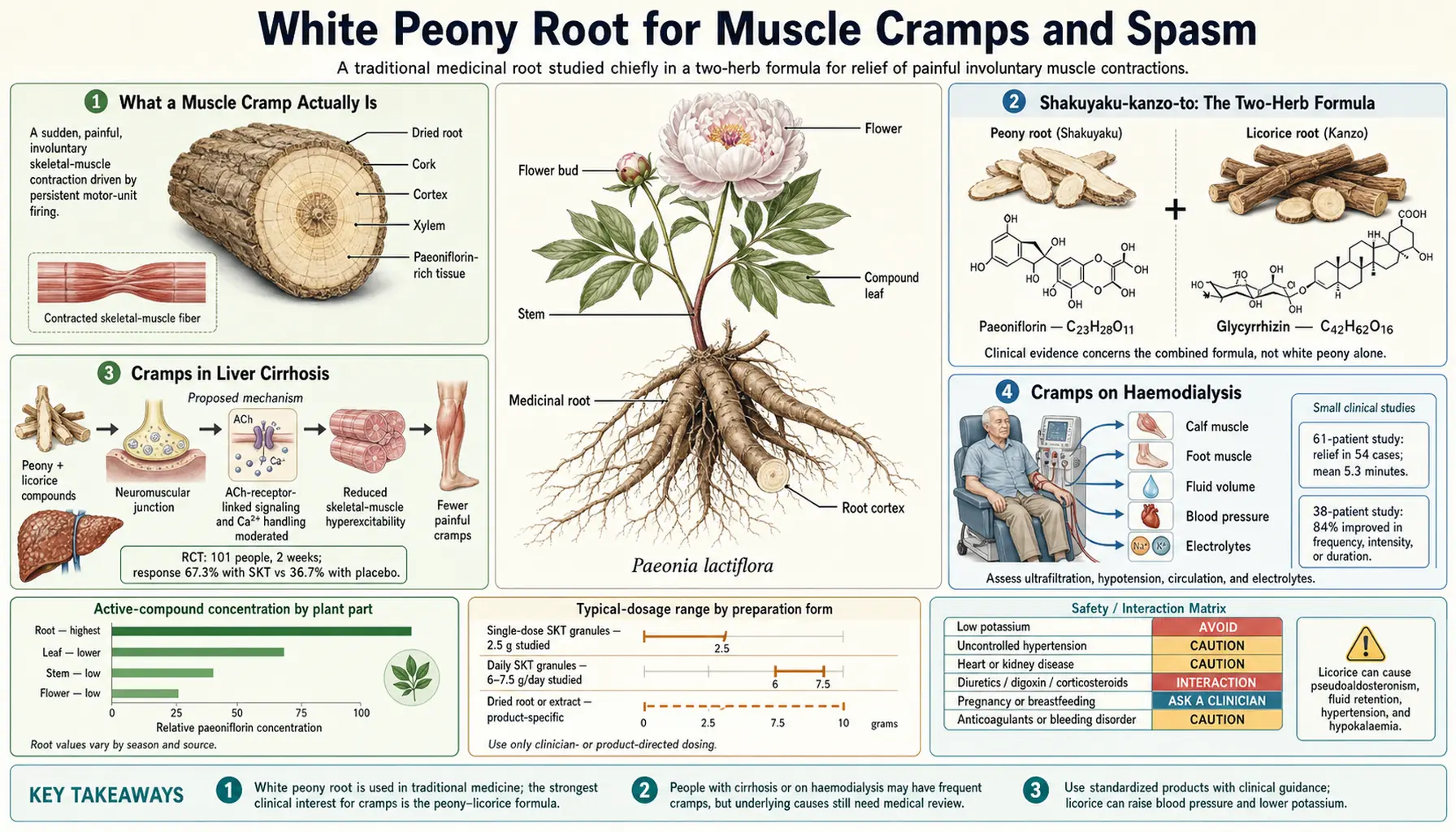
The oldest and most consistent claim made for white peony root — Radix Paeoniae Alba, Bai Shao — is that it stops cramp. In classical Chinese terms it “relaxes tension and relieves spasm,” and the two-herb formula built around that idea, peony with licorice, is still one of the most widely dispensed traditional prescriptions in Japan.
This article covers the two clinical settings where it has actually been studied — cramps in liver cirrhosis and cramps on haemodialysis — the pharmacology that makes the effect plausible, and the serious, documented reason you should not take this every day: the licorice in it can lower your potassium and raise your blood pressure, which can eventually make cramping worse.
Table of Contents
- What a Muscle Cramp Actually Is
- Shakuyaku-kanzo-to: The Two-Herb Formula
- Cramps in Liver Cirrhosis
- Cramps on Haemodialysis
- The Antispasmodic Pharmacology
- How Fast It Works and How It Is Used
- The Licorice Risk — The Most Important Section
- Using It More Safely: Intermittent, Not Daily
- What Else Actually Helps With Cramps
- Peony on the Supplement Shelf Is Not TGP
- Cautions and Contraindications
- Key Research Papers
- Connections
- Featured Videos
What a Muscle Cramp Actually Is
A true cramp is a sudden, involuntary, sustained contraction of a muscle that will not let go. It is not the muscle running out of something — it is the nerve supplying it firing in a runaway burst. Electrical recordings during a cramp show extremely rapid motor-unit discharge, far faster than voluntary effort produces. The muscle is being told to contract and never told to stop.
Most everyday night cramps in the calf or foot are benign and have no identified cause. But certain situations reliably generate them, and they share a theme of disturbed fluid, salt or nerve-excitability balance:
- Liver cirrhosis — cramps are extremely common, often nocturnal, and a major cause of poor sleep and reduced quality of life.
- Haemodialysis — cramps during or shortly after a session, driven by rapid fluid removal and shifting osmolality.
- Low potassium, magnesium or calcium — including from diuretics, prolonged diarrhoea, or licorice.
- Pregnancy, particularly in the later months.
- Certain medications, notably diuretics and some asthma drugs.
- Neurological disease — motor neurone disease, radiculopathy and peripheral neuropathy, where cramps can be an early sign.
That last point matters: new, frequent, severe cramps with muscle twitching, weakness or wasting need a medical assessment, not a herb.
Shakuyaku-kanzo-to: The Two-Herb Formula
Shao Yao Gan Cao Tang (芍藥甘草湯), known in Japan as shakuyaku-kanzo-to and supplied as the standardized Kampo extract TJ-68, is one of the simplest formulas in East Asian medicine: white peony root and licorice root, classically in roughly equal parts.
Its traditional indication is unusually specific for a classical formula — not a broad constitutional pattern but a symptom: cramping, spasm, and the pain that comes with it, whether in the calf, the abdomen, the biliary tract or the uterus. In modern Japanese practice it is used for nocturnal leg cramps, for cramps in cirrhosis and dialysis, as a pre-procedural antispasmodic in endoscopy, and for period pain.
Two features of the formula are worth noticing immediately. First, it is licorice-heavy — licorice is not a minor harmoniser here, it is half the prescription. Second, in the classical texts it is a short-course remedy, given for an acute problem, not a daily tonic. Modern pharmacovigilance has validated that instinct: shakuyaku-kanzo-to is consistently among the Kampo formulas most often implicated in licorice-related pseudoaldosteronism, precisely because people take a licorice-heavy formula continuously.
Cramps in Liver Cirrhosis
Muscle cramps in advanced liver disease are common — reported in a majority of patients in several series — and they are genuinely miserable. They tend to strike at night, in the calves and feet, and they interrupt sleep in people who are already exhausted. Conventional options are unsatisfying: taurine, zinc, baclofen, methocarbamol, orphenadrine and albumin infusion have all been tried, none is a clear standard, and quinine is no longer recommended because of haematological toxicity.
Into that gap comes shakuyaku-kanzo-to, which has been used in Japan for exactly this and studied in small clinical reports and trials. The reported pattern is a reduction in cramp frequency and severity, often noticeable within days, with good short-term tolerability.
Be careful how much weight that carries. The one systematic review to go looking for randomized trials of shakuyaku-kanzo-to in muscle cramps found only three, and judged them too heterogeneous to pool. In the cirrhosis comparison against placebo, the odds ratio for improvement was 1.27 with a confidence interval that crossed 1 — a result pointing the right way but not statistically significant. The favourable reports are real; the randomized evidence behind them is thin.
The caveats are substantial and should be read alongside the result:
- The studies are small — typically dozens of patients, not hundreds.
- Many are open-label, and cramp frequency is a self-reported outcome that responds strongly to attention and expectation.
- They are almost entirely Japanese, with limited independent replication elsewhere.
- Cirrhosis is the worst possible population for a licorice-containing drug. People with cirrhosis often already have fluid retention, ascites, low potassium and secondary hyperaldosteronism, and many are taking spironolactone and furosemide. Adding a pseudoaldosteronism-inducing herb into that is not a trivial decision, and it is one that belongs to the hepatology team, not to a supplement aisle.
The practical conclusion for someone with cirrhosis: this is worth raising with your hepatologist, who can check potassium and watch the ascites, and it is not something to start quietly on your own.
Cramps on Haemodialysis
Cramps during dialysis are a classic problem. As the machine pulls fluid off, the circulating volume drops faster than the tissues can refill it, plasma osmolality shifts, and muscles cramp — often hard enough that the session has to be paused or the ultrafiltration target abandoned, which then leaves the patient fluid-overloaded for the next round.
Standard measures are dialysis-prescription measures: slower or gentler fluid removal, adjusting dry weight, sodium profiling, correcting low calcium or magnesium, and reviewing the dialysate. Small Japanese studies have examined shakuyaku-kanzo-to in this setting, given before or around dialysis, and report fewer or less severe intradialytic cramps.
The same three caveats apply — small, largely open, single-country — plus one that is specific and important: people on dialysis have limited or absent ability to excrete a potassium or fluid load, and their potassium is already being actively managed. Licorice’s effect on potassium handling operates through the kidney, so its behaviour in someone with minimal residual kidney function is not straightforward. Anyone on dialysis should treat this strictly as a conversation with their nephrologist.
The Antispasmodic Pharmacology
Unlike some traditional claims, the anti-cramp effect of peony has a coherent laboratory story behind it, and it involves both herbs.
Muscle contraction needs calcium. When a nerve signal arrives, calcium floods into the muscle cell’s contractile machinery; the muscle shortens; calcium is pumped back; the muscle relaxes. Anything that reduces the calcium available for that cycle makes contraction less forceful and less likely to lock.
In isolated-tissue experiments, paeoniflorin relaxes both smooth muscle (gut, uterus, vasculature) and skeletal muscle preparations, with reported effects on calcium entry and on the response to contraction-triggering signals such as acetylcholine. The glycosides also show reported activity at neuromuscular transmission — the junction where the nerve hands its instruction to the muscle.
Glycyrrhizin, the licorice constituent, has its own reported effects on muscle-cell excitability. The classic account of the formula is that the two herbs act at different points of the same pathway — peony chiefly on the muscle’s contraction machinery, licorice chiefly on excitability — producing more relaxation together than either alone. That synergy is the pharmacological argument for why the formula has stayed two herbs for two thousand years.
Two honest qualifications. Most of this is tissue-bath and animal work, at concentrations chosen by the experimenter, and paeoniflorin’s oral bioavailability is modest — a compound that relaxes a strip of muscle in a dish has not thereby shown it reaches your calf. And the clinical reports of rapid relief are largely uncontrolled, in a symptom that resolves on its own within minutes anyway.
How Fast It Works and How It Is Used
Unusually for a herbal preparation, shakuyaku-kanzo-to is used acutely. Japanese clinical practice commonly gives it at the onset of a cramp or shortly before a predictable trigger — before a dialysis session, before bed for nocturnal cramps, before an endoscopy for gut spasm — with relief reported within minutes to about half an hour. Kampo extract granules dissolved in hot water are absorbed quickly, which fits.
Typical use patterns reported in the literature and in practice:
- A single sachet or dose at cramp onset, rather than a fixed daily schedule.
- A dose before a known trigger — bedtime, dialysis, a long run.
- A short course of a few days to a couple of weeks during a bad patch, then stopping.
This is a genuinely useful property, and it is also the safest way to use the formula, because the licorice risk is a function of cumulative daily exposure.
The Licorice Risk — The Most Important Section
If you read nothing else on this page, read this. Peony itself is a mild herb. Licorice is not, and the cramp formula is half licorice.
The mechanism. Glycyrrhizin is converted in the gut to glycyrrhetinic acid, which inhibits the kidney enzyme 11β-hydroxysteroid dehydrogenase type 2 (11β-HSD2). That enzyme sits guard in front of the mineralocorticoid receptor, converting cortisol to inactive cortisone so that cortisol — which is present at far higher concentrations than aldosterone and binds the same receptor — cannot activate it. Knock out the guard, and cortisol floods the receptor. The kidney behaves as if aldosterone were high.
The consequences. Sodium and water are retained; potassium is excreted; blood pressure rises. This is pseudoaldosteronism: the clinical picture of aldosterone excess with measured aldosterone and renin actually suppressed. Documented effects include:
- Hypokalaemia — often the first laboratory sign, causing weakness, fatigue and, cruelly, more muscle cramps.
- Hypertension, sometimes substantial and sometimes resistant to treatment until the licorice is stopped.
- Oedema — swollen ankles, puffy face, weight gain from fluid.
- Metabolic alkalosis.
- Cardiac arrhythmias when potassium falls far enough — the serious end of the spectrum.
- Rhabdomyolysis — muscle breakdown — reported in severe hypokalaemia, occasionally with acute kidney injury.
The self-defeating loop. Notice what has happened. Someone takes a licorice-containing formula every day for leg cramps. Over weeks, potassium falls. Low potassium causes cramps. The cramps get worse, so they take more of the formula. This progression is documented in case reports and it is the single most important practical hazard of long-term shakuyaku-kanzo-to use.
Who is at highest risk: older adults; anyone on diuretics (especially thiazides and loop diuretics); people with cirrhosis, heart failure or kidney disease; those on corticosteroids or digoxin; and those already prone to low potassium. Susceptibility varies substantially between individuals, and no universally safe daily dose can be quoted.
Drug interactions that matter:
| Drug or class | Why licorice matters |
|---|---|
| Thiazide and loop diuretics | Additive potassium loss |
| Digoxin | Low potassium markedly increases digoxin toxicity risk |
| Corticosteroids | Additive sodium retention and potassium loss |
| Antihypertensives | Licorice raises blood pressure, opposing them |
| Antiarrhythmics and QT-prolonging drugs | Hypokalaemia increases arrhythmia risk |
| Laxatives (chronic use) | Compounding potassium depletion |
Warning signs to act on: unusual muscle weakness, worsening rather than improving cramps, new swelling of the ankles or face, unexplained weight gain over days, headaches with a rising blood-pressure reading, palpitations. Any of these means stop the product and get potassium and blood pressure checked.
Using It More Safely: Intermittent, Not Daily
The framing that fits both the traditional use and the modern safety data is simple: this is a rescue remedy, not a supplement.
- Take it when you need it, or shortly before a known trigger — not on a fixed daily schedule indefinitely.
- Cap the run. If you find yourself taking it daily for more than about two weeks, that is the moment to reassess rather than to reorder.
- Get baseline and follow-up bloods if you use it regularly: potassium, sodium, and blood pressure. This is cheap and it is the whole safety net.
- Look for licorice-free alternatives if you need something ongoing. Deglycyrrhizinated licorice (DGL) has the glycyrrhizin removed and does not cause pseudoaldosteronism — but it is also not what the cramp studies used, so do not assume equivalent benefit.
- Fix the cause where there is one. Cramps from a diuretic, from low magnesium, or from dialysis prescription are best fixed at the source.
What Else Actually Helps With Cramps
An honest herb page should tell you what the alternatives are.
- Stretching the affected muscle during a cramp is the most reliable immediate intervention — dorsiflex the foot for a calf cramp. Regular calf stretching before bed has modest supportive evidence for nocturnal cramps.
- Correcting a genuine deficiency — magnesium or potassium — works when a deficiency is present. Magnesium supplements have generally not outperformed placebo for idiopathic nocturnal cramps in trials, and specifically not in pregnancy-related cramps in several studies, which is a widely ignored negative result.
- Adequate hydration and sodium for exercise-associated cramping, though the dehydration model of exercise cramps is itself contested; altered neuromuscular control from fatigue is the better-supported explanation.
- Reviewing medications with a pharmacist — diuretics are a frequent and fixable culprit.
- Quinine is not recommended for routine cramps by regulators in several countries because of the risk of serious blood disorders.
- Investigation for cramps that are new, severe, escalating, or accompanied by weakness, twitching or wasting.
Peony on the Supplement Shelf Is Not TGP
One recurring source of confusion needs closing off. The impressive clinical literature attached to peony — the randomized trials and meta-analyses in rheumatoid arthritis — used Total Glucosides of Paeony (TGP), a standardized extract of roughly 40 percent or more paeoniflorin, approved as a prescription drug in China and dosed at 600 mg two to three times daily.
That is a different product from everything on this page. The cramp studies used shakuyaku-kanzo-to, a two-herb decoction or granule extract. And a generic “white peony root” capsule from a supplement shelf is a third thing again — usually milled crude root at around the pharmacopeial minimum of 1.6 percent paeoniflorin, roughly a twenty-fifth the concentration of TGP.
What to check on a label:
- Species and part: Paeonia lactiflora Pall., root, peeled (Bai Shao / Radix Paeoniae Alba). Not peony flower.
- Paeoniflorin content stated as both a percentage and milligrams per dose. “Standardized” without a number tells you nothing.
- Whether it is the cramp formula. For cramps you want the peony-plus-licorice formula (shakuyaku-kanzo-to / Shao Yao Gan Cao Tang), not a single-herb peony capsule and not TGP.
- Licorice disclosed by amount, ideally with the glycyrrhizin content, so you can gauge the risk above.
- Third-party testing with a certificate of analysis available.
Cautions and Contraindications
- Do not use licorice-containing formulas if you have hypertension, heart failure, kidney disease, low potassium, or take diuretics, digoxin or corticosteroids — unless a clinician is supervising and checking bloods.
- Cirrhosis and dialysis: these are precisely the populations studied and the populations most vulnerable to the licorice effect. Involve the specialist team.
- Pregnancy: avoid. High licorice intake in pregnancy has been associated with adverse outcomes, and peony extracts are not established as safe. Pregnancy leg cramps are common and better addressed with stretching and a review of any contributing factors.
- Breastfeeding: not established; avoid.
- Anticoagulants and antiplatelets: caution — peony preparations have reported effects on platelet aggregation.
- Surgery: stop at least two weeks beforehand.
- Gastrointestinal upset: loose stools are the commonest complaint with concentrated peony preparations. Persistent diarrhoea causes potassium and magnesium loss — which causes cramps.
- Red flags needing assessment, not herbs: cramps with muscle wasting, persistent twitching, progressive weakness, numbness, or dark urine after cramping.
Key Research Papers
Every numbered identifier below was checked live against NCBI E-utilities — author, title, journal and year all had to match before a PMID was printed. Where an identifier could not be confirmed that way, the entry keeps a PubMed topic search rather than a number that might point at the wrong paper.
- Ota K, Fukui K, Nakamura E, et al. Effect of Shakuyaku-kanzo-to in patients with muscle cramps: a systematic literature review. Journal of General and Family Medicine. 2020;21(3):56–62.
- Hinoshita F, Ogura Y, Suzuki Y, et al. Effect of orally administered shao-yao-gan-cao-tang (Shakuyaku-kanzo-to) on muscle cramps in maintenance hemodialysis patients: a preliminary study. American Journal of Chinese Medicine. 2003;31(3):445–453.
- Management of muscle cramps in patients with cirrhosis — reviews of treatment options. PubMed search.
- Antispasmodic and muscle-relaxant actions of paeoniflorin in isolated smooth and skeletal muscle. PubMed search.
- Synergistic actions of paeoniflorin and glycyrrhizin on neuromuscular and smooth-muscle contraction. PubMed search.
- Shakuyaku-kanzo-to as an antispasmodic in gastrointestinal endoscopy. PubMed search.
- Farese RV Jr, Biglieri EG, Shackleton CH, Irony I, Gomez-Fontes R. Licorice-induced hypermineralocorticoidism. New England Journal of Medicine. 1991;325(17):1223–1227.
- Stewart PM, Wallace AM, Valentino R, Burt D, Shackleton CH, Edwards CR. Mineralocorticoid activity of liquorice: 11-beta-hydroxysteroid dehydrogenase deficiency comes of age. The Lancet. 1987;2(8563):821–824.
- Hypokalaemia and rhabdomyolysis associated with licorice or licorice-containing Kampo formulas. PubMed search.
- Garrison SR, Korownyk CS, Kolber MR, et al. Magnesium for skeletal muscle cramps. Cochrane Database of Systematic Reviews. 2020;9(9):CD009402.
- Miller TM, Layzer RB. Muscle cramps. Muscle & Nerve. 2005;32(4):431–442.
Live PubMed Searches
- Shakuyaku-kanzo-to
- Shao Yao Gan Cao Tang
- Paeoniflorin and calcium handling
- Intradialytic cramps
- Kampo adverse events and licorice
- Glycyrrhizin, blood pressure and potassium
- Nocturnal leg cramps — trials
- Quinine for cramps — safety
Connections
- All Herbs
- White Peony Root (Bai Shao)
- White Peony Root Benefits — hub
- White Peony Root: History and Traditional Use
- Licorice — the other half of the cramp formula
- Liver Protection — cirrhosis context
- Dong Quai
- Codonopsis