Valerian: History and Traditional Use
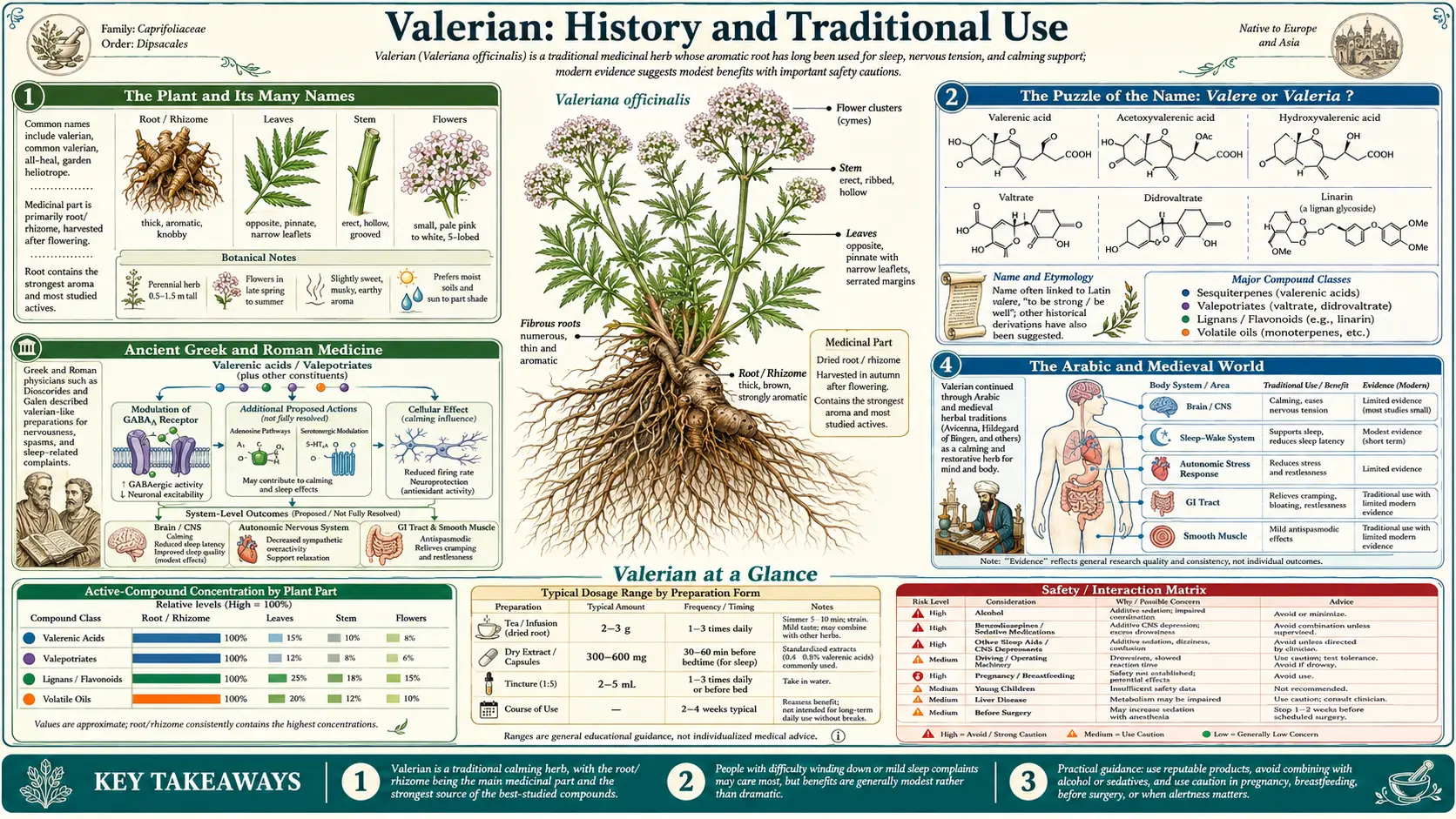
Valerian (Valeriana officinalis) is one of the oldest calming plants in the Western herbal cabinet, but its history is more tangled — and more interesting — than the tidy “used since Hippocrates for sleep” story usually told. For most of two thousand years the plant was known not as valerian but by older names such as phu, nard, and setwall, and historians genuinely disagree about which ancient writers meant the plant we grow today. This page follows the strongly woolly-rooted herb from the classical Mediterranean and the Arabic and medieval medical books, through the Renaissance herbalists who first set it apart as its own species, into the “nerve tonic” era and the air-raid shelters of two world wars, and finally to the 1957 laboratory in Switzerland where chemists first isolated the molecule that bears its name. Throughout, we are careful to separate what the record solidly documents from what is beloved tradition and folklore — and to say plainly which is which.
Table of Contents
- The Plant and Its Many Names
- The Puzzle of the Name: Valere or Valeria?
- Ancient Greek and Roman Medicine
- The Arabic and Medieval World
- Renaissance Herbals and the Birth of a Species
- The Nerve Remedy and the World Wars
- Naming the Molecules: Modern Phytochemistry
- Cats, Charms, and Folklore
- From Tradition to Modern Research
- Research Papers and References
- Connections
- Featured Videos
The Plant and Its Many Names
Valerian is the common English name for Valeriana officinalis L., a tall perennial of the family Caprifoliaceae (older texts place it in its own family, Valerianaceae) native to Europe and temperate Asia and long cultivated in gardens. The species epithet officinalis is itself a historical marker: in botanical Latin it means “of the officina,” the storeroom or workshop of a monastery or apothecary, and it was reserved for plants kept on the medicine shelf. The part used is almost always the underground rhizome and roots, which develop a famously strong, earthy, slightly sour smell as they dry — an odour that, as we will see, gave the plant one of its oldest names.
Like most very old medicinal plants, valerian collected a thick cluster of folk and historical names, and untangling them is part of writing its history honestly. The most important older name is phu (also written fu or fou), the term used by Greek and Roman writers; it is widely said to imitate an exclamation of disgust at the root's smell, though that explanation is itself traditional. In the medieval and early-modern world the plant was often called setwall (or setewale) — a name that, confusingly, was also applied to the unrelated spice zedoary, so an old reference to “setwall” does not always mean valerian. It picked up the grand title all-heal (a name shared with several other plants), the misleading garden name garden heliotrope (it is not related to true heliotrope), and, from its well-known effect on cats, names along the lines of cat's valerian and cat's love. This very cloud of overlapping names is one reason the plant's early history is so easy to misread: the same word could mean different plants, and the plant we mean had several different words.
The Puzzle of the Name: Valere or Valeria?
The name “valerian” is genuinely younger than the plant's medicinal use. The Latin word valeriana is not found in the surviving classical texts; it appears only later, working its way into the medieval medical literature, and the popular claim that the ancients called the herb “valerian” is simply not supported by the record. By the thirteenth century a Latin herbal known as the Tractatus de herbis could note that the plant called fu “is said to be also named valleriana,” one of the earliest moments the familiar word surfaces.
Where the name itself comes from is still debated, and reputable sources give two different answers. The most commonly repeated derivation traces it to the Latin verb valere, “to be strong” or “to be well” — a flattering reading that fits the plant's reputation as a healing root and is the version most herb books print. A second, more recent scholarly suggestion is that the name is geographical, pointing to the Roman province of Pannonia Valeria (an administrative district reorganised around the end of the third century CE in what is now Hungary and Croatia), so that “valerian” would originally have meant something like “the plant from Valeria.” A third, looser tradition connects it to people or emperors bearing the Roman name Valerius or Valerianus, but this is the least evidenced of the three. The honest position is that the etymology is uncertain: the valere story is the traditional favourite, the provincial Valeria theory is a serious modern alternative, and we cannot at present say which is correct.
Ancient Greek and Roman Medicine
Valerian's medicinal story does reach back to classical antiquity — but the documented uses are not the ones modern marketing usually claims. Two medical treatises ascribed to the school of Hippocrates (5th–4th century BCE), conventionally titled Nature of Women and Diseases of Women, refer to the plant in gynaecological preparations — a fumigation and a post-partum remedy — rather than as a treatment for sleeplessness. The botanist Theophrastus (c. 371–c. 287 BCE) described a small, sweet-smelling root from Thrace that scholars associate with a Valeriana species. These works are named here as historical primary sources rather than as modern citations.
In the first century CE the Greek physician Dioscorides discussed the plant under the name phu in his foundational De Materia Medica, describing a tangle of yellowish rootlets with a strong scent and recommending it chiefly as a warming, drying, diuretic remedy — for digestive complaints, for “feminine” conditions, and the like. His near-contemporary Pliny the Elder (23/24–79 CE) likewise recorded aromatic nard-type plants in his Natural History, including ornamental and ceremonial uses. The well-known statement that the great Roman physician Galen (2nd century CE) “prescribed valerian for insomnia” is repeated by many reputable secondary sources, and Galen did write about phu; but readers should treat the specific “for insomnia” framing as a traditional attribution rather than a verbatim quotation, since the careful historical scholarship emphasises the plant's aromatic and diuretic reputation in this period. The larger point is honest and important: the classical writers knew this strongly scented root and valued it, but as a warming, settling, women's and digestive medicine — its now-famous identity as the sleep and nerve herb is a later development, not a classical one.
The Arabic and Medieval World
Through the medieval centuries the plant travelled under its older names and was steadily catalogued by the great medical compilers. In the Arabic world the physician and philosopher Avicenna (Ibn Sīnā, c. 980–1037 CE) discussed it in his enormously influential Canon of Medicine using names derived from the Greek nard and phu tradition, classing it among the warming, drying remedies and listing uses for the chest and lungs, for the liver, and for women's complaints — broadly continuous with Dioscorides. European Latin herbals of the period, such as the verse De viribus herbarum (often associated with the name Odo of Meung, around the eleventh century) and the thirteenth-century Tractatus de herbis, treated the plant under fu and spica and recorded similar diuretic, digestive, and gynaecological indications. It is in exactly these medieval books that the Latin word valeriana first appears and gradually attaches itself to the plant.
Folk tradition holds that the twelfth-century German abbess and healer Hildegard of Bingen wrote about valerian among the many plants in her medical works; this attribution is commonly made in herb literature, and we note it here as part of the medieval record while flagging that the precise identification of plants in her texts is a matter for specialists. What the medieval period establishes beyond doubt is continuity: a strongly scented, warming root, used much as the ancients had used it, slowly acquiring the name by which we now know it. Its reputation specifically as a calming “nerve” remedy — the use that dominates today — would not move to the foreground until the early-modern and eighteenth-century writers took it up.
Renaissance Herbals and the Birth of a Species
The Renaissance is where valerian steps out of the shadow of its older names and becomes, recognisably, the plant we mean. The Flemish physician and botanist Rembert Dodoens (1517–1585) is generally credited with first clearly distinguishing valerian as a species in its own right in his celebrated herbal, the Cruydeboeck (1554), where the name Valeriana is used and the apothecary's garden plant set apart from the various wild “nards.” Later in the same century the great systematists Caspar Bauhin (1560–1624) and his elder brother Johann Bauhin (1541–1613) helped pin the genus down, separating Valeriana cleanly from Nardus in works such as Caspar's Pinax Theatri Botanici (1623). These are named here as historical texts.
In England the herbalists give us vivid, quotable evidence of how ordinary the plant had become. John Gerard, in his Herball of 1597, recorded that dried valerian root (under the name setwall) was so prized as a medicine among the poor of northern England and southern Scotland that, in the often-quoted phrasing, no broths or physical dishes were thought worth anything unless setwall were in them. A little over half a century later Nicholas Culpeper, in his hugely popular mid-seventeenth-century English Physician, listed valerian for coughs, for “the plague,” for cramps and bruises, and for nervous complaints, fitting it into his astrological framework. The herbals of this era are where valerian's modern reputation begins to crystallise: alongside the old digestive and diuretic uses, the plant is now firmly recorded as a remedy for the nerves — the thread that the next two centuries would pull to the very front.
The Nerve Remedy and the World Wars
From the eighteenth century onward, valerian's identity narrowed and sharpened into the one we recognise today: the calming herb, the remedy for “nervous” conditions, restlessness, and disordered sleep. Physicians of the period prescribed it for what they called nervous excitability, hysteria, palpitations of nervous origin, trembling, and “low spirits,” and the root and its tincture were standard items in the pharmacopoeias and dispensatories of Europe and North America. In nineteenth-century America valerian was an official preparation listed in the period's medical and pharmaceutical references and was used, among other things, as a sedative to quiet nervous excitement — including during the American Civil War.
The plant's most evocative modern chapter belongs to the two world wars. During World War I, valerian preparations were used to treat the shattered nerves of soldiers — the condition then called “shell shock” — and to settle frightened civilians. During World War II, it was used in Britain to ease the strain of the bombing raids: with sustained air attacks beginning in 1940, the wartime committee responsible for prioritising medicinal-plant collection placed valerian, long valued for its sedative reputation, among the essential herbs to be gathered. Some popular retellings of this story add dramatic numbers and claim valerian was relied on “almost exclusively” for wartime nerves; those specific embellishments are not well documented and are best treated with caution. What is solidly established is the humane core of the story: in an age before modern anti-anxiety drugs, a cheap, familiar, gentle garden root was reached for, again and again, to help ordinary people endure fear and sleeplessness — which is, in the end, very close to how valerian is still used today.
Naming the Molecules: Modern Phytochemistry
For all its long history, no one could say why valerian calmed the nerves until chemists began taking the root apart in the twentieth century. The decisive early milestone is well documented. In 1957, working at the Sandoz research laboratories in Basel, Switzerland, the chemists Arthur Stoll, Ernst Seebeck, and Daniel Stauffacher isolated and characterised a set of previously unknown constituents from the neutral fraction of fresh valerian, including the sesquiterpene compound now called valerenic acid — the molecule that takes its name directly from the plant and that later research would identify as central to valerian's sedative action. Their report appeared in the Swiss chemistry journal Helvetica Chimica Acta; it is cited in full in the references below.
The chemical picture filled in over the following decades. Another distinctive class of valerian constituents, the unstable valepotriates (such as valtrate and isovaltrate), was characterised in the mid-twentieth century and was for a time thought to account for the sedative effect — until it was noticed that water-based valerian extracts are calming even though the valepotriates barely dissolve in water, which pointed attention back toward valerenic acid and other water-soluble components. By the early twenty-first century, laboratory work had begun to explain the mechanism: in 2007 a University of Vienna group led by Sophia Khom and Steffen Hering showed that valerenic acid acts on the brain's GABA-A receptors — the same broad family of calming receptors that anti-anxiety and sedative drugs target — in a way that depends on the receptor's specific subunit make-up. This is the point at which valerian's two-thousand-year reputation finally acquired a chemical address: the old “nerve root” was shown to contain a molecule that speaks the brain's own calming language.
Cats, Charms, and Folklore
No history of valerian is complete without its folklore, and the most famous piece of it is entirely real: cats are strongly attracted to valerian root, often reacting to it much as they do to catnip, rolling on it and growing playful or excited. This well-observed effect is the source of the names cat's valerian and cat's love, and it has fed centuries of stories — including the popular legend that the Pied Piper of Hamelin owed his power over the town's rats not only to his pipe but to valerian hidden on his person. That tale is folklore, not history, but it is a charming illustration of how firmly the plant's animal-attracting reputation lodged in the popular imagination.
Beyond the cats, valerian gathered the usual layer of protective and domestic lore. In parts of northern Europe sprigs of the plant were tucked into a bridegroom's wedding clothes to ward off the envy of the elves, and the herb appears here and there in charms for peace, protection, and the calming of quarrels — a symbolic extension of its very real reputation for soothing agitation. These beliefs are presented here as the cultural folklore they are, not as documented medicine; but, like the smell and the cats, they are part of why valerian was never merely a line in a pharmacopoeia. It was a plant people lived alongside, talked about, and trusted.
From Tradition to Modern Research
The honest shape of valerian's history is not the straight line that advertising likes to draw, and it is more interesting for being crooked. The classical world knew a strongly scented root called phu and used it as a warming, settling, women's and digestive medicine; the Arabic and medieval compilers carried that knowledge forward and slowly attached the name valeriana to it; the Renaissance herbalists set it apart as a distinct species and began to record its calming, “nervous” uses; the eighteenth and nineteenth centuries made it the nerve remedy; the world wars pressed it into service against fear and sleeplessness; and only in 1957 did chemists isolate the molecule that bears its name and begin, at last, to explain how it works.
That long arc is why valerian is worth taking seriously and also why it should be described carefully. The modern clinical evidence is real but modest: reviews such as the 2006 meta-analysis by Bent and colleagues conclude that valerian may improve subjective sleep quality, while cautioning that the available trials are often small and of uneven quality — an honest verdict that neither dismisses the herb nor oversells it. The detailed active compounds, the GABA-A mechanism, the clinical trials, and the practical questions of dose, form, timing, and safety are taken up in the companion Valerian hub and the Valerian Benefits articles, including Sleep Quality and Anxiety Relief. Tradition raised the question of why an old garden root could quiet a restless mind; modern research is still working out the answer — and that continuity, from the medieval medicine shelf to the laboratory bench, is what makes valerian's history worth knowing.
Research Papers and References
The list below combines key peer-reviewed sources on the chemistry, pharmacology, and clinical study of Valeriana officinalis with curated PubMed topic-search links and an authoritative government resource. Historical primary texts (the Hippocratic gynaecological treatises, Dioscorides' De Materia Medica, Pliny's Natural History, Avicenna's Canon of Medicine, the Tractatus de herbis, Dodoens' Cruydeboeck, Gerard's Herball, and Culpeper's English Physician) are named in the article as historical sources rather than as modern citations. Author names, titles, and journals are given as plain text; only stable identifiers (DOI, PMID, or a curated PubMed search) are linked, and each opens in a new tab.
- Stoll A, Seebeck E, Stauffacher D. Isolierung und Charakterisierung von bisher unbekannten Inhaltsstoffen aus dem Neutralteil des frischen Baldrians (Isolation and characterisation of previously unknown constituents from the neutral fraction of fresh valerian; the first isolation of valerenic acid). Helvetica Chimica Acta. 1957;40(5):1205-1229. — doi:10.1002/hlca.19570400512
- Houghton PJ. The scientific basis for the reputed activity of valerian. Journal of Pharmacy and Pharmacology. 1999;51(5):505-512. — PMID: 10411208 · doi:10.1211/0022357991772772
- Khom S, Baburin I, Timin E, Hohaus A, Trauner G, Kopp B, Hering S. Valerenic acid potentiates and inhibits GABA(A) receptors: molecular mechanism and subunit specificity. Neuropharmacology. 2007;53(1):178-187. — PMID: 17585957 · doi:10.1016/j.neuropharm.2007.04.018
- Bent S, Padula A, Moore D, Patterson M, Mehling W. Valerian for sleep: a systematic review and meta-analysis. The American Journal of Medicine. 2006;119(12):1005-1012. — PMID: 17145239 · doi:10.1016/j.amjmed.2006.02.026
- Valeriana officinalis ethnobotany, history, and traditional use — PubMed: Valeriana officinalis history and traditional use
- Valerian phytochemistry — valerenic acid, valepotriates, and sedative constituents — PubMed: valerian phytochemistry and active compounds
External Authoritative Resources
- NCCIH — Valerian
- NIH Office of Dietary Supplements — Valerian Fact Sheet
- PubMed — All research on Valeriana officinalis