Self-Heal — Benefits Deep Dive
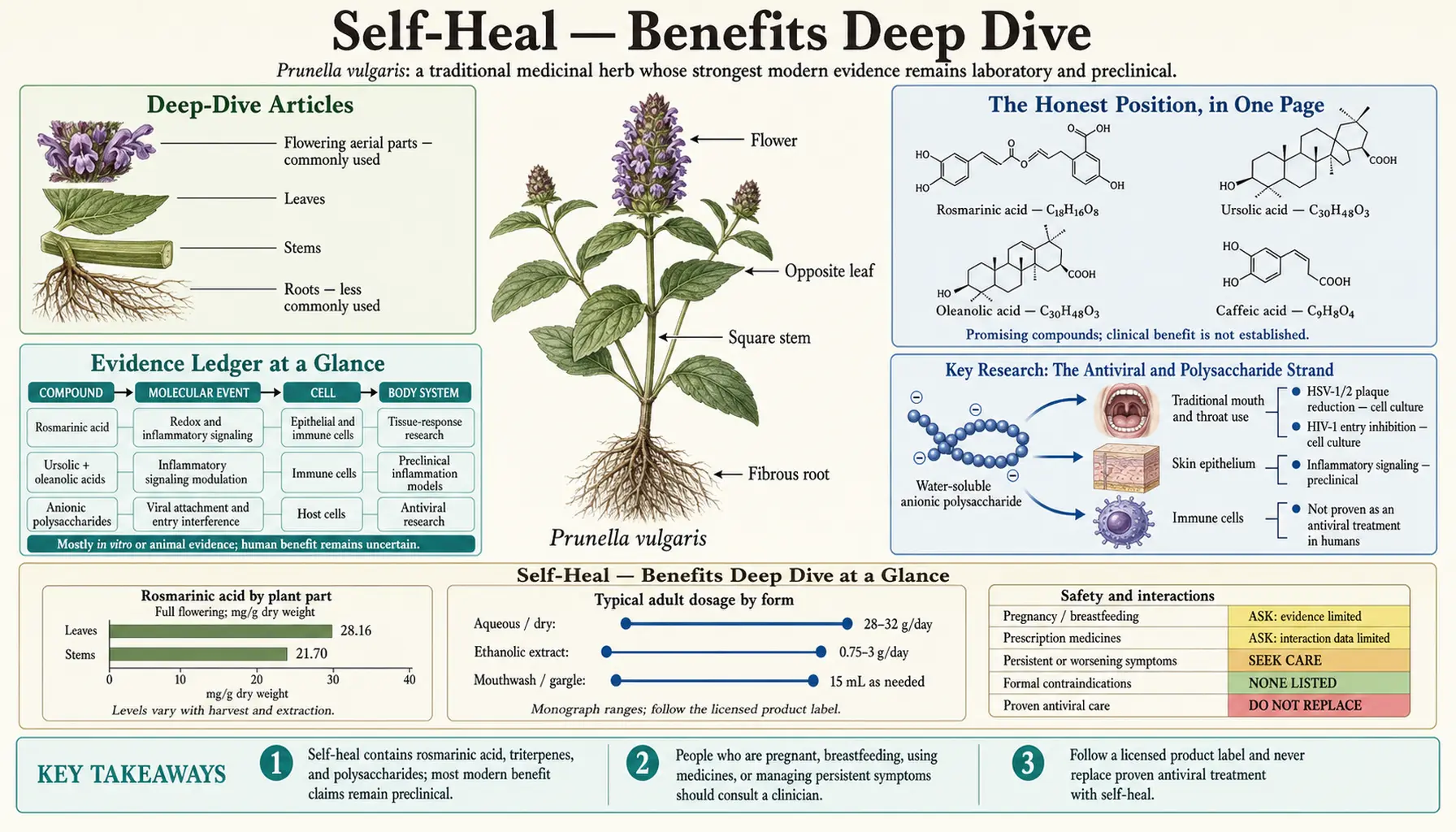
Prunella vulgaris arrives carrying two of the boldest promises in the whole herbal vocabulary. Self-heal. Heal-all. Those names were not earned by any comparison of treated and untreated patients; they are Renaissance-era labels produced by the doctrine of signatures, a way of reasoning about plants that has been obsolete for two hundred years. The plant deserves better than its own marketing, in both directions — it is more interesting than the hype suggests, and far less proven.
These four pages set out what is actually established. In short: an unusually clean safety record built on centuries of food and tea use; one strand of genuinely reproducible modern laboratory research on herpes simplex virus; a traditional core of throat, mouth and skin uses that the plant's chemistry supports better than the oral supplements built on it; and no high-quality human trial of the herb on its own for any of it — the human trials that exist are Chinese add-on trials for thyroid disease, rated low quality by their own reviewers, and one small toothpaste trial of self-heal combined with another herb. Not a record of failed trials — an absence of good trials, which is a materially different and much less damning position, and one worth stating precisely rather than blurring.
Along the way we do something you will rarely see on a herb page: we follow the antiviral mechanism to the place where it was tested properly in humans, at proper doses, by the right route, in randomised trials with thousands of participants — and report that it failed. We also clear the plant of nine specific hazards it does not have, because refusing to invent a danger is as much a part of accuracy as refusing to invent a benefit.
Deep-Dive Articles
The Name and What It Promises
"Self-heal" and "heal-all" are among the most over-promising names in herbal medicine, and they came from the doctrine of signatures rather than from evidence. How the names were generated, why "woundwort" belongs to half a dozen unrelated plants, what the Chinese name xia ku cao says instead, and an evidence ledger that puts the plant's three best-established facts — all safety facts — above its most famous claim.
Read the deep dive →Antiviral and Herpes Research
The one genuinely interesting modern strand: water extracts and the polysaccharide "prunellin" block herpes simplex virus in cell culture, reproducibly, across independent groups. Also why that is a finding about an entire chemical class rather than about this plant, why the aciclovir-resistance claim is less impressive than it sounds, and what happened when the same mechanism went into large human trials.
Read the deep dive →Sore Throat and Topical Use
The traditional core across both European and Chinese practice, reported at traditional-use tier. What a warm gargle physically does with no herb in it at all, which constituents a water infusion actually extracts and which it leaves in the strainer, why rosmarinic acid is a plant-kingdom compound rather than a self-heal result, and when a sore throat stops being a herb question.
Read the deep dive →Rosmarinic Acid, Safety and Unknowns
Where the honest answer is mostly reassuring, and where saying so is part of accuracy. Nine hazards this plant does not have; why "it is just a mint" is a bad argument even when its conclusion is right; the coumarin fallacy that props up the blood-thinning warning; the potassium arithmetic that kills the blood-pressure mechanism; and ten numbered things nobody knows.
Read the deep dive →Thyroid Trials in Chinese Medicine
What the Chinese randomised trials and their meta-analyses report for overactive thyroid, Graves' disease, nodules and Hashimoto's, mostly with self-heal added to standard drugs, and the quality limits the reviewers name.
Read the deep dive →Table of Contents
- Deep-Dive Articles
- The Honest Position, in One Page
- Evidence Ledger at a Glance
- Key Research: The Antiviral and Polysaccharide Strand
- Key Research: Where the Mechanism Was Tested in Humans
- Key Research: Rosmarinic Acid and the Triterpenes
- Key Research: Tradition, Food Use and Safety
- Key Research: Comparators With Real Human Trials
- External Resources
- Connections
- Featured Videos
The Honest Position, in One Page
If you read nothing else in this section, read this.
What is solid
- It is a food. Young leaves are eaten raw and cooked across Europe, Turkey, Korea, Japan and China; the dried flower spike is drunk as a cooling tea, including casually and commercially. That is a very large, very long, cross-cultural exposure record.
- No toxicity signal has emerged from it. No recognised poisoning syndrome, no cluster of liver or kidney injury, no regulatory action of the kind that hit comfrey, germander, kava or aristolochia. This is absence of a signal rather than a completed safety programme — but it is real, and it is more than most medicinal herbs can show.
- The chemistry is well described. Rosmarinic acid and other phenolic acids, flavonoid glycosides, the triterpene acids ursolic and oleanolic, and water-soluble sulfated polysaccharides.
- The herpes cell-culture finding is real and reproducible. Independent groups, consistent direction, a coherent mechanism.
What is not
- There is no high-quality human trial of this plant on its own. The human trials that exist are of two kinds. In China, self-heal preparations have been added to standard thyroid drugs in randomised trials: a 2025 meta-analysis of 17 trials (1,366 patients with overactive thyroid) and a second meta-analysis of 9 trials (966 patients with Graves' disease, using a self-heal oral liquid) reported better thyroid hormone levels and smaller glands than the drugs alone, but rated the evidence low (2025) and low to very low (the second review), mostly because of unclear allocation concealment and lack of blinding; a 2021 meta-analysis of 13 trials (1,468 patients with thyroid nodules) also reported benefit and called the quality of the studies uncertain. And one small double-blind, placebo-controlled trial (40 volunteers, 84 days) tested a toothpaste containing self-heal and plume poppy (Macleya cordata) for gingivitis — a combination, so the effect cannot be credited to self-heal alone. For wounds, sore throat, mouth ulcers, cold sores, genital herpes, eye inflammation, blood pressure and cancer there is no adequate human trial.
- Nobody has measured what happens to it in a person. No pharmacokinetics, no dose-finding, no interaction studies. "No known interactions" here means nobody has looked, which is absent data rather than reassurance.
- The antiviral fraction is unlikely to work by the oral route. Large sulfated polysaccharides are very poorly absorbed from the gut — measured directly in humans for the best-studied member of the class, dextran sulfate, although a later study with a more sensitive method found small amounts reaching the blood. A swallowed extract cannot deliver useful amounts of it to a virus.
- A water infusion leaves the triterpenes behind. Ursolic and oleanolic acid are poorly water-soluble, so the plant's best anti-inflammatory laboratory finding does not transfer to a tea.
- Rosmarinic acid results are not self-heal results. The compound is abundant in rosemary, lemon balm, perilla, sage and spearmint. A finding about the molecule belongs to all of them jointly and to none exclusively.
The one conclusion that surprised us
Taking the chemistry seriously ends up supporting the old-fashioned topical uses over the modern oral supplement. The antiviral polysaccharides act on contact and are very poorly absorbed; rosmarinic acid's oral bioavailability is low; antibacterial concentrations achievable in a strong infusion are plausible at a mucosal surface and impossible in the bloodstream. Capsules sold on the strength of the herpes research are sold on a mechanism that cannot operate the way they are taken. The gargle is the preparation with the coherent rationale — and it is the one nobody has bothered to trial.
The only real hazard
Not the plant. The delay. A herb called "self-heal" implies that no clinician is needed, and its flagship Chinese indication is dissipating neck lumps. A persistent, hard, painless or enlarging neck lump in an adult is investigated, not steeped. The same goes for a severe or one-sided sore throat, a spreading skin infection, or anything at all in someone immunosuppressed.
Evidence Ledger at a Glance
Ranked by how well established each item is, not by how often it is repeated. Note where the list starts, and note that negative and absent are logged separately because they are different verdicts.
- Established, human: edible leaf, palatable tea, long cross-cultural food record.
- Established by absence of signal, human: no notable toxicity from centuries of casual use.
- Established, chemical: the constituent profile.
- Reproducible, laboratory: inhibition of HSV-1 and HSV-2 in cell culture by aqueous extracts and purified polysaccharide.
- Reproducible, laboratory: antioxidant activity, reduced inflammatory signalling in cells and some animal models, protection of human keratinocytes against oxidative and ultraviolet stress.
- Reproducible, laboratory: inhibition of assorted bacteria and fungi in broth or agar.
- Traditional, two independent traditions: throat, mouth, minor wounds. Convergent, specific, plausible — and untrialled, apart from one small toothpaste trial for gingivitis that combined self-heal with another herb.
- Traditional, one tradition: eyes, neck nodules, goitre. The eye use is untrialled; overactive thyroid and thyroid nodules have been tested only as add-ons to standard drugs in Chinese trials that their reviewers rate low quality; and the nodule indication carries a delayed-diagnosis risk.
- Traditional with a mechanism that fails arithmetic: blood pressure via potassium salts. At a generous ceiling, a cup of tea carries about a seventh of a banana's potassium and a full traditional decoction about one banana. Whatever the herb may do, potassium is not how.
- Preclinical only, and heavily overstated online: anticancer activity. Cell lines and tumour-bearing mice. This is the claim most likely to cause real harm by displacing treatment.
- Negative, human, borrowed but directly relevant: oral bioavailability of the active antiviral class — measured and poor. And topical polyanion antivirals for preventing viral infection — large randomised trials, failed.
- Absent or weak: no high-quality trial of the herb alone for any clinical endpoint (the thyroid add-on trials are rated low quality, and the toothpaste trial tested a combination); and absent altogether: all pharmacokinetics, all dose-finding, all interaction studies, all pregnancy data, all product standardisation.
Key Research: The Antiviral and Polysaccharide Strand
Papers verified record by record end in their PubMed PMID; topic entries link a live PubMed search, so you see the current literature rather than a snapshot. Where we could not verify a paper's details we describe the finding and link the topic instead.
- Tabba HD, Chang RS, Smith KM. "Isolation, purification, and partial characterization of prunellin, an anti-HIV component from aqueous extracts of Prunella vulgaris." Antiviral Research, 1989;11(5-6):263–273. PubMed PMID: 2802570 — The origin of the name that supplement labels now use as though it denoted a characterised drug. The words "partial characterization" are in the founding paper's own title.
- Xu HX, Lee SH, Lee SF, White RL, Blay J. "Isolation and characterization of an anti-HSV polysaccharide from Prunella vulgaris." Antiviral Research, 1999;44(1):43–54. PubMed PMID: 10588332 — The purification tying antiviral activity to the polysaccharide fraction, and the source of the aciclovir-resistant-strain report. The same paper found that the polysaccharide still cut the yield of virus inside cells by 99% and 94% when added 5.5 and 8 hours after infection (heparin: 53% and 3%), that it was not cytotoxic and showed no anticoagulant activity, and concluded that “its mode of action appears to be different from other anionic carbohydrates, such as heparin.”
- Chiu LC, Zhu W, Ooi VE. "A polysaccharide fraction from medicinal herb Prunella vulgaris downregulates the expression of herpes simplex virus antigen in Vero cells." Journal of Ethnopharmacology, 2004;93(1):63–68. PubMed PMID: 15182906 — Independent confirmation with a downstream readout, in a monkey kidney cell line.
- Psotová J, Kolář M, Soušek J, et al. "Biological activities of Prunella vulgaris extract." Phytotherapy Research, 2003;17(9):1082–1087. PubMed PMID: 14595592 — Antioxidant and anti-HSV activity in a single characterised extract.
- Sulfated polysaccharides as antiviral entry inhibitors — class reviews. Essential context: carrageenan, dextran sulfate, fucoidan, heparin and pentosan polysulfate all do this, for the same physical-chemical reason. Much of the finding belongs to the class — although the founding purification paper above found the self-heal polysaccharide also acting after the virus had entered cells, in a way that appears different from heparin. — PubMed search
- Aciclovir resistance mechanisms in herpes simplex virus. Resistance arises mainly in viral thymidine kinase — which an entry blocker never touches; the resistant strains in the purification paper were thymidine-kinase-deficient or polymerase-defective. That makes "active against resistant strains" predictable rather than remarkable. — PubMed search
Key Research: Where the Mechanism Was Tested in Humans
This block is the most important on the page, and the rarest thing on a herb site: the proposed mechanism, tested properly in people, in randomised trials, by the right route.
- Lorentsen KJ, Hendrix CW, Collins JM, et al. "Dextran sulfate is poorly absorbed after oral administration." Annals of Internal Medicine, 1989;111(7):561–566. PubMed PMID: 2476054 — Human pharmacokinetics for the class of molecule credited with self-heal's antiviral activity, measured directly: after a single 1,800 mg oral dose, plasma levels were not measurable and less than 0.5% of the dose was recovered in the urine. The authors concluded it is “very poorly absorbed”. This is why an oral antiviral claim for this plant is not merely unstudied but implausible.
- Hiebert LM, Wice SM, Jaques LB, Williams KE, Conly JM. "Orally administered dextran sulfate is absorbed in HIV-positive individuals." Journal of Laboratory and Clinical Medicine, 1999;133(2):161–170. PubMed PMID: 9989768 — The qualification: with a more sensitive method, in a short-term study (7 people) and a long-term study (8 people), oral dextran sulfate was found in 67% of plasma samples (peak 2.2 µg/mL in the short-term study) and in all urine samples; activated partial thromboplastin time rose and platelet counts fell, with thrombocytopenia in 3 patients. Poorly absorbed, then — but small amounts do reach the blood.
- Abrams DI, Kuno S, Wong R, Jeffords K, et al. "Oral dextran sulfate (UA001) in the treatment of the acquired immunodeficiency syndrome (AIDS) and AIDS-related complex." Annals of Internal Medicine, 1989;110(3):183–188. PubMed PMID: 2463780 — The clinical arm of the same story. The class did not deliver, and was effectively abandoned as an oral antiviral.
- Skoler-Karpoff S, Ramjee G, Ahmed K, Altini L, et al. "Efficacy of Carraguard for prevention of HIV infection in women in South Africa: a randomised, double-blind, placebo-controlled trial." The Lancet, 2008;372(9654):1977–1987. PubMed PMID: 19059048 — A carrageenan-based gel — a sulfated polysaccharide entry blocker — applied topically at the site of exposure, at drug concentrations, in 6,202 randomised women. HIV incidence was 3.3 per 100 woman-years with the gel and 3.8 with placebo (adjusted hazard ratio 0.87, 95% CI 0.69–1.09): it did not prevent infection. Applicator testing estimated that gel was used in only 42.1% of sex acts.
- Van Damme L, Govinden R, Mirembe FM, Guédou F, et al. "Lack of effectiveness of cellulose sulfate gel for the prevention of vaginal HIV transmission." New England Journal of Medicine, 2008;359(5):463–472. PubMed PMID: 18669425 — The trial was stopped early after an interim finding (hazard ratio 2.02). Among 1,398 women there were 25 new HIV infections with cellulose sulfate gel and 16 with placebo (hazard ratio 1.61, P=0.13, not significant); the authors concluded that cellulose sulfate “did not prevent HIV infection and may have increased the risk of HIV acquisition.”
- Trials of a polymer-based microbicide gel for HIV prevention. The other major polyanion candidate: a suggestive smaller result, a null larger one. — PubMed search
- Eccles R, Meier C, Jawad M, Weinmüllner R, et al. "Efficacy and safety of an antiviral Iota-Carrageenan nasal spray: a randomized, double-blind, placebo-controlled exploratory study in volunteers with early symptoms of the common cold." Respiratory Research, 2010;11:108. PubMed PMID: 20696083 — The honest counterweight: the same mechanism, applied continuously to the exposed surface, with a positive result in 35 people. The class is not dead — it just cannot be swallowed.
- Eccles R, Winther B, Johnston SL, Robinson P, et al. "Efficacy and safety of iota-carrageenan nasal spray versus placebo in early treatment of the common cold in adults: the ICICC trial." Respiratory Research, 2015;16:121. PubMed PMID: 26438038 — The larger follow-up, in 200 adults, missed its primary endpoint: mean symptom scores on days 2–4 were 5.78 with the spray and 6.39 with placebo (p = 0.0895, not significant). Differences in favour of the spray appeared only in exploratory analyses after unblinding.
Key Research: Rosmarinic Acid and the Triterpenes
- Petersen M, Simmonds MS. "Rosmarinic acid." Phytochemistry, 2003;62(2):121–125. PubMed PMID: 12482446 — The standard review, including the compound's wide distribution across the mint and borage families — the reason a rosmarinic acid result is never a self-heal result.
- Ryu SY, Oak MH, Yoon SK, et al. "Anti-allergic and anti-inflammatory triterpenes from the herb of Prunella vulgaris." Planta Medica, 2000;66(4):358–360. PubMed PMID: 10865455 — The paper behind the ursolic and oleanolic acid claims — and, given their poor water solubility, the paper least applicable to a tea.
- Psotová J, Svobodová A, Kolářová H, Walterová D. "Photoprotective properties of Prunella vulgaris and rosmarinic acid on human keratinocytes." Journal of Photochemistry and Photobiology B: Biology, 2006;84(3):167–174. PubMed PMID: 16631374 — The most route-appropriate laboratory evidence the plant has: human skin cells, the tissue the tradition actually treated.
- Rosmarinic acid pharmacokinetics, metabolism and bioavailability in humans. Low oral bioavailability, extensive conjugation, rapid clearance — and therefore a large gap between cell-culture concentrations and anything achievable by drinking a herb. — PubMed search
- Ursolic acid: aqueous solubility, formulation and bioavailability. The chemistry behind the solvent argument — why a water infusion leaves the triterpenes in the strainer. — PubMed search
- Hwang SM, Lee YJ, Yoon JJ, Lee SM, et al. "Prunella vulgaris suppresses HG-induced vascular inflammation via Nrf2/HO-1/eNOS activation." International Journal of Molecular Sciences, 2012;13(1):1258–1268. PubMed PMID: 22312316 — A representative anti-inflammatory mechanism study, in cells, and a good example of how far such work sits from a clinical claim.
Key Research: Tradition, Food Use and Safety
- Bai Y, Xia B, Xie W, et al. "Phytochemistry and pharmacological activities of the genus Prunella." Food Chemistry, 2016;204:483–496. PubMed PMID: 26988527 — The most complete compositional map, and the reference against which we checked which hazards the plant does not carry.
- Wang SJ, Wang XH, Dai YY, et al. "Prunella vulgaris: a comprehensive review of chemical constituents, pharmacological effects and clinical applications." Current Pharmaceutical Design, 2019;25(3):359–369. PubMed PMID: 30864498 — Its clinical section shows how little is there. That thinness is the finding.
- Prunella vulgaris in ethnobotanical wild-food and beverage surveys. The documentary basis for the food-history safety argument, from Europe, Turkey, Korea, Japan and China. — PubMed search
- Xia ku cao in traditional Chinese medicine and multi-herb formulas. Most clinical literature attaches to formulas rather than to the single herb. The search makes the pattern obvious. — PubMed search
- Wei M, Zhao Q, Yuan M, Fan Y, Li M. "Efficacy and safety of Prunella vulgaris L. combined with antithyroid drugs for hyperthyroidism: a systematic review and meta-analysis." Frontiers in Pharmacology, 2025;16:1530152. PubMed PMID: 40083379 — 17 randomised trials, 1,366 patients: self-heal preparations added to antithyroid drugs gave better thyroid function, antibody levels and gland size than the drugs alone, with the strength of evidence rated low.
- Chen Z, Yuan B, Zhang L, Zhang L, et al. "Prunella Oral Liquid in combination with Western medical treatment for Graves' disease: a systematic review and meta-analysis." Journal of Ethnopharmacology, 2027;373:122255. PubMed PMID: 42526549 — 9 randomised trials, 966 patients with Graves' disease, a self-heal oral liquid added to standard treatment; certainty of evidence low to very low, with risk of bias mainly from unclear allocation concealment and lack of blinding.
- Han Q, Xu N, Chen B, Wu W, Sheng L. "Safety and efficacy of Prunella vulgaris preparation in adjuvant treatment of thyroid nodules: a meta-analysis." Medicine (Baltimore), 2021;100(41):e27490. PubMed PMID: 34731129 — 13 randomised trials, 1,468 patients, self-heal added to levothyroxine or thyroxine tablets; smaller nodules reported, with the quality of the studies described as uncertain.
- Germander (Teucrium chamaedrys) hepatotoxicity. The Lamiaceae counterexample that destroys the "it is just a mint, so it is safe" argument — even though the conclusion happens to be right for self-heal. — PubMed search
- Herbal product adulteration and species substitution, including DNA barcoding surveys. Why "woundwort" is a job description rather than an identification, and why the safety record belongs to the species you meant. — PubMed search
- Live search for toxicology and safety studies of Prunella vulgaris. We could not verify a coherent toxicology programme; if that changes, this link will show it first. — PubMed search
Key Research: Comparators With Real Human Trials
These exist to answer the standing defence that traditional remedies cannot be trialled. Every item is a traditional or over-the-counter remedy that was tested anyway — often cheaply, often by small groups, and in one case on a mint-family herb for exactly the condition self-heal is claimed to treat.
- Koytchev R, Alken RG, Dundarov S. "Balm mint extract (Lo-701) for topical treatment of recurring herpes labialis." Phytomedicine, 1999;6(4):225–230. PubMed PMID: 10589440 — A lemon balm cream, randomised and placebo-controlled, for cold sores. A Lamiaceae herb with a similar rosmarinic acid profile and a similar traditional reputation was trialled properly. Self-heal could have been.
- Hubbert M, Sievers H, Lehnfeld R, Kehrl W. "Efficacy and tolerability of a spray with Salvia officinalis in the treatment of acute pharyngitis – a randomised, double-blind, placebo-controlled study with adaptive design and interim analysis." European Journal of Medical Research, 2006;11(1):20–26. PubMed PMID: 16504956 — A sage throat spray against placebo.
- Schapowal A, Berger D, Klein P, Suter A. "Echinacea/sage or chlorhexidine/lidocaine for treating acute sore throats: a randomized double-blind trial." European Journal of Medical Research, 2009;14(9):406–412. PubMed PMID: 19748859 — A herbal spray taken head-to-head against a conventional one, which is the design a self-heal gargle deserves and has never received.
- Honey for acute cough in children — Cochrane systematic review. How much evidence a cheap traditional remedy can genuinely accumulate when someone bothers. — PubMed search
- Pelargonium sidoides for acute respiratory tract infections — Cochrane systematic review. Another traditional preparation with a real evidence base. — PubMed search
- Sacks SL, Thisted RA, Jones TM, Barbarash RA, et al. "Clinical efficacy of topical docosanol 10% cream for herpes simplex labialis: a multicenter, randomized, placebo-controlled trial." Journal of the American Academy of Dermatology, 2001;45(2):222–230. PubMed PMID: 11464183 — Calibration: a real, statistically solid effect in this condition is about 18 hours of healing time (median healing 4.1 days in 370 patients on docosanol, 18 hours shorter than in 367 on placebo). Far smaller than herbal marketing implies.
- Herbal mouthwashes for oral mucositis — chamomile, calendula and others. A validated, inexpensive, ready-made trial design with a genuine unmet need, sitting in the literature next to a herb that has never been put through it. — PubMed search
- Adámková H, Vicar J, Palasová J, Ulrichová J, Simánek V. "Macleya cordata and Prunella vulgaris in oral hygiene products – their efficacy in the control of gingivitis." Biomedical Papers of the Medical Faculty of the University Palacký, Olomouc, Czech Republic, 2004;148(1):103–105. PubMed PMID: 15523557 — Self-heal itself, tested in people: a double-blind, placebo-controlled trial of a toothpaste containing self-heal and plume poppy (Macleya cordata) in 40 volunteers over 84 days reduced symptoms of gingivitis on the periodontal treatment-needs (CPITN) and papillary bleeding (PBI) indexes. It tested the combination, so the effect cannot be credited to self-heal alone.
- Live search for human trials of Prunella vulgaris. It returns the Chinese thyroid add-on trials and the combination toothpaste trial cited on this page; no high-quality trial of the herb on its own for the throat, mouth or skin uses was found. — PubMed search
External Resources
- PubMed — the biomedical literature database behind every citation on these pages.
- ClinicalTrials.gov — the trials registry. A November 2026 search found a registered trial of a self-heal oral liquid for thyroid nodules (NCT06423235).
- National Center for Complementary and Integrative Health — plain-language, evidence-graded summaries of herbs and supplements.
- LiverTox — the National Library of Medicine's reference on drug- and herb-induced liver injury. Useful for checking which herbs genuinely have a hepatotoxicity record.
- European Medicines Agency — herbal monographs, and the place to read what a "traditional use registration" actually certifies, which is documented long use plus plausibility and explicitly not efficacy trials.
- Plants of the World Online (Kew) — authoritative botanical names and distributions, for settling which species a folk name refers to.
- Cochrane Library — systematic reviews, including the honey and Pelargonium reviews cited above.
Connections
- All Herbs
- Self-Heal (Prunella vulgaris) — the main topic page for the plant
- The Name and What It Promises — the doctrine of signatures, and an evidence ledger
- Antiviral and Herpes Research — prunellin, and where the mechanism was tested
- Sore Throat and Topical Use — the traditional core, and the red flags
- Rosmarinic Acid, Safety and Unknowns — nine hazards it does not have
- Thyroid Trials in Chinese Medicine — the meta-analyses and their limits
- Lemon Balm: Antiviral and HSV — the mint-family comparator that was trialled
- Lemon Balm — rosmarinic acid, with more human data behind it
- Rosemary: Benefits — the herb the compound is named after
- Perilla: Benefits — where this site makes the same rosmarinic-acid argument
- Yarrow: Benefits — the other great woundwort, under the same scrutiny
- Calendula: Benefits — a wound and mouth herb with real trial data
- Sage: Benefits — the Lamiaceae throat remedy that got tested
- Agrimony: Sore Throat and Topical Use — a closely parallel astringent tradition
- Plantain — the everyday poultice herb
- Comfrey — a wound herb with a genuine internal hazard
- Chrysanthemum: Cooling, Fever and Sore Throat — the cooling herb paired with xia ku cao
- Herpes Simplex — the infection, and the treatments with evidence
- Lysine: Herpes Simplex and Cold Sores — a claim that was tested, with mixed results
- Sore Throat — the symptom, its causes and its red flags