Shallot — Benefits Deep Dive
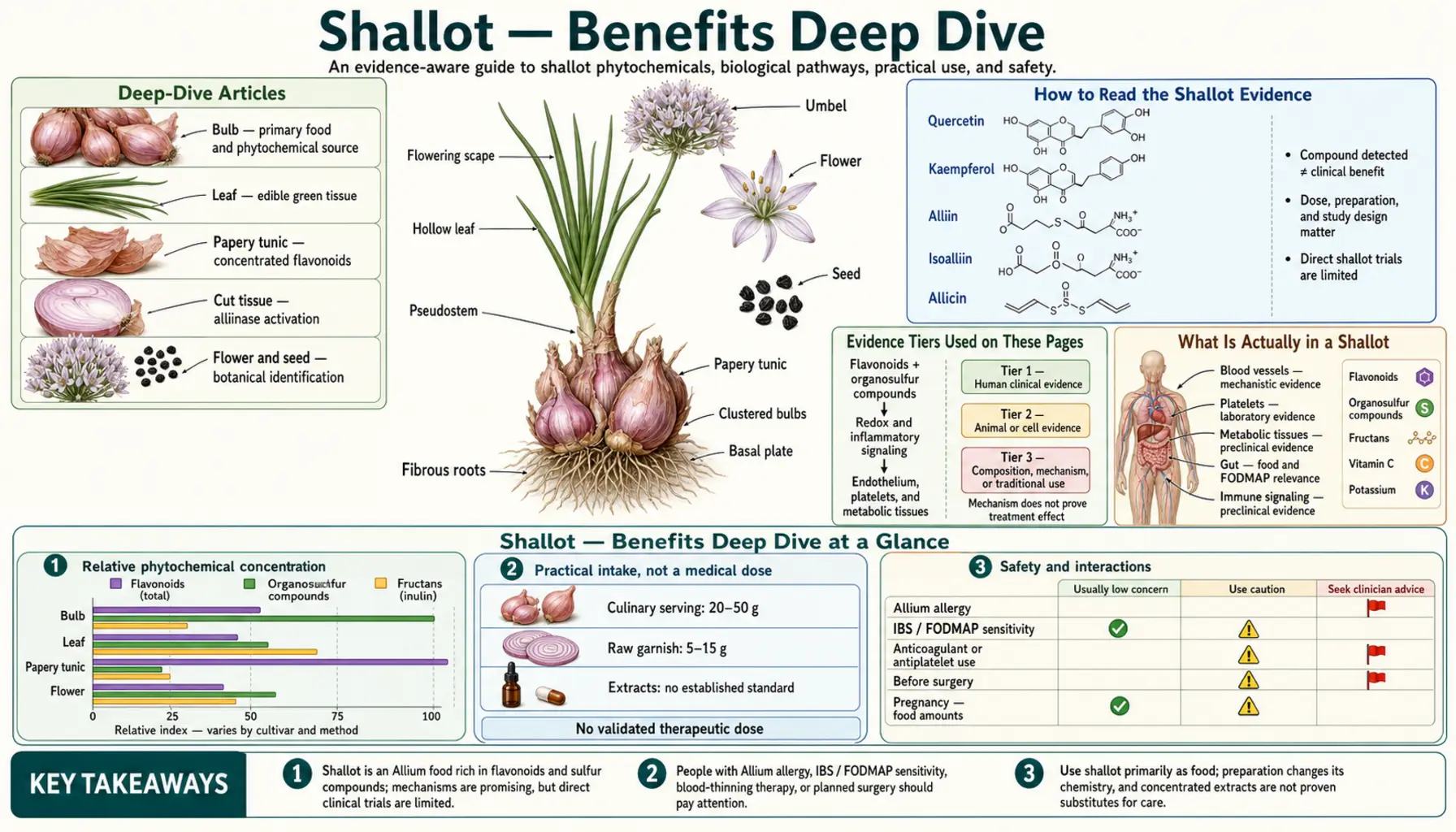
This is the benefits section for the shallot — Allium ascalonicum in the older literature, Allium cepa L. Aggregatum Group (often written Allium cepa var. aggregatum) in modern botanical treatments. Four deep-dive articles sit beneath this page: cholesterol and heart health, blood sugar control, antimicrobial and immune support, and antioxidants with the cancer research literature.
Before any of that, the single most important thing to understand about shallot health claims. The shallot lives in a genus with two of the most heavily researched plants in nutritional medicine: garlic (Allium sativum) and the common onion (Allium cepa). Garlic alone has hundreds of randomized human trials and multiple Cochrane-level reviews. The shallot has almost none. What happens in practice — on supplement labels, in blog posts, and sometimes in review papers that should know better — is that garlic's and onion's clinical results get quietly relabelled as "allium benefits" and then attached to the shallot, which never earned them.
Every page in this section marks its evidence explicitly. When a finding comes from a shallot, we say shallot. When it comes from garlic or onion and is being offered as a plausible extension, we say so in the same sentence. That distinction is not a technicality; it is the honest core of this topic.
There is one genuinely shallot-specific nutritional fact worth leading with. Shallots really do carry more total phenolics and more quercetin than most common onions — not as a marketing claim but as a measured difference. Yang, Meyers, van der Heide and Liu compared phenolic content and antioxidant and antiproliferative activity across a range of onion varieties and shallots in the Journal of Agricultural and Food Chemistry in 2004, and shallots ranked at or near the top, far above the mild sweet onion types. The reason is structural: flavonols concentrate in a bulb's outer fleshy layers, and a small clustered shallot is mostly outer layer. Add the anthocyanins in the purple skin and flesh, which yellow onions essentially lack, and the gap is built into the plant rather than being an artifact of one laboratory.
Table of Contents
- Deep-Dive Articles
- How to Read the Shallot Evidence
- Evidence Tiers Used on These Pages
- What Is Actually in a Shallot
- The Three Plants Called "Shallot"
- Key Research: Composition and Polyphenols
- Key Research: Quercetin Bioavailability
- Key Research: Cardiometabolic Evidence
- Key Research: Antimicrobial and Immune
- Key Research: Antioxidant and Cancer Epidemiology
- Cautions That Apply Across All Four Pages
- External Resources
- Connections
Deep-Dive Articles
Shallots for Cholesterol and Heart Health
What the allium cardiovascular literature actually shows, which parts belong to garlic and onion rather than shallot, and why a polyphenol-rich vegetable can be worth eating even without a trial behind it.
Shallots for Blood Sugar Control
Rodent and cell studies on shallot and insulin resistance, the onion and garlic trials that get borrowed, the fructan question, and an honest answer to whether shallots lower blood sugar in people.
Shallots for Antimicrobial and Immune Support
Thiosulfinate chemistry, forty-five years of laboratory antimicrobial work on Allium ascalonicum, the allergic-rhinitis studies, and why laboratory activity is not an antibiotic.
Shallots, Antioxidants and Cancer Research
Quercetin, anthocyanins, Nrf2 induction, and the allium-vegetable cancer epidemiology — kept strictly at the level of population association and in-vitro work, because that is all that exists.
How to Read the Shallot Evidence
Four habits will protect you from almost every bad shallot claim you will encounter.
1. Ask which plant was in the study. This sounds pedantic until you see how often it matters. A paper titled "effects of shallot extract" may have used the kitchen shallot, the Iranian mountain plant moosir (Allium hirtifolium / Allium stipitatum, marketed in English as "Persian shallot"), or one of the Croatian coastal hybrids sold locally as shallots. These are different species with different organosulfur profiles. A randomized trial of Persian shallot in metabolic syndrome tells you nothing about the bulb in your pantry, and it gets cited as if it does.
2. Ask whether the subjects were human. The shallot-specific literature is dominated by rats, mice and cultured cells. Animal and in-vitro work is how research starts, not how it finishes. A rat given a concentrated aqueous extract at a dose no human diet could deliver is a mechanistic experiment, not a dietary recommendation.
3. Ask which part of the bulb was extracted. A surprising fraction of published allium chemistry uses the papery skin — the part everyone throws away — because that is where the phenolics concentrate. Mobin and colleagues, reporting on the antibacterial and antioxidant potential of phenolic extracts and fractions from Allium ascalonicum peel in Natural Product Research in 2022, is a clear example. Peel results do not transfer to the flesh you eat.
4. Ask what dose of what preparation. Alliums are chemically unstable by design. Cutting a shallot triggers an enzyme, alliinase, which manufactures reactive thiosulfinates on the spot; those compounds then decompose over minutes to hours. Deep-frying shallots into crisp bawang goreng denatures the enzyme, drives off volatiles and caramelizes sugars. Ratseewo and colleagues measured exactly this in Food Chemistry: X in 2025, comparing how different drying methods change chemical composition, volatile compounds and bioactive-compound retention in shallots. Raw shallot, slow-cooked shallot paste, fried shallot crisps and a dried shallot powder are four different chemical products wearing one name.
Evidence Tiers Used on These Pages
Every substantive claim in this section carries one of four labels. They are used consistently so you can skim for them.
- Randomized clinical trial — humans, randomized, with a control group. For the shallot specifically this tier is close to empty. Where it appears in these pages it almost always describes garlic, onion or isolated quercetin, and the page says which.
- Human observational — cohort and case-control studies, usually of total allium-vegetable intake. Useful for generating hypotheses, permanently vulnerable to confounding, because people who eat more vegetables differ from people who eat fewer in dozens of ways.
- Preliminary (animal or in-vitro) — rodents, cell culture, isolated tissue, or a chemical assay in a test tube. This is where most shallot-specific research lives.
- Traditional use only — a documented historical or cultural practice with no controlled evidence behind it. Worth recording as history. Not evidence of effect.
The site's position, stated once here so the sub-articles do not have to keep repeating it: shallots are an excellent vegetable and a sensible part of a diet associated with good health. There is no condition for which shallots have been shown to work as a treatment, and there is no reason to buy shallot capsules.
What Is Actually in a Shallot
Four compound families do the work discussed across these four articles.
Organosulfur compounds
Intact shallot cells store non-volatile cysteine sulfoxides in the cytoplasm and keep alliinase locked in the vacuole. Damage the tissue and the two meet. Within seconds you get thiosulfinates and the characteristic smell. An accuracy point that matters throughout this section: garlic's dominant precursor is alliin, which converts to allicin. Onion-type alliums including shallots are dominated instead by isoalliin (trans-S-1-propenyl-L-cysteine sulfoxide), plus methiin and propiin, which generate a propenyl- and propyl-derived family of thiosulfinates and feed a second enzyme, lachrymatory factor synthase — the one that makes you cry, characterized by Imai and colleagues in Nature in 2002. So shallots make allicin-family compounds but very little allicin proper. Any shallot supplement claiming standardized allicin content deserves scepticism.
Quercetin and other flavonols
Present mainly as glycosides — principally quercetin 4'-glucoside and quercetin 3,4'-diglucoside — concentrated in the outer fleshy layers and the dry skin, with kaempferol derivatives alongside. Slimestad, Fossen and Vagen surveyed this chemistry in "Onions: a source of unique dietary flavonoids" in the Journal of Agricultural and Food Chemistry in 2007. The glucoside forms matter because they are unusually well absorbed for a flavonoid.
Anthocyanins
Cyanidin glycosides give the red-purple skin and the violet flush in the flesh of Southeast Asian shallots. Yellow onions have essentially none. This is part of why shallots test higher on total phenolics.
Fructans
Inulin-type prebiotic fibres that feed colonic bacteria. They are a genuine benefit for most people and the single most common reason shallots cause trouble for the rest: fructans are the "F" in FODMAP, and shallots are a high-FODMAP food.
The Three Plants Called "Shallot"
This deserves its own section because it is the most common source of wrong information about shallots on the internet.
The kitchen shallot. Allium cepa L. Aggregatum Group, historically Allium ascalonicum. A multiplier onion: plant one bulb, harvest a cluster. Small and deep purple-red in Southeast Asia, larger and coppery in Europe. This is what these pages mean by "shallot" unless they say otherwise.
Persian shallot. Allium hirtifolium or Allium stipitatum, Iranian moosir, a wild allium gathered in the Zagros mountains and sold dried or pickled. It has its own small clinical literature, some of it genuinely interesting, and it is routinely cited in English-language marketing as evidence for the kitchen shallot. It is not the same plant.
The hybrid "shallots." Major, Perkovic, Palcic and colleagues, publishing in Antioxidants in 2022, compared Allium × cornutum, Allium × proliferum and A. cepa Aggregatum Group — all sold as shallots in coastal Croatia — and found their phytochemical and nutritional composition to be both genetically and environmentally determined. Related work by Fredotovic and colleagues on the organosulfur and amino-acid composition of the triploid onion Allium × cornutum versus common onion, in Plants in 2020, makes the same point from the chemistry side. The label "shallot" does not fix the composition.
There is a fourth confusion that is merely linguistic: in Australia and New Zealand "shallot" has often meant spring onion, and the cluster-forming bulb is sold as "eschalot" or "French shallot."
Key Research: Composition and Polyphenols
Tier: laboratory analysis of food composition. These are measurements, not health outcomes.
- Yang J, Meyers KJ, van der Heide J, Liu RH. Varietal differences in phenolic content and antioxidant and antiproliferative activities of onions. Journal of Agricultural and Food Chemistry, 2004. The primary source for shallots outranking most onion varieties on total phenolics and antioxidant capacity. Find on PubMed
- Slimestad R, Fossen T, Vagen IM. Onions: a source of unique dietary flavonoids. Journal of Agricultural and Food Chemistry, 2007. The reference survey of onion-family flavonol chemistry. Find on PubMed
- Major N, Perkovic J, Palcic I, et al. The phytochemical and nutritional composition of shallot species is genetically and environmentally dependent. Antioxidants, 2022. Why "shallot" on a label does not determine chemistry. Find on PubMed
- Fredotovic Z, Soldo B, Sprung M, et al. Comparison of organosulfur and amino acid composition between triploid onion Allium × cornutum and common onion Allium cepa. Plants, 2020. Find on PubMed
- Ratseewo J, Chumroenphat T, Li H, et al. Changes in chemical composition, volatile compounds and bioactive compound retention in shallots under different drying methods. Food Chemistry: X, 2025. Directly relevant to fried and dried shallots. Find on PubMed
- Imai S, Tsuge N, Tomotake M, et al. Plant biochemistry: an onion enzyme that makes the eyes water. Nature, 2002. The discovery of lachrymatory factor synthase, which distinguishes onion-type alliums from garlic. Find on PubMed
- Rose P, Whiteman M, Moore PK, Zhu YZ. Bioactive S-alk(en)yl cysteine sulfoxide metabolites in the genus Allium. Natural Product Reports, 2005. The chemistry that underlies every organosulfur claim in this section. Find on PubMed
Key Research: Quercetin Bioavailability
Tier: human pharmacokinetic studies. These show absorption, not clinical benefit — but absorption is the necessary first step, and this is the strongest shallot-specific human evidence that exists.
- Wiczkowski W, Romaszko J, Bucinski A, et al. Quercetin from shallots (Allium cepa L. var. aggregatum) is more bioavailable than its glucosides. The Journal of Nutrition, 2008. A human study working specifically with shallots. Find on PubMed
- Nemeth K, Piskula MK. Food content, processing, absorption and metabolism of onion flavonoids. Critical Reviews in Food Science and Nutrition, 2007. Find on PubMed
- Mullen W, Edwards CA, Crozier A. Absorption, excretion and metabolite profiling of quercetin conjugates in human plasma and urine after ingestion of onions. British Journal of Nutrition, 2006. Find on PubMed
- Lee J, Mitchell AE. Pharmacokinetics of quercetin absorption from apples and onions in healthy humans. Journal of Agricultural and Food Chemistry, 2012. Find on PubMed
Key Research: Cardiometabolic Evidence
Tier: mixed, and the mix is the point. The randomized trials here are garlic, onion or isolated quercetin. The shallot entries are rodent studies.
- Ried K, Toben C, Fakler P. Effect of garlic on serum lipids: an updated meta-analysis. Nutrition Reviews, 2013. Randomized-trial evidence — for garlic. Find on PubMed
- Ried K. Garlic lowers blood pressure in hypertensive subjects, improves arterial stiffness and gut microbiota: a review and meta-analysis. Experimental and Therapeutic Medicine, 2020. Again garlic. Find on PubMed
- Brull V, Burak C, Stoffel-Wagner B, et al. Effects of a quercetin-rich onion skin extract on 24-hour ambulatory blood pressure and endothelial function in overweight-to-obese patients with (pre-)hypertension. British Journal of Nutrition, 2015. A randomized crossover trial of onion skin extract. Find on PubMed
- Serban MC, Sahebkar A, Zanchetti A, et al. Effects of quercetin on blood pressure: a systematic review and meta-analysis of randomized controlled trials. Journal of the American Heart Association, 2016. Isolated quercetin. Find on PubMed
- Jalal R, Bagheri SM, Moghimi A, Rasuli MB. Hypoglycemic effect of aqueous shallot and garlic extracts in rats with fructose-induced insulin resistance. Journal of Clinical Biochemistry and Nutrition, 2007. One of the few studies to test shallot directly — in rats. Find on PubMed
- Wongmekiat O, Leelarugrayub N, Thamprasert K. Beneficial effect of shallot (Allium ascalonicum L.) extract on cyclosporine nephrotoxicity in rats. Food and Chemical Toxicology, 2008. Shallot, rats. Find on PubMed
- Galavi A, Hosseinzadeh H, Razavi BM. The effects of Allium cepa L. (onion) and its active constituents on metabolic syndrome: a review. Iranian Journal of Basic Medical Sciences, 2021. Find on PubMed
Key Research: Antimicrobial and Immune
Tier: overwhelmingly in-vitro, with a single small clinical line of work on allergic rhinitis.
- Dankert J, Tromp TF, de Vries H, Klasen HJ. Antimicrobial activity of crude juices of Allium ascalonicum, Allium cepa and Allium sativum. Zentralblatt fur Bakteriologie, 1979. The oldest direct shallot-versus-onion-versus-garlic comparison. Find on PubMed
- Amin M, Kapadnis BP. Heat stable antimicrobial activity of Allium ascalonicum against bacteria and fungi. Indian Journal of Experimental Biology, 2005. Find on PubMed
- Mobin L, Haq MA, Ali R, et al. Antibacterial and antioxidant potential of the phenolic extract and its fractions isolated from Allium ascalonicum peel. Natural Product Research, 2022. Find on PubMed
- Arpornchayanon W, Klinprung S, Chansakaow S, et al. Antiallergic activities of shallot (Allium ascalonicum L.) and its therapeutic effects in allergic rhinitis. Asian Pacific Journal of Allergy and Immunology. The closest thing to a shallot clinical study. Find on PubMed
- Lissiman E, Bhasale AL, Cohen M. Garlic for the common cold. Cochrane Database of Systematic Reviews, 2014. The canonical demonstration of how thin even garlic's cold evidence is. Find on PubMed
- Ankri S, Mirelman D. Antimicrobial properties of allicin from garlic. Microbes and Infection, 1999. The thiol-reactivity mechanism, established in garlic. Find on PubMed
Key Research: Antioxidant and Cancer Epidemiology
Tier: human observational studies of allium-vegetable intake, plus in-vitro antiproliferative work. Nothing here shows that shallots treat or prevent cancer, and this section makes no such claim.
- Zhou Y, Zhuang W, Hu W, et al. Consumption of large amounts of allium vegetables reduces risk for gastric cancer with a meta-analysis. Gastroenterology, 2011. Observational, whole allium category. Find on PubMed
- Turati F, Guercio V, Pelucchi C, La Vecchia C, Galeone C. Colorectal cancer and adenomatous polyps in relation to allium vegetables intake: a meta-analysis of observational studies. Molecular Nutrition and Food Research, 2014. Find on PubMed
- Galeone C, Pelucchi C, Levi F, et al. Onion and garlic use and human cancer. The American Journal of Clinical Nutrition, 2006. Find on PubMed
- Nicastro HL, Ross SA, Milner JA. Garlic and onions: their cancer prevention properties. Cancer Prevention Research, 2015. A careful review of what the mechanistic and epidemiological evidence does and does not support. Find on PubMed
- Seyfi P, Mostafaie A, Mansouri K, et al. In-vitro and in-vivo anti-angiogenesis effect of shallot (Allium ascalonicum): a heat-stable and flavonoid-rich fraction of shallot extract potently inhibits angiogenesis. Toxicology in Vitro, 2010. Shallot, but laboratory only. Find on PubMed
- Chen C, Pung D, Leong V, et al. Induction of detoxifying enzymes by garlic organosulfur compounds through transcription factor Nrf2. Free Radical Biology and Medicine, 2004. The indirect-antioxidant mechanism that better explains allium effects than simple radical scavenging. Find on PubMed
Cautions That Apply Across All Four Pages
Each sub-article repeats the cautions relevant to it. Five apply everywhere and are worth reading once, here.
FODMAPs and IBS. Shallots are high in fructans and are excluded during the elimination phase of a low-FODMAP diet. For people with irritable bowel syndrome they are among the more reliable triggers of bloating, wind and pain. The useful workaround: fructans are water-soluble but not oil-soluble, so shallot-infused oil with the solids strained out is usually tolerated, which lets people with IBS keep the flavour. Fried shallot crisps are the solids themselves and are not a workaround.
Reflux and gastritis. Alliums, especially raw, are a common trigger for gastro-oesophageal reflux. If onions bother you, shallots will too.
Bleeding, anticoagulants and surgery. Garlic has a reasonably documented antiplatelet effect, and isolated quercetin inhibits platelet aggregation in human pilot work. Shallot-specific data is sparse, so this is prudent extrapolation rather than established fact. Culinary amounts of shallot are not a concern on warfarin, a direct oral anticoagulant, clopidogrel or aspirin. Concentrated allium supplements should be cleared with the prescriber and stopped one to two weeks before planned surgery.
Botulism risk from alliums in oil. Not theoretical. Alliums held in oil at room temperature create the anaerobic, low-acid conditions Clostridium botulinum needs, and garlic-in-oil has caused documented outbreaks. Home-made shallot oil or shallot confit must be refrigerated and used within a few days, or frozen.
Toxic to dogs and cats. Every allium — shallot, onion, garlic, leek, chive — causes oxidative damage to red blood cells in dogs and cats, producing Heinz-body haemolytic anaemia. Cats are especially sensitive. This includes cooked shallots, shallot powder, fried shallot crisps and any leftovers containing them. Contact a vet if a pet eats a meaningful quantity.
External Resources
- PubMed: Allium ascalonicum — the traditional binomial, which still retrieves the majority of shallot research.
- PubMed: Allium cepa Aggregatum Group — the modern name. Search both or you will miss half the literature.
- PubMed: Allium hirtifolium (Persian shallot) — the other plant, so you can tell the two literatures apart.
- USDA FoodData Central — nutrient composition for shallots and other alliums.
- Monash University FODMAP program — the group that developed low-FODMAP dietary management; the authority on which alliums are tolerated and in what form.
- ASPCA Animal Poison Control — for allium exposure in dogs and cats.
- NIH Office of Dietary Supplements: Garlic — a useful calibration point for how strong allium evidence gets even at its best.
Connections
- All Herbs
- Shallot (Allium ascalonicum) — the main topic page: botany, the taxonomy problem, names across Southeast Asia, culinary technique.
- Garlic — the allium with the largest clinical literature, and the source of most claims wrongly transferred to shallots.
- Garlic Benefits — what a well-researched allium's evidence base actually looks like, for comparison.
- Onions — the species the shallot is now considered a variety of.
- Quercetin — the flavonol shallots supply in unusually generous, well-absorbed amounts.
- Quercetin Benefits — the isolated-compound trials that sit behind many shallot claims.
- Anthocyanins — the pigments that give purple shallots their colour and part of their phenolic edge.
- Irritable Bowel Syndrome — why shallots are restricted on a low-FODMAP diet, and the infused-oil workaround.
- Atherosclerosis — the disease process the cardiovascular claims are aimed at.
- Insulin Resistance — the target of the rodent shallot glucose studies.
- Antibacterial Herbs — where allium antimicrobial chemistry sits among the wider plant literature.