Schisandra: History and Traditional Use
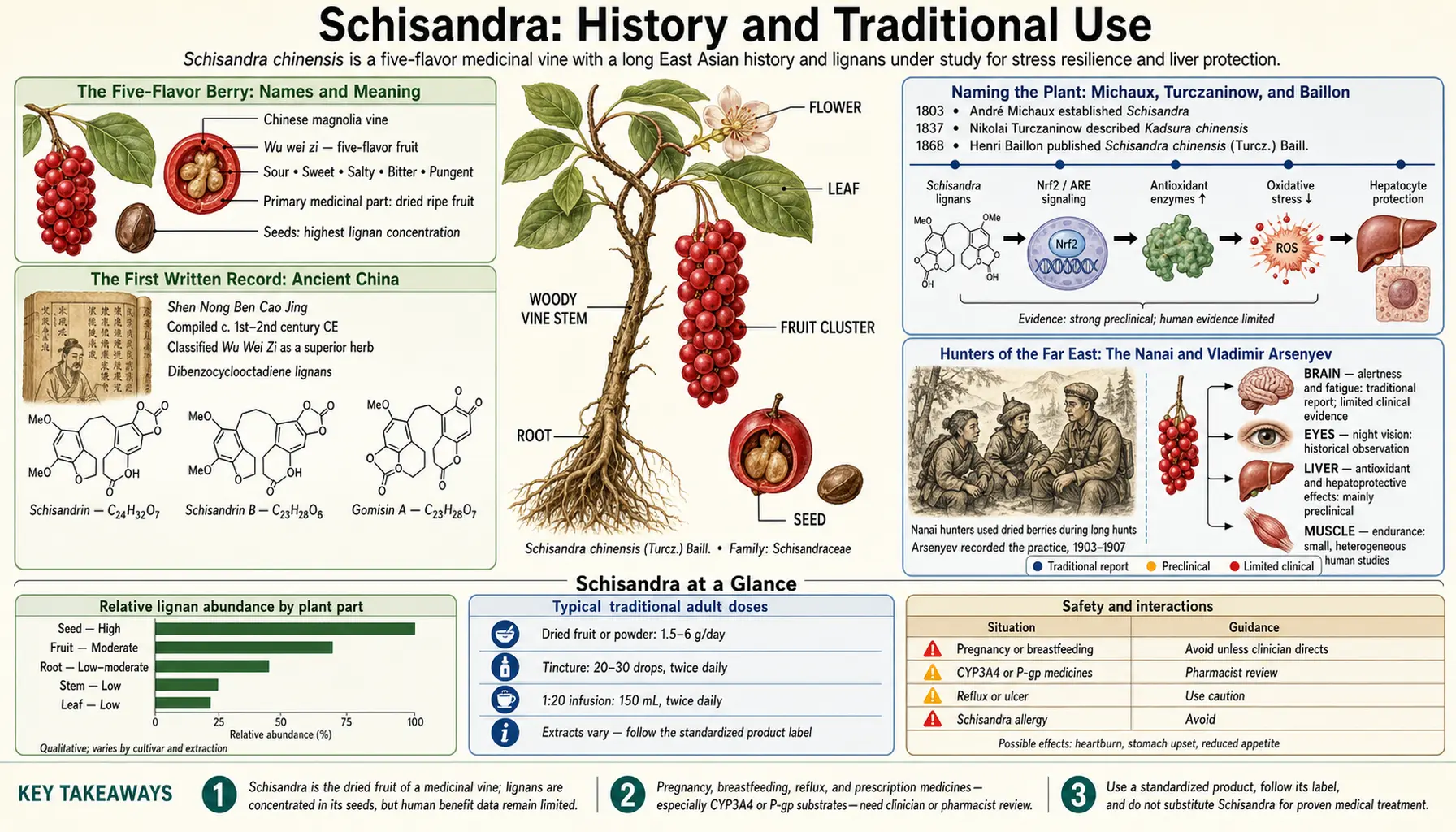
Few herbs carry their reputation in their name as plainly as schisandra. The Chinese call it wu wei zi — the "five-flavor berry" — because a single fruit is said to taste sweet, sour, bitter, pungent, and salty all at once, and traditional doctors took that completeness as a sign that it nourished the whole body. This article follows what the historical record actually supports: where the names come from, the first written mention of the berry in ancient China, the moment a French botanist gave the plant its odd Greek genus name, how hunters in the forests of the Russian Far East used it on long treks, the twentieth-century Soviet research that turned a folk tonic into one of the first "adaptogens," and the day in 1961 when chemists in Moscow isolated the molecule behind much of its activity. Where the record is firm, we say so; where a claim is tradition, folklore, or still debated, we name it as such.
Table of Contents
- The Five-Flavor Berry: Names and Meaning
- The First Written Record: Ancient China
- Naming the Plant: Michaux, Turczaninow, and Baillon
- Hunters of the Far East: The Nanai and Vladimir Arsenyev
- Soviet Science and the Birth of the "Adaptogen"
- Korea, Japan, and the Folk Kitchen
- Isolating Schisandrin: The Lignan Era
- From Tradition to Modern Research
- Research Papers and References
- Connections
- Featured Videos
The Five-Flavor Berry: Names and Meaning
The plant we call schisandra is Schisandra chinensis, a hardy woody climbing vine that produces small, bright-red berries in dense clusters. Its best-known name is the Chinese wu wei zi (五味子), which translates literally as "five-flavor berry" or "five-taste seed." The name reflects an old and genuinely unusual observation: that a single dried berry seems to carry all five of the classical Chinese flavors at once — sweet, sour, bitter, pungent (acrid), and salty. The sour and the sweet sit mostly in the flesh, while the seed, when chewed, turns pungent and bitter with a faintly salty, resinous edge. In the theory of traditional Chinese medicine, a plant that touches all five flavors was held to act on all five of the body's major organ systems, which is why wu wei zi was classed as a broad, harmonizing tonic rather than a remedy for one narrow complaint.
The species is native to the temperate forests of northern China, the Russian Far East, Korea, and Japan, and its other common names track that range. In English it is often called Chinese magnolia-vine or simply magnolia berry, from its loose botanical kinship to that group of flowering plants. To distinguish the northern, cold-hardy plant from a related southern Chinese species (Schisandra sphenanthera), Chinese sources call it bĕi wѨwēizi (北五味子), "northern five-flavor berry." In Korea the berry is omija (오미자) — the name again meaning "five-taste fruit" — and it is the basis of a well-known traditional cordial. The cluster of names tells the same story from every direction: this was a familiar, widely used plant whose defining feature, in every language that named it, was its remarkable five-in-one taste.
The First Written Record: Ancient China
Schisandra's documented medical career begins in China. Its first written appearance is in the Shen Nong Ben Cao Jing (神農本草經, "The Divine Farmer's Classic of Materia Medica"), the foundational Chinese herbal that survives in later reconstructions and is generally dated by scholars to roughly the first to second century CE, in the Han period. The work is traditionally attributed to the legendary emperor-farmer Shennong, but that attribution is folklore: like many ancient classics, it is a compilation by unknown hands rather than the work of a single, datable author, and no real "founder" can be named. What the text does tell us is concrete and important: wu wei zi is listed among the "superior" or upper-class herbs — the top of a three-tier scheme reserved for tonics believed to be safe for long-term use, to strengthen the body, and to support a long, healthy life rather than merely to treat acute disease.
Across the following two thousand years, schisandra kept that high standing in the Chinese materia medica and accumulated a consistent set of traditional uses. Classical practice prescribed the berry as an astringent tonic: to quiet a chronic, dry, lingering cough and "hold" the lungs; to curb night sweats and excessive sweating; to ease chronic thirst and support the body's fluids; to steady the heart and calm a restless spirit (the traditional indications include palpitations, insomnia, and anxious dreams); and to strengthen the kidney system, where it was used for fatigue and weakness following long illness. The herb was rarely given alone; it was — and still is — combined with other herbs in classical formulas. These uses are recorded here as the traditional indications of Chinese medicine, framed in that system's own concepts; they describe a long and well-attested healing tradition, not modern clinical claims.
Naming the Plant: Michaux, Turczaninow, and Baillon
The plant's scientific name has a tidy, well-documented history. The genus Schisandra was established by the French botanist and explorer André Michaux in 1803, in his posthumously published Flora Boreali-Americana — based, in the first instance, on a North American relative rather than the Asian plant. The name is built from two Greek roots, schizein ("to split") and andros ("man," in the botanical sense of the male parts of a flower), and refers to the way the anther cells on the stamens are split or separated. (The same name is sometimes spelled Schizandra in older literature, which is why early chemical papers wrote of "schizandrin"; the modern botanical spelling is Schisandra.)
The full botanical authority for the species is written Schisandra chinensis (Turcz.) Baill. The parenthetical and trailing names record two botanists. The Russian botanist Nikolai Turczaninow first described the East Asian plant in the nineteenth century, and the French botanist Henri Ernest Baillon later transferred it into the genus Schisandra — the standard botanical shorthand for "first named by Turczaninow, reclassified by Baillon." These are documented acts of scientific classification and are named here as such. They are a useful reminder that giving the vine its Linnaean name was a piece of nineteenth-century European and Russian botany layered on top of a plant that East Asian healers had already been using for many centuries.
Hunters of the Far East: The Nanai and Vladimir Arsenyev
Schisandra's second great tradition grew up far to the north of the Chinese pharmacy, in the dense forests of the Russian Far East, where the vine grows wild. There the berry was used not by physicians but by hunters. According to the detailed review of Russian research by Panossian and Wikman, the indigenous Nanai people of the Amur and Ussuri basins (recorded in older sources under the names Goldes or Samagir) ate the dried berries and seeds on long hunting trips as a tonic — specifically, it is reported, to reduce thirst, hunger, and exhaustion and to improve night vision during extended treks through the taiga. This is a folk-use tradition, passed on by practice rather than written down by its own users, and it is described here as such.
The reason this folk knowledge entered the written record at all is largely down to Russian explorers and botanists working in the region around the turn of the twentieth century. Botanical and ethnographic notes on the plant's local use go back at least to Komarov in 1895, and the explorer Vladimir Arsenyev, who surveyed the Ussuri wilderness in the expeditions of 1902 to 1907, is credited in this literature with recording how the native hunters relied on the berry. Arsenyev is himself a documented historical figure: his celebrated 1923 memoir Dersu Uzala — named for his real Nanai guide, the hunter Dersu Uzala (who lived from about 1849 to 1908, and whose story Akira Kurosawa later filmed) — recounts his years in that forest. Popular accounts often say it was Dersu Uzala who introduced Arsenyev to schisandra; that specific, personal claim comes to us through this Russian narrative tradition rather than from independent documentation, so it is fairer to say simply that Arsenyev and his contemporaries recorded the Nanai hunters' use of the berry. Either way, it was this Far-Eastern hunting tradition — a berry that let a tired person keep going, see better in low light, and feel less hunger and thirst — that would soon catch the attention of Soviet science.
Soviet Science and the Birth of the "Adaptogen"
In the middle of the twentieth century, schisandra became the subject of an unusually large body of state-backed research in the Soviet Union, and that research gave the herb — and a whole class of herbs — a new identity. The pivotal word is adaptogen. It was coined in 1947 by the Soviet toxicologist Nikolai Lazarev to describe a substance that helps the body resist a wide range of physical, chemical, and biological stresses and return to balance, and Lazarev's work explicitly grew out of an interest in the traditional Far-Eastern tonic plants, schisandra among them. The concept was then developed and given formal criteria over the following decades by the pharmacologists Israel Brekhman and his colleague I. V. Dardymov, working at the Soviet Academy of Sciences in Vladivostok — the same research school that established Eleutherococcus ("Siberian ginseng") and helped popularize Rhodiola rosea.
The Soviet program treated schisandra as a performance and resilience tonic, and tested it accordingly: in laboratory studies and in human trials aimed at fatigue, physical endurance, mental work capacity under strain, and recovery from exertion. As the Panossian and Wikman review summarizes, schisandra first gained recognition as an adaptogen in the official medicine of the USSR in the early 1960s, on the strength of the pharmacological and clinical studies of the two preceding decades, and the drug was subsequently included in editions of the State Pharmacopoeia of the USSR — a formal stamp of recognition that took the berry from folk remedy to officially listed medicine. Soviet-era reports also describe its use to support people working under demanding conditions, including soldiers, pilots, and night-shift workers; the broad direction of this research is well documented, even where individual program details from the period are harder to verify, so the specifics are best read as the claims of that Soviet literature. This adaptogen framing — resilience, stamina, and clearer functioning under stress — is the lens through which much of the modern world still encounters schisandra.
Korea, Japan, and the Folk Kitchen
Schisandra was never only a clinic or laboratory herb; across its native range it has long had a place in the kitchen and in everyday folk practice, which is part of why the tradition stayed alive. The clearest example is Korea, where the berry, known as omija ("five-taste fruit"), is the basis of omija-cha — a traditional cordial made by steeping the raw red berries in water (often with honey or sugar) to draw out their striking sweet-sour-tart flavor, drunk warm in winter or chilled in summer. The same fruit flavors traditional Korean and Chinese syrups, teas, and fruit wines, so that the line between "food" and "tonic" was, for ordinary households, never very sharp.
That domestic, food-and-drink use matters historically for a simple reason: a plant that people gather, brew, and enjoy at home tends to keep its traditions intact across generations far better than one confined to professional medicine. In Korea, Japan, China, and the Russian Far East alike, schisandra survived as a familiar berry — pleasant enough to make into a drink, valued enough to carry on a journey, and esteemed enough to write into the medical classics. When modern researchers went looking for the plant behind the reputation, they were studying something that had stayed in continuous, living use the whole time. As always with traditional preparations, these are descriptions of cultural and culinary practice rather than dosing or treatment advice.
Isolating Schisandrin: The Lignan Era
The bridge from tradition to laboratory chemistry can be dated quite precisely. In 1961, a team of chemists in the Soviet Union — N. K. Kochetkov, A. Khorlin, O. S. Chizhov, and V. I. Sheichenko — reported the isolation of schisandrin (then spelled "schizandrin") from the berries of Schisandra chinensis, in a paper titled, fittingly, "Schizandrin — lignan of unusual structure." This was the first of the plant's characteristic dibenzocyclooctadiene lignans to be pinned down — a structurally unusual family of compounds that turned out to be largely unique to the genus Schisandra. The isolation is a genuine, documented scientific milestone, and these are the real chemists who reported it.
That 1961 paper opened the door to the rest of the family. Over the following decades, researchers identified a whole suite of related lignans — the various schisandrins, schisantherins, and gomisins — concentrated especially in the seeds rather than the fleshy pulp, which is why careful traditional and modern preparations use the whole berry, seed included. Naming the molecules did something important for an old folk medicine: it gave schisandra's long-claimed effects a concrete chemical address, and it set up the laboratory and clinical work — especially on the liver and on stress physiology — that occupies researchers today. The detailed chemistry, mechanisms, and clinical evidence are taken up in the companion Schisandra Benefits articles, including Liver Protection and Adaptogenic and Stress support.
From Tradition to Modern Research
What makes schisandra's history satisfying is how neatly its two great traditions point at the questions modern science actually asks. The Chinese classics prized the berry for the lungs, the liver and the "essence," and for steadying a restless heart and mind; the hunters of the Russian Far East valued it for stamina, alertness, and endurance under hardship; and Soviet pharmacology, gathering both threads, recast it as an adaptogen for stress and fatigue. Each of these is a claim that can, in principle, be tested — and each maps onto an area where laboratory and clinical research on schisandra has since concentrated: liver protection, antioxidant activity, and resilience to physical and mental stress.
The honest summary is that tradition raised the questions and research is still working through the answers. The plant's lignans are now well characterized and are the focus of active study, and contemporary reviews — such as the comprehensive ethnopharmacological survey by Yang and colleagues — gather a large modern literature on schisandra's constituents and reported activities. As with any herb, traditional standing and promising laboratory findings are not the same as proof of benefit for a given person or condition, and schisandra has real, documented interactions with the liver enzymes that process many medications. None of that diminishes the history. The thread that runs from a Han-dynasty materia medica, through a Nanai hunter's pouch of dried berries and a 1961 Moscow chemistry paper, to a present-day research laboratory is continuous — and that continuity is exactly what makes the story of the five-flavor berry worth knowing.
Research Papers and References
The list below combines the key peer-reviewed sources used in this article with curated PubMed topic-search links into the ethnobotanical, historical, and phytochemical literature on Schisandra chinensis. Author names, titles, and journals are given as plain text; only stable identifiers (DOI, PMID, or PubMed search URLs) are hyperlinked, and each opens in a new tab. The ancient Chinese source named in the article (the Shen Nong Ben Cao Jing) is referred to as a historical primary text rather than as a modern citation.
- Panossian A, Wikman G. Pharmacology of Schisandra chinensis Bail.: an overview of Russian research and uses in medicine. Journal of Ethnopharmacology. 2008;118(2):183-212. — doi:10.1016/j.jep.2008.04.020 · PMID 18515024
- Kochetkov NK, Khorlin A, Chizhov OS, Sheichenko VI. Schizandrin — lignan of unusual structure. Tetrahedron Letters. 1961;2(20):730-734. — doi:10.1016/S0040-4039(01)91684-3
- Yang K, Qiu J, Huang Z, et al. A comprehensive review of ethnopharmacology, phytochemistry, pharmacology, and pharmacokinetics of Schisandra chinensis (Turcz.) Baill. and Schisandra sphenanthera Rehd. et Wils. Journal of Ethnopharmacology. 2022;284:114759. — doi:10.1016/j.jep.2021.114759 · PMID 34678416
- Schisandra chinensis ethnobotany and traditional use — PubMed: Schisandra chinensis ethnobotany and traditional use
- Schisandra chinensis as an adaptogen — history and pharmacology — PubMed: Schisandra chinensis adaptogen
- Schisandra lignans (schisandrin, gomisin, schisantherin) phytochemistry — PubMed: Schisandra lignans phytochemistry
External Authoritative Resources
- NCCIH — Herbs at a Glance
- MedlinePlus — Herbs and Supplements
- PubMed — All research on Schisandra chinensis
Connections
- All Herbs
- Schisandra Hub
- Schisandra Benefits Deep Dive
- Schisandra for Liver Protection
- Schisandra for Stress & Resilience
- Rhodiola Rosea
- Ashwagandha
- Ginseng
- Astragalus
- He Shou Wu