Sage: History and Traditional Use
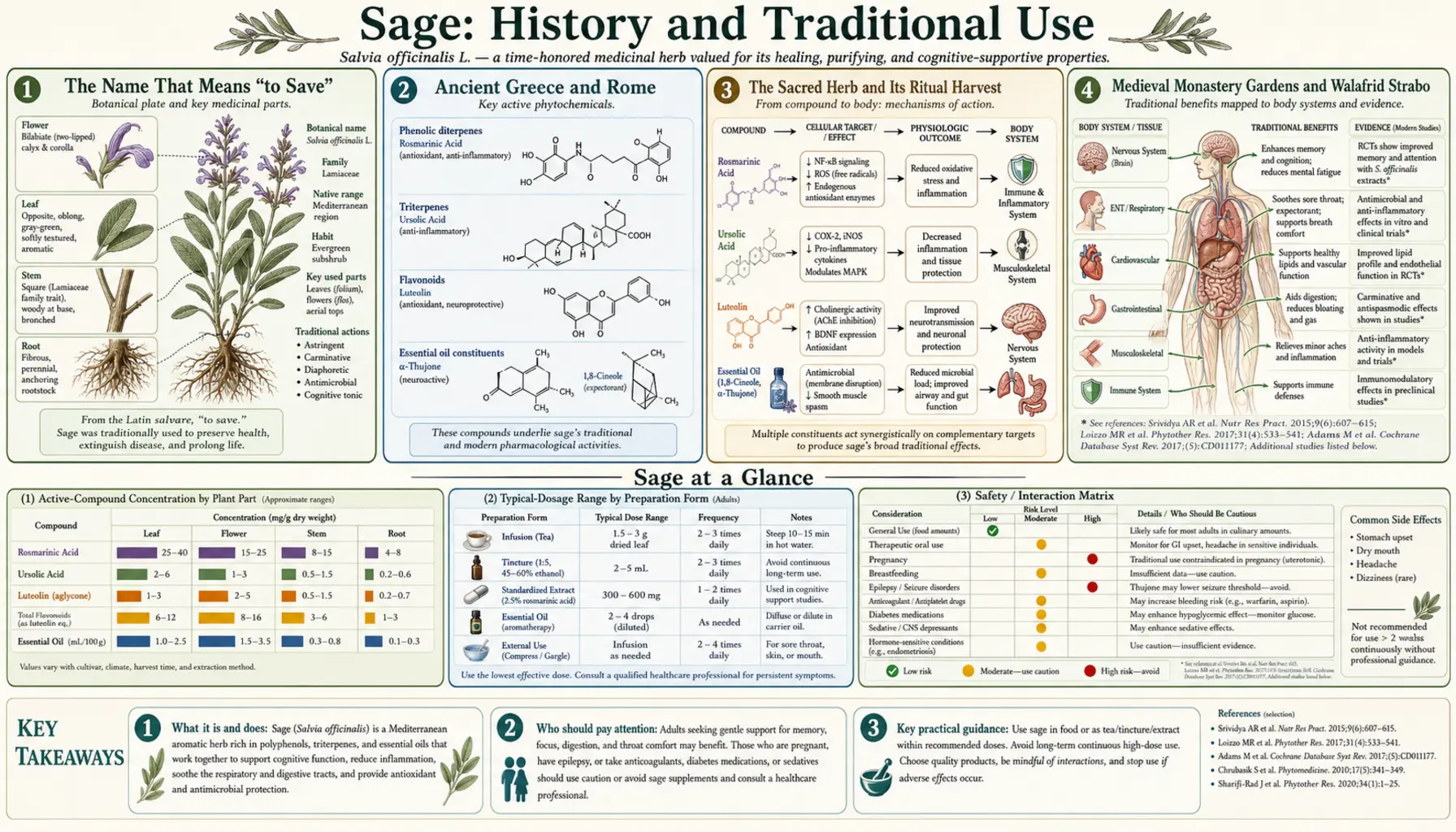
Few garden plants carry a name that is itself a promise of healing. The very word sage descends from the Latin Salvia, built on the verb salvare — "to save" or "to heal" — and for more than two thousand years cultures around the Mediterranean and beyond treated this grey-green, velvet-leaved shrub as one of the most valuable herbs a household could grow. Romans called it a sacred herb, medieval monks gave it the place of honour in their physic gardens, and a famous medical school asked, in all seriousness, why anyone should die while sage grew in the garden. This article traces that long story — the documented record where we have it, and the folklore and tradition where the record gives way to belief — and shows how modern science has begun to test the oldest of sage's reputations.
Table of Contents
- The Name That Means "to Save"
- Ancient Greece and Rome
- The Sacred Herb and Its Ritual Harvest
- Medieval Monastery Gardens and Walafrid Strabo
- The School of Salerno and "Salvia salvatrix"
- Renaissance Herbals and the Sage-for-Tea Trade
- Folklore, Longevity, and the Herb of Remembrance
- From Tradition to Modern Research
- Research Papers and References
- Connections
- Featured Videos
The Name That Means "to Save"
The common garden sage of the kitchen and the apothecary is Salvia officinalis L., a small evergreen shrub of the mint family (Lamiaceae) native to the northern Mediterranean, especially the Balkan coast and the hills of southern Europe. From there it spread, by cultivation, across the whole of Europe and eventually around the world. Botanists count roughly a thousand species in the genus Salvia, which makes it the largest genus in the mint family, but it is this one Mediterranean species that the Western tradition means when it simply says "sage."
The plant's scientific name is a compact history lesson. Salvia comes from the Latin salvus, "safe" or "healthy," and the related verb salvare, "to save" or "to heal" — the same root that gives English salvation and salve. The species name officinalis is a botanical badge of medicinal status: it marks a plant that was kept in the officina, the storeroom of a monastery or apothecary where medicines were prepared and shelved. A name like Salvia officinalis therefore tells us, before we read a single herbal, that generations of Europeans regarded this plant as a healer worth keeping on the shelf.
The naming of sage in the ancient world was not perfectly tidy, and it is worth being honest about that. The Greek botanist Theophrastus, writing in the fourth and third centuries BCE, distinguished two related plants — a wild undershrub he called sphakos and a cultivated one he called elelisphakos — and later authors did not always agree on which plant was which. Pliny the Elder recorded that the Romans of his day called the plant the Greeks knew as elelisphacus by the Latin name salvia. Sorting out exactly which ancient name maps onto our modern Salvia officinalis is a genuine puzzle that scholars have debated, so the safest statement is the simplest: a sage-like aromatic herb of the mint family was named, cultivated, and prized for medicine across the classical Mediterranean, and our garden sage is its direct descendant in name and in use.
Ancient Greece and Rome
Sage's documented medical career begins, like so much of Western herbalism, with the great physician-naturalists of the classical Mediterranean. The Greek army doctor and pharmacologist Dioscorides, in his first-century De Materia Medica, described a sage-type plant under the Greek name elelisphakos and recorded a remarkably specific set of uses: he wrote that it promotes menstruation and urine, heals the wound of the stingray and numbs the affected area, and that taken in drink with wine it helps dysentery. These are concrete, observational claims, and they sit at the head of the entire Western record of sage.
His near-contemporary Pliny the Elder catalogued the plant in his vast Natural History, noting the Greek name elelisphacus and the Latin salvia, and reported that the Romans used it as a diuretic, as a local anaesthetic for the skin, and as a styptic to stop bleeding, among other purposes. The physician Galen, the most influential medical writer of the Roman world, likewise placed sage among the useful drugs of his pharmacopoeia. Taken together, Dioscorides, Pliny, and Galen are commonly described as recommending sage as a diuretic, a wound-and-bleeding remedy, a promoter of menstruation, and a general tonic — the foundation on which every later European herbal would build. For accessibility, these ancient works are named here as historical primary sources rather than as modern citations.
What is striking is how durable those first-century indications proved to be. The respiratory, menstrual, wound-healing, and tonic uses named by these authors recur, almost unchanged, in herbals written fifteen centuries later, and several of them — the soothing of an inflamed mouth and throat, the staunching of bleeding, the general "tonic" reputation — map closely onto the areas where modern laboratory and clinical research on sage has since concentrated. The classical inheritance was transmitted, largely intact, into the monasteries of medieval Europe.
The Sacred Herb and Its Ritual Harvest
Beyond its plain medicinal value, sage carried an aura of the sacred in the Roman world. Roman writers referred to it as a herba sacra — a "sacred" or "holy" herb — and the plant was associated with religious ritual rather than treated as an ordinary kitchen weed. This reverence is part of why sage's reputation travelled so far and lasted so long; a plant regarded as holy was a plant worth growing, recording, and passing on.
Tradition, drawing on Pliny's account, holds that the gathering of sage was a ceremonious affair. The reports describe a gatherer who approached the plant only after making an offering — commonly said to be bread, or bread and wine — who wore a clean white tunic, came freshly washed and barefoot, and who was instructed not to cut the herb with an iron blade. Folklore offers a poetic reason (iron was thought to disturb the plant's power) and later writers have noted a practical one as well (iron salts react badly with sage), but the essential point for a history page is that this is a described tradition handed down from antiquity, not a modern, repeatable observation. We can say with confidence that the Romans treated sage as sacred and that classical sources record a ritualised harvest; the finer details should be read as the kind of ceremonial lore that ancient herb-gathering attracted.
It is worth pausing on how much that single word — sacred — tells us. Across cultures, plants were rarely called holy unless they were also useful, abundant, and woven into daily life. Sage qualified on every count: it grew readily, it kept its grey leaves through winter, it flavoured and preserved food, and it had a long list of trusted remedies attached to it. The sacred status of Roman sage is the symbolic expression of a thoroughly practical relationship between a people and a plant.
Medieval Monastery Gardens and Walafrid Strabo
When the Roman world gave way to medieval Europe, the keepers of classical medical learning were very often monks, and sage moved naturally from the Roman officina into the monastery physic garden. It became one of the standard plants of the cloister garden, grown for the infirmary and the kitchen alike, and it appears among the herbs that early-medieval authorities expected to find under cultivation. Sage is, for example, named among the plants listed in the Carolingian estate ordinance known as the Capitulare de villis — a late-eighth- or early-ninth-century decree, issued under the emperor Charlemagne, that directed which crops and herbs were to be grown on the royal estates. (The exact date of the document is debated by historians, so it is best described simply as a decree of Charlemagne's reign.) Its inclusion in such a list confirms that sage was regarded as a standard, expected medicinal and culinary herb of the early medieval garden.
The single most charming early-medieval witness to sage is the monk Walafrid Strabo, who in the 830s tended a small garden on the island of Reichenau in Lake Constance and wrote a Latin poem about it, the Liber de cultura hortorum, better known as the Hortulus ("The Little Garden"). The poem describes the herbs he grew and their virtues, and it gives sage the very first place of honour, ahead of rue and the rest. Walafrid praises sage as sweetly scented, rich in virtue, good to mix in a medicinal drink, and of proven use for many a human ailment. The Hortulus is one of the earliest pieces of European garden writing, and the fact that it opens with sage is a small but telling measure of the plant's standing in the medieval mind.
Sage's place in medieval medicine is often linked with the great twelfth-century abbess and healer Hildegard of Bingen, whose medical writings discuss many plants of the German monastery garden. Hildegard is genuinely a towering figure in medieval herbal medicine, and sage was a well-known cloister-garden herb of exactly the kind she wrote about; readers interested in the precise wording of her recommendations should consult her works directly, since popular summaries vary. What is not in doubt is the larger pattern: through the monastery gardens of the early and high Middle Ages, the classical reputation of sage was preserved, copied, and handed on to the physicians and herbalists who came after.
The School of Salerno and "Salvia salvatrix"
The high point of sage's medieval fame is tied to Salerno, the southern Italian town that hosted the most celebrated medical school of medieval Europe. The school's teaching was distilled into a famous didactic health poem in Latin verse, the Regimen Sanitatis Salernitanum (also known as the Flos Medicinae, the "Flower of Medicine"), which circulated for centuries in countless copies and translations. In its lines on sage the poem asks a question that became one of the most quoted phrases in all of herbal medicine:
"Cur moriatur homo cui Salvia crescit in horto?" — "Why should a man die while sage grows in his garden?"
The same passage hails the plant as Salvia salvatrix — "sage the saviour" — and calls it a reconciler with nature. The verse is, of course, rhetorical praise rather than a medical claim to be taken literally; no herb confers immortality, and the Salernitan masters knew it. But it captures, better than any list of indications, the sheer trust that medieval Europe placed in this single plant. Sage was the household standby, the herb you reached for first, the one whose mere presence in the garden felt like a hedge against illness and death.
That reputation explains the cascade of admiring by-names sage collected in the medieval and early-modern centuries — it was, quite literally, "the herb that saves." The Salernitan verse fixed that idea in the European imagination, and it is still repeated today, usually with a smile, by gardeners and herbalists who know perfectly well that it is hyperbole and treasure it anyway. Few plants have ever been paid a higher compliment.
Renaissance Herbals and the Sage-for-Tea Trade
With the arrival of printing, sage passed from manuscript herbals into the great printed botanical books of the Renaissance, where its classical reputation was repeated and expanded. The English herbalist John Gerard, in his celebrated Herball of 1597, summed up the prevailing view in a sentence that already points toward sage's most modern reputation: sage, he wrote, "is singularly good for the head and braine, it quickeneth the senses and memory, strengtheneth the sinewes." Half a century later Nicholas Culpeper and other seventeenth-century writers carried the same indications — head and nerves, mouth and throat, digestion and bleeding — into the popular English herbals that ordinary households actually owned. These herbals are named here as historical texts; the uses they record map closely onto the traditional-use literature catalogued in modern ethnobotanical reviews of Salvia officinalis.
One of the most telling episodes in sage's history comes from this same early-modern period and concerns not medicine but trade. According to accounts later gathered by eighteenth-century writers on tea (notably Thomas Short's A Dissertation Upon Tea of 1730), Dutch traders of the East India Company found that the Chinese — the very inventors of tea — so prized European sage that they would exchange their own tea for it, by some reports at a rate of several pounds of Chinese tea for a single pound of dried sage. The tale is usually told as a historical anecdote rather than a documented ledger entry, and it should be read in that spirit. But true in detail or merely traditional, it captures something real: in the Europe of that era, sage tea was an everyday, valued drink, and its reputation as a healthful infusion was strong enough that the story of out-trading China for it felt entirely believable.
By this period sage had also long since proved its worth in the kitchen as a preserver and flavouring — the enduring partnership of sage with rich meats and sausages is, at root, the same aromatic, keeping-quality herb at work that the apothecaries valued. The Renaissance, in short, did not so much discover anything new about sage as broadcast its ancient reputation more widely than ever, in print, in the teacup, and on the table, just as Europe stood on the threshold of the scientific age that would begin to ask why the old herb worked.
Folklore, Longevity, and the Herb of Remembrance
Around the documented medicine grew a thick hedge of folklore, and much of it clusters on two themes: long life and memory. Because the name itself promised health and salvation, sage became a folk emblem of longevity and well-being, and old European sayings held that eating sage — especially in May — would lengthen one's life. A well-known piece of garden lore even claimed that the state of the sage bush mirrored the fortunes of the household or the business of its owner, flourishing when the family prospered and failing when it declined. These are charming beliefs rather than facts, and they are best enjoyed as folklore; what they record is the affection and trust an ordinary plant could command.
The second great folk theme — sage as the "herb of remembrance," a strengthener of memory and the mind — turns out to be the most interesting, because here folklore and laboratory science eventually shook hands. The association is genuinely old: it runs through Gerard's "quickeneth the senses and memory" in 1597 and the broader European herbal tradition of sage as good "for the head and brain." For centuries this was simply received wisdom, the sort of thing a herbalist said and a patient believed. It is exactly this traditional reputation that, much later, sent modern researchers to the laboratory bench to test whether sage actually does anything for memory — the subject of the final section below.
Sage also gathered the everyday domestic roles that familiar herbs always accumulate: it was burned and strewn for its clean, resinous scent, kept as a tooth-cleaner and breath-freshener (its leaves were rubbed on the teeth and gums long before commercial toothpaste), and valued as a steadfast, hardy presence in the garden that asked little and gave much. As with all such lore, this page presents these customs as historical and cultural practice, not as medical advice; the point is simply that sage was woven into the texture of daily life as thoroughly as any plant in the European tradition.
From Tradition to Modern Research
The most satisfying chapter in sage's history is the one being written now, in which old reputations are put to a modern test. The clearest example concerns the ancient idea of sage as a herb for "the head and brain." In a frequently cited 1996 study in the International Journal of Geriatric Psychiatry, the researchers Nicolette Perry, Elaine Perry, and colleagues deliberately took plants that European herbal tradition reputed to aid memory — sage, rosemary, and balm — and tested their extracts against acetylcholinesterase, an enzyme in the brain that breaks down acetylcholine, a neurotransmitter central to memory and depleted in Alzheimer's disease. Sage extract inhibited the enzyme in a dose-dependent way. In other words, a folk reputation many centuries old pointed modern scientists toward a plausible biological mechanism — the same kind of mechanism targeted by several modern Alzheimer's drugs.
That thread has been followed into the clinic. In a small 2003 randomised, placebo-controlled trial published in the Journal of Clinical Pharmacy and Therapeutics, Shahin Akhondzadeh and colleagues in Iran reported that a Salvia officinalis extract improved cognitive scores over four months in patients with mild-to-moderate Alzheimer's disease compared with placebo. Other modern work has begun to examine sage's long-traditional uses for sore throats, for menopausal hot flushes, and for blood-sugar and cholesterol balance. These are early findings, not settled conclusions, and they belong to the companion Sage and Sage Benefits articles, where the clinical evidence, dosing, and important safety cautions (especially around the compound thujone and the concentrated essential oil) are set out in full.
What the history shows, in the end, is a single unbroken thread. A small Mediterranean shrub whose very name means "to save" was prized by Dioscorides and Pliny, called sacred by Rome, given the first place of honour in a ninth-century monk's garden poem, and immortalised by the masters of Salerno — and the oldest of all its reputations, sage for the memory and the mind, is precisely the one a modern enzyme assay reached out to test. Tradition raised the questions; research is now, carefully, beginning to answer them. That continuity — a humble kitchen herb used the same ways across two millennia and only now being explained — is what makes the history of sage worth knowing.
Research Papers and References
The list below combines key peer-reviewed studies and reviews of Salvia officinalis with curated PubMed topic-search links into the historical, ethnobotanical, and clinical literature. Historical primary texts (Dioscorides' De Materia Medica, Pliny's Natural History, the works of Galen, the Carolingian Capitulare de villis, Walafrid Strabo's Hortulus, the Regimen Sanitatis Salernitanum, and Gerard's Herball) are named in the article as historical sources rather than as modern citations. Each external link opens in a new tab.
- Perry N, Court G, Bidet N, Court J, Perry E. European herbs with cholinergic activities: potential in dementia therapy. International Journal of Geriatric Psychiatry. 1996;11(12):1063-1069. — doi:10.1002/(SICI)1099-1166(199612)11:12<1063::AID-GPS532>3.0.CO;2-1
- Akhondzadeh S, Noroozian M, Mohammadi M, Ohadinia S, Jamshidi AH, Khani M. Salvia officinalis extract in the treatment of patients with mild to moderate Alzheimer's disease: a double blind, randomized and placebo-controlled trial. Journal of Clinical Pharmacy and Therapeutics. 2003;28(1):53-59. — doi:10.1046/j.1365-2710.2003.00463.x (PMID: 12605619)
- Ghorbani A, Esmaeilizadeh M. Pharmacological properties of Salvia officinalis and its components. Journal of Traditional and Complementary Medicine. 2017;7(4):433-440. — doi:10.1016/j.jtcme.2016.12.014 (PMID: 29034191)
- Hubbert M, Sievers H, Lehnfeld R, Kehrl W. Efficacy and tolerability of a spray with Salvia officinalis in the treatment of acute pharyngitis: a randomised, double-blind, placebo-controlled study with adaptive design and interim analysis. European Journal of Medical Research. 2006;11(1):20-26. — Find on PubMed (PMID: 16504956)
- Walch SG, Tinzoh LN, Zimmermann BF, Stühlinger W, Lachenmeier DW. Antioxidant capacity and polyphenolic composition as quality indicators for aqueous infusions of Salvia officinalis L. (sage tea). Frontiers in Pharmacology. 2011;2:79. — doi:10.3389/fphar.2011.00079 (PMID: 22194722)
- Bozin B, Mimica-Dukic N, Samojlik I, Jovin E. Antimicrobial and antioxidant properties of rosemary and sage (Rosmarinus officinalis L. and Salvia officinalis L., Lamiaceae) essential oils. Journal of Agricultural and Food Chemistry. 2007;55(19):7879-7885. — doi:10.1021/jf0715323 (PMID: 17708648)
- Salvia officinalis ethnobotany, history, and traditional use — PubMed: Salvia officinalis ethnobotany and traditional use
- Sage, memory, and cognitive performance — PubMed: Salvia officinalis memory, cognition, and acetylcholinesterase
External Authoritative Resources
- NCCIH — Herbs at a Glance
- MedlinePlus — Herbs and Supplements
- PubMed — All research on Salvia officinalis