Passionflower: History and Traditional Use
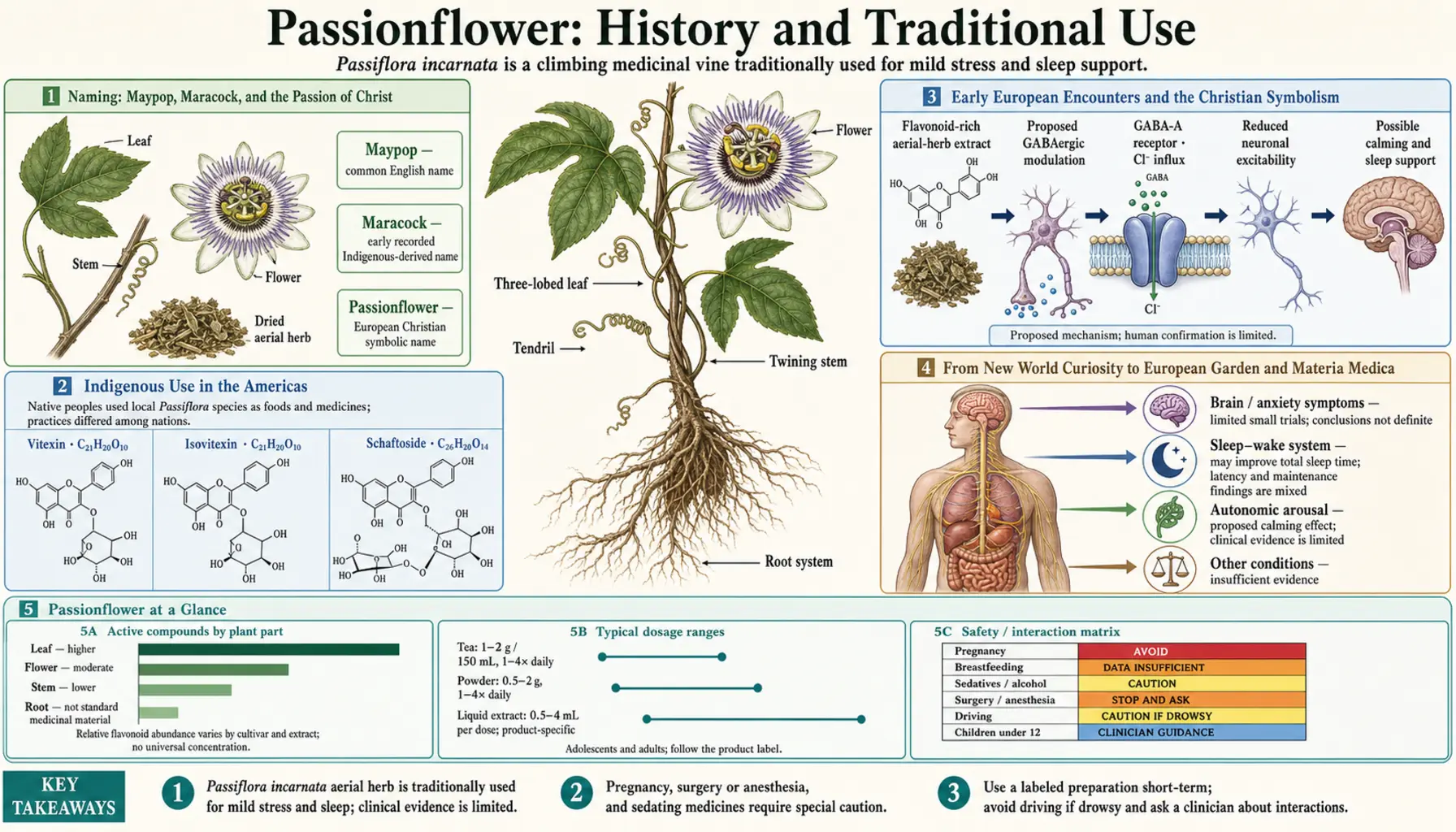
Passionflower (Passiflora incarnata) is a climbing vine of the American Southeast whose extraordinary flower carried two very different stories across the Atlantic. To the Native peoples who had eaten its maypop fruit for thousands of years, it was food, drink, and medicine. To the Spanish missionaries who first met it in the 1500s, the bloom looked like a living diagram of the crucifixion — the crown of thorns, the nails, the wounds — and they gave it the name “passion flower” that it still carries today. This page traces what is genuinely documented about that history, separates record from legend, and follows the plant from Indigenous fields and Jesuit treatises into the European garden, the American pharmacy shelf, and the modern research literature.
Table of Contents
- Naming: Maypop, Maracock, and the Passion of Christ
- Indigenous Use in the Americas
- Early European Encounters and the Christian Symbolism
- From New World Curiosity to European Garden and Materia Medica
- Passionflower in 19th- and Early 20th-Century American Medicine
- The Chemistry Behind the Tradition
- Modern Regulatory Recognition
- Folklore, Symbolism, and Cultural Legacy
- Research Papers and References
- Connections
- Featured Videos
Naming: Maypop, Maracock, and the Passion of Christ
Few plants carry names that pull in such different directions. The same vine is called passionflower — a name born from Christian devotion — and maypop, a plain, practical word that almost certainly comes from a Native American language. Untangling the two names is the first step in understanding the plant's history.
The American common name maypop is widely traced by linguists and historians to the Powhatan (Virginia Algonquian) word rendered as mahcawq, which appears in early colonial records and is thought to have meant something like “squash” or a similar cultivated gourd-fruit. Through generations of English mouths, related forms recorded by colonists — maracock, maracoc, maycock — are commonly said to have drifted into maypop. A popular folk explanation holds instead that “maypop” describes the audible pop the ripe hollow fruit makes when stepped on, and some sources add that the plant itself “pops” up out of the ground in May after lying dormant all winter. The honest position is that the Powhatan-derivation is the explanation most often favored by scholars, while the popping-sound story is a memorable folk etymology; both are commonly repeated, and the ripe fruit really does pop underfoot.
The name passionflower has nothing to do with romantic passion. It refers to the Passion of Christ — the suffering, crucifixion, and death of Jesus. When Spanish and Portuguese Catholics in the Americas examined the flower's elaborate structure, they read it as a divine emblem of the crucifixion, and the Latin genus name Passiflora (later fixed by Linnaeus) preserves that reading. The traditional symbolic interpretation, repeated in countless herbals and devotional texts, assigns the flower's parts to the instruments of the Passion: the fringed corona of filaments is the crown of thorns; the three stigmas are the three nails; the five anthers are the five wounds; the coiling tendrils are the whips of the scourging; and the petals and sepals were counted as the faithful apostles, with Judas the betrayer and Peter the denier left out. This symbolism is genuine historical tradition — it is how real people interpreted the flower — rather than any property of the plant itself.
In Spanish the plant also picked up devotional names such as flor de las cinco llagas (“flower of the five wounds”) and espina de Cristo (“thorn of Christ”), while the fruit became known across Latin America as the granadilla (“little pomegranate”). The collision of these names — an Indigenous food-word and a Counter-Reformation religious emblem on the very same plant — is itself a compact record of two worlds meeting in the sixteenth century.
Indigenous Use in the Americas
Long before Europeans gave it a religious name, Passiflora incarnata was a familiar and useful plant to the Native peoples of the American Southeast, and the archaeological record makes this concrete. Ethnobotanists report that charred, dimpled maypop seeds turn up in archaeobotanical assemblages from many Southeastern U.S. archaeological sites, and that the species has been spreading in association with human-disturbed ground for at least the past three to four thousand years. The plant thrives on exactly the kind of open, tilled, sunny ground that Native farming created, so it grew abundantly at the edges of cornfields and settlements — a relationship scholars describe as a long-standing human–plant mutualism rather than simple wild gathering.
The fruit was the primary attraction. Among the Cherokee, for whom the maypop is a long-documented and culturally important plant, the ripe fruits were eaten raw or crushed into a juice, and the young shoots were boiled and fried, often mixed with other edible greens. The Cherokee also recorded medicinal uses of the pounded root, including topical applications for skin problems, and uses connected with earache, liver complaints, and weaning infants. The Cherokee name for the plant is often given as ocoee, and the Ocoee River and valley in Tennessee are named for it — a durable trace of the plant's place in the regional landscape and language.
The plant's use extended to other Southeastern nations. The Houma of Louisiana are reported in the ethnobotanical literature to have used passionflower among their medicinal and food plants; older herbal sources commonly describe a Houma use of the root as a tonic, though the specifics of such single-source claims should be read as traditional reports rather than firmly verified clinical history. What is clearly documented is the broad regional pattern: across the Southeast the maypop was valued chiefly as a food and a drink, with medicinal uses of the leaf and root recorded alongside.
It is worth being careful here. Passionflower is sometimes loosely grouped with the dried-leaf “smoking herbs” that several Native nations used for respiratory complaints, but the well-attested asthma-relief smoking tradition of that era centers on a different plant — jimsonweed (Datura stramonium, the source of nineteenth-century “asthma cigarettes”) — not on passionflower. For passionflower the solid record is culinary and gentle-medicinal: the maypop as food, the juice as drink, and leaf and root preparations for everyday complaints. Readers should also note that historical ethnobotanical records describe past cultural practice and are not modern clinical recommendations.
Early European Encounters and the Christian Symbolism
Passionflower reached European attention through the Spanish encounter with the Americas, and the early written record names real people. The Sevillian physician Nicolás Monardes (c. 1493–1588) — who never crossed the Atlantic himself but studied the plants, seeds, and reports that flowed into Seville, then Spain's sole port for New World trade — described the American granadilla in his influential treatise on the medicinal products of the Indies, first published in Seville in 1569 and expanded in later editions. Monardes is commonly credited as the first author in print to connect the flower's form with the symbols of Christ's Passion, even though, by his own account, he was working from specimens and descriptions rather than a living plant. His work was carried across Europe in translation, including the English version by John Frampton (1577), titled Joyfull Newes out of the Newe Founde Worlde.
The religious reading of the flower was developed by Catholic missionaries working in the Americas. The Jesuit naturalist José de Acosta, in his Historia natural y moral de las Indias (1590), recorded that the granadilla flower was locally esteemed for displaying the “emblems of the Passion” — the nails, the pillar, the lashes, the crown of thorns, and the wounds. The interpretation gained momentum in Rome in the early seventeenth century: historical accounts describe a dried specimen and drawings of the flower being brought from the New World and presented to the Vatican (a presentation to Pope Paul V around 1608 is frequently cited), where the bloom's resemblance to the instruments of the crucifixion was taken as remarkable. The Roman churchman and historian Giacomo Bosio is widely reported to have incorporated the flower into his early-seventeenth-century writings on the Passion, working from such drawings; readers will find his name attached to this episode in many popular histories, and it is offered here as the commonly repeated account.
What can be stated plainly is that by the early 1600s the “passion flower” identification was established in European learned and devotional culture, the product of several authors and missionaries rather than any single discoverer. The plant was simultaneously a botanical novelty and a piece of religious wonder — and that double identity is exactly what drove its rapid spread through European collections.
From New World Curiosity to European Garden and Materia Medica
The Virginia colony provides some of the earliest first-hand English records of the plant in its native ground. Captain John Smith, writing of Virginia in 1612, described a fruit the inhabitants called maracock as a pleasant, wholesome fruit, and the Jamestown colony secretary William Strachey (1572–1621), also in 1612, famously observed “cart-loads” of the fruit, which the Algonquians called maracocks, growing “in a manner amongst the corne.” These accounts confirm both the plant's abundance and its close association with Native agriculture, and passionflower seeds have been recovered from the archaeology of early Jamestown.
Through the seventeenth and eighteenth centuries the passionflowers became prized ornamental exotics in European gardens and herbaria, celebrated as much for their astonishing flowers as for any medicine. The genus was formally fixed by the great Swedish botanist Carl Linnaeus, who described and named Passiflora incarnata in Species Plantarum in 1753, placing the centuries of folk names and devotional lore onto a stable scientific footing. The species epithet incarnata — “made flesh,” a reference to the flesh-pink coloring of the bloom — carries its own faint echo of the plant's religious associations.
The shift from curiosity to recognized remedy came chiefly in North America rather than in the European gardens. While European herbalists knew the plant, it was American physicians of the nineteenth century who developed passionflower's reputation as a calming nervine and wrote it into the formal pharmacopoeial record, the subject of the next section. The plant's journey — Indigenous food, missionary emblem, European garden exotic, and finally listed drug — is unusually well marked by named texts and datable events compared with most folk herbs.
Passionflower in 19th- and Early 20th-Century American Medicine
Passionflower entered formal Western medicine through nineteenth-century American practice, where it was adopted as a gentle sedative and antispasmodic for what physicians of the day called “nervous” conditions. The Eclectic physicians — a reform movement of American doctors who built their practice around botanical medicines — took an interest in the plant, and it was prescribed across the United States for insomnia, restlessness, nervous agitation, neuralgia, and the convulsive and “hysterical” conditions that period medicine grouped together. Reports from the later 1800s, including work associated with American physicians who promoted it as a remedy for restlessness and sleeplessness, helped move passionflower from folk use into the professional materia medica.
That professional standing is recorded in the country's official drug references. The dried flowering and fruiting tops of Passiflora incarnata were listed as an official drug in the United States National Formulary, appearing in editions issued in the early twentieth century — commonly cited as being official from 1916 until its removal in 1936 — where it was recognized chiefly as a sedative and sleep aid. Listing in the National Formulary marked passionflower's passage from hedgerow vine and folk remedy to a standardized pharmaceutical ingredient in mainstream American medicine of the era.
Its official career in the United States later contracted. In the twentieth century, U.S. regulators withdrew approval of passionflower as an ingredient in over-the-counter sleep aids because manufacturers had not submitted adequate evidence of safety and effectiveness to support that specific marketing claim — a regulatory action about over-the-counter drug labeling, not a finding that the plant was unsafe. Passionflower remained in wide use as a dietary supplement and herbal tea, and it was in Europe, rather than the United States, that the most formal modern recognition of its traditional calming use would eventually be granted.
The Chemistry Behind the Tradition
The traditional reputation of passionflower as a calming herb has, over the last century, been given a chemical address. Modern phytochemical analysis identifies the plant's most studied constituents as a group of flavonoids — in particular the C-glycosyl flavones vitexin, isovitexin, orientin, and isoorientin, together with related compounds such as apigenin and chrysin derivatives — which are widely regarded as central to its mild sedative and anxiety-easing effects. These flavonoids, rather than any single “active ingredient,” are the constituents most consistently linked in the research literature to passionflower's influence on the brain's calming GABA system.
Passionflower also contains small amounts of harman (harmala) alkaloids — harman, harmine, harmaline, and harmol — the beta-carboline compounds that historically attracted attention because of their known activity in the nervous system. It is important to be accurate about these: although these alkaloids are real constituents, careful analytical work (for example, reversed-phase HPLC studies in the 1990s) found them present only in trace amounts in Passiflora incarnata, and undetectable in many commercial preparations, so they are generally considered a minor contributor at best. A common historical confusion is worth correcting: harmine was first isolated and named in the nineteenth century from the seeds of Syrian rue (Peganum harmala) by the chemist Julius Fritzsche, not from passionflower — the alkaloid simply shares the “harmala” family name.
The honest summary is that the chemistry supports the broad direction of the tradition without proving every historical claim. Independent users across centuries — Indigenous peoples, Eclectic physicians, European herbalists — converged on passionflower as a gentle calmer of the nerves, and modern analysis has found a plausible flavonoid-based mechanism for that effect. The detailed pharmacology, the clinical-trial evidence for anxiety and sleep, and the practical dosing are covered on the main Passionflower page and in the Passionflower Benefits articles, including GABA Modulation and Anxiety Relief.
Modern Regulatory Recognition
Passionflower is one of the relatively few traditional herbs to have received formal recognition from modern European drug authorities, and the wording of that recognition is itself part of the plant's history. The European Medicines Agency (EMA), through its Committee on Herbal Medicinal Products, adopted a monograph and assessment report on Passiflora incarnata L., herba, concluding that the herb can be used as a traditional herbal medicine “for the relief of mild symptoms of mental stress and to aid sleep.” Crucially, the EMA was explicit that this is a traditional-use approval: it found that the available clinical trials had too few patients and too many design weaknesses to support firm conclusions, so its recognition rests on the herb's long-standing use — documented safe use for at least thirty years, including within the European Union — rather than on definitive trial evidence.
In Germany, the influential Commission E — the expert body that evaluated herbal medicines for the German health authority — approved passionflower herb for “nervous restlessness,” a recognition that lent the plant considerable credibility within European phytotherapy from the 1980s onward. Together, the EMA monograph and the Commission E approval represent the formal European endorsement of passionflower's centuries-old role as a gentle calmative.
In the United States, the National Center for Complementary and Integrative Health (NCCIH) takes a measured view, noting that passionflower was historically used as a sedative and that sixteenth-century Spanish explorers in South America learned of it before it was carried to Europe. NCCIH summarizes the current science cautiously: a small amount of research suggests oral passionflower might help reduce anxiety — including anxiety before a surgical or dental procedure — and might improve total sleep time in adults with insomnia, but the evidence is limited and the conclusions are not definite. This careful framing is consistent with the EMA's position: passionflower's standing today rests on a long, well-documented tradition of safe calming use, now partly — but not yet fully — confirmed by modern clinical research.
Folklore, Symbolism, and Cultural Legacy
Because its very name is a piece of religious symbolism, passionflower carries an unusually rich cultural and devotional legacy. In Christian tradition the flower became an emblem of the crucifixion and of holy suffering, and it appears as such in religious art, garden lore, and the “Mary garden” planting tradition. The flower's spread into European gardens in the seventeenth and eighteenth centuries was driven partly by this devotional appeal, and in the floral “language of flowers” popular in the Victorian era the passionflower came to stand for faith, piety, and religious fervor — an emblem of the Passion before later sensibilities also read it as a symbol of exotic beauty.
Alongside the Christian symbolism, passionflower acquired a gentler folk reputation tied directly to its calming use: as a plant of peace, rest, and quiet sleep. In popular herbal and folk-magical traditions it is associated with soothing anxiety, easing troubled minds, and encouraging restful, untroubled sleep — a symbolic role that simply mirrors the plant's well-known sedative reputation. These associations are folklore and cultural meaning rather than medical claims, but they show how thoroughly the plant's real, observed action wove itself into the way people imagined it.
The deepest cultural legacy, though, may be the simplest. The maypop remains a beloved native plant of the American Southeast — a wildflower, a wild fruit foraged and made into jelly, and a piece of living heritage for the Cherokee and other Southeastern peoples who have known it for millennia. From an Indigenous food crop, to a missionary's emblem of the Passion, to a Victorian symbol of faith, to a modern calming herb in a tea bag, passionflower has been continuously re-imagined by every culture that encountered it — which is precisely the mark of a plant that has been genuinely useful, and genuinely loved, for a very long time.
Research Papers and References
The list below combines key peer-reviewed and authoritative reviews of Passiflora incarnata with curated PubMed topic-search links into the ethnobotanical and historical literature. Historical primary texts (Nicolás Monardes' treatise on the products of the Indies, José de Acosta's Historia natural y moral de las Indias, William Strachey's and John Smith's Virginia accounts, and Linnaeus' Species Plantarum) are named in the article as historical sources rather than as modern citations. Author names, titles, and journals are given as plain text; only stable links (DOI, PMID, or institutional URLs) are hyperlinked, and each opens in a new tab.
- Miroddi M, Calapai G, Navarra M, Minciullo PL, Gangemi S. Passiflora incarnata L.: ethnopharmacology, clinical application, safety and evaluation of clinical trials. Journal of Ethnopharmacology. 2013;150(3):791-804. — doi:10.1016/j.jep.2013.09.047 (PMID 24140586)
- Janda K, Wojtkowska K, Jakubczyk K, Antoniewicz J, Skonieczna-Żydecka K. Passiflora incarnata in Neuropsychiatric Disorders — A Systematic Review. Nutrients. 2020;12(12):3894. — doi:10.3390/nu12123894 (PMID 33352740)
- Appel K, Rose T, Fiebich B, Kammler T, Hoffmann C, Weiss G. Modulation of the gamma-aminobutyric acid (GABA) system by Passiflora incarnata L. Phytotherapy Research. 2011;25(6):838-843. — doi:10.1002/ptr.3352 (PMID 21089181)
- Rehwald A, Sticher O, Meier B. Trace analysis of harman alkaloids in Passiflora incarnata by reversed-phase high performance liquid chromatography. Phytochemical Analysis. 1995;6(2):96-100. — doi:10.1002/pca.2800060206
- European Medicines Agency, Committee on Herbal Medicinal Products. Assessment report on Passiflora incarnata L., herba (EMA/HMPC/669740/2013). 2014. — EMA assessment report (PDF)
- National Center for Complementary and Integrative Health (NCCIH). Passionflower: Usefulness and Safety. — nccih.nih.gov/health/passionflower
- Passiflora incarnata ethnobotany and traditional use — PubMed: Passiflora incarnata ethnobotany traditional use
- Passiflora incarnata history, phytochemistry, and pharmacology — PubMed: Passiflora incarnata phytochemistry and pharmacology
External Authoritative Resources
- NCCIH — Passionflower: Usefulness and Safety
- MedlinePlus — Herbs and Supplements
- PubMed — All research on Passiflora incarnata