Devil's Claw Benefits
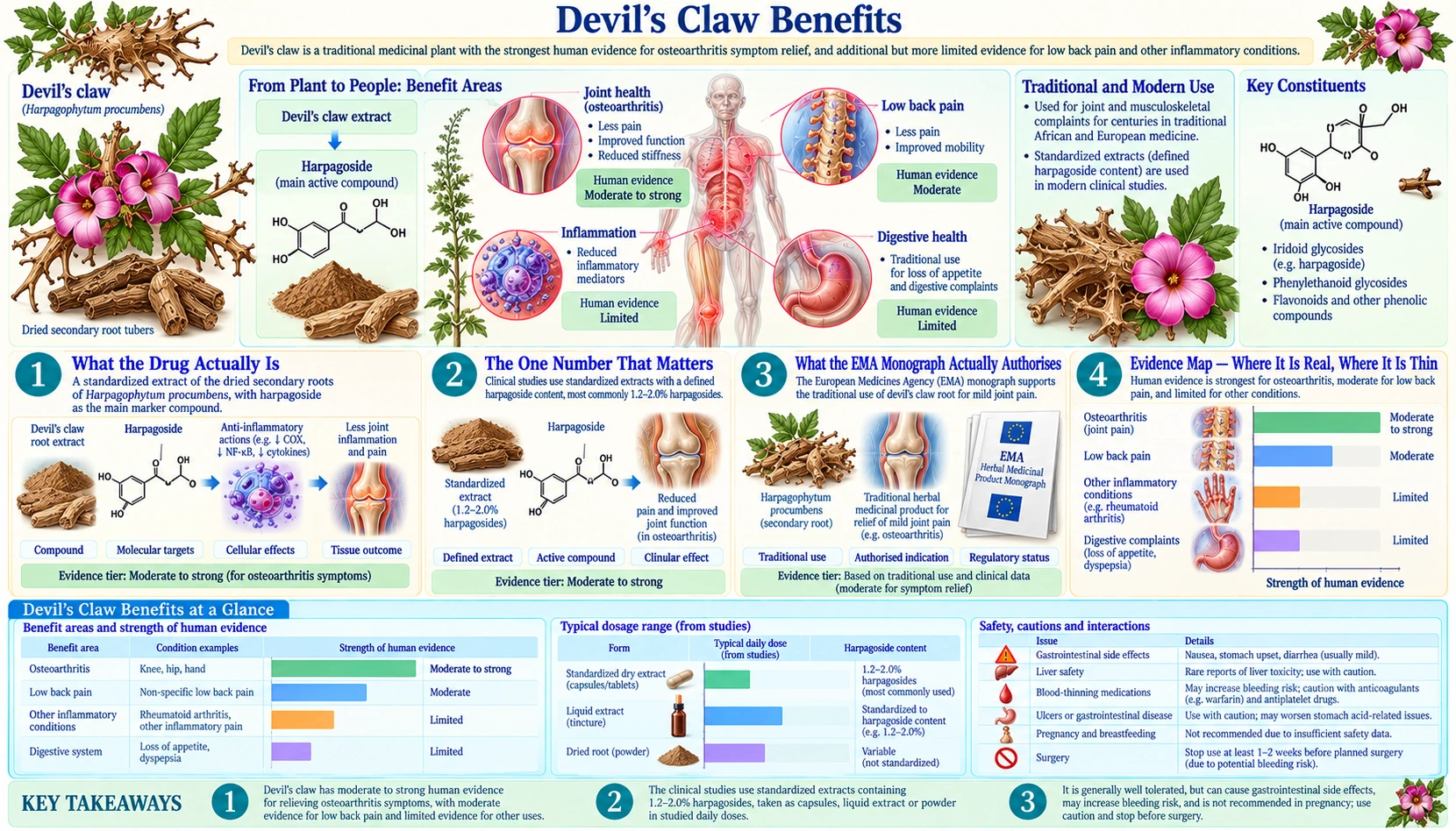
Devil's claw — Harpagophytum procumbens DC., family Pedaliaceae — is a trailing perennial of the Kalahari sands of Namibia, Botswana and South Africa. The medicine is not the hooked fruit that gave the plant its name but the secondary storage roots: the fleshy tubers that hang off the main taproot like potatoes off a runner. Those are sliced and dried, and the bitter iridoid glycoside harpagoside is the marker compound used to measure how much drug is in the bottle.
Among herbs sold for joint and back pain, devil's claw sits unusually high on the evidence ladder. It has genuine randomised, double-blind, placebo-controlled trials — not one, several — and it has been put head to head against real pharmaceuticals: diacerein in osteoarthritis and rofecoxib in low back pain. That is more than most botanicals can say.
It is also a herb where the honest summary contains two large caveats, and this hub exists to state them plainly rather than bury them. First, the European Medicines Agency has a monograph on devil's claw root and it is a traditional use monograph, not a well-established use one — the regulator looked at the same trials and concluded they were not sufficient to license the herb on efficacy grounds. Second, the dose that matters is milligrams of harpagoside, not milligrams of root, and commercial products vary by more than an order of magnitude on exactly that number. A great deal of disappointment with devil's claw is really disappointment with an under-dosed capsule.
Table of Contents
Deep-Dive Articles
Four articles cover the ground in detail. The dosing article is the one that determines whether any of the rest applies to a given product, because it compares a label's harpagoside content with the doses the trials used.
Osteoarthritis and Joint Pain
The four-month trial against diacerein, the surveillance studies of a standardised devil's claw extract, the 259-patient open study, and what the systematic reviews concluded — with every trial's size, extract, dose and duration stated.
Read the deep dive →Low Back Pain
The two placebo-controlled trials of standardised devil's claw extracts, the underpowered rofecoxib comparison, the Cochrane verdicts from 2006 to 2016, and the arithmetic of how many people you have to treat for one to become pain-free.
Read the deep dive →Harpagoside, Dosing and Extract Types
How to turn any label into milligrams of harpagoside per day, why an “X:1 ratio” is not a dose, what surveys found actually inside commercial products, and how the trial extracts differed from each other.
Read the deep dive →Safety, Interactions and Sustainability
Gastrointestinal upset, the peptic-ulcer and gallstone cautions, the animal cardiac data that underlies the arrhythmia warning, warfarin and P-glycoprotein, and the wild-harvest conservation problem in southern Africa.
Read the deep dive →What the Drug Actually Is
Three details about the raw material change how you read everything else.
- It is the secondary tubers, not the taproot. The primary taproot is the plant's survival organ; the secondary tubers are the storage organs strung along lateral roots. Harvesters who take the secondary tubers and leave the taproot in the ground can return to the same plant in four to six years. Harvesters who dig out the whole plant kill it. That single technical distinction is the whole sustainability story, and it is covered in the safety and sustainability article.
- Two species are traded under one name. Harpagophytum procumbens is the species named in the pharmacopoeias; H. zeyheri is a legitimate but chemically different relative that generally carries less harpagoside. European monographs accept both, and chemometric work has shown that commercial material is not always what the label says. Species substitution is one reason two bottles labelled the same way can behave differently. A 2021 DNA-barcode test of 23 devil's claw supplements bought in the United States found that, of the 20 that could be fully analysed, 75% contained no detectable H. procumbens, 25% contained both H. procumbens and H. zeyheri, and none contained H. procumbens alone. The authors note that the sale of H. zeyheri as a herbal supplement is not legal in the United States.
- The European Pharmacopoeia sets a floor, not a target. Dried devil's claw root must contain a minimum of 1.2 percent harpagoside to be sold as the pharmacopoeial drug. That is a quality floor for the raw herb. It is not the concentration used in the clinical trials, which used concentrated extracts running several times higher.
Chemically the root is a mixture. Harpagoside is the measured marker, accompanied by the related iridoids harpagide and procumbide, the phenylethanoid glycosides verbascoside (acteoside) and isoacteoside, plus flavonoids, phenolic acids and sugars. Laboratory work suggests the accompanying compounds contribute, which is why whole standardised extracts sometimes outperform pure harpagoside in cell assays — a point that recurs in the drug-interaction data, where commercial extracts inhibited a transporter that pure harpagoside barely touched.
The One Number That Matters
Every worthwhile devil's claw trial reported its dose in milligrams of harpagoside per day, and the successful ones cluster in a narrow band: roughly 50 to 60 mg of harpagoside daily, with one back-pain trial testing 100 mg and finding the higher dose gave the clearer signal. Here is what that meant in practice for the trial preparations.
| Trial preparation | Daily dose as sold | Harpagoside delivered | Implied strength |
|---|---|---|---|
| Standardised dry extract (lower arm) | 600 mg extract | 50 mg | about 8–9% harpagoside |
| Standardised dry extract (higher arm) | 1,200 mg extract | 100 mg | about 8–9% harpagoside |
| Standardised aqueous extract | 2,400 mg extract | 50–60 mg | about 2–2.5% harpagoside |
| Cryoground root powder | 2,610 mg powder | not stated in the report | crude root, at least 1.2% by pharmacopoeia |
Read the second and third rows together. The aqueous extract needed four times as much extract as the dry extract to deliver the same harpagoside. Both worked in trials; neither is “stronger” as a product. The milligrams on the front of the box told you nothing useful on their own. That is the trap.
The arithmetic you need is one line:
mg of extract per day × harpagoside percentage = mg of harpagoside per day.
A capsule of 400 mg extract standardised to 5 percent harpagoside delivers 20 mg per capsule, so three a day reaches 60 mg — squarely in the trial range. A capsule of 500 mg of plain root powder at the pharmacopoeial floor of 1.2 percent delivers 6 mg, so you would need eight or nine capsules a day to reach the same place. A bottle that says only “devil's claw extract 10:1” gives you no way to do the sum at all, and a ratio is not a dose. The full worked method, including how to compare cost per 50 mg of harpagoside across brands, is in the dosing article.
Labels are a known weak point. A 2025 analysis of 88 devil's claw products found that those labelled as food or dietary supplements showed significant gaps in consumer information compared with herbal medicinal products, and that their naming and packaging were often suggestive and potentially misleading. The same analysis noted a limited number of clinical studies, no long-term studies and poor methodological quality.
What the European Medicines Agency Monograph Actually Authorises
Devil's claw is often described as “European Medicines Agency (EMA) approved,” and the phrasing does real work that the underlying document does not support. Here is the accurate version.
The European Medicines Agency's Committee on Herbal Medicinal Products (HMPC) maintains a European Union herbal monograph on Harpagophytum procumbens DC. and/or Harpagophytum zeyheri Decne., radix. The current version is Revision 1, adopted in 2016. European herbal monographs come in two flavours, and the difference is the whole point:
- Well-established use — the herb has recognised efficacy backed by acceptable clinical evidence, under Article 10a of Directive 2001/83/EC. This is an efficacy judgement.
- Traditional use — the preparation has been used safely for at least 30 years, of which 15 in the EU, and is plausible on the strength of long use. Registration under Articles 16a to 16i requires no demonstration of efficacy. The regulator is signing off on plausibility and safety, not on the herb working.
The devil's claw monograph is assessed under the traditional use articles. Its indications are worded as traditional herbal medicinal product claims: relief of minor joint pain, and relief of mild digestive disorders such as bloating and flatulence and temporary loss of appetite. The monograph restricts use to adults, and sets duration limits — consult a doctor if joint symptoms persist beyond about four weeks, or digestive symptoms beyond about two weeks.
The revision process makes the point sharper. During the 2016 consultation an industry association argued that the clinical data on certain defined devil's claw preparations were now good enough to move them into the well-established use category. The HMPC did not make that change. A regulator that had read every trial on the following pages looked at them and declined to license the herb on efficacy.
That is not a reason to dismiss devil's claw. It is a reason to hold two things at once: the trials are real and mostly favourable, and they were not judged strong enough to clear a pharmaceutical efficacy bar. Both statements are true, and any page that gives you only one of them is selling something.
Evidence Map — Where It Is Real, Where It Is Thin
| Use | Best available evidence | Honest verdict |
|---|---|---|
| Osteoarthritis of knee and hip | A 122-patient four-month randomised double-blind trial against diacerein; a 250-patient and a 75-patient open surveillance study; a 259-patient open study; several systematic reviews | The best-supported use. But the only large, long, properly blinded trial was an active comparison with no placebo arm, so it shows non-inferiority to a modest drug rather than a proven effect size |
| Non-specific and chronic low back pain | Two placebo-controlled randomised trials of standardised devil's claw extracts (118 and 197 patients, four weeks); an 88-patient pilot against rofecoxib; repeated Cochrane assessment | Real, replicated, short-term benefit at 50–100 mg harpagoside daily — but the absolute effect is small, the trials are four to six weeks, and Cochrane graded the evidence for devil's claw against placebo as low quality (very low for the rofecoxib comparison) |
| Anti-inflammatory mechanism | Cell and animal work: suppression of tumor necrosis factor-α and cyclooxygenase-2 (COX-2) expression, inhibition of NF-κB and AP-1 signalling, free-radical scavenging | A coherent laboratory story. Whether the concentrations used in a dish are reached in an inflamed human joint after a capsule is not established |
| Digestive complaints and appetite | Traditional use; bitter-tonic pharmacology; one cell study on ghrelin receptor modulation | Traditional indication only. The European Medicines Agency lists it; there are essentially no controlled human trials |
| Rheumatoid arthritis, gout, tendinopathy | Included as “general rheumatic disorders” in one open study; no dedicated randomised trials | Not established. Devil's claw has not been shown to modify autoimmune joint disease and is not a substitute for disease-modifying treatment |
| Cartilage repair or disease modification | None | No evidence at all. Devil's claw is a symptom treatment |
The two large open studies in the first row had no comparison group. The 250-patient study was an 8-week post-marketing surveillance of people with non-specific low back pain or osteoarthritic knee or hip pain, taking a standardised extract at a dose providing 60 mg harpagoside a day: 227 completed it, about 10% had minor adverse events possibly attributable to the extract, and between 50% and 70% benefited. The 259-patient study was an 8-week single-group open study in the United Kingdom in people with arthritis and other rheumatic conditions; 60% of patients either reduced or stopped other pain medication.
A 2021 randomised trial in 60 people aged 40–60 with mild knee osteoarthritis compared two devil's claw tablets a day (2 × 480 mg) for one month with meloxicam 15 mg a day for ten days. Pain (visual analogue scale), WOMAC and Oxford Knee Scale scores improved in both groups, with no significant superiority of either at 8 weeks; the authors note that the two treatments ran for different lengths of time.
Cautions in Brief
The full discussion, with the underlying studies, is in the safety article. The short version:
- Gastrointestinal upset is the commonest adverse effect — diarrhoea, loose stools, nausea, fullness. In the trials it ran at roughly 8–10 percent, mild, and usually manageable by taking doses with food.
- Peptic ulcer disease, gastritis and reflux: devil's claw is a bitter that stimulates gastric acid secretion. The European Medicines Agency monograph lists active gastric or duodenal ulcer as a contraindication.
- Gallstones and bile-duct disease: it also stimulates bile flow. The European Medicines Agency monograph carries a special warning that people with gallstones consult a physician before use.
- Warfarin: a genuine, if thinly evidenced, concern. Case-level reports and pharmacological plausibility both point the same way; warfarin's effect is tracked with the international normalized ratio (INR) blood test.
- Heart rhythm and conduction: animal studies found dose-dependent falls in blood pressure and heart rate, negative inotropy at higher doses, and clear effects on experimentally induced arrhythmias. This is animal data, but the concern it raises is specific: people with arrhythmia or conduction disease, and people taking antiarrhythmic drugs or digoxin.
- P-glycoprotein and CYP substrates: commercial devil's claw preparations inhibited the ABCB1/P-glycoprotein transporter in cell culture and altered its expression on repeated exposure. The concern is greatest for narrow-therapeutic-index drugs, where small changes in blood levels matter.
- Pregnancy: traditional use includes an oxytocic (labour-inducing) reputation, safety data are absent, and the European Medicines Agency monograph states that safety during pregnancy and lactation has not been established and that, in the absence of sufficient data, use during pregnancy and lactation is not recommended.
Key Research Papers
Every PubMed identifier below was checked live against NCBI E-utilities before it was written — first author, title, journal and year all had to match. Where a source could not be confirmed that way, the entry carries a PubMed topic search instead of a number that might point at the wrong paper.
Randomised trials in osteoarthritis
- Chantre P, Cappelaere A, Leblan D, Guedon D, Vandermander J, Fournie B. Efficacy and tolerance of Harpagophytum procumbens versus diacerhein in treatment of osteoarthritis. Phytomedicine. 2000;7(3):177–183 — PubMed PMID: 11185727. — 122 patients, four months, cryoground root powder six capsules daily versus diacerein 100 mg/day; no efficacy difference, less rescue medication and fewer adverse events on the herb.
- Leblan D, Chantre P, Fournié B. Harpagophytum procumbens in the treatment of knee and hip osteoarthritis. Four-month results of a prospective, multicenter, double-blind trial versus diacerhein. Joint Bone Spine. 2000;67(5):462–467 — PubMed PMID: 11143915. — the same trial reported in a rheumatology journal, giving the dose as 2,610 mg/day.
- Wegener T, Lüpke NP. Treatment of patients with arthrosis of hip or knee with an aqueous extract of devil's claw (Harpagophytum procumbens DC.) Phytotherapy Research. 2003;17(10):1165–1172 — PubMed PMID: 14669250. — 75 patients, 12 weeks, 2,400 mg aqueous extract (50 mg harpagoside); WOMAC total fell 22.9 percent. Uncontrolled.
- Farpour HR, Rajabi N, Ebrahimi B. The Efficacy of Harpagophytum procumbens (Teltonal) in Patients with Knee Osteoarthritis: A Randomized Active-Controlled Clinical Trial. Evidence-Based Complementary and Alternative Medicine. 2021;2021:5596892 — PubMed PMID: 34712343. — 60 patients, devil's claw tablets for one month versus meloxicam for ten days; both improved, neither superior at 8 weeks.
- Chrubasik S, Thanner J, Künzel O, Conradt C, Black A, Pollak S. Comparison of outcome measures during treatment with the proprietary Harpagophytum extract doloteffin in patients with pain in the lower back, knee or hip. Phytomedicine. 2002;9(3):181–194 — PubMed PMID: 12046857. — 250 patients, 8 weeks, 60 mg harpagoside daily. Open surveillance, no control group.
- Warnock M, McBean D, Suter A, Tan J, Whittaker P. Effectiveness and safety of Devil's Claw tablets in patients with general rheumatic disorders. Phytotherapy Research. 2007;21(12):1228–1233 — PubMed PMID: 17886223. — 259 patients, 8 weeks, single-group open study.
Randomised trials in low back pain
- Chrubasik S, Zimpfer C, Schütt U, Ziegler R. Effectiveness of Harpagophytum procumbens in treatment of acute low back pain. Phytomedicine. 1996;3(1):1–10 — PubMed PMID: 23194854. — 118 patients, four weeks, 50 mg harpagoside daily; 9 of 51 pain-free versus 1 of 54 on placebo, but the pre-specified rescue-medication endpoint was negative.
- Chrubasik S, Junck H, Breitschwerdt H, Conradt C, Zappe H. Effectiveness of Harpagophytum extract WS 1531 in the treatment of exacerbation of low back pain: a randomized, placebo-controlled, double-blind study. European Journal of Anaesthesiology. 1999;16(2):118–129 — PubMed PMID: 10101629. — 197 patients, four weeks, 50 versus 100 mg harpagoside versus placebo; pain-free counts 3, 6 and 10 respectively.
- Chrubasik S, Model A, Black A, Pollak S. A randomized double-blind pilot study comparing Doloteffin and Vioxx in the treatment of low back pain. Rheumatology (Oxford). 2003;42(1):141–148 — PubMed PMID: 12509627. — 88 patients, six weeks, 60 mg harpagoside daily versus rofecoxib 12.5 mg/day; no significant difference, and the authors concluded far larger numbers would be needed to show equivalence.
Systematic reviews and regulatory-grade assessments
- Gagnier JJ, Chrubasik S, Manheimer E. Harpagophytum procumbens for osteoarthritis and low back pain: a systematic review. BMC Complementary and Alternative Medicine. 2004;4:13. — PubMed PMID: 15369596
- Oltean H, Robbins C, van Tulder MW, Berman BM, Bombardier C, Gagnier JJ. Herbal medicine for low-back pain. Cochrane Database of Systematic Reviews. 2014;(12):CD004504. — PubMed PMID: 25536022
- Gagnier JJ, Oltean H, van Tulder MW, Berman BM, Bombardier C, Robbins CB. Herbal medicine for low back pain: a Cochrane review. Spine. 2016;41(2):116–133. — PubMed PMID: 26630428
- Brien S, Lewith GT, McGregor G. Devil's claw (Harpagophytum procumbens) as a treatment for osteoarthritis: a review of efficacy and safety. Journal of Alternative and Complementary Medicine. 2006;12(10):981–993. — PubMed PMID: 17212570
- Chrubasik S, Conradt C, Black A. The quality of clinical trials with Harpagophytum procumbens. Phytomedicine. 2003;10(6–7):613–623 — PubMed PMID: 13678253. — a critique of the trial literature written by its most prolific investigator.
Chemistry, mechanism and product quality
- Mncwangi N, Chen W, Vermaak I, Viljoen AM, Gericke N. Devil's claw — a review of the ethnobotany, phytochemistry and biological activity of Harpagophytum procumbens. Journal of Ethnopharmacology. 2012;143(3):755–771. — PubMed PMID: 22940241
- Fiebich BL, Muñoz E, Rose T, Weiss G, McGregor GP. Molecular targets of the antiinflammatory Harpagophytum procumbens (devil's claw): inhibition of TNFα and COX-2 gene expression by preventing activation of AP-1. Phytotherapy Research. 2012;26(6):806–811. — PubMed PMID: 22072539
- Mncwangi NP, Viljoen AM, Zhao J, Vermaak I, Chen W, Khan I. What the devil is in your phytomedicine? Exploring species substitution in Harpagophytum through chemometric modeling. Phytochemistry. 2014;106:104–115. — PubMed PMID: 25041697
- Diaz-Silveira GL, Deutsch J, Little DP. DNA Barcode Authentication of Devil's Claw Herbal Dietary Supplements. Plants (Basel). 2021;10(10):2005. — PubMed PMID: 34685813
- Bargsten FE, Seifert R. Devil's claw (Harpagophytum procumbens): is the buzz in Google justified? Naunyn-Schmiedeberg's Archives of Pharmacology. 2025;398(8):10823–10842. — PubMed PMID: 40042557
- Menghini L, Recinella L, Leone S, et al. Devil's claw (Harpagophytum procumbens) and chronic inflammatory diseases: a concise overview on preclinical and clinical data. Phytotherapy Research. 2019;33(9):2152–2162. — PubMed PMID: 31273865
Safety, interactions and sustainability
- Vlachojannis J, Roufogalis BD, Chrubasik S. Systematic review on the safety of Harpagophytum preparations for osteoarthritic and low back pain. Phytotherapy Research. 2008;22(2):149–152. — PubMed PMID: 18236448
- Circosta C, Occhiuto F, Ragusa S, et al. A drug used in traditional medicine: Harpagophytum procumbens DC. II. Cardiovascular activity. Journal of Ethnopharmacology. 1984;11(3):259–274 — PubMed PMID: 6482477. — the rat and rabbit-heart study behind the cardiac caution.
- Romiti N, Tramonti G, Corti A, Chieli E. Effects of devil's claw (Harpagophytum procumbens) on the multidrug transporter ABCB1/P-glycoprotein. Phytomedicine. 2009;16(12):1095–1100. — PubMed PMID: 19577448
- Stewart KM, Cole D. The commercial harvest of devil's claw (Harpagophytum spp.) in southern Africa: the devil's in the details. Journal of Ethnopharmacology. 2005;100(3):225–236. — PubMed PMID: 16112533
PubMed Topic Searches
- PubMed: Harpagophytum procumbens
- PubMed: Harpagoside
- PubMed: Harpagophytum and osteoarthritis
- PubMed: Harpagophytum and low back pain
- PubMed: Harpagophytum safety and adverse effects
- PubMed: Devil's claw harvesting and sustainability
- PubMed: Harpagophytum zeyheri
- PubMed: Harpagoside anti-inflammatory mechanism
External Resources
- European Medicines Agency — Harpagophyti radix herbal monograph and assessment report
- PubChem — harpagoside compound record
- NCBI Bookshelf (DARE) — Devil's Claw as a treatment for osteoarthritis: a review of efficacy and safety
- LiverTox — U.S. National Institutes of Health database of drug and herbal liver injury
- Kew Plants of the World Online — Harpagophytum procumbens
- ClinicalTrials.gov — registered devil's claw trials
Connections
- All Herbs
- Devil's Claw — the main topic page
- Boswellia — the other well-trialled anti-inflammatory resin
- Turmeric — the most-studied botanical for joint pain
- Willow Bark — the salicylate route to the same problem
- Ginger — a milder anti-inflammatory with knee-OA data
- Cat's Claw — a different “claw,” a different plant entirely
- Orthopedics — musculoskeletal conditions
- Osteoarthritis
- Low-Back Pain
- Rheumatology