Safety, Interactions and Sustainability
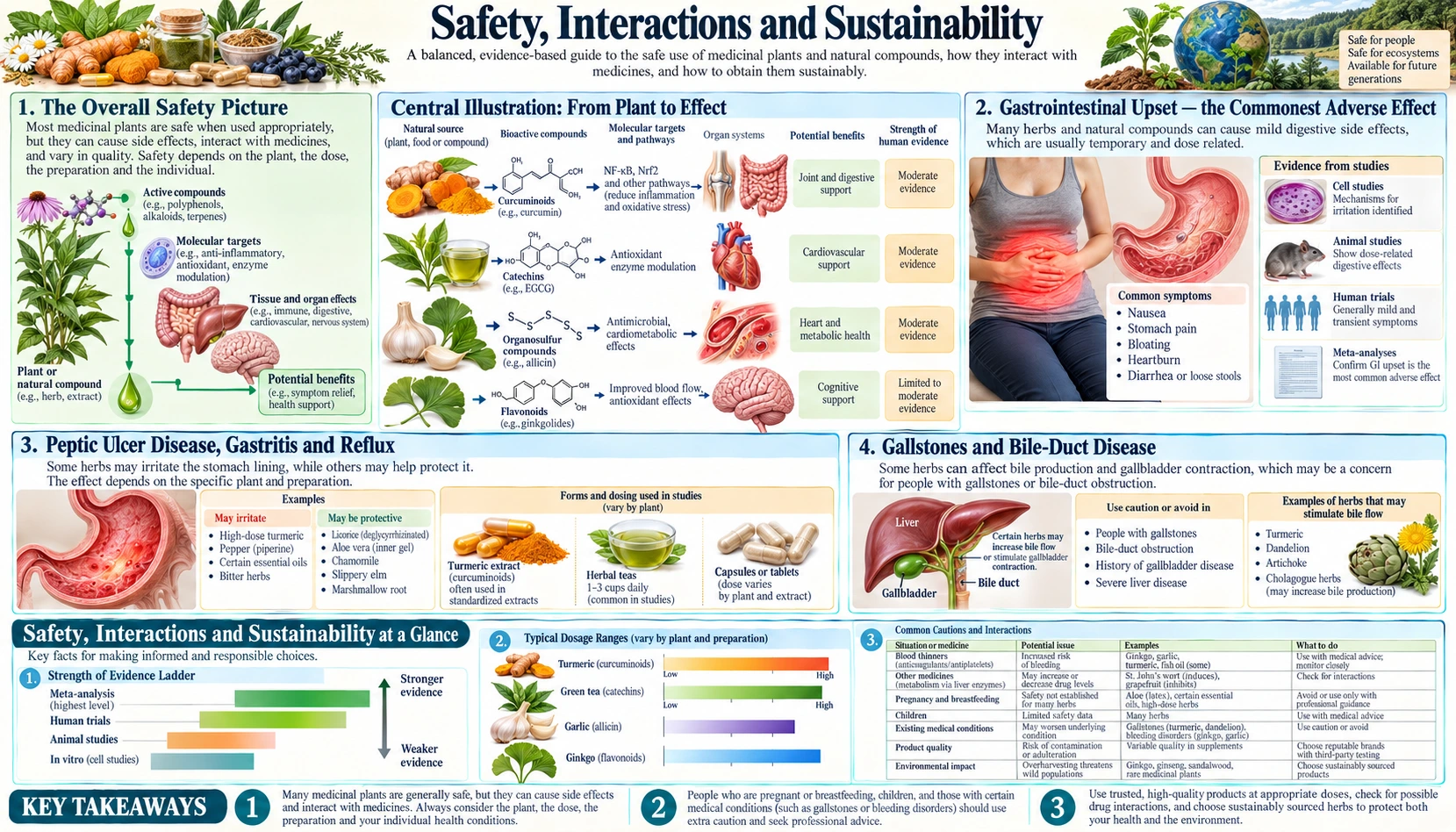
Devil's claw is one of the better-tolerated herbal anti-inflammatories — in the four-month trial against diacerein it produced fewer adverse events than the pharmaceutical it was tested against. That is the headline, and it is real. But “well tolerated on average” is not the same as “safe for everyone,” and the research raises concerns for a specific list of people. Two entries on that list — peptic ulcer disease and cardiac rhythm disorders — follow directly from what the herb does in the body rather than from generic caution.
This article also covers something most supplement pages skip: where devil's claw comes from. It is wild-dug from the Kalahari, its conservation status has been formally contested at an international treaty conference, and the income from harvesting it matters enormously to some of the poorest rural communities in southern Africa. Those facts belong on the same page as the dosing information.
Table of Contents
- The Overall Safety Picture
- Gastrointestinal Upset — the Commonest Adverse Effect
- Peptic Ulcer Disease, Gastritis and Reflux
- Gallstones and Bile-Duct Disease
- The Cardiac Caution — What the Animal Data Actually Show
- Warfarin, Anticoagulants and Bleeding
- P-Glycoprotein, CYP Enzymes and Other Medicines
- Pregnancy, Breastfeeding and Children
- Diabetes, Blood Pressure and Surgery
- Who the Research Raises Concerns For
- Sustainability — the Part Nobody Puts on the Label
- Buying Well
- Key Research Papers
- Connections
- Featured Videos
The Overall Safety Picture
A systematic review specifically devoted to the safety of devil's claw preparations in osteoarthritis and low back pain concluded that the adverse events recorded in the clinical literature were predominantly minor, and predominantly digestive. Of the 28 clinical trials it identified, 20 stated adverse events; minor adverse events occurred in around 3 percent of patients, mainly gastrointestinal, and in none of the double-blind studies was the incidence of adverse events on devil's claw higher than on placebo. The reviewers found a few reports of acute toxicity but no reports of chronic toxicity, and wrote that more safety data are urgently needed, since the dosage in most studies was at the lower limit. The individual trials bear that out:
- In the four-month randomised trial against diacerein (122 patients), adverse events were significantly less frequent on devil's claw. Diarrhoea — the commonest complaint in both arms — occurred in 8.1 percent on devil's claw versus 26.7 percent on the drug, and patients' own tolerance ratings favoured the herb.
- In the 250-patient surveillance study of a standardized devil's claw extract (8 weeks, a dose providing 60 mg harpagoside per day), about 10 percent of patients had minor adverse events possibly attributable to the extract.
- In the 75-patient, roughly 12-week uncontrolled study of an aqueous extract (2,400 mg extract daily, corresponding to 50 mg harpagoside), only two possible adverse drug reactions were reported in the whole cohort: dyspeptic complaints, and a sensation of fullness.
- In the 197-patient, 4-week placebo-controlled trial, the authors found no evidence of extract-related side effects except mild and infrequent gastrointestinal symptoms.
- In the 259-patient UK open study, safety was assessed by self-report plus blood analysis and liver function tests, and the findings were reassuring.
Set against that, one limitation applies to all of it: the trials were four weeks to four months long. Open follow-up out to a year exists, but there is no randomised evidence on taking devil's claw continuously for years. Rare adverse effects and slow-developing ones are exactly what short trials in a few hundred people cannot detect. Formal toxicology work on aqueous-alcohol extracts has been published, but the human long-term picture rests largely on the absence of alarming reports rather than on positive evidence of long-term safety. Those are different things.
Gastrointestinal Upset — the Commonest Adverse Effect
Across every study, the same complaints recur: diarrhoea, loose stools, nausea, stomach discomfort, a sense of fullness. In the comparative trials the rate ran at roughly 8 to 10 percent — common enough to be a real possibility, mild enough that most people carry on.
This is not a mystery side effect. Devil's claw is an intensely bitter herb, and bitters act on the digestive tract by design: they stimulate salivary flow, gastric acid secretion and bile release. The traditional European indication for devil's claw — recognised in the European Medicines Agency (EMA) monograph — is precisely mild digestive disorders such as bloating and flatulence and temporary loss of appetite. The digestive side effect and the digestive indication are the same pharmacology pointed in different directions.
Measures described for limiting it:
- Taking it with food is the measure most often described for reducing stomach upset.
- Building the dose up over a week rather than starting at full strength is another. There is no benefit to loading — the herb takes weeks to act regardless.
- Split doses across the day. Every trial dosed two or three times daily; a single large dose is harder on the stomach.
- Persistent diarrhoea. Persistent diarrhoea brings a risk of dehydration and electrolyte loss, which matters most in older adults and in people taking diuretics or digoxin.
Less frequently reported effects include headache, dizziness, tinnitus and allergic skin reactions. Allergy is a real if uncommon possibility — rash, swelling or breathing difficulty are the signs of an allergic reaction, and swelling or breathing difficulty are signs hospitals treat as urgent.
Peptic Ulcer Disease, Gastritis and Reflux
This is the caution with the clearest mechanistic basis. Devil's claw stimulates gastric acid secretion. That is how bitters work and it is why the herb has a traditional appetite and digestion indication.
In an active gastric or duodenal ulcer, erosive gastritis, or significant gastro-oesophageal reflux, extra acid is the last thing the tissue needs. Standard herbal reference sources and regulatory monographs list peptic ulcer as a contraindication, and the reasoning holds up: a drug that raised acid output would be a problem for an ulcer, and the same logic applies to a plant that does it.
Two situations deserve individual thought:
- A proton-pump inhibitor taken because a nonsteroidal anti-inflammatory drug upset the stomach. This is extremely common in osteoarthritis. Adding an acid-stimulating bitter while taking an acid-suppressing drug works in both directions at once.
- An ulcer that has healed. Not an absolute bar; the relevant warning sign, given the acid effect, is upper-abdominal (epigastric) pain after starting.
There is an interesting wrinkle worth flagging honestly: some animal work has reported gastroprotective rather than ulcerogenic effects for devil's claw extracts, and a 2014 cell and mouse study found devil's claw root extract acted on the ghrelin receptor (the receptor for the hunger hormone) in cells and reduced food intake in mice given the extract by injection into the abdomen — suggesting appetite suppression — which sits oddly against the traditional appetite-stimulant use. The pharmacology here is less tidy than either the traditional claim or the standard warning suggests. Until that is resolved in humans, the regulatory contraindication for active peptic ulcer stands.
Gallstones and Bile-Duct Disease
Devil's claw also stimulates bile flow — part of the same bitter-tonic action. For most people that is either neutral or mildly helpful for digestion. For someone with gallstones, provoking gallbladder contraction can trigger biliary colic, and if a stone lodges in the duct the result is a genuine medical emergency.
Known gallstones or biliary obstruction are therefore the situations where the bile-flow effect carries this risk, and the same concern extends to anyone with a history of pancreatitis related to gallstones.
The Cardiac Caution — What the Animal Data Actually Show
This is the caution most often stated vaguely, so here is what the underlying research actually reported. Two studies from the same Italian group in the mid-1980s examined devil's claw's cardiovascular pharmacology, and their findings are specific enough to be useful.
In conscious rats
A dried crude methanolic extract of the secondary roots produced a significant, dose-dependent reduction in arterial blood pressure, reaching significance at higher oral doses (a dried extract dose of 400 mg/kg). Heart rate fell at the same time. Purified harpagoside alone was less active than an amount of whole extract containing the equivalent harpagoside — another reminder that harpagoside is a marker, not the sole actor.
In isolated rabbit hearts
In spontaneously beating Langendorff preparations, the extract produced a mild fall in heart rate, with a mild positive inotropic effect (stronger contraction) at lower doses and a marked negative inotropic effect (weaker contraction) at higher doses. Coronary flow fell at higher doses only. Purified harpagoside showed comparatively stronger negative chronotropic and positive inotropic effects than the extract; harpagide had a slight negative chronotropic and a considerable negative inotropic effect.
And — importantly — an antiarrhythmic effect
In both intact rats and isolated hearts, the extract was protective against experimentally induced arrhythmias: those provoked by aconitine, and particularly those provoked by calcium chloride and epinephrine–chloroform. A companion study looked at hyperkinetic ventricular arrhythmias induced by reperfusion.
How to read all that
The honest summary is not “devil's claw causes arrhythmias.” It is that devil's claw is measurably cardioactive in animals — it lowers heart rate and blood pressure, it changes contractile force in a dose-dependent and direction-changing way, and it interferes with arrhythmia generation. A substance that does all of that is a substance that can interact with drugs doing the same jobs.
What this means alongside heart and blood-pressure medicines:
- Antiarrhythmic drugs — amiodarone, flecainide, sotalol and others: devil's claw is a potential interaction, because in animals it acts on heart rate, contractility and arrhythmia generation.
- Digoxin — doubly flagged, because of the rate and contractility effects and because digoxin is a classic P-glycoprotein substrate (see below).
- Rate-control and blood-pressure drugs — beta-blockers, calcium-channel blockers, and antihypertensives generally: the concern is additive slowing of the heart (bradycardia) or low blood pressure (hypotension), which shows as dizziness on standing.
- Existing arrhythmia or conduction disease — atrial fibrillation, heart block, a pacemaker: the animal effects on heart rate, contractility and arrhythmia generation bear directly on these conditions, and no human study has tested them.
Keep the evidence level in view. This is animal and isolated-organ work from the 1980s, at doses that may not correspond to a human capsule, and there is no body of human cardiac case reports to match it. It is a well-founded caution, not a documented human harm. But it is specific, it is reproducible, and it makes the herb a cardioactive substance rather than a neutral supplement.
Warfarin, Anticoagulants and Bleeding
A possible interaction between devil's claw and warfarin appears in essentially every serious herbal-safety reference. It rests on two things: case-level reports of altered anticoagulation or bleeding in people taking both, and pharmacological plausibility — a herb that affects drug-metabolising enzymes and transporters can shift the level of a drug with a famously narrow therapeutic window.
What does not exist is a controlled human interaction study. Nobody has given devil's claw to warfarin-stabilised volunteers and measured what happened to their international normalized ratio (INR). The evidence is therefore thin but pointed in one direction, and with warfarin, thin-but-pointed is enough.
What this means in practice:
- Adding devil's claw to warfarin is exactly the kind of change that can shift the international normalized ratio, which is what anticoagulation clinics monitor.
- A new herb is the kind of change that usually brings more frequent international normalized ratio checks for the first several weeks, and again after a change of brand or dose.
- Unusual bruising, nosebleeds, bleeding gums, blood in urine or stool, or unusually heavy periods are bleeding warning signs that are treated as urgent in people on warfarin.
- The same concern applies, with less certainty, to direct oral anticoagulants (apixaban, rivaroxaban, edoxaban, dabigatran) — several are P-glycoprotein substrates, so the transporter data below apply. There is no international normalized ratio to monitor with these, which makes an unnoticed interaction more dangerous, not less.
- For antiplatelet drugs (aspirin, clopidogrel) the concern is weaker.
P-Glycoprotein, CYP Enzymes and Other Medicines
The most concrete drug-interaction data on devil's claw comes from a 2009 cell study on the multidrug transporter ABCB1, better known as P-glycoprotein. P-glycoprotein is a pump in the gut wall, kidney, liver and blood–brain barrier that throws drugs back out of cells; inhibit it and blood levels of its substrates rise, induce it and they fall.
The findings, in human kidney proximal tubule cells:
- Three commercially available devil's claw preparations inhibited P-glycoprotein activity, to differing extents.
- Pure harpagoside was almost ineffective — so the effect does not track the marker compound, and one product's behaviour cannot be predicted from another's harpagoside content.
- After three days of exposure, the preparations produced a dose-dependent up-regulation of P-glycoprotein expression — the opposite direction from the acute inhibition.
That last point is the awkward one. Acute inhibition and chronic induction pointing opposite ways means the direction of any real-world interaction could change between the first week and the second month. The authors' own conclusion was that these results raise the possibility of herb–drug interactions requiring further study.
Devil's claw has also been included in screening work measuring the inhibitory potency of herbal extracts against six major cytochrome P450 enzymes. As with the transporter data, this is in vitro screening rather than a human interaction study, and it is a flag rather than a quantified risk.
Who this matters for. The concern is greatest for drugs with a narrow therapeutic index — where a modest change in blood level matters. That list includes digoxin, warfarin, ciclosporin and tacrolimus, several antiarrhythmics, some anticonvulsants, some human immunodeficiency virus (HIV) and hepatitis antivirals, and the direct oral anticoagulants. For the P-glycoprotein substrates among them, inhibition of the pump can raise blood levels and induction can lower them.
Pregnancy, Breastfeeding and Children
The research raises two separate concerns in pregnancy:
- Devil's claw has a traditional reputation as an oxytocic — a uterine stimulant — in southern African use. Traditional reputation is not proof, but nothing has ruled it out in humans.
- There is no adequate human safety data in pregnancy, and none is likely to be generated. Absence of evidence is not reassurance.
Breastfeeding: no meaningful safety data on transfer into milk or effects on an infant.
Children and adolescents: The European Medicines Agency herbal monograph restricts devil's claw to adults. There is no paediatric dosing and no paediatric safety data.
Diabetes, Blood Pressure and Surgery
- Diabetes. Devil's claw may lower blood glucose. With insulin or an oral hypoglycaemic, the effects could add up, raising the risk of low blood sugar (hypoglycaemia). The effect is not large or well quantified, but additive effects are the concern.
- Blood pressure. The animal data above show dose-dependent falls in blood pressure. On top of antihypertensive medication, the concern is light-headedness on standing, particularly in older adults where a fall is the real risk rather than the number itself.
- Before surgery. A stop one to two weeks before a planned procedure is the usual precaution, given the possible effects on bleeding, blood glucose, blood pressure and heart rate. Recent use matters to the anaesthetist and surgical team even after stopping — herbal supplements are among the most under-declared things in a pre-operative assessment.
- Kidney and liver disease. No specific evidence of harm, but no adequate data either.
Who the Research Raises Concerns For
| Situation | What the sources say | Why |
|---|---|---|
| Pregnancy | No human safety data | Traditional oxytocic reputation; no safety data |
| Breastfeeding | No safety data | No data on transfer or infant effects |
| Children and adolescents | Adults only in the monograph | European Medicines Agency monograph restricts use to adults; no paediatric data |
| Active peptic ulcer, erosive gastritis | Listed contraindication in regulatory monographs | Stimulates gastric acid secretion |
| Gallstones or biliary obstruction | Can trigger biliary colic | Stimulates bile flow; risk of biliary colic |
| Warfarin or a direct oral anticoagulant | Possible interaction; no controlled human study | Case-level reports plus transporter and enzyme plausibility |
| Arrhythmia, conduction disease, antiarrhythmic drugs, digoxin | Cardioactive in animals; no human data | Animal data show effects on heart rate, contractility and arrhythmia generation |
| Narrow-therapeutic-index drugs generally | Possible interaction (cell data) | P-glycoprotein inhibition acutely, induction chronically |
| Reflux, or a proton pump inhibitor (PPI) taken because of nonsteroidal anti-inflammatory drug (NSAID)-related upset | Opposing effects | Acid-stimulating bitter working against acid suppression |
| Diabetes on glucose-lowering medication | Not well quantified | Possible additive glucose-lowering |
| Planned surgery within two weeks | One-to-two-week stop is the usual precaution | Bleeding, glucose, blood pressure, heart rate |
| Known allergy to devil's claw or Pedaliaceae | Allergic reactions possible | Allergic skin reactions are reported |
Sustainability — the Part Nobody Puts on the Label
Almost every gram of devil's claw sold in Europe and North America was dug out of the wild. It is not meaningfully farmed at commercial scale. The plant grows in the deep Kalahari sands of Namibia, Botswana and South Africa, Namibia being the dominant exporter, and it is harvested by hand, largely by rural people in some of the most economically marginal communities in the region, including San (Khoe-San) harvesters.
That creates a genuine dilemma rather than a simple villain. Over-collection threatens the resource. But the harvest is also a rare source of cash income in areas with almost no alternatives, and it is seasonal, requiring no capital, accessible to people with no land. Any conservation measure that simply shuts the trade down transfers the cost onto the poorest people in the chain.
The scale is large. According to a 2005 review of the trade, in 2002 — the peak export year — 1,018 tonnes of dried tubers were exported from southern Africa, representing the harvest of millions of plants. In 2001, sales in Germany were estimated at 30 million euros, accounting for 74 percent of the prescriptions for rheumatism.
What actually happened at CITES
Devil's claw is often described as “CITES-protected.” That is not correct, and the real history is more interesting.
At the eleventh CITES Conference of the Parties in 2000, held in Kenya, Germany — the largest importing country — proposed listing Harpagophytum species in Appendix II, the tier that permits regulated trade with export permits. The southern African range states opposed it, on two grounds: fear that a listing would damage the livelihoods of thousands of harvesters, and the absence of solid data on population status and harvest impact. According to the 2005 review of the trade, the proposal was formally withdrawn in 2004, owing to the efforts of the range states to address sustainability issues. Devil's claw is not CITES-listed today.
What exists instead is a patchwork:
- EU monitoring. Harpagophytum species are listed in Annex D of the EU Wildlife Trade Regulation — a monitoring annex requiring import notification so trade volumes can be tracked. It is surveillance, not restriction.
- National protection. Devil's claw is a protected species in Namibia, Botswana and South Africa, with permit systems governing harvesting and export.
- Community harvesting programmes. Community harvesting programmes in Namibia, running since the late 1990s, are built on the premise that harvesters who capture more of the value have a direct interest in not exhausting the resource. Organic and fair-trade-style certification schemes now cover part of the supply.
Why the harvesting technique is the whole story
Recall the botany from the Benefits hub: the medicine is the secondary storage tubers, not the primary taproot. That single fact determines whether harvesting is renewable or extractive.
- Sustainable practice: dig a trench along a lateral root, remove some of the secondary tubers, leave the primary taproot and some tubers intact, and refill the hole so the plant can regrow. A plant harvested this way can be returned to after several years.
- Destructive practice: dig out the entire plant including the taproot. Faster, higher yield today, and the plant is dead. Repeated across a heavily worked area, local populations decline.
The landmark analysis of the commercial harvest — published in 2005 under the title the devil's in the details — makes exactly this argument at scale: the sustainability of devil's claw cannot be settled by looking at export tonnages, because it depends on land tenure, harvest technique, who trains the harvesters, how the trade is structured and how much of the final price reaches the person with the digging stick. Change the details and the same tonnage is either sustainable or ruinous.
What this means for buyers
A supply chain cannot be verified from a shelf. Three questions bear on it:
- Where was it harvested, and under what permit? A manufacturer that knows can say Namibia, Botswana or South Africa, and name a permit or programme.
- Is there a sustainability or fair-trade certification? Organic certification, sustainable-harvest certification schemes and named community-harvesting programmes are all meaningful signals. A vague “ethically sourced” with no scheme behind it is not.
- Which species, and is it verified? Species identity is both a quality question and a conservation one — substitution between H. procumbens and H. zeyheri has been documented in traded material.
One point outweighs any certificate: a course that is not helping uses up wild root for nothing. This is a wild-dug root from a semi-desert, dug by people who need the income, for a treatment with a number-needed-to-treat somewhere around six to nine. When twelve weeks at a studied dose have changed nothing, continuing costs the plant and the harvesters without benefit to the person taking it.
Buying Well
Pulling the safety and sustainability threads together into one short list:
- The cautions above concern specific medicines and conditions. Warfarin, arrhythmia, ulcers, gallstones and pregnancy are the five that matter most.
- Stated harpagoside content is what shows whether a product reaches the 50–60 mg/day studied range — the arithmetic is in the dosing article.
- A named species and a named sourcing programme are the label details that bear on identity and sustainability.
- Interactions are caught only when the herb is declared — to the prescriber, the pharmacist and, before an operation, the surgical team.
- Time frames. Four weeks is enough to judge tolerance; twelve weeks is the span over which benefit is usually judged.
Key Research Papers
Every identifier below was verified live against NCBI E-utilities before it was written — first author, title, journal and year all had to match. Where a claim rests on case reports or regulatory documents rather than an indexed paper, a topic search is given instead of a number.
Safety and tolerability
- Vlachojannis J, Roufogalis BD, Chrubasik S. Systematic review on the safety of Harpagophytum preparations for osteoarthritic and low back pain. Phytotherapy Research. 2008;22(2):149–152. — PubMed PMID: 18236448
- Chantre P, Cappelaere A, Leblan D, Guedon D, Vandermander J, Fournie B. Efficacy and tolerance of Harpagophytum procumbens versus diacerhein in treatment of osteoarthritis. Phytomedicine. 2000;7(3):177–183 — PubMed PMID: 11185727. — diarrhoea 8.1% on devil's claw versus 26.7% on diacerein.
- Warnock M, McBean D, Suter A, Tan J, Whittaker P. Effectiveness and safety of devil's claw tablets in patients with general rheumatic disorders. Phytotherapy Research. 2007;21(12):1228–1233 — PubMed PMID: 17886223. — 259 patients with bloods and liver function tests.
- Joshi K, Parrish A, Grunz-Borgmann EA, Gerkovich M, Folk WR. Toxicology studies of aqueous-alcohol extracts of Harpagophytum procumbens subsp. procumbens (Burch.) DC. ex Meisn. (Pedaliaceae). BMC Complementary Medicine and Therapies. 2020;20(1):9. — PubMed PMID: 32020872
- Denner SS. A review of the efficacy and safety of devil's claw for pain associated with degenerative musculoskeletal diseases, rheumatoid, and osteoarthritis. Holistic Nursing Practice. 2007;21(4):203–207. — PubMed PMID: 17627199
- Chrubasik S, Junck H, Breitschwerdt H, Conradt C, Zappe H. Effectiveness of Harpagophytum extract WS 1531 in the treatment of exacerbation of low back pain: a randomized, placebo-controlled, double-blind study. European Journal of Anaesthesiology. 1999;16(2):118–129. — PubMed PMID: 10101629. — 197 patients, 4 weeks.
- Chrubasik S, Thanner J, Künzel O, Conradt C, Black A, Pollak S. Comparison of outcome measures during treatment with the proprietary Harpagophytum extract doloteffin in patients with pain in the lower back, knee or hip. Phytomedicine. 2002;9(3):181–194. — PubMed PMID: 12046857. — 250 patients, 8 weeks; about 10% minor adverse events.
- Wegener T, Lüpke NP. Treatment of patients with arthrosis of hip or knee with an aqueous extract of devil's claw (Harpagophytum procumbens DC.). Phytotherapy Research. 2003;17(10):1165–1172. — PubMed PMID: 14669250. — 75 patients, about 12 weeks; two possible adverse drug reactions.
Cardiovascular pharmacology — the basis of the cardiac caution
- Circosta C, Occhiuto F, Ragusa S, Trovato A, Tumino G, Briguglio F, de Pasquale A. A drug used in traditional medicine: Harpagophytum procumbens DC. II. Cardiovascular activity. Journal of Ethnopharmacology. 1984;11(3):259–274. — PubMed PMID: 6482477
- Costa De Pasquale R, Busa G, Circosta C, et al. A drug used in traditional medicine: Harpagophytum procumbens DC. III. Effects on hyperkinetic ventricular arrhythmias by reperfusion. Journal of Ethnopharmacology. 1985;13(2):193–199. — PubMed PMID: 4021516
Drug interactions — transporters and enzymes
- Romiti N, Tramonti G, Corti A, Chieli E. Effects of devil's claw (Harpagophytum procumbens) on the multidrug transporter ABCB1/P-glycoprotein. Phytomedicine. 2009;16(12):1095–1100. — PubMed PMID: 19577448
- Unger M, Frank A. Simultaneous determination of the inhibitory potency of herbal extracts on the activity of six major cytochrome P450 enzymes using liquid chromatography/mass spectrometry and automated online extraction. Rapid Communications in Mass Spectrometry. 2004;18(19):2273–2281. — PubMed PMID: 15384148
- Unger M. Pharmacokinetic drug interactions by herbal drugs: critical evaluation and clinical relevance [in German]. Wiener Medizinische Wochenschrift. 2010;160(21–22):571–577. — PubMed PMID: 21170698
- Devil's claw and warfarin — no controlled human interaction study exists; the caution rests on case-level reports and plausibility. PubMed search.
Digestive pharmacology
- Torres-Fuentes C, Theeuwes WF, McMullen MK, et al. Devil's claw to suppress appetite — ghrelin receptor modulation potential of a Harpagophytum procumbens root extract. PLoS One. 2014;9(7):e103118. — PubMed PMID: 25068823
- Soulimani R, Younos C, Mortier F, Derrieu C. The role of stomachal digestion on the pharmacological activity of plant extracts, using as an example extracts of Harpagophytum procumbens. Canadian Journal of Physiology and Pharmacology. 1994;72(12):1532–1536. — PubMed PMID: 7736345
Sourcing, conservation and species identity
- Stewart KM, Cole D. The commercial harvest of devil's claw (Harpagophytum spp.) in southern Africa: the devil's in the details. Journal of Ethnopharmacology. 2005;100(3):225–236. — PubMed PMID: 16112533
- Mncwangi N, Chen W, Vermaak I, Viljoen AM, Gericke N. Devil's claw — a review of the ethnobotany, phytochemistry and biological activity of Harpagophytum procumbens. Journal of Ethnopharmacology. 2012;143(3):755–771. — PubMed PMID: 22940241
- Mncwangi NP, Viljoen AM, Zhao J, Vermaak I, Chen W, Khan I. What the devil is in your phytomedicine? Exploring species substitution in Harpagophytum through chemometric modeling. Phytochemistry. 2014;106:104–115. — PubMed PMID: 25041697
- CITES CoP11 (2000) proposal to include Harpagophytum procumbens in Appendix II, and its withdrawal. CITES proposal document.
PubMed Topic Searches
- PubMed: Harpagophytum safety and adverse effects
- PubMed: Harpagophytum cardiovascular effects
- PubMed: Herb–drug interactions and P-glycoprotein
- PubMed: Warfarin, herbal supplements and INR
- PubMed: Bitter herbs and gastric acid secretion
- PubMed: Devil's claw sustainable harvesting in Namibia
- PubMed: Wild-harvested medicinal plants, conservation and livelihoods
- PubMed: Herbal medicines and pre-operative discontinuation
Connections
- All Herbs
- Devil's Claw Benefits — hub
- Osteoarthritis and Joint Pain
- Low Back Pain
- Harpagoside, Dosing and Extract Types
- Devil's Claw — main topic page
- Boswellia
- Turmeric
- Willow Bark — the salicylate cautions run in parallel
- Ginger
- Orthopedics
- Osteoarthritis