Low Back Pain
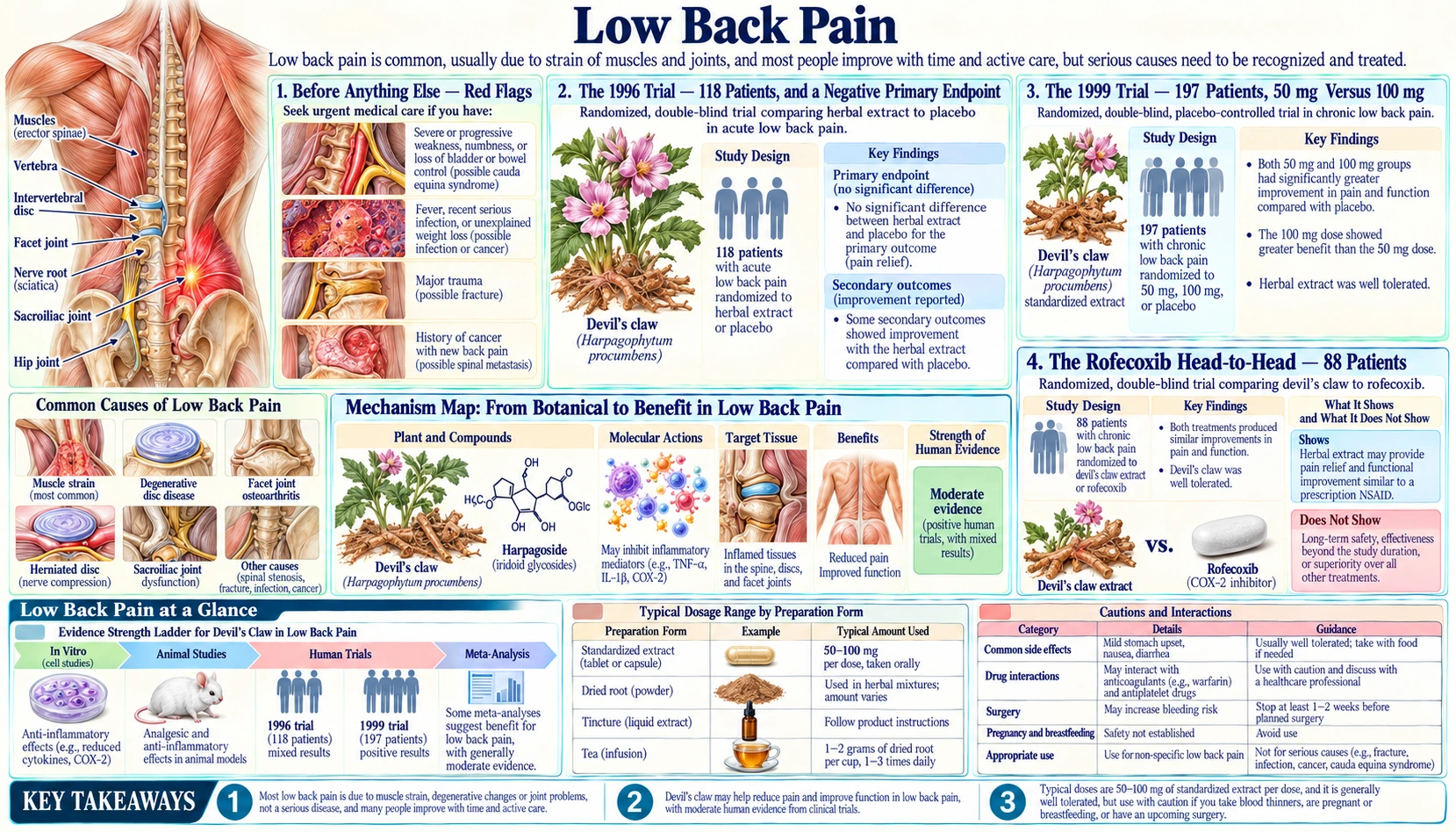
Low back pain is where devil's claw has its placebo-controlled evidence — two randomised, double-blind trials totalling 315 patients, plus a head-to-head against a cyclooxygenase-2 (COX-2) inhibitor, plus repeated assessment by Cochrane reviewers who have looked at the herb four separate times across a decade. It is also where the dose question was settled: this is the one condition where a trial deliberately compared 50 mg of harpagoside a day against 100 mg, and found the higher dose gave the clearer signal.
What follows gives each trial's size, extract, dose, duration and actual numbers — including the endpoints that failed, because one of these trials has a negative primary result buried inside a positive-sounding abstract, and another reached significance only on a one-tailed test.
Table of Contents
- Before Anything Else — Red Flags
- The 1996 Trial — 118 Patients, and a Negative Primary Endpoint
- The 1999 Trial — 197 Patients, 50 mg Versus 100 mg
- The Rofecoxib Head-to-Head — 88 Patients
- What the Numbers Actually Mean — Doing the Arithmetic
- The Cochrane Verdicts, 2006 to 2016
- Longer-Term Data
- Dose and Duration for Back Pain
- What Research Finds Alongside It — the Things With Better Evidence
- The Honest Limits
- Key Research Papers
- Connections
- Featured Videos
Before Anything Else — Red Flags
The trials below enrolled people with non-specific low back pain — the ordinary, mechanical, no-sinister-cause kind that accounts for the overwhelming majority of back pain. Devil's claw has been studied in that population and nowhere else. Some back pain is not that, and no herb has been studied for it.
Back pain that comes with any of the following signs is treated by hospitals as urgent, and none of the devil's claw trials included it:
- Loss of bladder or bowel control, difficulty starting or feeling urination, or numbness in the saddle area — possible cauda equina syndrome, a surgical emergency.
- Progressive leg weakness, foot drop, or numbness spreading down both legs.
- Fever, night sweats, or unexplained weight loss with back pain — infection or malignancy.
- A history of cancer, immunosuppression, or intravenous drug use.
- Significant trauma, or minor trauma in someone with osteoporosis or on long-term steroids — possible fracture.
- Pain that is worse at night or at rest and does not ease with position change.
- Age under 20 or over 55 at first onset of severe back pain.
Everything below assumes none of those apply.
The 1996 Trial — 118 Patients, and a Negative Primary Endpoint
The first proper randomised trial enrolled 118 patients with chronic back problems who were seeking treatment for an acute attack of pain. It ran for four weeks, double-blind, against placebo.
- Dose: two tablets three times daily. The treatment group received the equivalent of 6,000 mg of crude preparation per day, delivering 50 mg of harpagoside.
- Primary endpoint: consumption of the rescue painkiller tramadol over the final three weeks.
- Completers: 109.
What it found — and what it did not
The primary endpoint failed. Tramadol consumption did not differ between the devil's claw and placebo groups. The investigators also noted, candidly, that tramadol use was not closely related to how much pain people were in — which tells you the endpoint they had chosen was a poor instrument.
A further analysis then found what everyone now quotes: 9 of 51 patients on devil's claw were pain-free at the end of treatment, compared with 1 of 54 on placebo. A modified Arhus index also improved more on the extract, but only at 94 percent confidence — below the conventional threshold.
The status of that headline number matters. It came from analysis conducted after the pre-specified endpoint had failed. That does not make it false, and 9-versus-1 is a striking contrast, but it is the kind of result that generates a hypothesis rather than confirming one. The authors said as much: their own conclusion was that “more definite clinical studies will be worthwhile.”
The 1999 Trial — 197 Patients, 50 mg Versus 100 mg
The follow-up trial is the most informative single study on devil's claw dosing anywhere in the literature, because it ran two doses side by side.
- Participants: 197 patients with chronic susceptibility to back pain, currently in an exacerbation producing pain worse than 5 on a 0–10 visual analogue scale.
- Design: randomised, double-blind, placebo-controlled, three arms, four weeks.
- Extract: a proprietary dry extract.
- Arms: 600 mg/day (containing 50 mg harpagoside), 1,200 mg/day (containing 100 mg harpagoside), or placebo.
- Primary endpoint: the number of patients who were pain-free, without the permitted rescue medication (tramadol), for five days out of the last week.
- Completers: 183 of 197.
The result
Pain-free patients numbered three on placebo, six on 600 mg, and ten on 1,200 mg. The trend across the three arms was statistically significant at P = 0.027, by a one-tailed Cochran-Armitage test.
Three things about that sentence deserve attention.
- The dose–response is the strongest feature. Three, six, ten across placebo, low dose and high dose is exactly the pattern you would expect from a real drug effect, and it is much harder to produce by chance or bias than a simple two-group difference. This is the single best piece of evidence that devil's claw does something.
- A one-tailed test is a weaker standard than a two-tailed one. It assumes in advance that the effect can only go one way. Under the more conventional two-tailed test the same data would not have reached the usual 0.05 threshold. That is a real qualification, not a technicality.
- The subgroup analyses contradicted each other. On the primary endpoint, responders were mostly people with more severe, radiating pain and neurological deficit. On the Arhus current-pain component, benefit appeared greatest in the 600 mg group and in patients without severe or radiating pain. Both cannot be a real biological pattern. Sensibly, the authors reported the inconsistency rather than picking the flattering half.
Safety was unremarkable: no evidence of extract-related side effects apart from mild, infrequent gastrointestinal symptoms.
The Rofecoxib Head-to-Head — 88 Patients
In 2003 the same group compared devil's claw directly against a prescription anti-inflammatory: rofecoxib, a selective cyclooxygenase-2 inhibitor (later withdrawn worldwide over cardiovascular risk — a fact that has nothing to do with devil's claw but which explains why nobody repeated the comparison).
- Participants: 88 patients with acutely exacerbated low back pain, randomised 44 and 44.
- Design: randomised, double-dummy, double-blind — explicitly labelled a pilot study, run to estimate effect sizes for a future definitive trial.
- Duration: six weeks.
- Devil's claw arm: an aqueous extract providing 60 mg of harpagoside per day.
- Drug arm: rofecoxib 12.5 mg/day.
- Rescue: up to 400 mg/day tramadol permitted in both arms.
The numbers
| Outcome at six weeks | Devil's claw (n = 43 completed) | Rofecoxib (n = 36 completed) |
|---|---|---|
| Pain-free without rescue for ≥5 days of week 6 | 10 | 5 |
| More than 50% reduction in weekly average pain | 18 | 12 |
| Mean % fall in Arhus pain component (SD) | 23 (52) | 26 (43) |
| Mean % fall in overall Arhus index (SD) | 11 (31) | 16 (24) |
| Used tramadol rescue | 21 | 13 |
| Patients with adverse effects | 14 | 14 |
Those columns do not all point the same way. More devil's claw patients became pain-free and more achieved a 50 percent pain reduction — but the mean percentage falls in the validated Arhus index slightly favoured rofecoxib, and more devil's claw patients reached for the rescue tramadol. Note too the standard deviations: 23 percent with an SD of 52 describes enormous scatter, with plenty of patients getting worse.
The authors' own conclusion is the correct one and worth quoting in substance: no significant intergroup differences were demonstrable, and large numbers would be needed to show equivalence. This trial does not establish that devil's claw works as well as a cyclooxygenase-2 inhibitor. It establishes that a study large enough to answer that question would be worth running. It has never been run.
What the Numbers Actually Mean — Doing the Arithmetic
Counts of pain-free patients are easy to quote and hard to interpret. Converting them into a number-needed-to-treat — how many people you have to give the herb for one extra person to reach the outcome — makes the size of the effect visible.
From the 1996 trial, where both denominators are stated: 9 of 51 pain-free on devil's claw (17.6 percent) versus 1 of 54 on placebo (1.9 percent). The absolute difference is about 15.7 percentage points, giving a number-needed-to-treat of roughly 6.
From the 1999 trial, the paper reports 183 completers across three arms without breaking the completers down by arm; taking roughly 61 per arm, 10 pain-free on 1,200 mg is about 16 percent against 3 on placebo, about 5 percent. That is an absolute difference near 11 points and a number-needed-to-treat of about 9. Treat that as an estimate, not a reported figure.
So on the most optimistic reading, somewhere between one in six and one in nine people who take a properly dosed devil's claw extract for four weeks becomes pain-free who would not otherwise have done. Put the other way round: seven or eight out of nine people get nothing measurable from it on that endpoint.
That is not a damning number. An NNT between 6 and 9 for a cheap, well-tolerated oral treatment of a condition with few good options is respectable — it is in the same broad territory as many conventional analgesics for chronic pain. But it sets expectations honestly: most people who try devil's claw for back pain will not become pain-free, and the fact that it did not work for you does not mean you took it wrong.
The Cochrane Verdicts, 2006 to 2016
The Cochrane Collaboration — the most conservative body that routinely evaluates this literature — has assessed herbal medicine for low back pain repeatedly, and devil's claw has appeared in every version.
- 2006 Cochrane review, republished in Spine in 2007: devil's claw standardised to 50 or 100 mg of harpagoside per day reduced pain more than placebo in the short term, with the 100 mg dose showing the clearer benefit.
- 2014 Cochrane update, republished in Spine in 2016: devil's claw standardised to 50 or 100 mg of harpagoside “may be better than placebo” for short-term pain relief and may reduce use of rescue medication, on low quality evidence (two trials, 315 participants). The rofecoxib comparison was rated very low quality (one trial, 88 participants). Across devil's claw and the other herbs apart from cayenne, the reviewers judged the evidence “of moderate quality at best”.
The most instructive thing about the update is what it did not contain. Between the original review and the update, no new randomised trials of devil's claw in low back pain were added. The evidence base did not grow. It is the same three studies from 1996, 1999 and 2003, now decades old, conducted largely by one research group, in Germany.
That single observation explains the European regulatory position better than anything else. As covered on the Benefits hub, the European Medicines Agency's herbal committee keeps devil's claw in the traditional use category — and declined a request in 2016 to move it to well-established use. Three old trials from one group, however favourable, are not a licensing dossier.
A 2026 narrative review comparing devil's claw with non-steroidal anti-inflammatory drugs (NSAIDs) found that clinical studies, mainly in osteoarthritis and low back pain, “suggest that selected [devil's claw] preparations may provide symptomatic benefit in some patients”, but that the evidence is “limited by small sample sizes, heterogeneous formulations, variable dosages, short follow-up durations”, while NSAIDs are supported by “a substantially broader and higher-certainty evidence base”. It concluded that current evidence does not support devil's claw as a general replacement for NSAIDs, and that it may be a complementary or selective option for some patients, particularly where NSAID intolerance or long-term safety concerns exist.
Longer-Term Data
The four-week and six-week trials leave an obvious question: what happens if you keep taking it? The answer comes from uncontrolled follow-up rather than randomised data.
A one-year follow-up of the rofecoxib pilot study tracked patients well beyond the trial window: 38 former devil's claw patients and 35 former rofecoxib patients took the aqueous extract, providing 60 mg of harpagoside a day, for up to 54 weeks. 53 patients remained at 24 weeks and 43 at 54 weeks; the two groups behaved similarly, and the follow-up showed a slight overall improvement on the gains made in the pilot. A further report on patient-perceived benefit during one year of treatment followed 114 patients (56 with chronic non-specific low back pain, 37 with knee and 21 with hip osteoarthritis pain) on 60 mg of harpagoside a day for up to 54 weeks; it reported an appreciable overall improvement, similar in the back, knee and hip groups, “response during treatment” in 75% of patients, and few adverse events, none serious. Both are open, uncontrolled observations. They suggest the extract continues to be tolerated and that a subset of patients keep taking it because they believe it helps — which is genuine information about persistence and tolerability, and no information at all about efficacy.
What does not exist: any randomised placebo-controlled trial of devil's claw in back pain lasting longer than six weeks. Taking it for a year extrapolates past the evidence — which people do with plenty of treatments, but it remains an extrapolation.
Dose and Duration for Back Pain
| Study | n | Harpagoside per day | Duration | Result |
|---|---|---|---|---|
| 1996 placebo-controlled | 118 | 50 mg | 4 weeks | Primary endpoint negative; 9/51 versus 1/54 pain-free on secondary analysis |
| 1999 placebo-controlled, 3 arms | 197 | 50 mg and 100 mg | 4 weeks | Pain-free 3 / 6 / 10 across placebo, 50 mg, 100 mg; P = 0.027 one-tailed |
| 2003 versus rofecoxib | 88 | 60 mg | 6 weeks | No significant difference from rofecoxib 12.5 mg/day; underpowered pilot |
| 2002 aqueous-extract surveillance (back subgroup) | 104 | 60 mg | 8 weeks | Improvement at 4 weeks, more at 8; open, uncontrolled |
What the trials did:
- The trials used 50–60 mg of harpagoside daily, and tested 100 mg for back pain specifically. Back pain is the one indication where a trial directly tested the higher dose and found it better. Osteoarthritis has no equivalent dose-ranging study.
- The dose was split across the day. Every trial did — typically two or three times daily with meals.
- The trials judged it at four weeks or later. All the positive trials were four to six weeks long, and the surveillance data showed continued improvement between weeks four and eight.
- The 2016 European Medicines Agency (EMA) monograph sets a four-week point for joint pain: “If the symptoms persist longer than 4 weeks during the use of the medicinal product, a doctor or a qualified health care practitioner should be consulted.” It lists active gastric or duodenal ulcer as a contraindication.
Converting a label into milligrams of harpagoside is the step where most people go wrong, and it is worked through in full in the dosing and extract types article.
What Research Finds Alongside It — the Things With Better Evidence
Devil's claw at its best has an NNT around 6 to 9 over four weeks. Several non-drug approaches to persistent low back pain have evidence at least as good, cost nothing per month, and carry no interaction risk.
- Staying active. The single most consistent finding in back-pain research is that prolonged bed rest makes outcomes worse. Staying active within tolerance beats resting.
- Structured exercise — almost any supervised programme, including walking, strengthening or graded activity — has repeatedly outperformed passive treatments for chronic low back pain.
- Sleep and mood. Poor sleep and low mood amplify pain perception measurably, and chronic back pain reliably degrades both. Treating that loop is not a consolation prize; it is one of the more effective levers available.
- Imaging. Disc bulges and degenerative changes appear on scans of large numbers of people with no pain at all. For non-specific back pain without red flags, scanning tends to worsen outcomes by producing frightening labels.
- Fluctuation. Non-specific back pain characteristically comes in waves. That is also why uncontrolled studies of anything look so impressive — people enrol when they are at their worst, and the natural course is improvement.
The Honest Limits
- Three randomised low-back-pain trials, one research group, decades old. The devil's claw back-pain literature has not grown since 2003. One small trial by a different team exists, in muscular back and neck pain: in 2001, 31 patients with slight to moderate muscular tension or muscular pain of the back, shoulder and neck took 480 mg of a devil's claw dry extract twice daily and 32 took placebo for 4 weeks. The extract group showed “highly significant effects” on the pain scale, the pressure-pain test, the muscle stiffness test and the muscular ischaemia test, and no serious adverse effects occurred.
- Short. Four to six weeks. Chronic back pain lasts years.
- Statistically fragile. A negative primary endpoint in one trial, a one-tailed test in another, an underpowered pilot in the third.
- Product-specific. The low-back-pain trials used two defined proprietary extracts, a dry extract and an aqueous extract, with stated harpagoside content. Most retail devil's claw is neither.
- Modest at best. Even reading the results generously, most people who take it will not become pain-free.
- Not risk-free. Gastrointestinal upset is common; peptic ulcer disease, gallstones, warfarin and cardiac rhythm disorders are all situations in which the research raises concerns about it. See the safety article.
Set against that: it is inexpensive, it has been used by very large numbers of people in Germany for decades, in the back-pain comparison with rofecoxib 14 patients in each group had adverse effects, while in a hip and knee osteoarthritis trial diarrhoea was less frequent than on the comparator drug diacerhein (8.1% versus 26.7%), and unlike NSAIDs it carries no known gastrointestinal bleeding or cardiovascular risk. For persistent non-specific low back pain, the trial evidence covers four to six weeks at 50–100 mg of harpagoside a day.
Key Research Papers
Every identifier below was verified live against NCBI E-utilities before it was written — first author, title, journal and year all had to match.
The randomised placebo-controlled trials
- Chrubasik S, Zimpfer C, Schütt U, Ziegler R. Effectiveness of Harpagophytum procumbens in treatment of acute low back pain. Phytomedicine. 1996;3(1):1–10 — PubMed PMID: 23194854. — 118 patients, 4 weeks, 50 mg harpagoside; primary tramadol endpoint negative, 9/51 versus 1/54 pain-free on further analysis.
- Chrubasik S, Junck H, Breitschwerdt H, Conradt C, Zappe H. Effectiveness of Harpagophytum extract WS 1531 in the treatment of exacerbation of low back pain: a randomized, placebo-controlled, double-blind study. European Journal of Anaesthesiology. 1999;16(2):118–129 — PubMed PMID: 10101629. — 197 patients, 4 weeks, 50 versus 100 mg harpagoside versus placebo; pain-free 3 / 6 / 10, P = 0.027 one-tailed.
- Chrubasik S, Model A, Black A, Pollak S. A randomized double-blind pilot study comparing Doloteffin and Vioxx in the treatment of low back pain. Rheumatology (Oxford). 2003;42(1):141–148 — PubMed PMID: 12509627. — 88 patients, 6 weeks, 60 mg harpagoside versus rofecoxib 12.5 mg/day; no significant intergroup difference.
- Göbel H, Heinze A, Ingwersen M, Niederberger U, Gerber D. [Effects of Harpagophytum procumbens LI 174 (devil's claw) on sensory, motor und vascular muscle reagibility in the treatment of unspecific back pain]. Schmerz. 2001;15(1):10–18 — PubMed PMID: 11810324. — Article in German; 31 versus 32 patients with muscular back, shoulder and neck pain, 2 × 480 mg/day for 4 weeks.
Cochrane and systematic reviews
- Gagnier JJ, van Tulder MW, Berman B, Bombardier C. Herbal medicine for low back pain: a Cochrane review. Spine. 2007;32(1):82–92. — PubMed PMID: 17202897
- Oltean H, Robbins C, van Tulder MW, Berman BM, Bombardier C, Gagnier JJ. Herbal medicine for low-back pain. Cochrane Database of Systematic Reviews. 2014;(12):CD004504. — PubMed PMID: 25536022
- Gagnier JJ, Oltean H, van Tulder MW, Berman BM, Bombardier C, Robbins CB. Herbal medicine for low back pain: a Cochrane review. Spine. 2016;41(2):116–133. — PubMed PMID: 26630428
- Gagnier JJ, Chrubasik S, Manheimer E. Harpagophytum procumbens for osteoarthritis and low back pain: a systematic review. BMC Complementary and Alternative Medicine. 2004;4:13. — PubMed PMID: 15369596
- Chrubasik JE, Roufogalis BD, Chrubasik S. Evidence of effectiveness of herbal antiinflammatory drugs in the treatment of painful osteoarthritis and chronic low back pain. Phytotherapy Research. 2007;21(7):675–683. — PubMed PMID: 17444576
- Hong JY, Lee J, Kim H, Kim H, Jeon WJ, Yeo C, Lee YJ, Go HY, Ha IH. Harpagophytum procumbens in musculoskeletal disorders: current evidence and comparison with NSAIDs. Frontiers in Pharmacology. 2026;17:1839470. — PubMed PMID: 42394971
Open studies and longer-term follow-up
- Chrubasik S, Thanner J, Künzel O, Conradt C, Black A, Pollak S. Comparison of outcome measures during treatment with the proprietary Harpagophytum extract Doloteffin in patients with pain in the lower back, knee or hip. Phytomedicine. 2002;9(3):181–194 — PubMed PMID: 12046857. — 250 patients, of whom 104 had non-specific low back pain.
- Chrubasik S, Künzel O, Thanner J, Conradt C, Black A. A 1-year follow-up after a pilot study with Doloteffin for low back pain. Phytomedicine. 2005;12(1–2):1–9. — PubMed PMID: 15693701
- Chrubasik S, Chrubasik C, Künzel O, Black A. Patient-perceived benefit during one year of treatment with Doloteffin. Phytomedicine. 2007;14(6):371–376. — PubMed PMID: 17521896
- Chrubasik S, Conradt C, Black A. The quality of clinical trials with Harpagophytum procumbens. Phytomedicine. 2003;10(6–7):613–623. — PubMed PMID: 13678253
Context and mechanism
- Mncwangi N, Chen W, Vermaak I, Viljoen AM, Gericke N. Devil's claw — a review of the ethnobotany, phytochemistry and biological activity of Harpagophytum procumbens. Journal of Ethnopharmacology. 2012;143(3):755–771. — PubMed PMID: 22940241
- Huang TH, Tran VH, Duke RK, et al. Harpagoside suppresses lipopolysaccharide-induced iNOS and COX-2 expression through inhibition of NF-kappaB activation. Journal of Ethnopharmacology. 2006;104(1–2):149–155. — PubMed PMID: 16203115
- Vlachojannis J, Roufogalis BD, Chrubasik S. Systematic review on the safety of Harpagophytum preparations for osteoarthritic and low back pain. Phytotherapy Research. 2008;22(2):149–152. — PubMed PMID: 18236448
- Chantre P, Cappelaere A, Leblan D, Guedon D, Vandermander J, Fournie B. Efficacy and tolerance of Harpagophytum procumbens versus diacerhein in treatment of osteoarthritis. Phytomedicine. 2000;7(3):177–183. — PubMed PMID: 11185727
PubMed Topic Searches
- PubMed: Harpagophytum and low back pain
- PubMed: Harpagoside dose and back pain
- PubMed: Herbal medicine for low back pain — Cochrane
- PubMed: Non-specific low back pain guidelines
- PubMed: Exercise therapy for chronic low back pain
- PubMed: Cauda equina syndrome and back-pain red flags
- PubMed: Rofecoxib and low back pain
- PubMed: Number-needed-to-treat in chronic pain
Connections
- All Herbs
- Devil's Claw Benefits — hub
- Osteoarthritis and Joint Pain
- Harpagoside, Dosing and Extract Types
- Safety, Interactions and Sustainability
- Devil's Claw — main topic page
- Low-Back Pain
- Back Pain — symptom overview and red flags
- Orthopedics
- Willow Bark — also assessed by Cochrane for back pain
- Boswellia
- Turmeric