Nhan Tran (Adenosma caeruleum) Benefits
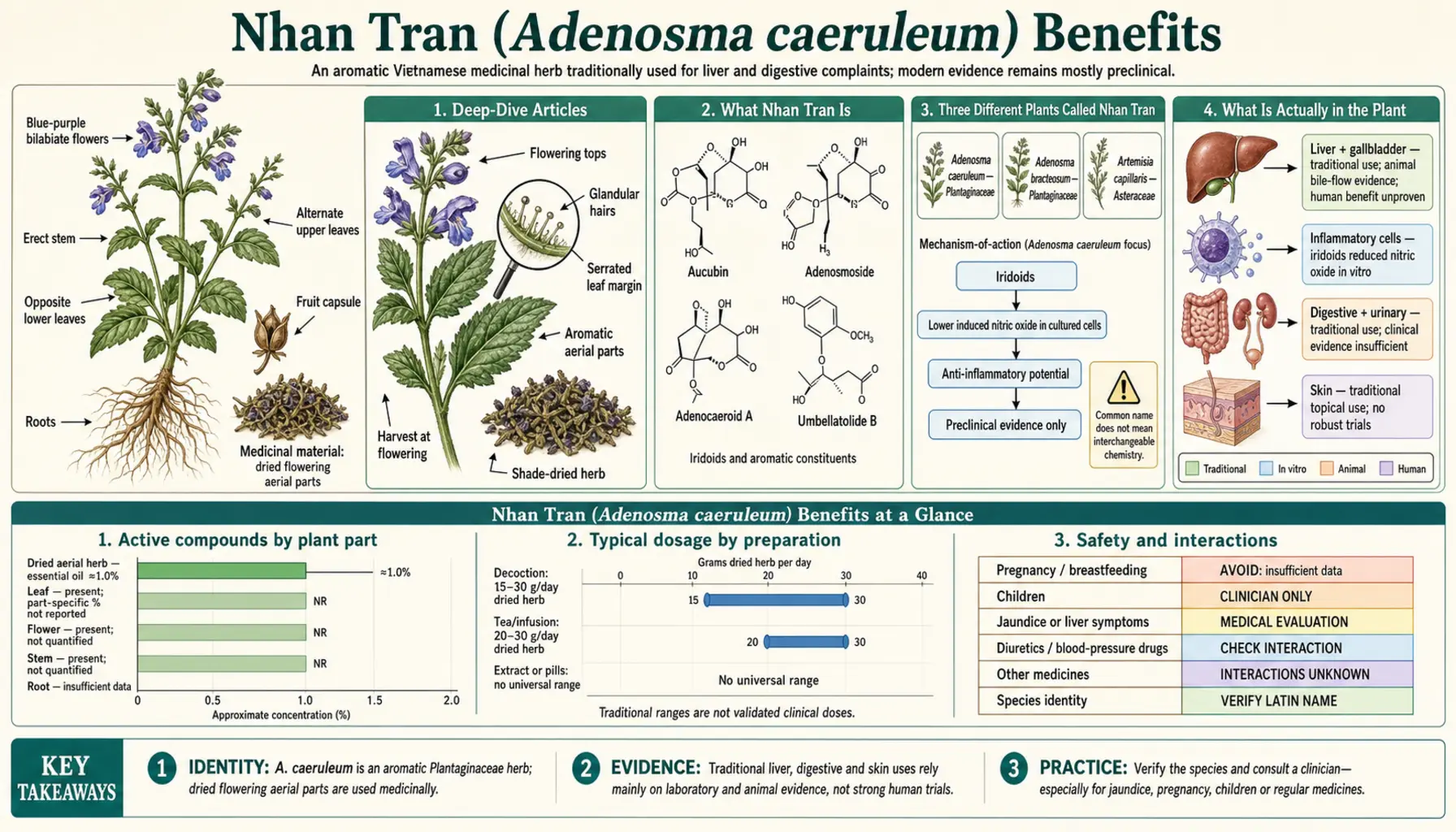
Nhân trần (Adenosma caeruleum R.Br.) is one of the most-drunk herbal teas in Vietnam and one of the least-studied herbs on this site. Bundles of the dried aerial parts sit in every traditional market, usually pre-blended with cam thảo (licorice), sold as a cooling everyday drink for "hot liver," poor appetite, jaundice and postpartum recovery. It smells wonderful, it has been used for generations, and it is genuinely part of Vietnamese daily life.
Here is the honest headline, stated up front rather than buried: there are essentially no randomized controlled trials of Adenosma caeruleum in humans. What exists is a small body of animal work on bile flow and liver enzymes, a set of in-vitro antimicrobial screens of the essential oil, and centuries of traditional use — much of it published in Vietnamese journals that are not indexed in PubMed and therefore cannot be checked by an English-speaking reader. That is not the same as evidence of benefit, and nothing on these four pages should be read as a claim that this tea treats a disease.
There is a second problem, and it is the reason this hub exists at all: three completely different plants are sold and written about as "nhân trần." Almost every impressive "nhân trần liver study" you will find in English was performed on a different species with different chemistry. The pages below keep those species separate, every time.
Deep-Dive Articles
Liver and Bile Flow
What "choleretic" really means, the rodent bile-flow work on Adenosma, the much larger Artemisia capillaris literature clearly labelled as a different plant, and why jaundice is a symptom that needs a diagnosis rather than a tea.
Digestive Comfort
Appetite, bloating and the bitter-aromatic pharmacology of an essential oil rich in limonene, fenchone and 1,8-cineole — plus a plain statement that no controlled human trial supports the traditional postprandial use.
Antimicrobial and Skin
In-vitro antibacterial and antifungal screens of the oil, what a disc-diffusion halo does and does not predict, traditional topical washes, and why "kills bacteria in a petri dish" is not an infection treatment.
Traditional Tea and Safety
The most useful page of the four: how the tea is really prepared, the nhân trần + licorice blend problem, pseudoaldosteronism, pregnancy and breastfeeding cautions, and the missing safety data.
Table of Contents
- Deep-Dive Articles
- What Nhan Tran Is
- Three Different Plants Called Nhan Tran
- What Is Actually in the Plant
- How Strong Is the Evidence, Really
- How the Tea Is Used in Vietnam
- Safety at a Glance
- Key Research Papers
- External Resources
- Connections
- Featured Videos
What Nhan Tran Is
Adenosma caeruleum R.Br. is a soft, aromatic annual herb in the family Plantaginaceae — the plantain family. Older books and many herbal labels still place it in Scrophulariaceae, the figwort family, because that is where it sat before molecular phylogenetics rearranged the group. Both names refer to the same plant; if you see "Scrophulariaceae" on a package, it is not an error so much as an old map.
The plant grows to roughly knee height, with opposite toothed leaves, a square-ish stem and small blue-violet to purple flowers crowded into a terminal spike — caeruleum is Latin for sky-blue. Crush a leaf and it releases a warm, camphorous, slightly citrus scent. That smell is the essential oil, and the smell is the point: it is what distinguishes real nhân trần from the many look-alike weeds it grows beside.
The drug — the part that is actually used — is Herba Adenosmatis caerulei, meaning the whole above-ground plant. It is cut at flowering, when the oil content peaks, then dried in shade and bundled. Roots are discarded. In Vietnamese it is nhân trần, also called nhân trần cái, chè cát ("sand tea," after the sandy open ground it colonises) and hoắc hương núi ("mountain patchouli," after the aroma).
It is native to Vietnam, southern China, Laos, Cambodia and India, favouring open sunny ground, field edges, hillsides and sandy waste places. It is not rare, it is not expensive, and it is not endangered — which is one genuinely good thing about it as a folk remedy.
Three Different Plants Called Nhan Tran
This is the single most important thing on this page, and every sub-article repeats it where it matters. "Nhân trần" is a market name, not a species. At least three unrelated plants carry it:
- Adenosma caeruleum R.Br. (Plantaginaceae) — the Vietnamese species in most nhân trần teas, tea bags and tablets sold in Vietnam. This is the plant this hub is about. Its chemistry is essential-oil-dominant.
- Adenosma bracteosum Bonati — a second Vietnamese species, sold as nhân trần Tây Ninh or bồ bồ, named for the province where it is gathered. Same genus, similar look, similar traditional use, different oil profile. It is routinely substituted for, blended with, or sold as, A. caeruleum.
- Artemisia capillaris Thunb. (Asteraceae) — the Chinese herb 茵陈 / yīn chén hāo, a daisy-family plant with entirely different chemistry (coumarins such as scoparone, the chromone capillarisin, chlorogenic acid). In Chinese-medicine texts translated into Vietnamese, Artemisia capillaris is also rendered "nhân trần."
Almost all of the published "nhân trần and the liver" research is Artemisia capillaris. Yin Chen Hao has been studied for decades in China, Japan and Korea, appears in the classical formula Yin Chen Hao Tang, and has a real mechanistic literature on bilirubin clearance. None of that transfers to Adenosma caeruleum. They are not related, not chemically similar, and not interchangeable — they share a market name and a folk indication, nothing more.
When you read anything about this herb, including anything on these pages, ask one question first: which species? If the source does not say, treat the claim as unattributed.
What Is Actually in the Plant
Adenosma caeruleum yields roughly 1% essential oil by weight of dried herb — high for a leafy plant, and the reason a handful of dried stems perfumes a whole pot. Reported major constituents of that oil include:
- Limonene — the citrus-peel monoterpene, also the dominant compound in orange and lemon oil.
- Fenchone — a camphor-like ketone, the same molecule that gives fennel seed its sharp back-note.
- 1,8-Cineole (eucalyptol) — the cool, opening, eucalyptus-and-rosemary note.
- α-Humulene — a sesquiterpene shared with hops and clove, studied in its own right for anti-inflammatory activity in cell and animal models.
Beyond the oil, the plant carries flavonoids and saponins. Flavonoids are the ordinary plant polyphenols found in nearly every leafy herb; saponins are soap-like glycosides that foam when shaken and, in many plants, contribute mild irritant and secretion-stimulating effects on mucous membranes.
This is a plausible profile for a mild aromatic digestive herb. It is not a profile that suggests a potent drug, and it contains no compound with an established human therapeutic role. Exact proportions vary substantially with harvest time, region, drying method and, crucially, with which of the three "nhân trần" plants was actually in the bag.
How Strong Is the Evidence, Really
It helps to grade what exists rather than argue about it:
| Claim | Best available evidence | What that means |
|---|---|---|
| Increases bile flow (choleretic) | Rodent bile-duct cannulation studies; large Artemisia capillaris literature on a different plant | Hypothesis. Plausible for an aromatic herb; unproven in humans for this species. |
| Helps jaundice / "liver heat" | Traditional use only | Not evidence. Jaundice always needs a cause identified. |
| Improves appetite and bloating | Traditional use; general pharmacology of bitter-aromatic oils | Plausible, untested. No controlled human trial. |
| Antibacterial / antifungal | In-vitro screens of the essential oil | Real in a dish. Says nothing about treating an infection in a person. |
| Safe for daily long-term use | No formal toxicology in humans | Unknown. Traditional caution exists against habitual use in pregnancy. |
Notice what is missing from every row: a human randomized controlled trial. That absence is not a technicality. It means that the honest answer to "does nhân trần work?" is nobody has properly tested it, and the correct posture is curiosity, not confidence.
Absence of evidence also cuts the other way — it does not prove the tea is useless. A pleasant aromatic infusion drunk warm after a heavy meal may well make people feel better, and that experience is real even if the mechanism is unproven. The line this site will not cross is letting long use quietly become an implied cure.
How the Tea Is Used in Vietnam
In practice, nhân trần is a household drink rather than a prescription. A small handful of dried herb — commonly quoted as roughly 10 to 20 grams — is simmered or steeped in about a litre of water and drunk warm or cooled through the day, especially in hot weather, after rich food, or during the postpartum month when new mothers traditionally drink warm herbal infusions rather than cold water.
It is very often sold pre-mixed with licorice root (cam thảo), because licorice sweetens a herb that is otherwise faintly bitter and medicinal. That blend is so normal in Vietnam that most people never think of it as two drugs. It is, and the combination has a real pharmacological problem — nhân trần is used precisely for its diuretic and bile-moving action while licorice makes the body hold sodium and water, so the two pull in opposite directions, and chronic licorice carries its own well-documented risk of pseudoaldosteronism. The Traditional Tea and Safety page covers this in full, and it is the page to read first if you actually drink this tea.
Safety at a Glance
- Pregnancy and breastfeeding: Vietnamese traditional practice cautions against habitual daily use, and there is no modern safety data. Treat as not recommended.
- Licorice blends: the common cam thảo mixture is the main practical hazard, especially if drunk daily for months, and especially in anyone with high blood pressure, heart failure, kidney disease or on diuretics.
- Jaundice, dark urine, pale stools, right-upper-abdominal pain: get a diagnosis. Biliary obstruction, hepatitis and haemolysis are not tea problems, and a choleretic given in true obstruction is at best useless.
- Liver failure, biliary obstruction, children: no safety data exists at all. Do not extrapolate adult folk dosing to a child.
- Identity: the biggest quality risk is that the bag is not the species on the label.
Key Research Papers
A note on how these are cited. Much of the Adenosma caeruleum literature is Vietnamese-language and not indexed in PubMed, and PMIDs quoted from memory are wrong roughly half the time. So rather than print identifiers that cannot be checked, every entry below links to a live PubMed query that will return the paper or its topic. Nothing here is a fabricated identifier.
Adenosma caeruleum: chemistry and essential oil
- Essential-oil composition studies of Adenosma caeruleum reporting limonene, fenchone, 1,8-cineole and α-humulene as major constituents, with substantial regional and seasonal variation. Search: Adenosma caeruleum essential oil.
- Comparative work on Adenosma bracteosum ("bồ bồ" / nhân trần Tây Ninh), the second Vietnamese species traded under the same market name. Search: Adenosma bracteosum.
- Flavonoid and phenolic profiling across the genus Adenosma. Search: Adenosma flavonoid.
Liver and bile — and the species problem
- Huang W, Zhang J, Moore DD. A traditional herbal medicine enhances bilirubin clearance by activating the nuclear receptor CAR. Journal of Clinical Investigation. 2004. This landmark bilirubin-clearance work is on Artemisia capillaris (Yin Chen Hao), not Adenosma caeruleum.
- Reviews of Artemisia capillaris phytochemistry and hepatoprotective pharmacology, including scoparone (6,7-dimethoxycoumarin) and capillarisin. Search: Artemisia capillaris hepatoprotective.
- Experimental choleretic evaluation of plant extracts by bile-duct cannulation in rodents — the standard method behind any "increases bile flow" claim. Search: choleretic activity bile flow rat.
Antimicrobial screening
- In-vitro antibacterial and antifungal screening of Vietnamese medicinal plant essential oils, including Adenosma species. Search: Vietnamese essential oil antibacterial.
- Mechanistic work on how monoterpenes such as limonene and 1,8-cineole disrupt bacterial membranes, and the concentration ranges required. Search: cineole limonene antibacterial mechanism.
Licorice safety — the blend problem
- Clinical reviews of glycyrrhizin-induced pseudoaldosteronism: hypokalaemia, sodium and water retention, hypertension, muscle weakness and, in severe cases, rhabdomyolysis. Search: licorice pseudoaldosteronism hypokalemia.
- Dose-response and threshold studies on glycyrrhizic acid intake and blood pressure in humans. Search: glycyrrhizic acid blood pressure dose response.
Live PubMed Searches
- Adenosma caeruleum
- Adenosma caeruleum hepatoprotective
- Adenosma bracteosum essential oil
- Artemisia capillaris jaundice
- Yin Chen Hao Tang
- α-Humulene anti-inflammatory
- Fenchone pharmacology
- Herbal tea species identification (DNA)
- Herbal medicine and liver injury
- Neonatal jaundice and herbal medicine safety
External Resources
- Plants of the World Online — Adenosma caeruleum (accepted name and distribution)
- World Flora Online — genus Adenosma
- PubChem — Limonene
- PubChem — 1,8-Cineole (eucalyptol)
- PubChem — Fenchone
- LiverTox — NIH database of drug and herbal liver injury
Connections
- All Herbs
- Nhan Tran (Adenosma caeruleum) — the main research article.
- Nhan Tran: History and Traditional Use — the name, the texts, the naming muddle.
- Milk Thistle — the liver herb that actually has human trial data, for contrast.
- Dandelion — the classic Western bitter-choleretic, same traditional logic.
- Licorice — the blend partner, and the reason to read the safety page.
- Chanca Piedra — another folk hepatobiliary herb with thin evidence.
- Artemisia annua — a different Artemisia, useful for keeping the genus straight.