Reishi Mushroom for Cardiovascular Health
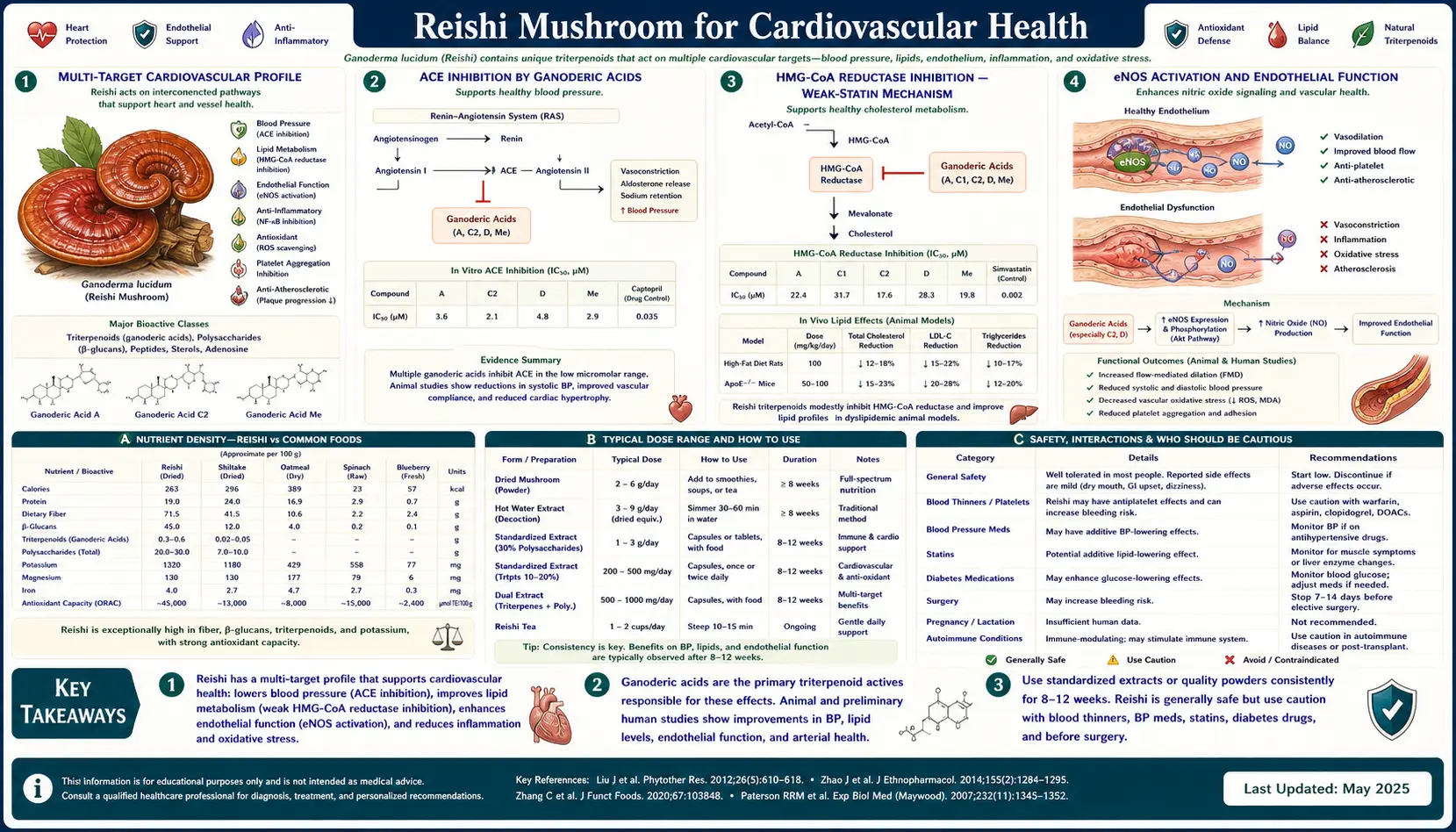
Reishi's cardiovascular pharmacology is a case study in multiple weak laboratory mechanisms whose combined effect has not shown up clearly in human trials. The triterpenoid fraction contains ganoderic acids that function as in-vitro angiotensin-converting enzyme (ACE) inhibitors, oxygenated lanosterol compounds that slowed cholesterol production in laboratory tests, and ganoderols that modestly enhance endothelial nitric oxide synthase (eNOS) expression. The fruiting body also contains free adenosine, which produces measurable platelet aggregation inhibition. The Klupp 2015 Cochrane review included five trials of Ganoderma lucidum for cardiovascular risk factors with a total of 398 participants (the three trials it could pool were all in people with type 2 diabetes) and concluded that the evidence “does not support the use of G lucidum for treatment of cardiovascular risk factors in people with type 2 diabetes mellitus.” A 2025 meta-analysis of 17 randomized trials found no significant effect on blood pressure, fasting glucose or the lipid profile. This article walks through each individual cardiovascular mechanism, the human evidence, and what the trials did and did not test.
Table of Contents
- A Multi-Target Cardiovascular Profile
- ACE Inhibition by Ganoderic Acids
- HMG-CoA Reductase Inhibition (the Weak-Statin Mechanism)
- eNOS Activation and Endothelial Function
- Antiplatelet Effect via Adenosine
- Lipid Profile: High-Density Lipoprotein, Low-Density Lipoprotein, Triglycerides
- Glycemic Control and Type 2 Diabetes
- The Klupp 2015 Cochrane Review
- Trials and Reviews Since 2015
- Clinical Applications — What the Trials Tested and What They Did Not
- Cautions and Drug Interactions
- Key Research Papers
- Connections
- Featured Videos
A Multi-Target Cardiovascular Profile
Pharmaceutical cardiovascular drugs are typically single-target: a statin inhibits HMG-CoA reductase, an angiotensin-converting enzyme inhibitor (ACE inhibitor) blocks angiotensin-converting enzyme, aspirin acetylates platelet cyclooxygenase. Each does one thing strongly. Reishi, in contrast, does many things weakly: a mild ACE inhibition, a mild HMG-CoA reductase inhibition, a mild eNOS enhancement, a mild antiplatelet effect, and a mild insulin-sensitizing effect.
The pharmacologic question is whether the combination of many weak effects produces a clinically meaningful net result. In the human trials pooled so far, it has not been shown to: the 2015 Cochrane review found no significant effect on blood pressure, HbA1c, fasting glucose or low-density lipoprotein cholesterol, and a 2025 meta-analysis of 17 randomized trials (971 participants) found “No significant effects” on blood pressure, fasting glucose or the lipid profile. The trials compared Reishi with placebo and measured risk factors such as blood pressure, blood sugar and blood fats, not heart attacks or strokes.
This is an important framing because Reishi has at times been marketed in the supplement industry with implicit claims that overstate its cardiovascular effects. A realistic understanding of the evidence base is critical to setting appropriate patient expectations.
ACE Inhibition by Ganoderic Acids
The renin-angiotensin-aldosterone system (RAAS) is the principal pharmacologic target for the management of hypertension and heart failure. Angiotensin-converting enzyme (ACE) cleaves the inactive decapeptide angiotensin I into the active octapeptide angiotensin II, which acts on AT1 receptors to produce vasoconstriction, aldosterone release, and increased sympathetic tone. Pharmacologic angiotensin-converting enzyme inhibitors (lisinopril, ramipril, enalapril) block this conversion and produce a robust 10–20 mmHg reduction in systolic blood pressure in hypertensive patients.
Multiple Ganoderma lucidum triterpenoids have been shown in vitro to inhibit ACE activity. The most potent appear to be ganoderic acids B and F, with IC50 values in the low micromolar range. The in-vivo significance of these in-vitro findings is unclear because the systemic concentrations of ganoderic acids achieved after oral Reishi administration are typically below the micromolar range — the in-vitro IC50 may not be reached at the relevant tissue site.
In humans, that ACE mechanism has not produced a measurable blood-pressure effect. The Klupp Cochrane review, which is the best synthesis available and is discussed in full below, reported no statistically significant difference between groups for blood pressure. An earlier version of this page claimed trials showed 5–10 mmHg reductions in hypertensive subjects; we could not find pooled evidence supporting that figure, and the Cochrane analysis is against it.
What that means in practice: the trials did not test Reishi as a replacement for blood-pressure medicine, and a 12-week trial of 1.44 g a day in people with borderline high blood pressure and/or cholesterol (Chu 2012) found “no changes in BMI or blood pressure” with Reishi or placebo. For someone who takes Reishi while on an angiotensin-converting enzyme inhibitor or angiotensin receptor blocker (ARB), an additive effect is theoretical, and the trials found no change in blood pressure. In stage-2 hypertension, heart failure, or proteinuric chronic kidney disease, the benefit of pharmacologic RAAS blockade is well established and large.
HMG-CoA Reductase Inhibition (the Weak-Statin Mechanism)
HMG-CoA reductase is the rate-limiting enzyme of cholesterol biosynthesis, converting 3-hydroxy-3-methylglutaryl-CoA to mevalonate. Statins (atorvastatin, rosuvastatin, simvastatin) bind the active site competitively and reduce hepatic cholesterol synthesis, which in turn upregulates low-density lipoprotein (LDL) receptor expression and accelerates clearance of circulating low-density lipoprotein particles.
What the laboratory and animal work on Reishi shows, in plain words:
- Rat liver fractions (Komoda 1989) — oxygenated lanosterol compounds isolated from Reishi, or made from them chemically, were tested on cholesterol production from 24,25-dihydrolanosterol in rat liver fractions; one of them (at 40 micromolar) “potently inhibited” that production. The study did not measure HMG-CoA reductase itself.
- Liver cells, hamsters and minipigs (Berger 2004) — Reishi fractions containing oxygenated lanosterol derivatives cut cholesterol production in liver cells (T9A4 hepatocytes). In hamsters, a diet with 5% Reishi did not change low-density lipoprotein but lowered total cholesterol by 9.8% and high-density lipoprotein by 11.2%, and both doses tested (2.5 and 5%) lowered liver HMG-CoA reductase activity measured outside the body (ex vivo). In minipigs, the 2.5 Reishi dose lowered total, low-density lipoprotein and high-density lipoprotein cholesterol by 20, 27 and 18%. These are animal results, not human ones.
In people, the Klupp 2015 Cochrane review found no reduction in low-density lipoprotein cholesterol (WMD 0.02 mmol/L; 95% CI -0.41 to 0.45 mmol/L; 107 participants, all with type 2 diabetes). A 2025 meta-analysis of 17 randomized trials found no significant effect on the lipid profile overall; total cholesterol improved only in some subgroups, such as people taking lower doses (< 1400 mg/day) or people aged < 50 years. The trials compared Reishi with placebo and did not test it as a replacement for statin therapy, including in established atherosclerotic cardiovascular disease or familial hypercholesterolemia.
For more on cholesterol management, see our Hyperlipidemia page.
eNOS Activation and Endothelial Function
Endothelial nitric oxide synthase (eNOS) produces nitric oxide (NO) from L-arginine in the vascular endothelium. NO diffuses to underlying vascular smooth muscle and produces relaxation, contributing to the moment-to-moment regulation of vascular tone. Endothelial dysfunction — reduced eNOS activity and NO bioavailability — is the earliest measurable abnormality in the progression toward atherosclerotic cardiovascular disease, preceding hypertension, lipid abnormalities, and overt plaque formation.
Reishi extracts and isolated triterpenoid fractions have been shown to upregulate eNOS expression in cultured human umbilical vein endothelial cells (HUVECs) and to improve flow-mediated dilation in animal models of endothelial dysfunction. The proposed mechanism involves modulation of the PI3K/Akt pathway, which phosphorylates eNOS at Ser1177 and increases enzymatic activity.
Whether this in-vitro and animal-model finding translates to clinically meaningful improvement in endothelial function in human cardiovascular disease patients remains uncertain. The translation to hard cardiovascular endpoints (myocardial infarction, stroke, cardiovascular mortality) requires much larger and longer trials than have been performed for Reishi. The mechanism is plausible and the direction of effect is favorable, but the evidence base does not yet support specific clinical recommendations.
Antiplatelet Effect via Adenosine
Reishi fruiting bodies contain pharmacologically meaningful quantities of free adenosine. Adenosine binds A2A and A2B receptors on platelet surfaces, activates adenylyl cyclase, increases intracellular cyclic AMP, and inhibits platelet aggregation in response to thrombin, collagen, and ADP. This is the same general mechanism (though not the same target receptor) that dipyridamole exploits as an antiplatelet drug.
The Reishi antiplatelet effect has been measured in people. In a 1990 study (Tao and Feng), a water extract of Reishi added to the platelets of 15 healthy volunteers in the test tube slowed platelet clumping (aggregation), and the effect was related to dose. Then 33 patients with atherosclerotic disease took 1 g three times a day for 2 weeks; clumping triggered by ADP at 2 and 3 micromol/L was inhibited by up to 31.49% and 17.7%, and clots formed outside the body were shorter and lighter. The study did not identify the active compound: the authors wrote that “its mechanism and active principles remain to be further investigated.” The magnitude is modest — nothing like the dramatic effect of aspirin, clopidogrel, or modern P2Y12 inhibitors — but is clinically relevant in two specific contexts:
- Bleeding risk on anticoagulant therapy — patients on warfarin or direct oral anticoagulants who also take Reishi may have additive bleeding risk; bruising, gum bleeding and unexplained anemia are the signs of it
- Planned surgery — the platelet effect is the reason Reishi falls in the same group as fish oil, ginkgo, and garlic supplements when bleeding risk around surgery is considered; the 1990 study did not measure how long the effect lasts after Reishi is stopped
The mild antiplatelet effect is generally considered favorable for cardiovascular health (reducing thrombotic risk), but the bleeding-risk caveats apply across all populations.
Lipid Profile: High-Density Lipoprotein, Low-Density Lipoprotein, Triglycerides
What the human studies found for each blood fat:
- Low-density lipoprotein cholesterol — no reduction in the 2015 Cochrane review (WMD 0.02 mmol/L; 95% CI -0.41 to 0.45 mmol/L; 107 participants); total cholesterol was not significantly changed either (WMD -0.07 mmol/L; 95% CI -0.57 to 0.42 mmol/L)
- High-density lipoprotein (HDL) cholesterol and triglycerides — in a randomized, double-blind crossover trial (Chu 2012), 26 patients with borderline high blood pressure and/or cholesterol took 1.44 g of Reishi a day or placebo for 12 weeks. Triglycerides fell and HDL cholesterol rose with Reishi but not with placebo in the first treatment period, “but significant carry-over effects prevented complete analysis of these parameters.” Plasma insulin and insulin resistance (HOMA-IR) were lower after Reishi than after placebo. The Cochrane review found no statistically significant difference between groups for triglycerides.
- Healthy adults — in a double-blinded, placebo-controlled crossover study (Wachtel-Galor 2004), 18 healthy adults took 1.44 g a day for 4 weeks; there was “No significant change in any of the variables”, “although a slight trend toward lower lipids was again seen.”
- Lipoprotein(a) — no consistent effect documented
- All trials pooled (2025) — a meta-analysis of 17 randomized trials with 971 participants found no significant effect on the lipid profile and rated the quality of evidence very low.
The pooled analyses found no significant change in the lipid profile. The trials were placebo-controlled and did not test Reishi in place of statin therapy.
The trials measured response with a standard blood-fat test (lipid panel) after 4 to 16 weeks of use.
Glycemic Control and Type 2 Diabetes
Reishi polysaccharides have shown insulin-sensitizing and modest glucose-lowering effects in multiple animal models of type 2 diabetes, with proposed mechanisms including improved insulin receptor signaling, reduced hepatic gluconeogenesis, and improved peripheral glucose uptake. The Klupp 2015 Cochrane review focused specifically on Reishi in type 2 diabetes and found:
- No improvement in fasting plasma glucose (WMD 0.30 mmol/L; 95% CI -0.95 to 1.55 mmol/L; from a single study of 84 participants)
- No statistically or clinically significant reduction in hemoglobin A1c (HbA1c) (WMD -0.10%; 95% CI -1.05% to 0.85%; 130 participants)
- Inconsistent results after meals: 2-hour post-meal glucose favoured placebo (WMD 0.7 mmol/L; 95% CI 0.29 to 1.11 mmol/L), while “plasma glucose under the curve at 4th hour” favoured Reishi (WMD -49.4 mg/dL/h; 95% CI -77.21 to -21.59 mg/dL/h); the reviewers wrote that the clinical significance is unclear because the minimal clinically important differences are unknown
- The reviewers concluded that the evidence “does not support the use of G lucidum for treatment of cardiovascular risk factors in people with type 2 diabetes mellitus”
A 2016 trial in people with type 2 diabetes and metabolic syndrome (3 g a day for 16 weeks, described below) also found no effect on HbA1c or fasting glucose, and no overall increased risk of adverse events. For people already on metformin or insulin, an additive glucose-lowering effect of Reishi is theoretical. The trials described here compared Reishi with placebo, not with diet and exercise changes.
The Klupp 2015 Cochrane Review
The Klupp et al. 2015 Cochrane Database systematic review titled "Ganoderma lucidum mushroom for the treatment of cardiovascular risk factors" remains the highest-quality synthesis of the cardiovascular evidence base for Reishi. Five trials (randomised controlled trials and controlled clinical trials) with a total of 398 participants were eligible. Only three supplied data that could be pooled; they compared Reishi (1.4 g to 3 g per day) with placebo over 12 to 16 weeks, and all of their participants had type 2 diabetes. Risk of bias was low for one study and unclear for the remaining four.
Outcomes assessed:
- Cardiovascular events (myocardial infarction, stroke, cardiovascular mortality) — no trial was long enough or large enough to assess this hard endpoint
- Blood pressure — no statistically significant difference between groups (from a single study of 84 participants)
- Lipid profile — no significant reduction in total cholesterol (WMD -0.07 mmol/L) or low-density lipoprotein (WMD 0.02 mmol/L), and no statistically significant difference for triglycerides
- Hemoglobin A1c and fasting glucose — no significant reduction in HbA1c (WMD -0.10%) and no improvement in fasting plasma glucose (WMD 0.30 mmol/L)
- Safety — participants who took Reishi for four months were 1.67 times (RR 1.67; 95% CI 0.86 to 3.24) more likely to have an adverse event than those who took placebo, “but these were not serious side effects”
Conclusions:
Evidence from a small number of randomised controlled trials does not support the use of G lucidum for treatment of cardiovascular risk factors in people with type 2 diabetes mellitus. Future research into the efficacy of G lucidum should be placebo-controlled and adhere to clinical trial reporting standards.
Two later studies, described in the next section, reached the same result: a 2016 placebo-controlled trial and a 2025 meta-analysis of 17 randomized trials.
Trials and Reviews Since 2015
In a 2016 double-blind, randomised, placebo-controlled trial (Klupp 2016), 84 people with type 2 diabetes and metabolic syndrome were assigned to Reishi, Reishi with Cordyceps, or placebo; the dose was 3 g a day of Reishi, with or without Cordyceps, for 16 weeks. The two Reishi groups were combined for analysis. Reishi had no effect on HbA1c (difference 0.13%; 95% CI -0.35 to 0.60) or fasting plasma glucose (0.03 mmol/L; 95% CI -0.90 to 0.96), or on any secondary measure, and there was no overall increased risk of adverse events.
A 2025 review (Jafari 2025) pooled 17 randomized controlled trials with 971 participants taking Reishi (200–11,200 mg/day for 1–24 weeks), including healthy people, people at risk and people with chronic disease. It found small reductions in body-mass index (WMD -0.43), creatinine (WMD -0.14) and heart rate (WMD -3.92), and a rise in the antioxidant enzyme glutathione peroxidase (WMD 2.29), but “No significant effects” on body fat, waist circumference, blood pressure, fasting glucose, lipid profile, inflammatory markers, or liver enzymes. Using the GRADE system, the authors rated the quality of evidence “very low across all outcomes.”
Clinical Applications — What the Trials Tested and What They Did Not
The human trials summarized above tested Reishi against placebo, in small groups, for 12 to 16 weeks in the Cochrane and 2016 trials and for 1 to 24 weeks in the 2025 meta-analysis. How common situations line up with that evidence:
- Borderline high blood pressure or cholesterol — in Chu 2012 (26 patients, 1.44 g a day for 12 weeks), there were no changes in BMI or blood pressure; insulin and insulin resistance were lower than with placebo, and the triglyceride and HDL results could not be fully analysed because of carry-over effects.
- Type 2 diabetes with metabolic syndrome — in Klupp 2016 (84 people, 3 g a day for 16 weeks), Reishi had no effect on HbA1c, fasting glucose or any secondary measure.
- People who cannot take statins — the pooled trials found no significant effect of Reishi on low-density lipoprotein cholesterol or the lipid profile.
Situations outside what the trials tested:
- Established atherosclerotic cardiovascular disease (ASCVD) treated with a statin — the trials did not test Reishi as a replacement for a statin
- Heart failure or proteinuric chronic kidney disease (CKD) treated with an angiotensin-converting enzyme inhibitor — the pharmaceutical effect is robust, and Reishi showed no blood-pressure effect in the trials
- Dual antiplatelet therapy after stent placement — the largest platelet effect measured for Reishi was an inhibition of ADP-triggered clumping by up to 31.49% in the 1990 study; the studies on this page did not test it for preventing clots in stents
- Acute coronary syndrome, decompensated heart failure, or any other acute cardiovascular emergency — these are emergencies that hospitals treat as urgent; the studies on this page did not include them
Cautions and Drug Interactions
- Anticoagulant interaction — additive bleeding risk with warfarin, DOACs, antiplatelet agents, based on the platelet effect described above (see the antiplatelet section for surgery).
- Antihypertensive interaction — possible additive blood-pressure lowering with angiotensin-converting enzyme inhibitors (ACE inhibitors), angiotensin receptor blockers (ARBs), calcium channel blockers, beta blockers, diuretics; the trials found no change in blood pressure with Reishi.
- Hypoglycemia in diabetics — possible additive glucose-lowering with insulin or sulfonylureas; the 2016 trial in people with type 2 diabetes found no change in fasting glucose or HbA1c.
- CYP450 interactions — potential induction of cytochrome P450 3A4 (CYP3A4) may reduce levels of drugs cleared by this pathway (e.g., calcium channel blockers, statins themselves, some antiarrhythmics). The clinical significance is uncertain.
- Pregnancy and breastfeeding — safety data are insufficient.
- Liver injury (hepatotoxicity), rare cases — shown by raised liver enzymes on a blood test; the 2004 study in 18 healthy adults found “no evidence of liver, renal or DNA toxicity” over 4 weeks.
- Allergic reaction — rare but possible in mushroom-allergic individuals.
Key Research Papers
- Klupp NL, Chang D, Hawke F, Kiat H, Cao H, Grant SJ, Bensoussan A (2015). Ganoderma lucidum mushroom for the treatment of cardiovascular risk factors. Cochrane Database of Systematic Reviews 2015;(2):CD007259. — PubMed PMID: 25686270
- Morigiwa A et al. (1986). Angiotensin-converting enzyme inhibitory triterpenes from Ganoderma lucidum. Chemical and Pharmaceutical Bulletin. — PubMed PMID: 3021351
- Komoda Y, Shimizu M, Sonoda Y, Sato Y (1989). Ganoderic acid and its derivatives as cholesterol synthesis inhibitors. Chemical and Pharmaceutical Bulletin 37(2):531-3. — PubMed PMID: 2743504
- Tao J, Feng KY (1990). Experimental and clinical studies on inhibitory effect of Ganoderma lucidum on platelet aggregation. Journal of Tongji Medical University 10(4):240-3. — PubMed PMID: 2098581
- Chu TT, Benzie IF, Lam CW, Fok BS, Lee KK, Tomlinson B (2012). Study of potential cardioprotective effects of Ganoderma lucidum (Lingzhi): results of a controlled human intervention trial. British Journal of Nutrition 107(7):1017-27. — PubMed PMID: 21801467
- Wachtel-Galor S, Tomlinson B, Benzie IF (2004). Ganoderma lucidum ("Lingzhi"), a Chinese medicinal mushroom: biomarker responses in a controlled human supplementation study. British Journal of Nutrition 91(2):263-9. — PubMed PMID: 14756912
- Berger A et al. (2004). Cholesterol-lowering properties of Ganoderma lucidum in vitro, ex vivo, and in hamsters and minipigs. Lipids in Health and Disease. — PubMed PMID: 14969592
- Klupp NL, Kiat H, Bensoussan A, Steiner GZ, Chang DH (2016). A double-blind, randomised, placebo-controlled trial of Ganoderma lucidum for the treatment of cardiovascular risk factors of metabolic syndrome. Scientific Reports 6:29540. — PubMed PMID: 27511742
- Jafari A, Mardani H, Mirzaei Fashtali Z, Arghavan B (2025). The Nutritional Significance of Ganoderma lucidum on Human Health: A GRADE-Assessed Systematic Review and Meta-Analysis of Clinical Trials. Food Science & Nutrition 13(6):e70423. — PubMed PMID: 40510787