Japanese Knotweed: History and Traditional Use
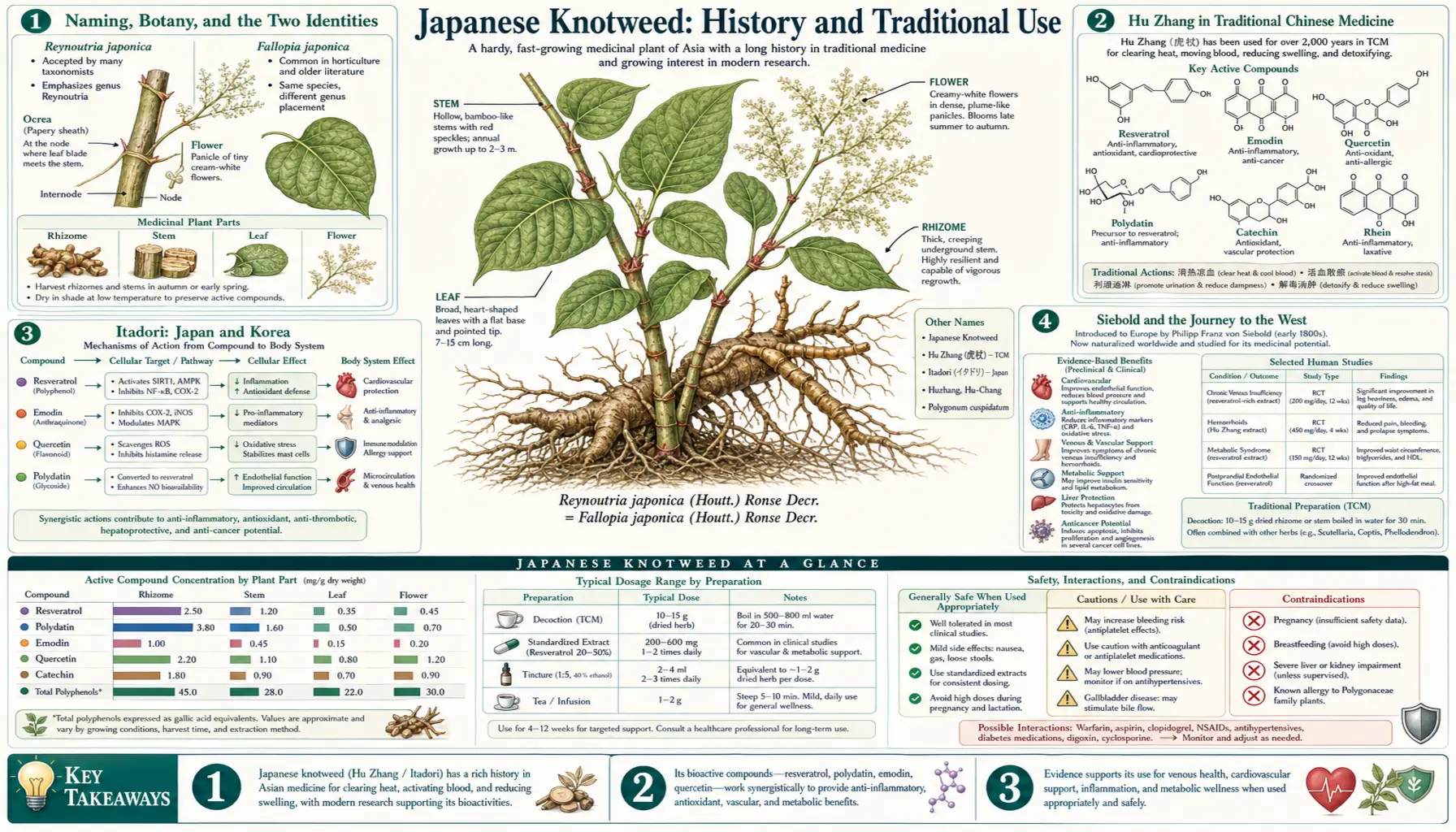
Few plants carry two reputations as opposite as Japanese knotweed's. In East Asia it has been a respected medicine for many centuries — the Chinese Hu Zhang and the Japanese itadori, used to move stagnant blood, clear heat, and ease pain. In Europe and North America it is reviled as one of the world's most destructive invasive weeds, descended from a handful of ornamental plants a single nineteenth-century collector shipped west. This page follows the documented thread — from the traditional pharmacopoeias of China, Japan, and Korea, through the botanist who carried the plant to a Dutch nursery, to the laboratory discovery that turned a despised roadside weed into the world's main commercial source of resveratrol. Where a claim is traditional, it is named as tradition; where a date or person is given, it has been checked against a reliable source.
Table of Contents
- Naming, Botany, and the Two Identities
- Hu Zhang in Traditional Chinese Medicine
- Itadori: Japan and Korea
- Siebold and the Journey to the West
- From Garden Ornamental to Invasive Weed
- The Discovery of Resveratrol
- The French Paradox and the Modern Revival
- Japanese Knotweed and the Lyme-Disease Protocols
- From Tradition to Modern Research
- Research Papers and References
- Connections
- Featured Videos
Naming, Botany, and the Two Identities
The plant English-speakers call Japanese knotweed is a tall, fast-growing perennial of the buckwheat family (Polygonaceae), native to Japan, China, and Korea. Its scientific name has shifted over the years, which is why supplement labels carry several at once. The species was formally described by the Dutch naturalist Martinus Houttuyn in 1777 as Reynoutria japonica; later botanists reclassified it as Polygonum cuspidatum (the name still most common on herbal products) and then as Fallopia japonica. Modern botanical consensus has returned to Reynoutria japonica Houtt. as the accepted name, with the other two treated as synonyms. All three refer to the same plant.
The medicinal part is the root and rhizome — the thick, woody underground stem. Above ground the plant throws up hollow, bamboo-like canes that can reach two to three metres in a single season, marked in spring with reddish-purple streaks. This cane is the source of the plant's East Asian name. In Chinese it is Hu Zhang (虎杖), and the Japanese name itadori is written with the same two characters; the pair is usually translated "tiger cane" or "tiger staff," a reference to the streaked, jointed stalks.
From the very beginning, then, the plant has carried a split identity that runs through its whole history: a valued garden and medicine plant in one set of cultures, and — once it left its homeland — an almost unstoppable weed in another. Both stories are true, and both are documented; the sections that follow take them in turn.
Hu Zhang in Traditional Chinese Medicine
The longest and best-documented branch of the plant's history is its use in Traditional Chinese Medicine under the name Hu Zhang. It is recorded as a very old remedy: the review by Liu and colleagues notes that the herb "was first recorded in the ‘Miscellaneous Records of Famous Physicians’ in the late Han Dynasty (B.C. 202–A.D. 220)" — a Chinese materia medica text (the Mingyi Bielu) compiled roughly 1,800 years ago. Readers should treat the very earliest dates as the traditional account rather than as something that can be pinned to a single surviving text, but the herb's long standing in the Chinese materia medica is not in doubt.
In the classical framework, Hu Zhang is classed as bitter and slightly cold and is said to enter the liver, gallbladder, and lung channels. Its traditional roles cluster into a few clear groups, and these recur consistently across the sources:
- Moving stagnant blood ("blood stasis") — for traumatic injury with bruising and swelling, and for pain attributed to stalled circulation. Hu Zhang sits in the blood-invigorating category of Chinese herbs.
- Clearing damp-heat — traditionally used for jaundice and other liver-and-gallbladder patterns.
- Clearing heat and resolving toxicity — applied to burns, scalds, skin sores and ulcers, and snakebite, often as a topical preparation of the root.
- Resolving phlegm and easing cough — for cough with phlegm and chest complaints, consistent with the lung channel it is said to enter.
The medicinal part is the dried root and rhizome, traditionally harvested, sliced, and prepared as a decoction. Polydatin — a natural glycoside of resveratrol abundant in the root — is today one of the marker compounds the Chinese Pharmacopoeia uses to assess the quality of Hu Zhang, a modern echo of the herb's very old status. These traditional indications are described here as the historical record of a medical system; they are not modern clinical recommendations.
Itadori: Japan and Korea
In Japan the same plant is itadori, and it has its own long folk and culinary life there and in Korea. The name is commonly explained as meaning something close to "remove pain," reflecting its folk reputation as a remedy for pain, inflammation, and the swelling of bruises and minor injuries — the same blood-moving theme found in the Chinese tradition. In Japanese herbal practice, knotweed preparations were used in connection with circulation and with infection, and the plant's young spring shoots have long been gathered and eaten as a sour wild vegetable.
The most often-cited traditional Japanese use in the modern scientific literature is itadori tea, a herbal infusion made from the root. The widely-referenced 2002 study by Burns and colleagues, which surveyed plant and herbal sources of resveratrol, states plainly that "itadori tea has long been used in Japan and China as a traditional herbal remedy for heart disease and strokes" — an observation made all the more interesting by their finding that the same tea is unusually rich in resveratrol. This is a useful illustration of tradition and chemistry pointing in the same direction, and it is one of the threads that later drew Western researchers to the plant.
As with the Chinese material, these are descriptions of long-standing folk and traditional practice in East Asia, recorded here as history. They tell us how the plant was valued and used; they are not a prescription for self-treatment.
Siebold and the Journey to the West
Japanese knotweed's arrival in the West is, unusually, tied to a single well-documented figure: the German physician and naturalist Philipp Franz von Siebold, who had lived and collected plants in Japan and later ran a commercial nursery in Leiden, in the Netherlands. In the 1840s Siebold's nursery introduced Japanese knotweed to the European horticultural trade, selling it as an ornamental novelty and as a plant recommended for fodder and for stabilising soil. The species' striking size, quick growth, and sprays of late-summer flowers made it a fashionable garden curiosity.
A specific, frequently-cited milestone marks how readily the plant spread through botanical channels: by 1850 a specimen originating from Siebold's stock had been donated to the Royal Botanic Gardens at Kew in London. From nurseries and botanic gardens it passed quickly into private gardens across Britain and Europe, admired and freely shared — exactly the network that would later carry it into the wild.
One detail of this history has enormous downstream consequences. The Japanese knotweed established in Britain — and much of the rest of Europe — is, genetically, a single female clone: essentially all the plants are copies of one another, descended from that early introduced stock, with no compatible male partner to set viable seed in the way the species does in its native Japan. That a continent-spanning invasion grew from so little genetic material is one of the most remarkable facts in the plant's story, and it follows directly from how it was first brought west.
From Garden Ornamental to Invasive Weed
What made Japanese knotweed a prized ornamental — its vigour — is exactly what made it a catastrophe once it escaped the garden. Because the European population cannot reproduce by seed, its spread has been almost entirely clonal: a fragment of root or rhizome the size of a fingernail, carried in dumped soil, on machinery, or along a watercourse, can grow into a whole new stand. The plant's deep, persistent rhizome system lets it regrow year after year and makes it extraordinarily difficult to eradicate.
Over the late nineteenth and twentieth centuries the plant moved steadily from cultivation into the wild, colonising riverbanks, railway embankments, roadsides, and waste ground across the United Kingdom, continental Europe, and North America. It crowds out native vegetation, and its tough shoots and rhizomes can exploit cracks in hard surfaces, damaging paving, drains, and the foundations of buildings. It is now routinely described among the most troublesome invasive plants in the world; in the UK in particular its presence carries real legal and financial weight, affecting property sales and requiring controlled disposal.
This is the face of Japanese knotweed most people in Britain and North America know, and it is worth stating honestly alongside the herb's medicinal reputation. The two are connected: the same robust, resource-packed biochemistry that makes the plant nearly impossible to kill is also what fills its roots with the compounds herbalists value. A practical irony has followed — some foragers and herbalists treat the abundant, already-unwanted invasive stands as a free, sustainable source of medicinal root, turning a disposal problem into a harvest.
The Discovery of Resveratrol
The chapter of the plant's history that reshaped its modern reputation belongs to the chemistry of a single molecule: resveratrol. The compound itself was not first found in Japanese knotweed. As the review by Catalgol and colleagues records, resveratrol "was first mentioned by M. Takaoka in 1939 after its isolation from the root of the white hellebore, Veratrum grandiflorum" — the Japanese chemist Michio Takaoka isolated and named it from a different plant entirely, and for decades it drew little attention.
The link to Japanese knotweed came later. In 1963, resveratrol was isolated from the root of Polygonum cuspidatum, and the herb's roots proved to be an exceptionally rich natural source of the compound — far richer, gram for gram, than grape skins, peanuts, or wine. Japanese knotweed root also supplies resveratrol partly in the form of polydatin (piceid), its more stable, water-soluble glycoside. This combination of abundance and stability is the simple commercial reason that, today, the great majority of resveratrol sold as a supplement is extracted not from grapes but from Japanese knotweed root.
So the plant entered the modern story twice: once as the source of resveratrol used in research and supplements, and once as the traditional medicine whose value had been recognised in East Asia long before anyone had a chemical name for what was inside it. The discovery of resveratrol is what connected those two threads.
The French Paradox and the Modern Revival
Resveratrol — and with it Japanese knotweed — might have stayed an obscure footnote were it not for two developments in the 1990s. The first was the popular idea of the "French Paradox": the observation that some populations with diets relatively high in saturated fat nonetheless had comparatively low rates of heart disease, a pattern that was popularly linked to regular consumption of red wine. Because red wine contains resveratrol, attention turned to that molecule as a candidate explanation, and resveratrol moved from the laboratory bench into public conversation.
The second development was scientific. As the historical reviews note, resveratrol attracted little sustained research interest until 1997, when Jang and colleagues published findings on its cancer-chemopreventive activity in laboratory models. That paper is widely credited with igniting the modern research boom; in the years since, resveratrol has become one of the most heavily studied plant polyphenols, examined for effects on the cardiovascular system, on metabolism, on the ageing-related sirtuin pathways, and more.
For Japanese knotweed the consequence was direct and commercial. As demand for resveratrol grew, manufacturers needed a source that could supply it cheaply and in quantity — and the despised invasive weed, with its resveratrol-packed roots, was the obvious answer. A plant being torn out of European and American riverbanks as a pest became, almost simultaneously, the raw material behind a popular wellness supplement. It is important to be clear that the underlying human health claims for resveratrol remain an active and unsettled area of research; what is historically certain is that the French-Paradox era is what pulled this plant into the modern supplement market.
Japanese Knotweed and the Lyme-Disease Protocols
A separate and much more recent chapter in the plant's Western history is its place in herbal approaches to Lyme disease. The American herbalist and author Stephen Harrod Buhner (1952–2022) made Japanese knotweed root a centrepiece of the influential botanical protocol he set out in his book Healing Lyme, first published in 2005 and revised in a second edition in 2015. In Buhner's framework the core of the protocol for active infection rests on three herbs — Japanese knotweed root, cat's claw, and andrographis — with knotweed chosen chiefly for its proposed action on the inflammation that he argued drives many chronic Lyme symptoms, and for the reach of its constituents into tissues including the brain.
This protocol became, and remains, one of the most widely followed integrative approaches among people with chronic or post-treatment Lyme symptoms, and it is a large part of why Japanese knotweed is so well known in the contemporary Western herbal market. It is worth being precise about what this is: a modern herbalist's protocol, not a part of the plant's ancient East Asian tradition, and one whose claims for chronic Lyme disease are not settled medical science. Lyme disease and its long-term effects are areas of genuine ongoing research and real medical controversy, and anyone considering this approach should do so alongside a clinician familiar with tick-borne illness rather than in place of proper diagnosis and care.
From Tradition to Modern Research
Japanese knotweed's history is, in the end, a story of two reputations slowly converging. For many centuries, on one side of the world, it was Hu Zhang and itadori — a medicine to move blood, cool heat, calm a cough, and ease the pain of an injury. On the other side of the world, after Siebold carried it to a Dutch nursery in the 1840s, it became an emblem of the destructive invasive weed. The discovery of resveratrol — named by Takaoka in 1939, found in this plant's roots by 1963 — and the French-Paradox excitement of the 1990s finally gave the two halves a common language.
Modern laboratory work has identified the plant's major constituents — resveratrol and its glycoside polydatin, the anthraquinones emodin, physcion, and chrysophanol, and a range of flavonoids and tannins — and has begun to test the traditional uses against measurable mechanisms. Review articles such as Peng and colleagues' survey of the botany, phytochemistry, and pharmacology of Polygonum cuspidatum, and Liu and colleagues' review framing the "invasive species Reynoutria japonica" as a candidate agent for cardiovascular and digestive complaints, show how directly the modern scientific questions grow out of the old traditional indications.
The detailed chemistry and the modern evidence — what is well supported, what is preliminary, and what remains unproven — are taken up in the companion Benefits articles and on the main Japanese Knotweed page. The history told here is the necessary background: a plant used and respected in East Asia for many centuries, accidentally turned loose as a weed across the West, and only recently understood at the level of its molecules — with tradition having raised the questions that research is still working to answer.
Research Papers and References
The list below gathers the key peer-reviewed sources used for the dated and named claims on this page, together with curated PubMed topic-search links into the historical, ethnobotanical, and phytochemical literature. Author names, titles, and journals are given as plain text; only stable DOI, PMID, or institutional links are hyperlinked, and each opens in a new tab. Historical and traditional accounts (the Chinese and Japanese pharmacopoeial uses, the Siebold introduction) are described in the article as history rather than as clinical guidance.
- Peng W, Qin R, Li X, Zhou H. Botany, phytochemistry, pharmacology, and potential application of Polygonum cuspidatum Sieb. et Zucc.: a review. Journal of Ethnopharmacology. 2013;148(3):729-745. — doi:10.1016/j.jep.2013.05.007 (PMID: 23707210)
- Burns J, Yokota T, Ashihara H, Lean MEJ, Crozier A. Plant foods and herbal sources of resveratrol. Journal of Agricultural and Food Chemistry. 2002;50(11):3337-3340. — doi:10.1021/jf0112973 ( — Search PubMed)
- Catalgol B, Batirel S, Taga Y, Ozer NK. Resveratrol: French paradox revisited. Frontiers in Pharmacology. 2012;3:141. — doi:10.3389/fphar.2012.00141
- Liu S, Zhang R, Zhang X, et al. The invasive species Reynoutria japonica Houtt. as a promising natural agent for cardiovascular and digestive system illness. Frontiers in Pharmacology. 2022;13:863707. — doi:10.3389/fphar.2022.863707
- Alperth F, Melinz L, Fladerer JP, Bucar F. UHPLC analysis of Reynoutria japonica Houtt. rhizome preparations regarding stilbene and anthranoid composition and their antimycobacterial activity evaluation. Plants (Basel). 2021;10(9):1809. — doi:10.3390/plants10091809
- Polygonum cuspidatum / Reynoutria japonica — traditional medicinal use and ethnobotany PubMed: Japanese knotweed traditional use and ethnobotany
- Japanese knotweed root as a source of resveratrol and polydatin (piceid) PubMed: Polygonum cuspidatum resveratrol and polydatin
- Reynoutria japonica as an invasive species — history and biology of the invasion PubMed: Reynoutria japonica invasion history
External Authoritative Resources
- NCCIH — Herbs at a Glance
- MedlinePlus — Herbs and Supplements
- PubMed — All research on Polygonum cuspidatum
- PubMed — All research on Reynoutria japonica
Connections
- All Herbs
- Japanese Knotweed Hub
- Japanese Knotweed Benefits
- Andrographis
- Cat's Claw
- He Shou Wu
- Astragalus
- Turmeric