⚠ Evidence warning: Clinical trials or other evidence do not support the claim that noni juice relieves joint pain, works like a nonsteroidal anti-inflammatory drug, or heals arthritis. This page keeps it as a report of what people, websites or other media say.
Noni for Pain and Joint Comfort
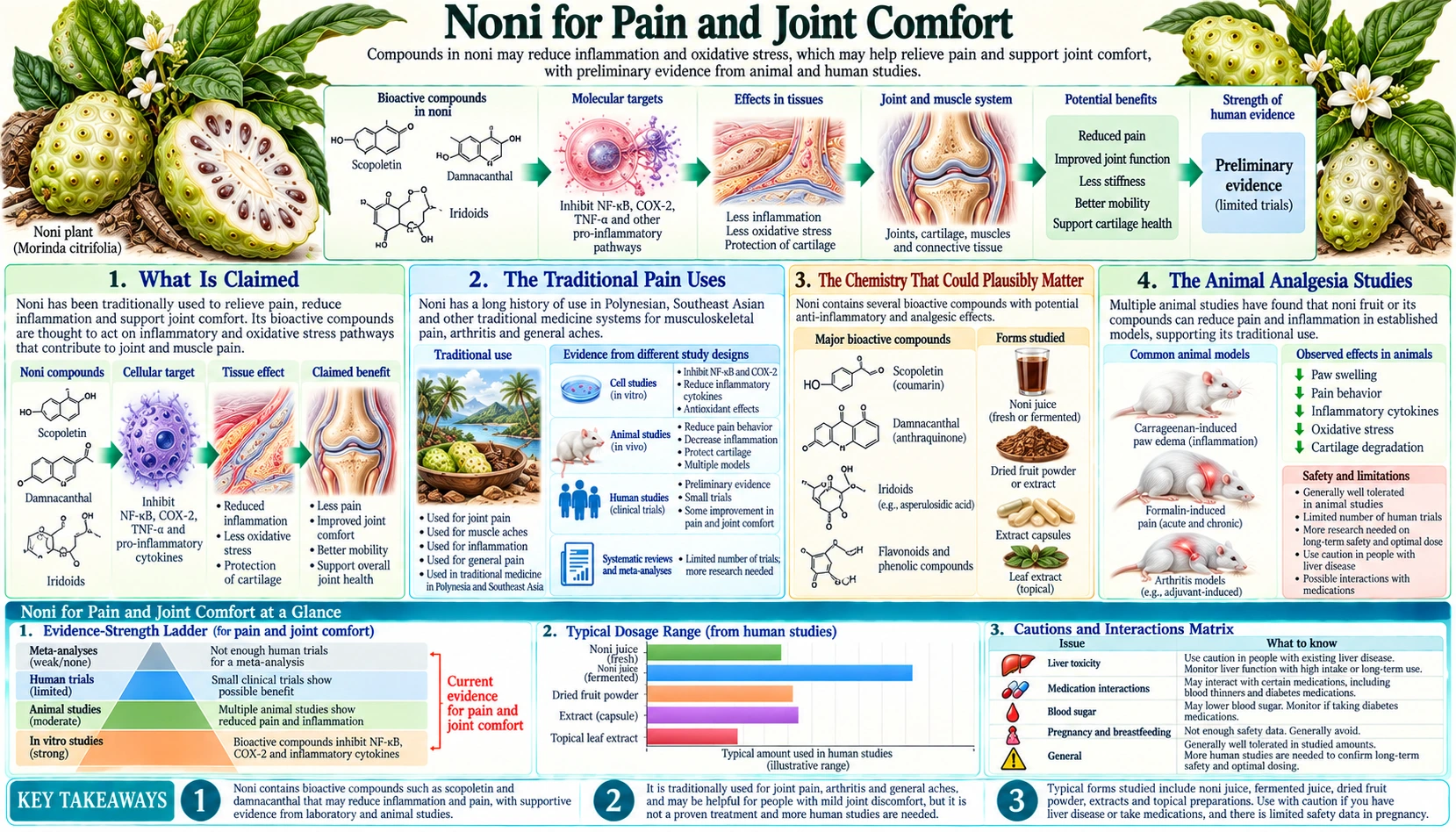
Pain relief is the oldest claim made for noni and the one with the most laboratory support behind it. It is also the claim where the gap between "there is a mechanism" and "it will help your knee" is easiest to misjudge. This page walks through what the traditional record says, what the animal studies found, what the small human trials actually measured, and where noni sits against options that have been tested properly.
The short version. Rodent studies from 1990 onwards report a genuine, dose-related analgesic effect from noni fruit extracts, and noni contains compound classes — iridoids and the coumarin scopoletin — with real anti-inflammatory activity in laboratory systems. The human evidence is thin: a handful of small, short, mostly industry-associated studies reporting improvement in self-rated joint pain and range of motion, none large or independent enough to establish that noni relieves pain in people. The honest label is preliminary. It is not "nothing", and it is not proof.
Table of Contents
- What Is Claimed
- The Traditional Pain Uses
- The Chemistry That Could Plausibly Matter
- The Animal Analgesia Studies
- The Human Studies, in Detail
- Arthritis: Where Substitution Causes Damage
- Neck, Back and Everyday Aches
- Leaf Poultices and Topical Use
- How Noni Compares with Better-Evidenced Options
- What to Know Before Trying It
- Harms That Sit Beside the Claim
- The Verdict
- Key Research Papers
- Connections
- Featured Videos
What Is Claimed
Marketing for noni juice makes, broadly, four pain claims. Each is written here as the seller states it, then graded.
- "Noni relieves joint pain and stiffness." Preliminary. Supported by small human reports of improved self-rated pain and mobility, plus consistent animal analgesia. Not established.
- "Noni is a natural anti-inflammatory." Preliminary (in vitro and animal). Iridoids and scopoletin reduce inflammatory signalling in laboratory systems. Whether drinking 30 ml of a blended juice delivers enough of them to matter in a human joint has not been demonstrated.
- "Noni works like a nonsteroidal anti-inflammatory drug without the side effects." Not supported. No head-to-head trial against ibuprofen or naproxen exists at a size that could support such a comparison, and the "without side effects" half is false as stated — noni carries its own documented hazards, including published hepatitis case reports and a potassium load that is dangerous in kidney disease.
- "Noni heals arthritis" or "reverses joint damage." Not supported. No human study shows structural change in a joint; one 2019 rat study of a noni leaf extract reported less cartilage damage (described under Leaf Poultices and Topical Use below). In inflammatory arthritis this claim is actively dangerous, because untreated disease destroys joints irreversibly.
The Traditional Pain Uses
The Pacific and Southeast Asian record does contain pain-related uses of noni, and they are worth stating accurately — partly out of respect, partly because they are not the same thing as the modern product.
- Hawaiian lā‘au lapa‘au. Leaves were warmed and applied over painful joints and over the abdomen. The fruit was used on wounds and boils. The leaf was the pain material; the fruit was mostly a wound and digestive remedy.
- Vietnam. Nhàu root and fruit are used in folk practice for joint and back pain and for blood pressure — the root, not the juice, being the traditional pain preparation.
- Indonesia and Malaysia. Mengkudu appears in Jamu formulations for aches, hypertension and diabetes, generally as part of a compound preparation.
- Polynesia and Micronesia. Leaf wraps for swelling and fever; fermented fruit liquid for general debility.
Two things follow. First, the traditional pain preparations were mostly external leaf applications and root decoctions, not a daily sweetened fruit juice. Second, traditional use tells us a plant was valued, not that it works — every medical tradition contains remedies that were used for centuries and later shown to do nothing. Evidence tier: traditional use only.
The Chemistry That Could Plausibly Matter
If noni relieves pain, these are the candidates. All of the mechanistic work below is laboratory work.
- Iridoids — deacetylasperulosidic acid (DAA) and asperulosidic acid. These are noni fruit's chemical signature, and better-quality products are increasingly standardised to DAA content. Iridoids as a class dampen inflammatory signalling in cell systems, including pathways involving NF-κB and downstream cytokines. PubMed topic search.
- Scopoletin. A coumarin present in the fruit, with vasodilatory and anti-inflammatory activity in laboratory models. It is heavily invoked in marketing. Being a coumarin, it is also the reason anticoagulant interaction is worth flagging. PubMed topic search.
- Ursolic acid, rutin and quercetin glycosides. Common plant anti-inflammatories present at modest levels. Their presence in a juice does not make the juice a drug; quercetin and rutin have their own, better-studied literatures.
- Anthraquinones — morindone, damnacanthal, rubiadin. Concentrated in root and bark, lower in fruit. Biologically active, and the leading suspect in the reported liver injury. A compound class being active is not automatically good news.
- A proposed opioid-pathway component. Some rodent work reported that the analgesic effect was reduced by naloxone, which would implicate opioid receptors. This is an animal-model observation and has not been characterised in humans. PubMed topic search.
The dose problem, stated plainly. Laboratory studies apply isolated compounds at concentrations chosen to produce an effect. A retail noni drink is a blend, often mostly grape or apple juice. Independent analytical work found the iridoids asperulosidic acid and deacetylasperulosidic acid in every product tested, but at concentrations that differed considerably between products. Nobody has established that a label dose delivers a pharmacologically relevant amount of anything. Evidence tier: preliminary (in vitro).
The Animal Analgesia Studies
This is the most consistent part of the pain evidence, and it is entirely in rodents.
- Younos and colleagues, Planta Medica, 1990 — the founding study. A freeze-dried water extract of noni root produced a significant, dose-related pain-relieving effect in mice in two standard pain tests (the writhing test and the hot-plate test), and the extract showed no toxic effects. Naloxone cancelled the effect. At high doses the extract also made the mice less active and lengthened induced sleeping time, which the authors read as a sedative effect. The material was root, not fruit juice — the same part that was the traditional pain preparation. Every later pain claim traces back through this paper. PubMed PMID: 1981810.
- Basar and colleagues, Phytotherapy Research, 2010 — mice given a 10% solution of freeze-concentrated noni fruit puree in their drinking water became less sensitive to pain on the hot-plate test, by about as much as mice given the prescription painkiller tramadol. Naloxone only partly reversed the effect. The anti-inflammatory part of this study was done in the test tube, not in animals: an alcohol extract of the fruit puree reduced the release of the enzyme matrix metalloproteinase-9 (MMP-9) from human white blood cells (monocytes) stimulated with bacterial lipopolysaccharide, an effect comparable to hydrocortisone. PubMed PMID: 19548275.
- Subsequent rodent work has examined noni fruit and leaf extracts in inflammatory and neuropathic pain models, arthritis models and thermal nociception, with generally positive but heterogeneous results across widely differing extracts and doses. PubMed topic search.
What "naloxone reversal" means. Naloxone is the drug used to reverse opioid overdoses; it blocks the body's opioid receptors, the ones morphine acts on. When naloxone cancels a pain-relief effect in an experiment, the effect most likely runs through those receptors. In the 1990 root study naloxone cancelled the effect; in the 2010 fruit study it reversed it only partly, so the fruit's effect is not fully explained by an opioid-type action.
How much weight this carries. Consistency across independent rodent studies is a real signal — more than one group, more than one model. But rodent analgesia has an unimpressive record of translating into clinical analgesia; the history of pain research is full of compounds that worked beautifully in mice and did nothing in people. Doses in these studies are also typically far higher, relative to body weight, than any human juice dose. Evidence tier: preliminary (animal).
The Human Studies, in Detail
Here is where the claim thins out. What exists in humans, as far as the indexed literature goes, is:
- Small trials and open-label reports of self-rated joint pain, several of them associated with the principal manufacturer, reporting improvement in pain scores, stiffness and range of motion over weeks. These are the studies quoted in marketing. PubMed topic search.
- Osteoarthritis-focused reports, again small and short. PubMed topic search.
- Neck-pain and cervicalgia reports using noni juice, which appear in the industry-associated literature and are frequently cited well beyond what their size supports. PubMed topic search.
- Inflammatory-marker measurements in the smoker studies described on the Immune and Antioxidant page, which are biochemical rather than symptomatic endpoints.
Why this cannot settle the question. Four structural problems, all of which apply to most of the trials:
- Size. Tens of participants, not hundreds. Pain trials need to be large because pain scores are noisy.
- Endpoint choice. Self-rated pain over a few weeks is the endpoint most sensitive to expectation. A person who has bought a bottle of expensive juice and been told it will help is not a neutral observer of their own knee.
- Placebo response. In osteoarthritis trials, placebo arms routinely improve substantially, and the improvement can persist for months. Without a well-matched placebo — hard with noni, whose taste is unmistakable — an uncontrolled improvement means very little.
- Funding and publication venue. Much of this work shares authorship with the manufacturer and appears in low-visibility journals. It is worth reading, and it remains unconfirmed until independent groups replicate it.
Evidence tier: preliminary human, industry-weighted. Not sufficient to show that noni relieves pain.
Arthritis: Where Substitution Causes Damage
This section is not a legal disclaimer. It is the single most consequential thing on the page.
Inflammatory arthritis is not the same as wear-and-tear arthritis. In rheumatoid arthritis, psoriatic arthritis, ankylosing spondylitis and related conditions, the immune system attacks the joint lining, and unchecked inflammation erodes cartilage and bone. That damage does not come back. Disease-modifying antirheumatic drugs and biologics prevent it, and the window in which they prevent most of it is measured in months, not years. Delaying them in favour of a juice trades a treatable disease for a permanent disability. No human study shows structural change in a joint; one 2019 rat study of a noni leaf extract reported less cartilage damage.
Osteoarthritis is different but not open season. Here the mainstay is not a drug at all — it is loading the joint appropriately: strengthening, weight management where relevant, and continuing to move. Those interventions have large, replicated effects. A juice that might shave a point off a pain score is not competing with a drug; it is competing with, and sometimes displacing, the exercise programme that actually works.
Gout deserves a specific warning. Gout is caused by urate crystals, is prevented by lowering serum urate, and flares are an acute inflammatory event. No noni preparation has been shown to lower urate in people; a 2023 mouse study and earlier test-tube work report lower uric acid and xanthine-oxidase inhibition (below). Treating recurrent gout with juice instead of urate-lowering therapy allows tophi and joint destruction to develop silently.
Noni and uric acid in the laboratory. In a 2023 study, mice were given potassium oxonate to raise their uric acid; in the mice treated with noni fruit juice, blood uric acid and the enzyme xanthine oxidase, which makes uric acid, were significantly lower. An earlier test-tube study found that noni fruit juice inhibited xanthine oxidase, more strongly at higher concentrations, and compared it with allopurinol, the gout drug that blocks the same enzyme. No study has measured uric acid in people taking noni. Evidence tier: preliminary (animal and in vitro).
The potassium and liver issues on the safety page matter more for people already taking methotrexate or a nonsteroidal anti-inflammatory drug.
Neck, Back and Everyday Aches
For ordinary musculoskeletal pain — a stiff neck, a sore back, aching after work — the stakes are lower and the reasoning changes. Nothing irreversible is happening, and self-limiting pain gets better on its own, which is precisely why testimonials for any remedy in this category are so abundant and so uninformative.
If someone with normal liver and kidney function, on no interacting medication, drinks a label dose of noni for a fortnight and feels better, three explanations fit equally well: the noni did something; the episode was going to resolve anyway; or expectation did the work. All three are common. The first is the only one that would justify continuing indefinitely, and it is the hardest to establish.
What has better evidence for non-specific neck and back pain is unglamorous: staying active rather than resting, graded strengthening, sleep, addressing workstation and load, and short-term simple analgesia. None of it is sold in a bottle. The site's Remedies section covers several of these.
Leaf Poultices and Topical Use
The traditional pain application was topical — warmed noni leaves laid over a joint — and it is the use with the least modern study. Topical botanical anti-inflammatories are not implausible in principle; there is reasonable evidence for some topical nonsteroidal anti-inflammatory drugs (NSAIDs) and for capsaicin, both of which reach tissue directly while avoiding systemic exposure.
For noni specifically:
- Leaf preparations have a different constituent profile from fruit juice and were assessed separately by European regulators. Data about the juice does not automatically apply to the leaf, or the other way round.
- Topical use avoids the potassium load and the hepatic exposure entirely, which makes it a substantially lower-risk way to try noni for a local ache — genuinely the safer route if someone is determined to try it at all.
- Skin reactions are possible with any plant material applied under warmth and occlusion.
- Noni leaf extract has one animal study in arthritis. In a 2019 study, rats were given knee osteoarthritis by an injection of monosodium iodoacetate into the knee and then treated with a noni leaf extract rich in scopoletin and epicatechin. After 28 days, blood and joint-tissue markers of cartilage breakdown were lower, and the joint cartilage and the bone beneath it were in better condition; in cartilage samples in the laboratory, the extract also reduced cartilage breakdown. The authors note that noni leaves are eaten as a vegetable. This is a rat study; no human trial of noni leaf for joints has been published. PubMed PMID: 31353568.
- The evidence for leaf poultices is traditional use only. There is no controlled trial of a noni leaf poultice for joint pain. PubMed topic search.
How Noni Compares with Better-Evidenced Options
The right comparison for a botanical is not "does it beat nothing" but "how does it stand against the other things a reader might reasonably take instead". On that test noni does poorly, not because it is uniquely weak but because several herbs in the same category have been studied far more.
- Turmeric / curcumin — multiple randomised osteoarthritis trials and meta-analyses, with meaningful effect sizes reported for knee pain. Absorption is the practical problem, not the evidence base.
- Boswellia — the strongest joint-pain evidence in the herbal category, with several randomised osteoarthritis trials.
- Devil's Claw — a European pharmacopoeial anti-inflammatory with trials in low back pain and osteoarthritis.
- Willow Bark — the original salicylate source, with back-pain trial data, and the same gastric and bleeding cautions that follow from salicylates.
- Ginger — modest but replicated osteoarthritis data, and a genuinely food-safe profile.
Every one of those has more human pain data than noni, and none of them has published hepatitis case reports of the kind noni carries. That asymmetry — comparable or weaker evidence, distinctly higher documented risk — is the main finding of this comparison, set beside the claim documented in full.
What to Know Before Trying It
Readers decide for themselves. These are the facts the research and the case reports point to; the safety page covers them in more depth.
- Who the research raises concerns for. The published hepatitis case reports raise a concern for people with any liver disease or a history of drug-induced liver injury. Noni juice's potassium raises a concern for people with chronic kidney disease, on dialysis, or with hyperkalaemia (high blood potassium) from any cause. There is no safety data for pregnancy or breastfeeding.
- What the interactions do. The potassium in noni juice adds to the potassium-raising effect of angiotensin-converting enzyme inhibitors (ACE inhibitors), angiotensin receptor blockers (ARBs), potassium-sparing diuretics, trimethoprim and potassium supplements. A 2004 report linked noni with warfarin working less well. Methotrexate and other medicines that can injure the liver add a second liver risk.
- The ingredient list tells more than the front label. It shows the actual percentage of noni. When grape or apple juice is the first ingredient, the drink is mostly sweetened fruit juice, and the sugar load is real.
- Label doses are commonly 30–60 ml daily. There is no evidence for "loading phase" instructions, and they increase both the potassium and the liver exposure.
- Duration. Four to six weeks is enough to see an effect on musculoskeletal pain, if there is one. Open-ended daily consumption is where the liver reports cluster.
- Measuring. A 0–10 pain score and one functional measure that can be timed or counted — stairs, grip, walking distance — written down at the start and at the end gives a fairer picture than memory, which reconstructs improvement that did not happen.
- One change at a time. Starting noni, a new exercise routine and a new supplement in the same week makes it impossible to tell which one did what.
- Warning signs. Jaundice (yellow skin or eyes), dark urine, pale stools, itching, right-upper-abdominal pain or unexplained nausea and fatigue are signs of liver injury that hospitals treat as urgent; liver function tests are the blood tests that check for it.
- Unexplained liver test results. Supplements are a common cause of unexplained abnormal liver tests, and clinicians usually find out only because the person mentioned taking one.
Harms That Sit Beside the Claim
Site policy is that documented harm is stated next to the claim it accompanies, not filed away at the bottom of another page. For pain specifically:
- People in chronic pain are often already on hepatically-metabolised or kidney-relevant drugs — paracetamol/acetaminophen, nonsteroidal anti-inflammatory drugs, methotrexate. Noni stacks an idiosyncratic hepatotoxin onto a predictable one, and nonsteroidal anti-inflammatory drugs plus a potassium-rich juice is exactly the combination that produces hyperkalaemia in someone with quietly declining kidney function.
- Nonsteroidal anti-inflammatory drug (NSAID) users often have reduced kidney reserve without knowing it, which makes the potassium content of noni juice more relevant, not less.
- Coumarin content matters for people on anticoagulants — scopoletin is a coumarin, and leaf material contains vitamin K. For people taking warfarin, the international normalized ratio (INR) is the blood test that measures warfarin's effect, and starting or stopping noni is when a change would show.
- Delay is itself a harm in inflammatory arthritis. The joint damage accumulated during a six-month trial of juice is permanent.
- Cost. Noni juice is expensive per dose relative to better-evidenced options, and money spent on it is money not spent on physiotherapy.
The Verdict
- Traditional use: real, mostly topical leaf and root preparations, respected as history. Traditional use only.
- Mechanism: plausible — iridoids and scopoletin have genuine anti-inflammatory activity in the laboratory. Preliminary (in vitro).
- Animal analgesia: reasonably consistent across independent groups. Preliminary (animal).
- Human pain relief: small, short, industry-weighted, unreplicated. Preliminary human — not established.
- Equivalence to nonsteroidal anti-inflammatory drugs, or joint repair: Not supported.
- Replacement for arthritis treatment: Not supported, and harmful.
For a reader with ordinary aches, normal liver and kidney function and no interacting medication, the hazards documented above are the ones least likely to apply, and the warning signs are listed. For readers with inflammatory arthritis, kidney disease or liver disease, the research raises the strongest concerns — delayed treatment, potassium build-up and liver injury — and turmeric, boswellia and physiotherapy each have more human pain data than noni.
Key Research Papers
- Younos and colleagues. Analgesic and behavioural effects of Morinda citrifolia. Planta Medica, 1990. The founding rodent analgesia study. PubMed PMID: 1981810 — Animal.
- Basar and colleagues. Analgesic and anti-inflammatory activity of Morinda citrifolia L. fruit. Phytotherapy Research, 2010. PubMed PMID: 19548275 — Animal.
- Wang and colleagues. Morinda citrifolia (Noni): a literature review and recent advances in Noni research. Acta Pharmacologica Sinica, 2002. The field's most-cited review. PubMed PMID: 12466051.
- Potterat and colleagues. Identification of markers and quantification of constituents in noni fruit powder and commercial noni-derived products. Journal of Agricultural and Food Chemistry, 2007. Independent evidence of how much products vary. PubMed PMID: 17696360.
- Millonig, Stadlmann and Vogel. Herbal hepatotoxicity: acute hepatitis caused by a Noni preparation. European Journal of Gastroenterology & Hepatology, 2005. The harm that sits beside the benefit claim. PubMed PMID: 15756098.
- Mueller and colleagues. Noni juice (Morinda citrifolia): hidden potential for hyperkalemia? American Journal of Kidney Diseases, 2000. PubMed PMID: 10676732.
- Palu and colleagues. Xanthine oxidase inhibiting effects of noni (Morinda citrifolia) fruit juice. Phytotherapy Research, 2009. PubMed PMID: 19434757 — In vitro.
- Wan Osman and colleagues. Epicatechin and scopoletin rich Morinda citrifolia (Noni) leaf extract supplementation, mitigated Osteoarthritis via anti-inflammatory, anti-oxidative, and anti-protease pathways. Journal of Food Biochemistry, 2019. PubMed PMID: 31353568 — Animal.
- Liu and colleagues. Characterizations of microRNAs involved in the molecular mechanisms underlying the therapeutic effects of noni (Morinda citrifolia L.) fruit juice on hyperuricemia in mice. Frontiers in Nutrition, 2023. PubMed PMID: 37426193 — Animal.
PubMed Topic Searches
- PubMed: Morinda citrifolia antinociceptive activity
- PubMed: Noni juice and joint pain — clinical trials
- PubMed: Deacetylasperulosidic acid and inflammation
- PubMed: Scopoletin anti-inflammatory activity
- PubMed: Noni leaf and topical anti-inflammatory use
- PubMed: Placebo response in osteoarthritis trials
- PubMed: Curcumin for knee osteoarthritis
- PubMed: Boswellia for osteoarthritis
- PubMed: Devil's claw for low back pain
- PubMed: Early treatment and joint damage in rheumatoid arthritis
Connections
- All Herbs
- Noni (Morinda citrifolia)
- Noni Benefits Hub
- Noni Safety: Liver, Potassium and Interactions
- Noni for Immune Function and Antioxidant Defence
- Osteoarthritis
- Rheumatoid Arthritis
- Arthritis
- Gout
- Fibromyalgia
- Rheumatology
- Turmeric
- Boswellia
- Devil's Claw
- Willow Bark
- Ginger
- Quercetin
- Liver Function Tests
Safety note and disclaimer. This article is health education, not medical advice, and nothing here is a treatment recommendation. Noni is not an established analgesic, and no study shows it can replace treatment for inflammatory arthritis, gout or any diagnosed condition. A published case report describes acute hepatitis in a man who drank noni juice for three weeks, with liver tests back in the normal range one month after he first came to hospital; another describes high blood potassium (hyperkalaemia) in a man with chronic kidney disease who drank noni juice, which contained potassium at levels similar to orange and tomato juice. The research therefore raises a concern for people with liver disease, a history of drug-induced liver injury, chronic kidney disease or hyperkalaemia; there is no safety data for pregnancy or breastfeeding. Noni's potassium adds to that of angiotensin-converting enzyme inhibitors (ACE inhibitors), angiotensin receptor blockers (ARBs), potassium-sparing diuretics, trimethoprim, potassium supplements and nonsteroidal anti-inflammatory drugs; warfarin resistance has been reported with noni; and methotrexate and other medicines that can injure the liver add liver risk. Jaundice, dark urine, pale stools, itching, abdominal pain or unexplained fatigue and nausea are signs of liver injury that hospitals treat as urgent.