⚠ Evidence warning: Clinical trials or other evidence do not support the claim that geraniin is metabolized by gut microbiota into urolithins that carry much of its downstream activity. This page keeps it as a report of what people, websites or other media say.
Chanca Piedra — Benefits Deep Dive
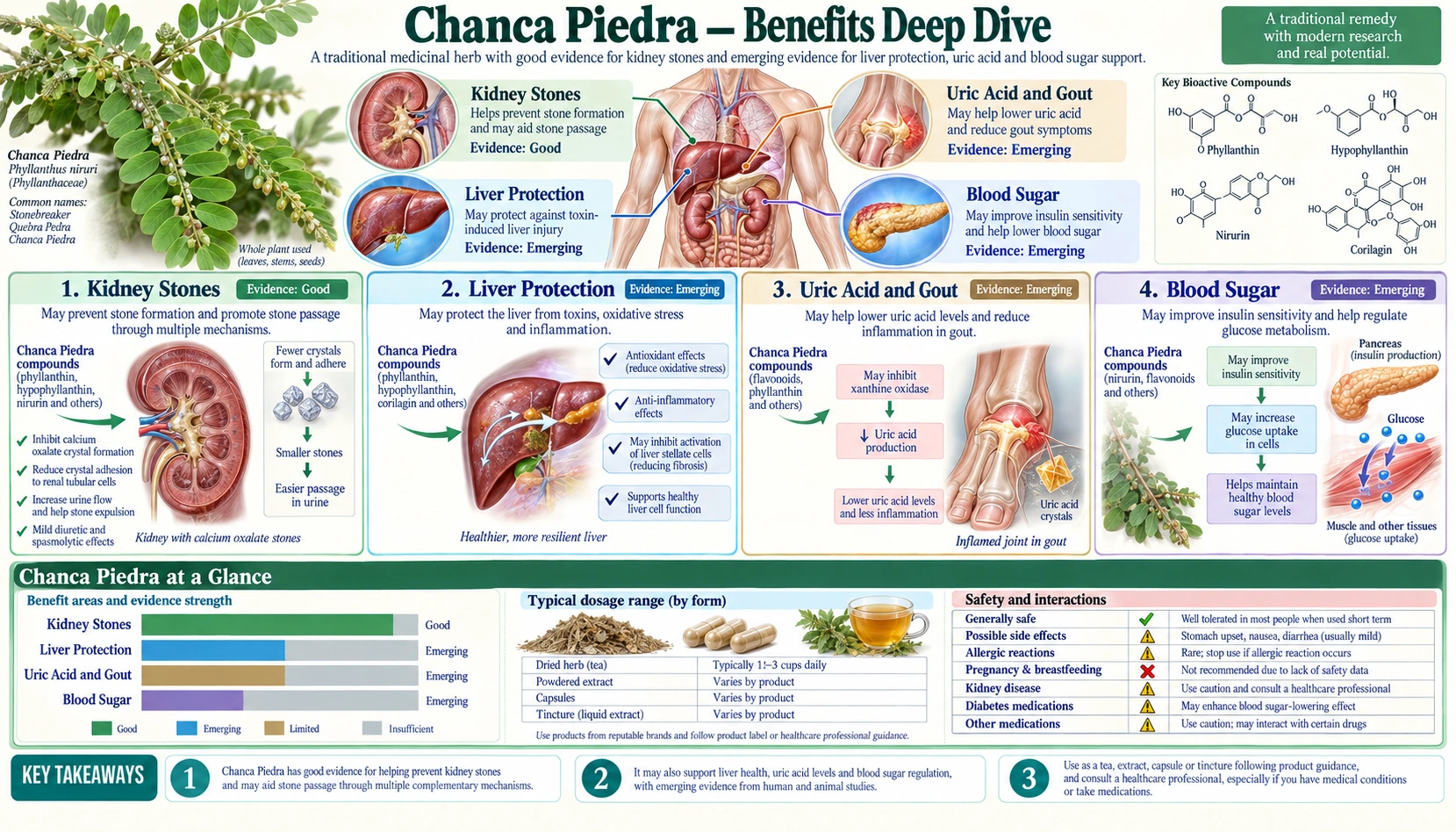
Chanca Piedra (Phyllanthus niruri) is the literal "stone breaker" — chanca piedra in Spanish, quebra pedra in Portuguese, bhumi amla in Hindi, ye xia zhu ("pearl under the leaf") in Chinese. Five centuries of overlapping Amazonian, Andean, Ayurvedic, and Southeast Asian traditional medicine converged on the same handful of indications: urinary stones, hepatobiliary disease, and metabolic disorders. Modern pharmacology has identified the active compound classes — lignans (phyllanthin, hypophyllanthin, niranthin), ellagitannins (geraniin, corilagin), securinine-type alkaloids, and ureteral-relaxing alkaloids — and mapped them onto four principal benefit categories where Phyllanthus has measurable clinical effect: kidney-stone anti-crystallization and post-lithotripsy fragment clearance, liver protection in chronic hepatitis B and non-alcoholic fatty liver disease (NAFLD), mild uric-acid lowering and ACE-inhibitor-like hypotensive activity, and modest glycemic and metabolic effects. The four deep-dive pages below cover each indication honestly — what the trials show, where the marketing oversells, and where Chanca Piedra fits relative to mainstream therapy.
Deep-Dive Articles
Kidney Stones
The headline indication and the source of the name. Anti-crystallization mechanism (not literal dissolution), the Nishiura 2004 hypercalciuria trial, the Micali 2006 trial in 150 patients after shock wave lithotripsy (SWL), where the stone-free rate at 180 days was 93.5% with the extract versus 83.3% without (not a significant difference) and, for lower-calyx stones (56 patients), 93.7% versus 70.8% (a significant difference), with no side effects recorded, the three patient-facing dosing protocols (post-SWL adjuvant, hypercalciuria prevention, stone-history maintenance), and where Chanca Piedra fits relative to potassium citrate, thiazides, and allopurinol.
Read the deep dive →Liver Protection
The Thyagarajan 1988 Lancet paper that reported 59% HBsAg loss in hepatitis B virus (HBV) carriers, the follow-up trials that couldn't reproduce that magnitude, the 2011 Cochrane review of 16 trials with 1,326 patients, which found no convincing evidence of benefit over placebo and a possible benefit when added to antiviral drugs, with heterogeneity and bias questioning those results, the multi-pronged hepatitis B virus mechanism (polymerase inhibition, immune modulation, hepatocyte protection), why Phyllanthus amarus has the strongest hepatitis B virus evidence, non-viral applications (non-alcoholic fatty liver disease, anti-TB drug hepatotoxicity), and the CYP450 interaction profile that determines safe co-administration.
Read the deep dive →Uric Acid and Gout
Mild xanthine oxidase inhibition (~10× weaker than allopurinol), uricosuric and alkalinizing effects, geraniin and corilagin's ACE-inhibitor-like activity via tannin-mediated zinc chelation, and what is known about combining it with allopurinol, febuxostat, angiotensin-converting enzyme inhibitors (ACE inhibitors), angiotensin receptor blockers (ARBs), and thiazides. The deep dive weighs its place as an add-on for borderline high uric acid and stage 1 hypertension, not a substitute for treatment of established disease.
Read the deep dive →Blood Sugar
The honest assessment. Preclinical mechanisms (alpha-glucosidase and alpha-amylase inhibition in laboratory tests, insulin sensitization, hepatic gluconeogenesis suppression) translating to a small clinical effect — fasting glucose 10–20 mg/dL, hemoglobin A1c 0.2–0.5%. Where Chanca Piedra ranks against berberine, gymnema, fenugreek, cinnamon, and bitter melon (last in the group for diabetes specifically), and why "natural metformin" marketing is rat-data extrapolation.
Read the deep dive →Table of Contents
- Deep-Dive Articles
- Why Chanca Piedra Produces Effects Across So Many Systems
- What Reviews of the Kidney-Stone Research Found
- Research Papers: Kidney Stones
- Research Papers: Liver Protection
- Research Papers: Uric Acid, Gout & Hypertension
- Research Papers: Blood Sugar & Metabolic
- Research Papers: Cross-Cutting (Lignans, Tannins, CYP450, Safety)
- External Authoritative Resources
- Connections
- Featured Videos
Why Chanca Piedra Produces Effects Across So Many Systems
Most medicinal herbs work through one or two principal compound classes acting on a narrow target. Chanca Piedra is unusual because three distinct phytochemical classes — lignans, ellagitannins, and alkaloids — act on largely independent molecular targets, producing four overlapping but mechanistically separate clinical effects. Each compound class maps to a distinct indication category.
- Lignans (phyllanthin, hypophyllanthin, niranthin, nirtetralin) — the chemical-marker class for standardized extracts. Hepatoprotective antioxidant activity, hepatocyte membrane stabilization, mild CYP450 modulation, and partial-agonist effects on insulin signaling pathways. These are the principal drivers of the liver-protection story and contribute to the modest glycemic effect.
- Ellagitannins (geraniin, corilagin) — the largest single class by mass in the dried herb. Geraniin is metabolized by gut microbiota into urolithins, which carry much of the downstream activity. The tannins inhibit hepatitis B virus polymerase (the hepatitis B mechanism), inhibit angiotensin-converting enzyme via zinc chelation (Ueno 1988 isolated geraniin as an angiotensin-converting enzyme inhibitor; the blood-pressure mechanism), and disrupt calcium-oxalate crystal nucleation and aggregation (the central stone-breaker mechanism). One compound family, several indications. For the uric-acid-lowering effect, Murugaiyah and Chan (2009) found in rats that the plant's methanol extract moderately inhibited xanthine oxidase, but traced most of its uric-acid lowering to increased uric-acid excretion, which the lignans phyllanthin, hypophyllanthin and phyltetralin also produced.
- Securinine-type alkaloids and ureteral-relaxing alkaloids — the smooth-muscle effect that helps existing stones pass with less colic, and the post-lithotripsy fragment-clearance mechanism proposed for the Micali 2006 result, where the stone-free rate was significantly higher only for lower-calyx stones (93.7% versus 70.8%); the overall rate (93.5% versus 83.3%) was not significantly different.
The fourth mechanism deserves explicit mention: crystal-shape modification at the renal tubule. Beyond simple anti-aggregation, Phyllanthus actually shifts the crystal habit of calcium oxalate from the sharp-edged monohydrate (COM) form toward the rounder dihydrate (COD) form, which slides through the ureter with less mucosal trauma. This is genuinely novel pharmacology — few plants and no prescription drugs work by modifying the crystal phase of a forming stone, only by reducing the concentration of stone-promoting solutes. It explains why post-SWL fragments pass more readily after Phyllanthus loading: the residual microcrystals have a more favorable morphology for clearance.
The trade-off of having multiple active compound classes hitting CYP450 is a meaningful drug-interaction footprint. In a 2011 laboratory study with human liver preparations (microsomes), extracts of Phyllanthus amarus inhibited cytochrome P450 3A4 (CYP3A4), and its lignans phyllanthin and hypophyllanthin were potent mechanism-based (irreversible) inhibitors of that enzyme; the extracts were weak inhibitors of CYP1A2, CYP2D6 and CYP2E1 (Taesotikul 2011). The authors concluded that taking P. amarus with drugs broken down by CYP3A4 may potentially cause herb-drug interactions; these are laboratory findings, not measurements in people. Herbal interaction lists also name warfarin, statins (especially atorvastatin and simvastatin), tacrolimus, cyclosporine, certain human immunodeficiency virus (HIV) protease inhibitors, tamoxifen, calcium-channel blockers, and certain anticonvulsants as drugs whose blood levels could change — usually rise — with Phyllanthus; these are reported interactions inferred from the enzyme findings. See Safety, Drug Interactions & Cautions for the full list.
What Reviews of the Kidney-Stone Research Found
Two reviews have pooled the kidney-stone research on chanca piedra (Phyllanthus niruri):
- 2020 meta-analysis. Only two controlled human studies reported stone size and number. Pooled together, chanca piedra was linked to smaller stones (standardized mean difference −0.39) and fewer stones (standardized mean difference −0.38), both statistically significant. The authors called this limited evidence of modest benefit, pending further study, and noted that chanca piedra is the most commonly listed active ingredient in commercial herbal kidney-stone products “despite limited supporting clinical evidence”.
- 2025 systematic review. It examined 16 human and rat studies published from 1994 to 2022 and described the results as mixed. The studies identified several ways the herb may act (promoting glycosaminoglycan aggregation, blocking the first stage of crystal formation, and changing stone density in a way that favours becoming stone-free), consistently supported its long-term safety on repeated blood-salt (electrolyte) and liver tests, and showed benefit as an add-on to shock wave lithotripsy for stones in the lower part of the kidney.
Research Papers: Kidney Stones
- Nishiura JL, Campos AH, Boim MA, Heilberg IP, Schor N (2004). Phyllanthus niruri normalizes elevated urinary calcium levels in calcium stone forming (CSF) patients. Urological Research 32(5):362-6. — PubMed PMID: 15221244
- Micali S, Sighinolfi MC, Celia A, De Stefani S, Grande M, Cicero AF, Bianchi G (2006). Can Phyllanthus niruri affect the efficacy of extracorporeal shock wave lithotripsy for renal stones? A randomized, prospective, long-term study. Journal of Urology 176(3):1020-2. — PubMed PMID: 16890682
- Dhawan S, Olweny EO (2020). Phyllanthus niruri (stone breaker) herbal therapy for kidney stones; a systematic review and meta-analysis of clinical efficacy, and Google Trends analysis of public interest. Canadian Journal of Urology 27(2):10162-6. — PubMed PMID: 32333735
- Iregui-Parra J, Rojas Ossa V, Arias Salazar CM, López Estupiñán AD, Díaz Varela D, Sinisterra Parra LM, Diéguez L, Emiliani E (2025). Phyllanthus niruri in the management of nephrolithiasis: a systematic review of the literature. Actas Urológicas Españolas (English Edition) 49(6):501791. — PubMed PMID: 40480426
- Barros ME, Schor N, Boim MA (2003). Effects of an aqueous extract from Phyllanthus niruri on calcium oxalate crystallization in vitro. Urological Research 30(6):374-9. — PubMed PMID: 12599017
- Pucci ND, Marchini GS, Mazzucchi E, Reis ST, Srougi M, Evazian D, Nahas WC (2018). Effect of Phyllanthus niruri on metabolic parameters of patients with kidney stone: a perspective for disease prevention. International Brazilian Journal of Urology 44(4):758-64. — PubMed PMID: 29617079
- Campos AH, Schor N (1999). Phyllanthus niruri inhibits calcium oxalate endocytosis by renal tubular cells: its role in urolithiasis. Nephron 81(4):393-7. — PubMed PMID: 10095174
- Freitas AM, Schor N, Boim MA (2002). The effect of Phyllanthus niruri on urinary inhibitors of calcium oxalate crystallization and other factors associated with renal stone formation. BJU International 89(9):829-34. — PubMed PMID: 12010223
- Boim MA, Heilberg IP, Schor N (2010). Phyllanthus niruri as a promising alternative treatment for nephrolithiasis. International Brazilian Journal of Urology 36(6):657-64. — PubMed PMID: 21176271
- Calixto JB, Santos AR, Cechinel Filho V, Yunes RA (1998). A review of the plants of the genus Phyllanthus: their chemistry, pharmacology, and therapeutic potential. Medicinal Research Reviews 18(4):225-58. — PubMed PMID: 9664291
Research Papers: Liver Protection
- Thyagarajan SP, Subramanian S, Thirunalasundari T, Venkateswaran PS, Blumberg BS (1988). Effect of Phyllanthus amarus on chronic carriers of hepatitis B virus. Lancet 2(8614):764-6. — PubMed PMID: 2901611
- Xia Y, Luo H, Liu JP, Gluud C (2011). Phyllanthus species for chronic hepatitis B virus infection. Cochrane Database Syst Rev (4):CD008960. — PubMed PMID: 21491412
- Venkateswaran PS, Millman I, Blumberg BS (1987). Effects of an extract from Phyllanthus niruri on hepatitis B and woodchuck hepatitis viruses: in vitro and in vivo studies. PNAS 84(1):274-8. — PubMed PMID: 3467354
- Shead A, Vickery K, Pajkos A, Medhurst R, Freiman J, Dixon R, Cossart Y (1992). Effects of Phyllanthus plant extracts on duck hepatitis B virus in vitro and in vivo. Antiviral Research 18(2):127-38. — PubMed PMID: 1416905
- Liu J, Lin H, McIntosh H (2001). Genus Phyllanthus for chronic hepatitis B virus infection: a systematic review. Journal of Viral Hepatitis 8(5):358-66. — PubMed PMID: 11555193
- Krithika R et al. Hepatoprotective effect of phyllanthin against carbon-tetrachloride-induced liver injury. Journal of Ethnopharmacology. — PubMed
- Naik AD, Juvekar AR (2003). Effects of alkaloidal extract of Phyllanthus niruri on HIV replication. Indian Journal of Medical Sciences 57(9):387-93. — PubMed PMID: 14515028
Research Papers: Uric Acid, Gout & Hypertension
- Murugaiyah V, Chan KL (2009). Mechanisms of antihyperuricemic effect of Phyllanthus niruri and its lignan constituents. Journal of Ethnopharmacology 124(2):233-9. — PubMed PMID: 19397979
- Iizuka T, Nagai M, Taniguchi A, Moriyama H, Hoshi K (2007). Inhibitory effects of methyl brevifolincarboxylate isolated from Phyllanthus niruri L. on platelet aggregation. Biological & Pharmaceutical Bulletin 30(2):382-4. — PubMed PMID: 17268086
- Srividya N, Periwal S (1995). Diuretic, hypotensive and hypoglycaemic effect of Phyllanthus amarus. Indian Journal of Experimental Biology 33(11):861-4. — PubMed PMID: 8786163
- Ueno H, Horie S, Nishi Y, Shogawa H, Kawasaki M, Suzuki S, Hayashi T, Arisawa M, Shimizu M, Yoshizaki M (1988). Chemical and pharmaceutical studies on medicinal plants in Paraguay. Geraniin, an angiotensin-converting enzyme inhibitor from “paraparai mi,” Phyllanthus niruri. Journal of Natural Products 51(2):357-9. — PubMed PMID: 3379417
Research Papers: Blood Sugar & Metabolic
- Raphael KR, Sabu MC, Kuttan R (2002). Hypoglycemic effect of methanol extract of Phyllanthus amarus Schum & Thonn on alloxan induced diabetes mellitus in rats and its relation with antioxidant potential. Indian Journal of Experimental Biology 40(8):905-9. — PubMed PMID: 12597020
- Okoli CO, Obidike IC, Ezike AC, Akah PA, Salawu OA (2011). Studies on the possible mechanisms of antidiabetic activity of extract of aerial parts of Phyllanthus niruri. Pharmaceutical Biology 49(3):248-55. — PubMed PMID: 21323477
- Karuna R et al. Antidiabetic and antihyperlipidemic activities of Phyllanthus amarus. Journal of Pharmacognosy and Phytotherapy. — PubMed
- Adeneye AA, Amole OO, Adeneye AK (2006). Hypoglycemic and hypocholesterolemic activities of the aqueous leaf and seed extract of Phyllanthus amarus in mice. Fitoterapia 77(7-8):511-4. — PubMed PMID: 16905277
- Yin J, Xing H, Ye J. Efficacy of berberine in patients with type 2 diabetes mellitus (comparator). Metabolism 2008. — PubMed
Research Papers: Cross-Cutting (Lignans, Tannins, CYP450, Safety)
- Calixto JB, Santos AR, Cechinel Filho V, Yunes RA (1998). A review of the plants of the genus Phyllanthus: their chemistry, pharmacology, and therapeutic potential. Medicinal Research Reviews 18(4):225-58. — PubMed PMID: 9664291
- Bagalkotkar G, Sagineedu SR, Saad MS, Stanslas J (2006). Phytochemicals from Phyllanthus niruri Linn. and their pharmacological properties: a review. Journal of Pharmacy and Pharmacology 58(12):1559-70. — PubMed PMID: 17331318
- Taesotikul T, Dumrongsakulchai W, Wattanachai N, Navinpipat V, Somanabandhu A, Tassaneeyakul W, Tassaneeyakul W (2011). Inhibitory effects of Phyllanthus amarus and its major lignans on human microsomal cytochrome P450 activities: evidence for CYP3A4 mechanism-based inhibition. Drug Metabolism and Pharmacokinetics 26(2):154-61. — PubMed PMID: 21178301
- Foo LY, Wong H. Phyllanthusiin D, an unusual hydrolysable tannin from Phyllanthus amarus. Phytochemistry. — PubMed
- Patel JR, Tripathi P, Sharma V, Chauhan NS, Dixit VK (2011). Phyllanthus amarus: ethnomedicinal uses, phytochemistry and pharmacology: a review. Journal of Ethnopharmacology 138(2):286-313. — PubMed PMID: 21982793
- Unander DW, Webster GL, Blumberg BS (1990). Records of usage or assays in Phyllanthus (Euphorbiaceae). I. Subgenera Isocladus, Kirganelia, Cicca and Emblica. Journal of Ethnopharmacology 30(3):233-64. — PubMed PMID: 2259214
External Authoritative Resources
- U.S. National Institutes of Health (NIH) U.S. National Center for Complementary and Integrative Health (NCCIH) — Herbs at a Glance — the US federal authority on complementary medicine, with research summaries and safety profiles for many of the same indications Phyllanthus targets
- LiverTox — Phyllanthus entry — the NIH/NIDDK clinical hepatology reference for drug-induced and herb-induced liver injury
- National Kidney Foundation — Kidney Stone Information
- American Urological Association — Stone Disease Guidelines
- PubMed — All research on Phyllanthus niruri (about 280 records in a basic PubMed search, October 2026)
- PubMed — All research on Phyllanthus amarus (about 1,900 records in a basic PubMed search, October 2026)
Connections
- All Herbs
- Chanca Piedra (Main Page)
- Chanca Piedra for Kidney Stones
- Chanca Piedra for Liver Protection
- Chanca Piedra for Uric Acid and Gout
- Chanca Piedra for Blood Sugar
- Active Compounds: Lignans & Tannins
- Forms, Dosing & Standardization
- Safety & Drug Interactions
- Phyllanthus Species Comparison
- History & Traditional Use
- Milk Thistle
- Dandelion
- Berberine
- Turmeric
- Kidney Stones
- Hepatitis B
- Gout
- Hypertension
- Diabetes
- Urinalysis
- Uric Acid
- Gamma-Glutamyl Transferase
- Hemoglobin A1C
- History